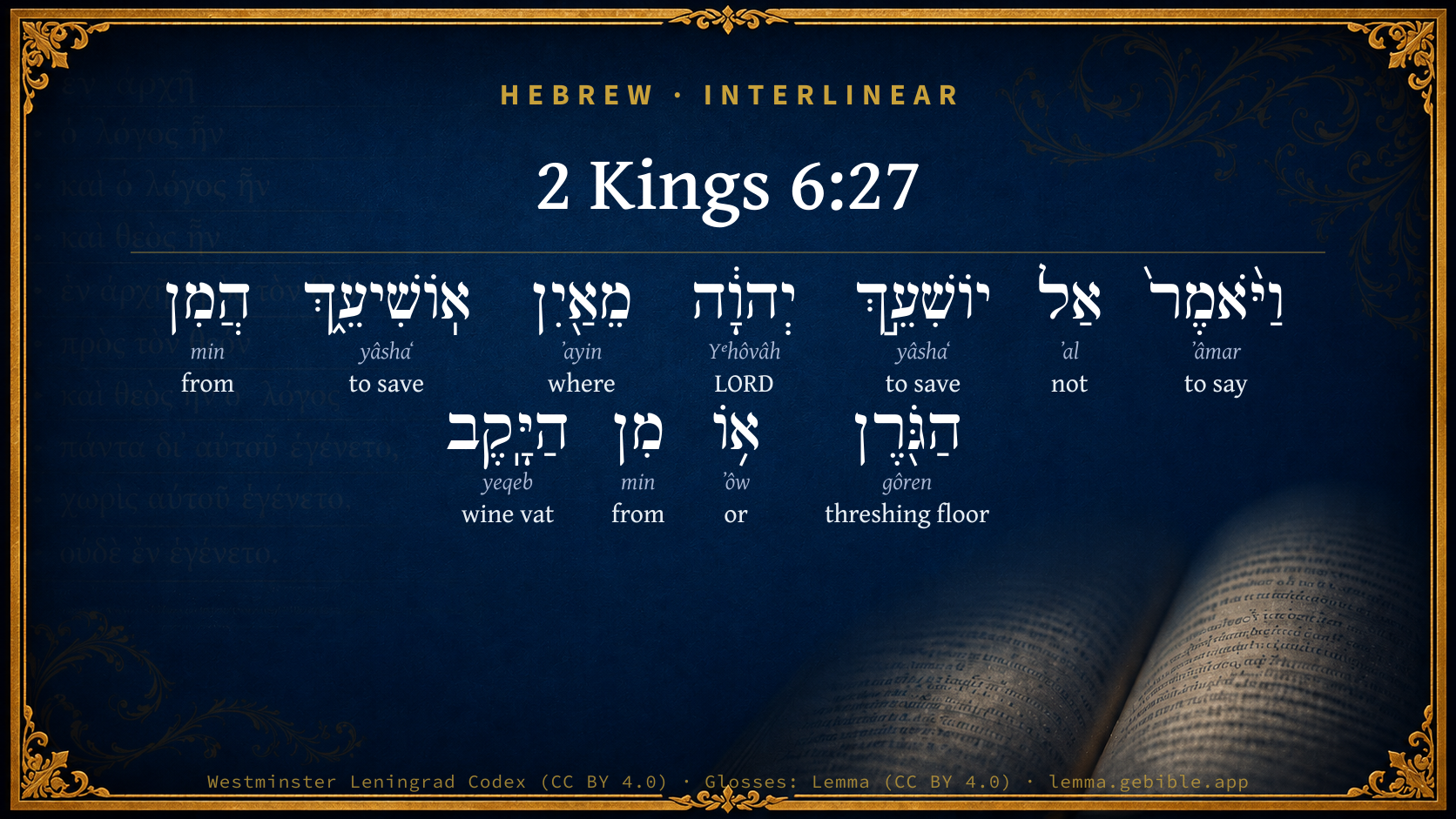
2 Kings 6:27

Hebrew (Westminster Leningrad Codex) 2 Kings 6:27 appears in the Hebrew Old Testament. The text above is from the Westminster Leningrad Codex. Each word links to its Strong’s number, a concise gloss, and parsing drawn from the Open Scriptures Hebrew Bible morphology. Click any word for its full Brown-Driver-Briggs (BDB) entry.
Download image
Cite this verse

2 Kings 6:27 (World English Bible). Public Domain. Lemma interlinear Bible study tool, https://lemma.gebible.app/v/2-kings/6/27.

Show BibTeX & RIS
BibTeX
RIS
English Translation
He said, If Yahweh doesn't help you, whence shall I help you? out of the threshing floor, or out of the winepress?
World English Bible · Public Domain
Download a study sheet

One document with this verse’s original text, its word-by-word gloss line, the meaning frame, cross-references with their text, attributed commentary, and full source and license credits — printable, and it pastes into notes with its structure intact.

This verse Autodidact and up

Study sheet (.html) Plain text (.txt)

A passage Seminary Student

Up to 50 verses in one chapter. A passage sheet keeps up to 6 commentary sources and 12 cross-references per verse, in the order this page ranks them, and says so on the sheet whenever that leaves anything out. Ask for a single verse and you get the Autodidact verse sheet above.

Everything on this page stays free to read, with no account — the sheet is a download of what is already on screen, not access to it.

Want to remove ads? Support Godless Engineer
Compare translations 3

The same verse in 3 English versions, stacked beneath the original-language interlinear above. Click any original word for its lexicon entry.

Each is an independent rendering of the whole verse — the interlinear is not word-aligned to these translations.

Highlighted words mark where these versions differ — a whole-verse word diff, not a word-by-word alignment.

  • World English Bible Public Domain
    He said, If Yahweh doesn't help you, whence shall I help you? out of the threshing floor, or out of the winepress?
  • King James Version Public Domain
    And he said, If the LORD do not help thee, whence shall I help thee? out of the barnfloor, or out of the winepress?
  • unfoldingWord Literal Text CC BY-SA 4.0
    And he said, “No, let Yahweh save you. From where will I save you? From the threshing floor or from the winepress?”

unfoldingWord Literal Text — © unfoldingWord, licensed CC BY-SA 4.0. Word-aligned USFM3 via Door43 (git.door43.org/unfoldingWord/en_ult).

Versions to compare (up to 4)

3 of 4 selected

Show all 18 translations

Every available English version of this verse, each an independent rendering of the whole verse.

  • World English Bible Public Domain
    He said, If Yahweh doesn't help you, whence shall I help you? out of the threshing floor, or out of the winepress?
  • Berean Standard Bible Public Domain
    He answered, “If the LORD does not help you, where can I find help for you? From the threshing floor or the winepress?”
  • Majority Standard Bible Public Domain
    He answered, “If the LORD does not help you, where can I find help for you? From the threshing floor or the winepress?”
  • King James Version Public Domain
    And he said, If the LORD do not help thee, whence shall I help thee? out of the barnfloor, or out of the winepress?
  • American Standard Version (1901) Public Domain
    And he said, If Jehovah do not help thee, whence shall I help thee? out of the threshing-floor, or out of the winepress?
  • Revised Version (1885) Public Domain
    And he said, If the LORD do not help thee, whence shall I help thee? out of the threshing-floor, or out of the winepress?
  • Geneva Bible (1599) Public Domain
    And he said, Seeing the Lord doeth not succour thee, howe shoulde I helpe thee with the barne, or with the wine presse?
  • Douay-Rheims (1899) Public Domain
    And he said: If the Lord doth not save thee, how can I save thee? out of the barnfloor, or out of the winepress? And the king said to her: What aileth thee? And she answered:
  • Young's Literal Translation Public Domain
    And he saith, `Jehovah doth not save thee -- whence do I save thee? out of the threshing-floor, or out of the wine-vat?'
  • Literal Standard Version CC BY-SA 4.0
    And he says, “YHWH does not save you—from where do I save you? Out of the threshing-floor or out of the wine-vat?”
  • Unlocked Literal Bible CC BY-SA 4.0
    He said, “If Yahweh does not help you, how can I help you? Is there anything coming from the threshing floor or winepress?”
  • unfoldingWord Literal Text CC BY-SA 4.0
    And he said, “No, let Yahweh save you. From where will I save you? From the threshing floor or from the winepress?”
  • Darby Bible Public Domain
    And he said, If Jehovah do not help thee, whence should I help thee? Out of the threshing-floor, or out of the winepress?
  • World Messianic Bible Public Domain
    He said, “If the LORD doesn’t help you, where could I get help for you? From the threshing floor, or from the wine press?”
  • Webster's Bible Public Domain
    And he said, If the LORD doth not help thee, whence shall I help thee? out of the barn-floor, or out of the wine-press?
  • Free Bible Version CC BY-SA 4.0
    “If the Lord doesn't help you, why would you think I can help you?” the king replied. “I don't have grain from the threshing floor, or wine from the winepress.”
  • Bible in Basic English Public Domain
    And he said, If the Lord does not give you help, where am I to get help for you? from the grain-floor or the grape-crusher?
  • JPS Tanakh (1917) Public Domain
    And he said: 'If the LORD do not help thee, whence shall I help thee? out of the threshingfloor, or out of the winepress?'

Literal Standard Version (2020), Covenant Press — licensed CC BY-SA 4.0. Text via the HelloAO Bible API (eBible.org). Unlocked Literal Bible (unfoldingWord) — licensed CC BY-SA 4.0. Text via the HelloAO Bible API (eBible.org). unfoldingWord Literal Text — © unfoldingWord, licensed CC BY-SA 4.0. Word-aligned USFM3 via Door43 (git.door43.org/unfoldingWord/en_ult). Free Bible Version, Dr. Jonathan Gallagher — licensed CC BY-SA 4.0. Text via the HelloAO Bible API (eBible.org).

Word by word

More ways to search: Search by grammar → Find every occurrence → Compare this word →

Practice this passage: Drill this verse → Learn its vocabulary →

מֵאַ֖יִן
ʼayin
H370
“from · where”
Preposition + Particle, Interrogative
Part of Speech
Preposition + Particle
Type
Interrogative
Full BDB Definition

Origin: probably identical with H369 in the sense of query (compare H336 )

TWOT: 75f

where?, whence?
  1. וַיֹּ֨אמֶר֙ ʼâmar H559 “and · to say” Conjunction + Verb, Qal, Sequential Imperfect, 3rd Person, Masculine, Singular
  2. אַל ʼal H408 “not” Particle, Negative
  3. יוֹשִׁעֵ֣ךְ yâshaʻ H3467 “to save · you” Verb, Hiphil, Jussive, 3rd Person, Masculine, Singular + Suffix, Personal, 2nd Person, Feminine, Singular
  4. יְהוָ֔ה Yᵉhôvâh H3068 “LORD” Noun, Proper
  5. אֽוֹשִׁיעֵ֑ךְ yâshaʻ H3467 “to save · you” Verb, Hiphil, Imperfect, 1st Person, Common, Singular + Suffix, Personal, 2nd Person, Feminine, Singular
  6. הֲמִן min H4480 “from” Particle, Interrogative + Preposition
  7. הַגֹּ֖רֶן gôren H1637 “the · threshing floor” Particle, Definite Article + Noun, Common, Both, Singular, Absolute
  8. א֥וֹ ʼôw H176 “or” Conjunction
  9. מִן min H4480 “from” Preposition
  10. הַיָּֽקֶב yeqeb H3342 “the · wine vat” Particle, Definite Article + Noun, Common, Masculine, Singular, Absolute

About this verse

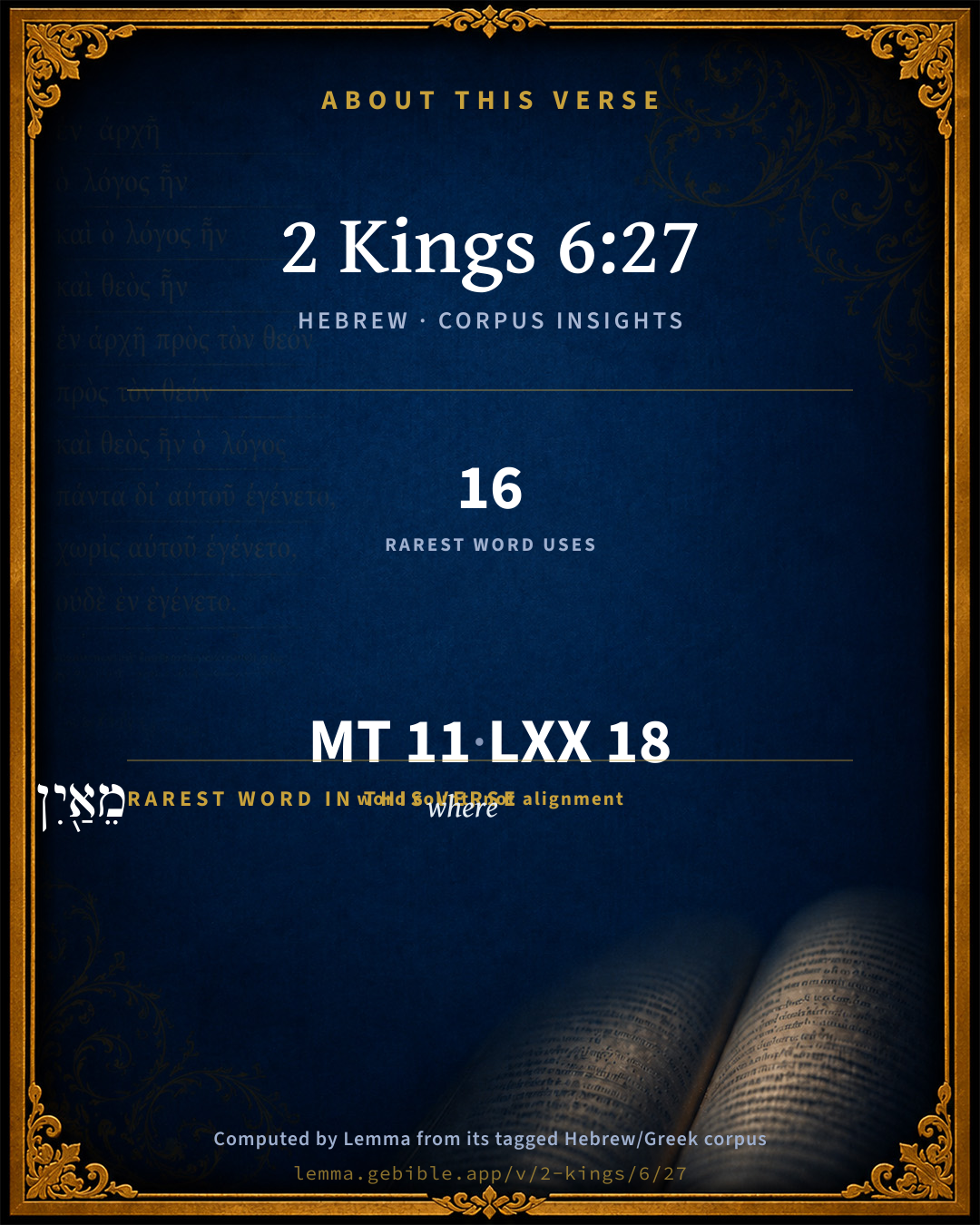
These counts appear in no published source. They are computed here, from the morphology-tagged text and Lemma’s own curated glosses. What Lemma adds →

11
words
9
distinct lemmas
Historical
section

Notable vocabulary

The rarest word here is מֵאַ֖יִן where H370 — appearing just 16 times in the whole Hebrew Bible.

Shared distinctive vocabulary

מֵאַ֖יִן where H370 occurs in 16 verses of the Hebrew Bible. Also found in:

Grammatical profile

  • 3 verbs
  • 3 nouns
  • 2 prepositions
  • 1 conjunction
  • 2 particles

Verb forms

  • וַיֹּ֨אמֶר֙ Qal · Sequential Imperfect
  • יוֹשִׁעֵ֣ךְ Hiphil · Jussive
  • אֽוֹשִׁיעֵ֑ךְ Hiphil · Imperfect

Repetition

Words recur within this verse — often emphatic in Hebrew:

  • יוֹשִׁעֵ֣ךְ to save H3467 ×2
  • הֲמִן from H4480 ×2

Hebrew & Septuagint length

In English translation the verse runs 22 words from the Hebrew and 22 from the Septuagint (LXX English) — the same length.

A rough comparison of the two English renderings, which tokenize alike — not a word-level alignment.

Word counts can differ between the Hebrew and the Greek without any difference in meaning — e.g. the Hebrew direct-object marker אֵת has no separate Greek word, and Greek often adds the article ὁ.

In the original languages it is 11 Hebrew tokens and 18 Greek tokens — but the two are counted differently (Hebrew bundles its prefixes and suffixes into one token; the Greek is in lemma form), so that isn’t a like-for-like length.

Cross-references

7

Topical passages linked to 2 Kings 6:27 in the Treasury of Scripture Knowledge — connected by theme and wording, ordered by reader-vote popularity; previews shown in the World English Bible.

  • Psalms 118:8–9 It is better to take refuge in Yahweh, Than to put confidence in man.
  • Psalms 124:1–3 If it had not been Yahweh who was on our side, Let Israel now say,
  • Psalms 60:11 Give us help against the adversary, For the help of man is vain.
  • Psalms 62:8 Trust in him at all times, you people. Pour out your heart before him. God is a refuge for us. Selah.
  • Psalms 127:1 Unless Yahweh builds the house, They labor in vain who build it. Unless Yahweh watches over the city, The watchman guards it in vain.
  • Psalms 146:3 Don't put your trust in princes, Each a son of man in whom there is no help.
  • Jeremiah 17:5 Thus says Yahweh: Cursed is the man who trusts in man, and makes flesh his arm, and whose heart departs from Yahweh.

Cross-references courtesy of OpenBible.info (CC BY 4.0).

Hebrew and Greek witnesses Masoretic Hebrew ↔ Greek Septuagint

The same verse in the two great witnesses to the Old Testament, shown verse-for-verse.

These are two independent witnesses, not word-aligned to each other, and the Septuagint is shown in lemma (dictionary) form.

Hebrew 2 Kings 6:27 Masoretic · Westminster Leningrad Codex

וַיֹּ֨אמֶר֙ אַל יוֹשִׁעֵ֣ךְ יְהוָ֔ה מֵאַ֖יִן אֽוֹשִׁיעֵ֑ךְ הֲמִן הַגֹּ֖רֶן א֥וֹ מִן הַיָּֽקֶב

He said, If Yahweh doesn't help you, whence shall I help you? out of the threshing floor, or out of the winepress?

World English Bible · Public Domain

Greek LXX 2 Kings 6:27 Septuagint · lemma form

καί εἶπον αὐτός μή σύ σώζω κύριος πόθεν σώζω σύ μή ἀπό ὁ ἅλων ἤ ἀπό ὁ ληνός

And he said to her, Unless the Lord help you, whence shall I help you? from the corn-floor, or from the wine-press?

LXX2012 (modern English Septuagint) · Public Domain

On this verse, The Cambridge Bible for Schools and Colleges discusses the Septuagint’s reading. Read the note in Commentary ↓

Hebrew: Westminster Leningrad Codex (CC BY 4.0). Greek: Septuagint (public domain); English from LXX2012 (modern English Septuagint) (Public Domain). How the Septuagint differs from the Hebrew →

Targum (Aramaic paraphrase)

1

The Targum is the ancient Jewish Aramaic paraphrase of the Hebrew Scriptures — an interpretive translation, not the Hebrew text itself. Onkelos (literal) and Pseudo-Jonathan (expansive) render the Torah, and Jonathan the Prophets. Coverage is partial: where no permissively-licensed English translation exists for a verse, only the Aramaic is shown. This is verse-level text, not a word-by-word alignment to the Hebrew.

  1. Targum Jonathan Prophets (Joshua–Malachi)
    וַאֲמַר לָא יִפְרְקִינָךְ יְיָ מְנַן אֶפְרְקִינָךְ הֲמִן אִדְרָא אוֹ מִן מַעֲצַרְתָּא:

    (no public-domain English translation for this verse)

    Targum Jonathan — Aramaic: “Mikraot Gedolot” (public domain). English: “Sefaria Community Translation” (CC0 1.0 (public-domain dedication)); “London "Chaldee Paraphrase," 1871” (public domain). Text via Sefaria.

Commentary

Notes on 2 Kings 6:27 from classic Christian and Jewish commentators (each source and its license shown beneath its notes). The classic Christian expositions comment on the surrounding passage and are grouped to its opening verse, so a note may address several verses; the Jewish commentaries on the Tanakh (Rashi and others) are per-verse, so they appear only where the commentator wrote on this verse.

Lemma curates 59 commentaries, every one of them public domain or Creative Commons licensed, each selected and text-cleaned for this edition rather than reprinted as found. About our sources →

Trapp's Complete Commentary

John Trapp

2Ki 6:27 And he said, If the LORD do not help thee, whence shall I help thee? out of the barnfloor, or out of the winepress?

Ver. 27. If the Lord do not help thee.] Or - by way of angry imprecation - Let not the Lord save thee; that is, God confound thee; {a} Dii te perdant, Dii tibi male faxint, said the heathens in like case. {b}

{a} Dispereas.

{b} Vatab.

John Trapp, A Commentary or Exposition upon All the Books of the Old and New Testament (1647–1656) — public domain. Text from a community e-Sword module.

Geneva Bible (1599)

Geneva Bible translators

Meaning, any kind of vittle, as corn and wine, etc.

Geneva Bible (1599) marginal notes — public domain. Text via Bolls.life.

Adam Clarke's Commentary

Verse 27. If the Lord do not help thee] Some read this as an imprecation, May God save thee not! how can I save thee?

Adam Clarke's Commentary on the Bible (1810–1826) — public domain. Text from a community e-Sword/MySword module.

Ellicott's Commentary for English Readers

(27) If the Lord do not help thee.—This is right. The marginal rendering, “Let not the Lord help thee!”—i.e., “May the Lord destroy thee!” would be possible in another context. Another rendering is, “Nay (i.e., do not supplicate me), let the Lord help thee!”

Out of the barnfloor.—Comp. Hosea ix 2.: “The floor and the winepress shall not feed them, and the new wine shall fail in her.” Jehoram, in the irony of despair, reminds the woman of what she well knows—viz., that the corn and wine, the staple foods of the time, are long since exhausted. The words, “If the Lord do not help thee,” may be compared with 2Ki_3:10, “Alas! that the Lord hath called,” &c. The character of Jehoram is consistently drawn. But perhaps the point is: “Jehovah alone is the giver of corn and wine (Hos_2:8-9). Appeal not to me for these.”

A Bible Commentary for English Readers, edited by Charles John Ellicott (1878–1897) — public domain. Text from a community e-Sword module.

The Cambridge Bible for Schools and Colleges

gen. ed. J. J. S. Perowne

27. If the Lord do not help thee] There is some difficulty here. The word rendered ‘if … not’ is that which in Hebrew is generally put with an imperative = ‘Let not’. So that the sense would be ‘May the Lord not help thee’. So the LXX. But such a wish could hardly have come at such a time into the king’s mind. The R.V. (marg.) attempts to keep the imperative force thus, ‘Nay, let the Lord help thee’. This comes a little nearer the sense of the English versions. But there is no warrant for separating the negative particle in this way from its verb. Perhaps it is best to explain the negative particle, as if the verb belonging to it were suppressed. Thus ‘Do not (cry to me); the Lord must help thee; for I cannot’. In this way the sense given in the English versions would be the correct force of the words.

out of the barnfloor, or out of the winepress?] i.e. with anything to eat or to drink. The supply of both was utterly spent, as the whole city knew. For the expression cf. Hos_9:2.

The Cambridge Bible for Schools and Colleges (gen. ed. J. J. S. Perowne; Cambridge University Press, 1878–1918) — public domain. Text from a community e-Sword module.

John Gill's Exposition

So we boiled my son, and did eat him,.... Thus what was predicted, by way of threatening, began to be accomplished, Deu 28:53; see Gill on Deu 28:53, and of which there were other instances of a like kind at the siege of Jerusalem, both by Nebuchadnezzar and Vespasian:

and I said unto her on the next day; after her child had been wholly ate up:

give thy son, that we may eat him; according to agreement:

and she hath hid her son; either to save him alive, or to eat him herself alone.

John Gill's Exposition of the Whole Bible (1746–1763) — public domain (CC PDM 1.0). Text via the HelloAO Bible API.

Albert Barnes' Notes on the Bible

If the Lord do not help - The translation in the text is decidedly better than the marginal rendering. Some prefer to render - “Nay ... let Jehovah help thee. Whence, shall I help thee?”

Out of the barnfloor ... - The king means that both were empty - that he had no longer any food in store; and therefore could not help the woman. Compare Hos 9:2.

Albert Barnes' Notes on the Bible (1834–1885) — public domain. Text from a community e-Sword/MySword module.

Haydock's Catholic Bible Commentary

CHAPTER VI.

Save (salvat.) Many ancient manuscripts read salvet, conformably to the Hebrew and Septuagint, as if the king cursed the woman: "Let not the Lord save thee," Josephus [Antiquities?] ix. 4. Others place the stops differently: "He said, no: the Lord save thee." (Calmet) --- He is the author of life. (Menochius)

George Leo Haydock (1774–1849), Haydock's Catholic Family Bible and Commentary, 1859 edition — public domain. Excludes Psalms (Douay-Rheims chapter numbering differs from Protestant) and Deuterocanonical books (Catholic canon only).

Matthew Poole's English Annotations

If the Lord do not help thee, or, let not God help thee, as some both ancient and late interpreters render the words. So they are words of impatience, and rage, and a formal curse, wishing that God would not help her, as he could not, as Josephus, amongst others, understand it; which agrees too well with the character of the man, an infidel, and an idolater, and a wicked man, and at this time in a great rage, as appears from 2Ki 6:31. Or they may be rendered thus, No; (as this Hebrew particle is sometimes used, as Job 20:17; Psa 24:5; Psa 41:2; 50:3; Pro 3:3,5; 31:4) let the Lord help thee. So it may be taken, either, first, As a direction: No; do not cry to me, but to God, for help: God help thee, for I cannot. Or rather, secondly, As a profane scoff: No; come not to me, but go to him to whom Elisha directs you; pray to the Lord: you see how ready he is to help you, by his suffering you to come to this extremity; wait upon God for relief, as Elisha adviseth me; but I will wait no longer for him, 2Ki 6:33, and I will take a course with Elisha for thus abusing both me and my people with vain hopes. Or thus, The Lord (on whom forsooth thou and I are commanded to wait for help) will not help thee, as he could easily do, and would do, if he were so good as Elisha pretends; whence then shall I help thee?

Out of the barn-floor, or out of the winepress? Dost thou ask of me corn or wine, which I want for myself?

Matthew Poole's English Annotations on the Holy Bible (1683–1685) — public domain. Text from a community e-Sword/MySword module.

Whedon's Commentary on the Bible

Daniel D. Whedon

27. Out of the barnfloor — Can I gather up grain for thee from the smooth rock or cleanly swept surface of the threshingfloor, or fruit from the empty and deserted winepress? Have I power to turn stones into bread?

Daniel D. Whedon (gen. ed.), Commentary on the Old and New Testaments (1874–1909) — public domain. Text from a community e-Sword module.

The Pulpit Commentary

And he said, If the Lord do not help thee. This is probably the true mean-tug. The king is not so brutal as to "curse" the woman (ejphrasato aujth ton, Josephus, "Ant. Jud:," 9:4. neither does he take upon himself to tell her that God will not save her (Maurer). He merely refers her to God, as alone competent to do what she asks. Whence shall I help thee? Whence, i.e. , dost thou suppose that I can save thee? Out of the barnfloor, or out of the winepress? Dost thou suppose that I have stores of food at my disposal? An overflowing barnfloor, where abundant corn is garnered, or a winepress full of the juice of the grape? I have nothing of the kind; my stores are as much exhausted as those of the meanest of my subjects. I cannot save thee.

The Pulpit Commentary (1880–1919), ed. H.D.M. Spence-Jones & Joseph S. Exell — public domain. Text from a community e-Sword module.

John Wesley's Explanatory Notes

Whence shall I help thee - Dost thou ask of me corn or wine, which I want for myself? If God does not, I cannot help thee. Creatures are helpless things without God. Every creature is all that, and only that which God makes it to be.

John Wesley, Explanatory Notes Upon the Whole Bible (1754–1765) — public domain. Text via the GEBible commentary corpus.

unfoldingWord translationNotes

Door43 World Missions Community

He said

"The king of Israel answered the woman,"

If Yahweh does not help you, how can I help you?

The king uses this rhetorical question to tell the woman that he cannot help her. This can be written as a statement. AT: "If Yahweh is not helping you, then I cannot help you." (See: Rhetorical Question)

Is there anything coming from the threshing floor or winepress?

The king uses this rhetorical question to emphasize that there is no food available. Here the threshing floor refers to grain and the winepress refers to wine. This can be written as a statement. AT: "There is nothing coming from the threshing floor or the winepress." or "There is no food to harvest or any grapes to make wine to drink." (See: Rhetorical Question)

The king continued

"The king said." This means that they continued talking.

we boiled

"we cooked"

translationWords

Yahweh

thresh

winepress

trouble

unfoldingWord translationNotes — © Distant Shores Media and the Door43 World Missions Community, licensed CC BY-SA 4.0. Source: git.door43.org/Door43/en_tn.

Lesson kit

Teaching starters — assembled from the data on this page, not authored interpretation. Every prompt links to the verse data it draws on. Edit before teaching.

2 Kings, in the Historical, opens this verse with 11 words (9 distinct Hebrew lemmas). Its most distinctive word is ʼayin (“where”). A historical commentator’s framing appears above. Read the whole chapter for the surrounding context.

Discussion questions

  1. What does “where” (ʼayin) contribute to the verse as a whole?
  2. How does Genesis 29:4, which shares the word «where», read alongside this verse?
  3. What does the repetition of “to save” (2× in this one verse) do in this verse?
  4. These translations render this verse differently. What is at stake in choosing one wording over another?
  5. «וַיֹּ֨אמֶר֙» is a Qal Sequential Imperfect verb. How does that grammatical form shape the action described?
  6. Compare how Trapp's Complete Commentary and Geneva Bible (1599) read this verse. Where do they agree or differ?

Things to notice

Reading settings

Reading text

Shown beneath each verse's original-language words.

Old Testament
Old Testament edition

Read the OT as the Masoretic Hebrew (MT) or the Greek Septuagint (LXX).

English shown for the Greek Septuagint (in the Hebrew ↔ Greek comparison).

Comparing translations? Open the Compare panel on any verse page to stack up to four side by side.