
2 Samuel 14:18

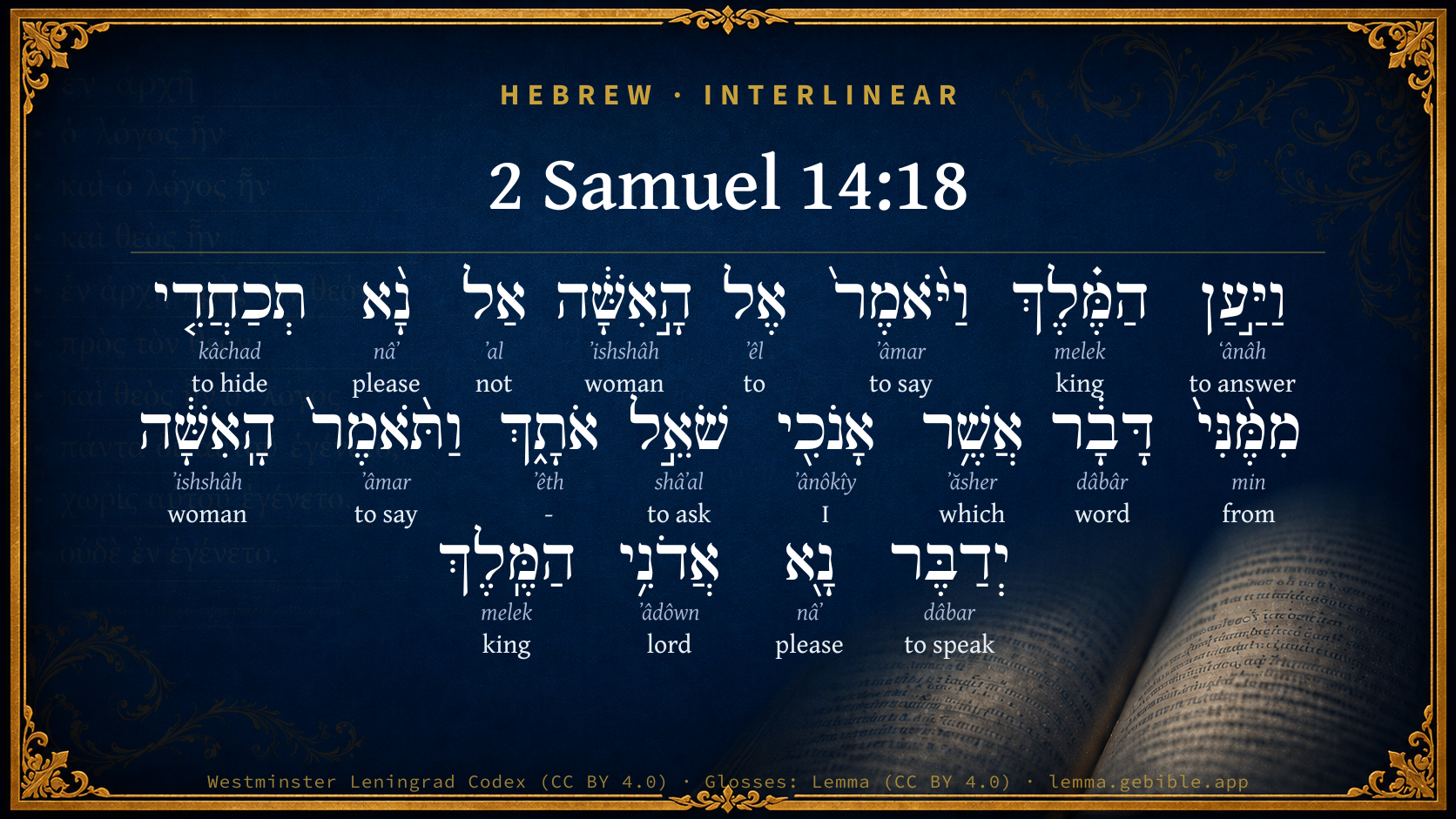
Hebrew (Westminster Leningrad Codex) 2 Samuel 14:18 appears in the Hebrew Old Testament. The text above is from the Westminster Leningrad Codex. Each word links to its Strong’s number, a concise gloss, and parsing drawn from the Open Scriptures Hebrew Bible morphology. Click any word for its full Brown-Driver-Briggs (BDB) entry.
Download image
Cite this verse

2 Samuel 14:18 (World English Bible). Public Domain. Lemma interlinear Bible study tool, https://lemma.gebible.app/v/2-samuel/14/18.

Show BibTeX & RIS
BibTeX
RIS
English Translation
Then the king answered the woman, Please don't hide anything from me that I shall ask you. The woman said, Let my lord the king now speak.
World English Bible · Public Domain
Download a study sheet

One document with this verse’s original text, its word-by-word gloss line, the meaning frame, cross-references with their text, attributed commentary, and full source and license credits — printable, and it pastes into notes with its structure intact.

This verse Autodidact and up

Study sheet (.html) Plain text (.txt)

A passage Seminary Student

Up to 50 verses in one chapter. A passage sheet keeps up to 6 commentary sources and 12 cross-references per verse, in the order this page ranks them, and says so on the sheet whenever that leaves anything out. Ask for a single verse and you get the Autodidact verse sheet above.

Everything on this page stays free to read, with no account — the sheet is a download of what is already on screen, not access to it.

Want to remove ads? Support Godless Engineer
Compare translations 3

The same verse in 3 English versions, stacked beneath the original-language interlinear above. Click any original word for its lexicon entry.

Each is an independent rendering of the whole verse — the interlinear is not word-aligned to these translations.

Highlighted words mark where these versions differ — a whole-verse word diff, not a word-by-word alignment.

  • World English Bible Public Domain
    Then the king answered the woman, Please don't hide anything from me that I shall ask you. The woman said, Let my lord the king now speak.
  • King James Version Public Domain
    Then the king answered and said unto the woman, Hide not from me, I pray thee, the thing that I shall ask thee. And the woman said, Let my lord the king now speak.
  • unfoldingWord Literal Text CC BY-SA 4.0
    And the king answered and said to the woman, “Now do not hide from me a thing that I am asking you.” And the woman said, “May my lord the king please speak.”

unfoldingWord Literal Text — © unfoldingWord, licensed CC BY-SA 4.0. Word-aligned USFM3 via Door43 (git.door43.org/unfoldingWord/en_ult).

Versions to compare (up to 4)

3 of 4 selected

Show all 18 translations

Every available English version of this verse, each an independent rendering of the whole verse.

  • World English Bible Public Domain
    Then the king answered the woman, Please don't hide anything from me that I shall ask you. The woman said, Let my lord the king now speak.
  • Berean Standard Bible Public Domain
    Then the king said to the woman, “I am going to ask you something; do not conceal it from me!” “Let my lord the king speak,” she replied.
  • Majority Standard Bible Public Domain
    Then the king said to the woman, “I am going to ask you something; do not conceal it from me!” “Let my lord the king speak,” she replied.
  • King James Version Public Domain
    Then the king answered and said unto the woman, Hide not from me, I pray thee, the thing that I shall ask thee. And the woman said, Let my lord the king now speak.
  • American Standard Version (1901) Public Domain
    Then the king answered and said unto the woman, Hide not from me, I pray thee, aught that I shall ask thee. And the woman said, Let my lord the king now speak.
  • Revised Version (1885) Public Domain
    Then the king answered and said unto the woman, Hide not from me, I pray thee, aught that I shall ask thee. And the woman said, Let my lord the king now speak.
  • Geneva Bible (1599) Public Domain
    Then the King answered, and said vnto the woman, Hide not from me, I pray thee, the thing that I shall aske thee. And the woman sayde, Let my lord the King now speake.
  • Douay-Rheims (1899) Public Domain
    And the king answering, said to the woman: Hide not from me the thing that I ask thee. And the woman said to him: Speak, my lord the king.
  • Young's Literal Translation Public Domain
    And the king answereth and saith unto the woman, `Do not, I pray thee, hide from me the thing that I am asking thee;' and the woman saith, `Let, I pray thee, my lord the king speak.'
  • Literal Standard Version CC BY-SA 4.0
    And the king answers and says to the woman, “Please do not hide from me the thing that I am asking you”; and the woman says, “Please let my lord the king speak.”
  • Unlocked Literal Bible CC BY-SA 4.0
    Then the king answered and said to the woman, “Please do not hide from me anything that I will ask you.” The woman replied, “Let my master the king now speak.”
  • unfoldingWord Literal Text CC BY-SA 4.0
    And the king answered and said to the woman, “Now do not hide from me a thing that I am asking you.” And the woman said, “May my lord the king please speak.”
  • Darby Bible Public Domain
    And the king answered and said to the woman, Hide not from me, I pray thee, the thing that I shall ask thee. And the woman said, Let my lord the king now speak.
  • World Messianic Bible Public Domain
    Then the king answered the woman, “Please don’t hide anything from me that I ask you.” The woman said, “Let my lord the king now speak.”
  • Webster's Bible Public Domain
    Then the king answered and said to the woman, Hide not from me, I pray thee, the thing that I shall ask thee. And the woman said, Let my lord the king now speak.
  • Free Bible Version CC BY-SA 4.0
    “Please don't refuse to answer the question I'm about to ask,” the king said to the woman. “Please ask your question, Your Majesty,” she replied.
  • Bible in Basic English Public Domain
    Then the king said to the woman, Now give me an answer to the question I am going to put to you; keep nothing back. And the woman said, Let my lord the king say on.
  • JPS Tanakh (1917) Public Domain
    Then the king answered and said unto the woman: 'Hide not from me, I pray thee, aught that I shall ask thee.' And the woman said: 'Let my lord the king now speak.'

Literal Standard Version (2020), Covenant Press — licensed CC BY-SA 4.0. Text via the HelloAO Bible API (eBible.org). Unlocked Literal Bible (unfoldingWord) — licensed CC BY-SA 4.0. Text via the HelloAO Bible API (eBible.org). unfoldingWord Literal Text — © unfoldingWord, licensed CC BY-SA 4.0. Word-aligned USFM3 via Door43 (git.door43.org/unfoldingWord/en_ult). Free Bible Version, Dr. Jonathan Gallagher — licensed CC BY-SA 4.0. Text via the HelloAO Bible API (eBible.org).

Word by word

More ways to search: Search by grammar → Find every occurrence → Compare this word →

Practice this passage: Drill this verse → Learn its vocabulary →

תְכַחֲדִ֤י
kâchad
H3582
“to hide”
Verb, Piel, Jussive, 2nd Person, Feminine, Singular
Part of Speech
Verb
Stem
Piel
Form
Jussive
Person
2nd Person
Gender
Feminine
Number
Singular
Full BDB Definition

Origin: a primitive root

TWOT: 972

to hide, conceal, cut off, cut down, make desolate, kick - (Niphal) - to be hidden - to be effaced, be destroyed, be cut off - (Piel) to cover, hide - (Hiphil) - to hide - to efface, annihilate
  1. וַיַּ֣עַן ʻânâh H6030 “and · to answer” Conjunction + Verb, Qal, Sequential Imperfect, 3rd Person, Masculine, Singular
  2. הַמֶּ֗לֶךְ melek H4428 “the · king” Particle, Definite Article + Noun, Common, Masculine, Singular, Absolute
  3. וַיֹּ֨אמֶר֙ ʼâmar H559 “and · to say” Conjunction + Verb, Qal, Sequential Imperfect, 3rd Person, Masculine, Singular
  4. אֶל ʼêl H413 “to” Preposition
  5. הָ֣אִשָּׁ֔ה ʼishshâh H802 “the · woman” Particle, Definite Article + Noun, Common, Feminine, Singular, Absolute
  6. אַל ʼal H408 “not” Particle, Negative
  7. נָ֨א nâʼ H4994 “please” Particle, Exhortation
  8. מִמֶּ֨נִּי֙ min H4480 “from · me” Preposition + Suffix, Personal, 1st Person, Common, Singular
  9. דָּבָ֔ר dâbâr H1697 “word” Noun, Common, Masculine, Singular, Absolute
  10. אֲשֶׁ֥ר ʼăsher H834 “which” Particle, Relative
  11. אָנֹכִ֖י ʼânôkîy H595 “I” Pronoun, Personal, 1st Person, Common, Singular
  12. שֹׁאֵ֣ל shâʼal H7592 “asking” Verb, Qal, Participle Active, Masculine, Singular, Absolute
  13. אֹתָ֑ךְ ʼêth H853 “- · you” Particle, Direct Object + Suffix, Personal, 2nd Person, Feminine, Singular
  14. וַתֹּ֨אמֶר֙ ʼâmar H559 “and · to say” Conjunction + Verb, Qal, Sequential Imperfect, 3rd Person, Feminine, Singular
  15. הָֽאִשָּׁ֔ה ʼishshâh H802 “the · woman” Particle, Definite Article + Noun, Common, Feminine, Singular, Absolute
  16. יְדַבֶּר dâbar H1696 “to speak” Verb, Piel, Jussive, 3rd Person, Masculine, Singular
  17. נָ֖א nâʼ H4994 “please” Particle, Exhortation
  18. אֲדֹנִ֥י ʼâdôwn H113 “lord · my” Noun, Common, Masculine, Singular, Construct + Suffix, Personal, 1st Person, Common, Singular
  19. הַמֶּֽלֶךְ melek H4428 “the · king” Particle, Definite Article + Noun, Common, Masculine, Singular, Absolute

About this verse

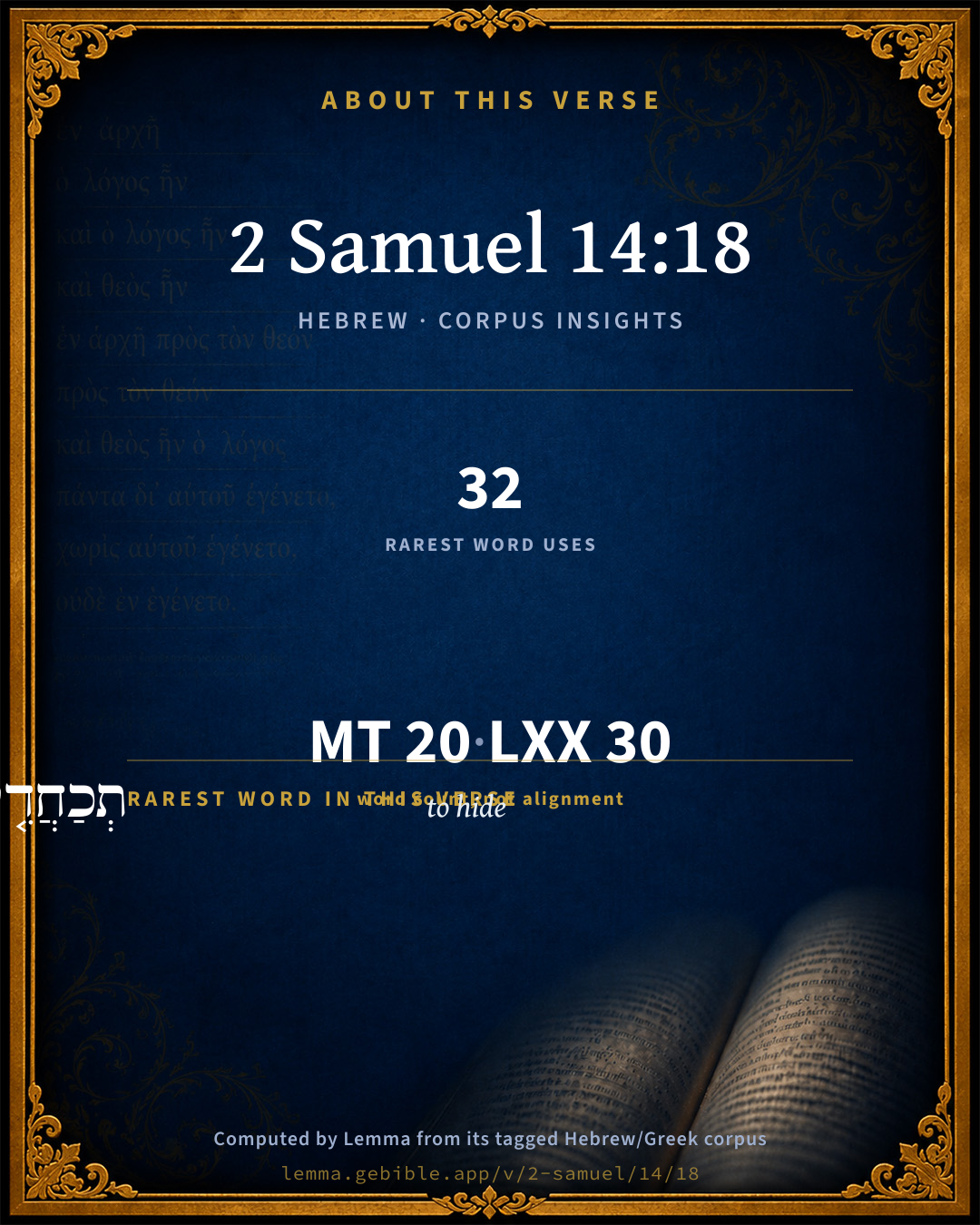
These counts appear in no published source. They are computed here, from the morphology-tagged text and Lemma’s own curated glosses. What Lemma adds →

20
words
16
distinct lemmas
Historical
section

Shared distinctive vocabulary

תְכַחֲדִ֤י to hide H3582 occurs in 30 verses of the Hebrew Bible. Also found in:

Grammatical profile

  • 6 verbs
  • 6 nouns
  • 1 pronoun
  • 2 prepositions
  • 5 particles

Verb forms

  • וַיַּ֣עַן Qal · Sequential Imperfect
  • וַיֹּ֨אמֶר֙ Qal · Sequential Imperfect
  • תְכַחֲדִ֤י Piel · Jussive
  • שֹׁאֵ֣ל Qal · Participle Active
  • וַתֹּ֨אמֶר֙ Qal · Sequential Imperfect
  • יְדַבֶּר Piel · Jussive

Repetition

Words recur within this verse — often emphatic in Hebrew:

  • הַמֶּ֗לֶךְ king H4428 ×2
  • וַיֹּ֨אמֶר֙ to say H559 ×2
  • הָ֣אִשָּׁ֔ה woman H802 ×2
  • נָ֨א please H4994 ×2

Hebrew & Septuagint length

In English translation the verse runs 27 words from the Hebrew and 35 from the Septuagint (LXX English) — closely comparable.

A rough comparison of the two English renderings, which tokenize alike — not a word-level alignment.

Word counts can differ between the Hebrew and the Greek without any difference in meaning — e.g. the Hebrew direct-object marker אֵת has no separate Greek word, and Greek often adds the article ὁ.

In the original languages it is 20 Hebrew tokens and 30 Greek tokens — but the two are counted differently (Hebrew bundles its prefixes and suffixes into one token; the Greek is in lemma form), so that isn’t a like-for-like length.

Cross-references

3

Topical passages linked to 2 Samuel 14:18 in the Treasury of Scripture Knowledge — connected by theme and wording, ordered by reader-vote popularity; previews shown in the World English Bible.

  • 1 Samuel 3:17–18 He said, "What is the thing that [Yahweh] has spoken to you? Please don't hide it from me. God do so to you, and more also, if you hide anything from me of all the things that he spoke to you."
  • Jeremiah 38:14 Then Zedekiah the king sent, and took Jeremiah the prophet to him into the third entry that is in the house of Yahweh: and the king said to Jeremiah, I will ask you a thing; hide nothing from me.
  • Jeremiah 38:25 But if the princes hear that I have talked with you, and they come to you, and tell you, Declare to us now what you have said to the king; don't hide it from us, and we will not put you to death; also what the king said to you:

Cross-references courtesy of OpenBible.info (CC BY 4.0).

Hebrew and Greek witnesses Masoretic Hebrew ↔ Greek Septuagint

The same verse in the two great witnesses to the Old Testament, shown verse-for-verse.

These are two independent witnesses, not word-aligned to each other, and the Septuagint is shown in lemma (dictionary) form.

Hebrew 2 Samuel 14:18 Masoretic · Westminster Leningrad Codex

וַיַּ֣עַן הַמֶּ֗לֶךְ וַיֹּ֨אמֶר֙ אֶל הָ֣אִשָּׁ֔ה אַל נָ֨א תְכַחֲדִ֤י מִמֶּ֨נִּי֙ דָּבָ֔ר אֲשֶׁ֥ר אָנֹכִ֖י שֹׁאֵ֣ל אֹתָ֑ךְ וַתֹּ֨אמֶר֙ הָֽאִשָּׁ֔ה יְדַבֶּר נָ֖א אֲדֹנִ֥י הַמֶּֽלֶךְ

Then the king answered the woman, Please don't hide anything from me that I shall ask you. The woman said, Let my lord the king now speak.

World English Bible · Public Domain

Greek LXX 2 Samuel 14:18 Septuagint · lemma form

καί ἀποκρίνω ὁ βασιλεύς καί εἶπον πρός ὁ γυνή μή δή κρύπτω ἀπό ἐγώ ῥῆμα ὅς ἐγώ ἐπιἐρωτάω σύ καί εἶπον ὁ γυνή λαλέω δή ὁ κύριος ἐγώ ὁ βασιλεύς

And the king answered, and said to the woman, Hide not from me, I pray you, the matter which I ask you. And the woman said, Let my lord the king by all means speak.

LXX2012 (modern English Septuagint) · Public Domain

Hebrew: Westminster Leningrad Codex (CC BY 4.0). Greek: Septuagint (public domain); English from LXX2012 (modern English Septuagint) (Public Domain). How the Septuagint differs from the Hebrew →

Targum (Aramaic paraphrase)

1

The Targum is the ancient Jewish Aramaic paraphrase of the Hebrew Scriptures — an interpretive translation, not the Hebrew text itself. Onkelos (literal) and Pseudo-Jonathan (expansive) render the Torah, and Jonathan the Prophets. Coverage is partial: where no permissively-licensed English translation exists for a verse, only the Aramaic is shown. This is verse-level text, not a word-by-word alignment to the Hebrew.

  1. Targum Jonathan Prophets (Joshua–Malachi)
    וַאֲתֵיב מַלְכָּא וַאֲמַר לְאִתְּתָא לָא כְעַן תְּכַסֵי מִנִי פִתְגָמָא דַאֲנָא שְׁאֵל יָתִיךְ וַאֲמַרַת אִתְּתָא יְמַלֵיל כְּעַן רִבּוֹנִי מַלְכָּא:

    (no public-domain English translation for this verse)

    Targum Jonathan — Aramaic: “Mikraot Gedolot” (public domain). English: “Sefaria Community Translation” (CC0 1.0 (public-domain dedication)); “London "Chaldee Paraphrase," 1871” (public domain). Text via Sefaria.

Commentary

Notes on 2 Samuel 14:18 from classic Christian and Jewish commentators (each source and its license shown beneath its notes). The classic Christian expositions comment on the surrounding passage and are grouped to its opening verse, so a note may address several verses; the Jewish commentaries on the Tanakh (Rashi and others) are per-verse, so they appear only where the commentator wrote on this verse.

Lemma curates 59 commentaries, every one of them public domain or Creative Commons licensed, each selected and text-cleaned for this edition rather than reprinted as found. About our sources →

Trapp's Complete Commentary

John Trapp

2Sa 14:18 Then the king answered and said unto the woman, Hide not from me, I pray thee, the thing that I shall ask thee. And the woman said, Let my lord the king now speak.

Ver. 18. Then the king answered and said.] Hitherto he had with great delight hearkened to her silken words: and now as smelling a plot, he desires therein to be satisfied. Neither was she to seek of an answer, but comes off truly and trimly, extolling the king’s singular sagacity.

John Trapp, A Commentary or Exposition upon All the Books of the Old and New Testament (1647–1656) — public domain. Text from a community e-Sword module.

Joseph Benson's Commentary

2Sa 14:18-19. The king said, Hide not from me, &c. — Observing the uncommon art and dexterity of her address in the management of this affair, the king immediately began to suspect it was a thing concerted between her and Joab, and asked, Is not the hand of Joab with thee in all this? — Hast thou not said and done all this by his direction? The woman said, None can turn, &c. — That is, it is even so: thou hast discovered the truth: and I will not seek by any turnings or windings, this way, or the other, to dissemble the matter, but will plainly confess it. He put these words into the mouth of thy handmaid — As to the sense and substance of them, but not as to all the expressions, for these were evidently varied as the king’s answer gave occasion.

Joseph Benson's Commentary on the Old and New Testaments (1811–1818) — public domain. Text from a community e-Sword module.

John Gill's Exposition

Then the king answered and said unto the woman,.... Understanding plainly what she meant by all this, that the case she brought was a feigned one, and that the intention of it was to let him know the sense of the people with respect to Absalom, and the recall of him:

hide not from me, I pray thee, the thing that I shall ask thee; he suspected that this was not a scheme of her own, but some considerable person had formed it, and made use of her to execute it, which was what he desired to know:

and the woman said, let my lord the king now speak; ask what question he pleases, I am ready to answer.

John Gill's Exposition of the Whole Bible (1746–1763) — public domain (CC PDM 1.0). Text via the HelloAO Bible API.

unfoldingWord translationNotes

Door43 World Missions Community

Please do not hide from me anything that I will ask you

The negative form here is used for emphasis and can be stated in a positive form. AT: "Please tell me the truth about everything I ask you" (See: Litotes)

Is not the hand of Joab with you in all this

Here the word "hand" refers to Joab's influence. AT: "Has not Joab influenced you in all this" or "Did Joab send you here to speak these things" (See: Metonymy)

As you live

"As surely as you are alive." Here the woman compares the certainty of what David has said to the certainty that he is alive, to emphasize how true his statement is. (See: Idiom)

no one can escape to the right hand ... the king has spoken

Here the woman describes the difficulty of speaking to the king and keeping him from finding out the truth by comparing it to a person not being about to escape in any direction. AT: "no one can keep you from knowing the truth" (See: Metaphor)

to the right hand or to the left

The expression gives two extremes and means "anywhere." AT: "anywhere at all" or "anywhere" (See: Merism)

My master is wise

"My master the king is wise"

is wise, like the wisdom of an angel of God

The woman compares David's wisdom to the wisdom of an angel to emphasize how very wise he is. AT: "you are very wise, like an angel of God" (See: Simile)

translationWords

know

unfoldingWord translationNotes — © Distant Shores Media and the Door43 World Missions Community, licensed CC BY-SA 4.0. Source: git.door43.org/Door43/en_tn.

Lesson kit

Teaching starters — assembled from the data on this page, not authored interpretation. Every prompt links to the verse data it draws on. Edit before teaching.

2 Samuel, in the Historical, opens this verse with 20 words (16 distinct Hebrew lemmas). Its most distinctive word is kâchad (“to hide”). A historical commentator’s framing appears above. Read the whole chapter for the surrounding context.

Discussion questions

  1. The word kâchad carries the sense “to hide.” How does it shape the verse?
  2. How does Genesis 47:18, which shares the word «to hide», read alongside this verse?
  3. What does the repetition of “king” (2× in this one verse) do in this verse?
  4. The translations on this page render this verse differently — a whole-verse word diff, not a word-by-word alignment. What might account for the different wordings?
  5. «וַיַּ֣עַן» is a Qal Sequential Imperfect verb. How does that grammatical form shape the action described?
  6. Compare how Trapp's Complete Commentary and Joseph Benson's Commentary read this verse. Where do they agree or differ?

Things to notice

Reading settings

Reading text

Shown beneath each verse's original-language words.

Old Testament
Old Testament edition

Read the OT as the Masoretic Hebrew (MT) or the Greek Septuagint (LXX).

English shown for the Greek Septuagint (in the Hebrew ↔ Greek comparison).

Comparing translations? Open the Compare panel on any verse page to stack up to four side by side.