
Numbers 16:26

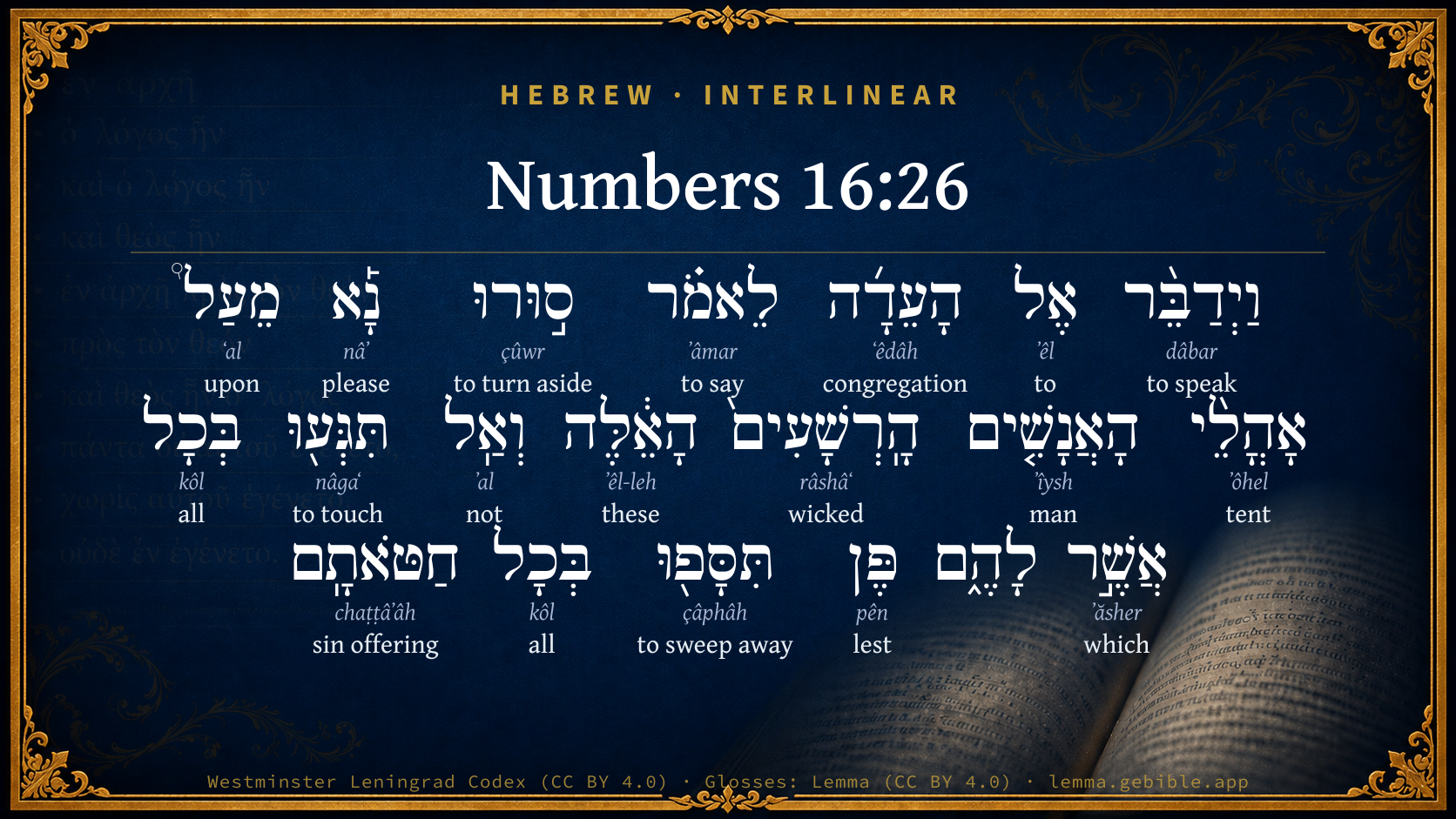
Hebrew (Westminster Leningrad Codex) Numbers 16:26 appears in the Hebrew Old Testament. The text above is from the Westminster Leningrad Codex. Each word links to its Strong’s number, a concise gloss, and parsing drawn from the Open Scriptures Hebrew Bible morphology. Click any word for its full Brown-Driver-Briggs (BDB) entry.
Download image
Cite this verse

Numbers 16:26 (World English Bible). Public Domain. Lemma interlinear Bible study tool, https://lemma.gebible.app/v/numbers/16/26.

Show BibTeX & RIS
BibTeX
RIS
English Translation
He spoke to the congregation, saying, Depart, I pray you, from the tents of these wicked men, and touch nothing of theirs, lest you be consumed in all their sins.
World English Bible · Public Domain
Download a study sheet

One document with this verse’s original text, its word-by-word gloss line, the meaning frame, cross-references with their text, attributed commentary, and full source and license credits — printable, and it pastes into notes with its structure intact.

This verse Autodidact and up

Study sheet (.html) Plain text (.txt)

A passage Seminary Student

Up to 50 verses in one chapter. A passage sheet keeps up to 6 commentary sources and 12 cross-references per verse, in the order this page ranks them, and says so on the sheet whenever that leaves anything out. Ask for a single verse and you get the Autodidact verse sheet above.

Everything on this page stays free to read, with no account — the sheet is a download of what is already on screen, not access to it.

Want to remove ads? Support Godless Engineer
Compare translations 3

The same verse in 3 English versions, stacked beneath the original-language interlinear above. Click any original word for its lexicon entry.

Each is an independent rendering of the whole verse — the interlinear is not word-aligned to these translations.

Highlighted words mark where these versions differ — a whole-verse word diff, not a word-by-word alignment.

  • World English Bible Public Domain
    He spoke to the congregation, saying, Depart, I pray you, from the tents of these wicked men, and touch nothing of theirs, lest you be consumed in all their sins.
  • King James Version Public Domain
    And he spake unto the congregation, saying, Depart, I pray you, from the tents of these wicked men, and touch nothing of theirs, lest ye be consumed in all their sins.
  • unfoldingWord Literal Text CC BY-SA 4.0
    And he spoke to the congregation, saying, “Turn aside, please, from upon the tents of these wicked men, and do not touch all that to them, lest you be swept away in all their sins.”

unfoldingWord Literal Text — © unfoldingWord, licensed CC BY-SA 4.0. Word-aligned USFM3 via Door43 (git.door43.org/unfoldingWord/en_ult).

Versions to compare (up to 4)

3 of 4 selected

Show all 18 translations

Every available English version of this verse, each an independent rendering of the whole verse.

  • World English Bible Public Domain
    He spoke to the congregation, saying, Depart, I pray you, from the tents of these wicked men, and touch nothing of theirs, lest you be consumed in all their sins.
  • Berean Standard Bible Public Domain
    And he warned the congregation, “Move away now from the tents of these wicked men. Do not touch anything that belongs to them, or you will be swept away because of all their sins.”
  • Majority Standard Bible Public Domain
    And he warned the congregation, “Move away now from the tents of these wicked men. Do not touch anything that belongs to them, or you will be swept away because of all their sins.”
  • King James Version Public Domain
    And he spake unto the congregation, saying, Depart, I pray you, from the tents of these wicked men, and touch nothing of theirs, lest ye be consumed in all their sins.
  • American Standard Version (1901) Public Domain
    And he spake unto the congregation, saying, Depart, I pray you, from the tents of these wicked men, and touch nothing of theirs, lest ye be consumed in all their sins.
  • Revised Version (1885) Public Domain
    And he spake unto the congregation, saying, Depart, I pray you, from the tents of these wicked men, and touch nothing of theirs, lest ye be consumed in all their sins.
  • Geneva Bible (1599) Public Domain
    And he spake vnto the Congregation, saying, Depart, I pray you, from the tentes of these wicked men, and touche nothing of theirs, lest ye perish in all their sinnes.
  • Douay-Rheims (1899) Public Domain
    He said to the multitude: Depart from the tents of these wicked men, and touch nothing of theirs, lest you be involved in their sins.
  • Young's Literal Translation Public Domain
    and he speaketh unto the company, saying, `Turn aside, I pray you, from the tents of these wicked men, and come not against anything that they have, lest ye be consumed in all their sins.'
  • Literal Standard Version CC BY-SA 4.0
    and he speaks to the congregation, saying, “Now turn aside from the tents of these wicked men, and do not come against anything that they have, lest you are consumed in all their sins.”
  • Unlocked Literal Bible CC BY-SA 4.0
    He spoke to the community and said, “Now leave the tents of these wicked men and touch nothing of theirs, or you will be consumed by all their sins.”
  • unfoldingWord Literal Text CC BY-SA 4.0
    And he spoke to the congregation, saying, “Turn aside, please, from upon the tents of these wicked men, and do not touch all that to them, lest you be swept away in all their sins.”
  • Darby Bible Public Domain
    And he spoke to the assembly, saying, Depart, I pray you, from the tents of these wicked men, and touch nothing of theirs, lest ye perish in all their sins.
  • World Messianic Bible Public Domain
    He spoke to the congregation, saying, “Depart, please, from the tents of these wicked men, and touch nothing of theirs, lest you be consumed in all their sins!”
  • Webster's Bible Public Domain
    And he spoke to the congregation, saying, Depart, I pray you, from the tents of these wicked men, and touch nothing of theirs, lest ye be consumed in all their sins.
  • Free Bible Version CC BY-SA 4.0
    He ordered the people, “Move away from the tents of these wicked men and don't touch anything that belongs to them, otherwise you will be destroyed along with them in all their sins.”
  • Bible in Basic English Public Domain
    And he said to the people, Come away now from the tents of these evil men, without touching anything of theirs, or you may be taken in the punishment of their sins.
  • JPS Tanakh (1917) Public Domain
    And he spoke unto the congregation, saying: 'Depart, I pray you, from the tents of these wicked men, and touch nothing of theirs, lest ye be swept away in all their sins.'

Literal Standard Version (2020), Covenant Press — licensed CC BY-SA 4.0. Text via the HelloAO Bible API (eBible.org). Unlocked Literal Bible (unfoldingWord) — licensed CC BY-SA 4.0. Text via the HelloAO Bible API (eBible.org). unfoldingWord Literal Text — © unfoldingWord, licensed CC BY-SA 4.0. Word-aligned USFM3 via Door43 (git.door43.org/unfoldingWord/en_ult). Free Bible Version, Dr. Jonathan Gallagher — licensed CC BY-SA 4.0. Text via the HelloAO Bible API (eBible.org).

Word by word

More ways to search: Search by grammar → Find every occurrence → Compare this word →

Practice this passage: Drill this verse → Learn its vocabulary →

תִּסָּפ֖וּ
çâphâh
H5595
“to sweep away”
Verb, Niphal, Imperfect, 2nd Person, Masculine, Plural
Part of Speech
Verb
Stem
Niphal
Form
Imperfect
Person
2nd Person
Gender
Masculine
Number
Plural
Full BDB Definition

Origin: a primitive root

TWOT: 1531

to sweep or snatch away, catch up, destroy, consume - (Qal) - to be snatched away - to sweep or snatch away - (Niphal) - to be swept away, be destroyed - to be caught up, be captured - (Hiphil) to catch up, gather
  1. וַיְדַבֵּ֨ר dâbar H1696 “and · to speak” Conjunction + Verb, Piel, Sequential Imperfect, 3rd Person, Masculine, Singular
  2. אֶל ʼêl H413 “to” Preposition
  3. הָעֵדָ֜ה ʻêdâh H5712 “the · congregation” Particle, Definite Article + Noun, Common, Feminine, Singular, Absolute
  4. לֵאמֹ֗ר ʼâmar H559 “to say” Preposition + Verb, Qal, Infinitive Construct
  5. ס֣וּרוּ çûwr H5493 “turn aside” Verb, Qal, Imperative, 2nd Person, Masculine, Plural
  6. נָ֡א nâʼ H4994 “please” Particle, Exhortation
  7. מֵעַל֩ ʻal H5921 “from · upon” Preposition + Preposition
  8. אָהֳלֵ֨י ʼôhel H168 “tents of” Noun, Common, Masculine, Plural, Construct
  9. הָאֲנָשִׁ֤ים ʼîysh H376 “the · men” Particle, Definite Article + Noun, Common, Masculine, Plural, Absolute
  10. הָֽרְשָׁעִים֙ râshâʻ H7563 “the · wicked” Particle, Definite Article + Adjective, Adjective, Masculine, Plural, Absolute
  11. הָאֵ֔לֶּה ʼêl-leh H428 “the · these” Particle, Definite Article + Pronoun, Demonstrative, Common, Plural
  12. וְאַֽל ʼal H408 “and · not” Conjunction + Particle, Negative
  13. תִּגְּע֖וּ nâgaʻ H5060 “to touch” Verb, Qal, Jussive, 2nd Person, Masculine, Plural
  14. בְּכָל kôl H3605 “in/at · all of” Preposition + Noun, Common, Masculine, Singular, Construct
  15. אֲשֶׁ֣ר ʼăsher H834 “which” Particle, Relative
  16. פֶּן pên H6435 “lest” Conjunction
  17. בְּכָל kôl H3605 “in/at · all of” Preposition + Noun, Common, Masculine, Singular, Construct
  18. חַטֹּאתָֽם chaṭṭâʼâh H2403 “sin offerings · their” Noun, Common, Feminine, Plural, Construct + Suffix, Personal, 3rd Person, Masculine, Plural

About this verse

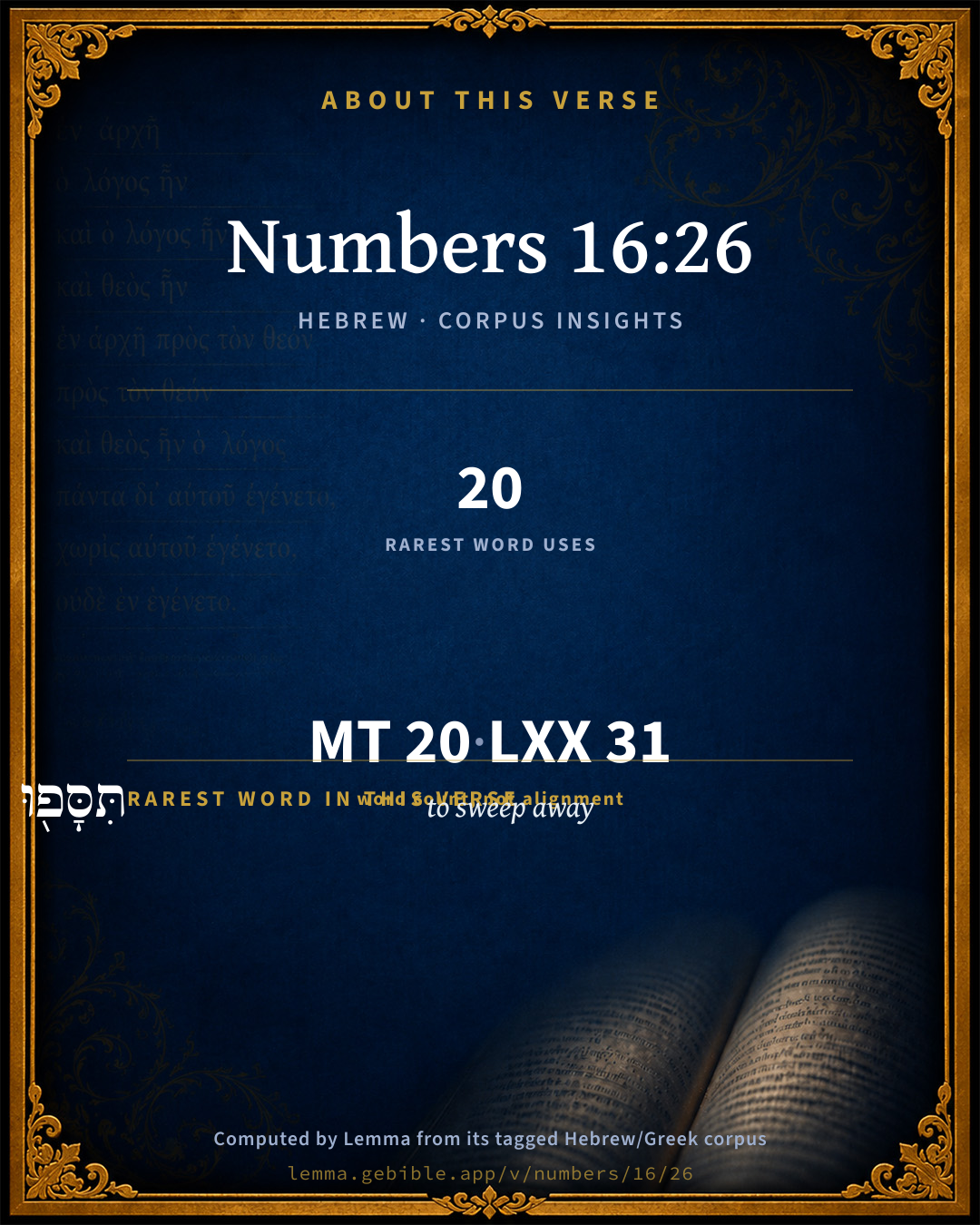
These counts appear in no published source. They are computed here, from the morphology-tagged text and Lemma’s own curated glosses. What Lemma adds →

20
words
18
distinct lemmas
Pentateuch
section

Notable vocabulary

The rarest word here is תִּסָּפ֖וּ to sweep away H5595 — appearing just 20 times in the whole Hebrew Bible.

Shared distinctive vocabulary

תִּסָּפ֖וּ to sweep away H5595 occurs in 20 verses of the Hebrew Bible. Also found in:

Grammatical profile

  • 5 verbs
  • 6 nouns
  • 1 adjective
  • 1 pronoun
  • 3 prepositions
  • 1 conjunction
  • 3 particles

Verb forms

  • וַיְדַבֵּ֨ר Piel · Sequential Imperfect
  • לֵאמֹ֗ר Qal · Infinitive Construct
  • ס֣וּרוּ Qal · Imperative
  • תִּגְּע֖וּ Qal · Jussive
  • תִּסָּפ֖וּ Niphal · Imperfect

Repetition

A word recurs within this verse — often emphatic in Hebrew:

  • בְּכָל all H3605 ×2

Hebrew & Septuagint length

In English translation the verse runs 30 words from the Hebrew and 33 from the Septuagint (LXX English) — closely comparable.

A rough comparison of the two English renderings, which tokenize alike — not a word-level alignment.

Word counts can differ between the Hebrew and the Greek without any difference in meaning — e.g. the Hebrew direct-object marker אֵת has no separate Greek word, and Greek often adds the article ὁ.

In the original languages it is 20 Hebrew tokens and 31 Greek tokens — but the two are counted differently (Hebrew bundles its prefixes and suffixes into one token; the Greek is in lemma form), so that isn’t a like-for-like length.

Cross-references

10

Topical passages linked to Numbers 16:26 in the Treasury of Scripture Knowledge — connected by theme and wording, ordered by reader-vote popularity; previews shown in the World English Bible.

  • Isaiah 52:11 Depart you, depart you, go you out from there, touch no unclean thing; go you out of the midst of her; cleanse yourselves, you who bear the vessels of Yahweh.
  • 2 Corinthians 6:17 Therefore, "'Come out from among them, And be separate,' says the Lord, 'Touch no unclean thing. I will receive you.
  • Revelation 18:4 I heard another voice from heaven, saying, "Come out of her, my people, that you have no participation in her sins, and that you don't receive of her plagues,
  • Genesis 19:12–15 The men said to Lot, "Do you have anybody else here? Sons-in-law, your sons, your daughters, and whoever you have in the city, bring them out of the place:
  • Numbers 16:21–24 Separate yourselves from among this congregation, that I may consume them in a moment.
  • Deuteronomy 13:17 There shall cleave nothing of the devoted thing to your hand; that Yahweh may turn from the fierceness of his anger, and show you mercy, and have compassion on you, and multiply you, as he has sworn to your fathers;
  • Acts 8:20 But Peter said to him, "May your silver perish with you, because you thought you could obtain the gift of God with money!
  • Acts 13:51 But they shook off the dust of their feet against them, and came to Iconium.
  • 1 Timothy 5:22 Lay hands hastily on no one, neither be a participant in other men's sins. Keep yourself pure.
  • Matthew 10:14 Whoever doesn't receive you, nor hear your words, as you go out of that house or that city, shake off the dust from your feet.

Cross-references courtesy of OpenBible.info (CC BY 4.0).

Hebrew and Greek witnesses Masoretic Hebrew ↔ Greek Septuagint

The same verse in the two great witnesses to the Old Testament, shown verse-for-verse.

These are two independent witnesses, not word-aligned to each other, and the Septuagint is shown in lemma (dictionary) form.

Hebrew Numbers 16:26 Masoretic · Westminster Leningrad Codex

וַיְדַבֵּ֨ר אֶל הָעֵדָ֜ה לֵאמֹ֗ר ס֣וּרוּ נָ֡א מֵעַל֩ אָהֳלֵ֨י הָאֲנָשִׁ֤ים הָֽרְשָׁעִים֙ הָאֵ֔לֶּה וְאַֽל תִּגְּע֖וּ בְּכָל אֲשֶׁ֣ר לָהֶ֑ם פֶּן תִּסָּפ֖וּ בְּכָל חַטֹּאתָֽם

He spoke to the congregation, saying, Depart, I pray you, from the tents of these wicked men, and touch nothing of theirs, lest you be consumed in all their sins.

World English Bible · Public Domain

Greek LXX Numbers 16:26 Septuagint · lemma form

καί λαλέω πρός ὁ συναγωγή λέγω ἀποσχίζω ἀπό ὁ σκηνή ὁ ἄνθρωπος ὁ σκληρός οὗτος καί μή ἅπτομαι ἀπό πᾶς ὅς εἰμί αὐτός μή συν ἀποὀλλύω ἐν πᾶς ὁ ἁμαρτία αὐτός

And he spoke to the congregation, saying, Separate yourselves from the tents of these stubborn men, and touch nothing that belongs to them, lest you⌃ be consumed with them in all their sin.

LXX2012 (modern English Septuagint) · Public Domain

Hebrew: Westminster Leningrad Codex (CC BY 4.0). Greek: Septuagint (public domain); English from LXX2012 (modern English Septuagint) (Public Domain). How the Septuagint differs from the Hebrew →

Targum (Aramaic paraphrase)

2

The Targum is the ancient Jewish Aramaic paraphrase of the Hebrew Scriptures — an interpretive translation, not the Hebrew text itself. Onkelos (literal) and Pseudo-Jonathan (expansive) render the Torah, and Jonathan the Prophets. Coverage is partial: where no permissively-licensed English translation exists for a verse, only the Aramaic is shown. This is verse-level text, not a word-by-word alignment to the Hebrew.

  1. Targum Onkelos Torah (Genesis–Deuteronomy)
    וּמַלֵיל עִם כְּנִשְׁתָּא לְמֵימָר זוּרוּ כְעַן מֵעִלַוֵי מַשְׁכְּנֵי גֻבְרַיָא חַיָיבַיָא הָאִלֵין וְלָא תְקָרְבוּן בְּכָל דִי לְהוֹן דִלְמָא תִלְקוּן בְּכָל חוֹבֵיהוֹן

    (no public-domain English translation for this verse)

    Targum Onkelos — Aramaic: “Onkelos Genesis” (public domain); “Onkelos Exodus” (public domain); “Onkelos Leviticus” (public domain); “Onkelos Numbers” (public domain); “Onkelos Deuteronomy” (public domain). English: “Sefaria Community Translation” (CC0 1.0 (public-domain dedication)); “J.W. Etheridge. The Targums of Onkelos and Jonathan Ben Uzziel on the Pentateuch. London: Longmans, Green, 1862” (public domain). Text via Sefaria.

  2. Targum Pseudo-Jonathan Torah (Genesis–Deuteronomy)
    וּמַלֵיל לִכְנִשְׁתָּא לְמֵימָר זוֹרוּ כְדֵין מֵעִלַוֵי מַשְׁכְּנֵי גוּבְרַיָא חַיָיבַיָא אִלְיֵין דְאִתְחַיְיבוּ קְטוֹל מִן טַלְיוּתְהוֹן בְּמִצְרַיִם פַּרְסִימוּ מְסַטְרִין דִילִי כַּד קְטָלִית יַת מִצְרָאֵי עַל יַמָא אַרְגִיזוּ קֳדָם יְיָ בְּאָלוּשׁ אַפִיסוּ יַת יוֹמָא דְשַׁבְּתָא כְּדוֹן אִזְדַמְנוּ עַל מֵימְרָא דַיְיָ בְּגִין כֵּן חַזֵי לְנִידוּיֵיהוֹן וּלְגַמְרָא יַת כָּל נִיכְסֵיהוֹן וְלָא תִקְרְבוּן בְּכָל מַה דְאִית לְהוֹן דִלְמָא תִלְקוּן בְּכָל חוֹבֵיהוֹן

    And he said to the congregation, Remove now away from the tents of these men of sin, who have been worthy of death from (the days of) their youth in Mizraim, for they betrayed my secret when I slew the Mizraite; they provoked the Lord at the sea; at Alush they profaned the Sabbath, and now are they gathered together against the Word of the Lord; and therefore is it fit that their wealth should be scattered abroad and destroyed. Touch not, then, anything that is theirs, nor be smitten on account of their sins.

    Targum Pseudo-Jonathan — Aramaic: “Targum Jonathan on Genesis” (public domain); “Targum Jonathan on Exodus” (public domain); “Targum Jonathan on Leviticus” (public domain); “Targum Jonathan on Numbers” (public domain); “Targum Jonathan on Deuteronomy” (public domain). English: “The Targum of Jonathan ben Uzziel, trans. J. W. Etheridge, London, 1862” (public domain). Text via Sefaria.

Commentary

Notes on Numbers 16:26 from classic Christian and Jewish commentators (each source and its license shown beneath its notes). The classic Christian expositions comment on the surrounding passage and are grouped to its opening verse, so a note may address several verses; the Jewish commentaries on the Tanakh (Rashi and others) are per-verse, so they appear only where the commentator wrote on this verse.

Lemma curates 59 commentaries, every one of them public domain or Creative Commons licensed, each selected and text-cleaned for this edition rather than reprinted as found. About our sources →

Trapp's Complete Commentary

John Trapp

Num 16:26 And he spake unto the congregation, saying, Depart, I pray you, from the tents of these wicked men, and touch nothing of theirs, lest ye be consumed in all their sins.

Ver. 26. Lest ye be consumed.] See Num 16:24, {See Trapp on "Rev 18:4"} Hamath fares the worse for lying so near Damascus. {Zec 9:2} St John sprang out of the bath, where he found Cerinthus the heretic.

John Trapp, A Commentary or Exposition upon All the Books of the Old and New Testament (1647–1656) — public domain. Text from a community e-Sword module.

Tyndale Open Study Notes

Tyndale Open Resources

16:26 don’t touch anything that belongs to them: These men and their belongings were now “set apart for destruction” (see Lev 27:28-29; cp. Deut 7:26; 13:17; Josh 6:18; 7:1-26).

Tyndale Open Study Notes — © Tyndale Open Resources, licensed CC BY-SA 4.0. Text via the HelloAO Bible API.

Geneva Bible (1599)

Geneva Bible translators

With them that have committed so many sins.

Geneva Bible (1599) marginal notes — public domain. Text via Bolls.life.

The Cambridge Bible for Schools and Colleges

gen. ed. J. J. S. Perowne

26. lest ye be swept away in all their sins] Perhaps an allusion to the form of death which awaited them. In Num_16:21 ‘consume’ represents a different Heb. word.

The Cambridge Bible for Schools and Colleges (gen. ed. J. J. S. Perowne; Cambridge University Press, 1878–1918) — public domain. Text from a community e-Sword module.

John Gill's Exposition

And he spake unto the congregation,.... To the people of Israel assembled together on this occasion: some, out of ill will to Moses and Aaron, inclining to the side of Korah and his accomplices, and some out of curiosity to see the issue of this affair

saying, depart, I pray you, from the tents of these wicked men; these turbulent, seditious, and ill-designing men, disturbers of the commonwealth and church of Israel, enemies to the peace of its civil and ecclesiastic state: and when Moses desires the people to depart from their tents, he means not only that they would remove in person, and stand at a distance, but such who had their tents, and families, and substance near them, would take care to remove, lest they should be destroyed with them:

and touch nothing of theirs; not carry off anything belonging to them along with their own, being all devoted to destruction:

lest ye be consumed in all their sins; lest partaking of their sins they should of their plagues, and die in their sins, as they would, or for them.

John Gill's Exposition of the Whole Bible (1746–1763) — public domain (CC PDM 1.0). Text via the HelloAO Bible API.

Haydock's Catholic Bible Commentary

Depart. If we give any encouragement to schismatics, or go to their meetings, we must expect to be involved in their sins. (St. Cyprian, de Lapsis 5.) (Worthington)

George Leo Haydock (1774–1849), Haydock's Catholic Family Bible and Commentary, 1859 edition — public domain. Excludes Psalms (Douay-Rheims chapter numbering differs from Protestant) and Deuterocanonical books (Catholic canon only).

Matthew Poole's English Annotations

Show your dislike of them and their wicked ways by a speedy removal of your persons and tents from about them.

Touch nothing of theirs; because they and all that was theirs was under a curse, and therefore not to be touched. See Deu 13:16,17.

In all their sins; lest, being guilty of their sins, you perish together with them.

Matthew Poole's English Annotations on the Holy Bible (1683–1685) — public domain. Text from a community e-Sword/MySword module.

Whedon's Commentary on the Bible

Daniel D. Whedon

26. Depart — Voluntary association with sinners in order to save them is right, (Luk_15:2,) but where it is continued for other reasons it must be construed into sympathy with iniquity. See 2Ti_2:19. note.

Touch nothing of theirs — They and all their possessions were under the ban, utterly devoted to destruction as accursed. Hence this prohibition, in order that the people by their standing aloof might solemnly protest against this wickedness and acknowledge the justice of the punishment inflicted on the rebels. See Lev_27:28; Jos_7:13-15, notes.

Daniel D. Whedon (gen. ed.), Commentary on the Old and New Testaments (1874–1909) — public domain. Text from a community e-Sword module.

The Pulpit Commentary

Touch nothing of theirs. Because they, and all that belonged to them, were anathema, devoted to destruction. Compare the case of Achan. (Jos_7:1)

The Pulpit Commentary (1880–1919), ed. H.D.M. Spence-Jones & Joseph S. Exell — public domain. Text from a community e-Sword module.

Ramban (Nachmanides)

Rabbi Moshe ben Nachman (Ramban / Nachmanides)

[DEPART, I PRAY YOU, FROM THE TENTS OF THESE WICKED MEN], AND TOUCH NOTHING OF THEIRS, LEST YE BE SWEPT AWAY IN ALL THEIR SINS. The correct order [in meaning] of this verse is as follows: “Depart, I pray you, from the tents of these wicked men, lest ye be swept away in all their sins and touch nothing of theirs.” The meaning [therefore] is that if they do not depart from there, they will be swallowed up by the mouth of the earth, and he furthermore warned them that they should not touch [their property] and try to save any of their wealth by taking it for themselves, for it is a doomed thing. And Rabbi Abraham ibn Ezra wrote that [the verse is to be interpreted as it reads, and it is saying] that if they attempt to save their wealth, they will go down into the pit like them [Korach and his company]. And if so, the meaning of this will be like that of the verse, And his [Lot’s] wife looked back from behind him, and she became a pillar of salt, for taking their wealth, but that they will automatically be affected as if it were a contagious disease. This is what happened to Lot’s wife when she turned back to see Sodom, for “the plague entered her mind when she saw the brimstone and salt, and it cleaved to her” (Ramban on Genesis, Vol. I, p. 259). as I have mentioned there in explaining the meaning of it., Verse 17 (Vol. I, pp. 258-260).

Ramban (Nachmanides) on the Tanakh — English translation: “Commentary on the Torah by Ramban (Nachmanides). Translated and annotated by Charles B. Chavel. New York, Shilo Pub. House, 1971-1976” (CC BY 4.0). Text via Sefaria.

Lesson kit

Teaching starters — assembled from the data on this page, not authored interpretation. Every prompt links to the verse data it draws on. Edit before teaching.

Numbers, in the Pentateuch, opens this verse with 20 words (18 distinct Hebrew lemmas). Its most distinctive word is çâphâh (“to sweep away”). A historical commentator’s framing appears above. Read the whole chapter for the surrounding context.

Discussion questions

  1. The word çâphâh carries the sense “to sweep away.” How does it shape the verse?
  2. How does Genesis 18:23, which shares the word «to sweep away», read alongside this verse?
  3. What does the repetition of “all” (2× in this one verse) do in this verse?
  4. These translations render this verse differently. What is at stake in choosing one wording over another?
  5. «וַיְדַבֵּ֨ר» is a Piel Sequential Imperfect verb. How does that grammatical form shape the action described?
  6. Compare how Trapp's Complete Commentary and Tyndale Open Study Notes read this verse. Where do they agree or differ?

Things to notice

Reading settings

Reading text

Shown beneath each verse's original-language words.

Old Testament
Old Testament edition

Read the OT as the Masoretic Hebrew (MT) or the Greek Septuagint (LXX).

English shown for the Greek Septuagint (in the Hebrew ↔ Greek comparison).

Comparing translations? Open the Compare panel on any verse page to stack up to four side by side.