2 Kings 4:24

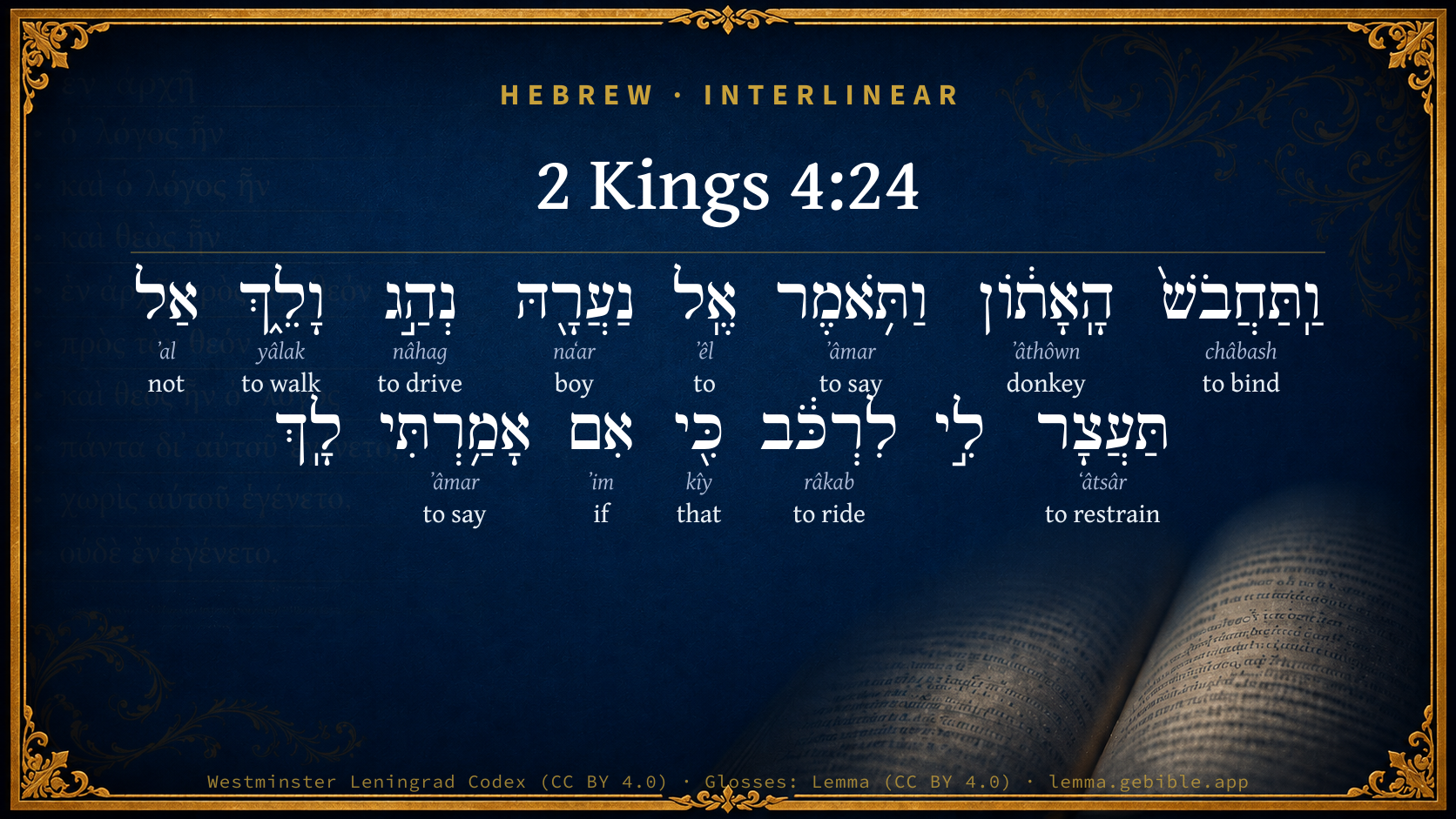
Hebrew (Westminster Leningrad Codex) 2 Kings 4:24 appears in the Hebrew Old Testament. The text above is from the Westminster Leningrad Codex. Each word links to its Strong’s number, a concise gloss, and parsing drawn from the Open Scriptures Hebrew Bible morphology. Click any word for its full Brown-Driver-Briggs (BDB) entry.
Download image
Cite this verse

2 Kings 4:24 (World English Bible). Public Domain. Lemma interlinear Bible study tool, https://lemma.gebible.app/v/2-kings/4/24.

Show BibTeX & RIS
BibTeX
RIS
English Translation
Then she saddled a donkey, and said to her servant, Drive, and go forward; don't slacken me the riding, except I bid you.
World English Bible · Public Domain
Download a study sheet

One document with this verse’s original text, its word-by-word gloss line, the meaning frame, cross-references with their text, attributed commentary, and full source and license credits — printable, and it pastes into notes with its structure intact.

This verse Autodidact and up

Study sheet (.html) Plain text (.txt)

A passage Seminary Student

Up to 50 verses in one chapter. A passage sheet keeps up to 6 commentary sources and 12 cross-references per verse, in the order this page ranks them, and says so on the sheet whenever that leaves anything out. Ask for a single verse and you get the Autodidact verse sheet above.

Everything on this page stays free to read, with no account — the sheet is a download of what is already on screen, not access to it.

Want to remove ads? Support Godless Engineer
Compare translations 3

The same verse in 3 English versions, stacked beneath the original-language interlinear above. Click any original word for its lexicon entry.

Each is an independent rendering of the whole verse — the interlinear is not word-aligned to these translations.

Highlighted words mark where these versions differ — a whole-verse word diff, not a word-by-word alignment.

  • World English Bible Public Domain
    Then she saddled a donkey, and said to her servant, Drive, and go forward; don't slacken me the riding, except I bid you.
  • King James Version Public Domain
    Then she saddled an ass, and said to her servant, Drive, and go forward; slack not thy riding for me, except I bid thee.
  • unfoldingWord Literal Text CC BY-SA 4.0
    And she saddled the donkey, and she said to her servant, “Drive and go! Do not slacken for me to ride unless I say to you.”

unfoldingWord Literal Text — © unfoldingWord, licensed CC BY-SA 4.0. Word-aligned USFM3 via Door43 (git.door43.org/unfoldingWord/en_ult).

Versions to compare (up to 4)

3 of 4 selected

Show all 18 translations

Every available English version of this verse, each an independent rendering of the whole verse.

  • World English Bible Public Domain
    Then she saddled a donkey, and said to her servant, Drive, and go forward; don't slacken me the riding, except I bid you.
  • Berean Standard Bible Public Domain
    Then she saddled the donkey and told her servant, “Drive onward; do not slow the pace for me unless I tell you.”
  • Majority Standard Bible Public Domain
    Then she saddled the donkey and told her servant, “Drive onward; do not slow the pace for me unless I tell you.”
  • King James Version Public Domain
    Then she saddled an ass, and said to her servant, Drive, and go forward; slack not thy riding for me, except I bid thee.
  • American Standard Version (1901) Public Domain
    Then she saddled an ass, and said to her servant, Drive, and go forward; slacken me not the riding, except I bid thee.
  • Revised Version (1885) Public Domain
    Then she saddled an ass, and said to her servant, Drive, and go forward; slacken me not the riding, except I bid thee.
  • Geneva Bible (1599) Public Domain
    Then she sadled an asse, and sayde to her seruant, Driue, and goe forward: staye not for me to get vp, except I bid thee.
  • Douay-Rheims (1899) Public Domain
    And she saddled an ass, and commanded her servant: Drive, and make haste, make no stay in going. And do that which I bid thee.
  • Young's Literal Translation Public Domain
    And she saddleth the ass, and saith unto her young man, `Lead, and go, do not restrain riding for me, except I have said `so' to thee.'
  • Literal Standard Version CC BY-SA 4.0
    And she saddles the donkey and says to her young man, “Lead, and go, do not restrain riding for me, except I have commanded [so] to you.”
  • Unlocked Literal Bible CC BY-SA 4.0
    Then she saddled a donkey and said to her servant, “Drive on quickly; do not slow down for me unless I say so.”
  • unfoldingWord Literal Text CC BY-SA 4.0
    And she saddled the donkey, and she said to her servant, “Drive and go! Do not slacken for me to ride unless I say to you.”
  • Darby Bible Public Domain
    Then she saddled the ass, and said to her servant, Drive and go forward; slack not the riding for me, except I bid thee.
  • World Messianic Bible Public Domain
    Then she saddled a donkey, and said to her servant, “Drive, and go forward! Don’t slow down for me, unless I ask you to.”
  • Webster's Bible Public Domain
    Then she saddled an ass, and said to her servant, Drive, and go forward; slack not thy riding for me, except I bid thee.
  • Free Bible Version CC BY-SA 4.0
    She put the saddle on the donkey and told her servant, “Let's go quickly! Don't slow down for me unless I tell you to!”
  • Bible in Basic English Public Domain
    Then she made the ass ready and said to her servant, Keep driving on; do not make a stop without orders from me.
  • JPS Tanakh (1917) Public Domain
    Then she saddled an ass, and said to her servant: 'Drive, and go forward; slacken me not the riding, except I bid thee.'

Literal Standard Version (2020), Covenant Press — licensed CC BY-SA 4.0. Text via the HelloAO Bible API (eBible.org). Unlocked Literal Bible (unfoldingWord) — licensed CC BY-SA 4.0. Text via the HelloAO Bible API (eBible.org). unfoldingWord Literal Text — © unfoldingWord, licensed CC BY-SA 4.0. Word-aligned USFM3 via Door43 (git.door43.org/unfoldingWord/en_ult). Free Bible Version, Dr. Jonathan Gallagher — licensed CC BY-SA 4.0. Text via the HelloAO Bible API (eBible.org).

Word by word

More ways to search: Search by grammar → Find every occurrence → Compare this word →

Practice this passage: Drill this verse → Learn its vocabulary →

נְהַ֣ג
nâhag
H5090
“drive”
Verb, Qal, Imperative, 2nd Person, Masculine, Singular
Part of Speech
Verb
Stem
Qal
Form
Imperative
Person
2nd Person
Gender
Masculine
Number
Singular
Full BDB Definition

Origin: a primitive root

TWOT: 1309 , 1310

to drive, lead, guide, conduct - (Qal) - to drive, lead on, drive away, drive off - to behave itself (figuratively) (of heart) - (Piel) - to drive away, lead off - to lead on, guide, guide on - to cause to drive - (Piel) to moan, lament
  1. וַֽתַּחֲבֹשׁ֙ châbash H2280 “and · to bind” Conjunction + Verb, Qal, Sequential Imperfect, 3rd Person, Feminine, Singular
  2. הָֽאָת֔וֹן ʼâthôwn H860 “the · donkey” Particle, Definite Article + Noun, Common, Feminine, Singular, Absolute
  3. וַתֹּ֥אמֶר ʼâmar H559 “and · to say” Conjunction + Verb, Qal, Sequential Imperfect, 3rd Person, Feminine, Singular
  4. אֶֽל ʼêl H413 “to” Preposition
  5. נַעֲרָ֖הּ naʻar H5288 “boy · her” Noun, Common, Masculine, Singular, Construct + Suffix, Personal, 3rd Person, Feminine, Singular
  6. וָלֵ֑ךְ yâlak H3212 “and · walk” Conjunction + Verb, Qal, Imperative, 2nd Person, Masculine, Singular
  7. אַל ʼal H408 “not” Particle, Negative
  8. תַּעֲצָר ʻâtsâr H6113 “to restrain” Verb, Qal, Jussive, 2nd Person, Masculine, Singular
  9. לִרְכֹּ֔ב râkab H7392 “to ride” Preposition + Verb, Qal, Infinitive Construct
  10. כִּ֖י kîy H3588 “that” Conjunction
  11. אִם ʼim H518 “if” Conjunction
  12. אָמַ֥רְתִּי ʼâmar H559 “to say” Verb, Qal, Perfect, 1st Person, Common, Singular

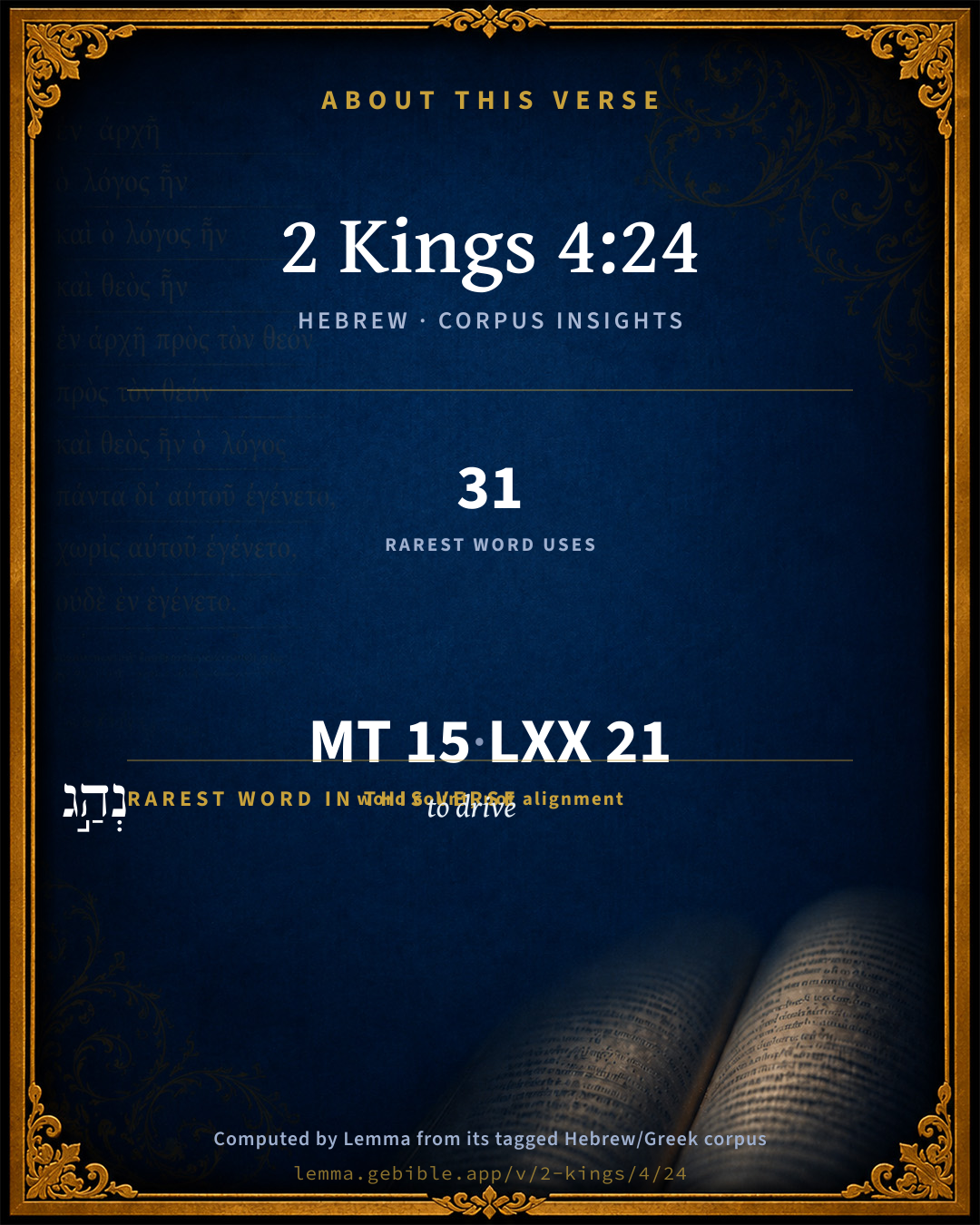
About this verse

These counts appear in no published source. They are computed here, from the morphology-tagged text and Lemma’s own curated glosses. What Lemma adds →

15
words
12
distinct lemmas
Historical
section

Shared distinctive vocabulary

נְהַ֣ג to drive H5090 occurs in 31 verses of the Hebrew Bible. Also found in:

Grammatical profile

  • 7 verbs
  • 2 nouns
  • 3 prepositions
  • 2 conjunctions
  • 1 particle

Verb forms

  • וַֽתַּחֲבֹשׁ֙ Qal · Sequential Imperfect
  • וַתֹּ֥אמֶר Qal · Sequential Imperfect
  • נְהַ֣ג Qal · Imperative
  • וָלֵ֑ךְ Qal · Imperative
  • תַּעֲצָר Qal · Jussive
  • לִרְכֹּ֔ב Qal · Infinitive Construct
  • אָמַ֥רְתִּי Qal · Perfect

Repetition

A word recurs within this verse — often emphatic in Hebrew:

  • וַתֹּ֥אמֶר to say H559 ×2

Hebrew & Septuagint length

In English translation the verse runs 23 words from the Hebrew and 40 from the Septuagint (LXX English) — the Septuagint runs noticeably longer here. See the side-by-side →

A rough comparison of the two English renderings, which tokenize alike — not a word-level alignment.

Word counts can differ between the Hebrew and the Greek without any difference in meaning — e.g. the Hebrew direct-object marker אֵת has no separate Greek word, and Greek often adds the article ὁ.

In the original languages it is 15 Hebrew tokens and 21 Greek tokens — but the two are counted differently (Hebrew bundles its prefixes and suffixes into one token; the Greek is in lemma form), so that isn’t a like-for-like length.

Cross-references

4

Topical passages linked to 2 Kings 4:24 in the Treasury of Scripture Knowledge — connected by theme and wording, ordered by reader-vote popularity; previews shown in the World English Bible.

  • Exodus 4:20 Moses took his wife and his sons, and set them on a donkey, and he returned to the land of Egypt. Moses took God's rod in his hand.
  • 1 Samuel 25:19–20 She said to her young men, Go on before me; behold, I come after you. But she didn't tell her husband, Nabal.
  • 1 Kings 13:13 He said to his sons, Saddle me the donkey. So they saddled him the donkey; and he rode thereon.
  • 1 Kings 13:23 It happened, after he had eaten bread, and after he had drunk, that he saddled for him the donkey, [to wit], for the prophet whom he had brought back.

Cross-references courtesy of OpenBible.info (CC BY 4.0).

Hebrew and Greek witnesses Masoretic Hebrew ↔ Greek Septuagint

The same verse in the two great witnesses to the Old Testament, shown verse-for-verse.

Here the Septuagint runs noticeably longer than the Hebrew — LXX2012 (modern English Septuagint) 40 words vs World English Bible 23. A rough length comparison of the two English translations, not a word-level alignment — read both below.

These are two independent witnesses, not word-aligned to each other, and the Septuagint is shown in lemma (dictionary) form.

Hebrew 2 Kings 4:24 Masoretic · Westminster Leningrad Codex

וַֽתַּחֲבֹשׁ֙ הָֽאָת֔וֹן וַתֹּ֥אמֶר אֶֽל נַעֲרָ֖הּ נְהַ֣ג וָלֵ֑ךְ אַל תַּעֲצָר לִ֣י לִרְכֹּ֔ב כִּ֖י אִם אָמַ֥רְתִּי לָֽךְ

Then she saddled a donkey, and said to her servant, Drive, and go forward; don't slacken me the riding, except I bid you.

World English Bible · Public Domain

Greek LXX 2 Kings 4:24 Septuagint · lemma form

καί ἐπισάττω ὁ ὄνος καί εἶπον πρός ὁ παιδάριον αὐτός ἄγω πορεύομαι μή ἐπιἔχω ἐγώ ὁ ἐπιβαίνω ὅτι ἐάν εἶπον σύ

And she saddled the ass, and said to her servant, Be quick, proceed: spare not on my account to ride, unless I shall tell you. Go, and you shall proceed, and come to the man of God to mount Carmel.

LXX2012 (modern English Septuagint) · Public Domain

Hebrew: Westminster Leningrad Codex (CC BY 4.0). Greek: Septuagint (public domain); English from LXX2012 (modern English Septuagint) (Public Domain). How the Septuagint differs from the Hebrew →

Targum (Aramaic paraphrase)

1

The Targum is the ancient Jewish Aramaic paraphrase of the Hebrew Scriptures — an interpretive translation, not the Hebrew text itself. Onkelos (literal) and Pseudo-Jonathan (expansive) render the Torah, and Jonathan the Prophets. Coverage is partial: where no permissively-licensed English translation exists for a verse, only the Aramaic is shown. This is verse-level text, not a word-by-word alignment to the Hebrew.

  1. Targum Jonathan Prophets (Joshua–Malachi)
    וְזָרֵיזַת אֲתָנָא וַאֲמַרַת לְעוּלֵמָהָא דְבַר וֶאֱזֵיל לָא תִדְחוֹק עֲלַי לְמִרְכַּב אֱלָהֵין כַּד אֵמַר לָךְ:

    (no public-domain English translation for this verse)

    Targum Jonathan — Aramaic: “Mikraot Gedolot” (public domain). English: “Sefaria Community Translation” (CC0 1.0 (public-domain dedication)); “London "Chaldee Paraphrase," 1871” (public domain). Text via Sefaria.

Commentary

Notes on 2 Kings 4:24 from classic Christian and Jewish commentators (each source and its license shown beneath its notes). The classic Christian expositions comment on the surrounding passage and are grouped to its opening verse, so a note may address several verses; the Jewish commentaries on the Tanakh (Rashi and others) are per-verse, so they appear only where the commentator wrote on this verse.

Lemma curates 59 commentaries, every one of them public domain or Creative Commons licensed, each selected and text-cleaned for this edition rather than reprinted as found. About our sources →

Trapp's Complete Commentary

John Trapp

2Ki 4:24 Then she saddled an ass, and said to her servant, Drive, and go forward; slack not [thy] riding for me, except I bid thee.

Ver. 24. Drive, and go forward.] Put on as fast as thou canst. Dolor addidit alas; grief rideth without reins, where there is but any hope of help.

John Trapp, A Commentary or Exposition upon All the Books of the Old and New Testament (1647–1656) — public domain. Text from a community e-Sword module.

Tyndale Open Study Notes

Tyndale Open Resources

4:24-26 Mount Carmel lay about twenty miles northwest of Shunem. The length of the trip and the woman’s obvious haste aroused Elisha’s suspicion that some tragedy concerning the child had occurred. • “everything is fine”: The woman brushed off Gehazi’s inquiries; she was resolved to deal with no one but Elisha.

Tyndale Open Study Notes — © Tyndale Open Resources, licensed CC BY-SA 4.0. Text via the HelloAO Bible API.

Jamieson, Fausset & Brown

Robert Jamieson, A. R. Fausset & David Brown

Drive, and go forward--It is usual for women to ride on asses, accompanied by a servant, who walks behind and drives the beast with his stick, goading the animal at the speed required by his mistress. The Shunammite had to ride a journey of five or six hours to the top of Carmel.

Jamieson, Fausset & Brown — Commentary Critical and Explanatory on the Whole Bible (1871) — public domain (CC PDM 1.0). Text via the HelloAO Bible API.

Adam Clarke's Commentary

Verse 24. Drive, and go forward] It is customary in the East for a servant to walk along side or drive the ass his master rides. Sometimes he walks behind, and goads on the beast; and when it is to turn, he directs its head with the long pole of the goad. It is probably to this custom that the wise man alludes when he says, "I have seen servants on horses, and princes walking as servants on the earth," on the ground.

Adam Clarke's Commentary on the Bible (1810–1826) — public domain. Text from a community e-Sword/MySword module.

Ellicott's Commentary for English Readers

(24) Then she saddled an ass.—And she saddled the ass—i.e., which the young man brought, and probably saddled at her bidding.

Slack not thy riding for me.—Literally, restrain me not from riding—i.e., do not stop, or slacken speed. A halt for rest might naturally be taken, as the distance was considerable.

A Bible Commentary for English Readers, edited by Charles John Ellicott (1878–1897) — public domain. Text from a community e-Sword module.

The Cambridge Bible for Schools and Colleges

gen. ed. J. J. S. Perowne

24. slack not thy riding for me] R.V. slacken me not the riding. The R.V. thus avoids the pronominal adjective, which has no equivalent in the Hebrew. The servant seems to have been one to run by the side of the rider as a driver, and as a protection, to be ready also in case of mishap. Such runners were not uncommon in the East, being especially used by dignified persons. So Adonijah (1Ki_1:5) and Absalom before him (2Sa_15:1) provided themselves with attendants of this sort, when they were aspiring to be kings. The rendering of A.V. would suggest that the servant was riding, but the Hebrew does not warrant this, and for women to travel thus riding behind a manservant on the same beast is not like Eastern custom.

The Cambridge Bible for Schools and Colleges (gen. ed. J. J. S. Perowne; Cambridge University Press, 1878–1918) — public domain. Text from a community e-Sword module.

John Gill's Exposition

Then she saddled an ass,.... Her servant did it by her order:

and said to her servant, drive, and go forward; make all the haste he could:

slack not thy riding for me, except I bid thee; do not be afraid of riding too fast for me; if thou dost, I will tell thee; till then, keep on a good pace: Abarbinel says she walked afoot all the way, and ordered the man not to slacken his pace in riding for her, unless she called to him; and the Targum seems to favour this sense,"do not press me to ride unless I call to thee;''so that the ass was for Elijah to ride on; but one would think, that, as she was in haste, quicker dispatch would be made by her riding than by walking, see Kg2 4:22.

John Gill's Exposition of the Whole Bible (1746–1763) — public domain (CC PDM 1.0). Text via the HelloAO Bible API.

Albert Barnes' Notes on the Bible

Slack not thy riding - Translate, “delay me not in my riding, except I bid thee.” The servant went on foot with the donkey to urge it forward, as is the ordinary custom in the East.

Albert Barnes' Notes on the Bible (1834–1885) — public domain. Text from a community e-Sword/MySword module.

Haydock's Catholic Bible Commentary

And do. Hebrew, "unless I bid thee." Some translate, "urge me not to get up, unless," &c. (Chaldean; Arabic, &c.) They suppose that she went on foot, and that the ass was designed for Eliseus. (Vatable)

George Leo Haydock (1774–1849), Haydock's Catholic Family Bible and Commentary, 1859 edition — public domain. Excludes Psalms (Douay-Rheims chapter numbering differs from Protestant) and Deuterocanonical books (Catholic canon only).

The Pulpit Commentary

Then she saddled an ass; rather, then she saddled (i.e. "caused to be saddled") the ass the particular animal which her husband had placed at her disposal. And said to her servant, Drive, and go forward ; i.e. "set the ass in motion, and then proceed steadily forward." In the East, each donkey has its driver, who sots it in motion, and regulates its pace. The rider leaves all to him. Slack not thy riding for me rather, slacken me not the riding (Revised Version), or, slacken not my riding; i.e. "do not lessen the pace of my ridingexcept I bid thee.

The Pulpit Commentary (1880–1919), ed. H.D.M. Spence-Jones & Joseph S. Exell — public domain. Text from a community e-Sword module.

Rashi

Rabbi Shlomo Yitzchaki (Rashi)

“Drive and go on.” [I.e.,] hurry.

Do not hold back from riding because of me. Do not hold back the riding [pace] because of me.

Rashi on the Tanakh — English translations: “The Judaica Press complete Tanach with Rashi, translated by A. J. Rosenberg” (CC BY 4.0); “Pentateuch with Rashi's commentary by M. Rosenbaum and A.M. Silbermann, 1929-1934” (public domain); “The Metsudah Tanach series, Lakewood, N.J” (CC BY 4.0); and “The Book of Joshua, Metsudah Publications, 1997” (CC BY 4.0). Text via Sefaria.

Lesson kit

Teaching starters — assembled from the data on this page, not authored interpretation. Every prompt links to the verse data it draws on. Edit before teaching.

2 Kings, in the Historical, opens this verse with 15 words (12 distinct Hebrew lemmas). Its most distinctive word is nâhag (“to drive”). The Greek Septuagint runs longer here. A historical commentator’s framing appears above. Read the whole chapter for the surrounding context.

Discussion questions

  1. What does “to drive” (nâhag) contribute to the verse as a whole?
  2. Genesis 31:18 shares the word «to drive» with this verse. How do the two illuminate each other?
  3. “to say” occurs 2× in this one verse. What is the effect of the repetition?
  4. Compared with the Hebrew, the Septuagint runs longer here. What questions does that raise?
  5. These translations render this verse differently; the difference is in the English rendering, not the original. What questions does that raise?
  6. The verb «וַֽתַּחֲבֹשׁ֙» is Qal Sequential Imperfect. How does its form color the action?
  7. Reading how Trapp's Complete Commentary and Tyndale Open Study Notes read this verse, where do the two commentators agree and where do they part?

Things to notice

Reading settings

Reading text

Shown beneath each verse's original-language words.

Old Testament
Old Testament edition

Read the OT as the Masoretic Hebrew (MT) or the Greek Septuagint (LXX).

English shown for the Greek Septuagint (in the Hebrew ↔ Greek comparison).

Comparing translations? Open the Compare panel on any verse page to stack up to four side by side.