
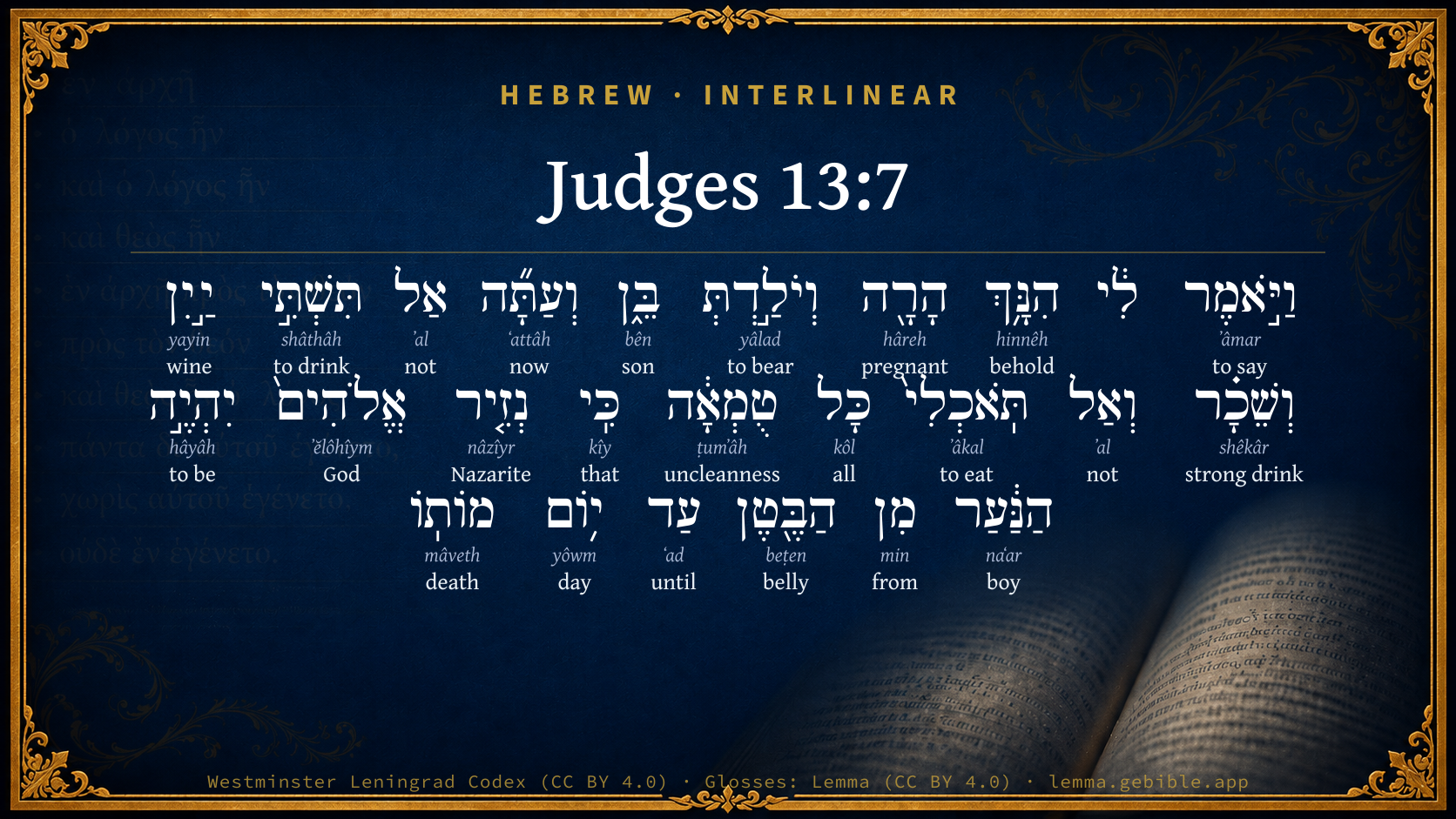
Judges 13:7

Hebrew (Westminster Leningrad Codex) Judges 13:7 appears in the Hebrew Old Testament. The text above is from the Westminster Leningrad Codex. Each word links to its Strong’s number, a concise gloss, and parsing drawn from the Open Scriptures Hebrew Bible morphology. Click any word for its full Brown-Driver-Briggs (BDB) entry.
Download image
Cite this verse

Judges 13:7 (World English Bible). Public Domain. Lemma interlinear Bible study tool, https://lemma.gebible.app/v/judges/13/7.

Show BibTeX & RIS
BibTeX
RIS
English Translation
but he said to me, Behold, you shall conceive, and bear a son; and now drink no wine nor strong drink, and eat not any unclean thing; for the child shall be a Nazirite to God from the womb to the day of his death.
World English Bible · Public Domain
Download a study sheet

One document with this verse’s original text, its word-by-word gloss line, the meaning frame, cross-references with their text, attributed commentary, and full source and license credits — printable, and it pastes into notes with its structure intact.

This verse Autodidact and up

Study sheet (.html) Plain text (.txt)

A passage Seminary Student

Up to 50 verses in one chapter. A passage sheet keeps up to 6 commentary sources and 12 cross-references per verse, in the order this page ranks them, and says so on the sheet whenever that leaves anything out. Ask for a single verse and you get the Autodidact verse sheet above.

Everything on this page stays free to read, with no account — the sheet is a download of what is already on screen, not access to it.

Want to remove ads? Support Godless Engineer
Compare translations 3

The same verse in 3 English versions, stacked beneath the original-language interlinear above. Click any original word for its lexicon entry.

Each is an independent rendering of the whole verse — the interlinear is not word-aligned to these translations.

Highlighted words mark where these versions differ — a whole-verse word diff, not a word-by-word alignment.

  • World English Bible Public Domain
    but he said to me, Behold, you shall conceive, and bear a son; and now drink no wine nor strong drink, and eat not any unclean thing; for the child shall be a Nazirite to God from the womb to the day of his death.
  • King James Version Public Domain
    But he said unto me, Behold, thou shalt conceive, and bear a son; and now drink no wine nor strong drink, neither eat any unclean thing: for the child shall be a Nazarite to God from the womb to the day of his death.
  • unfoldingWord Literal Text CC BY-SA 4.0
    And he said to me, ‘Behold, you will conceive and bear a son. And now, do not drink wine or beer, and do not eat any unclean, for the boy will be a Nazirite of God from the womb until the day of his death.’”

unfoldingWord Literal Text — © unfoldingWord, licensed CC BY-SA 4.0. Word-aligned USFM3 via Door43 (git.door43.org/unfoldingWord/en_ult).

Versions to compare (up to 4)

3 of 4 selected

Show all 18 translations

Every available English version of this verse, each an independent rendering of the whole verse.

  • World English Bible Public Domain
    but he said to me, Behold, you shall conceive, and bear a son; and now drink no wine nor strong drink, and eat not any unclean thing; for the child shall be a Nazirite to God from the womb to the day of his death.
  • Berean Standard Bible Public Domain
    But he said to me, ‘Behold, you will conceive and give birth to a son. Now, therefore, do not drink wine or strong drink, and do not eat anything unclean, because the boy will be a Nazirite to God from the womb until the day of his death.’”
  • Majority Standard Bible Public Domain
    But he said to me, ‘Behold, you will conceive and give birth to a son. Now, therefore, do not drink wine or strong drink, and do not eat anything unclean, because the boy will be a Nazirite to God from the womb until the day of his death.’”
  • King James Version Public Domain
    But he said unto me, Behold, thou shalt conceive, and bear a son; and now drink no wine nor strong drink, neither eat any unclean thing: for the child shall be a Nazarite to God from the womb to the day of his death.
  • American Standard Version (1901) Public Domain
    but he said unto me, Behold, thou shalt conceive, and bear a son; and now drink no wine nor strong drink, and eat not any unclean thing; for the child shall be a Nazirite unto God from the womb to the day of his death.
  • Revised Version (1885) Public Domain
    but he said unto me, Behold, thou shalt conceive, and bear a son; and now drink no wine nor strong drink, and eat not any unclean thing: for the child shall be a Nazirite unto God from the womb to the day of his death.
  • Geneva Bible (1599) Public Domain
    But he saide vnto me, Beholde, thou shalt conceiue, and beare a sonne, and nowe thou shalt drinke no wine, nor strong drinke, neither eate any vncleane thing: for the childe shalbe a Nazarite to God from his birth to the day of his death.
  • Douay-Rheims (1899) Public Domain
    But he answered thus: Behold thou shalt conceive and bear a son: beware thou drink no wine, nor strong drink, nor eat any unclean thing: for the child shall be a Nazarite of God from his infancy, from his mother's womb until the day of his death.
  • Young's Literal Translation Public Domain
    and he saith to me, Lo, thou art pregnant, and bearing a son, and now do not drink wine and strong drink, and do not eat any unclean thing, for a Nazarite to God is the youth from the womb till the day of his death.'
  • Literal Standard Version CC BY-SA 4.0
    and He says to me, Behold, you are pregnant, and bearing a son, and now do not drink wine and strong drink, and do not eat any unclean thing, for the youth is a Nazarite to God from the womb until the day of his death.”
  • Unlocked Literal Bible CC BY-SA 4.0
    He said to me, 'Look! You will become pregnant, and you will give birth to a son. So then drink no wine or strong drink, and do not eat any food that the law declares to be unclean, because the child will be a Nazirite to God from the time he is in your womb until the day of his death.'”
  • unfoldingWord Literal Text CC BY-SA 4.0
    And he said to me, ‘Behold, you will conceive and bear a son. And now, do not drink wine or beer, and do not eat any unclean, for the boy will be a Nazirite of God from the womb until the day of his death.’”
  • Darby Bible Public Domain
    but he said to me, 'Behold, you shall conceive and bear a son; so then drink no wine or strong drink, and eat nothing unclean, for the boy shall be a Nazirite to God from birth to the day of his death.'"
  • World Messianic Bible Public Domain
    but he said to me, ‘Behold, you shall conceive and bear a son; and now drink no wine nor strong drink. Don’t eat any unclean thing, for the child shall be a Nazirite to God from the womb to the day of his death.’”
  • Webster's Bible Public Domain
    But he said to me, Behold, thou shalt conceive, and bear a son; and now drink no wine nor strong drink, neither eat any unclean thing: for the child shall be a Nazarite to God from his birth to the day of his death.
  • Free Bible Version CC BY-SA 4.0
    But he told me, ‘You're going to become pregnant and give birth to a son. You must not drink wine or any other alcoholic drink, and don't eat anything unclean. For the boy is to be a Nazirite, dedicated to God from birth until the day of his death.’”
  • Bible in Basic English Public Domain
    But he said to me, You are with child and will give birth to a son; and now do not take any wine or strong drink or let anything unclean be your food; for the child will be separate to God from his birth to the day of his death.
  • JPS Tanakh (1917) Public Domain
    but he said unto me: Behold, thou shalt conceive, and bear a son; and now drink no wine nor strong drink, and eat not any unclean thing; for the child shall be a Nazirite unto God from the womb to the day of his death.'

Literal Standard Version (2020), Covenant Press — licensed CC BY-SA 4.0. Text via the HelloAO Bible API (eBible.org). Unlocked Literal Bible (unfoldingWord) — licensed CC BY-SA 4.0. Text via the HelloAO Bible API (eBible.org). unfoldingWord Literal Text — © unfoldingWord, licensed CC BY-SA 4.0. Word-aligned USFM3 via Door43 (git.door43.org/unfoldingWord/en_ult). Free Bible Version, Dr. Jonathan Gallagher — licensed CC BY-SA 4.0. Text via the HelloAO Bible API (eBible.org).

Word by word

More ways to search: Search by grammar → Find every occurrence → Compare this word →

Practice this passage: Drill this verse → Learn its vocabulary →

הָרָ֖ה
hâreh
H2030
“pregnant”
Adjective, Adjective, Feminine, Singular, Absolute
Part of Speech
Adjective
Type
Adjective
Gender
Feminine
Number
Singular
State
Absolute
Full BDB Definition

Origin: from H2029

TWOT: 515a

pregnant
  1. וַיֹּ֣אמֶר ʼâmar H559 “and · to say” Conjunction + Verb, Qal, Sequential Imperfect, 3rd Person, Masculine, Singular
  2. הִנָּ֥ךְ hinnêh H2009 “behold · you” Particle, Demonstrative + Suffix, Personal, 2nd Person, Feminine, Singular
  3. וְיֹלַ֣דְתְּ yâlad H3205 “and · to bear” Conjunction + Verb, Qal, Sequential Perfect, 2nd Person, Feminine, Singular
  4. בֵּ֑ן bên H1121 “son” Noun, Common, Masculine, Singular, Absolute
  5. וְעַתָּ֞ה ʻattâh H6258 “and · now” Conjunction + Adverb
  6. אַל ʼal H408 “not” Particle, Negative
  7. תִּשְׁתִּ֣י shâthâh H8354 “to drink” Verb, Qal, Jussive, 2nd Person, Feminine, Singular
  8. יַ֣יִן yayin H3196 “wine” Noun, Common, Masculine, Singular, Absolute
  9. וְשֵׁכָ֗ר shêkâr H7941 “and · strong drink” Conjunction + Noun, Common, Masculine, Singular, Absolute
  10. וְאַל ʼal H408 “and · not” Conjunction + Particle, Negative
  11. תֹּֽאכְלִי֙ ʼâkal H398 “to eat” Verb, Qal, Jussive, 2nd Person, Feminine, Singular
  12. כָּל kôl H3605 “all of” Noun, Common, Masculine, Singular, Construct
  13. טֻמְאָ֔ה ṭumʼâh H2932 “uncleanness” Noun, Common, Feminine, Singular, Absolute
  14. כִּֽי kîy H3588 “that” Conjunction
  15. נְזִ֤יר nâzîyr H5139 “Nazarite of” Noun, Common, Masculine, Singular, Construct
  16. אֱלֹהִים֙ ʼĕlôhîym H430 “God(s)” Noun, Common, Masculine, Plural, Absolute
  17. יִהְיֶ֣ה hâyâh H1961 “to be” Verb, Qal, Imperfect, 3rd Person, Masculine, Singular
  18. הַנַּ֔עַר naʻar H5288 “the · boy” Particle, Definite Article + Noun, Common, Masculine, Singular, Absolute
  19. מִן min H4480 “from” Preposition
  20. הַבֶּ֖טֶן beṭen H990 “the · belly” Particle, Definite Article + Noun, Common, Feminine, Singular, Absolute
  21. עַד ʻad H5704 “until” Preposition
  22. י֥וֹם yôwm H3117 “day of” Noun, Common, Masculine, Singular, Construct
  23. מוֹתֽוֹ mâveth H4194 “death · his” Noun, Common, Masculine, Singular, Construct + Suffix, Personal, 3rd Person, Masculine, Singular

About this verse

These counts appear in no published source. They are computed here, from the morphology-tagged text and Lemma’s own curated glosses. What Lemma adds →

25
words
23
distinct lemmas
Historical
section

Notable vocabulary

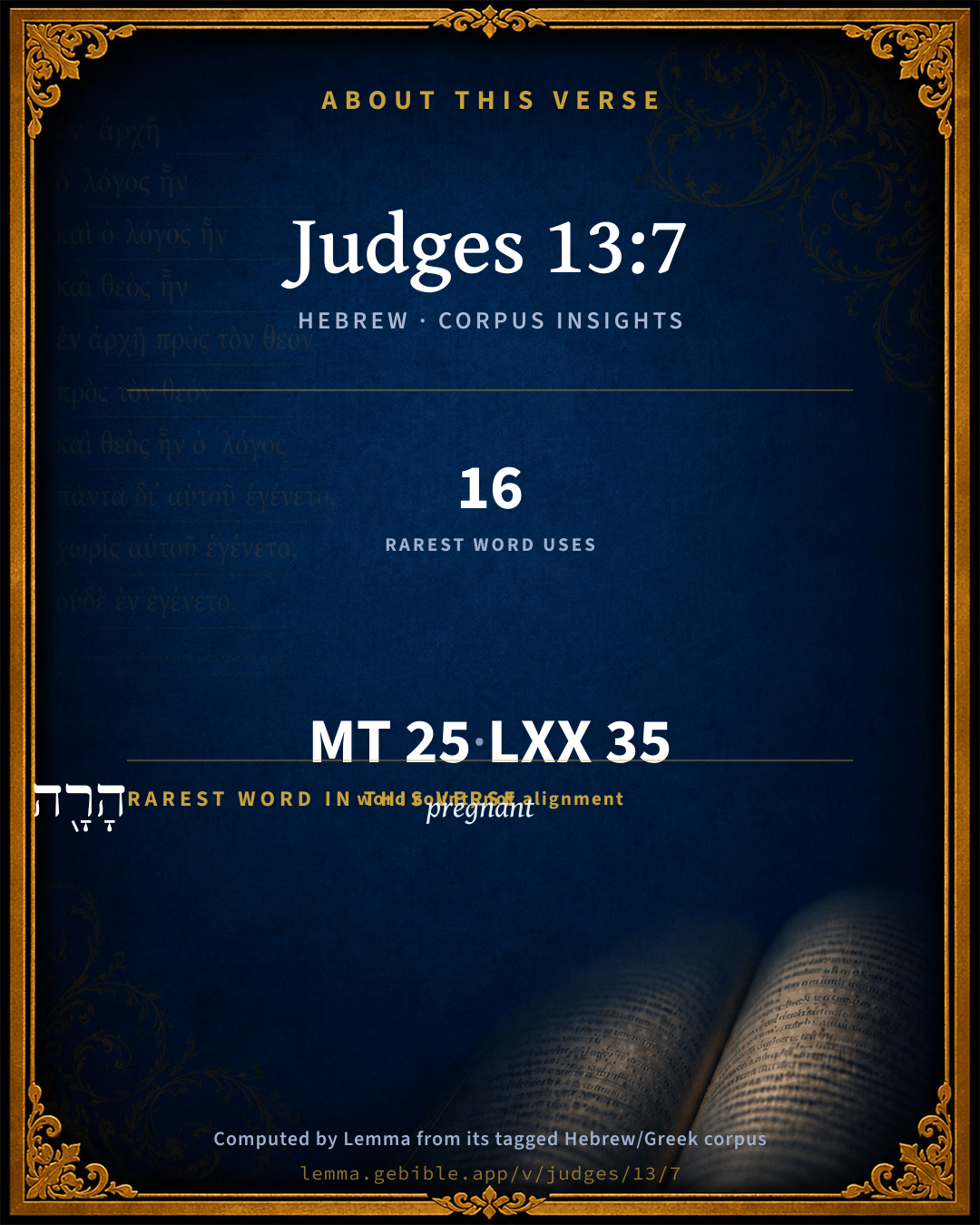
The rarest word here is הָרָ֖ה pregnant H2030 — appearing just 16 times in the whole Hebrew Bible.

Shared distinctive vocabulary

הָרָ֖ה pregnant H2030 occurs in 16 verses of the Hebrew Bible. Also found in:

Grammatical profile

  • 5 verbs
  • 11 nouns
  • 1 adjective
  • 3 prepositions
  • 1 conjunction
  • 1 adverb
  • 3 particles

Verb forms

  • וַיֹּ֣אמֶר Qal · Sequential Imperfect
  • וְיֹלַ֣דְתְּ Qal · Sequential Perfect
  • תִּשְׁתִּ֣י Qal · Jussive
  • תֹּֽאכְלִי֙ Qal · Jussive
  • יִהְיֶ֣ה Qal · Imperfect

Repetition

A word recurs within this verse — often emphatic in Hebrew:

  • אַל not H408 ×2

Hebrew & Septuagint length

In English translation the verse runs 45 words from the Hebrew and 46 from the Septuagint (LXX English) — closely comparable.

A rough comparison of the two English renderings, which tokenize alike — not a word-level alignment.

Word counts can differ between the Hebrew and the Greek without any difference in meaning — e.g. the Hebrew direct-object marker אֵת has no separate Greek word, and Greek often adds the article ὁ.

In the original languages it is 25 Hebrew tokens and 35 Greek tokens — but the two are counted differently (Hebrew bundles its prefixes and suffixes into one token; the Greek is in lemma form), so that isn’t a like-for-like length.

Cross-references

1

Topical passages linked to Judges 13:7 in the Treasury of Scripture Knowledge — connected by theme and wording, ordered by reader-vote popularity; previews shown in the World English Bible.

  • Judges 13:4 Now therefore please beware and drink no wine nor strong drink, and don't eat any unclean thing:

Cross-references courtesy of OpenBible.info (CC BY 4.0).

Hebrew and Greek witnesses Masoretic Hebrew ↔ Greek Septuagint

The same verse in the two great witnesses to the Old Testament, shown verse-for-verse.

These are two independent witnesses, not word-aligned to each other, and the Septuagint is shown in lemma (dictionary) form.

Hebrew Judges 13:7 Masoretic · Westminster Leningrad Codex

וַיֹּ֣אמֶר לִ֔י הִנָּ֥ךְ הָרָ֖ה וְיֹלַ֣דְתְּ בֵּ֑ן וְעַתָּ֞ה אַל תִּשְׁתִּ֣י יַ֣יִן וְשֵׁכָ֗ר וְאַל תֹּֽאכְלִי֙ כָּל טֻמְאָ֔ה כִּֽי נְזִ֤יר אֱלֹהִים֙ יִהְיֶ֣ה הַנַּ֔עַר מִן הַבֶּ֖טֶן עַד י֥וֹם מוֹתֽוֹ

but he said to me, Behold, you shall conceive, and bear a son; and now drink no wine nor strong drink, and eat not any unclean thing; for the child shall be a Nazirite to God from the womb to the day of his death.

World English Bible · Public Domain

Greek LXX Judges 13:7 Septuagint · lemma form

καί εἶπον ἐγώ ἰδού σύ ἐν γαστήρ ἔχω καί τίκτω υἱός καί νῦν μή πίνω οἶνος καί μέθυσμα καί μή ἐσθίω πᾶς ἀκάθαρτος ὅτι ἅγιος θεός εἰμί ὁ παιδάριον ἀπό γαστήρ ἕως ἡμέρα θάνατος αὐτός

And he said to me, Behold, you are with child, and shall bring forth a son; and now drink no wine nor strong drink, and eat no unclean thing; for the child shall be holy to God from the womb until the day of his death.

LXX2012 (modern English Septuagint) · Public Domain

Hebrew: Westminster Leningrad Codex (CC BY 4.0). Greek: Septuagint (public domain); English from LXX2012 (modern English Septuagint) (Public Domain). How the Septuagint differs from the Hebrew →

Targum (Aramaic paraphrase)

1

The Targum is the ancient Jewish Aramaic paraphrase of the Hebrew Scriptures — an interpretive translation, not the Hebrew text itself. Onkelos (literal) and Pseudo-Jonathan (expansive) render the Torah, and Jonathan the Prophets. Coverage is partial: where no permissively-licensed English translation exists for a verse, only the Aramaic is shown. This is verse-level text, not a word-by-word alignment to the Hebrew.

  1. Targum Jonathan Prophets (Joshua–Malachi)
    וַאֲמַר לִי הָא אַתְּ מְעַדְיָא וּתְלִידִין בַּר וּכְעַן לָא תִשְׁתִּין חֲמַר חֲדַת וְעַתִּיק וְלָא תֵיכְלִין כָּל מְסָאָב אֲרֵי נְזִירָא דַיְיָ יְהֵי רַבְיָא מִן בִּטְנָא עַד יוֹם מוֹתֵיהּ:

    (no public-domain English translation for this verse)

    Targum Jonathan — Aramaic: “Mikraot Gedolot” (public domain). English: “Sefaria Community Translation” (CC0 1.0 (public-domain dedication)); “London "Chaldee Paraphrase," 1871” (public domain). Text via Sefaria.

Commentary

Notes on Judges 13:7 from classic Christian and Jewish commentators (each source and its license shown beneath its notes). The classic Christian expositions comment on the surrounding passage and are grouped to its opening verse, so a note may address several verses; the Jewish commentaries on the Tanakh (Rashi and others) are per-verse, so they appear only where the commentator wrote on this verse.

Lemma curates 59 commentaries, every one of them public domain or Creative Commons licensed, each selected and text-cleaned for this edition rather than reprinted as found. About our sources →

Trapp's Complete Commentary

John Trapp

Jdg 13:7 But he said unto me, Behold, thou shalt conceive, and bear a son; and now drink no wine nor strong drink, neither eat any unclean [thing]: for the child shall be a Nazarite to God from the womb to the day of his death.

Ver. 7. Behold, thou shalt conceive.] Had her husband been jealous, as Josephus wrongfully reporteth him, she would hardly have told him this story. But had not she been barren, the angel had not now been sent to her. Afflictions to the saints are advantageous.

From the womb to the day of his death.] By God’s special designation and command. So was John Baptist. This was not ordinary.

John Trapp, A Commentary or Exposition upon All the Books of the Old and New Testament (1647–1656) — public domain. Text from a community e-Sword module.

Ellicott's Commentary for English Readers

(7) The child shall be a Nazarite.—Comp. Luk_1:15. Since Samuel was also a Nazarite, we see that the distress of the people had led mothers to meditate on the old law of life-dedication to God. In Samson’s case this vow was imposed on him from his birth, perhaps to teach the Israelites a moral lesson. Other Nazarites were John the Baptist and James, the Lord’s brother. It is not impossible that Joseph was a Nazarite, for in Gen_49:26 this word is used, though in the English Version it is rendered “separated” from his brethren. The order was highly valued in later days (Lam_4:7; Amo_2:11).

A Bible Commentary for English Readers, edited by Charles John Ellicott (1878–1897) — public domain. Text from a community e-Sword module.

John Gill's Exposition

But he said unto me, behold, thou shalt conceive and bear a son,.... She says nothing of her barrenness, which the angel took notice of to her, that having been to her reproach:

and now drink no wine nor strong drink; neither new wine nor old wine; so the Targum as before:

neither eat any unclean thing; which was so in a ceremonial sense; otherwise every creature of God is good, and not to be called common or unclean; it here respects what was forbidden Nazarites to eat; see Jdg 13:4.

for the child shall be a Nazarite to God from the womb; it is here added, what is not before expressed:

unto his death; for he was to be a perpetual Nazarite; some were only Nazarites for a time, for so many days or months, according to their vow; but this son was to be a Nazarite all his days, by the appointment of God; nor is it any objection to what is here said, that his hair was cut off before his death, which caused his Nazariteship to cease; since these words are not a prophecy, but a precept; and besides, that affair happened but a little before his death, he died quickly afterwards.

John Gill's Exposition of the Whole Bible (1746–1763) — public domain (CC PDM 1.0). Text via the HelloAO Bible API.

Rashi

Rabbi Shlomo Yitzchaki (Rashi)

Do not consume anything ritually defiled. Anything prohibited to the Nazirite.

Rashi on the Tanakh — English translations: “The Judaica Press complete Tanach with Rashi, translated by A. J. Rosenberg” (CC BY 4.0); “Pentateuch with Rashi's commentary by M. Rosenbaum and A.M. Silbermann, 1929-1934” (public domain); “The Metsudah Tanach series, Lakewood, N.J” (CC BY 4.0); and “The Book of Joshua, Metsudah Publications, 1997” (CC BY 4.0). Text via Sefaria.

Lesson kit

Teaching starters — assembled from the data on this page, not authored interpretation. Every prompt links to the verse data it draws on. Edit before teaching.

Judges, in the Historical, opens this verse with 25 words (23 distinct Hebrew lemmas). Its most distinctive word is hâreh (“pregnant”). A historical commentator’s framing appears above. Read the whole chapter for the surrounding context.

Discussion questions

  1. What does “pregnant” (hâreh) contribute to the verse as a whole?
  2. How does Genesis 16:11, which shares the word «pregnant», read alongside this verse?
  3. What does the repetition of “not” (2× in this one verse) do in this verse?
  4. These translations render this verse differently; the difference is in the English rendering, not the original. What questions does that raise?
  5. «וַיֹּ֣אמֶר» is a Qal Sequential Imperfect verb. How does that grammatical form shape the action described?
  6. Compare how Trapp's Complete Commentary and Ellicott's Commentary for English Readers read this verse. Where do they agree or differ?

Things to notice

Reading settings

Reading text

Shown beneath each verse's original-language words.

Old Testament
Old Testament edition

Read the OT as the Masoretic Hebrew (MT) or the Greek Septuagint (LXX).

English shown for the Greek Septuagint (in the Hebrew ↔ Greek comparison).

Comparing translations? Open the Compare panel on any verse page to stack up to four side by side.