
Deuteronomy 31:6

Hebrew (Westminster Leningrad Codex) Deuteronomy 31:6 appears in the Hebrew Old Testament. The text above is from the Westminster Leningrad Codex. Each word links to its Strong’s number, a concise gloss, and parsing drawn from the Open Scriptures Hebrew Bible morphology. Click any word for its full Brown-Driver-Briggs (BDB) entry.
Download image
Cite this verse

Deuteronomy 31:6 (World English Bible). Public Domain. Lemma interlinear Bible study tool, https://lemma.gebible.app/v/deuteronomy/31/6.

Show BibTeX & RIS
BibTeX
RIS
English Translation
Be strong and of good courage, don't be afraid, nor be scared of them: for Yahweh your God, he it is who does go with you; he will not fail you, nor forsake you.
World English Bible · Public Domain
Download a study sheet

One document with this verse’s original text, its word-by-word gloss line, the meaning frame, cross-references with their text, attributed commentary, and full source and license credits — printable, and it pastes into notes with its structure intact.

This verse Autodidact and up

Study sheet (.html) Plain text (.txt)

A passage Seminary Student

Up to 50 verses in one chapter. A passage sheet keeps up to 6 commentary sources and 12 cross-references per verse, in the order this page ranks them, and says so on the sheet whenever that leaves anything out. Ask for a single verse and you get the Autodidact verse sheet above.

Everything on this page stays free to read, with no account — the sheet is a download of what is already on screen, not access to it.

Want to remove ads? Support Godless Engineer
Compare translations 3

The same verse in 3 English versions, stacked beneath the original-language interlinear above. Click any original word for its lexicon entry.

Each is an independent rendering of the whole verse — the interlinear is not word-aligned to these translations.

Highlighted words mark where these versions differ — a whole-verse word diff, not a word-by-word alignment.

  • World English Bible Public Domain
    Be strong and of good courage, don't be afraid, nor be scared of them: for Yahweh your God, he it is who does go with you; he will not fail you, nor forsake you.
  • King James Version Public Domain
    Be strong and of a good courage, fear not, nor be afraid of them: for the LORD thy God, he it is that doth go with thee; he will not fail thee, nor forsake thee.
  • unfoldingWord Literal Text CC BY-SA 4.0
    Be strong and courageous, you shall not fear, and you shall not be afraid of their faces; for Yahweh your God, he goes with you; he will not fail you nor forsake you.”

unfoldingWord Literal Text — © unfoldingWord, licensed CC BY-SA 4.0. Word-aligned USFM3 via Door43 (git.door43.org/unfoldingWord/en_ult).

Versions to compare (up to 4)

3 of 4 selected

Show all 18 translations

Every available English version of this verse, each an independent rendering of the whole verse.

  • World English Bible Public Domain
    Be strong and of good courage, don't be afraid, nor be scared of them: for Yahweh your God, he it is who does go with you; he will not fail you, nor forsake you.
  • Berean Standard Bible Public Domain
    Be strong and courageous; do not be afraid or terrified of them, for it is the LORD your God who goes with you; He will never leave you nor forsake you.”
  • Majority Standard Bible Public Domain
    Be strong and courageous; do not be afraid or terrified of them, for it is the LORD your God who goes with you; He will never leave you nor forsake you.”
  • King James Version Public Domain
    Be strong and of a good courage, fear not, nor be afraid of them: for the LORD thy God, he it is that doth go with thee; he will not fail thee, nor forsake thee.
  • American Standard Version (1901) Public Domain
    Be strong and of good courage, fear not, nor be affrighted at them: for Jehovah thy God, he it is that doth go with thee; he will not fail thee, nor forsake thee.
  • Revised Version (1885) Public Domain
    Be strong and of a good courage, fear not, nor be affrighted at them: for the LORD thy God, he it is that doth go with thee; he will not fail thee, nor forsake thee.
  • Geneva Bible (1599) Public Domain
    Plucke vp your hearts therefore, and be strong: dread not, nor be afraid of them: for the Lord thy God him selfe doeth goe with thee: he will not faile thee, nor forsake thee.
  • Douay-Rheims (1899) Public Domain
    Do manfully and be of good heart: fear not, nor be ye dismayed at their sight: for the Lord thy God he himself is thy leader, and will not leave thee nor forsake thee.
  • Young's Literal Translation Public Domain
    be strong and courageous, fear not, nor be terrified because of them, for Jehovah thy God `is' He who is going with thee; He doth not fail thee nor forsake thee.'
  • Literal Standard Version CC BY-SA 4.0
    be strong and courageous, do not fear, nor be terrified because of them, for your God YHWH [is] He who is going with you; He does not fail you nor forsake you.”
  • Unlocked Literal Bible CC BY-SA 4.0
    Be strong and of good courage, fear not, and do not be afraid of them; for Yahweh your God, he it is who goes with you; he will not fail you nor forsake you.”
  • unfoldingWord Literal Text CC BY-SA 4.0
    Be strong and courageous, you shall not fear, and you shall not be afraid of their faces; for Yahweh your God, he goes with you; he will not fail you nor forsake you.”
  • Darby Bible Public Domain
    Be strong and courageous, fear them not, neither be afraid of them; for Jehovah thy God, he it is that goeth with thee; he will not leave thee, nor forsake thee.
  • World Messianic Bible Public Domain
    Be strong and courageous. Don’t be afraid or scared of them, for the LORD your God himself is who goes with you. He will not fail you nor forsake you.”
  • Webster's Bible Public Domain
    Be strong and of a good courage, fear not, nor be afraid of them: for the LORD thy God, he it is that doth go with thee, he will not fail thee, nor forsake thee.
  • Free Bible Version CC BY-SA 4.0
    Be strong! Be brave! Don't be frightened or terrified of them, because the Lord your God will go with you. He won't ever leave you or abandon you.
  • Bible in Basic English Public Domain
    Be strong and take heart, and have no fear of them: for it is the Lord your God who is going with you; he will not take away his help from you.
  • JPS Tanakh (1917) Public Domain
    Be strong and of good courage, fear not, nor be affrighted at them; for the LORD thy God, He it is that doth go with thee; He will not fail thee, nor forsake thee.'

Literal Standard Version (2020), Covenant Press — licensed CC BY-SA 4.0. Text via the HelloAO Bible API (eBible.org). Unlocked Literal Bible (unfoldingWord) — licensed CC BY-SA 4.0. Text via the HelloAO Bible API (eBible.org). unfoldingWord Literal Text — © unfoldingWord, licensed CC BY-SA 4.0. Word-aligned USFM3 via Door43 (git.door43.org/unfoldingWord/en_ult). Free Bible Version, Dr. Jonathan Gallagher — licensed CC BY-SA 4.0. Text via the HelloAO Bible API (eBible.org).

Word by word

More ways to search: Search by grammar → Find every occurrence → Compare this word →

Practice this passage: Drill this verse → Learn its vocabulary →

תַּעַרְצ֖וּ
ʻârats
H6206
“to tremble”
Verb, Qal, Jussive, 2nd Person, Masculine, Plural
Part of Speech
Verb
Stem
Qal
Form
Jussive
Person
2nd Person
Gender
Masculine
Number
Plural
Full BDB Definition

Origin: a primitive root

TWOT: 1702

to tremble, dread, fear, oppress, prevail, break, be terrified, cause to tremble - (Qal) - to cause to tremble, terrify - to tremble, feel dread - (Niphal) to be awesome, be terrible - (Hiphil) - to regard or treat with awe, regard or treat as awful - to inspire with awe, terrify
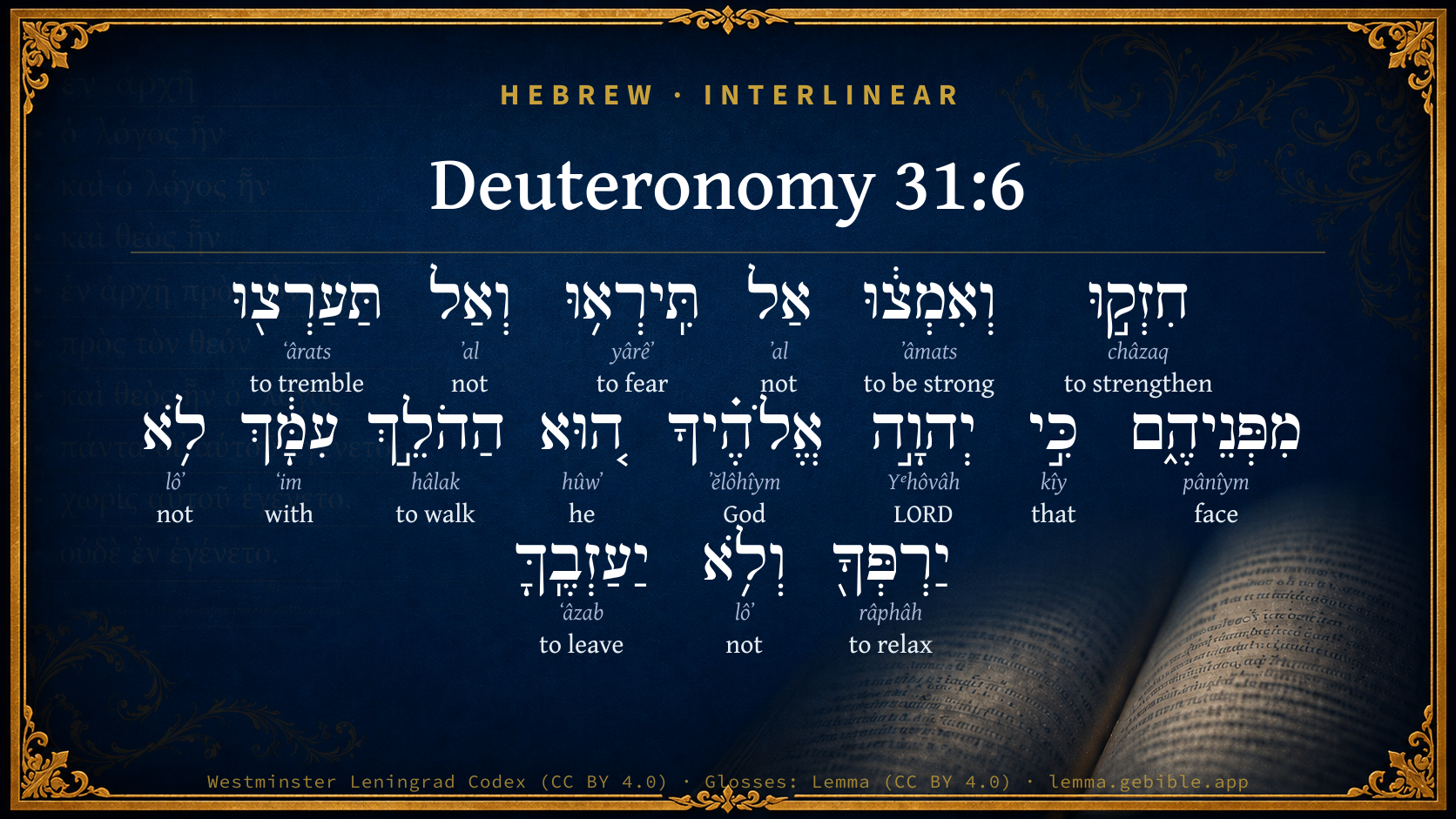
  1. חִזְק֣וּ châzaq H2388 “strengthen” Verb, Qal, Imperative, 2nd Person, Masculine, Plural
  2. וְאִמְצ֔וּ ʼâmats H553 “and · be strong” Conjunction + Verb, Qal, Imperative, 2nd Person, Masculine, Plural
  3. אַל ʼal H408 “not” Particle, Negative
  4. תִּֽירְא֥וּ yârêʼ H3372 “to fear” Verb, Qal, Jussive, 2nd Person, Masculine, Plural
  5. וְאַל ʼal H408 “and · not” Conjunction + Particle, Negative
  6. מִפְּנֵיהֶ֑ם pânîym H6440 “from · face(s) · their” Preposition + Noun, Common, Both, Plural, Construct + Suffix, Personal, 3rd Person, Masculine, Plural
  7. כִּ֣י kîy H3588 “that” Conjunction
  8. יְהוָ֣ה Yᵉhôvâh H3068 “LORD” Noun, Proper
  9. אֱלֹהֶ֗יךָ ʼĕlôhîym H430 “God(s) · your” Noun, Common, Masculine, Plural, Construct + Suffix, Personal, 2nd Person, Masculine, Singular
  10. ה֚וּא hûwʼ H1931 “he” Pronoun, Personal, 3rd Person, Masculine, Singular
  11. הַהֹלֵ֣ךְ hâlak H1980 “the · walking” Particle, Definite Article + Verb, Qal, Participle Active, Masculine, Singular, Absolute
  12. עִמָּ֔ךְ ʻim H5973 “with · you” Preposition + Suffix, Personal, 2nd Person, Feminine, Singular
  13. לֹ֥א lôʼ H3808 “not” Particle, Negative
  14. יַרְפְּךָ֖ râphâh H7503 “to relax · you” Verb, Hiphil, Imperfect, 3rd Person, Masculine, Singular + Suffix, Personal, 2nd Person, Masculine, Singular
  15. וְלֹ֥א lôʼ H3808 “and · not” Conjunction + Particle, Negative
  16. יַעַזְבֶֽךָּ ʻâzab H5800 “to leave · you” Verb, Qal, Imperfect, 3rd Person, Masculine, Singular + Suffix, Personal, 2nd Person, Masculine, Singular

About this verse

These counts appear in no published source. They are computed here, from the morphology-tagged text and Lemma’s own curated glosses. What Lemma adds →

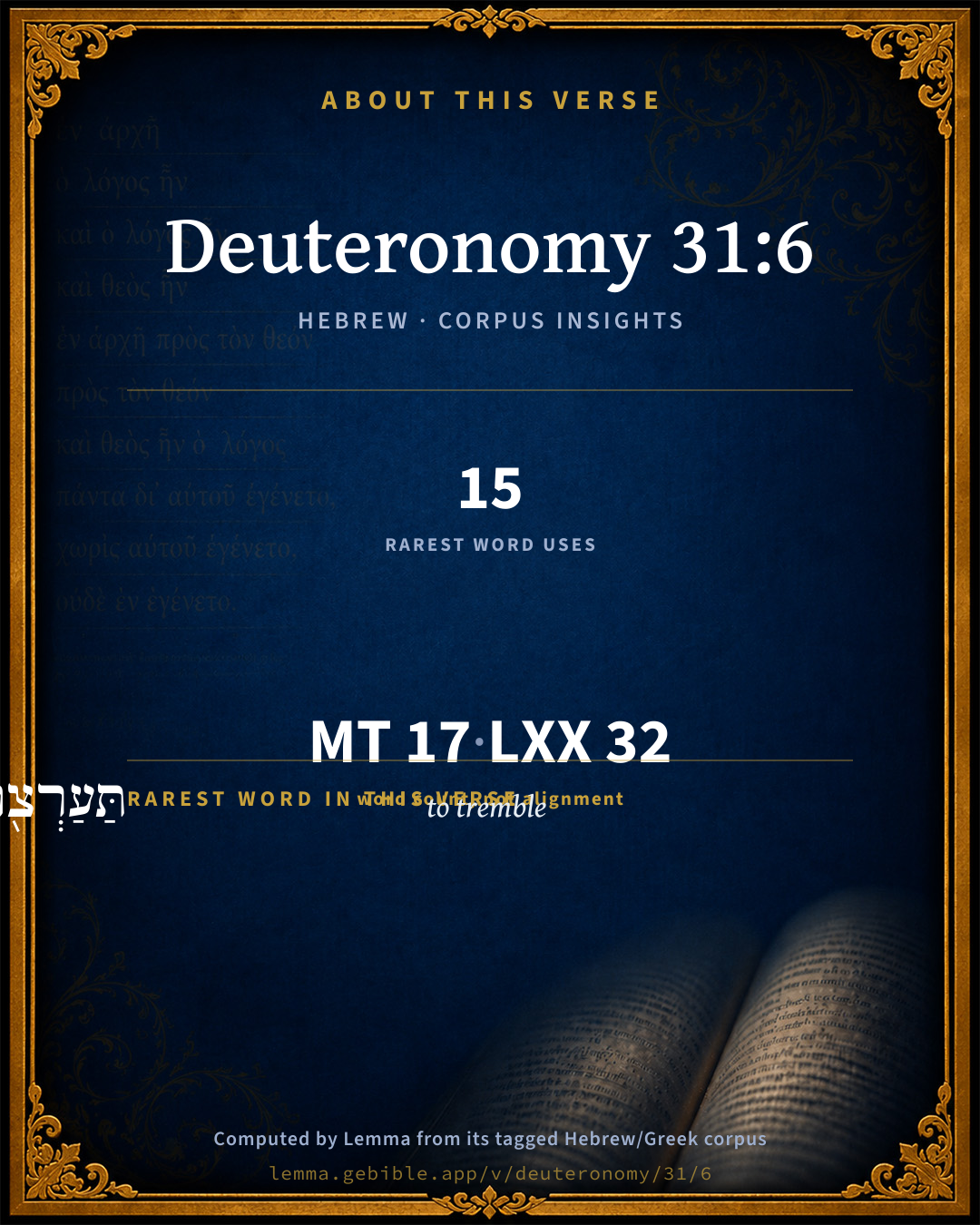
17
words
15
distinct lemmas
Pentateuch
section

Notable vocabulary

The rarest word here is תַּעַרְצ֖וּ to tremble H6206 — appearing just 15 times in the whole Hebrew Bible.

Shared distinctive vocabulary

תַּעַרְצ֖וּ to tremble H6206 occurs in 15 verses of the Hebrew Bible. Also found in:

Grammatical profile

  • 7 verbs
  • 3 nouns
  • 1 pronoun
  • 1 preposition
  • 1 conjunction
  • 4 particles

Verb forms

  • חִזְק֣וּ Qal · Imperative
  • וְאִמְצ֔וּ Qal · Imperative
  • תִּֽירְא֥וּ Qal · Jussive
  • תַּעַרְצ֖וּ Qal · Jussive
  • הַהֹלֵ֣ךְ Qal · Participle Active
  • יַרְפְּךָ֖ Hiphil · Imperfect
  • יַעַזְבֶֽךָּ Qal · Imperfect

Repetition

Words recur within this verse — often emphatic in Hebrew:

Hebrew & Septuagint length

In English translation the verse runs 34 words from the Hebrew and 41 from the Septuagint (LXX English) — closely comparable.

A rough comparison of the two English renderings, which tokenize alike — not a word-level alignment.

Word counts can differ between the Hebrew and the Greek without any difference in meaning — e.g. the Hebrew direct-object marker אֵת has no separate Greek word, and Greek often adds the article ὁ.

In the original languages it is 17 Hebrew tokens and 32 Greek tokens — but the two are counted differently (Hebrew bundles its prefixes and suffixes into one token; the Greek is in lemma form), so that isn’t a like-for-like length.

Cross-references

29

Topical passages linked to Deuteronomy 31:6 in the Treasury of Scripture Knowledge — connected by theme and wording, ordered by reader-vote popularity; previews shown in the World English Bible.

  • Joshua 1:9 Haven't I commanded you? Be strong and of good courage; don't be afraid, neither be dismayed: for Yahweh your God is with you wherever you go.
  • Ephesians 6:10 Finally, be strong in the Lord, and in the strength of his might.
  • Psalms 27:14 Wait for Yahweh. Be strong, and let your heart take courage. Yes, wait for Yahweh.
  • 1 Chronicles 28:20 David said to Solomon his son, Be strong and of good courage, and do it: don't be afraid, nor be dismayed; for Yahweh God, even my God, is with you; he will not fail you, nor forsake you, until all the work for the service of the house of Yahweh is finished.
  • Isaiah 41:10 Don't you be afraid, for I am with you; don't be dismayed, for I am your God; I will strengthen you; yes, I will help you; yes, I will uphold you with the right hand of my righteousness.
  • Luke 12:32 Don't be afraid, little flock, for it is your Father's good pleasure to give you the Kingdom.
  • 2 Timothy 2:1 You therefore, my child, be strengthened in the grace that is in Christ Jesus.
  • Psalms 27:1 Yahweh is my light and my salvation. Whom shall I fear? Yahweh is the strength of my life. Of whom shall I be afraid?
  • Isaiah 43:1–5 But now thus says Yahweh who created you, Jacob, and he who formed you, Israel: Don't be afraid, for I have redeemed you; I have called you by your name, you are mine.
  • Joshua 10:25 Joshua said to them, Don't be afraid, nor be dismayed; be strong and of good courage: for thus shall Yahweh do to all your enemies against whom you fight.
  • 1 Chronicles 22:13 Then shall you prosper, if you observe to do the statutes and the ordinances which Yahweh gave Moses concerning Israel. Be strong, and of good courage. Don't be afraid, neither be dismayed.
  • Deuteronomy 7:18 you shall not be afraid of them: you shall well remember what Yahweh your God did to Pharaoh, and to all Egypt;
  • Deuteronomy 1:29 Then I said to you, Don't dread, neither be afraid of them.
  • Deuteronomy 20:1 When you go forth to battle against your enemies, and see horses, and chariots, [and] a people more than you, you shall not be afraid of them; for Yahweh your God is with you, who brought you up out of the land of Egypt.
  • Deuteronomy 31:23 He gave Joshua the son of Nun a charge, and said, Be strong and of good courage; for you shall bring the children of Israel into the land which I swore to them: and I will be with you.
  • Hebrews 13:5 Be free from the love of money, content with such things as you have, for he has said, "I will in no way leave you, neither will I in any way forsake you."
  • Isaiah 51:12 I, even I, am he who comforts you: who are you, that you are afraid of man who shall die, and of the son of man who shall be made as grass;
  • Joshua 1:5–7 There shall not any man be able to stand before you all the days of your life. As I was with Moses, so I will be with you; I will not fail you, nor forsake you.
  • 1 Corinthians 16:13 Watch! Stand firm in the faith! Be courageous! Be strong!
  • Deuteronomy 4:31 for Yahweh your God is a merciful God; he will not fail you, neither destroy you, nor forget the covenant of your fathers which he swore to them.
  • Deuteronomy 20:3–4 and shall tell them, Hear, Israel, you draw near this day to battle against your enemies: don't let your heart faint; don't be afraid, nor tremble, neither be scared of them;
  • 1 Chronicles 28:10 Take heed now; for Yahweh has chosen you to build a house for the sanctuary: be strong, and do it.
  • Deuteronomy 31:7 Moses called to Joshua, and said to him in the sight of all Israel, Be strong and of good courage: for you shall go with this people into the land which Yahweh has sworn to their fathers to give them; and you shall cause them to inherit it.
  • 2 Chronicles 32:7 Be strong and of good courage, don't be afraid nor dismayed for the king of Assyria, nor for all the multitude who is with him; for there is a greater with us than with him:
  • Isaiah 41:13–17 For I, Yahweh your God, will hold your right hand, saying to you, Don't be afraid; I will help you.
  • Haggai 2:4 Yet now be strong, Zerubbabel,' says Yahweh. 'Be strong, Joshua, son of Jehozadak, the high priest. Be strong, all you people of the land,' says Yahweh, 'and work, for I am with you,' says Yahweh of Hosts.
  • Numbers 14:9 Only don't rebel against Yahweh, neither fear the people of the land; for they are bread for us: their defense is removed from over them, and Yahweh is with us: don't fear them.
  • Revelation 21:8 But for the cowardly, unbelieving, sinners, abominable, murderers, sexually immoral, sorcerers, idolaters, and all liars, their part is in the lake that burns with fire and sulfur, which is the second death."
  • Zechariah 8:13 It shall come to pass that, as you were a curse among the nations, house of Judah and house of Israel, so will I save you, and you shall be a blessing. Don't be afraid. Let your hands be strong."

Cross-references courtesy of OpenBible.info (CC BY 4.0).

Hebrew and Greek witnesses Masoretic Hebrew ↔ Greek Septuagint

The same verse in the two great witnesses to the Old Testament, shown verse-for-verse.

These are two independent witnesses, not word-aligned to each other, and the Septuagint is shown in lemma (dictionary) form.

Hebrew Deuteronomy 31:6 Masoretic · Westminster Leningrad Codex

חִזְק֣וּ וְאִמְצ֔וּ אַל תִּֽירְא֥וּ וְאַל תַּעַרְצ֖וּ מִפְּנֵיהֶ֑ם כִּ֣י יְהוָ֣ה אֱלֹהֶ֗יךָ ה֚וּא הַהֹלֵ֣ךְ עִמָּ֔ךְ לֹ֥א יַרְפְּךָ֖ וְלֹ֥א יַעַזְבֶֽךָּ

Be strong and of good courage, don't be afraid, nor be scared of them: for Yahweh your God, he it is who does go with you; he will not fail you, nor forsake you.

World English Bible · Public Domain

Greek LXX Deuteronomy 31:6 Septuagint · lemma form

ἀνδρίζομαι καί ἰσχύω μή φοβέω μηδέ δειλιάω μηδέ πτοέω ἀπό πρόσωπον αὐτός ὅτι κύριος ὁ θεός σύ ὁ προπορεύομαι μετά σύ ἐν σύ οὐ μή σύ ἀναἵημι οὔτε μή σύ ἐν καταλείπω

Be courageous and strong, fear not, neither be cowardly neither be afraid before them; for it is the Lord your God that advances with you in the midst of you, neither will he by any means forsake you, nor desert you.

LXX2012 (modern English Septuagint) · Public Domain

On this verse, Adam Clarke's Commentary discusses the Septuagint’s reading. Read the note in Commentary ↓

Hebrew: Westminster Leningrad Codex (CC BY 4.0). Greek: Septuagint (public domain); English from LXX2012 (modern English Septuagint) (Public Domain). How the Septuagint differs from the Hebrew →

Targum (Aramaic paraphrase)

2

The Targum is the ancient Jewish Aramaic paraphrase of the Hebrew Scriptures — an interpretive translation, not the Hebrew text itself. Onkelos (literal) and Pseudo-Jonathan (expansive) render the Torah, and Jonathan the Prophets. Coverage is partial: where no permissively-licensed English translation exists for a verse, only the Aramaic is shown. This is verse-level text, not a word-by-word alignment to the Hebrew.

  1. Targum Onkelos Torah (Genesis–Deuteronomy)
    תְּקִיפוּ וְאַלִימוּ לָא תִדְחֲלוּן וְלָא תִתָּבְרוּן מִקֳדָמֵיהוֹן אֲרֵי יְיָ אֱלָהָךְ הוּא דִמְדַבַּר קֳדָמָךְ לָא יִשְׁבְּקִנָךְ וְלָא יַרְטֵשִׁנָךְ

    (no public-domain English translation for this verse)

    Targum Onkelos — Aramaic: “Onkelos Genesis” (public domain); “Onkelos Exodus” (public domain); “Onkelos Leviticus” (public domain); “Onkelos Numbers” (public domain); “Onkelos Deuteronomy” (public domain). English: “Sefaria Community Translation” (CC0 1.0 (public-domain dedication)); “J.W. Etheridge. The Targums of Onkelos and Jonathan Ben Uzziel on the Pentateuch. London: Longmans, Green, 1862” (public domain). Text via Sefaria.

  2. Targum Pseudo-Jonathan Torah (Genesis–Deuteronomy)
    אִיתוֹקְפוּ וְאִתְחַיְילוּ לָא תִדַחֲלוּן וְלָא תִתְיַרְעוּן מִן קֳדָמֵיהוֹן אֲרוּם יְיָ אֱלָהָכוֹן שְׁכִינְתֵּיהּ מִידַבְּרָא קֳדָמֵיכוֹן לָא יִשְׁבְּקִינְכוֹן וְלָא יַרְחְקִינְכוֹן

    Be strong, then, and of good courage, fear not, nor be dismayed before them; for the Shekinah of the Lord your God will be the Leader of you, He will not forsake nor be far from you.

    Targum Pseudo-Jonathan — Aramaic: “Targum Jonathan on Genesis” (public domain); “Targum Jonathan on Exodus” (public domain); “Targum Jonathan on Leviticus” (public domain); “Targum Jonathan on Numbers” (public domain); “Targum Jonathan on Deuteronomy” (public domain). English: “The Targum of Jonathan ben Uzziel, trans. J. W. Etheridge, London, 1862” (public domain). Text via Sefaria.

Commentary

Notes on Deuteronomy 31:6 from classic Christian and Jewish commentators (each source and its license shown beneath its notes). The classic Christian expositions comment on the surrounding passage and are grouped to its opening verse, so a note may address several verses; the Jewish commentaries on the Tanakh (Rashi and others) are per-verse, so they appear only where the commentator wrote on this verse.

Lemma curates 59 commentaries, every one of them public domain or Creative Commons licensed, each selected and text-cleaned for this edition rather than reprinted as found. About our sources →

John Gill's Exposition

And Moses called unto Joshua,.... Who might be at some distance from him, with the tribe to which he belonged. The Targum of Jonathan adds,"out of the midst of the people:"

and said unto him, in the sight of all Israel; now assembled together, and what follows was said in their hearing, to make him the more respectable to them:

be strong and of a good courage; the same that is said to the people in Deu 31:6, and which was still more necessary in him, who was to be their general, and to go at the head of them, and lead them on to battle; and though Joshua was a man of courage and valour, as well as had military skill, as appears by his fight with Amalek, Exo 17:9; yet such an exhortation was not needless, seeing he had so much work to do, and so many enemies to contend with:

for thou must go with this people unto the land which the Lord hath sworn unto their fathers to give them, and thou shalt cause them to inherit it; the Targum of Jonathan is,"which the Word of the Lord hath sworn to give;''the land of Canaan, thither he must go with them; this was the will and determination of God, and he must go alone without him, Moses, which would be a trial of his courage.

John Gill's Exposition of the Whole Bible (1746–1763) — public domain (CC PDM 1.0). Text via the HelloAO Bible API.

Trapp's Complete Commentary

John Trapp

Deu 31:6 Be strong and of a good courage, fear not, nor be afraid of them: for the LORD thy God, he [it is] that doth go with thee; he will not fail thee, nor forsake thee.

Ver. 6. He will not fall thee.] Five times in holy Scriptures is this precious promise repeated; and in Heb 13:5, made common to all believers, with a very deep asseveration.

John Trapp, A Commentary or Exposition upon All the Books of the Old and New Testament (1647–1656) — public domain. Text from a community e-Sword module.

Joseph Benson's Commentary

Deu 31:6. Be strong — In faith in God. He will not fail thee nor forsake thee — Will not leave thee to thyself, but will be always present with thee to assist and make thee successful in thy undertakings. This promise, though made at this time particularly to Israel and Joshua, yet belongs to all believers, Heb 13:5.

Joseph Benson's Commentary on the Old and New Testaments (1811–1818) — public domain. Text from a community e-Sword module.

Tyndale Open Study Notes

Tyndale Open Resources

31:6 He will neither fail you nor abandon you: This encouragement for Israel on the verge of taking possession of the Promised Land also states a general principle of God’s care for his people (see also Heb 13:5).

Tyndale Open Study Notes — © Tyndale Open Resources, licensed CC BY-SA 4.0. Text via the HelloAO Bible API.

Geneva Bible (1599)

Geneva Bible translators

Or, be of good courage.

Geneva Bible (1599) marginal notes — public domain. Text via Bolls.life.

Adam Clarke's Commentary

Verse 6. Be strong] חזקו chizku, the same word that is used Ex 4:21; Ex 9:15, for hardening Pharaoh's heart. See the notes there. The Septuagint, in this and the following verse, have, Ανδριζου και ισχυε, Play the man, and be strong; and from this St. Paul seems to have borrowed his ideas, 1Co 16:13: Στηκετε εν τῃ πιστει· ανδριζεσθε, κρατιουσθε: Stand firm in the faith; play the man - act like heroes; be vigorous.

Adam Clarke's Commentary on the Bible (1810–1826) — public domain. Text from a community e-Sword/MySword module.

The Cambridge Bible for Schools and Colleges

gen. ed. J. J. S. Perowne

6. Be strong and of a good courage] Cp. Deu_3:28 : encourage and strengthen him (causative forms of the same vbs.).

fear not, nor be affrighted] The phrase usual with Pl. passages (for the corresponding Sg. see Deu_1:21 and below Deu_31:8). Deu_1:29 takes these vbs. in the reverse order. The Pl. in this part of the v. is confirmed by Sam. The LXX has Sg. per incuriam.

doth go with thee] Deu_20:4; before thee, Deu_1:30. Sam. confirms Sg. The LXX has Pl.

fail thee] let thee drop; Deu_4:31 : not fail nor forsake thee, so Deu_31:8, Jos_1:5 (deuter.), 1Ch_28:20, Heb_13:5. Sg. is confirmed by Sam. LXX.

The Cambridge Bible for Schools and Colleges (gen. ed. J. J. S. Perowne; Cambridge University Press, 1878–1918) — public domain. Text from a community e-Sword module.

Rashi

Rabbi Shlomo Yitzchaki (Rashi)

לא ירפך means He will give you no looseness that you should be abandoned by Him (cf. Rashi on Deuteronomy 4:31).

Rashi on the Tanakh — English translations: “The Judaica Press complete Tanach with Rashi, translated by A. J. Rosenberg” (CC BY 4.0); “Pentateuch with Rashi's commentary by M. Rosenbaum and A.M. Silbermann, 1929-1934” (public domain); “The Metsudah Tanach series, Lakewood, N.J” (CC BY 4.0); and “The Book of Joshua, Metsudah Publications, 1997” (CC BY 4.0). Text via Sefaria.

Lesson kit

Teaching starters — assembled from the data on this page, not authored interpretation. Every prompt links to the verse data it draws on. Edit before teaching.

Deuteronomy, in the Pentateuch, opens this verse with 17 words (15 distinct Hebrew lemmas). Its most distinctive word is ʻârats (“to tremble”). A historical commentator’s framing appears above. Read the whole chapter for the surrounding context.

Discussion questions

  1. What does “to tremble” (ʻârats) contribute to the verse as a whole?
  2. How does Deuteronomy 1:29, which shares the word «to tremble», read alongside this verse?
  3. What does the repetition of “not” (2× in this one verse) do in this verse?
  4. These translations render this verse differently. What is at stake in choosing one wording over another?
  5. «חִזְק֣וּ» is a Qal Imperative verb. How does that grammatical form shape the action described?
  6. Compare how John Gill's Exposition and Trapp's Complete Commentary read this verse. Where do they agree or differ?

Things to notice

Reading settings

Reading text

Shown beneath each verse's original-language words.

Old Testament
Old Testament edition

Read the OT as the Masoretic Hebrew (MT) or the Greek Septuagint (LXX).

English shown for the Greek Septuagint (in the Hebrew ↔ Greek comparison).

Comparing translations? Open the Compare panel on any verse page to stack up to four side by side.