
Judges 18:25

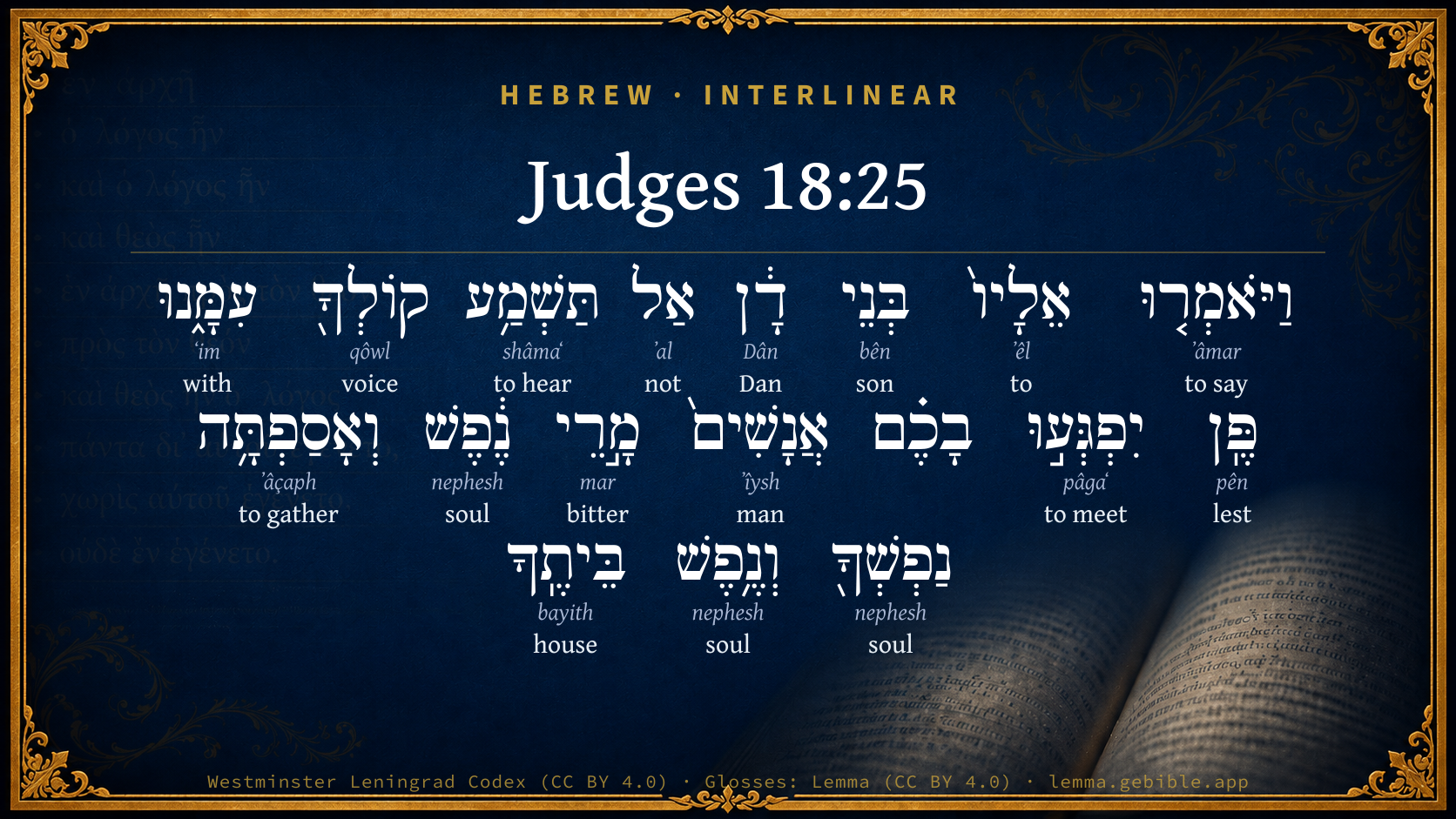
Hebrew (Westminster Leningrad Codex) Judges 18:25 appears in the Hebrew Old Testament. The text above is from the Westminster Leningrad Codex. Each word links to its Strong’s number, a concise gloss, and parsing drawn from the Open Scriptures Hebrew Bible morphology. Click any word for its full Brown-Driver-Briggs (BDB) entry.
Download image
Cite this verse

Judges 18:25 (World English Bible). Public Domain. Lemma interlinear Bible study tool, https://lemma.gebible.app/v/judges/18/25.

Show BibTeX & RIS
BibTeX
RIS
English Translation
The children of Dan said to him, "Don't let your voice be heard among us, lest angry fellows fall on you, and you lose your life, with the lives of your household."
World English Bible · Public Domain
Download a study sheet

One document with this verse’s original text, its word-by-word gloss line, the meaning frame, cross-references with their text, attributed commentary, and full source and license credits — printable, and it pastes into notes with its structure intact.

This verse Autodidact and up

Study sheet (.html) Plain text (.txt)

A passage Seminary Student

Up to 50 verses in one chapter. A passage sheet keeps up to 6 commentary sources and 12 cross-references per verse, in the order this page ranks them, and says so on the sheet whenever that leaves anything out. Ask for a single verse and you get the Autodidact verse sheet above.

Everything on this page stays free to read, with no account — the sheet is a download of what is already on screen, not access to it.

Want to remove ads? Support Godless Engineer
Compare translations 3

The same verse in 3 English versions, stacked beneath the original-language interlinear above. Click any original word for its lexicon entry.

Each is an independent rendering of the whole verse — the interlinear is not word-aligned to these translations.

Highlighted words mark where these versions differ — a whole-verse word diff, not a word-by-word alignment.

  • World English Bible Public Domain
    The children of Dan said to him, "Don't let your voice be heard among us, lest angry fellows fall on you, and you lose your life, with the lives of your household."
  • King James Version Public Domain
    And the children of Dan said unto him, Let not thy voice be heard among us, lest angry fellows run upon thee, and thou lose thy life, with the lives of thy household.
  • unfoldingWord Literal Text CC BY-SA 4.0
    And sons of Dan said to him, “You should not make your voice heard among us, lest men bitter of soul strike you and you gather your soul and the soul of your house.”

unfoldingWord Literal Text — © unfoldingWord, licensed CC BY-SA 4.0. Word-aligned USFM3 via Door43 (git.door43.org/unfoldingWord/en_ult).

Versions to compare (up to 4)

3 of 4 selected

Show all 18 translations

Every available English version of this verse, each an independent rendering of the whole verse.

  • World English Bible Public Domain
    The children of Dan said to him, "Don't let your voice be heard among us, lest angry fellows fall on you, and you lose your life, with the lives of your household."
  • Berean Standard Bible Public Domain
    The Danites said to him, “Do not raise your voice against us, or angry men will attack you, and you and your family will lose your lives.”
  • Majority Standard Bible Public Domain
    The Danites said to him, “Do not raise your voice against us, or angry men will attack you, and you and your family will lose your lives.”
  • King James Version Public Domain
    And the children of Dan said unto him, Let not thy voice be heard among us, lest angry fellows run upon thee, and thou lose thy life, with the lives of thy household.
  • American Standard Version (1901) Public Domain
    And the children of Dan said unto him, Let not thy voice be heard among us, lest angry fellows fall upon you, and thou lose thy life, with the lives of thy household.
  • Revised Version (1885) Public Domain
    And the children of Dan said unto him, Let not thy voice be heard among us, lest angry fellows fall upon you, and thou lose thy life, with the lives of thy household.
  • Geneva Bible (1599) Public Domain
    And the children of Dan sayde vnto him, Let not thy voyce be heard among vs, least angrie fellowes runne vpon thee, and thou lose thy life with the liues of thine housholde.
  • Douay-Rheims (1899) Public Domain
    And the children of Dan said to him: See thou say no more to us, lest men enraged come upon thee, and thou perish with all thy house.
  • Young's Literal Translation Public Domain
    And the sons of Dan say unto him, `Let not thy voice be heard with us, lest men bitter in soul fall upon you, and thou hast gathered thy life, and the life of thy household;'
  • Literal Standard Version CC BY-SA 4.0
    And the sons of Dan say to him, “Do not let your voice be heard with us, lest men bitter in soul fall on you, and you have gathered your life, and the life of your household”;
  • Unlocked Literal Bible CC BY-SA 4.0
    The people of Dan said to him, “You should not let us hear you say anything, or some very angry men will attack you, and you and your family will be killed.”
  • unfoldingWord Literal Text CC BY-SA 4.0
    And sons of Dan said to him, “You should not make your voice heard among us, lest men bitter of soul strike you and you gather your soul and the soul of your house.”
  • Darby Bible Public Domain
    And the Danites said to him, "Do not let your voice be heard among us, lest angry fellows fall upon you, and you lose your life with the lives of your household."
  • World Messianic Bible Public Domain
    The children of Dan said to him, “Don’t let your voice be heard among us, lest angry fellows fall on you, and you lose your life, with the lives of your household.”
  • Webster's Bible Public Domain
    And the children of Dan said to him, Let not thy voice be heard among us, lest angry fellows rush upon thee, and thou lose thy life, with the lives of thy household.
  • Free Bible Version CC BY-SA 4.0
    “Don't complain to us!” Danites replied. “Otherwise some hot-tempered people here might attack you, and you and your family will lose your lives!”
  • Bible in Basic English Public Domain
    And the children of Dan said to him, Say no more, or men of bitter spirit may make an attack on you, causing loss of your life and the lives of your people.
  • JPS Tanakh (1917) Public Domain
    And the children of Dan said unto him: 'Let not thy voice be heard among us, lest angry fellows fall upon you, and thou lose thy life, with the lives of thy household.'

Literal Standard Version (2020), Covenant Press — licensed CC BY-SA 4.0. Text via the HelloAO Bible API (eBible.org). Unlocked Literal Bible (unfoldingWord) — licensed CC BY-SA 4.0. Text via the HelloAO Bible API (eBible.org). unfoldingWord Literal Text — © unfoldingWord, licensed CC BY-SA 4.0. Word-aligned USFM3 via Door43 (git.door43.org/unfoldingWord/en_ult). Free Bible Version, Dr. Jonathan Gallagher — licensed CC BY-SA 4.0. Text via the HelloAO Bible API (eBible.org).

Word by word

More ways to search: Search by grammar → Find every occurrence → Compare this word →

Practice this passage: Drill this verse → Learn its vocabulary →

מָ֣רֵי
mar
H4751
“bitter of”
Adjective, Adjective, Masculine, Plural, Construct
Part of Speech
Adjective
Type
Adjective
Gender
Masculine
Number
Plural
State
Construct
Full BDB Definition

Origin: from H4843

TWOT: 1248a , 1248c

bitter, bitterness (adjective) - of water or food - of harlot's end, end of wickedness, cry (figuratively) - of pain (substantive) - bitterly (adverb)
  1. וַיֹּאמְר֤וּ ʼâmar H559 “and · to say” Conjunction + Verb, Qal, Sequential Imperfect, 3rd Person, Masculine, Plural
  2. אֵלָיו֙ ʼêl H413 “to · him” Preposition + Suffix, Personal, 3rd Person, Masculine, Singular
  3. בְּנֵי bên H1121 “sons of” Noun, Common, Masculine, Plural, Construct
  4. דָ֔ן Dân H1835 “Dan” Noun, Proper
  5. אַל ʼal H408 “not” Particle, Negative
  6. תַּשְׁמַ֥ע shâmaʻ H8085 “to hear” Verb, Hiphil, Jussive, 2nd Person, Masculine, Singular
  7. קוֹלְךָ֖ qôwl H6963 “voice · your” Noun, Common, Masculine, Singular, Construct + Suffix, Personal, 2nd Person, Masculine, Singular
  8. עִמָּ֑נוּ ʻim H5973 “with · us” Preposition + Suffix, Personal, 1st Person, Common, Plural
  9. פֶּֽן pên H6435 “lest” Conjunction
  10. יִפְגְּע֣וּ pâgaʻ H6293 “to meet” Verb, Qal, Imperfect, 3rd Person, Masculine, Plural
  11. אֲנָשִׁים֙ ʼîysh H376 “men” Noun, Common, Masculine, Plural, Absolute
  12. נֶ֔פֶשׁ nephesh H5315 “soul” Noun, Common, Both, Singular, Absolute
  13. וְאָסַפְתָּ֥ה ʼâçaph H622 “and · to gather” Conjunction + Verb, Qal, Sequential Perfect, 2nd Person, Masculine, Singular
  14. נַפְשְׁךָ֖ nephesh H5315 “soul · your” Noun, Common, Both, Singular, Construct + Suffix, Personal, 2nd Person, Masculine, Singular
  15. וְנֶ֥פֶשׁ nephesh H5315 “and · soul of” Conjunction + Noun, Common, Both, Singular, Construct
  16. בֵּיתֶֽךָ bayith H1004 “house · your” Noun, Common, Masculine, Singular, Construct + Suffix, Personal, 2nd Person, Masculine, Singular

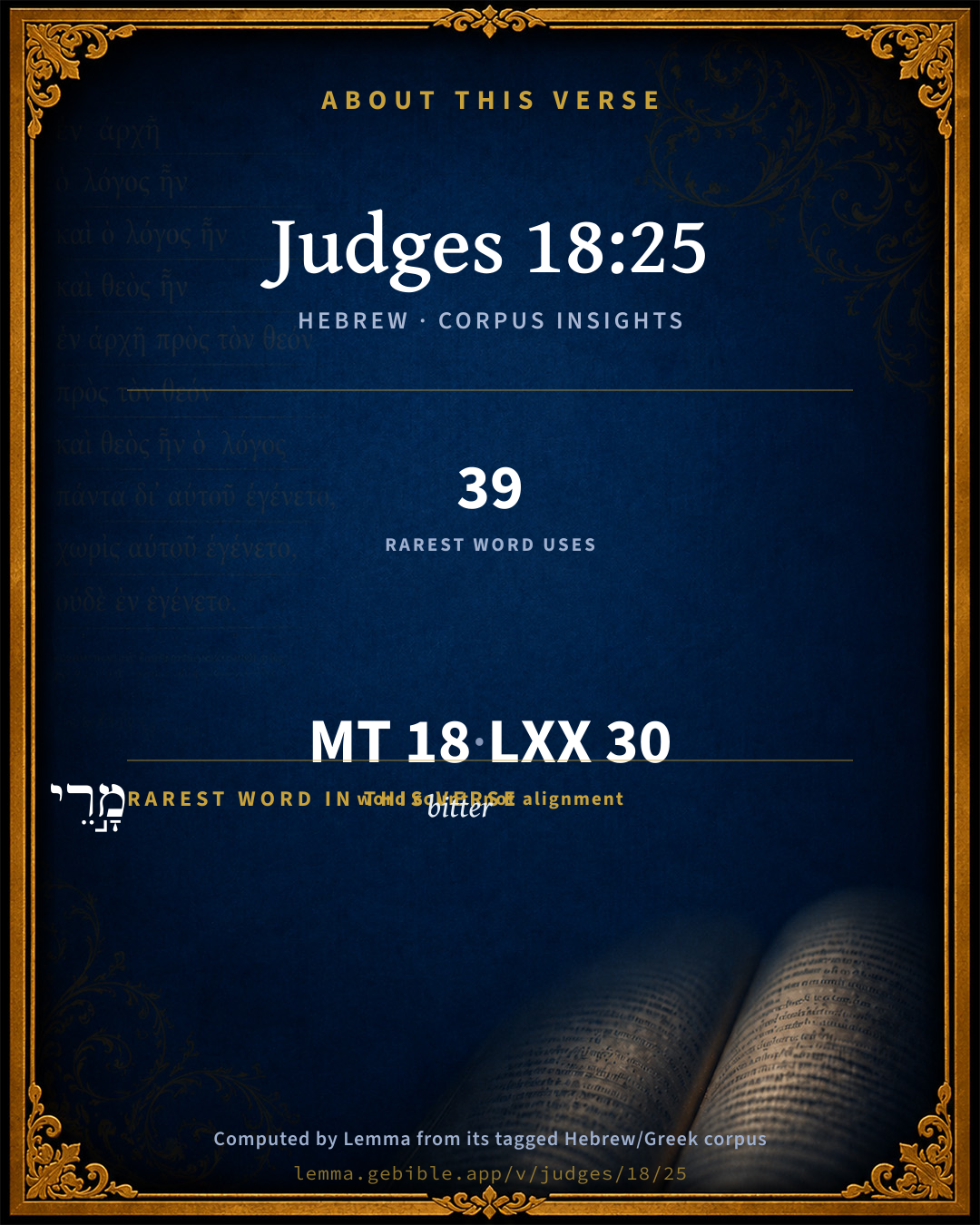
About this verse

These counts appear in no published source. They are computed here, from the morphology-tagged text and Lemma’s own curated glosses. What Lemma adds →

18
words
15
distinct lemmas
Historical
section

Shared distinctive vocabulary

מָ֣רֵי bitter H4751 occurs in 36 verses of the Hebrew Bible. Also found in:

Grammatical profile

  • 4 verbs
  • 8 nouns
  • 1 adjective
  • 3 prepositions
  • 1 conjunction
  • 1 particle

Verb forms

  • וַיֹּאמְר֤וּ Qal · Sequential Imperfect
  • תַּשְׁמַ֥ע Hiphil · Jussive
  • יִפְגְּע֣וּ Qal · Imperfect
  • וְאָסַפְתָּ֥ה Qal · Sequential Perfect

Repetition

A word recurs within this verse — often emphatic in Hebrew:

  • נֶ֔פֶשׁ soul H5315 ×3

Hebrew & Septuagint length

In English translation the verse runs 32 words from the Hebrew and 33 from the Septuagint (LXX English) — closely comparable.

A rough comparison of the two English renderings, which tokenize alike — not a word-level alignment.

Word counts can differ between the Hebrew and the Greek without any difference in meaning — e.g. the Hebrew direct-object marker אֵת has no separate Greek word, and Greek often adds the article ὁ.

In the original languages it is 18 Hebrew tokens and 30 Greek tokens — but the two are counted differently (Hebrew bundles its prefixes and suffixes into one token; the Greek is in lemma form), so that isn’t a like-for-like length.

Cross-references

4

Topical passages linked to Judges 18:25 in the Treasury of Scripture Knowledge — connected by theme and wording, ordered by reader-vote popularity; previews shown in the World English Bible.

  • Job 27:2 "As God lives, who has taken away my right, The Almighty, who has made my soul bitter.
  • 1 Samuel 30:6 David was greatly distressed; for the people spoke of stoning him, because the soul of all the people was grieved, every man for his sons and for his daughters: but David strengthened himself in Yahweh his God.
  • 2 Samuel 17:8 Hushai said moreover, You know your father and his men, that they are mighty men, and they are fierce in their minds, as a bear robbed of her cubs in the field; and your father is a man of war, and will not lodge with the people.
  • Job 3:5 Let darkness and the shadow of death claim it for their own. Let a cloud dwell on it. Let all that makes black the day terrify it.

Cross-references courtesy of OpenBible.info (CC BY 4.0).

Hebrew and Greek witnesses Masoretic Hebrew ↔ Greek Septuagint

The same verse in the two great witnesses to the Old Testament, shown verse-for-verse.

These are two independent witnesses, not word-aligned to each other, and the Septuagint is shown in lemma (dictionary) form.

Hebrew Judges 18:25 Masoretic · Westminster Leningrad Codex

וַיֹּאמְר֤וּ אֵלָיו֙ בְּנֵי דָ֔ן אַל תַּשְׁמַ֥ע קוֹלְךָ֖ עִמָּ֑נוּ פֶּֽן יִפְגְּע֣וּ בָכֶ֗ם אֲנָשִׁים֙ מָ֣רֵי נֶ֔פֶשׁ וְאָסַפְתָּ֥ה נַפְשְׁךָ֖ וְנֶ֥פֶשׁ בֵּיתֶֽךָ

The children of Dan said to him, "Don't let your voice be heard among us, lest angry fellows fall on you, and you lose your life, with the lives of your household."

World English Bible · Public Domain

Greek LXX Judges 18:25 Septuagint · lemma form

καί εἶπον πρός αὐτός ὁ υἱός δαν μή ἀκούω δή φωνή σύ μετά ἐγώ μήποτε συνἀντάω ἐν ἐγώ ἀνήρ πικρός ψυχή καί προςτίθημι ψυχή καί ὁ ψυχή ὁ οἶκος σύ

And the children of Dan said to him, Let not your voice be heard with us, lest angry men run upon you, and take away your life, and the lives of your house.

LXX2012 (modern English Septuagint) · Public Domain

Hebrew: Westminster Leningrad Codex (CC BY 4.0). Greek: Septuagint (public domain); English from LXX2012 (modern English Septuagint) (Public Domain). How the Septuagint differs from the Hebrew →

Targum (Aramaic paraphrase)

1

The Targum is the ancient Jewish Aramaic paraphrase of the Hebrew Scriptures — an interpretive translation, not the Hebrew text itself. Onkelos (literal) and Pseudo-Jonathan (expansive) render the Torah, and Jonathan the Prophets. Coverage is partial: where no permissively-licensed English translation exists for a verse, only the Aramaic is shown. This is verse-level text, not a word-by-word alignment to the Hebrew.

  1. Targum Jonathan Prophets (Joshua–Malachi)
    וַאֲמַרוּ לֵיהּ בְּנֵי דָן לָא תַשְׁמַע קָלָךְ עִמָנָא דִלְמָא יִשְׁלְטוּן בְּכוֹן גַבְרִין מְרִירַן נַפְשָׁן וְתָסֵיף נַפְשָׁךְ וּנְפַשׁ אֱנָשׁ בֵיתָךְ:

    (no public-domain English translation for this verse)

    Targum Jonathan — Aramaic: “Mikraot Gedolot” (public domain). English: “Sefaria Community Translation” (CC0 1.0 (public-domain dedication)); “London "Chaldee Paraphrase," 1871” (public domain). Text via Sefaria.

Commentary

Notes on Judges 18:25 from classic Christian and Jewish commentators (each source and its license shown beneath its notes). The classic Christian expositions comment on the surrounding passage and are grouped to its opening verse, so a note may address several verses; the Jewish commentaries on the Tanakh (Rashi and others) are per-verse, so they appear only where the commentator wrote on this verse.

Lemma curates 59 commentaries, every one of them public domain or Creative Commons licensed, each selected and text-cleaned for this edition rather than reprinted as found. About our sources →

Trapp's Complete Commentary

John Trapp

Jdg 18:25 And the children of Dan said unto him, Let not thy voice be heard among us, lest angry fellows run upon thee, and thou lose thy life, with the lives of thy household.

Ver. 25. Let not thy voice be heard.] Tace, si sapis. The noise of weapons drowns the voice of right. {Lam 2:9} The law is no more.

Lest angry fellows run upon thee.] Irati et irritati, biliosi et bellicosi. Heb., Men bitter of soul. Gallice, Gens de cholere.

And thou lose thy life, &c.] Heb., Ne recolligas animam tuam: that is, lest God take thy soul to himself, as Vatablus rendereth it: lest thou be sent to heaven the sooner for thy devotion.

John Trapp, A Commentary or Exposition upon All the Books of the Old and New Testament (1647–1656) — public domain. Text from a community e-Sword module.

Joseph Benson's Commentary

Jdg 18:25. Let not thy voice be heard — Thy complaints and reproaches. Lest angry fellows run upon thee — The soldiers, who are sharp and fierce and will soon be inflamed by thy provoking words. And thou lose thy life — Which, notwithstanding all thy pretences, thou valuest more than thy image, teraphim, and ephod.

Joseph Benson's Commentary on the Old and New Testaments (1811–1818) — public domain. Text from a community e-Sword module.

Geneva Bible (1599)

Geneva Bible translators

Hebrew, who have their heart bitter.

Geneva Bible (1599) marginal notes — public domain. Text via Bolls.life.

Adam Clarke's Commentary

Verse 25. And thou lose thy life] This was argumentum ad hominem; he must put up with the loss of his substance, or else lose his life! It was the mere language of a modern highwayman: Your life or your money.

Adam Clarke's Commentary on the Bible (1810–1826) — public domain. Text from a community e-Sword/MySword module.

Ellicott's Commentary for English Readers

(25) Lest angry fellows run upon thee.—Literally, lest men bitter of soul fall upon thee. (Comp. Jdg_8:21; Jdg_15:12; 2Sa_17:8, “chafed in their minds.”)

Thou lose thy life.—Literally, thou gather thy life, as in Psa_26:9.

A Bible Commentary for English Readers, edited by Charles John Ellicott (1878–1897) — public domain. Text from a community e-Sword module.

The Cambridge Bible for Schools and Colleges

gen. ed. J. J. S. Perowne

25. angry fellows] See marg.; fierce-tempered as in 2Sa_17:8; cf. also 1Sa_22:2. The rough humour and insolence of the robbers are admirably described. The writer hardly disguises his relish of the scene.

The Cambridge Bible for Schools and Colleges (gen. ed. J. J. S. Perowne; Cambridge University Press, 1878–1918) — public domain. Text from a community e-Sword module.

John Gill's Exposition

And the children of Dan said unto him, let not thy voice be heard among us,.... Complaining of us as having done an unjust thing, charging and reproaching us with theft and sacrilege, insisting upon a restoration of the things taken, and abusing with odious names and characters:

lest angry fellows run upon thee: lest men of bitter and passionate spirits, provoked by ill language given them, should draw their swords and fall upon thee:

and thou lose thy life, and the life of thy household; the life of himself, his family, servants, tenants, and neighbours with him, which ought to have been more precious and valuable than his gods; of which there was great danger in demanding his gods, which by this they let him know they would not part with.

John Gill's Exposition of the Whole Bible (1746–1763) — public domain (CC PDM 1.0). Text via the HelloAO Bible API.

Haydock's Catholic Bible Commentary

House. The violence and injustice of the Danites cannot be excused, particularly as they were stealing what they deemed sacred. (Calmet)

George Leo Haydock (1774–1849), Haydock's Catholic Family Bible and Commentary, 1859 edition — public domain. Excludes Psalms (Douay-Rheims chapter numbering differs from Protestant) and Deuterocanonical books (Catholic canon only).

Matthew Poole's English Annotations

Thy voice; thy complaints and reproaches.

Angry fellows; the soldiers, who are in themselves sharp and fierce, and will soon be inflamed by thy provoking words.

And thou lose thy life; which, notwithstanding all thy pretences, thou dost value more than thy images, as indeed appeared from his following practice.

Matthew Poole's English Annotations on the Holy Bible (1683–1685) — public domain. Text from a community e-Sword/MySword module.

The Pulpit Commentary

Run upon thee. Rather, run, or fall, upon you; it is the plural pronoun, comprehending the whole party. The argument of the Danites was the argument of the stronger.

The Pulpit Commentary (1880–1919), ed. H.D.M. Spence-Jones & Joseph S. Exell — public domain. Text from a community e-Sword module.

John Wesley's Explanatory Notes

Thy voice - Thy complaints and reproaches. Angry fellows - The soldiers, who are in themselves sharp and fierce, and will soon be enflamed by thy provoking words. Thy Life - Which, not withstanding all thy pretenses, thou dost value more than thy images.

John Wesley, Explanatory Notes Upon the Whole Bible (1754–1765) — public domain. Text via the GEBible commentary corpus.

Rashi

Rabbi Shlomo Yitzchaki (Rashi)

Bitter tempered men. There are angry men in our company.

Rashi on the Tanakh — English translations: “The Judaica Press complete Tanach with Rashi, translated by A. J. Rosenberg” (CC BY 4.0); “Pentateuch with Rashi's commentary by M. Rosenbaum and A.M. Silbermann, 1929-1934” (public domain); “The Metsudah Tanach series, Lakewood, N.J” (CC BY 4.0); and “The Book of Joshua, Metsudah Publications, 1997” (CC BY 4.0). Text via Sefaria.

Lesson kit

Teaching starters — assembled from the data on this page, not authored interpretation. Every prompt links to the verse data it draws on. Edit before teaching.

Judges, in the Historical, opens this verse with 18 words (15 distinct Hebrew lemmas). Its most distinctive word is mar (“bitter”). A historical commentator’s framing appears above. Read the whole chapter for the surrounding context.

Discussion questions

  1. How does “bitter” (mar) shape what this verse is saying?
  2. Genesis 27:34 shares the word «bitter» with this verse. How do the two illuminate each other?
  3. “soul” occurs 3× in this one verse. What is the effect of the repetition?
  4. These translations render this verse differently. What is at stake in choosing one wording over another?
  5. The verb «וַיֹּאמְר֤וּ» is Qal Sequential Imperfect. How does its form color the action?
  6. Reading how Trapp's Complete Commentary and Joseph Benson's Commentary read this verse, where do the two commentators agree and where do they part?

Things to notice

Reading settings

Reading text

Shown beneath each verse's original-language words.

Old Testament
Old Testament edition

Read the OT as the Masoretic Hebrew (MT) or the Greek Septuagint (LXX).

English shown for the Greek Septuagint (in the Hebrew ↔ Greek comparison).

Comparing translations? Open the Compare panel on any verse page to stack up to four side by side.