
1 Kings 18:40

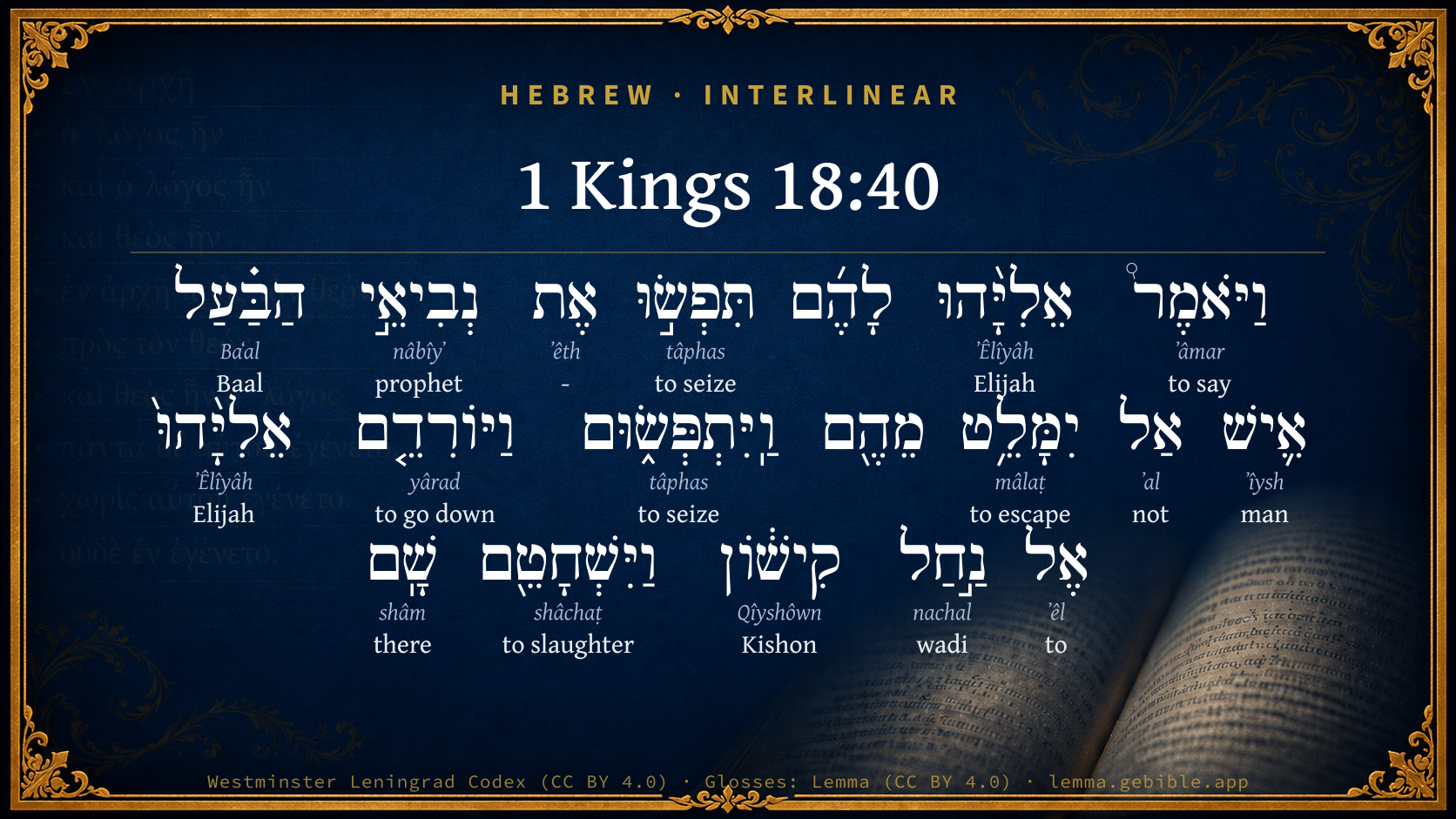
Hebrew (Westminster Leningrad Codex) 1 Kings 18:40 appears in the Hebrew Old Testament. The text above is from the Westminster Leningrad Codex. Each word links to its Strong’s number, a concise gloss, and parsing drawn from the Open Scriptures Hebrew Bible morphology. Click any word for its full Brown-Driver-Briggs (BDB) entry.
Download image
Cite this verse

1 Kings 18:40 (World English Bible). Public Domain. Lemma interlinear Bible study tool, https://lemma.gebible.app/v/1-kings/18/40.

Show BibTeX & RIS
BibTeX
RIS
English Translation
and Elijah said to them, Take the prophets of Baal; don't let one of them escape. They took them; and Elijah brought them down to the brook Kishon, and killed them there.
World English Bible · Public Domain
Download a study sheet

One document with this verse’s original text, its word-by-word gloss line, the meaning frame, cross-references with their text, attributed commentary, and full source and license credits — printable, and it pastes into notes with its structure intact.

This verse Autodidact and up

Study sheet (.html) Plain text (.txt)

A passage Seminary Student

Up to 50 verses in one chapter. A passage sheet keeps up to 6 commentary sources and 12 cross-references per verse, in the order this page ranks them, and says so on the sheet whenever that leaves anything out. Ask for a single verse and you get the Autodidact verse sheet above.

Everything on this page stays free to read, with no account — the sheet is a download of what is already on screen, not access to it.

Want to remove ads? Support Godless Engineer
Compare translations 3

The same verse in 3 English versions, stacked beneath the original-language interlinear above. Click any original word for its lexicon entry.

Each is an independent rendering of the whole verse — the interlinear is not word-aligned to these translations.

Highlighted words mark where these versions differ — a whole-verse word diff, not a word-by-word alignment.

  • World English Bible Public Domain
    and Elijah said to them, Take the prophets of Baal; don't let one of them escape. They took them; and Elijah brought them down to the brook Kishon, and killed them there.
  • King James Version Public Domain
    And Elijah said unto them, Take the prophets of Baal; let not one of them escape. And they took them: and Elijah brought them down to the brook Kishon, and slew them there.
  • unfoldingWord Literal Text CC BY-SA 4.0
    And Elijah said to them, “Seize the prophets of Baal! Do not let a man from them escape.” And they seized them. And Elijah led them down to the wadi Kishon, and he slaughtered them there.

unfoldingWord Literal Text — © unfoldingWord, licensed CC BY-SA 4.0. Word-aligned USFM3 via Door43 (git.door43.org/unfoldingWord/en_ult).

Versions to compare (up to 4)

3 of 4 selected

Show all 18 translations

Every available English version of this verse, each an independent rendering of the whole verse.

  • World English Bible Public Domain
    and Elijah said to them, Take the prophets of Baal; don't let one of them escape. They took them; and Elijah brought them down to the brook Kishon, and killed them there.
  • Berean Standard Bible Public Domain
    Then Elijah ordered them, “Seize the prophets of Baal! Do not let a single one escape.” So they seized them, and Elijah brought them down to the Kishon Valley and slaughtered them there.
  • Majority Standard Bible Public Domain
    Then Elijah ordered them, “Seize the prophets of Baal! Do not let a single one escape.” So they seized them, and Elijah brought them down to the Kishon Valley and slaughtered them there.
  • King James Version Public Domain
    And Elijah said unto them, Take the prophets of Baal; let not one of them escape. And they took them: and Elijah brought them down to the brook Kishon, and slew them there.
  • American Standard Version (1901) Public Domain
    and Elijah said unto them, Take the prophets of Baal; let not one of them escape. And they took them; and Elijah brought them down to the brook Kishon, and slew them there.
  • Revised Version (1885) Public Domain
    and Elijah said unto them, Take the prophets of Baal; let not one of them escape. And they took them: and Elijah brought them down to the brook Kishon, and slew them there.
  • Geneva Bible (1599) Public Domain
    And Elijah said vnto them, Take the prophets of Baal, let not a man of them escape. and they tooke them, and Eliiah brought them to the brooke Kishon, and slewe them there.
  • Douay-Rheims (1899) Public Domain
    And Elias said to them: Take the prophets of Baal, and let not one of them escape. And when they had taken them, Elias brought them down to the torrent Cison, and killed them there.
  • Young's Literal Translation Public Domain
    And Elijah saith to them, `Catch ye the prophets of Baal; let not a man escape of them;' and they catch them, and Elijah bringeth them down unto the stream Kishon, and doth slaughter them there.
  • Literal Standard Version CC BY-SA 4.0
    And Elijah says to them, “Catch the prophets of Ba‘al; do not let a man escape from them”; and they catch them, and Elijah brings them down to the Brook of Kishon, and slaughters them there.
  • Unlocked Literal Bible CC BY-SA 4.0
    So Elijah said to them, “Take the prophets of Baal. Do not let one of them escape.” So they took them, and Elijah brought the prophets of Baal down to the Kishon River and killed them there.
  • unfoldingWord Literal Text CC BY-SA 4.0
    And Elijah said to them, “Seize the prophets of Baal! Do not let a man from them escape.” And they seized them. And Elijah led them down to the wadi Kishon, and he slaughtered them there.
  • Darby Bible Public Domain
    And Elijah said to them, Seize the prophets of Baal; let not one of them escape! And they seized them; and Elijah brought them down to the torrent of Kishon, and slaughtered them there.
  • World Messianic Bible Public Domain
    Elijah said to them, “Seize the prophets of Baal! Don’t let one of them escape!” They seized them; and Elijah brought them down to the brook Kishon, and killed them there.
  • Webster's Bible Public Domain
    And Elijah said to them, Take the prophets of Baal; let not one of them escape. And they took them: and Elijah brought them down to the brook Kishon, and slew them there.
  • Free Bible Version CC BY-SA 4.0
    Then Elijah ordered them, “Grab hold of the prophets of Baal. Don't let any escape!” They grabbed them, and Elijah brought them down to the Kishon Valley and killed them there.
  • Bible in Basic English Public Domain
    And Elijah said to them, Take the prophets of Baal, let not one of them get away. So they took them, and Elijah made them go down to the stream Kishon, and put them to death there.
  • JPS Tanakh (1917) Public Domain
    And Elijah said unto them: 'Take the prophets of Baal; let not one of them escape.' And they took them; and Elijah brought them down to the brook Kishon, and slew them there.

Literal Standard Version (2020), Covenant Press — licensed CC BY-SA 4.0. Text via the HelloAO Bible API (eBible.org). Unlocked Literal Bible (unfoldingWord) — licensed CC BY-SA 4.0. Text via the HelloAO Bible API (eBible.org). unfoldingWord Literal Text — © unfoldingWord, licensed CC BY-SA 4.0. Word-aligned USFM3 via Door43 (git.door43.org/unfoldingWord/en_ult). Free Bible Version, Dr. Jonathan Gallagher — licensed CC BY-SA 4.0. Text via the HelloAO Bible API (eBible.org).

Word by word

More ways to search: Search by grammar → Find every occurrence → Compare this word →

Practice this passage: Drill this verse → Learn its vocabulary →

קִישׁ֔וֹן
Qîyshôwn
H7028
“Kishon”
Noun, Proper
Part of Speech
Noun
Type
Proper
Full BDB Definition

Origin: from H6983

TWOT: None

Kishon = "winding" - a river in central Palestine; scene of the defeat of Sisera by the Israelites in the time of the judges and the destruction of the prophets of Baal by Elijah
  1. וַיֹּאמֶר֩ ʼâmar H559 “and · to say” Conjunction + Verb, Qal, Sequential Imperfect, 3rd Person, Masculine, Singular
  2. אֵלִיָּ֨הוּ ʼÊlîyâh H452 “Elijah” Noun, Proper
  3. תִּפְשׂ֣וּ tâphas H8610 “seize” Verb, Qal, Imperative, 2nd Person, Masculine, Plural
  4. אֶת ʼêth H853 “-” Particle, Direct Object
  5. נְבִיאֵ֣י nâbîyʼ H5030 “prophets of” Noun, Common, Masculine, Plural, Construct
  6. הַבַּ֗עַל Baʻal H1168 “the · Baal” Particle, Definite Article + Noun, Proper
  7. אִ֛ישׁ ʼîysh H376 “man” Noun, Common, Masculine, Singular, Absolute
  8. אַל ʼal H408 “not” Particle, Negative
  9. יִמָּלֵ֥ט mâlaṭ H4422 “to escape” Verb, Niphal, Jussive, 3rd Person, Masculine, Singular
  10. וַֽיִּתְפְּשׂ֑וּם tâphas H8610 “and · to seize · them” Conjunction + Verb, Qal, Sequential Imperfect, 3rd Person, Masculine, Plural + Suffix, Personal, 3rd Person, Masculine, Plural
  11. וַיּוֹרִדֵ֤ם yârad H3381 “and · to go down · them” Conjunction + Verb, Hiphil, Sequential Imperfect, 3rd Person, Masculine, Singular + Suffix, Personal, 3rd Person, Masculine, Plural
  12. אֵלִיָּ֨הוּ֙ ʼÊlîyâh H452 “Elijah” Noun, Proper
  13. אֶל ʼêl H413 “to” Preposition
  14. נַ֣חַל nachal H5158 “wadi of” Noun, Common, Masculine, Singular, Construct
  15. וַיִּשְׁחָטֵ֖ם shâchaṭ H7819 “and · to slaughter · them” Conjunction + Verb, Qal, Sequential Imperfect, 3rd Person, Masculine, Singular + Suffix, Personal, 3rd Person, Masculine, Plural
  16. שָֽׁם shâm H8033 “there” Adverb

About this verse

These counts appear in no published source. They are computed here, from the morphology-tagged text and Lemma’s own curated glosses. What Lemma adds →

19
words
15
distinct lemmas
Historical
section

Notable vocabulary

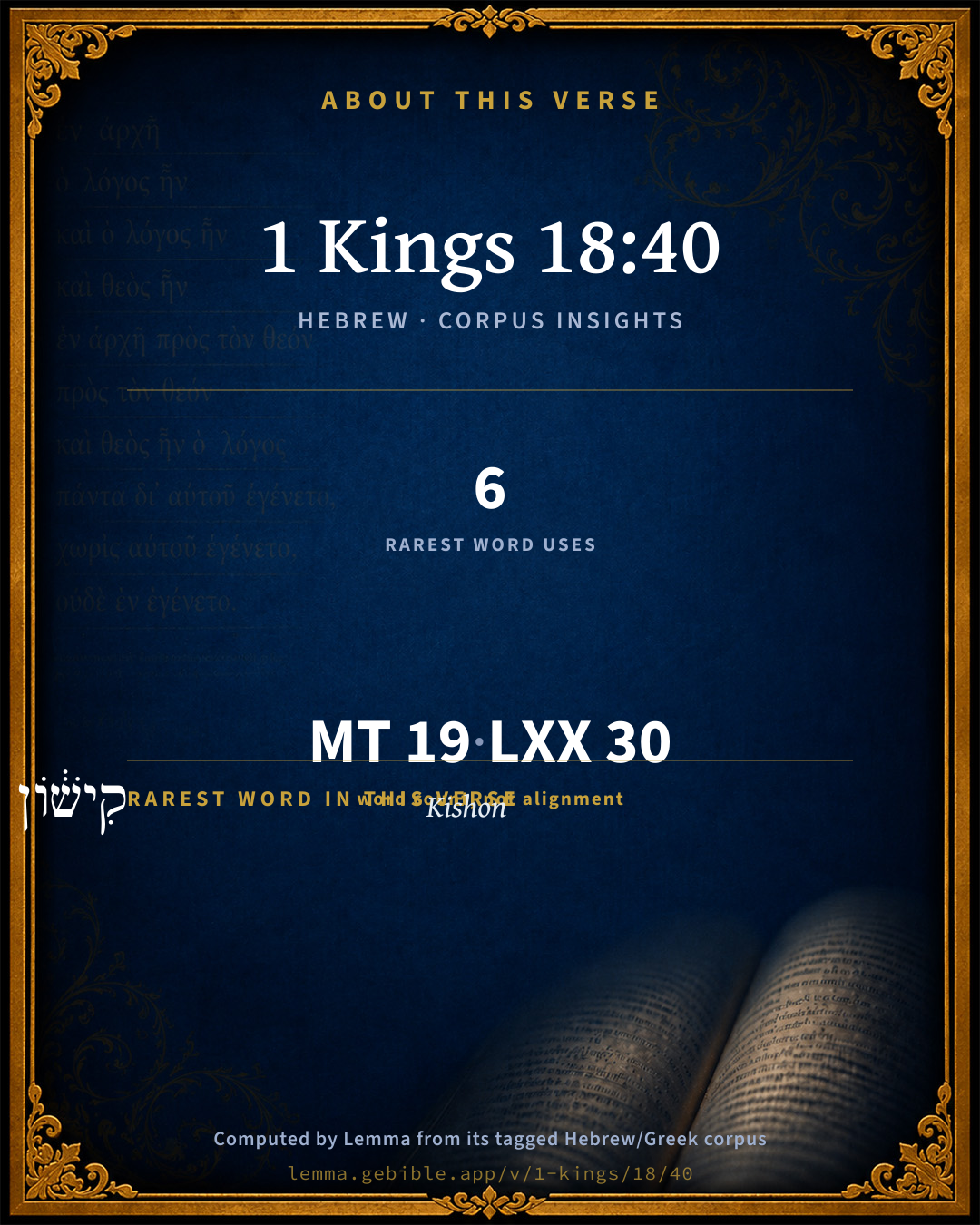
The rarest word here is קִישׁ֔וֹן Kishon H7028 — appearing just 6 times in the whole Hebrew Bible.

Shared distinctive vocabulary

קִישׁ֔וֹן Kishon H7028 occurs in 5 verses of the Hebrew Bible. Also found in:

Grammatical profile

  • 6 verbs
  • 7 nouns
  • 3 prepositions
  • 1 adverb
  • 2 particles

Verb forms

  • וַיֹּאמֶר֩ Qal · Sequential Imperfect
  • תִּפְשׂ֣וּ Qal · Imperative
  • יִמָּלֵ֥ט Niphal · Jussive
  • וַֽיִּתְפְּשׂ֑וּם Qal · Sequential Imperfect
  • וַיּוֹרִדֵ֤ם Hiphil · Sequential Imperfect
  • וַיִּשְׁחָטֵ֖ם Qal · Sequential Imperfect

Repetition

Words recur within this verse — often emphatic in Hebrew:

  • אֵלִיָּ֨הוּ Elijah H452 ×2
  • תִּפְשׂ֣וּ to seize H8610 ×2

Hebrew & Septuagint length

In English translation the verse runs 32 words from the Hebrew and 35 from the Septuagint (LXX English) — closely comparable.

A rough comparison of the two English renderings, which tokenize alike — not a word-level alignment.

Word counts can differ between the Hebrew and the Greek without any difference in meaning — e.g. the Hebrew direct-object marker אֵת has no separate Greek word, and Greek often adds the article ὁ.

In the original languages it is 19 Hebrew tokens and 30 Greek tokens — but the two are counted differently (Hebrew bundles its prefixes and suffixes into one token; the Greek is in lemma form), so that isn’t a like-for-like length.

Cross-references

9

Topical passages linked to 1 Kings 18:40 in the Treasury of Scripture Knowledge — connected by theme and wording, ordered by reader-vote popularity; previews shown in the World English Bible.

  • Deuteronomy 18:20 But the prophet, who shall speak a word presumptuously in my name, which I have not commanded him to speak, or who shall speak in the name of other gods, that same prophet shall die.
  • Judges 4:7 I will draw to you, to the river Kishon, Sisera, the captain of Jabin's army, with his chariots and his multitude; and I will deliver him into your hand.
  • Deuteronomy 13:5 That prophet, or that dreamer of dreams, shall be put to death, because he has spoken rebellion against Yahweh your God, who brought you out of the land of Egypt, and redeemed you out of the house of bondage, to draw you aside out of the way which Yahweh your God commanded you to walk in. So shall you put away the evil from the midst of you.
  • Judges 5:21 The river Kishon swept them away, That ancient river, the river Kishon. My soul, march on with strength.
  • Zechariah 13:2–3 It will come to pass in that day, says Yahweh of Hosts, that I will cut off the names of the idols out of the land, and they will no more be remembered; and also I will cause the prophets and the spirit of impurity to pass out of the land.
  • 2 Kings 10:24–25 They went in to offer sacrifices and burnt offerings. Now Jehu had appointed him eighty men outside, and said, If any of the men whom I bring into your hands escape, [he who lets him go], his life shall be for the life of him.
  • Jeremiah 48:10 Cursed be he who does the work of Yahweh negligently; and cursed be he who keeps back his sword from blood.
  • Revelation 19:20 The beast was taken, and with him the false prophet who worked the signs in his sight, with which he deceived those who had received the mark of the beast and those who worshiped his image. These two were thrown alive into the lake of fire that burns with sulfur.
  • Revelation 20:10 The devil who deceived them was thrown into the lake of fire and sulfur, where the beast and the false prophet are also. They will be tormented day and night forever and ever.

Cross-references courtesy of OpenBible.info (CC BY 4.0).

Hebrew and Greek witnesses Masoretic Hebrew ↔ Greek Septuagint

The same verse in the two great witnesses to the Old Testament, shown verse-for-verse.

These are two independent witnesses, not word-aligned to each other, and the Septuagint is shown in lemma (dictionary) form.

Hebrew 1 Kings 18:40 Masoretic · Westminster Leningrad Codex

וַיֹּאמֶר֩ אֵלִיָּ֨הוּ לָהֶ֜ם תִּפְשׂ֣וּ אֶת נְבִיאֵ֣י הַבַּ֗עַל אִ֛ישׁ אַל יִמָּלֵ֥ט מֵהֶ֖ם וַֽיִּתְפְּשׂ֑וּם וַיּוֹרִדֵ֤ם אֵלִיָּ֨הוּ֙ אֶל נַ֣חַל קִישׁ֔וֹן וַיִּשְׁחָטֵ֖ם שָֽׁם

and Elijah said to them, Take the prophets of Baal; don't let one of them escape. They took them; and Elijah brought them down to the brook Kishon, and killed them there.

World English Bible · Public Domain

Greek LXX 1 Kings 18:40 Septuagint · lemma form

καί εἶπον ηλιου πρός ὁ λαός συνλαμβάνω ὁ προφήτης ὁ βααλ μηδείς σώζω ἐκ αὐτός καί συνλαμβάνω αὐτός καί καταἄγω αὐτός ηλιου εἰς ὁ χειμάρρους κισων καί σφάζω αὐτός ἐκεῖ

And Eliu said to the people, Take the prophets of Baal; let not one of them escape. And they took them; and Eliu brings them down to the brook Kisson, and he killed them there.

LXX2012 (modern English Septuagint) · Public Domain

Hebrew: Westminster Leningrad Codex (CC BY 4.0). Greek: Septuagint (public domain); English from LXX2012 (modern English Septuagint) (Public Domain). How the Septuagint differs from the Hebrew →

Targum (Aramaic paraphrase)

1

The Targum is the ancient Jewish Aramaic paraphrase of the Hebrew Scriptures — an interpretive translation, not the Hebrew text itself. Onkelos (literal) and Pseudo-Jonathan (expansive) render the Torah, and Jonathan the Prophets. Coverage is partial: where no permissively-licensed English translation exists for a verse, only the Aramaic is shown. This is verse-level text, not a word-by-word alignment to the Hebrew.

  1. Targum Jonathan Prophets (Joshua–Malachi)
    וַאֲמַר אֵלִיָהוּ לְהוֹן אֲחוּדוּ יַת נְבִיֵי בַעֲלָא גְבַר אַל יִשְׁתֵּיזֵיב מִנְהוֹן וְאַחְדוּנוּן וַאֲחָתִינוּן אֵלִיָהוּ לְנַחְלָא דְקִישׁוֹן וְנַכְסִינוּן תַּמָן:

    (no public-domain English translation for this verse)

    Targum Jonathan — Aramaic: “Mikraot Gedolot” (public domain). English: “Sefaria Community Translation” (CC0 1.0 (public-domain dedication)); “London "Chaldee Paraphrase," 1871” (public domain). Text via Sefaria.

Commentary

Notes on 1 Kings 18:40 from classic Christian and Jewish commentators (each source and its license shown beneath its notes). The classic Christian expositions comment on the surrounding passage and are grouped to its opening verse, so a note may address several verses; the Jewish commentaries on the Tanakh (Rashi and others) are per-verse, so they appear only where the commentator wrote on this verse.

Lemma curates 59 commentaries, every one of them public domain or Creative Commons licensed, each selected and text-cleaned for this edition rather than reprinted as found. About our sources →

Trapp's Complete Commentary

John Trapp

1Ki 18:40 And Elijah said unto them, Take the prophets of Baal; let not one of them escape. And they took them: and Elijah brought them down to the brook Kishon, and slew them there.

Ver. 40. And they took them.] The recent miracle had made them submissive.

To the brook Kishon.] Haply, to testify that because of their idolatry God’s hand was upon the brooks and rivers.

John Trapp, A Commentary or Exposition upon All the Books of the Old and New Testament (1647–1656) — public domain. Text from a community e-Sword module.

The Biblical Illustrator

Joseph S. Exell

1Ki_18:40

Take the prophets of Baal; let not one of them escape.

The true narrowness

Elijah was intolerant--narrow, as some would call it. Dr. Cadman says that some things must be narrow in order to do their work. You want a narrow edge on your razor. About the broadest thing in the world is the Desert of Sahara. No Christian should attempt a compromise between wrong and right.

The Biblical Illustrator, edited by Joseph S. Exell (c. 1880s–1900s) — public domain. Text from a community e-Sword module.

Joseph Benson's Commentary

1Ki 18:40. Elijah said, Take the prophets of Baal — He takes the opportunity of ordering the execution of these idolaters, while the people’s hearts wore warm with the fresh sense of this great miracle. And they took them — For the people, in that fit of zeal wherein they now were, readily obeyed Elijah’s command, and executed the sentence he pronounced. And Ahab could make no opposition, being himself also, it is likely, astonished at the stupendous miracle. And Elijah brought them down to the brook Kishon — That their blood might be poured into that river, and thence conveyed into the sea, and might not defile the holy land. And slew them there — Or, ordered them to be slain by the people. As these idolatrous priests were manifestly under a sentence of death, passed upon such by the sovereign Lord of life and death, so Elijah had authority to execute it, being a prophet, and an extraordinary minister of God’s vengeance. The four hundred prophets of the groves, it seems, did not attend, and so escaped, which perhaps Ahab rejoiced in: but it proved, they were reserved to be the instruments of his destruction, by encouraging him to go up to Ramoth-Gilead.

Joseph Benson's Commentary on the Old and New Testaments (1811–1818) — public domain. Text from a community e-Sword module.

Geneva Bible (1599)

Geneva Bible translators

He commanded them that as they were truly persuaded to confess the only God: so they would serve him with all their power, and destroy the idolaters his enemies.

Geneva Bible (1599) marginal notes — public domain. Text via Bolls.life.

Adam Clarke's Commentary

Verse 40. Let not one of them escape.] They had committed the highest crime against the state and the people by introducing idolatry, and bringing down God's judgments upon the land; therefore their lives were forfeited to that law which had ordered every idolater to be slain. It seems also that Ahab, who was present, consented to this act of impartial justice.

Adam Clarke's Commentary on the Bible (1810–1826) — public domain. Text from a community e-Sword/MySword module.

Ellicott's Commentary for English Readers

(40) Slew them.—This ruthless slaughter of Baal’s prophets, as a judgment on their idolatry and perversion of the people, belongs alike to the fierce righteousness of the character of Elijah, and to the spirit of the old Law. (See, for example, Deu_13:6-18; Deu_17:2-7.) The law was adapted (as in the terrible crucial example of the slaughter of the Canaanites) to the “hardness of men’s hearts.” In the imperfect moral and religious education of those times, it did not recognise the difference between moral and political offences punishable by human law, and the religious sin or apostasy which we have been taught to leave to the judgment of God alone; and it enjoined an unrelenting severity in the execution of righteous vengeance, which would be morally impossible to us, who have been taught to hate the sin, and yet spare, as far as possible, the sinner. The frequent quotation of such examples by Christians—of which Luk_9:54 is the first example—is a spiritual anachronism. In this particular case, however, it is also to be remembered that those slain were no doubt implicated in the persecution headed by Jezebel, and that the Baal-worship was a licentious and perhaps bloody system. Elijah, presiding over the slaughter which dyed the waters of the Kishon with blood, felt himself the avenger of the slaughtered prophets, as well as the instrument of the judgment of God.

A Bible Commentary for English Readers, edited by Charles John Ellicott (1878–1897) — public domain. Text from a community e-Sword module.

The Cambridge Bible for Schools and Colleges

gen. ed. J. J. S. Perowne

40. Take the prophets of Baal] Elijah avails himself of the newlykindled enthusiasm to put an end, as far as he may, to the false worship. Josephus explains ‘they seized and slew the prophets, Elijah exhorting them so to do.’ Although the text may be taken to signify that Elijah put the priests to death with his own hand, we can hardly suppose this to have been so. He is only said to do himself what he caused others to do.

the brook Kishon] This is at the foot of Mount Carmel on the side towards the sea. It was the spot where Sisera was overthrown by Barak (Jdg_4:7) and the stream then was pictured as sweeping away the dead bodies of those who had been slain by the Israelite forces (Jdg_5:21).

The Cambridge Bible for Schools and Colleges (gen. ed. J. J. S. Perowne; Cambridge University Press, 1878–1918) — public domain. Text from a community e-Sword module.

John Gill's Exposition

So Ahab went up to eat and to drink,.... Up to his chariot, as some think, or rather to some place higher than that in which he now was:

and Elijah went up to the top of Carmel; higher still, where he both might be alone, and have the opportunity of observing the clouds gathering, and the rain coming:

and he cast himself down upon the earth, and put his face between his knees; expressive of his humility, and of his earnestness, and vehement desire, and continued importunity, that rain might fall; for this was a posture of prayer he put himself into, and continued in; and it is certain that it was through his prayer that rain came, Jam 5:18 and from hence came the fable of the Grecians concerning Aeacus praying for rain in a time of drought, when it came (h). So the Chinese writers (i) report that at the prayers of their emperor Tangus, after a seven years' drought, great rains fell.

(h) Pausan. Attica, sive, l. 1. prope finem. Isocrat. Evagoras, p. 373. (i) Martin. Sinic. Hist. l. 3. p. 60.

John Gill's Exposition of the Whole Bible (1746–1763) — public domain (CC PDM 1.0). Text via the HelloAO Bible API.

Albert Barnes' Notes on the Bible

Elijah required the people to show their conviction by acts - acts which might expose them to the anger of king or queen, but which once committed would cause them to break with Baal and his worshippers forever.

Elijah is said to have slain the “prophets of Baal,” because the people killed them by his orders. Why they were brought down to the torrent-bed of Kishon to be killed, is difficult to explain. Perhaps the object of Elijah was to leave the bodies in a place where they would not be found, since the coming rain would, he knew, send a flood down the Kishon ravine, and bear off the corpses to the sea. Elijah’s act is to be justified by the express command of the Law, that idolatrous Israelites were to be put to death, and by the right of a prophet under the theocracy to step in and execute the Law when the king failed in his duty.

Albert Barnes' Notes on the Bible (1834–1885) — public domain. Text from a community e-Sword/MySword module.

Haydock's Catholic Bible Commentary

Cison, at the foot of Carmel. (Adrichomius) --- Achab durst not protect his prophets, being confounded by the evidence of the miracle, (Menochius) and the unanimity of the people’s cry. (Haydock) --- Killed them, by God’s inspiration, (Calmet) as impostors, who had deluded the people, and were worthy of death.

George Leo Haydock (1774–1849), Haydock's Catholic Family Bible and Commentary, 1859 edition — public domain. Excludes Psalms (Douay-Rheims chapter numbering differs from Protestant) and Deuterocanonical books (Catholic canon only).

Matthew Poole's English Annotations

Elijah said unto them; he takes the opportunity, whilst the people’s hearts were warm with the fresh sense of this great miracle.

Elijah brought them down to the brook Kishon, that their blood might be poured into that river, and thence conveyed into the sea, and might not defile the holy land.

Slew them there.

Quest. How could Elijah do this, seeing he was but a private person?

Answ. First, he had no doubt the consent of all the heads of the people, who were there assembled; and of the king too, who durst not resist the universal torrent, and could not deny that they were impostors, and worthy of death; and probably was by the prophet assured of rain when this was done.

Answ. Secondly, As these idolatrous priests were manifestly under a sentence of death, passed upon such by the sovereign Lord of life and death, Deu 13; Deu 17; so Elijah had sufficient authority to execute it, as being a prophet, and an extraordinary minister of God’s vengeance against sinners, now especially when the magistrate so grossly neglected his duty therein.

Matthew Poole's English Annotations on the Holy Bible (1683–1685) — public domain. Text from a community e-Sword/MySword module.

Whedon's Commentary on the Bible

Daniel D. Whedon

40. Take the prophets of Baal — Take them prisoners; lay hold upon them as criminals worthy of immediate death. The order was addressed to the obedient multitude, now all enthusiasm to vindicate Jehovah’s honour.

Down to the brook Kishon — Which flows along the very base of Carmel. See note on 1Ki_18:35. “With regard to the place where the slaughter took place, there is general agreement. The path down the mountain, after passing the fountain,… continues with no great windings almost directly towards Tell Kussis, a commanding hill on the opposite side of the Kishon, but very near it. It is a spur from the hills which bound the plain of Esdraelon on the north, close by where the plain contracts into the narrow valley which connects it with the plain of Akka. Its name, signifying hill of the priests, is not improbably derived from the fact of the slaughter of the prophets of Baal, which must have taken place near it.” — PROF. MEAD, in Bibliotheca Sacra, 1873, p. 685.

Slew them there — Here we may see some retaliation for Jezebel’s slaughter of the prophets of Jehovah. See 1Ki_18:4. But we must not judge this act of Elijah on the principles of Christian ethics, but by the spirit and letter of the Mosaic economy. The law commanded that the devotees of idolatry should be punished with death. See Deu_13:1-15; Deu_17:2-4; Deu_18:20. And so great was the passion with which the people, at the order of Elijah, helped to execute the law in this case, that Ahab, who was present, had no power or apparent disposition to interfere. On the moral principle involved in this slaughter of the Baal prophets, see notes on 1Ki_2:24; 2Sa_12:31.

Daniel D. Whedon (gen. ed.), Commentary on the Old and New Testaments (1874–1909) — public domain. Text from a community e-Sword module.

The Pulpit Commentary

And Elijah said unto them, Take the prophets of Baal; let not one of them escape. Elijah"s promptitude is extremely striking. The people had hardly recovered from their terror and awe before he proceeds to judgment. The narrative has the air of truth, and was doubtless reduced to writing by an eye-witness. And they took them: and Elijah brought them down Heb. caused them to go down, i.e., had them brought down. He could but lead the way, as they numbered 450 to the brook Wady. "Like most of the so called "rivers of Palestine," the perennial stream forms but a small part of the Kishon" (Grove) Kishon "Tortuous," now called Nahr el Mukatta, the "river of slaughter." See Thomson, L. and B. 2. pp. 140, 141; Porter, pp. 383-4; Dict. Bib. 2.p.45. It flows directly underCarmel, and slew them there. Obviously, he merely superintended the slaughter. That he slew them all with his own hand is altogether out of the question. Nor is it clear that" sword in hand he stood over them" (Stanley). Josephus rightly explains: "they slew the prophets at Elijah"s instigation." It is almost certain, from their resorting to the Kishon for this purpose, that it was not quite dry at the time. Their blood would mingle with its waters, and the flood which the "great rain" would presently produce (cf. Jud_1:5:21) would carry their corpses down to the sea. It has often been supposed that the mound near the Kishon, known as Tell el Cassis, "the mound of the priests," derives its name from this slaughter of the prophets of Baal. But Conder (p. 90) remarks that "Kassis is the word applied to a Christian priest, and the word Kohen or Kamir would more naturally be expected if there was any real connexion with the idolatrous priests of Baal.

This action of the prophet Elijah in instituting this wholesale slaughter in the hour of his triumph has been repeatedly arraigned and denounced, but most unjustly. According to some, it was an act of gross fanaticism and cruelty; others have seen it in a wild and terrible vendetta for the murder of the Lord"s prophets. By some, indeed, it has been justified on the principles of the lex talionis; (Exo_21:24, etc.) on the ground, that is to say, that the men who had instigated Jezebel in her attempted extermination of the prophetic schools had merited extermination in their turn. But it is a fatal objection to their view, first, that we not only have no proof, but no reason for thinking, that it was at their instigation that the queen "cut off the prophets of the Lord;" and, secondly, that it is not clear that she succeeded in her sanguinary purpose, or that many lives were sacrificed to her fury. And Elljah"s action needs no such lame apologies. As the Lord"s prophet, as the vindicator and restorer of the law, there was no other course open to him. If the Mosaic law was then written, and this very incident is one of the proofs that it was then written; if, however it had fallen into contempt or desuetude, it was still binding upon Israel; and if Elijah was justified in executing its provisions, and was required to execute them, however repugnant they might be to his inclinations (Deu_27:26; Gal_3:10) then he could not have done otherwise than he did. For it was an essential part of that law, it was an obligation that was laid, not once or twice, but on three separate occasions, (Exo_22:20 Deu 13:17:2-7) on the Jewish people, it was a duty they were to perform, however distressing and harrowing it might be, (Deu_13:6-9) to provide that the worshipper of false gods, and especially the teacher of such worship, should be put to death. It was primarily, of course, the duty of the authorities, of the theocratic king and his subordinates, to execute these injunctions. But the king of that age was corrupt and powerless nay, was himself idolatrous. So great was the depravity of the time that the false prophet enjoyed the favour and protection of the court, and the true prophet was everywhere being hunted to death. The execution of this law, consequently, could not be expected from the king. It must be executed, if at all, in spite of him, and in disregard of his protests. It was only Elijah, therefore, could put it into force, and Elijah only in the hour of his triumph. And the jus zelotyparum, the right claimed by every faithful Jew to execute vengeance, after the example of Phinehas, (Num_25:11) upon any gross breach of the Divine law committed in his presence, was not his only warranty; he held a commission, higher than the king"s, as the prophet of the Most High. He had just proved that the Lord He was God. It was now for him to prove that God"s law was no dead letter. It was for him to cut off the men some of them renegades from the faith of Israel, some of them foreign emissaries introduced into the land who had corrupted his countrymen, and threatened the very existence of the true religion. It is necessary, therefore, for those who challenge his conduct in this respect, who call him sanguinary, vindictive, etc., to settle their account with the law which he obeyed, and, indeed, with Him who has approved this deed, and has forewarned us that He too will act in like manner. (Luk_19:27) For this terrible retribution is by no means an exceptional or isolated act, in contrast to the general spirit of that dispensation; on the contrary, it is in thorough accord with the system out of which it sprung. We gain nothing, therefore, by repudiating this one transaction. For clearly, in the first place, it was allowed and approved of God, who otherwise would hardly have answered the prayer which Elijah presently offered, and (2) other similar acts have distinctly received Divine commendation (Exo_32:25-28; Num_25:7-13; 2Ki_1:9 sqq.) It is true that the spirit of Elias was not the spirit of Christianity, (Luk_9:56) but it is forgotten how different was the dispensation of Elijah from that of the New Covenant. In that age idolaters must receive their just recompense of reward, because the judgment to come had not then been revealed; because justice must be measured out to men in this life. We do not avenge idolatry or irreligion now with fire and sword, not because the thing is any the less sinful, but because the duty has been taken out of our hands; because our religion instructs us to leave it to Him who has said, "Vengeance is Mine," etc. It is perhaps worth remarking here that there is nothing in this history half so dreadful as might be seen on a thousand battlefields and those not battlefields for truth and right on which, nevertheless, Elijah"s critics have learned to look with complacency. It may, however, be objected to this view that the punishment denounced by the law was stoning. (Deu_13:10 Deu_17:5) But surely it is easy to see why, in this particular, the law was not kept. It was simply that the exigency of the occasion did not permit of its being kept. It was because the 450 traitors to God and their country could not be stoned within the few hours that remained before the night closed in and the multitude dispersed, that a more speedy punishment, that of the sword, was adopted. And it would have been a sacrifice of the spirit of the law to the letter had some few false prophets been stoned and the rest thereby been afforded the opportunity to escape, and, under Jezebel"s protection, to renew their efforts against truth and morality and religion.

The Pulpit Commentary (1880–1919), ed. H.D.M. Spence-Jones & Joseph S. Exell — public domain. Text from a community e-Sword module.

John Wesley's Explanatory Notes

Elijah said - He takes the opportunity, whilst the peoples hearts were warm with the fresh sense of this great miracle. The brook Kishon - That their blood might be poured into that river, and thence conveyed into the sea, and might not defile the holy land. Slew them - As these idolatrous priests were manifestly under a sentence of death, passed upon such by the sovereign Lord of life and death, so Elijah had authority to execute it, being a prophet, and an extraordinary minister of God's vengeance. The four hundred prophets of the groves, it seems, did not attend, and so escaped, which perhaps Ahab rejoiced in. But it proved, they were reserved to be the instruments of his destruction, by encouraging him to go up to Ramoth-Gilead.

John Wesley, Explanatory Notes Upon the Whole Bible (1754–1765) — public domain. Text via the GEBible commentary corpus.

Lesson kit

Teaching starters — assembled from the data on this page, not authored interpretation. Every prompt links to the verse data it draws on. Edit before teaching.

1 Kings, in the Historical, opens this verse with 19 words (15 distinct Hebrew lemmas). Its most distinctive word is Qîyshôwn (“Kishon”). A historical commentator’s framing appears above. Read the whole chapter for the surrounding context.

Discussion questions

  1. How does “Kishon” (Qîyshôwn) shape what this verse is saying?
  2. Judges 4:7 shares the word «Kishon» with this verse. How do the two illuminate each other?
  3. “Elijah” occurs 2× in this one verse. What is the effect of the repetition?
  4. These translations render this verse differently. What is at stake in choosing one wording over another?
  5. The verb «וַיֹּאמֶר֩» is Qal Sequential Imperfect. How does its form color the action?
  6. Reading how Trapp's Complete Commentary and The Biblical Illustrator read this verse, where do the two commentators agree and where do they part?

Things to notice

Reading settings

Reading text

Shown beneath each verse's original-language words.

Old Testament
Old Testament edition

Read the OT as the Masoretic Hebrew (MT) or the Greek Septuagint (LXX).

English shown for the Greek Septuagint (in the Hebrew ↔ Greek comparison).

Comparing translations? Open the Compare panel on any verse page to stack up to four side by side.