
1 Kings 8:57

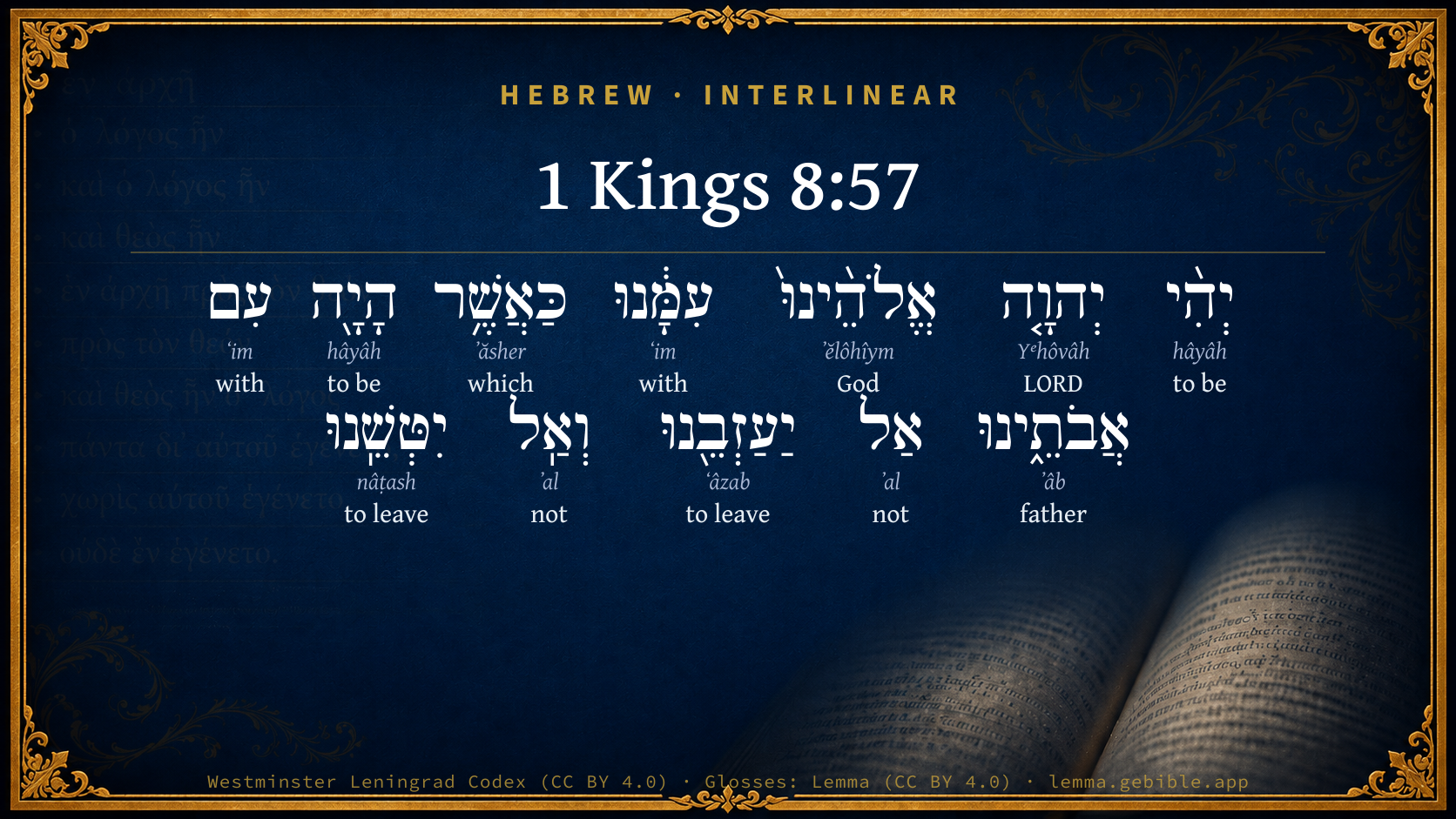
Hebrew (Westminster Leningrad Codex) 1 Kings 8:57 appears in the Hebrew Old Testament. The text above is from the Westminster Leningrad Codex. Each word links to its Strong’s number, a concise gloss, and parsing drawn from the Open Scriptures Hebrew Bible morphology. Click any word for its full Brown-Driver-Briggs (BDB) entry.
Download image
Cite this verse

1 Kings 8:57 (World English Bible). Public Domain. Lemma interlinear Bible study tool, https://lemma.gebible.app/v/1-kings/8/57.

Show BibTeX & RIS
BibTeX
RIS
English Translation
Yahweh our God be with us, as he was with our fathers: let him not leave us, nor forsake us;
World English Bible · Public Domain
Download a study sheet

One document with this verse’s original text, its word-by-word gloss line, the meaning frame, cross-references with their text, attributed commentary, and full source and license credits — printable, and it pastes into notes with its structure intact.

This verse Autodidact and up

Study sheet (.html) Plain text (.txt)

A passage Seminary Student

Up to 50 verses in one chapter. A passage sheet keeps up to 6 commentary sources and 12 cross-references per verse, in the order this page ranks them, and says so on the sheet whenever that leaves anything out. Ask for a single verse and you get the Autodidact verse sheet above.

Everything on this page stays free to read, with no account — the sheet is a download of what is already on screen, not access to it.

Want to remove ads? Support Godless Engineer
Compare translations 3

The same verse in 3 English versions, stacked beneath the original-language interlinear above. Click any original word for its lexicon entry.

Each is an independent rendering of the whole verse — the interlinear is not word-aligned to these translations.

Highlighted words mark where these versions differ — a whole-verse word diff, not a word-by-word alignment.

  • World English Bible Public Domain
    Yahweh our God be with us, as he was with our fathers: let him not leave us, nor forsake us;
  • King James Version Public Domain
    The LORD our God be with us, as he was with our fathers: let him not leave us, nor forsake us:
  • unfoldingWord Literal Text CC BY-SA 4.0
    May Yahweh our God be with us, just as he was with our fathers. May he not forsake us and may he not abandon us,

unfoldingWord Literal Text — © unfoldingWord, licensed CC BY-SA 4.0. Word-aligned USFM3 via Door43 (git.door43.org/unfoldingWord/en_ult).

Versions to compare (up to 4)

3 of 4 selected

Show all 18 translations

Every available English version of this verse, each an independent rendering of the whole verse.

  • World English Bible Public Domain
    Yahweh our God be with us, as he was with our fathers: let him not leave us, nor forsake us;
  • Berean Standard Bible Public Domain
    May the LORD our God be with us, as He was with our fathers. May He never leave us nor forsake us.
  • Majority Standard Bible Public Domain
    May the LORD our God be with us, as He was with our fathers. May He never leave us or forsake us.
  • King James Version Public Domain
    The LORD our God be with us, as he was with our fathers: let him not leave us, nor forsake us:
  • American Standard Version (1901) Public Domain
    Jehovah our God be with us, as he was with our fathers: let him not leave us, nor forsake us;
  • Revised Version (1885) Public Domain
    The LORD our God be with us, as he was with our fathers: let him not leave us, nor forsake us:
  • Geneva Bible (1599) Public Domain
    The Lord our God be with vs, as he was with our fathers, that he forsake vs not, neither leaue vs,
  • Douay-Rheims (1899) Public Domain
    The Lord our God be with us, as he was with our fathers, and not leave us, nor cast us off:
  • Young's Literal Translation Public Domain
    `Jehovah our God is with us as He hath been with our fathers; He doth not forsake us nor leave us;
  • Literal Standard Version CC BY-SA 4.0
    Our God YHWH is with us as He has been with our fathers; He does not forsake us nor leave us;
  • Unlocked Literal Bible CC BY-SA 4.0
    May Yahweh our God be with us, as he was with our ancestors. May he never leave us or forsake us,
  • unfoldingWord Literal Text CC BY-SA 4.0
    May Yahweh our God be with us, just as he was with our fathers. May he not forsake us and may he not abandon us,
  • Darby Bible Public Domain
    Jehovah our God be with us, as he was with our fathers; let him not forsake us nor cast us off:
  • World Messianic Bible Public Domain
    May the LORD our God be with us as he was with our fathers. Let him not leave us or forsake us,
  • Webster's Bible Public Domain
    The LORD our God be with us, as he was with our fathers: let him not leave us, nor forsake us:
  • Free Bible Version CC BY-SA 4.0
    May the Lord our God be with us in the same way he was with our forefathers. May he never leave us or abandon us.
  • Bible in Basic English Public Domain
    Now may the Lord our God be with us as he was with our fathers; let him never go away from us or give us up;
  • JPS Tanakh (1917) Public Domain
    The LORD our God be with us, as He was with our fathers; let Him not leave us, nor forsake us;

Literal Standard Version (2020), Covenant Press — licensed CC BY-SA 4.0. Text via the HelloAO Bible API (eBible.org). Unlocked Literal Bible (unfoldingWord) — licensed CC BY-SA 4.0. Text via the HelloAO Bible API (eBible.org). unfoldingWord Literal Text — © unfoldingWord, licensed CC BY-SA 4.0. Word-aligned USFM3 via Door43 (git.door43.org/unfoldingWord/en_ult). Free Bible Version, Dr. Jonathan Gallagher — licensed CC BY-SA 4.0. Text via the HelloAO Bible API (eBible.org).

Word by word

More ways to search: Search by grammar → Find every occurrence → Compare this word →

Practice this passage: Drill this verse → Learn its vocabulary →

יִטְּשֵֽׁנוּ
nâṭash
H5203
“to leave · us”
Verb, Qal, Jussive, 3rd Person, Masculine, Singular + Suffix, Personal, 1st Person, Common, Plural
Part of Speech
Verb
Stem
Qal
Form
Jussive
Person
3rd Person
Gender
Masculine
Number
Singular
Full BDB Definition

Origin: a primitive root

TWOT: 1357

to leave, permit, forsake, cast off or away, reject, suffer, join, spread out or abroad, be loosed, cease, abandon, quit, hang loose, cast down, make a raid, lie fallow, let fall, forgo, draw - (Qal) - to leave, let alone, lie fallow, entrust to - to forsake, abandon - to permit - (Niphal) - to be forsaken - to be loosened, be loose - to be let go, spread abroad - (Pual) to be abandoned, be deserted
  1. יְהִ֨י hâyâh H1961 “to be” Verb, Qal, Jussive, 3rd Person, Masculine, Singular
  2. יְהוָ֤ה Yᵉhôvâh H3068 “LORD” Noun, Proper
  3. אֱלֹהֵ֨ינוּ֙ ʼĕlôhîym H430 “God(s) · our” Noun, Common, Masculine, Plural, Construct + Suffix, Personal, 1st Person, Common, Plural
  4. עִמָּ֔נוּ ʻim H5973 “with · us” Preposition + Suffix, Personal, 1st Person, Common, Plural
  5. כַּאֲשֶׁ֥ר ʼăsher H834 “like/as · which” Preposition + Particle, Relative
  6. הָיָ֖ה hâyâh H1961 “to be” Verb, Qal, Perfect, 3rd Person, Masculine, Singular
  7. עִם ʻim H5973 “with” Preposition
  8. אֲבֹתֵ֑ינוּ ʼâb H1 “fathers · our” Noun, Common, Masculine, Plural, Construct + Suffix, Personal, 1st Person, Common, Plural
  9. אַל ʼal H408 “not” Particle, Negative
  10. יַעַזְבֵ֖נוּ ʻâzab H5800 “to leave · us” Verb, Qal, Jussive, 3rd Person, Masculine, Singular + Suffix, Personal, 1st Person, Common, Plural
  11. וְאַֽל ʼal H408 “and · not” Conjunction + Particle, Negative

About this verse

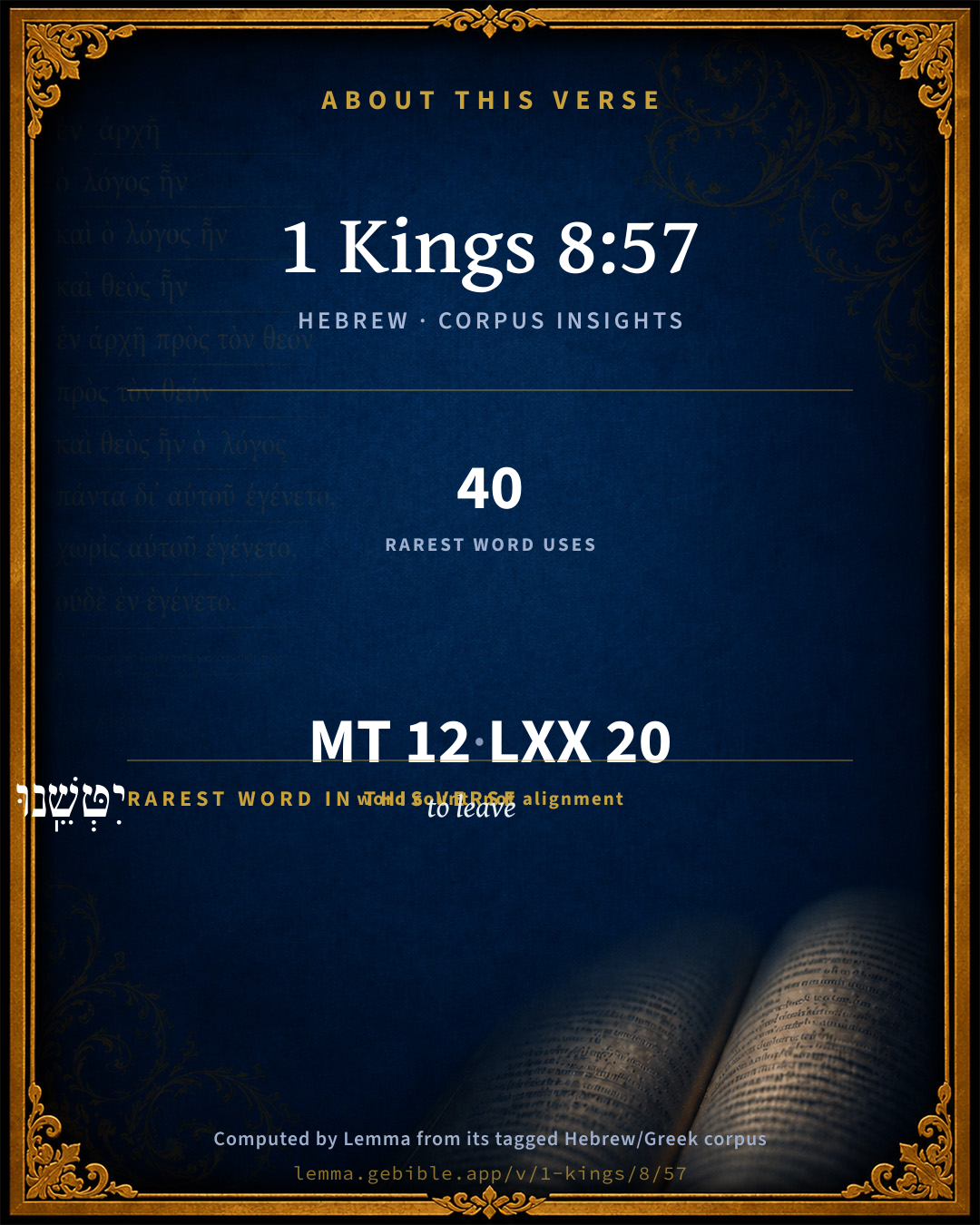
These counts appear in no published source. They are computed here, from the morphology-tagged text and Lemma’s own curated glosses. What Lemma adds →

12
words
9
distinct lemmas
Historical
section

Shared distinctive vocabulary

יִטְּשֵֽׁנוּ to leave H5203 occurs in 39 verses of the Hebrew Bible. Also found in:

Grammatical profile

  • 4 verbs
  • 3 nouns
  • 2 prepositions
  • 3 particles

Verb forms

  • יְהִ֨י Qal · Jussive
  • הָיָ֖ה Qal · Perfect
  • יַעַזְבֵ֖נוּ Qal · Jussive
  • יִטְּשֵֽׁנוּ Qal · Jussive

Repetition

Words recur within this verse — often emphatic in Hebrew:

  • יְהִ֨י to be H1961 ×2
  • עִמָּ֔נוּ with H5973 ×2
  • אַל not H408 ×2

Hebrew & Septuagint length

In English translation the verse runs 20 words from the Hebrew and 23 from the Septuagint (LXX English) — closely comparable.

A rough comparison of the two English renderings, which tokenize alike — not a word-level alignment.

Word counts can differ between the Hebrew and the Greek without any difference in meaning — e.g. the Hebrew direct-object marker אֵת has no separate Greek word, and Greek often adds the article ὁ.

In the original languages it is 12 Hebrew tokens and 20 Greek tokens — but the two are counted differently (Hebrew bundles its prefixes and suffixes into one token; the Greek is in lemma form), so that isn’t a like-for-like length.

Cross-references

15

Topical passages linked to 1 Kings 8:57 in the Treasury of Scripture Knowledge — connected by theme and wording, ordered by reader-vote popularity; previews shown in the World English Bible.

  • Joshua 1:5 There shall not any man be able to stand before you all the days of your life. As I was with Moses, so I will be with you; I will not fail you, nor forsake you.
  • Deuteronomy 31:6 Be strong and of good courage, don't be afraid, nor be scared of them: for Yahweh your God, he it is who does go with you; he will not fail you, nor forsake you.
  • Deuteronomy 31:8 Yahweh, he it is who does go before you; he will be with you, he will not fail you, neither forsake you: don't be afraid, neither be dismayed.
  • Hebrews 13:5 Be free from the love of money, content with such things as you have, for he has said, "I will in no way leave you, neither will I in any way forsake you."
  • Joshua 1:9 Haven't I commanded you? Be strong and of good courage; don't be afraid, neither be dismayed: for Yahweh your God is with you wherever you go.
  • 1 Samuel 12:22 For Yahweh will not forsake his people for his great name's sake, because it has pleased Yahweh to make you a people to himself.
  • 1 Chronicles 28:9 You, Solomon my son, know the God of your father, and serve him with a perfect heart and with a willing mind; for Yahweh searches all hearts, and understands all the imaginations of the thoughts: if you seek him, he will be found of you; but if you forsake him, he will cast you off forever.
  • Matthew 1:23 "Behold, the virgin shall be with child, And shall bring forth a son. They shall call his name Immanuel;" Which is, being interpreted, "God with us."
  • Matthew 28:20 teaching them to observe all things that I commanded you. Behold, I am with you always, even to the end of the age." Amen.
  • Romans 8:31 What then shall we say about these things? If God is for us, who can be against us?
  • 2 Chronicles 32:7–8 Be strong and of good courage, don't be afraid nor dismayed for the king of Assyria, nor for all the multitude who is with him; for there is a greater with us than with him:
  • Psalms 46:11 Yahweh of Hosts is with us. The God of Jacob is our refuge. Selah.
  • Isaiah 8:10 Take counsel together, and it shall be brought to nothing; speak the word, and it shall not stand: for God is with us.
  • Isaiah 41:10 Don't you be afraid, for I am with you; don't be dismayed, for I am your God; I will strengthen you; yes, I will help you; yes, I will uphold you with the right hand of my righteousness.
  • Psalms 46:7 Yahweh of Hosts is with us. The God of Jacob is our refuge. Selah.

Cross-references courtesy of OpenBible.info (CC BY 4.0).

Hebrew and Greek witnesses Masoretic Hebrew ↔ Greek Septuagint

The same verse in the two great witnesses to the Old Testament, shown verse-for-verse.

These are two independent witnesses, not word-aligned to each other, and the Septuagint is shown in lemma (dictionary) form.

Hebrew 1 Kings 8:57 Masoretic · Westminster Leningrad Codex

יְהִ֨י יְהוָ֤ה אֱלֹהֵ֨ינוּ֙ עִמָּ֔נוּ כַּאֲשֶׁ֥ר הָיָ֖ה עִם אֲבֹתֵ֑ינוּ אַל יַעַזְבֵ֖נוּ וְאַֽל יִטְּשֵֽׁנוּ

Yahweh our God be with us, as he was with our fathers: let him not leave us, nor forsake us;

World English Bible · Public Domain

Greek LXX 1 Kings 8:57 Septuagint · lemma form

γίγνομαι κύριος ὁ θεός ἐγώ μετά ἐγώ καθώς εἰμί μετά ὁ πατήρ ἐγώ μή ἐν καταλείπω ἐγώ μηδέ ἀποστρέφω ἐγώ

May the Lord our God be with us, as he was with our fathers; let him not desert us nor turn from us,

LXX2012 (modern English Septuagint) · Public Domain

Hebrew: Westminster Leningrad Codex (CC BY 4.0). Greek: Septuagint (public domain); English from LXX2012 (modern English Septuagint) (Public Domain). How the Septuagint differs from the Hebrew →

Targum (Aramaic paraphrase)

1

The Targum is the ancient Jewish Aramaic paraphrase of the Hebrew Scriptures — an interpretive translation, not the Hebrew text itself. Onkelos (literal) and Pseudo-Jonathan (expansive) render the Torah, and Jonathan the Prophets. Coverage is partial: where no permissively-licensed English translation exists for a verse, only the Aramaic is shown. This is verse-level text, not a word-by-word alignment to the Hebrew.

  1. Targum Jonathan Prophets (Joshua–Malachi)
    יְהֵי מֵימְרָא דַייָ אֱלָהָנָא בְּסַעֲדָנָא כְּמָא דַהֲוָה בְּסַעֲדָא דַאֲבָהָתָנָא לָא יִשְׁבְּקִינָנָא וְלָא יַרְחִקִינָנָא:

    (no public-domain English translation for this verse)

    Targum Jonathan — Aramaic: “Mikraot Gedolot” (public domain). English: “Sefaria Community Translation” (CC0 1.0 (public-domain dedication)); “London "Chaldee Paraphrase," 1871” (public domain). Text via Sefaria.

Commentary

Notes on 1 Kings 8:57 from classic Christian and Jewish commentators (each source and its license shown beneath its notes). The classic Christian expositions comment on the surrounding passage and are grouped to its opening verse, so a note may address several verses; the Jewish commentaries on the Tanakh (Rashi and others) are per-verse, so they appear only where the commentator wrote on this verse.

Lemma curates 59 commentaries, every one of them public domain or Creative Commons licensed, each selected and text-cleaned for this edition rather than reprinted as found. About our sources →

Trapp's Complete Commentary

John Trapp

1Ki 8:57 The LORD our God be with us, as he was with our fathers: let him not leave us, nor forsake us:

Ver. 57. Let him not leave us, nor forsake us.] Or, If he leave us for a time, let him not forsake us utterly.

John Trapp, A Commentary or Exposition upon All the Books of the Old and New Testament (1647–1656) — public domain. Text from a community e-Sword module.

The Biblical Illustrator

Joseph S. Exell

1Ki_8:57-60

The Lord our God be with us, as He was with our fathers.

The travail of the ages

This text plants us on the border-line between two generations. A king was dead. A king was born. Only a heart-throb divided the two reigns, but within the secrecy of that moment a new age began to be. Our text stations us at a point where, with dramatic impressiveness, we witness the onward march of time, sweeping past and burying in shadow the workers of yesterday; creating fresh conditions, calling out new men, commissioning advanced endeavour, for the day that is to be.. But the text erects for us a higher platform. It lifts our thought to the Eternal, and plants us by the ageless throne. It speaks to us of our God, our fathers God, the God of ages. The very name works magic, and lifts us above the fleeting shadows of time and sense. Earth with its grinding effort and its vanishing forms, with its intermittent lights and shifting scenes, fades into mist beneath us. Our souls are loosed. Upward we pass into the white radiance of eternity. Time knows no succession. Space surpasses measurement. Progress is a heightening consciousness without the undulations of effort or the tide-marks of accumulation. Motion is rest. Life is an eternal joy, in which all memory and all hope centralise in a present of infinite peace. Boundless and changeless is the vision. And suffusing it all, constituting it all, is God, our God, our fathers God, the God of ages. We think of Him as surpassing the limits of past or future. But the text affords us still another platform. It has shown us man, the shifting. It has unveiled God, the Eternal. Now it passes into petition, and reveals subtle links of love and purpose joining God above to men beneath, and throwing a chain of union across the moving ages. The Eternal fills and saves the temporal. The nations and epochs of a fading life are united in origin and destiny. The children of a day are made sons of God. And that vision is best and brightest of all. God is shown in contact with man. He was with our fathers. He is to be with us. His heart feels. His power obeys His love. Heaven enswathes earth. God in very truth dwells with men. The Eternal becomes the Gracious. The Strong becomes the Worshipful. But if this revelation is necessary to Gods praise, it is not less needful to mans uplifting. The mere lateral outlook on life has in it the germs of all despair. That way madness lies. Ill were it for any man to dwell long on the sight of swift-declining generations, till he has learned to link them with a stable purpose and a noble destiny. Time must be looked at from eternity. Man can only be seen as we stand close by God. History is an enigma and a despair till we read its pages under the lamps of the light eternal. And under those lamps we stand to-day. The light is dimmed by many an earth-cast shadow. Round and above us sweeps the purple haze of mystery. Such are the three outlooks of the text. They are instinct with an atmosphere which is favourable to my purpose. I am to speak to the new generation. I am to commend to young men and maidens the tasks which come from vanished hands, or hands now failing for lack of strength; to stir in them the sense of kinship to the travail of humanity; to create or to revive that zeal for Christ which is the service of man; and to arouse ambition to help the weary ages to the issue of their pain. Where better could I ask them to meet and meditate than amid these outlooks?

I. Achievement. That word is capable of two meanings. In one sense it suggests something absolutely completed; not only work well done, but so done as to overtake all necessity and leave nothing to be added. With that significance we gratefully apply the word to the great facts and provisions of religion, and supremely to that central sacrifice by which Christ offered Himself once for all to put away sin. The gospel is an achievement in the absolute sense; there is no more sacrifice for sin--it is finished--and the last age no more than the first can add to its efficacy or dispense with its grace. But there is another and equally admissible use of this word. It is spoken approximately to denote stages of accomplishment and single steps of progress. In this sense only can we apply it to the upward toil of the ages. Man has finished nothing. He has cleared primeval forests of difficulty, and dug out many a vein of silver thought, and quarried goodly stones of excellence, and made the trenches and laid the foundations for noble structures he had seen in dreams. But he never finished anything. It was not his business to complete. Alas for us if it had been! Imagine a civilisation, an educational system, a political standard, a social ideal, a compact religion, completed once for all by Aaron or Isaiah, by John Knox or Oliver Cromwell! No. It was not their business to finish things,--theirs to contribute to the one toil of progress, to add to the slow structure of humanity. But in that sense they bequeathed achievements. Behind us lie armies of heroes and centuries of toil. Had they not been, and been what they were, we were not here to-day. We do well to recall their memory. Augustine, patiently erecting his city of God as an ideal of the new home in which the new humanity might dwell; Anselm, silent, profound, meek of heart, looking with fixed gaze and reverent soul into universal questions that have no certain answers; Melancthon, the man of brave and gentle spirit, possessed of piercing insight and persuasive speech, abler perhaps to see than to do, yet an architect who made the builder possible; Luther, inspired of God to mans much-needed service, a man of lion heart and iron will, the executor of Europes prayers and Gods purposes, the father of our new liberty because the saviour of our ancient faith. These are they who have done Gods work and lifted humanity into a fairer heritage. From them have we sprung. To them we owe all. Our age has outgrown theirs. In many directions our faiths and outlooks have advanced and broadened. But it is on the foundations which they laid that we have been able to build.

II. Succession. Achievements, as we have seen, grow from age to age. But the workers are taken. The generations move onward with ceaseless change. Abraham had been and was not. David did a big days work and then slept with his fathers. Fresh faces greet us as we travel each mile through history. New voices take up the old-time song. It was ever thus. Gods work needs many workmen, and workmen oft renewed. No man, no age, is allowed to stay on. There was one Melchizedek whose presence spanned a longer time; but men know nothing of him, and his like was not repeated. There was one Methuselah who measured years as days, who lived as long as many a dynasty; but he did nothing in particular, and was not made a copy. No age can do Gods whole work, so He puts ages in succession. No man can do more than a set portion, so God is ever sending fresh men. Gods method of rejuvenescence is not to dip an old man in a stream which renews his youth, nor to mix for him an elixir to wing away his years. It is the spring-time method of rejuvenescence which sends fresh leaves upon the ancient tree. But there is another point to note in this succession. The generations are made to overlap each other. Not at one fell moment does one age go and another come.. Every hour men die. Every hour men are born. The change proceeds silently,. and secretly. God enables the succeeding ages to clasp hands. He has so, ordered it that the lessons of experience shall wait upon the untried energies of youth. Ours to-day is this glory of inheritance, this solemn duty of broad human service. Do we perceive? Have we considered? Are we ready? The time is short. We must soon make room for others. What shall the record mark when our day is done! Shall its increase of wealth measure a decrease in heroism, godliness, humanity? Shall its more accessible means of life end in the loss of all that makes life worth living? Because our age has discovered the path to a new and swifter possession of what life can give, are we to allow our larger place to degenerate into a bog of barren selfishness? God forbid.

III. Progress. Solomon not only followed David, he increased upon him. The ages have not only come in succession, but with steady improvement. Isaiah the prophet was more and better than Jephthah the judge. Paul the apostle was of higher capacity and nobler mission than Solomon the king. In this sense history, controlled by providence, has ever moved up as it has pressed on. Succession, spoken of highest things, carries with it the idea of advancement. A horse is not a successor; he is a repetition. Anatomists will tell you that even in a horse there is development; but the most searching study will show you only modifications of a function and adaptations of a limb. A horse is as horses have been--a repetition. But the world was not made for horses, nor for repetitions, else Christ had never supplanted Adam, nor our fair English piety the iron paganism of Rome. Progress marks the ages, and still must mark our time. But what do we mean by progress? There are some things we cannot move from. Would you call that world progressive that broke away from the sun? Would you call that man progressive who in his business repudiated the principles of arithmetic? That word progress needs guarding by careful definition. Progress, as the cry of a party, is often the emptiest of all hypocrisies. Progress with some men is only a euphemism for that excitable restlessness which is ever seeking change. But it is not in such sense we speak of progress. That is not progress which leads us away from the fixed sources of spiritual energy. The modern locomotive presents a remarkable advance upon the gaunt machine which first did duty in drawing a train; but it depends on the same force and is governed by obedience to the same laws. Progress does not mean the repudiation of ancient force, but its fuller recognition. And progress can mean nothing else in the spiritual advancement of mankind. Christ was more and better than Moses, had a larger message to speak and a grander work to do; but He came from the same God, and in the same God found His inspiration. The modern teacher of religion presents an interpretation of truth and duty which distances a great stride from early or medieval instruction; but the foundation is the same, and by the same Spirit does he accomplish his task. And because Christ is the fulness of the Godhead, our progress must be on Him, not from Him.

IV. Solidarity. The ages are many and fleeting; the race is one and permanent. The work is partial and progressive; the purpose and the goal are ever the same. David departs and Solomon comes, but humanity remains. One age reforms, another consolidates, but the work is one. The individual withers, and the world is more and more. And as in destiny so in interest are all men joined. Humanity was made for God: only in God can it find the solution of its problems and the realisation of its dreams. And we shall best help to its issue the pain of progress by first giving ourselves to God, and then by striving to set in right relation to God the weary hearts of men and the multiplied interests of mankind. (C. A. Berry.)

Prayer for the New Year

I. The need that suggested the prayer.

II. The faith that prompted the prayer.

III. The love that dictated the prayer.

IV. The hope that inspired the prayer,

V. The memories that sustained the prayer. (F. W. Brown.)

The Biblical Illustrator, edited by Joseph S. Exell (c. 1880s–1900s) — public domain. Text from a community e-Sword module.

Tyndale Open Study Notes

Tyndale Open Resources

8:57-61 Solomon asked that God continue to be with his people and mold them into an obedient and faithful nation. Through God’s grace and their faithfulness, Israel could experience God’s righteous justice and teach people all over the earth that the Lord alone is God.

Tyndale Open Study Notes — © Tyndale Open Resources, licensed CC BY-SA 4.0. Text via the HelloAO Bible API.

John Gill's Exposition

That he may incline our hearts unto him,.... By his Spirit, to love, fear, and serve him; to attend to his worship, word, and ordinances:

to walk in all his ways; he has prescribed and directed to:

and to keep his commandments, and his statutes, and his judgments, which he commanded our fathers; all his laws, moral, ceremonial, and judicial.

John Gill's Exposition of the Whole Bible (1746–1763) — public domain (CC PDM 1.0). Text via the HelloAO Bible API.

Matthew Poole's English Annotations

The Lord our God be with us, by the presence of his grace and mercy.

Matthew Poole's English Annotations on the Holy Bible (1683–1685) — public domain. Text from a community e-Sword/MySword module.

The Pulpit Commentary

The Lord our God be With us, as he was with our fathers: let him not leave us, nor forsake us. Solomon insensibly glides again into prayer; here for the presence of God, in ver. 59 for His help. There is probably a reference to Deu_31:6, 8 Jos_1:5, where, however, "forsake" is represented by a different word.

The Pulpit Commentary (1880–1919), ed. H.D.M. Spence-Jones & Joseph S. Exell — public domain. Text from a community e-Sword module.

unfoldingWord translationNotes

Door43 World Missions Community

leave us or forsake us

These two phrases mean basically the same thing and emphasize Solomon's desire for Yahweh to be present with the people. (See: Doublet)

incline our hearts to him

Here their "hearts" refer to the people's desires and emotions. Desiring to please someone is spoken of as inclining the heart toward that person. AT: "make us want to please him" (See: Metonymy and Metaphor)

live in all his ways

Here "in his ways" is an idiom that refers to the way he wants people to live. AT: "live as he requires us to live" (See: Idiom)

translationWords

God

forsake

heart

life

command

statute

decree

ancestor

unfoldingWord translationNotes — © Distant Shores Media and the Door43 World Missions Community, licensed CC BY-SA 4.0. Source: git.door43.org/Door43/en_tn.

Lesson kit

Teaching starters — assembled from the data on this page, not authored interpretation. Every prompt links to the verse data it draws on. Edit before teaching.

1 Kings, in the Historical, opens this verse with 12 words (9 distinct Hebrew lemmas). Its most distinctive word is nâṭash (“to leave”). A historical commentator’s framing appears above. Read the whole chapter for the surrounding context.

Discussion questions

  1. The word nâṭash carries the sense “to leave.” How does it shape the verse?
  2. How does Genesis 31:28, which shares the word «to leave», read alongside this verse?
  3. What does the repetition of “to be” (2× in this one verse) do in this verse?
  4. The translations on this page render this verse differently — a whole-verse word diff, not a word-by-word alignment. What might account for the different wordings?
  5. «יְהִ֨י» is a Qal Jussive verb. How does that grammatical form shape the action described?
  6. Compare how Trapp's Complete Commentary and The Biblical Illustrator read this verse. Where do they agree or differ?

Things to notice

Reading settings

Reading text

Shown beneath each verse's original-language words.

Old Testament
Old Testament edition

Read the OT as the Masoretic Hebrew (MT) or the Greek Septuagint (LXX).

English shown for the Greek Septuagint (in the Hebrew ↔ Greek comparison).

Comparing translations? Open the Compare panel on any verse page to stack up to four side by side.