Numbers 32:5

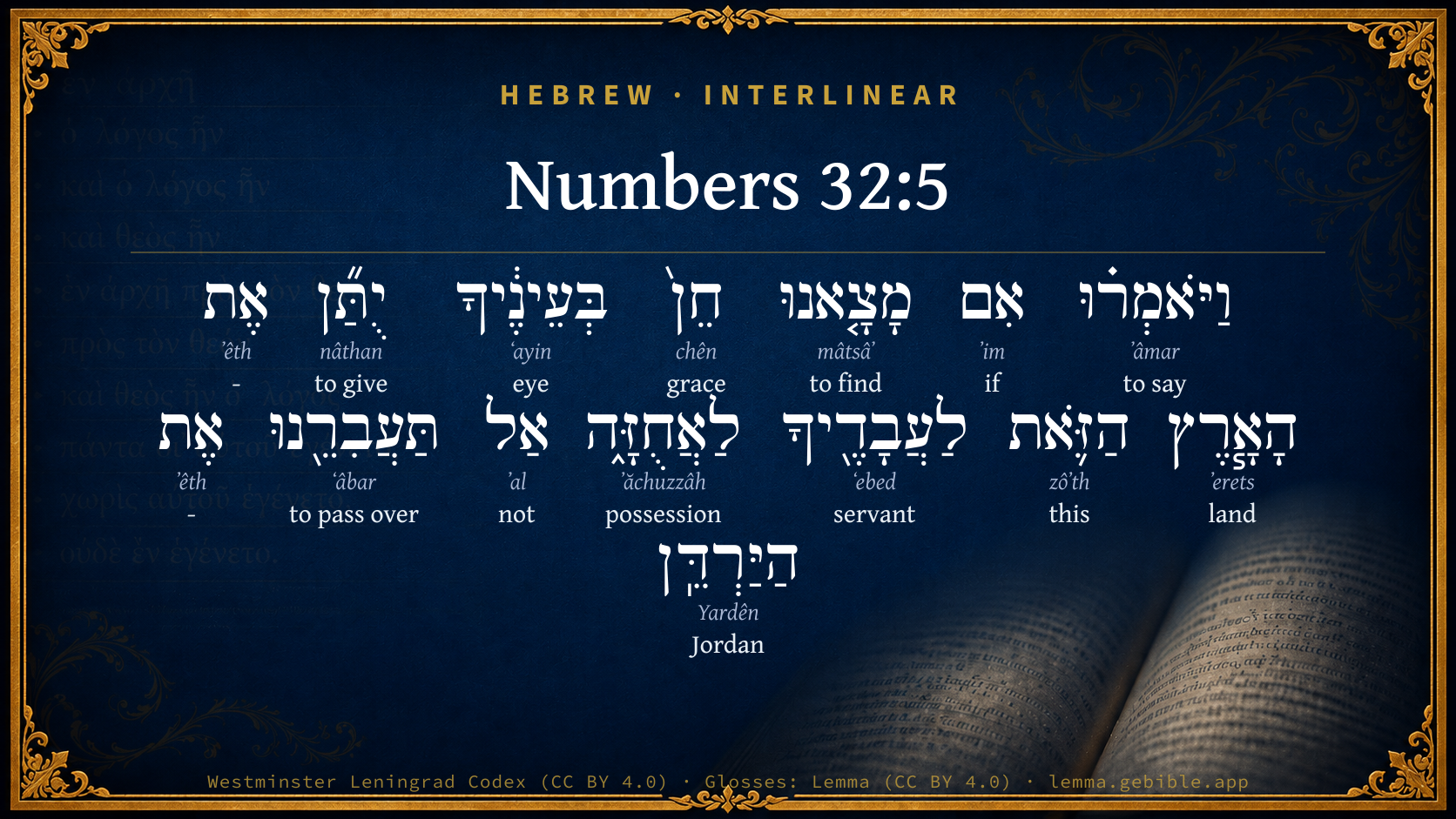
Hebrew (Westminster Leningrad Codex) Numbers 32:5 appears in the Hebrew Old Testament. The text above is from the Westminster Leningrad Codex. Each word links to its Strong’s number, a concise gloss, and parsing drawn from the Open Scriptures Hebrew Bible morphology. Click any word for its full Brown-Driver-Briggs (BDB) entry.
Download image
Cite this verse

Numbers 32:5 (World English Bible). Public Domain. Lemma interlinear Bible study tool, https://lemma.gebible.app/v/numbers/32/5.

Show BibTeX & RIS
BibTeX
RIS
English Translation
They said, If we have found favor in your sight, let this land be given to your servants for a possession; don't bring us over the Jordan.
World English Bible · Public Domain
Download a study sheet

One document with this verse’s original text, its word-by-word gloss line, the meaning frame, cross-references with their text, attributed commentary, and full source and license credits — printable, and it pastes into notes with its structure intact.

This verse Autodidact and up

Study sheet (.html) Plain text (.txt)

A passage Seminary Student

Up to 50 verses in one chapter. A passage sheet keeps up to 6 commentary sources and 12 cross-references per verse, in the order this page ranks them, and says so on the sheet whenever that leaves anything out. Ask for a single verse and you get the Autodidact verse sheet above.

Everything on this page stays free to read, with no account — the sheet is a download of what is already on screen, not access to it.

Want to remove ads? Support Godless Engineer
Compare translations 3

The same verse in 3 English versions, stacked beneath the original-language interlinear above. Click any original word for its lexicon entry.

Each is an independent rendering of the whole verse — the interlinear is not word-aligned to these translations.

Highlighted words mark where these versions differ — a whole-verse word diff, not a word-by-word alignment.

  • World English Bible Public Domain
    They said, If we have found favor in your sight, let this land be given to your servants for a possession; don't bring us over the Jordan.
  • King James Version Public Domain
    Wherefore, said they, if we have found grace in thy sight, let this land be given unto thy servants for a possession, and bring us not over Jordan.
  • unfoldingWord Literal Text CC BY-SA 4.0
    And they said, “If we have found favor in your eyes, let this land be given to your servants as a possession. Do not make us cross over the Jordan.”

unfoldingWord Literal Text — © unfoldingWord, licensed CC BY-SA 4.0. Word-aligned USFM3 via Door43 (git.door43.org/unfoldingWord/en_ult).

Versions to compare (up to 4)

3 of 4 selected

Show all 18 translations

Every available English version of this verse, each an independent rendering of the whole verse.

  • World English Bible Public Domain
    They said, If we have found favor in your sight, let this land be given to your servants for a possession; don't bring us over the Jordan.
  • Berean Standard Bible Public Domain
    “If we have found favor in your sight,” they said, “let this land be given to your servants as a possession. Do not make us cross the Jordan.”
  • Majority Standard Bible Public Domain
    “If we have found favor in your sight,” they said, “let this land be given to your servants as a possession. Do not make us cross the Jordan.”
  • King James Version Public Domain
    Wherefore, said they, if we have found grace in thy sight, let this land be given unto thy servants for a possession, and bring us not over Jordan.
  • American Standard Version (1901) Public Domain
    And they said, If we have found favor in thy sight, let this land be given unto thy servants for a possession; bring us not over the Jordan.
  • Revised Version (1885) Public Domain
    And they said, If we have found grace in thy sight, let this land be given unto thy servants for a possession; bring us not over Jordan.
  • Geneva Bible (1599) Public Domain
    Wherefore, said they, if we haue foud grace in thy sight, let this lande be giuen vnto thy seruants for a possession, and bring vs not ouer Iorde.
  • Douay-Rheims (1899) Public Domain
    And we pray thee, if we have found favour in thy sight, that thou give it to us thy servants in possession, and make us not pass over the Jordan.
  • Young's Literal Translation Public Domain
    And they say, `If we have found grace in thine eyes, let this land be given to thy servants for a possession; cause us not to pass over the Jordan.'
  • Literal Standard Version CC BY-SA 4.0
    And they say, “If we have found grace in your eyes, let this land be given to your servants for a possession; cause us not to pass over the Jordan.”
  • Unlocked Literal Bible CC BY-SA 4.0
    They said, “If we have found favor in your eyes, let this land be given to us, your servants, as a possession. Do not make us cross over the Jordan.”
  • unfoldingWord Literal Text CC BY-SA 4.0
    And they said, “If we have found favor in your eyes, let this land be given to your servants as a possession. Do not make us cross over the Jordan.”
  • Darby Bible Public Domain
    and they said, If we have found favour in thine eyes, let this land be given to thy servants for a possession: bring us not over the Jordan.
  • World Messianic Bible Public Domain
    They said, “If we have found favor in your sight, let this land be given to your servants for a possession. Don’t bring us over the Jordan.”
  • Webster's Bible Public Domain
    Wherefore, said they, if we have found grace in thy sight, let this land be given to thy servants for a possession, and bring us not over Jordan.
  • Free Bible Version CC BY-SA 4.0
    They continued, “Please respond to our request favorably: give us this land. Don't make us cross the Jordan.”
  • Bible in Basic English Public Domain
    And they said, With your approval, let this land be given to your servants as their heritage: do not take us over Jordan.
  • JPS Tanakh (1917) Public Domain
    And they said: 'If we have found favour in thy sight, let this land be given unto thy servants for a possession; bring us not over the Jordan.'

Literal Standard Version (2020), Covenant Press — licensed CC BY-SA 4.0. Text via the HelloAO Bible API (eBible.org). Unlocked Literal Bible (unfoldingWord) — licensed CC BY-SA 4.0. Text via the HelloAO Bible API (eBible.org). unfoldingWord Literal Text — © unfoldingWord, licensed CC BY-SA 4.0. Word-aligned USFM3 via Door43 (git.door43.org/unfoldingWord/en_ult). Free Bible Version, Dr. Jonathan Gallagher — licensed CC BY-SA 4.0. Text via the HelloAO Bible API (eBible.org).

Word by word

More ways to search: Search by grammar → Find every occurrence → Compare this word →

Practice this passage: Drill this verse → Learn its vocabulary →

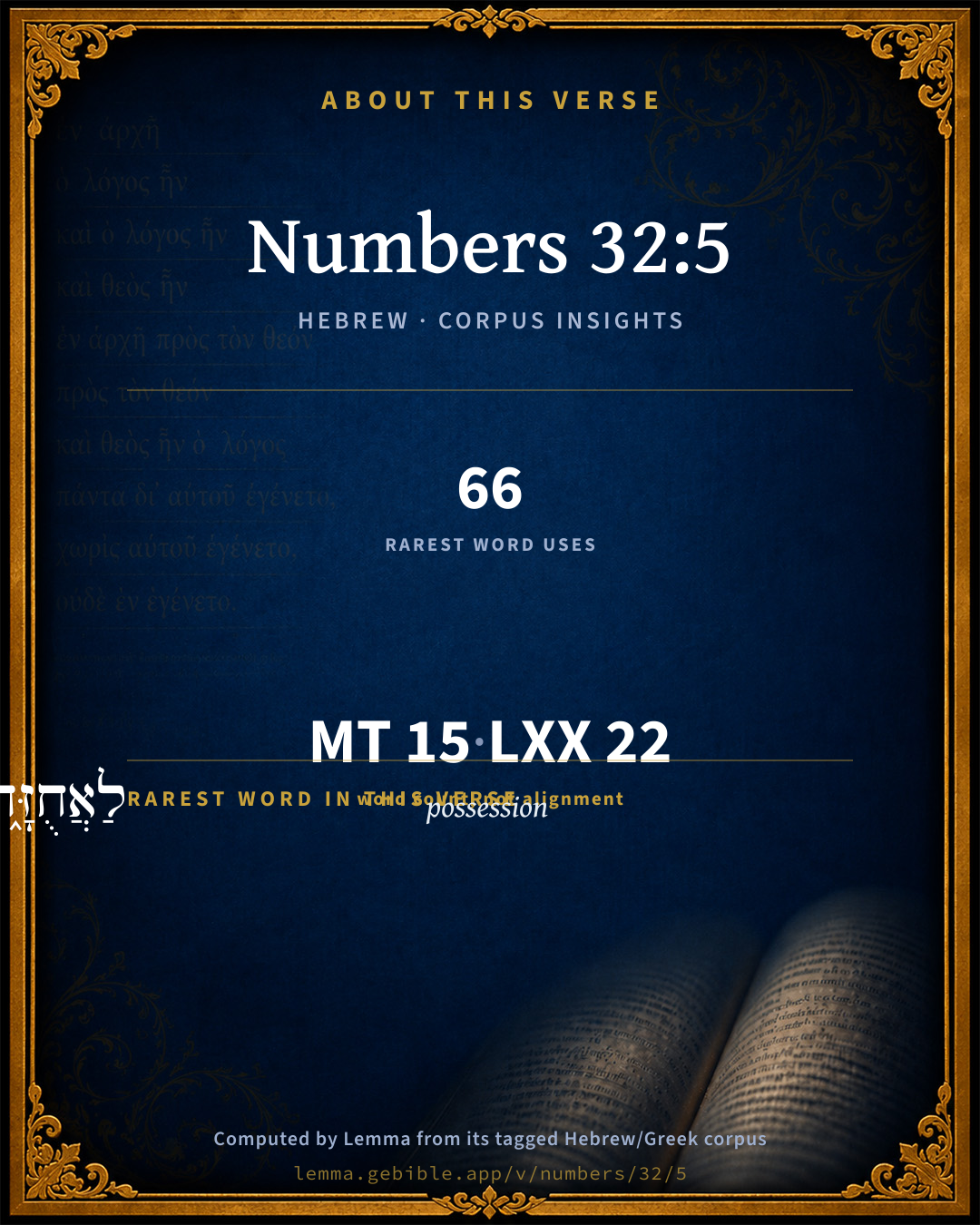
לַאֲחֻזָּ֑ה
ʼăchuzzâh
H272
“to/for · possession”
Preposition + Noun, Common, Feminine, Singular, Absolute
Part of Speech
Preposition + Noun
Type
Common
Gender
Feminine
Number
Singular
State
Absolute
Full BDB Definition

Origin: from passive participle from H270

TWOT: 64a

possession, property - land - possession by inheritance
  1. וַיֹּאמְר֗וּ ʼâmar H559 “and · to say” Conjunction + Verb, Qal, Sequential Imperfect, 3rd Person, Masculine, Plural
  2. אִם ʼim H518 “if” Conjunction
  3. מָצָ֤אנוּ mâtsâʼ H4672 “to find” Verb, Qal, Perfect, 1st Person, Common, Plural
  4. חֵן֙ chên H2580 “grace” Noun, Common, Masculine, Singular, Absolute
  5. בְּעֵינֶ֔יךָ ʻayin H5869 “in/at · eyes · your” Preposition + Noun, Common, Both, Dual, Construct + Suffix, Personal, 2nd Person, Masculine, Singular
  6. יֻתַּ֞ן nâthan H5414 “to give” Verb, Hophal, Imperfect, 3rd Person, Masculine, Singular
  7. אֶת ʼêth H853 “-” Particle, Direct Object
  8. הָאָ֧רֶץ ʼerets H776 “the · land” Particle, Definite Article + Noun, Common, Both, Singular, Absolute
  9. הַזֹּ֛את zôʼth H2063 “the · this” Particle, Definite Article + Pronoun, Demonstrative, Feminine, Singular
  10. לַעֲבָדֶ֖יךָ ʻebed H5650 “to/for · servants · your” Preposition + Noun, Common, Masculine, Plural, Construct + Suffix, Personal, 2nd Person, Masculine, Singular
  11. אַל ʼal H408 “not” Particle, Negative
  12. תַּעֲבִרֵ֖נוּ ʻâbar H5674 “to pass over · us” Verb, Hiphil, Jussive, 2nd Person, Masculine, Singular + Suffix, Personal, 1st Person, Common, Plural
  13. אֶת ʼêth H853 “-” Particle, Direct Object
  14. הַיַּרְדֵּֽן Yardên H3383 “the · Jordan” Particle, Definite Article + Noun, Proper

About this verse

These counts appear in no published source. They are computed here, from the morphology-tagged text and Lemma’s own curated glosses. What Lemma adds →

15
words
14
distinct lemmas
Pentateuch
section

Grammatical profile

  • 4 verbs
  • 6 nouns
  • 1 pronoun
  • 1 conjunction
  • 3 particles

Verb forms

  • וַיֹּאמְר֗וּ Qal · Sequential Imperfect
  • מָצָ֤אנוּ Qal · Perfect
  • יֻתַּ֞ן Hophal · Imperfect
  • תַּעֲבִרֵ֖נוּ Hiphil · Jussive

Hebrew & Septuagint length

In English translation the verse runs 27 words from the Hebrew and 31 from the Septuagint (LXX English) — closely comparable.

A rough comparison of the two English renderings, which tokenize alike — not a word-level alignment.

Word counts can differ between the Hebrew and the Greek without any difference in meaning — e.g. the Hebrew direct-object marker אֵת has no separate Greek word, and Greek often adds the article ὁ.

In the original languages it is 15 Hebrew tokens and 22 Greek tokens — but the two are counted differently (Hebrew bundles its prefixes and suffixes into one token; the Greek is in lemma form), so that isn’t a like-for-like length.

Cross-references

9

Topical passages linked to Numbers 32:5 in the Treasury of Scripture Knowledge — connected by theme and wording, ordered by reader-vote popularity; previews shown in the World English Bible.

  • Genesis 19:19 See now, your servant has found favor in your sight, and you have magnified your loving kindness, which you have shown to me in saving my life. I can't escape to the mountain, lest evil overtake me, and I die.
  • Deuteronomy 1:37 Also Yahweh was angry with me for your sakes, saying, You also shall not go in there:
  • Deuteronomy 3:25–26 Please let me go over and see the good land that is beyond the Jordan, that goodly mountain, and Lebanon.
  • Joshua 7:7 Joshua said, Alas, Lord Yahweh, why have you at all brought this people over the Jordan, to deliver us into the hand of the Amorites, to cause us to perish? would that we had been content and lived beyond the Jordan!
  • Ruth 2:10 Then she fell on her face, and bowed herself to the ground, and said to him, Why have I found favor in your sight, that you should take knowledge of me, seeing I am a foreigner?
  • 1 Samuel 20:3 David swore moreover, and said, Your father knows well that I have found favor in your eyes; and he says, Don't let Jonathan know this, lest he be grieved: but truly as Yahweh lives, and as your soul lives, there is but a step between me and death.
  • 2 Samuel 14:22 Joab fell to the ground on his face, and did obeisance, and blessed the king: and Joab said, Today your servant knows that I have found favor in your sight, my lord, king, in that the king has performed the request of his servant.
  • Esther 5:2 It was so, when the king saw Esther the queen standing in the court, that she obtained favor in his sight; and the king held out to Esther the golden scepter that was in his hand. So Esther drew near, and touched the top of the scepter.
  • Jeremiah 31:2 Thus says Yahweh, The people who were left of the sword found favor in the wilderness; even Israel, when I went to cause him to rest.

Cross-references courtesy of OpenBible.info (CC BY 4.0).

Hebrew and Greek witnesses Masoretic Hebrew ↔ Greek Septuagint

The same verse in the two great witnesses to the Old Testament, shown verse-for-verse.

These are two independent witnesses, not word-aligned to each other, and the Septuagint is shown in lemma (dictionary) form.

Hebrew Numbers 32:5 Masoretic · Westminster Leningrad Codex

וַיֹּאמְר֗וּ אִם מָצָ֤אנוּ חֵן֙ בְּעֵינֶ֔יךָ יֻתַּ֞ן אֶת הָאָ֧רֶץ הַזֹּ֛את לַעֲבָדֶ֖יךָ לַאֲחֻזָּ֑ה אַל תַּעֲבִרֵ֖נוּ אֶת הַיַּרְדֵּֽן

They said, If we have found favor in your sight, let this land be given to your servants for a possession; don't bring us over the Jordan.

World English Bible · Public Domain

Greek LXX Numbers 32:5 Septuagint · lemma form

καί λέγω εἰ εὑρίσκω χάρις ἐνώπιον σύ δίδωμι ὁ γῆ οὗτος ὁ οἰκέτης σύ ἐν κατάσχεσις καί μή διαβιβάζω ἐγώ ὁ ἰορδάνης

And they said, If we have found grace in your sight, let this land be given to your servants for a possession, and do not cause us to pass over Jordan.

LXX2012 (modern English Septuagint) · Public Domain

Hebrew: Westminster Leningrad Codex (CC BY 4.0). Greek: Septuagint (public domain); English from LXX2012 (modern English Septuagint) (Public Domain). How the Septuagint differs from the Hebrew →

Targum (Aramaic paraphrase)

2

The Targum is the ancient Jewish Aramaic paraphrase of the Hebrew Scriptures — an interpretive translation, not the Hebrew text itself. Onkelos (literal) and Pseudo-Jonathan (expansive) render the Torah, and Jonathan the Prophets. Coverage is partial: where no permissively-licensed English translation exists for a verse, only the Aramaic is shown. This is verse-level text, not a word-by-word alignment to the Hebrew.

  1. Targum Onkelos Torah (Genesis–Deuteronomy)
    וַאֲמָרוּ אִם אַשְׁכַּחְנָא רַחֲמִין בְּעֵינָיךְ תִּתְיְהִיב יָת אַרְעָא הָדָא לְעַבְדָךְ לְאַחֲסָנָא לָא תְעַבְרִינָנָא יָת יַרְדְנָא

    (no public-domain English translation for this verse)

    Targum Onkelos — Aramaic: “Onkelos Genesis” (public domain); “Onkelos Exodus” (public domain); “Onkelos Leviticus” (public domain); “Onkelos Numbers” (public domain); “Onkelos Deuteronomy” (public domain). English: “Sefaria Community Translation” (CC0 1.0 (public-domain dedication)); “J.W. Etheridge. The Targums of Onkelos and Jonathan Ben Uzziel on the Pentateuch. London: Longmans, Green, 1862” (public domain). Text via Sefaria.

  2. Targum Pseudo-Jonathan Torah (Genesis–Deuteronomy)
    וַאֲמָרוּ אִין אַשְׁכַּחְנָא רַחֲמִין קֳדָמָךְ תִּתְיְהַב אַרְעָא הֲדָא לְעַבְדָךְ לְאַחְסָנָא לָא תַעַבְרִינָנָא יַת יוֹרְדָנָא

    They said therefore, If we have found grace before thee, let this land be given to thy servants for a possession, and let us not pass over Jordan.

    Targum Pseudo-Jonathan — Aramaic: “Targum Jonathan on Genesis” (public domain); “Targum Jonathan on Exodus” (public domain); “Targum Jonathan on Leviticus” (public domain); “Targum Jonathan on Numbers” (public domain); “Targum Jonathan on Deuteronomy” (public domain). English: “The Targum of Jonathan ben Uzziel, trans. J. W. Etheridge, London, 1862” (public domain). Text via Sefaria.

Commentary

Notes on Numbers 32:5 from classic Christian and Jewish commentators (each source and its license shown beneath its notes). The classic Christian expositions comment on the surrounding passage and are grouped to its opening verse, so a note may address several verses; the Jewish commentaries on the Tanakh (Rashi and others) are per-verse, so they appear only where the commentator wrote on this verse.

Lemma curates 59 commentaries, every one of them public domain or Creative Commons licensed, each selected and text-cleaned for this edition rather than reprinted as found. About our sources →

Trapp's Complete Commentary

John Trapp

Num 32:5 Wherefore, said they, if we have found grace in thy sight, let this land be given unto thy servants for a possession, [and] bring us not over Jordan.

Ver. 5. Let this land be given unto thy servants.] An unsavoury and unseasonable motion this might seem at first, and did, even to Moses himself, as appears in the next verse. And surely it is probable that they were too much set upon that portion of earth, as Lot was upon the plain of Sodom, {Gen 13:10} and was therefore soon after carried captive by the four kings, as these in the text are noted to be the first that were carried captives out of their land. {1Ch 5:25-26} Strong affections cause strong afflictions; when God seeth people set upon it to have this or that, have it they may, but with an after-clap that shall dissweeten it. How was David crossed in his Absalom, Absalom in his kingdom, Amnon in his Tamar, Elkanah in his Hannah! {1Sa 1:5} He loved her, and the Lord made her barren.

John Trapp, A Commentary or Exposition upon All the Books of the Old and New Testament (1647–1656) — public domain. Text from a community e-Sword module.

Joseph Benson's Commentary

Num 32:5-7. Bring us not over Jordan — To give us our possession there; but let this land, on this side Jordan, be our whole possession. Shall ye sit here? — In ease and peace, while your brethren are engaged in war. Wherefore discourage ye the heart of Israel — Their words were ambiguous, and Moses suspected that mere cowardice, and a love of ease, made them desire to stay where they were; which ill example might have disheartened the rest of their brethren.

Joseph Benson's Commentary on the Old and New Testaments (1811–1818) — public domain. Text from a community e-Sword module.

Adam Clarke's Commentary

Verse 5. Let this land be given unto thy servants] Because it was good for pasturage, and they had many flocks, Nu 32:1.

Adam Clarke's Commentary on the Bible (1810–1826) — public domain. Text from a community e-Sword/MySword module.

Ellicott's Commentary for English Readers

(5) Bring us not over Jordan.—These words may be understood either simply as a request that the inheritance of the speakers might be assigned to them on the eastern side of the Jordan, or, as they appear to have been understood by Moses, and as they were in all probability designed to be understood, as a request that the conquest of the western side of the Jordan might be left to the other tribes, and that the Reubenites and Gadites might be permitted at once to establish themselves in the land which had been already subjugated. It is possible that the speakers, judging from the ease and rapidity with which the eastern side of the Jordan had been conquered, might have thought that their brethren were well able to subdue the western side without their aid. Be this as it may, their language indicated a selfish consideration of their own interests, and it was calculated to discourage and dishearten their brethren, and consequently it was strongly reproved by Moses. It is deserving of notice that the tribes of Reuben and Gad and the half tribe of Manasseh were amongst the first who were taken into captivity by the King of Assyria (1Ch_5:26).

A Bible Commentary for English Readers, edited by Charles John Ellicott (1878–1897) — public domain. Text from a community e-Sword module.

John Gill's Exposition

And Moses said unto the children of Gad, and to the children of Reuben,.... Being displeased with their motion, as his following discourse shows, it having at first sight an appearance of covetousness and cowardice:

shall your brethren go to war, and shall ye sit here? it is not reasonable that your brethren should be left by you and engage in a war with your common enemies, to dispossess them of their land before they can settle in it and you remain here easy and quiet in the possession of a fruitful country.

John Gill's Exposition of the Whole Bible (1746–1763) — public domain (CC PDM 1.0). Text via the HelloAO Bible API.

Haydock's Catholic Bible Commentary

Jordan. They are a figure of those who would possess heaven without labour. But none is crowned, except he strive lawfully, 2 Timothy ii. 5. (Worthington)

George Leo Haydock (1774–1849), Haydock's Catholic Family Bible and Commentary, 1859 edition — public domain. Excludes Psalms (Douay-Rheims chapter numbering differs from Protestant) and Deuterocanonical books (Catholic canon only).

Matthew Poole's English Annotations

To wit, to give us our possession there, but let this land on this side Jordan be our whole possession.

Matthew Poole's English Annotations on the Holy Bible (1683–1685) — public domain. Text from a community e-Sword/MySword module.

Whedon's Commentary on the Bible

Daniel D. Whedon

5. Bring us not over Jordan — The charitable construction of this petition is that these tribes did not wish their allotments on the west side of the Jordan, but that they intended to assist in its conquest. But Moses understood them to desire to settle at once east of the river, and leave the other tribes to conquer Canaan alone.

Daniel D. Whedon (gen. ed.), Commentary on the Old and New Testaments (1874–1909) — public domain. Text from a community e-Sword module.

The Pulpit Commentary

Bring us not over Jordan. The two tribes have been charged on the strength of these words with "shameless selfishness," but there is nothing to justify such an accusation. If they thought at all of the effect of their request upon their brethren, it is quite likely that they intended to do them a kindness by leaving them more room on the other side Jordan; and indeed Canaan proper was all too strait for such a population. Whether they were wise in wishing to stay in the wider and more attractive lands which they had seen is another matter. They knew that the God of Israel had designed to plant his people between Jordan and the sea, and they certainly risked a partial severance from his promises and his protection by remaining where they did. The subsequent history of the trans-Jordanic tribes is a melancholy commentary on the real unwisdom of their choice. Yet it would have been difficult for them to know that they were wrong, except by an instinct of faith which no Israelites perhaps at that time possessed.

The Pulpit Commentary (1880–1919), ed. H.D.M. Spence-Jones & Joseph S. Exell — public domain. Text from a community e-Sword module.

Lesson kit

Teaching starters — assembled from the data on this page, not authored interpretation. Every prompt links to the verse data it draws on. Edit before teaching.

Numbers, in the Pentateuch, opens this verse with 15 words (14 distinct Hebrew lemmas). Its most distinctive word is ʼăchuzzâh (“possession”). A historical commentator’s framing appears above. Read the whole chapter for the surrounding context.

Discussion questions

  1. What does “possession” (ʼăchuzzâh) contribute to the verse as a whole?
  2. Genesis 19:19 shares this passage’s theme. How do the two illuminate each other?
  3. These translations render this verse differently; the difference is in the English rendering, not the original. What questions does that raise?
  4. The verb «וַיֹּאמְר֗וּ» is Qal Sequential Imperfect. How does its form color the action?
  5. Reading how Trapp's Complete Commentary and Joseph Benson's Commentary read this verse, where do the two commentators agree and where do they part?

Things to notice

Reading settings

Reading text

Shown beneath each verse's original-language words.

Old Testament
Old Testament edition

Read the OT as the Masoretic Hebrew (MT) or the Greek Septuagint (LXX).

English shown for the Greek Septuagint (in the Hebrew ↔ Greek comparison).

Comparing translations? Open the Compare panel on any verse page to stack up to four side by side.