
1 Samuel 23:17

Hebrew (Westminster Leningrad Codex) 1 Samuel 23:17 appears in the Hebrew Old Testament. The text above is from the Westminster Leningrad Codex. Each word links to its Strong’s number, a concise gloss, and parsing drawn from the Open Scriptures Hebrew Bible morphology. Click any word for its full Brown-Driver-Briggs (BDB) entry.
Download image
Cite this verse

1 Samuel 23:17 (World English Bible). Public Domain. Lemma interlinear Bible study tool, https://lemma.gebible.app/v/1-samuel/23/17.

Show BibTeX & RIS
BibTeX
RIS
English Translation
He said to him, Don't be afraid; for the hand of Saul my father shall not find you; and you shall be king over Israel, and I shall be next to you; and that also Saul my father knows.
World English Bible · Public Domain
Download a study sheet

One document with this verse’s original text, its word-by-word gloss line, the meaning frame, cross-references with their text, attributed commentary, and full source and license credits — printable, and it pastes into notes with its structure intact.

This verse Autodidact and up

Study sheet (.html) Plain text (.txt)

A passage Seminary Student

Up to 50 verses in one chapter. A passage sheet keeps up to 6 commentary sources and 12 cross-references per verse, in the order this page ranks them, and says so on the sheet whenever that leaves anything out. Ask for a single verse and you get the Autodidact verse sheet above.

Everything on this page stays free to read, with no account — the sheet is a download of what is already on screen, not access to it.

Want to remove ads? Support Godless Engineer
Compare translations 3

The same verse in 3 English versions, stacked beneath the original-language interlinear above. Click any original word for its lexicon entry.

Each is an independent rendering of the whole verse — the interlinear is not word-aligned to these translations.

Highlighted words mark where these versions differ — a whole-verse word diff, not a word-by-word alignment.

  • World English Bible Public Domain
    He said to him, Don't be afraid; for the hand of Saul my father shall not find you; and you shall be king over Israel, and I shall be next to you; and that also Saul my father knows.
  • King James Version Public Domain
    And he said unto him, Fear not: for the hand of Saul my father shall not find thee; and thou shalt be king over Israel, and I shall be next unto thee; and that also Saul my father knoweth.
  • unfoldingWord Literal Text CC BY-SA 4.0
    And he said to him, “Do not be afraid, for the hand of Saul my father will not find you. And you yourself will reign over Israel, and I myself will be to you for a second. And even Saul my father is knowing so.”

unfoldingWord Literal Text — © unfoldingWord, licensed CC BY-SA 4.0. Word-aligned USFM3 via Door43 (git.door43.org/unfoldingWord/en_ult).

Versions to compare (up to 4)

3 of 4 selected

Show all 18 translations

Every available English version of this verse, each an independent rendering of the whole verse.

  • World English Bible Public Domain
    He said to him, Don't be afraid; for the hand of Saul my father shall not find you; and you shall be king over Israel, and I shall be next to you; and that also Saul my father knows.
  • Berean Standard Bible Public Domain
    saying, “Do not be afraid, for my father Saul will never lay a hand on you. And you will be king over Israel, and I will be your second-in-command. Even my father Saul knows this is true.”
  • Majority Standard Bible Public Domain
    saying, “Do not be afraid, for my father Saul will never lay a hand on you. And you will be king over Israel, and I will be your second-in-command. Even my father Saul knows this is true.”
  • King James Version Public Domain
    And he said unto him, Fear not: for the hand of Saul my father shall not find thee; and thou shalt be king over Israel, and I shall be next unto thee; and that also Saul my father knoweth.
  • American Standard Version (1901) Public Domain
    And he said unto him, Fear not; for the hand of Saul my father shall not find thee; and thou shalt be king over Israel, and I shall be next unto thee; and that also Saul my father knoweth.
  • Revised Version (1885) Public Domain
    And he said unto him, Fear not: for the hand of Saul my father shall not find thee; and thou shalt be king over Israel, and I shall be next unto thee; and that also Saul my father knoweth.
  • Geneva Bible (1599) Public Domain
    And said vnto him, Feare not: for the hand of Saul my father shall not finde thee, and thou shalt be King ouer Israel, and I shalbe next vnto thee: and also Saul my father knoweth it.
  • Douay-Rheims (1899) Public Domain
    Fear not: for the hand of my father Saul shall not find thee, and thou shalt reign over Israel, and I shall be next to thee, yea, and my father knoweth this.
  • Young's Literal Translation Public Domain
    and saith unto him, `Fear not, for the hand of Saul my father doth not find thee, and thou dost reign over Israel, and I am to thee for second, and also so knoweth Saul my father.'
  • Literal Standard Version CC BY-SA 4.0
    and says to him, “Do not fear, for the hand of my father Saul does not find you, and you reign over Israel, and I am to you for second, and also so knows my father Saul.”
  • Unlocked Literal Bible CC BY-SA 4.0
    He said to him, “Do not be afraid. For the hand of Saul my father will not find you. You will be king over Israel, and I will be next to you. Saul my father also knows this.”
  • unfoldingWord Literal Text CC BY-SA 4.0
    And he said to him, “Do not be afraid, for the hand of Saul my father will not find you. And you yourself will reign over Israel, and I myself will be to you for a second. And even Saul my father is knowing so.”
  • Darby Bible Public Domain
    And he said to him, Fear not; for the hand of Saul my father will not find thee; and thou shalt be king over Israel, and I shall be next to thee; and that also Saul my father knows.
  • World Messianic Bible Public Domain
    He said to him, “Don’t be afraid, for the hand of Saul my father won’t find you; and you will be king over Israel, and I will be next to you; and Saul my father knows that also.”
  • Webster's Bible Public Domain
    And he said to him, Fear not: for the hand of Saul my father shall not find thee; and thou wilt be king over Israel, and I shall be next to thee; and that also Saul my father knoweth.
  • Free Bible Version CC BY-SA 4.0
    “Don't worry, because my father Saul is never going to find you. You're going to be king of Israel, and I'll be your deputy. Even my father Saul knows this.”
  • Bible in Basic English Public Domain
    And said to him, Have no fear, for Saul my father will not get you into his power; and you will be king of Israel, and I will be by your side, and my father Saul is certain of this.
  • JPS Tanakh (1917) Public Domain
    And he said unto him: 'Fear not; for the hand of Saul my father shall not find thee; and thou shalt be king over Israel, and I shall be next unto thee; and that also Saul my father knoweth.'

Literal Standard Version (2020), Covenant Press — licensed CC BY-SA 4.0. Text via the HelloAO Bible API (eBible.org). Unlocked Literal Bible (unfoldingWord) — licensed CC BY-SA 4.0. Text via the HelloAO Bible API (eBible.org). unfoldingWord Literal Text — © unfoldingWord, licensed CC BY-SA 4.0. Word-aligned USFM3 via Door43 (git.door43.org/unfoldingWord/en_ult). Free Bible Version, Dr. Jonathan Gallagher — licensed CC BY-SA 4.0. Text via the HelloAO Bible API (eBible.org).

Word by word

More ways to search: Search by grammar → Find every occurrence → Compare this word →

Practice this passage: Drill this verse → Learn its vocabulary →

לְמִשְׁנֶ֑ה
mishneh
H4932
“to/for · second”
Preposition + Noun, Common, Masculine, Singular, Absolute
Part of Speech
Preposition + Noun
Type
Common
Gender
Masculine
Number
Singular
State
Absolute
Full BDB Definition

Origin: from H8138

TWOT: 2421c

double, copy, second, repetition - double - copy (of law) - second (in order) - second rank - second in age - second quarter or district
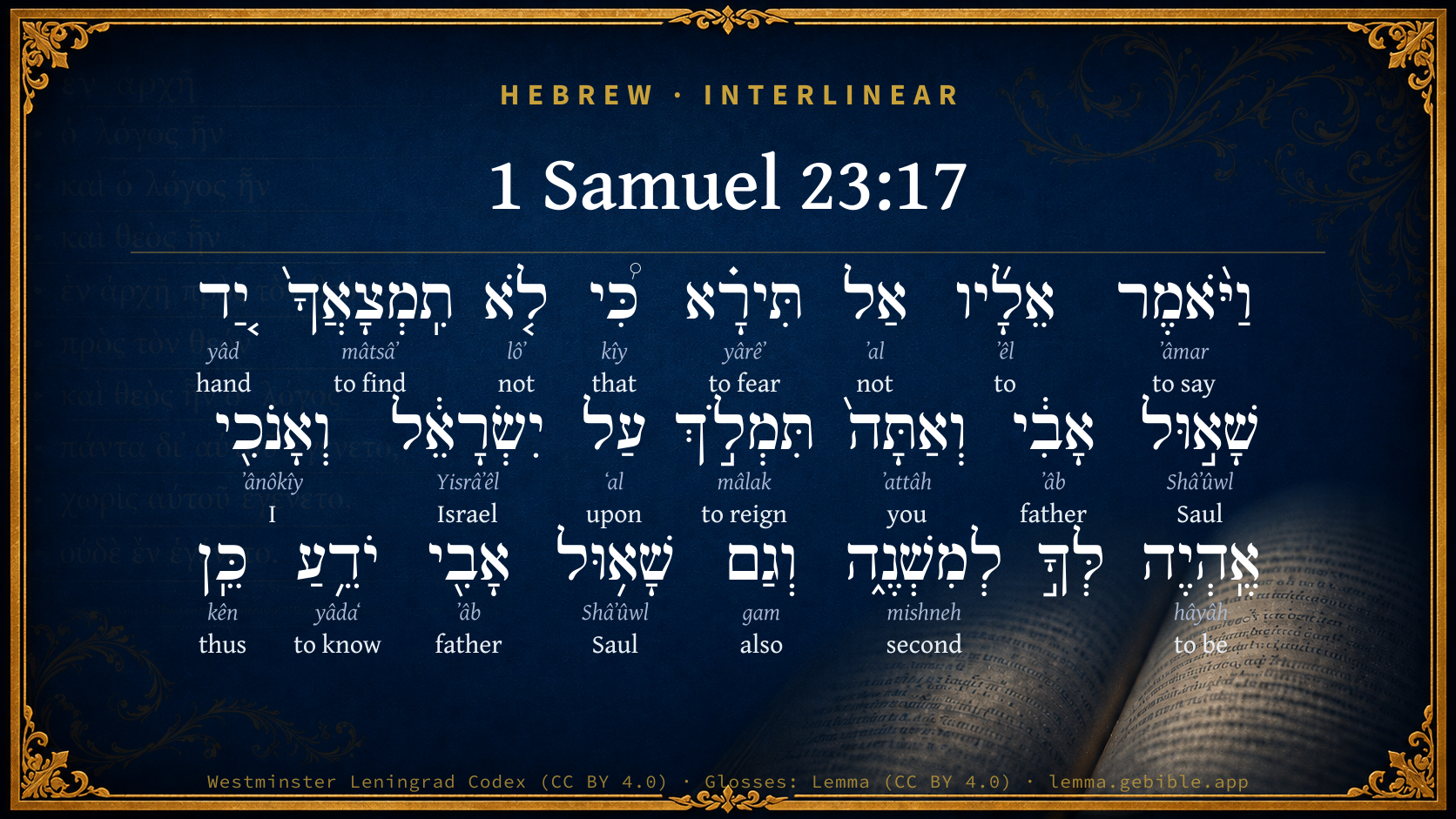
  1. וַיֹּ֨אמֶר ʼâmar H559 “and · to say” Conjunction + Verb, Qal, Sequential Imperfect, 3rd Person, Masculine, Singular
  2. אֵלָ֜יו ʼêl H413 “to · him” Preposition + Suffix, Personal, 3rd Person, Masculine, Singular
  3. אַל ʼal H408 “not” Particle, Negative
  4. תִּירָ֗א yârêʼ H3372 “to fear” Verb, Qal, Jussive, 2nd Person, Masculine, Singular
  5. כִּ֠י kîy H3588 “that” Conjunction
  6. לֹ֤א lôʼ H3808 “not” Particle, Negative
  7. תִֽמְצָאֲךָ֙ mâtsâʼ H4672 “to find · you” Verb, Qal, Imperfect, 3rd Person, Feminine, Singular + Suffix, Personal, 2nd Person, Masculine, Singular
  8. יַ֚ד yâd H3027 “hand of” Noun, Common, Both, Singular, Construct
  9. שָׁא֣וּל Shâʼûwl H7586 “Saul” Noun, Proper
  10. אָבִ֔י ʼâb H1 “father · my” Noun, Common, Masculine, Singular, Construct + Suffix, Personal, 1st Person, Common, Singular
  11. וְאַתָּה֙ ʼattâh H859 “and · you” Conjunction + Pronoun, Personal, 2nd Person, Masculine, Singular
  12. תִּמְלֹ֣ךְ mâlak H4427 “to reign” Verb, Qal, Imperfect, 2nd Person, Masculine, Singular
  13. עַל ʻal H5921 “upon” Preposition
  14. יִשְׂרָאֵ֔ל Yisrâʼêl H3478 “Israel” Noun, Proper
  15. וְאָנֹכִ֖י ʼânôkîy H595 “and · I” Conjunction + Pronoun, Personal, 1st Person, Common, Singular
  16. אֶֽהְיֶה hâyâh H1961 “to be” Verb, Qal, Imperfect, 1st Person, Common, Singular
  17. וְגַם gam H1571 “and · also” Conjunction + Particle, Accusative
  18. שָׁא֥וּל Shâʼûwl H7586 “Saul” Noun, Proper
  19. אָבִ֖י ʼâb H1 “father · my” Noun, Common, Masculine, Singular, Construct + Suffix, Personal, 1st Person, Common, Singular
  20. יֹדֵ֥עַ yâdaʻ H3045 “knowing” Verb, Qal, Participle Active, Masculine, Singular, Absolute
  21. כֵּֽן kên H3651 “thus” Particle, Demonstrative

About this verse

These counts appear in no published source. They are computed here, from the morphology-tagged text and Lemma’s own curated glosses. What Lemma adds →

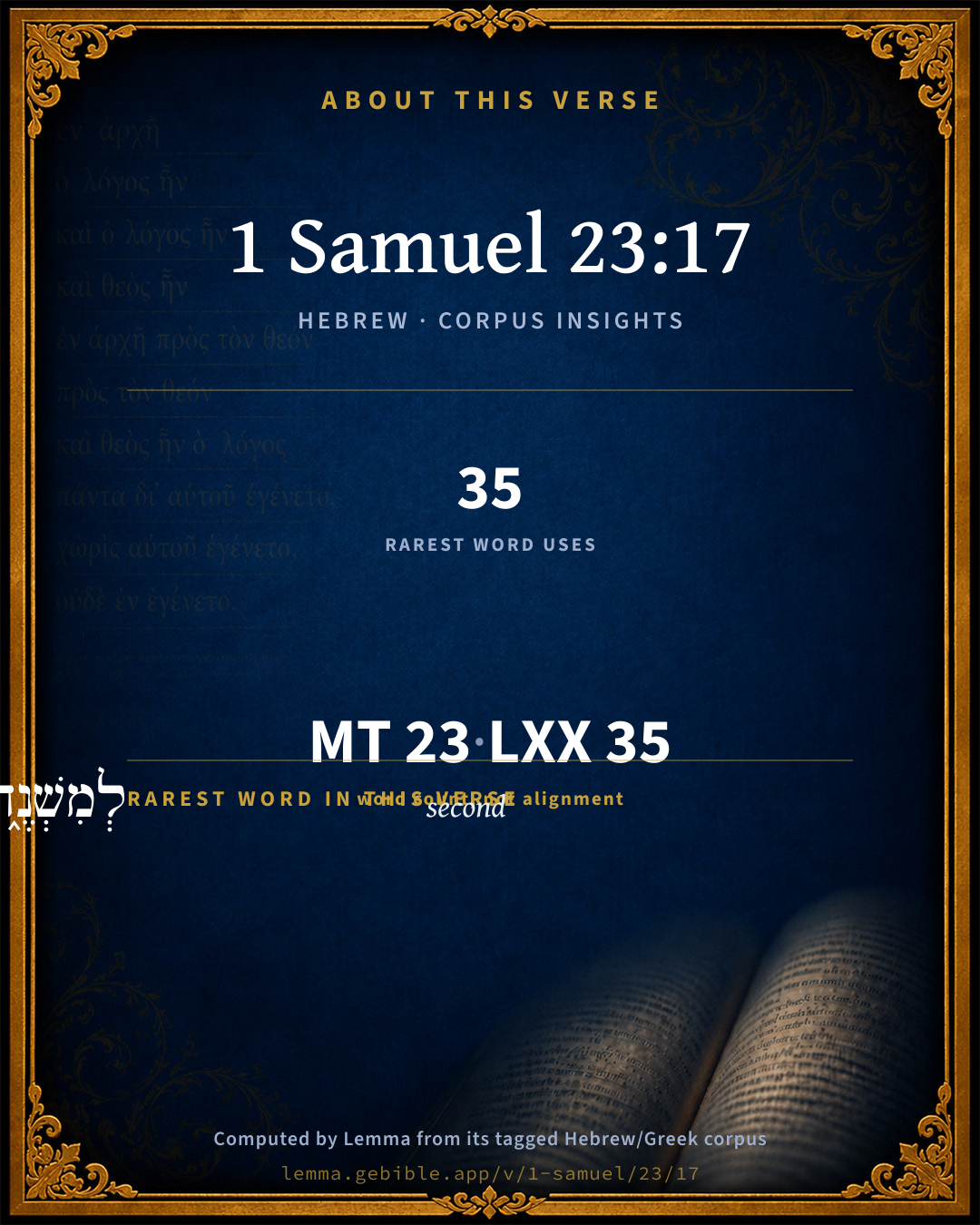
23
words
20
distinct lemmas
Historical
section

Shared distinctive vocabulary

לְמִשְׁנֶ֑ה second H4932 occurs in 34 verses of the Hebrew Bible. Also found in:

Grammatical profile

  • 6 verbs
  • 7 nouns
  • 2 pronouns
  • 3 prepositions
  • 1 conjunction
  • 4 particles

Verb forms

  • וַיֹּ֨אמֶר Qal · Sequential Imperfect
  • תִּירָ֗א Qal · Jussive
  • תִֽמְצָאֲךָ֙ Qal · Imperfect
  • תִּמְלֹ֣ךְ Qal · Imperfect
  • אֶֽהְיֶה Qal · Imperfect
  • יֹדֵ֥עַ Qal · Participle Active

Repetition

Words recur within this verse — often emphatic in Hebrew:

  • שָׁא֣וּל Saul H7586 ×2
  • אָבִ֔י father H1 ×2

Hebrew & Septuagint length

In English translation the verse runs 39 words from the Hebrew and 38 from the Septuagint (LXX English) — closely comparable.

A rough comparison of the two English renderings, which tokenize alike — not a word-level alignment.

Word counts can differ between the Hebrew and the Greek without any difference in meaning — e.g. the Hebrew direct-object marker אֵת has no separate Greek word, and Greek often adds the article ὁ.

In the original languages it is 23 Hebrew tokens and 35 Greek tokens — but the two are counted differently (Hebrew bundles its prefixes and suffixes into one token; the Greek is in lemma form), so that isn’t a like-for-like length.

Cross-references

16

Topical passages linked to 1 Samuel 23:17 in the Treasury of Scripture Knowledge — connected by theme and wording, ordered by reader-vote popularity; previews shown in the World English Bible.

  • 1 Samuel 20:31 For as long as the son of Jesse lives on the earth, you shall not be established, nor your kingdom. Therefore now send and bring him to me, for he shall surely die.
  • 1 Samuel 24:20 Now, behold, I know that you shall surely be king, and that the kingdom of Israel shall be established in your hand.
  • Job 5:11–15 So that he sets up on high those who are low, Those who mourn are exalted to safety.
  • Isaiah 54:17 No weapon that is formed against you shall prosper; and every tongue that shall rise against you in judgment you shall condemn. This is the heritage of the servants of Yahweh, and their righteousness which is of me, says Yahweh.
  • Acts 28:16 When we entered into Rome, the centurion delivered the prisoners to the captain of the guard, but Paul was allowed to stay by himself with the soldier who guarded him.
  • Hebrews 13:6 So that with good courage we say, "The Lord is my helper. I will not fear. What can man do to me?"
  • Psalms 27:1–3 Yahweh is my light and my salvation. Whom shall I fear? Yahweh is the strength of my life. Of whom shall I be afraid?
  • Psalms 46:1–2 God is our refuge and strength, A very present help in trouble.
  • Psalms 91:1–2 He who dwells in the secret place of the Most High Will rest in the shadow of the Almighty.
  • Proverbs 14:26 In the fear of Yahweh is a secure fortress, And he will be a refuge for his children.
  • Proverbs 19:21 There are many plans in a man's heart, But Yahweh's counsel will prevail.
  • Isaiah 41:10 Don't you be afraid, for I am with you; don't be dismayed, for I am your God; I will strengthen you; yes, I will help you; yes, I will uphold you with the right hand of my righteousness.
  • Isaiah 41:14 Don't be afraid, you worm Jacob, and you men of Israel; I will help you, says Yahweh, and your Redeemer is the Holy One of Israel.
  • Luke 12:32 Don't be afraid, little flock, for it is your Father's good pleasure to give you the Kingdom.
  • Acts 5:39 But if it is of God, you will not be able to overthrow it, and you would be found even to be fighting against God!"
  • Romans 15:24 whenever I journey to Spain, I will come to you. For I hope to see you on my journey, and to be helped on my way there by you, if first I may enjoy your company for a while.

Cross-references courtesy of OpenBible.info (CC BY 4.0).

Hebrew and Greek witnesses Masoretic Hebrew ↔ Greek Septuagint

The same verse in the two great witnesses to the Old Testament, shown verse-for-verse.

These are two independent witnesses, not word-aligned to each other, and the Septuagint is shown in lemma (dictionary) form.

Hebrew 1 Samuel 23:17 Masoretic · Westminster Leningrad Codex

וַיֹּ֨אמֶר אֵלָ֜יו אַל תִּירָ֗א כִּ֠י לֹ֤א תִֽמְצָאֲךָ֙ יַ֚ד שָׁא֣וּל אָבִ֔י וְאַתָּה֙ תִּמְלֹ֣ךְ עַל יִשְׂרָאֵ֔ל וְאָנֹכִ֖י אֶֽהְיֶה לְּךָ֣ לְמִשְׁנֶ֑ה וְגַם שָׁא֥וּל אָבִ֖י יֹדֵ֥עַ כֵּֽן

He said to him, Don't be afraid; for the hand of Saul my father shall not find you; and you shall be king over Israel, and I shall be next to you; and that also Saul my father knows.

World English Bible · Public Domain

Greek LXX 1 Samuel 23:17 Septuagint · lemma form

καί εἶπον πρός αὐτός μή φοβέω ὅτι οὐ μή εὑρίσκω σύ ὁ χείρ σαούλ ὁ πατήρ ἐγώ καί σύ βασιλεύω ἐπί ἰσραήλ καί ἐγώ εἰμί σύ εἰς δεύτερος καί σαούλ ὁ πατήρ ἐγώ οἶδα οὕτως

And he said to him, Fear not, for the hand of Saul my father shall not find you; and you shall be king over Israel, and I shall be second to you; and Saul my father knows it.

LXX2012 (modern English Septuagint) · Public Domain

Hebrew: Westminster Leningrad Codex (CC BY 4.0). Greek: Septuagint (public domain); English from LXX2012 (modern English Septuagint) (Public Domain). How the Septuagint differs from the Hebrew →

Targum (Aramaic paraphrase)

1

The Targum is the ancient Jewish Aramaic paraphrase of the Hebrew Scriptures — an interpretive translation, not the Hebrew text itself. Onkelos (literal) and Pseudo-Jonathan (expansive) render the Torah, and Jonathan the Prophets. Coverage is partial: where no permissively-licensed English translation exists for a verse, only the Aramaic is shown. This is verse-level text, not a word-by-word alignment to the Hebrew.

  1. Targum Jonathan Prophets (Joshua–Malachi)
    וַאֲמַר לֵיהּ לָא תִדְחַל אֲרֵי לָא תַשְׁכְּחִינָךְ יְדָא דְשָׁאוּל אַבָּא וְאַתְּ תִּמְלוֹךְ עַל יִשְׂרָאֵל וַאֲנָא אֱהֵי לָךְ לְתִנְיָן וְאַף שָׁאוּל אַבָּא יְדַע כֵּן:

    (no public-domain English translation for this verse)

    Targum Jonathan — Aramaic: “Mikraot Gedolot” (public domain). English: “Sefaria Community Translation” (CC0 1.0 (public-domain dedication)); “London "Chaldee Paraphrase," 1871” (public domain). Text via Sefaria.

Commentary

Notes on 1 Samuel 23:17 from classic Christian and Jewish commentators (each source and its license shown beneath its notes). The classic Christian expositions comment on the surrounding passage and are grouped to its opening verse, so a note may address several verses; the Jewish commentaries on the Tanakh (Rashi and others) are per-verse, so they appear only where the commentator wrote on this verse.

Lemma curates 59 commentaries, every one of them public domain or Creative Commons licensed, each selected and text-cleaned for this edition rather than reprinted as found. About our sources →

Trapp's Complete Commentary

John Trapp

1Sa 23:17 And he said unto him, Fear not: for the hand of Saul my father shall not find thee; and thou shalt be king over Israel, and I shall be next unto thee; and that also Saul my father knoweth.

Ver. 17. And I shall be next unto thee.] In heaven he might be, but not on earth, because prevented by death; but otherwise they might have lived together in as great unity and unanimity as did lately Frederick and John, dukes of Saxony; who as they dwelt both in one and the same house, so their mutual love grew to the last, in utriusque periculis et gravissimis deliberationibus, saith mine author, {a} dum omnia in rep. communicatis sententiis constituebant; so that they did nothing in the commonwealth without one another’s counsel and consent. Those that say, as some do, that Jonathan is next unto David in heaven, have as little assurance of it as those that tell us - but who told them? - that John Baptist, for his humility, {Mat 3:11} hath the same place in heaven that Lucifer lost by his pride.

{a} Exner.

John Trapp, A Commentary or Exposition upon All the Books of the Old and New Testament (1647–1656) — public domain. Text from a community e-Sword module.

The Biblical Illustrator

Joseph S. Exell

1Sa_23:17

I shall be next unto thee.

A sermon to boys

This conduct of the kings son teaches some important lessons.

1. Stand by the weak and defenceless. There is no nobler feature in any boys character than a determination to do this.

2. We also learn to be content with a lower place when God has clearly marked out another for a higher. Jonathan saw that God was with David, and he made his own conduct to serve Gods purpose. Be always on the look out to render others service. Fear not the taunts of men or the frowns of the world. Take Christ as your pattern. For yourselves do not forget that unselfishness is the ornament of every true man, the mark of every true gentleman, the essence of pure religion, and the germ of an undying character. (Arthur Vinter.)

.

The Biblical Illustrator, edited by Joseph S. Exell (c. 1880s–1900s) — public domain. Text from a community e-Sword module.

Joseph Benson's Commentary

1Sa 23:17. Thou shalt be king, and I shall be next unto thee — Or, hold the second place in the kingdom; which words import thus much: I do not look to be king myself, as by my birth I might expect, but that thou shalt be king, God having so appointed, and I but in a secondary place, inferior to thee. The first part of this sentence Jonathan might well speak, as he had the promise of God for it, which must stand; but the other he spoke in human confidence, and the event showed how little is to be built on that. He ought, as we ought all to do with respect to what is future and only in expectation, to have spoken in the language of St. James: “If the Lord will, I shall be next unto thee.” And that also my father knoweth — For he could not but remember what Samuel told him, (1Sa 15:28,) and, from David’s wonderful successes, he probably inferred that he was the person of whom Samuel spake.

Joseph Benson's Commentary on the Old and New Testaments (1811–1818) — public domain. Text from a community e-Sword module.

Tyndale Open Study Notes

Tyndale Open Resources

23:17 You are going to be the king. . . I will be next to you (literally second to you): Jonathan recognized God’s selection of David and renounced any personal ambition to the throne. Jonathan never occupied an official position in David’s court but was killed in battle along with his father (31:2).

Tyndale Open Study Notes — © Tyndale Open Resources, licensed CC BY-SA 4.0. Text via the HelloAO Bible API.

Geneva Bible (1599)

Geneva Bible translators

Jonathan assureth David, that God will accomplish his promise, and that his father striveth against his own conscience.

Geneva Bible (1599) marginal notes — public domain. Text via Bolls.life.

Ellicott's Commentary for English Readers

(17) And I shall be next unto thee.—To us—who read a few pages on in the record of these times how this same generous, loving friend found a grave on Mount Gilboa instead of a home with David, whom he admired with so ungrudging an admiration—these words of Jonathan possess a pathetic interest of their own. That brave, romantic career was nearly run when he met David for the last time in the woods of Ziph. As far as we can judge, if Jonathan had lived he would have certainly ceded any rights he had to the throne of his father Saul in favour of David, unlike that other comparatively unknown son of Saul, Ishbosheth, who set up as a rival claimant to the son of Jesse. But his generosity was not to be exposed to any such severe test, and David was spared the presence of such a rival as the gallant and gifted Jonathan would assuredly have been to him.

And that also Saul my father knoweth.—It is very likely by this time that the circumstance of Samuel’s mysterious anointing of the son of Jesse years before at Bethlehem had become known to Saul. Now that David had been openly proclaimed a public enemy, and that the king had repeatedly and openly sought his life, there was no reason for any concealment. No doubt, by this time very many in Israel looked on him as the anointed successor of Saul. The covenant alluded to in the next verse was, of course, the old covenant of eternal friendship which they had made when they parted outside Gibeah at the New Moon feast, as we find related at length in 1 Samuel 20.

After this meeting David never looked on Jonathan’s face in life again.

“Oh, heart of fire! misjudged by wilful man,

Thou flower of Jesse’s race!

What woe was thine when thou and Jonathan

Last greeted face to face!

He doomed to die, thou on us to impress

The portent of a blood-stained holiness.”

Lyra Apostolica.

A Bible Commentary for English Readers, edited by Charles John Ellicott (1878–1897) — public domain. Text from a community e-Sword module.

The Cambridge Bible for Schools and Colleges

gen. ed. J. J. S. Perowne

17. Saul my father knoweth] Both that thou art destined to be king (see on 1Sa_18:9), and that I am ready to resign my claims in thy favour. This is the climax of Jonathan’s unselfish generosity.

The Cambridge Bible for Schools and Colleges (gen. ed. J. J. S. Perowne; Cambridge University Press, 1878–1918) — public domain. Text from a community e-Sword module.

John Gill's Exposition

And he said unto him, fear not,.... Distrust not the power, providence, and promises of God, nor dread the wrath of Saul, or fear falling into his hands:

for the hand of Saul my father shall not find thee; to lay hold on him, seize him, and do him any hurt:

and thou shalt be king over Israel; meaning after the death of his father; which he knew either by some special revelation made to him; or rather by being informed he had been anointed by Samuel, and which he had either from Samuel or from David himself; and this he most firmly believed, though David was now in so low a condition:

and I shall be next unto thee; not succeed him in the kingdom; but if living when he came to the throne, he should be the second man in civil affairs, as he now was, and that he should be content with:

and that also Saul my father knoweth; having knowledge of the anointing of David by Samuel; or he might, and did conclude this from various circumstances, that David was his neighbour Samuel had told him of, God had given his kingdom to, Sa1 15:28.

John Gill's Exposition of the Whole Bible (1746–1763) — public domain (CC PDM 1.0). Text via the HelloAO Bible API.

Haydock's Catholic Bible Commentary

Next, in dignity; thy helper and associate. See Ecclesiastes iv. 8, 11. --- This, our league, (Calmet) or the decree appointing David to be king. (Menochius)

George Leo Haydock (1774–1849), Haydock's Catholic Family Bible and Commentary, 1859 edition — public domain. Excludes Psalms (Douay-Rheims chapter numbering differs from Protestant) and Deuterocanonical books (Catholic canon only).

Matthew Poole's English Annotations

I shall be next unto thee; which he gathered either from David’s generosity, ingenuousness, and true friendship to him; or from some promise made to him by David concerning it. Or the meaning of the words, next unto thee, may be as much as to say, I shall be under thee, after thee, or inferior to thee, as the phrase tibi secundus oft signifies. So that the whole imports thus much: I do not look to be king myself, (as by my birth I might expect,) but that thou shalt be king, (God having so appointed,) and I but in a secondary place inferior to thee.

That also Saul my father knoweth, by strong and well-grounded conjectures, as hath been noted.

Matthew Poole's English Annotations on the Holy Bible (1683–1685) — public domain. Text from a community e-Sword/MySword module.

John Wesley's Explanatory Notes

Next to thee - Which he gathered either from David's generosity, and friendship to him; or from some promise made to him by David concerning it. So that the whole imports thus much; I do not look to be king myself (as by my birth I might expect,) but that thou shalt be king (God having so appointed) and I but in a secondary place inferior to thee.

John Wesley, Explanatory Notes Upon the Whole Bible (1754–1765) — public domain. Text via the GEBible commentary corpus.

unfoldingWord translationNotes

Door43 World Missions Community

For the hand of Saul my father will not find you

Here "hand" is a metonym for Saul and his power. AT: "For Saul my father will not find you" or "For Saul my father will never be able to have power over you" (See: Metonymy)

translationWords

Saul (OT)

king

Israel

know

covenant

unfoldingWord translationNotes — © Distant Shores Media and the Door43 World Missions Community, licensed CC BY-SA 4.0. Source: git.door43.org/Door43/en_tn.

Lesson kit

Teaching starters — assembled from the data on this page, not authored interpretation. Every prompt links to the verse data it draws on. Edit before teaching.

1 Samuel, in the Historical, opens this verse with 23 words (20 distinct Hebrew lemmas). Its most distinctive word is mishneh (“second”). A historical commentator’s framing appears above. Read the whole chapter for the surrounding context.

Discussion questions

  1. The word mishneh carries the sense “second.” How does it shape the verse?
  2. How does Genesis 41:43, which shares the word «second», read alongside this verse?
  3. What does the repetition of “Saul” (2× in this one verse) do in this verse?
  4. These translations render this verse differently. What is at stake in choosing one wording over another?
  5. «וַיֹּ֨אמֶר» is a Qal Sequential Imperfect verb. How does that grammatical form shape the action described?
  6. Compare how Trapp's Complete Commentary and The Biblical Illustrator read this verse. Where do they agree or differ?

Things to notice

Reading settings

Reading text

Shown beneath each verse's original-language words.

Old Testament
Old Testament edition

Read the OT as the Masoretic Hebrew (MT) or the Greek Septuagint (LXX).

English shown for the Greek Septuagint (in the Hebrew ↔ Greek comparison).

Comparing translations? Open the Compare panel on any verse page to stack up to four side by side.