
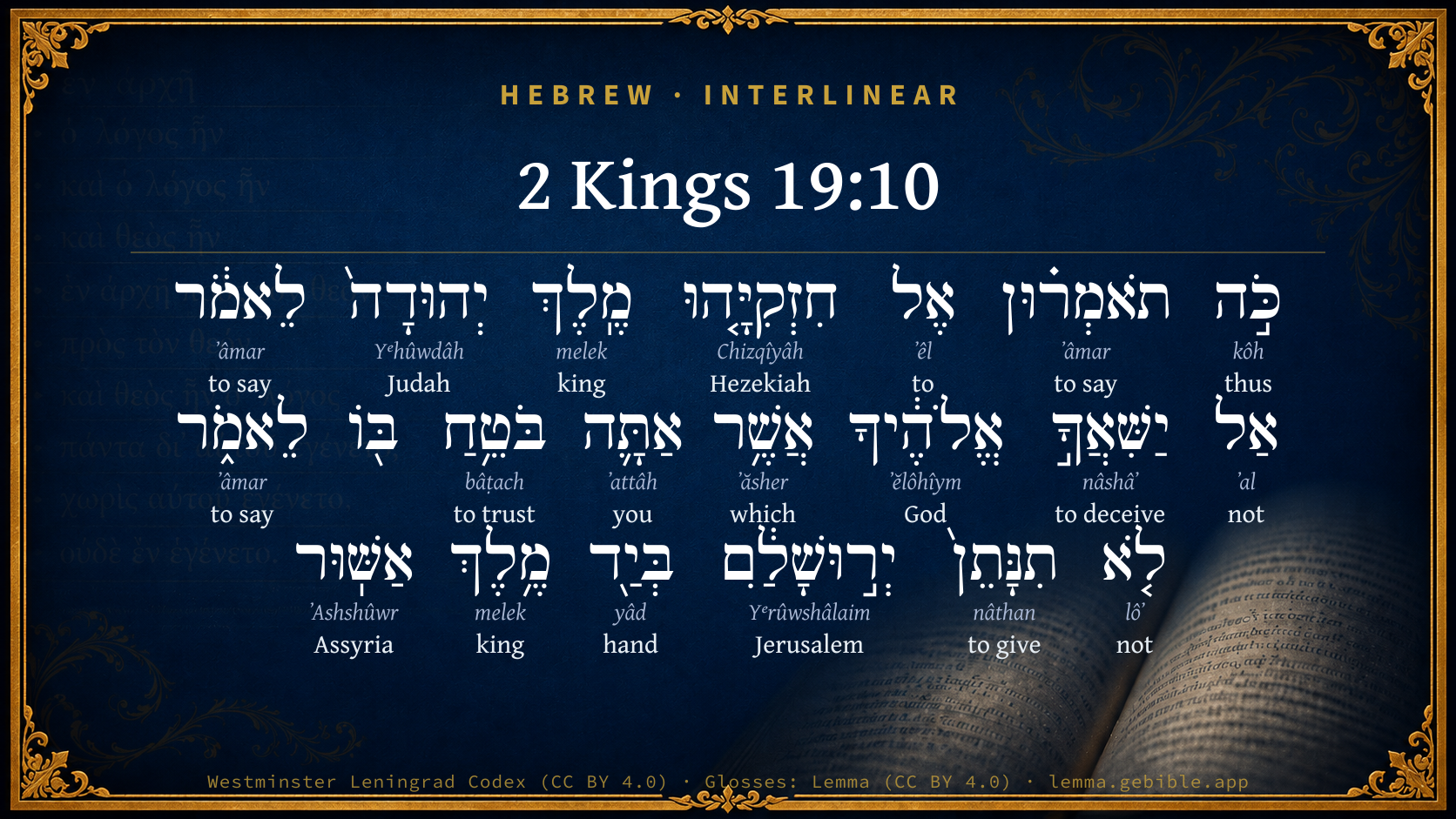
2 Kings 19:10

Hebrew (Westminster Leningrad Codex) 2 Kings 19:10 appears in the Hebrew Old Testament. The text above is from the Westminster Leningrad Codex. Each word links to its Strong’s number, a concise gloss, and parsing drawn from the Open Scriptures Hebrew Bible morphology. Click any word for its full Brown-Driver-Briggs (BDB) entry.
Download image
Cite this verse

2 Kings 19:10 (World English Bible). Public Domain. Lemma interlinear Bible study tool, https://lemma.gebible.app/v/2-kings/19/10.

Show BibTeX & RIS
BibTeX
RIS
English Translation
Thus shall you speak to Hezekiah king of Judah, saying, Don't let your God in whom you trust deceive you, saying, Jerusalem shall not be given into the hand of the king of Assyria.
World English Bible · Public Domain
Download a study sheet

One document with this verse’s original text, its word-by-word gloss line, the meaning frame, cross-references with their text, attributed commentary, and full source and license credits — printable, and it pastes into notes with its structure intact.

This verse Autodidact and up

Study sheet (.html) Plain text (.txt)

A passage Seminary Student

Up to 50 verses in one chapter. A passage sheet keeps up to 6 commentary sources and 12 cross-references per verse, in the order this page ranks them, and says so on the sheet whenever that leaves anything out. Ask for a single verse and you get the Autodidact verse sheet above.

Everything on this page stays free to read, with no account — the sheet is a download of what is already on screen, not access to it.

Want to remove ads? Support Godless Engineer
Compare translations 3

The same verse in 3 English versions, stacked beneath the original-language interlinear above. Click any original word for its lexicon entry.

Each is an independent rendering of the whole verse — the interlinear is not word-aligned to these translations.

Highlighted words mark where these versions differ — a whole-verse word diff, not a word-by-word alignment.

  • World English Bible Public Domain
    Thus shall you speak to Hezekiah king of Judah, saying, Don't let your God in whom you trust deceive you, saying, Jerusalem shall not be given into the hand of the king of Assyria.
  • King James Version Public Domain
    Thus shall ye speak to Hezekiah king of Judah, saying, Let not thy God in whom thou trustest deceive thee, saying, Jerusalem shall not be delivered into the hand of the king of Assyria.
  • unfoldingWord Literal Text CC BY-SA 4.0
    “Thus you shall say to Hezekiah, the king of Judah, saying, ‘Do not let your God, in whom you are trusting, deceive you, saying, “Jerusalem will not be given into the hand of the king of Assyria.”

unfoldingWord Literal Text — © unfoldingWord, licensed CC BY-SA 4.0. Word-aligned USFM3 via Door43 (git.door43.org/unfoldingWord/en_ult).

Versions to compare (up to 4)

3 of 4 selected

Show all 18 translations

Every available English version of this verse, each an independent rendering of the whole verse.

  • World English Bible Public Domain
    Thus shall you speak to Hezekiah king of Judah, saying, Don't let your God in whom you trust deceive you, saying, Jerusalem shall not be given into the hand of the king of Assyria.
  • Berean Standard Bible Public Domain
    “Give this message to Hezekiah king of Judah: ‘Do not let your God, in whom you trust, deceive you by saying that Jerusalem will not be delivered into the hand of the king of Assyria.
  • Majority Standard Bible Public Domain
    “Give this message to Hezekiah king of Judah: ‘Do not let your God, in whom you trust, deceive you by saying that Jerusalem will not be delivered into the hand of the king of Assyria.
  • King James Version Public Domain
    Thus shall ye speak to Hezekiah king of Judah, saying, Let not thy God in whom thou trustest deceive thee, saying, Jerusalem shall not be delivered into the hand of the king of Assyria.
  • American Standard Version (1901) Public Domain
    Thus shall ye speak to Hezekiah king of Judah, saying, Let not thy God in whom thou trustest deceive thee, saying, Jerusalem shall not be given into the hand of the king of Assyria.
  • Revised Version (1885) Public Domain
    Thus shall ye speak to Hezekiah king of Judah, saying, Let not thy God in whom thou trustest deceive thee, saying, Jerusalem shall not be given into the hand of the king of Assyria.
  • Geneva Bible (1599) Public Domain
    Thus shall ye speake to Hezekiah King of Iudah, and say, Let not thy God deceiue thee in whome thou trustest, saying, Ierusalem shall not be deliuered into the hande of the King of Asshur.
  • Douay-Rheims (1899) Public Domain
    Thus shall you say to Ezechias king of Juda: Let not thy God deceive thee, in whom thou trustest: and do not say: Jerusalem shall not be delivered into the hands of the king of the Assyrians.
  • Young's Literal Translation Public Domain
    `Thus do ye speak unto Hezekiah king of Judah, saying, Let not thy God lift thee up in whom thou art trusting, saying, Jerusalem is not given into the hand of the king of Asshur.
  • Literal Standard Version CC BY-SA 4.0
    “Thus you speak to Hezekiah king of Judah, saying, Do not let your God in whom you are trusting lift you up, saying, Jerusalem is not given into the hand of the king of Asshur.
  • Unlocked Literal Bible CC BY-SA 4.0
    “Say to Hezekiah king of Judah, 'Do not let your God in whom you trust deceive you, saying, “Jerusalem will not be given over into the hand of the king of Assyria.”
  • unfoldingWord Literal Text CC BY-SA 4.0
    “Thus you shall say to Hezekiah, the king of Judah, saying, ‘Do not let your God, in whom you are trusting, deceive you, saying, “Jerusalem will not be given into the hand of the king of Assyria.”
  • Darby Bible Public Domain
    Thus shall ye speak to Hezekiah king of Judah saying: Let not thy God, upon whom thou reliest, deceive thee, saying, Jerusalem shall not be delivered into the hand of the king of Assyria.
  • World Messianic Bible Public Domain
    “Tell Hezekiah king of Judah this: ‘Don’t let your God in whom you trust deceive you, saying, Jerusalem will not be given into the hand of the king of Assyria.
  • Webster's Bible Public Domain
    Thus shall ye speak to Hezekiah king of Judah, saying, Let not thy God in whom thou trustest deceive thee, saying, Jerusalem shall not be delivered into the hand of the king of Assyria.
  • Free Bible Version CC BY-SA 4.0
    “Tell Hezekiah, king of Judah: ‘Don't let your God, the one you're trusting in, fool you by saying that Jerusalem won't fall into the hands of the king of Assyria.
  • Bible in Basic English Public Domain
    This is what you are to say to Hezekiah, king of Judah: Let not your God, in whom is your faith, give you a false hope, saying, Jerusalem will not be given into the hands of the king of Assyria.
  • JPS Tanakh (1917) Public Domain
    'Thus shall ye speak to Hezekiah king of Judah, saying: Let not thy God in whom thou trustest beguile thee, saying: Jerusalem shall not be given into the hand of the king of Assyria.

Literal Standard Version (2020), Covenant Press — licensed CC BY-SA 4.0. Text via the HelloAO Bible API (eBible.org). Unlocked Literal Bible (unfoldingWord) — licensed CC BY-SA 4.0. Text via the HelloAO Bible API (eBible.org). unfoldingWord Literal Text — © unfoldingWord, licensed CC BY-SA 4.0. Word-aligned USFM3 via Door43 (git.door43.org/unfoldingWord/en_ult). Free Bible Version, Dr. Jonathan Gallagher — licensed CC BY-SA 4.0. Text via the HelloAO Bible API (eBible.org).

Word by word

More ways to search: Search by grammar → Find every occurrence → Compare this word →

Practice this passage: Drill this verse → Learn its vocabulary →

יַשִּׁאֲךָ֣
nâshâʼ
H5377
“to deceive · you”
Verb, Hiphil, Jussive, 3rd Person, Masculine, Singular + Suffix, Personal, 2nd Person, Masculine, Singular
Part of Speech
Verb
Stem
Hiphil
Form
Jussive
Person
3rd Person
Gender
Masculine
Number
Singular
Full BDB Definition

Origin: a primitive root

TWOT: 1425

to beguile, deceive - (Niphal) to be beguiled - (Hiphil) to beguile, deceive - (Qal) utterly (infinitif)
  1. כֹּ֣ה kôh H3541 “thus” Adverb
  2. תֹאמְר֗וּן ʼâmar H559 “to say” Verb, Qal, Imperfect, 2nd Person, Masculine, Plural + Suffix, n
  3. אֶל ʼêl H413 “to” Preposition
  4. חִזְקִיָּ֤הוּ Chizqîyâh H2396 “Hezekiah” Noun, Proper
  5. מֶֽלֶךְ melek H4428 “king of” Noun, Common, Masculine, Singular, Construct
  6. יְהוּדָה֙ Yᵉhûwdâh H3063 “Judah” Noun, Proper
  7. לֵאמֹ֔ר ʼâmar H559 “to say” Preposition + Verb, Qal, Infinitive Construct
  8. אַל ʼal H408 “not” Particle, Negative
  9. אֱלֹהֶ֔יךָ ʼĕlôhîym H430 “God(s) · your” Noun, Common, Masculine, Plural, Construct + Suffix, Personal, 2nd Person, Masculine, Singular
  10. אֲשֶׁ֥ר ʼăsher H834 “which” Particle, Relative
  11. אַתָּ֛ה ʼattâh H859 “you” Pronoun, Personal, 2nd Person, Masculine, Singular
  12. בֹּטֵ֥חַ bâṭach H982 “trusting” Verb, Qal, Participle Active, Masculine, Singular, Absolute
  13. לֵאמֹ֑ר ʼâmar H559 “to say” Preposition + Verb, Qal, Infinitive Construct
  14. לֹ֤א lôʼ H3808 “not” Particle, Negative
  15. תִנָּתֵן֙ nâthan H5414 “to give” Verb, Niphal, Imperfect, 3rd Person, Feminine, Singular
  16. יְר֣וּשָׁלִַ֔ם Yᵉrûwshâlaim H3389 “Jerusalem” Noun, Proper
  17. בְּיַ֖ד yâd H3027 “in/at · hand of” Preposition + Noun, Common, Both, Singular, Construct
  18. מֶ֥לֶךְ melek H4428 “king of” Noun, Common, Masculine, Singular, Construct
  19. אַשּֽׁוּר ʼAshshûwr H804 “Assyria” Noun, Proper

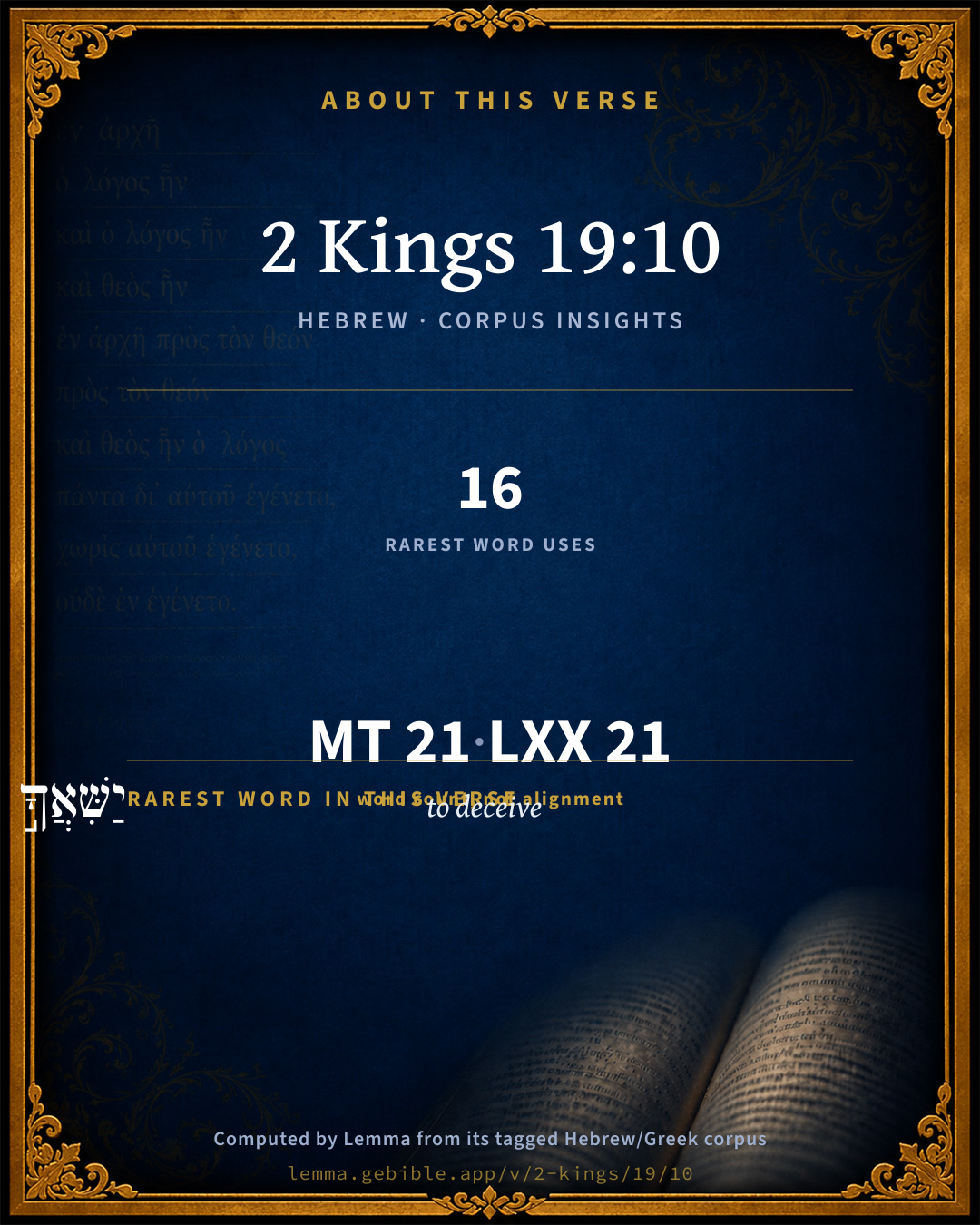
About this verse

These counts appear in no published source. They are computed here, from the morphology-tagged text and Lemma’s own curated glosses. What Lemma adds →

21
words
17
distinct lemmas
Historical
section

Notable vocabulary

The rarest word here is יַשִּׁאֲךָ֣ to deceive H5377 — appearing just 16 times in the whole Hebrew Bible.

Shared distinctive vocabulary

יַשִּׁאֲךָ֣ to deceive H5377 occurs in 15 verses of the Hebrew Bible. Also found in:

Grammatical profile

  • 6 verbs
  • 8 nouns
  • 1 pronoun
  • 2 prepositions
  • 1 adverb
  • 3 particles

Verb forms

  • תֹאמְר֗וּן Qal · Imperfect
  • לֵאמֹ֔ר Qal · Infinitive Construct
  • יַשִּׁאֲךָ֣ Hiphil · Jussive
  • בֹּטֵ֥חַ Qal · Participle Active
  • לֵאמֹ֑ר Qal · Infinitive Construct
  • תִנָּתֵן֙ Niphal · Imperfect

Repetition

Words recur within this verse — often emphatic in Hebrew:

  • תֹאמְר֗וּן to say H559 ×3
  • מֶֽלֶךְ king H4428 ×2

Hebrew & Septuagint length

In English translation the verse runs 34 words from the Hebrew and 25 from the Septuagint (LXX English) — closely comparable.

A rough comparison of the two English renderings, which tokenize alike — not a word-level alignment.

Word counts can differ between the Hebrew and the Greek without any difference in meaning — e.g. the Hebrew direct-object marker אֵת has no separate Greek word, and Greek often adds the article ὁ.

In the original languages it is 21 Hebrew tokens and 21 Greek tokens — but the two are counted differently (Hebrew bundles its prefixes and suffixes into one token; the Greek is in lemma form), so that isn’t a like-for-like length.

Cross-references

4

Topical passages linked to 2 Kings 19:10 in the Treasury of Scripture Knowledge — connected by theme and wording, ordered by reader-vote popularity; previews shown in the World English Bible.

  • 2 Kings 18:5 He trusted in Yahweh, the God of Israel; so that after him was none like him among all the kings of Judah, nor [among them] that were before him.
  • 2 Kings 18:29–30 Thus says the king, Don't let Hezekiah deceive you; for he will not be able to deliver you out of his hand:
  • 2 Chronicles 32:15–19 Now therefore don't let Hezekiah deceive you, nor persuade you after this manner, neither believe you him; for no god of any nation or kingdom was able to deliver his people out of my hand, and out of the hand of my fathers: how much less shall your God deliver you out of my hand?
  • Isaiah 37:10–14 Thus shall you speak to Hezekiah king of Judah, saying, Don't let your God in whom you trust deceive you, saying, Jerusalem shall not be given into the hand of the king of Assyria.

Cross-references courtesy of OpenBible.info (CC BY 4.0).

Hebrew and Greek witnesses Masoretic Hebrew ↔ Greek Septuagint

The same verse in the two great witnesses to the Old Testament, shown verse-for-verse.

These are two independent witnesses, not word-aligned to each other, and the Septuagint is shown in lemma (dictionary) form.

Hebrew 2 Kings 19:10 Masoretic · Westminster Leningrad Codex

כֹּ֣ה תֹאמְר֗וּן אֶל חִזְקִיָּ֤הוּ מֶֽלֶךְ יְהוּדָה֙ לֵאמֹ֔ר אַל יַשִּׁאֲךָ֣ אֱלֹהֶ֔יךָ אֲשֶׁ֥ר אַתָּ֛ה בֹּטֵ֥חַ בּ֖וֹ לֵאמֹ֑ר לֹ֤א תִנָּתֵן֙ יְר֣וּשָׁלִַ֔ם בְּיַ֖ד מֶ֥לֶךְ אַשּֽׁוּר

Thus shall you speak to Hezekiah king of Judah, saying, Don't let your God in whom you trust deceive you, saying, Jerusalem shall not be given into the hand of the king of Assyria.

World English Bible · Public Domain

Greek LXX 2 Kings 19:10 Septuagint · lemma form

μή ἐπιαἴρω σύ ὁ θεός σύ ἐπί ὅς σύ πείθω ἐπί αὐτός λέγω οὐ μή παραδίδωμι ἰερουσαλήμ εἰς χείρ βασιλεύς ἀσσύριος

Let not your God on whom you trust encourage you, saying, Jerusalem shall not be delivered into the hands of the king of the Assyrians.

LXX2012 (modern English Septuagint) · Public Domain

On this verse, The Cambridge Bible for Schools and Colleges discusses the Septuagint’s reading. Read the note in Commentary ↓

Hebrew: Westminster Leningrad Codex (CC BY 4.0). Greek: Septuagint (public domain); English from LXX2012 (modern English Septuagint) (Public Domain). How the Septuagint differs from the Hebrew →

Targum (Aramaic paraphrase)

1

The Targum is the ancient Jewish Aramaic paraphrase of the Hebrew Scriptures — an interpretive translation, not the Hebrew text itself. Onkelos (literal) and Pseudo-Jonathan (expansive) render the Torah, and Jonathan the Prophets. Coverage is partial: where no permissively-licensed English translation exists for a verse, only the Aramaic is shown. This is verse-level text, not a word-by-word alignment to the Hebrew.

  1. Targum Jonathan Prophets (Joshua–Malachi)
    כִּדְנַן תֵּימְרוּן לְחִזְקִיָה מֶלֶךְ שִׁבְטָא דְבֵית יְהוּדָה לְמֵימָר לָא יַטְעִינָךְ אֱלָהָךְ דְאַתְּ רָחִיץ בֵּיהּ לְמֵימָר לָא תִתְמְסַר יְרוּשְׁלֵם בְּיַד מַלְכָּא דְאַתּוּר:

    (no public-domain English translation for this verse)

    Targum Jonathan — Aramaic: “Mikraot Gedolot” (public domain). English: “Sefaria Community Translation” (CC0 1.0 (public-domain dedication)); “London "Chaldee Paraphrase," 1871” (public domain). Text via Sefaria.

Commentary

Notes on 2 Kings 19:10 from classic Christian and Jewish commentators (each source and its license shown beneath its notes). The classic Christian expositions comment on the surrounding passage and are grouped to its opening verse, so a note may address several verses; the Jewish commentaries on the Tanakh (Rashi and others) are per-verse, so they appear only where the commentator wrote on this verse.

Lemma curates 59 commentaries, every one of them public domain or Creative Commons licensed, each selected and text-cleaned for this edition rather than reprinted as found. About our sources →

Trapp's Complete Commentary

John Trapp

2Ki 19:10 Thus shall ye speak to Hezekiah king of Judah, saying, Let not thy God in whom thou trustest deceive thee, saying, Jerusalem shall not be delivered into the hand of the king of Assyria.

Ver. 10. Let not thy God in whom thou trustest deceive thee.] Sennacherib and Rabshakeh are both in a song. Reckon these two, saith an author, among the first and chiefest kill-Christs, because ever an honest mind is more afflicted with words than blows. {Psa 12:3}

John Trapp, A Commentary or Exposition upon All the Books of the Old and New Testament (1647–1656) — public domain. Text from a community e-Sword module.

Joseph Benson's Commentary

2Ki 19:10-11. Thus shall ye speak to Hezekiah — That is, these things shall ye communicate; for they did not signify them by word of mouth, but in writing. Let not thy God, in whom thou trustest, deceive thee — Rab- shakeh had said to the people, Let not Hezekiah deceive you. Sennacherib writes to Hezekiah, Let not thy God deceive thee. Those who have the God of Jacob for their help, and whose hope is in the Lord their God, need not fear being deceived by him, as the heathen were by their pretended gods. It is probable Sennacherib had heard that Hezekiah professed to have an assurance from the Lord, that the king of Assyria should not prevail against him. Behold thou hast heard, &c. — This letter is of the same import with the former message, presuming that the God of Israel was like the gods of other countries, and had no more power to preserve his worshippers than they had to preserve theirs.

Joseph Benson's Commentary on the Old and New Testaments (1811–1818) — public domain. Text from a community e-Sword module.

Tyndale Open Study Notes

Tyndale Open Resources

19:10-13 Sennacherib’s second message reminded the people of Jerusalem of the Assyrians’ ruthless victories; it was common knowledge that the kings of Assyria had plundered, tortured, mutilated (see 19:28), and completely destroyed everyone who stood in their way. No nation, king, or god had been able to resist them. In the face of this threat, the people would be wiser to trust their common sense and surrender rather than trust Hezekiah and his deceptive piety.

Tyndale Open Study Notes — © Tyndale Open Resources, licensed CC BY-SA 4.0. Text via the HelloAO Bible API.

Geneva Bible (1599)

Geneva Bible translators

The more near that the wicked are to their destruction, the more they blaspheme.

Geneva Bible (1599) marginal notes — public domain. Text via Bolls.life.

Adam Clarke's Commentary

Verse 10. Let not thy God in whom thou trustest] This letter is nearly the same with the speech delivered by Rab-shakeh. See 2Kg 18:29.

Adam Clarke's Commentary on the Bible (1810–1826) — public domain. Text from a community e-Sword/MySword module.

Ellicott's Commentary for English Readers

(10) Let not thy God . . . deceive thee.—Through prophets, or dreams, or any other recognised medium of communication.

(10-13) Sennacherib’s second message repeats the arguments of 2Ki_18:29-35.

A Bible Commentary for English Readers, edited by Charles John Ellicott (1878–1897) — public domain. Text from a community e-Sword module.

The Cambridge Bible for Schools and Colleges

gen. ed. J. J. S. Perowne

10. Thus shall ye speak to Hezekiah king of Judah, saying] These words are unrepresented in the LXX.

Let not thy God … deceive thee] This was the sort of railing on the God of Israel, and the speaking against Him on which the Chronicler dwells so strongly.

Jerusalem shall not be delivered] R.V. given. The change brings this passage into conformity with Isaiah. Also as ‘deliver’ is used in the two following verses in a different sense, it is well that the word should be varied.

The Cambridge Bible for Schools and Colleges (gen. ed. J. J. S. Perowne; Cambridge University Press, 1878–1918) — public domain. Text from a community e-Sword module.

Whedon's Commentary on the Bible

Daniel D. Whedon

10. Let not thy God… deceive thee — The arguments urged in this second message are substantially identical with those urged by Rab-shakeh in 2Ki_18:19-35, and were probably prepared by the same officer.

Daniel D. Whedon (gen. ed.), Commentary on the Old and New Testaments (1874–1909) — public domain. Text from a community e-Sword module.

The Pulpit Commentary

Thus shall ye speak to Hezekiah King of Judah, saying. The messengers brought a "letter" ( as we see from ver. 14; but still they were to "speak to Hezekiahi.e. they were first to read the contents to him, and then to hand him the copy. Let not thy God in whom thou trustest deceive thee, saying, Jerusalem shall not be delivered into the hand of the King of Assyria. Sennacherib drops the fiction that he himself is sent by Jehovah to attack Judaea and destroy it, (2Ki_18:25) and contents himself with suggesting that any announcements which Hezekiah may have received from his God are untrustworthy. Probably he spoke his convictions. He did not think it possible that Jerusalem could resist or escape him. (comp. Isa_10:8-11, Isa_10:13, Isa_10:14)

The Pulpit Commentary (1880–1919), ed. H.D.M. Spence-Jones & Joseph S. Exell — public domain. Text from a community e-Sword module.

Scofield Reference Notes

C. I. Scofield

trustest

(See Scofield "Psa 2:12").

The Scofield Reference Bible (1917 edition), notes by C. I. Scofield — public domain. Text from a community e-Sword module.

unfoldingWord translationNotes

Door43 World Missions Community

General Information:

This is the message that King Sennacharib of Assyria sent to King Hezekiah.

Do not let your God in whom you trust deceive you, saying

"Do not believe your God in whom you trust. He is lying when he says"

the hand of the king of Assyria

"Hand" is metonymy for control, authority or power. AT: "the control of the government of Assyria" (See: Metonymy)

See, you have heard

"Notice, you have heard" or "You have certainly heard." Here "see" was used to draw attention to what he was about to say next.

So will you be rescued?

Sennacharib used this question to emphasize that God will not be able to rescue them. AT: "Your God will not rescue you!" or "You will not be able to escape either!" (See: Rhetorical Question)

translationWords

Hezekiah

kingdom of Judah

trust

deceive

Jerusalem

hand

Assyria

unfoldingWord translationNotes — © Distant Shores Media and the Door43 World Missions Community, licensed CC BY-SA 4.0. Source: git.door43.org/Door43/en_tn.

Lesson kit

Teaching starters — assembled from the data on this page, not authored interpretation. Every prompt links to the verse data it draws on. Edit before teaching.

2 Kings, in the Historical, opens this verse with 21 words (17 distinct Hebrew lemmas). Its most distinctive word is nâshâʼ (“to deceive”). A historical commentator’s framing appears above. Read the whole chapter for the surrounding context.

Discussion questions

  1. The word nâshâʼ carries the sense “to deceive.” How does it shape the verse?
  2. How does Genesis 3:13, which shares the word «to deceive», read alongside this verse?
  3. What does the repetition of “to say” (3× in this one verse) do in this verse?
  4. These translations render this verse differently. What is at stake in choosing one wording over another?
  5. «תֹאמְר֗וּן» is a Qal Imperfect verb. How does that grammatical form shape the action described?
  6. Compare how Trapp's Complete Commentary and Joseph Benson's Commentary read this verse. Where do they agree or differ?

Things to notice

Reading settings

Reading text

Shown beneath each verse's original-language words.

Old Testament
Old Testament edition

Read the OT as the Masoretic Hebrew (MT) or the Greek Septuagint (LXX).

English shown for the Greek Septuagint (in the Hebrew ↔ Greek comparison).

Comparing translations? Open the Compare panel on any verse page to stack up to four side by side.