
Genesis 19:17

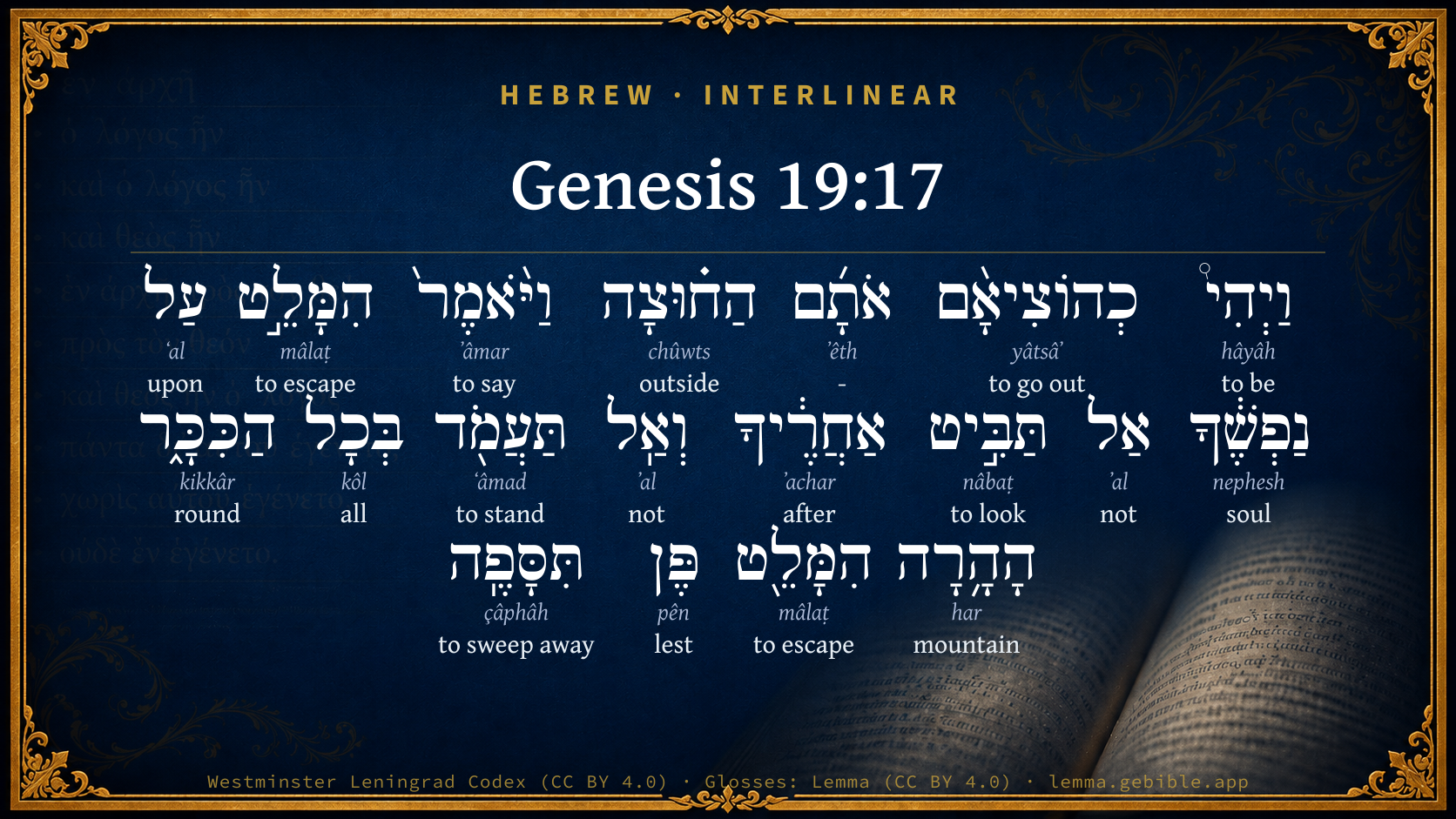
Hebrew (Westminster Leningrad Codex) Genesis 19:17 appears in the Hebrew Old Testament. The text above is from the Westminster Leningrad Codex. Each word links to its Strong’s number, a concise gloss, and parsing drawn from the Open Scriptures Hebrew Bible morphology. Click any word for its full Brown-Driver-Briggs (BDB) entry.
Download image
Cite this verse

Genesis 19:17 (World English Bible). Public Domain. Lemma interlinear Bible study tool, https://lemma.gebible.app/v/genesis/19/17.

Show BibTeX & RIS
BibTeX
RIS
English Translation
It came to pass, when they had taken them out, that he said, "Escape for your life! Don't look behind you, neither stay anywhere in the plain. Escape to the mountain, lest you be consumed!"
World English Bible · Public Domain
Highlights
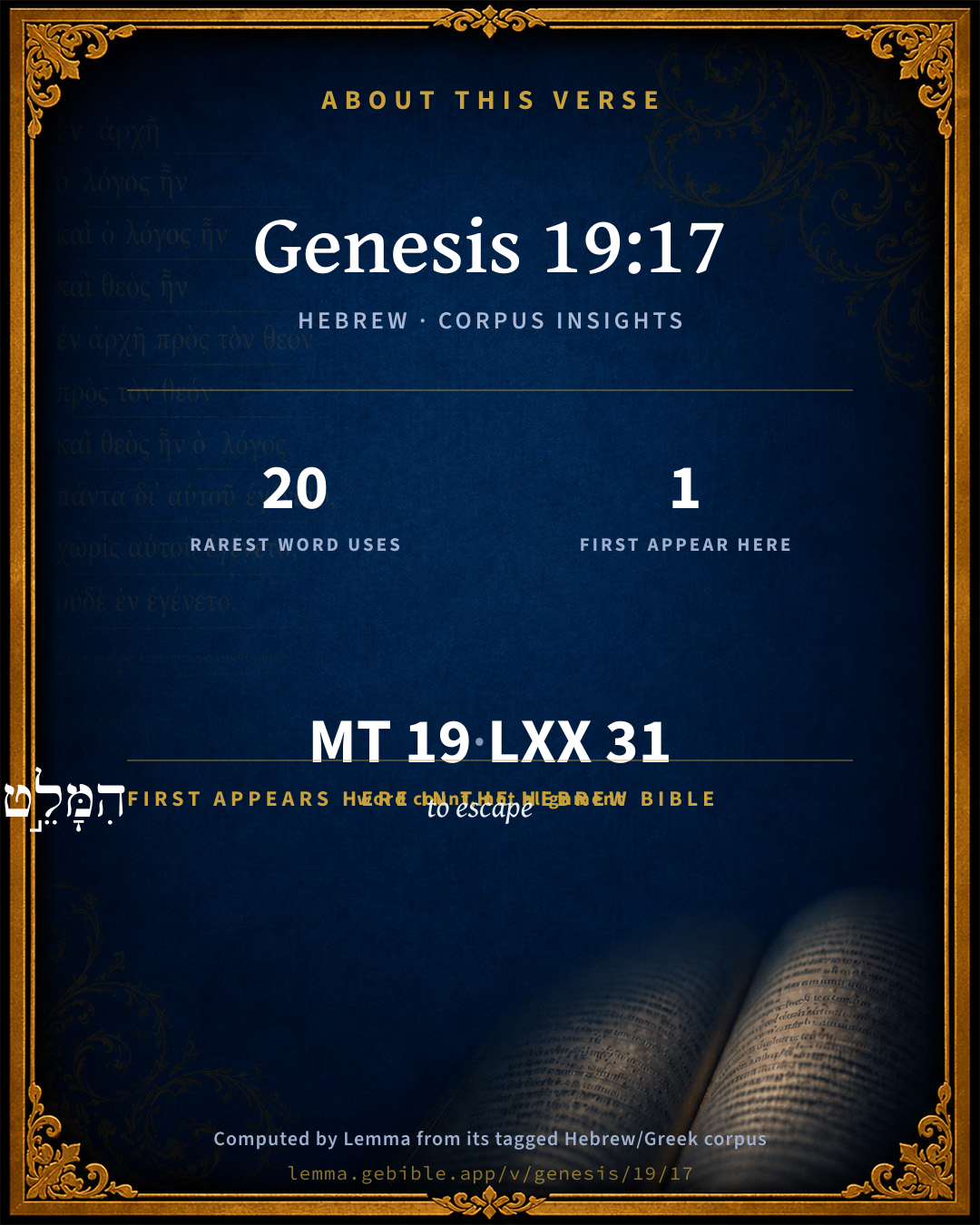
  • 1 first appearance in the Hebrew Bible
Full analysis ↓
Download a study sheet

One document with this verse’s original text, its word-by-word gloss line, the meaning frame, cross-references with their text, attributed commentary, and full source and license credits — printable, and it pastes into notes with its structure intact.

This verse Autodidact and up

Study sheet (.html) Plain text (.txt)

A passage Seminary Student

Up to 50 verses in one chapter. A passage sheet keeps up to 6 commentary sources and 12 cross-references per verse, in the order this page ranks them, and says so on the sheet whenever that leaves anything out. Ask for a single verse and you get the Autodidact verse sheet above.

Everything on this page stays free to read, with no account — the sheet is a download of what is already on screen, not access to it.

Want to remove ads? Support Godless Engineer
Compare translations 3

The same verse in 3 English versions, stacked beneath the original-language interlinear above. Click any original word for its lexicon entry.

Each is an independent rendering of the whole verse — the interlinear is not word-aligned to these translations.

Highlighted words mark where these versions differ — a whole-verse word diff, not a word-by-word alignment.

  • World English Bible Public Domain
    It came to pass, when they had taken them out, that he said, "Escape for your life! Don't look behind you, neither stay anywhere in the plain. Escape to the mountain, lest you be consumed!"
  • King James Version Public Domain
    And it came to pass, when they had brought them forth abroad, that he said, Escape for thy life; look not behind thee, neither stay thou in all the plain; escape to the mountain, lest thou be consumed.
  • unfoldingWord Literal Text CC BY-SA 4.0
    And it happened when they had brought them out to the outside, then he said, “Flee for your life! Do not look behind you, and do not stop anywhere in the plain! Escape to the mountain so that you are not swept away!”

unfoldingWord Literal Text — © unfoldingWord, licensed CC BY-SA 4.0. Word-aligned USFM3 via Door43 (git.door43.org/unfoldingWord/en_ult).

Versions to compare (up to 4)

3 of 4 selected

Show all 18 translations

Every available English version of this verse, each an independent rendering of the whole verse.

  • World English Bible Public Domain
    It came to pass, when they had taken them out, that he said, "Escape for your life! Don't look behind you, neither stay anywhere in the plain. Escape to the mountain, lest you be consumed!"
  • Berean Standard Bible Public Domain
    As soon as the men had brought them out, one of them said, “Run for your lives! Do not look back, and do not stop anywhere on the plain! Flee to the mountains, or you will be swept away!”
  • Majority Standard Bible Public Domain
    As soon as the men had brought them out, one of them said, “Run for your lives! Do not look back, and do not stop anywhere on the plain! Flee to the mountains, or you will be swept away!”
  • King James Version Public Domain
    And it came to pass, when they had brought them forth abroad, that he said, Escape for thy life; look not behind thee, neither stay thou in all the plain; escape to the mountain, lest thou be consumed.
  • American Standard Version (1901) Public Domain
    And it came to pass, when they had brought them forth abroad, that he said, Escape for thy life; look not behind thee, neither stay thou in all the Plain; escape to the mountain, lest thou be consumed.
  • Revised Version (1885) Public Domain
    And it came to pass, when they had brought them forth abroad, that he said, Escape for thy life; look not behind thee, neither stay thou in all the Plain; escape to the mountain, lest thou be consumed.
  • Geneva Bible (1599) Public Domain
    And when they had brought them out, the Angel said, Escape for thy life: looke not behinde thee, neither tarie thou in all the plaine: escape into ye mountaine, least thou be destroyed.
  • Douay-Rheims (1899) Public Domain
    And they brought him forth, and set him without the city: and there they spoke to him, saying: Save thy life: look not back, neither stay thou in all the country about: but save thyself in the mountain, lest thou be also consumed.
  • Young's Literal Translation Public Domain
    And it cometh to pass when he hath brought them out without, that he saith, `Escape for thy life; look not expectingly behind thee, nor stand thou in all the circuit; to the mountain escape, lest thou be consumed.'
  • Literal Standard Version CC BY-SA 4.0
    And it comes to pass, when he has brought them outside, that he says, “Escape for your life; do not look behind you, nor stand in all the circuit; escape to the mountain, lest you are consumed.”
  • Unlocked Literal Bible CC BY-SA 4.0
    When they had brought them out, one of the men said, “Run for your lives! Do not look back, or stay anywhere on the plain. Escape to the mountains so you are not swept away.”
  • unfoldingWord Literal Text CC BY-SA 4.0
    And it happened when they had brought them out to the outside, then he said, “Flee for your life! Do not look behind you, and do not stop anywhere in the plain! Escape to the mountain so that you are not swept away!”
  • Darby Bible Public Domain
    And it came to pass when they had brought them outside, that he said, Escape for thy life: look not behind thee, neither stay thou in all the plain: escape to the mountain, lest thou perish.
  • World Messianic Bible Public Domain
    It came to pass, when they had taken them out, that he said, “Escape for your life! Don’t look behind you, and don’t stay anywhere in the plain. Escape to the mountains, lest you be consumed!”
  • Webster's Bible Public Domain
    And it came to pass, when they had brought them forth abroad, that he said, Escape for thy life: look not behind thee, neither stay thou in all the plain: escape to the mountain, lest thou be consumed.
  • Free Bible Version CC BY-SA 4.0
    As soon as they were outside, one of the men said, “Run for your lives! Don't look back, and don't stop anywhere in the valley! Run to the mountains otherwise you'll be destroyed!”
  • Bible in Basic English Public Domain
    And when they had put them out, he said, Go for your life, without looking back or waiting in the lowland; go quickly to the mountain or you will come to destruction.
  • JPS Tanakh (1917) Public Domain
    And it came to pass, when they had brought them forth abroad, that he said: 'Escape for thy life; look not behind thee, neither stay thou in all the Plain; escape to the mountain, lest thou be swept away.'

Literal Standard Version (2020), Covenant Press — licensed CC BY-SA 4.0. Text via the HelloAO Bible API (eBible.org). Unlocked Literal Bible (unfoldingWord) — licensed CC BY-SA 4.0. Text via the HelloAO Bible API (eBible.org). unfoldingWord Literal Text — © unfoldingWord, licensed CC BY-SA 4.0. Word-aligned USFM3 via Door43 (git.door43.org/unfoldingWord/en_ult). Free Bible Version, Dr. Jonathan Gallagher — licensed CC BY-SA 4.0. Text via the HelloAO Bible API (eBible.org).

Word by word

More ways to search: Search by grammar → Find every occurrence → Compare this word →

Practice this passage: Drill this verse → Learn its vocabulary →

תִּסָּפֶֽה
çâphâh
H5595
“to sweep away”
Verb, Niphal, Imperfect, 2nd Person, Masculine, Singular
Part of Speech
Verb
Stem
Niphal
Form
Imperfect
Person
2nd Person
Gender
Masculine
Number
Singular
Full BDB Definition

Origin: a primitive root

TWOT: 1531

to sweep or snatch away, catch up, destroy, consume - (Qal) - to be snatched away - to sweep or snatch away - (Niphal) - to be swept away, be destroyed - to be caught up, be captured - (Hiphil) to catch up, gather
  1. וַיְהִי֩ hâyâh H1961 “and · to be” Conjunction + Verb, Qal, Sequential Imperfect, 3rd Person, Masculine, Singular
  2. כְהוֹצִיאָ֨ם yâtsâʼ H3318 “like/as · to go out · them” Preposition + Verb, Hiphil, Infinitive Construct + Suffix, Personal, 3rd Person, Masculine, Plural
  3. אֹתָ֜ם ʼêth H853 “- · them” Particle, Direct Object + Suffix, Personal, 3rd Person, Masculine, Plural
  4. הַח֗וּצָה chûwts H2351 “the · outside · toward” Particle, Definite Article + Noun, Common, Masculine, Singular, Absolute + Suffix, Demonstrative
  5. וַיֹּ֨אמֶר֙ ʼâmar H559 “and · to say” Conjunction + Verb, Qal, Sequential Imperfect, 3rd Person, Masculine, Singular
  6. הִמָּלֵ֣ט mâlaṭ H4422 “escape” Verb, Niphal, Imperative, 2nd Person, Masculine, Singular
  7. עַל ʻal H5921 “upon” Preposition
  8. נַפְשֶׁ֔ךָ nephesh H5315 “soul · your” Noun, Common, Both, Singular, Construct + Suffix, Personal, 2nd Person, Masculine, Singular
  9. אַל ʼal H408 “not” Particle, Negative
  10. תַּבִּ֣יט nâbaṭ H5027 “to look” Verb, Hiphil, Jussive, 2nd Person, Masculine, Singular
  11. אַחֲרֶ֔יךָ ʼachar H310 “after · you” Preposition + Suffix, Personal, 2nd Person, Masculine, Singular
  12. וְאַֽל ʼal H408 “and · not” Conjunction + Particle, Negative
  13. תַּעֲמֹ֖ד ʻâmad H5975 “to stand” Verb, Qal, Jussive, 2nd Person, Masculine, Singular
  14. בְּכָל kôl H3605 “in/at · all of” Preposition + Noun, Common, Masculine, Singular, Construct
  15. הַכִּכָּ֑ר kikkâr H3603 “the · round” Particle, Definite Article + Noun, Common, Both, Singular, Absolute
  16. הָהָ֥רָה har H2022 “the · mountain · toward” Particle, Definite Article + Noun, Common, Masculine, Singular, Absolute + Suffix, Demonstrative
  17. הִמָּלֵ֖ט mâlaṭ H4422 “escape” Verb, Niphal, Imperative, 2nd Person, Masculine, Singular
  18. פֶּן pên H6435 “lest” Conjunction

About this verse

These counts appear in no published source. They are computed here, from the morphology-tagged text and Lemma’s own curated glosses. What Lemma adds →

19
words
17
distinct lemmas
Pentateuch
section

Notable vocabulary

The rarest word here is תִּסָּפֶֽה to sweep away H5595 — appearing just 20 times in the whole Hebrew Bible.

First appearance in Scripture

This word makes its first canonical appearance in the Hebrew Bible here:

  • הִמָּלֵ֣ט to escape H4422

Shared distinctive vocabulary

תִּסָּפֶֽה to sweep away H5595 occurs in 20 verses of the Hebrew Bible. Also found in:

Grammatical profile

  • 8 verbs
  • 5 nouns
  • 2 prepositions
  • 1 conjunction
  • 3 particles

Verb forms

  • וַיְהִי֩ Qal · Sequential Imperfect
  • כְהוֹצִיאָ֨ם Hiphil · Infinitive Construct
  • וַיֹּ֨אמֶר֙ Qal · Sequential Imperfect
  • הִמָּלֵ֣ט Niphal · Imperative
  • תַּבִּ֣יט Hiphil · Jussive
  • תַּעֲמֹ֖ד Qal · Jussive
  • הִמָּלֵ֖ט Niphal · Imperative
  • תִּסָּפֶֽה Niphal · Imperfect

Repetition

Words recur within this verse — often emphatic in Hebrew:

  • הִמָּלֵ֣ט to escape H4422 ×2
  • אַל not H408 ×2

Hebrew & Septuagint length

In English translation the verse runs 35 words from the Hebrew and 48 from the Septuagint (LXX English) — closely comparable.

A rough comparison of the two English renderings, which tokenize alike — not a word-level alignment.

Word counts can differ between the Hebrew and the Greek without any difference in meaning — e.g. the Hebrew direct-object marker אֵת has no separate Greek word, and Greek often adds the article ὁ.

In the original languages it is 19 Hebrew tokens and 31 Greek tokens — but the two are counted differently (Hebrew bundles its prefixes and suffixes into one token; the Greek is in lemma form), so that isn’t a like-for-like length.

Cross-references

15

Topical passages linked to Genesis 19:17 in the Treasury of Scripture Knowledge — connected by theme and wording, ordered by reader-vote popularity; previews shown in the World English Bible.

  • Matthew 24:16–18 then let those who are in Judea flee to the mountains.
  • Luke 9:62 But Jesus said to him, "No one, having put his hand to the plow, and looking back, is fit for the Kingdom of God."
  • Philippians 3:13–14 Brothers, I don't regard myself as yet having taken hold, but one thing I do. Forgetting the things which are behind, and stretching forward to the things which are before,
  • Genesis 19:26 But his wife looked back from behind him, and she became a pillar of salt.
  • Genesis 19:22 Hurry, escape there, for I can't do anything until you get there." Therefore the name of the city was called Zoar.
  • Matthew 3:7 But when he saw many of the Pharisees and Sadducees coming for his baptism, he said to them, "You offspring of vipers, who warned you to flee from the wrath to come?
  • Luke 17:31–32 In that day, he who will be on the housetop, and his goods in the house, let him not go down to take them away. Let him who is in the field likewise not turn back.
  • Jeremiah 48:6 Flee, save your lives, and be like the heath in the wilderness.
  • Genesis 13:10 Lot lifted up his eyes, and saw all the plain of the Jordan, that it was well watered every where, before Yahweh destroyed Sodom and Gomorrah, like the garden of Yahweh, like the land of Egypt, as you go to Zoar.
  • 1 Kings 19:3 When he saw that, he arose, and went for his life, and came to Beersheba, which belongs to Judah, and left his servant there.
  • Genesis 19:14–15 Lot went out, and spoke to his sons-in-law, who were pledged to marry his daughters, and said, "Get up! Get out of this place, for Yahweh will destroy the city." But he seemed to his sons-in-law to be joking.
  • Psalms 121:1 I will lift up my eyes to the hills. Where does my help come from?
  • 1 Samuel 19:11 Saul sent messengers to David's house, to watch him, and to kill him in the morning: and Michal, David's wife, told him, saying, If you don't save your life tonight, tomorrow you will be slain.
  • Genesis 18:22 The men turned from there, and went toward Sodom, but Abraham stood yet before Yahweh.
  • Hebrews 2:3 how will we escape if we neglect so great a salvation-- which at the first having been spoken through the Lord, was confirmed to us by those who heard;

Cross-references courtesy of OpenBible.info (CC BY 4.0).

Hebrew and Greek witnesses Masoretic Hebrew ↔ Greek Septuagint

The same verse in the two great witnesses to the Old Testament, shown verse-for-verse.

These are two independent witnesses, not word-aligned to each other, and the Septuagint is shown in lemma (dictionary) form.

Hebrew Genesis 19:17 Masoretic · Westminster Leningrad Codex

וַיְהִי֩ כְהוֹצִיאָ֨ם אֹתָ֜ם הַח֗וּצָה וַיֹּ֨אמֶר֙ הִמָּלֵ֣ט עַל נַפְשֶׁ֔ךָ אַל תַּבִּ֣יט אַחֲרֶ֔יךָ וְאַֽל תַּעֲמֹ֖ד בְּכָל הַכִּכָּ֑ר הָהָ֥רָה הִמָּלֵ֖ט פֶּן תִּסָּפֶֽה

It came to pass, when they had taken them out, that he said, "Escape for your life! Don't look behind you, neither stay anywhere in the plain. Escape to the mountain, lest you be consumed!"

World English Bible · Public Domain

Greek LXX Genesis 19:17 Septuagint · lemma form

καί γίγνομαι ἡνίκα ἐκἄγω αὐτός ἔξω καί εἶπον σώζω σώζω ὁ σεαυτοῦ ψυχή μή περιβλέπω εἰς ὁ ὀπίσω μηδέ ἵστημι ἐν πᾶς ὁ περίχωρος εἰς ὁ ὄρος σώζω μήποτε συν παραλαμβάνω

And it came to pass when they brought them out, that they said, Save your own life by all means; look not round to that which is behind, nor stay in all the country round about, escape to the mountain, lest perhaps you be overtaken together with them.

LXX2012 (modern English Septuagint) · Public Domain

On this verse, Keil & Delitzsch discusses the Septuagint’s reading. Read the note in Commentary ↓

Hebrew: Westminster Leningrad Codex (CC BY 4.0). Greek: Septuagint (public domain); English from LXX2012 (modern English Septuagint) (Public Domain). How the Septuagint differs from the Hebrew →

Targum (Aramaic paraphrase)

2

The Targum is the ancient Jewish Aramaic paraphrase of the Hebrew Scriptures — an interpretive translation, not the Hebrew text itself. Onkelos (literal) and Pseudo-Jonathan (expansive) render the Torah, and Jonathan the Prophets. Coverage is partial: where no permissively-licensed English translation exists for a verse, only the Aramaic is shown. This is verse-level text, not a word-by-word alignment to the Hebrew.

  1. Targum Onkelos Torah (Genesis–Deuteronomy)
    וַהֲוָה כַּד אַפִּיקוּ יָתְהוֹן לְבָרָא וַאֲמַר חוּס עַל נַפְשָׁךְ לָא תִּסְתְּכִי לַאֲחוֹרָךְ וְלָא תְקוּם בְּכָל מֵישְׁרָא לְטוּרָא אִשְׁתְּזֵב דִּלְמָא תִלְקֵי

    (no public-domain English translation for this verse)

    Targum Onkelos — Aramaic: “Onkelos Genesis” (public domain); “Onkelos Exodus” (public domain); “Onkelos Leviticus” (public domain); “Onkelos Numbers” (public domain); “Onkelos Deuteronomy” (public domain). English: “Sefaria Community Translation” (CC0 1.0 (public-domain dedication)); “J.W. Etheridge. The Targums of Onkelos and Jonathan Ben Uzziel on the Pentateuch. London: Longmans, Green, 1862” (public domain). Text via Sefaria.

  2. Targum Pseudo-Jonathan Torah (Genesis–Deuteronomy)
    וַהֲוָה בְּאַפְקָתְהוֹן יַתְהוֹן לְבָרָא וְהָדָר חַד מִנְהוֹן לִסְדוֹם לְחַבְּלוּתָהּ וְחַד אִשְתָּאֵר עִם לוֹט וְאָמַר לֵיהּ חוּס עַל נַפְשָׁךְ לָא תִּסְתַּכֵּל לַאֲחוֹרָךְ וְלָא תְקוּם בְּכָל מֵישְׁרָא לְטַוְורָא אִשְׁתְּזִיב דִילְמָא תִּשְׁתֵּצֵי

    And it was that as they led them without, one of them returned into Sedom, to destroy it; and one remained with Lot, and said to him, Be merciful to your life; look not behind you, and stand not in all the plain; to the mountain escape, or you perish.

    Targum Pseudo-Jonathan — Aramaic: “Targum Jonathan on Genesis” (public domain); “Targum Jonathan on Exodus” (public domain); “Targum Jonathan on Leviticus” (public domain); “Targum Jonathan on Numbers” (public domain); “Targum Jonathan on Deuteronomy” (public domain). English: “The Targum of Jonathan ben Uzziel, trans. J. W. Etheridge, London, 1862” (public domain). Text via Sefaria.

Commentary

Notes on Genesis 19:17 from classic Christian and Jewish commentators (each source and its license shown beneath its notes). The classic Christian expositions comment on the surrounding passage and are grouped to its opening verse, so a note may address several verses; the Jewish commentaries on the Tanakh (Rashi and others) are per-verse, so they appear only where the commentator wrote on this verse.

Lemma curates 59 commentaries, every one of them public domain or Creative Commons licensed, each selected and text-cleaned for this edition rather than reprinted as found. About our sources →

Trapp's Complete Commentary

John Trapp

Gen 19:17 And it came to pass, when they had brought them forth abroad, that he said, Escape for thy life; look not behind thee, neither stay thou in all the plain; escape to the mountain, lest thou be consumed.

Ver. 17. Look not behind thee.] As loath to depart. Non minus difficulter a deliciis Sodomorum abstrahimur, quam canis ab uncto corio .

John Trapp, A Commentary or Exposition upon All the Books of the Old and New Testament (1647–1656) — public domain. Text from a community e-Sword module.

The Biblical Illustrator

Joseph S. Exell

Gen_19:17

Escape for thy life; look not behind thee

Delays are dangerous

I.

AN ALARM. Escape for thy life.

1. Lots life was in imminent danger. So is the life of every unconverted man.

2. But Lot had timely warning to escape from the impending storm, and so has every sinner.

3. Lots escape was to be effected in haste; and if he had not left the place at that time, he would have been destroyed with the wicked.

II. A CAUTION.

1. Look not behind thee.

(1) To consult the world.

(2) To confer with flesh and blood.

(3) To reason with the devil.

2. Neither stay in all the plain.

(1) Of carnal security.

(2) Of desire.

(3) Of procrastination.

(4) Of good resolution.

(5) Of despondency and unbelief.

III. AN EXHORTATION. Escape to the mountain, lest thou be consumed.

1. Those who flee to Christ find a place of safety.

2. Those who escape to Jesus Christ shall find rest.

3. Those who escape to Christ are blessed with peace. (Benson Bailey.)

Delay in religion

I. THE GREAT CRISIS IN THE HISTORY OF THE SOUL.

1. We illustrate this by the case of Lot, as here described.

2. We apply this to the ease of undecided persons.

II. THE CAUSE OF THIS LINGERING IN RESPECT TO RELIGION.

1. The cause of Lots lingering is evident.

(1) Worldly attractions.

(2) Domestic ties.

2. The reason why some linger on the subject of religion.

(1) Taken up with the pleasures and vanities of the world, its gratifications, enjoyments, amusements.

(2) Influenced by the consideration of worldly gain.

(3) Influenced by relations and associations.

III. THE SIN AND DANGER OF LINGERING, AS IT RESPECTS RELIGION.

1. The sin committed against God.

2. The dangerous consequences of this halting in religion. (The Evangelical Preacher.)

The awakened sinner

I. I wish to speak of the MEANS by which a sinner is awakened from his spiritual slumber--from that deathly lethargy in which every human being lies by nature. The means, I hesitate not to consider, is the Word of God. Other things may assist in giving entrance to the Word, but it is by the Word, as a rule, that Gods Holy Spirit works in convincing the sinner of his sin. It matters not how the sinner gets the Word, so that he do get it.

II. Having spoken of the means employed to awaken the sinners conscience, we proceed to consider the ANXIETY which is the result. A sense of sin is produced; and sin is felt to be as a heavy burden pressing upon the soul.

III. How important that such an anxious soul should receive proper INSTRUCTION! HOW precious, then, the opportunity of meeting with a Christian friend! I have said that it is by means of the Word of God that the sinner is awakened, that the Holy Spirit proceeds in commencing that process whereby we are brought out of darkness into marvellous light; let me add, that there is a connection between the Bible and human agency. Gods plan of converting the sinner is by the preaching of the Word; and it is in this way generally that conversions are effected.

IV. We suppose the awakened sinner, thus instructed, to make his ESCAPE. Be has many temptations to remain. But one thought, one anxiety, overpowers all; life, eternal life, is his motive and his object. (W. M.Whittemore.)

Run for your life

1. My text, in the first place, suggests urgency on the part of all those who would induce people out of their sins. Why was not the angel more polite? Why did he not coolly and formally invite Lot and his wife to leave that city? The angel was in earnest.

2. My subject also suggests that the mere starting gives no security. Lot had started out of the city, but he might have perished half-way before he got to the mountains. Men start for heaven, but do not always get there. If my house be burning, and I take a bucket of water and put out the flames in this, and that, and yonder room, while I leave the flames in another room, I might as well have wasted no strength and brought no buckets of water at all. And if a man is only half saved, he is not saved at all.

3. The text suggests further, that a man, after being persuaded out of sin, sometimes looks back.

4. My text suggests that some men, having started, loiter by the way. They tarry in the plain. They are too lazy to get on. You know that men, in order to get on in this world, must deny themselves, and work hard; must go through drudgery, that after awhile they may have luxuries. If we get to heaven it will be by gathering up all the energies of our souls and hurling them ahead in one persistent direction. In mid-ocean, on the China going out at midnight, the screw stopped. Whats the matter? everybody cried. People rushed out to see why the screw had stopped in mid-ocean. Something wrong, or it would not stop in the middle of the Atlantic. So it is a bad sign when men voyaging towards heaven stop half-way. It is a sign of infinite peril. (Dr. Talmage.)

The angels admonition to Lot

I. Escape for thy life. This was the general admonition. It was not a small matter which was at stake. It was his life.

II. Escape for thy life. Are you aware of the guilt and danger of a sinful, worldly life? Remember the treasure which you have at stake; even your life; not the life merely of your body, but the life of your soul; the everlasting happiness of your immortal spirit. Be in earnest in this great work of saving your precious, your immortal soul. Be active, be diligent. Let nothing turn you from your purpose. Lay hold on eternal life. Attend especially to the three directions attached to the general admonition.

1. Look not behind thee. Renounce for ever all thoughts of returning to that state of sin and death from which you are beginning to escape. Suffer not your mind, even for a moment, to reflect with complacency on those pursuits, pleasures, or companions, from which you must for ever separate. Having once set your face toward heaven, O! look not back on Sodom. Remember Lots wife.

2. Neither stay thou in all the plain. Think it not enough to have escaped from Sodom, but remove to the greatest possible distance from everything connected with that devoted place. Think it not enough to have renounced old habits of sin, to have broken off from the commission of gross offences, from openly profane and irreligious practices: but have no fellowship with the unfruitful works of darkness. Allow not yourself to remain within the forbidden regions of self-indulgence and worldly gratification.

3. Escape to the mountain, lest thou be consumed. If there were no place of safety to which you could flee, and be at peace, then indeed would your efforts to escape be in vain, and my endeavours to assist you fruitless. But, blessed be God I there is a place of safety, a refuge provided for you, where you may be secure from the impending ruin, and may delight yourself in the abundance of peace. Lot was directed to a mountain whither he might escape and be in safety. You are directed not to a mountain, but to Jesus Christ: He is a hiding-place from the storm, a covert from the tempest. Would Lot be safe if he should flee to the mountain? Whosoever flees to Jesus Christ shall be delivered from the wrath to come. He shall be delivered from all the consequences of sin, from the punishment which it has incurred, from the power which it has obtained in the heart. Do you ask how you are to flee to Christ? You are to flee to Him in your mind, with your heart, with all the desires and affections of your soul. You are to flee to Him in faith, believing His word and promises, and casting yourselves upon His mercy and power. (E. Cooper, M. A.)

The last night of Sodom

Tarry all night: Escape for thy life. The words of man and the words of angels. The man, a master of courtesy and hospitality; the angels, ministers of mercy and of vengeance. The man speaks of house and home and feasting and rest; the angels speak of impending wrath and swift destruction. The man persuades to the enjoyment of a quiet evening in a luxurious clime, and promises the return of a beautiful day; the angels would hasten an escape from a scene of enchantment and delight, at the sacrifice of all earthly possessions. The man speaks from mere feeling and a vivid impression of things as they are passing before his eyes; the angels speak of things as they are--and behind the calm and peaceful aspect of the closing day, they see the fiery tempest of the coming morn. Such is the contrast between feeling and fact, shadow and substance, appearance and reality. So unlike and allied to each other are the sensual and the spiritual; the earthly and the heavenly; the aspect of peace and safety, and the near approach of danger and destruction. Such is the difference between the judgment of man, who is all involved in the cares and toils and pleasures of the passing day, and the judgment of beings who stand outside the range of our mistakes and temptations, and who see the affairs of time in the light of eternity This awful lesson in sacred history may be all summed up in two words. The one is from man and the world; the other is from heaven and God. One says to the careless and the worldly, Tarry, he at ease, enjoy yourself while you can; the other says, Escape for thy life. One says, Wait, be not alarmed; make yourself comfortable where you are; the other says, Haste, look not behind thee; flee to the mountain, lest thou be consumed. One says, Soul, take thine ease; eat, drink, and be merry; the other says, Thou fool! this night thy soul may be required of thee. The question which every one must answer for himself is always this, Which of these two voices shall I obey? To many it seems like mockery to talk of danger to the young and the gay, the healthful and the happy. But who was the mocker on the peaceful night when the cities of the plain rioted in pleasure for the last time? All the seductions and falsehoods of temptation, and all the dangers and sorrows of perdition, are bound up in that one word--wait. The voice of love speaks to the careless in terms of terror and alarm. Gods patience will not always last. The day of grace must have an end. And with many it is much shorter than they expect. (D. Marsh, D. D.)

Illustration of the sinners state, duty, and prospects

I. THE DANGER TO WHICH THE SINNER IS EXPOSED.

1. It is real. Not imaginary.

2. It is imminent. Not distant. Nearer and nearer every day.

3. It is tremendous. Not slight.

II. THE POSSIBILITY OF ESCAPE FROM THE DANGER TO WHICH THE SINNER IS EXPOSED.

1. It is proved by the invitations addressed to him in the Bible. Numerous, earnest, pathetic.

2. It is proved by the revelation of the work of Christ, on which these invitations are founded. That work is a mountain, if that be the proper emblem of strength, stability, immutability.

3. It is proved by the experience of all believers. Fire-escape. Life-boat.

III. THE NECESSITY OF PROMPT AND DECISIVE ACTION ON THE PART OF THE SINNER, IF HE WOULD ESCAPE FROM THE DANGER TO WHICH HE IS EXPOSED.

1. His flight must be instantaneous. Without procrastination.

2. His flight must be rapid. No delay.

3. His flight must be persevering. The city of refuge.

IV. THE URGENCY OF THE MOTIVES BY WHICH THE SINNER SHOULD BE INDUCED TO ESCAPE FROM THE DANGER TO WHICH HE IS EXPOSED.

1. The magnitude of the interests at stake. Life! life! eternal life!

2. The exclusiveness of the gospel method of salvation. No other name.

3. The happiness of escape. Beneficial results to ourselves and others. Address

(1) Those who are at ease in Sodom;

(2) Those who are lingering and deferring their flight;

(3) Those who are daily running in the way prescribed. (G. Brooks.)

Escape for thy life

I. You must escape for your life--THE LIFE NOT OF THE BODY BUT OF THE SOUL.

1. The everlasting welfare of your soul is in danger.

2. To effect your deliverance you must escape yourselves.

3. You must be in earnest.

4. You must sacrifice everything that stands in your way.

II. Look NOT BEHIND.

1. He who has once left this sinful world ought to give up all thoughts of return.

2. Look not behind you for the sake of your former companions.

3. Look not back to relieve yourself of the sense of guilt which weighs upon you.

4. Look not behind lest you should never advance beyond your present position.

III. STAY NOT IN ALL THE PLAIN. Delay not--

1. In hope of a better opportunity.

2. In reliance upon your good intentions.

3. Because you have begun to attend to religion.

4. Though you have been brought to reel deeply about religion.

5. For a more thorough conviction of sin.

6. Through discouragement and despondency.

7. Because you hope you are a Christian. (J. Day, D. D.)

Saved as by fire

There is such a fate as being saved, yet so as by fire, going into the brightness with the smell of fire on your garments. (A. Maclaren, D. D.)

Escape for thy life

When danger is behind us we should strain all our powers to escape from it as Indians or settlers do to escape from the prairie fires in America. A tribe of Indians, who were swift of foot, once gave a white man they intended to kill a chance to escape by running whilst they all pursued him. He ran with such mad haste that he managed, though with great difficulty, to escape. Look not behind thee,. . . lest thou be consumed Gen_19:17).

Look not behind

The ancients told a fable about Orpheus who, they said, could move men and beasts, birds and fishes, and even trees and rocks by his wonderful music; that when his wife Eurydice was bitten by a serpent and had died, then Orpheus followed her into the infernal regions and there played his music with such exquisite skill that even Pluto (who was said to be the stern and inexorable king of hell) and his grave wife Proserpina were moved to such pity that they gave Orpheus leave to take his wife back to the world again on condition that he did not look around whilst they ascended. As, however, they were rising, the fable says he looked round, either from love, or doubt, or forgetfulness. The result was he saw his much-loved wife for a moment, but then she vanished from his sight for ever. If we look and turn back to the world or sin, we shall lose Gods favour and blessings, and we may lose our souls for ever.

No time for delay

A man was once shut up in prison, loaded with chains, and condemned to be hung. He had been taken a prisoner in war by a cruel tyrant, and knew that there was no hope for him if he could not in some way make his escape. In the dead hour of night, when all his guards were sound asleep, and not a footstep was to be heard around his prison, the door of his dungeon was opened, his general entered and took off his chains, and said to him, Haste thee, escape from this place. I have, at immense expense and terrible exposure of my life, entered this prison to save you. Follow me, and I will guide you safely. But you have not a moment to lose. An hours delay may prove for ever too late. What will you think when I tell you that the prisoner said, Let me think about it--wait a little while; and then actually refused to go with him? Who was to blame for that mans death, but himself? This is precisely the way that sinners, condemned and bound by Satan to be shut up in the dark prison of despair, act when Jesus, the great Captain of our salvation, comes to set them free. A great warrior was once persuaded by his enemies to put on a beautiful robe which they presented him. Not suspecting their design, he wrapped himself tightly in it, but in a few moments found that it was coated on the inside with a deadly poison. It stuck to his flesh as if it had been glued. The poison entered into his flesh so that in trying to throw off the cloak he was left torn and bleeding. But did he for that reason hesitate about taking it off? Did he stop to think whether it was painful or not? Did he say, Let me wait and think about it awhile? No, he had more sense than that. He tore it off at once, and threw it from him, and hastened away from it to the physician. Sinner, this is the way you must treat your sins if you would be saved. And do it now. Now is the accepted time; now is the day of salvation. A sprightly boy, who was the pride of his master, who was loved by all his fellow-servants, once came to me to talk about his souls salvation. He had heard that to live in sin was to live in rebellion against God and in great danger. He felt that he was a sinner. He knew that he ought to forsake his sins. He talked freely with me about himself. Before we parted he promised to begin the service of God the next day. He went off to his business. I saw no more of him for about three months. As I was riding along one day his master met me and asked me to go in and see William, for that was his name, who was very sick. I found him very ill, and about to die. Surely, said I to myself, he is prepared and willing to go, for I remember his promises and good resolutions to begin the next day. I said to him, William, I hope Christ is precious to you now? Oh! sir, said he, I have no hope in Christ! I fear I am lost. I resolved when I saw you last to repent and be a Christian the next day. But the next day brought something that prevented me, and caused me to put it off till the next day still, and so I thought at the end of every day that I would begin the next day. But every day passed on and closed in the same way, And here I am yet, a hardened sinner, and in the arms of death. I tried to tell him about Jesus as his Saviour. I prayed for him. And while I was repeating some precious promises from the Word of God, he turned to me and said, Oh! sir, it is too late; I am lost. I cannot be saved now. Tell my fellow-servants not to put off another day making their peace with God. Scarcely had he given this testimony of the danger of delay, when he was overcome by stupor and delirium, and thus died in darkness and impenitence. (Bp. Meade.)

Escape for thy life!

For thy life! Ah, brethren, were it only the life of your body that you knew to be in jeopardy, you would not hesitate, you would not tarry. You would escape from a burning house, you would leap from a sinking ship, and leave all you have in the world behind you. Skin for skin, yea, all that a man hath will he give for his life. One instance of the truth of these words. A young officer doing duty with an Indian cavalry regiment when tiger shooting one day, missed his mark, and soon found himself in the tigers clutches. It was an anxious moment--few of his friends being at hand. As a sportsman of experience the young man knew well that his best course was to lie quietly and sham death. The tiger surveyed his prey, looked around, and thinking all was safe, set to work to make its meal. Taking the young officers hand in his mouth he deliberately devoured it, and the arm was eaten to the elbow before help arrived. Had the victim moved, or uttered even a groan, the tiger would have put an end to his existence before going on with his repast. Of course the shattered arm had to be removed from the shoulder, but that brave officer lives, and holds at this present moment a post of honour under the Government. Now imagine the suffering endured by him whilst lying, quite conscious, in the power of a voracious man-eater! Why do I tell you this? To ask you what it was that strengthened him to such an act of heroism. It was love of life--it was for his life! (J. B. C. Murphy, B. A.)

Escape

It is a rather popular word with young people. At the head of a newspaper paragraph or of a chapter in a story it instantly commands attention. We at once think of a convicts escape from prison, or a backwoodsmans escape from Indians, or a mail-steamers escape from icebergs. But observe--what are all these escapes from? The convict escapes from weary confinement; the backwoodsman from hated foes; the mail-steamer from dreaded peril. No necessity to urge escape from these. (E. Stock.)

Look not behind thee

This demand seems somewhat strange to us; for we would rather expect that the angels would summon them to look at the cities while God was executing judgment on their wicked inhabitants, in order to show them His power. But the words of the angels to Lot rest on a certain idea found among many ancient nations. To witness with human and profane eyes Gods holy acts was regarded as fatal to the beholder. We find this fact as it existed among the old Hebrews expressed in many passages of the Old Testament. Moses, as soon as he hears the voice, I am the God of thy father, out of the burning bush, hides his face, being afraid to look upon Eloheem. When the Lord revealed Himself in fire and smoke on Mount Sinai, the children of Israel were forbidden to break through the bounds to gaze on the Lord, lest they perish. Gideon (Jdg_6:22) andManoah (Jdg_13:22) feared that they might die because they had seen the angel of the Lord. Even Isaiah, when about to be consecrated by Jehovah for his prophetical office, exclaims, in the aspect of the throne and of the all-covering magnificent garment of God: Woe is me! for I am undone, for mine eyes have seen the King, the Lord of hosts. Indeed, the Divine holiness is a devouring fire to men regarded as sinners (Isa_33:14). Even the seraphim, according to the immense contrast between the Creator and His creatures, cannot stand the holy God and cover their face Isa_6:2). Similar to the Jewish is this conception among heathen nations. The Greeks and Romans were not accustomed to look back while performing certain sacred rites; and the classical legends are full of examples in which this ceremony is observed. Tiresias, the famous diviner of Thebes, consulted by Alcmena, daughter of Electryon, king of Mycenae (now partly re-excavated), ordered her to burn the two dreadful dragons which her son, a boy of only ten months, had killed, and to send the ashes over the river. There the servant should spread them in the clefts of the rocks, and after that come back without turning his back. Thus Theocritus tells us in the twenty-fourth book of his idylls. Another case is recorded by Ovid. When Deucalion and Pyrrha, the only two persons who were saved out of the deluge according to the Greek tradition, consulted the ancient oracle of Themis regarding the restoration of mankind, they received the answer: Depart from the fane, veil your heads, loosen your girded vestments, and east behind you the great bones of your parent (that is, the stones of the earth). And in one of the most beautiful of the old myths the turning back of the person in question was not less fatal than in the case of Lots wife. Orpheus, who struck the lyre so wonderfully as to move the very rocks and trees, mollified even the rulers of the lower regions, and obtained permission to take back to the world of light his beloved wife, the nymph Eurydice, who had died from the bite of a serpent, on the condition that he was not to look back before reaching the tontines of the Hades. But curious, like the wife of Lot, Orpheus broke this condition shortly before his wish was fulfilled, and Eurydice vanished from his sight to return to the kingdom of darkness. (H. V. Hilprecht, D. D.)

Escape from destruction

It is related that once the city of Pleurs stood in a quiet valley of the Alps, beneath the shadow of the snow-covered mountains, a pleasant and prosperous town. Above it hung the avalanche threatening destruction. One night a wakeful man heard the ominous sound breaking on the still air, which heralds the descending mass of ice. Starting from his repose, he awoke his daughter, and with her hastened towards the city gate. There she recollected that her casket of jewelry had been left in the house, and turned back to secure the treasure. In another moment the overwhelming deluge of the avalanche fell with the voice of thunder between father and daughter, burying the city beneath it, When the morning dawned, the spires of the churches alone rose above the cold, white grave of the just before busy town. The maiden perished with her idol, while he who sought to save her escaped. (Tract Journal.)

The Biblical Illustrator, edited by Joseph S. Exell (c. 1880s–1900s) — public domain. Text from a community e-Sword module.

Joseph Benson's Commentary

Gen 19:17. Look not behind thee — He must not loiter by the way; stay not in all the plain — For it would all be made one dead sea; he must not take up short of the place of refuge appointed him; escape to the mountain — Such are the commands given to those who, through grace, are delivered out of a sinful state. 1st, Return not to sin and Satan, for that is looking back to Sodom. 2d, Rest not in the world, for that is staying in the plain.

3d, Reach toward Christ and heaven, for that is escaping to the mountain, short of which we must not take up.

Joseph Benson's Commentary on the Old and New Testaments (1811–1818) — public domain. Text from a community e-Sword module.

Keil & Delitzsch

C. F. Keil & F. Delitzsch

When they left him here (הנּיח, to let loose, and leave, to leave to one's self), the Lord commanded him, for the sake of his life, not to look behind him, and not to stand still in all the plain (כּכּר, Gen 13:10), but to flee to the mountains (afterwards called the mountains of Moab). In Gen 19:17 we are struck by the change from the plural to the singular: "when they brought them forth, he said." To think of one of the two angels - the one, for example, who led the conversation - seems out of place, not only because Lot addressed him by the name of God, "Adonai" (Gen 19:18), but also because the speaker attributed to himself the judgment upon the cities (Gen 19:21, Gen 19:22), which is described in Gen 19:24 as executed by Jehovah. Yet there is nothing to indicate that Jehovah suddenly joined the angels. The only supposition that remains, therefore, is that Lot recognised in the two angels a manifestation of God, and so addressed them (Gen 19:18) as Adonai (my Lord), and that the angel who spoke addressed him as the messenger of Jehovah in the name of God, without its following from this, that Jehovah was present in the two angels. Lot, instead of cheerfully obeying the commandment of the Lord, appealed to the great mercy shown to him in the preservation of his life, and to the impossibility of his escaping to the mountains, without the evil overtaking him, and entreated therefore that he might be allowed to take refuge in the small and neighbouring city, i.e., in Bela, which received the name of Zoar (Gen 14:2) on account of Lot's calling it little. Zoar, the Σηγώρ of the lxx, and Segor of the crusaders, is hardly to be sought for on the peninsula which projects a long way into the southern half of the Dead Sea, in the Ghor of el Mezraa, as Irby and Robinson (Pal. iii. p. 481) suppose; it is much more probably to be found on the south-eastern point of the Dead Sea, in the Ghor of el Szaphia, at the opening of the Wady el Ahsa (vid., v. Raumer, Pal. p. 273, Anm. 14).

Keil & Delitzsch — Biblical Commentary on the Old Testament (1861–1891) — public domain (CC PDM 1.0). Text via the HelloAO Bible API. (Old Testament only.)

Geneva Bible (1599)

Geneva Bible translators

He willed him to flee from God’s judgments, and not to be sorry to depart from that rich country, and full of vain pleasures.

Geneva Bible (1599) marginal notes — public domain. Text via Bolls.life.

Adam Clarke's Commentary

Verse 17. When they had brought them forth, c.] Every word here is emphatic, Escape for thy LIFE thou art in the most imminent danger of perishing; thy life and thy soul are both at stake. Look not behind thee - thou hast but barely time enough to escape from the judgment that is now descending; no lingering, or thou art lost! one look back may prove fatal to thee, and God commands thee to avoid it. Neither stay thou in all the plain, because God will destroy that as well as the city. Escape to the mountain, on which these judgments shall not light, and which God has appointed thee for a place of refuge; lest thou be CONSUMED. It is not an ordinary judgment that is coming; a fire from heaven shall burn up the cities, the plain, and all that remain in the cities and in the plain. Both the beginning and end of this exhortation are addressed to his personal feelings. "Skin for skin, yea, all that a man hath will he give for his life;" and self-preservation is the first law of nature, to which every other consideration is minor and unimportant.

Adam Clarke's Commentary on the Bible (1810–1826) — public domain. Text from a community e-Sword/MySword module.

John Calvin's Commentaries

17. Escape for thy life. This was added by Moses, to teach use that the Lord not only stretches out his hand to us for a moment, in order to begin our salvation; but that without leaving his work imperfect, he will carry it on even to the end. It certainly was no common act of grace, that the ruin of Sodom was predicted to Lot himself, lest it should crush him unawares; next, that a certain hope of salvation was given him by the angels; and, finally, that he was led by the hand out of the danger. Yet the Lord, not satisfied with having granted him so many favors, informs him of what was afterwards to be done, and thus proves himself to be the Director of his course, till he should arrive at the haven of safety. Lot is forbidden to look behind him, in order that he may know, that he is leaving a pestilential habitation. This was done, first, that he might indulge no desire after it, and then, that he might the better reflect on the singular kindness of God, by which he had escaped hell. Moses had before related, how fertile and rich was that plain; Lot is now commanded to depart thence, that he may perceive himself to have been delivered, as out of the midst of a shipwreck. And although, while dwelling in Sodom, his heart was continually vexed; it was still scarcely possible that he should avoid contracting some defilement from a sink of wickedness so profound: being now, therefore, about to be purified by the Lord, he is deprived of those delights in which he had taken too much pleasure. Let us also hence learn, that God best provides for our salvation, when he cuts off those superfluities, which serve to the pampering of the flesh; and when, for the purpose of correcting excessive self-indulgence, he banishes us from a sweet and pleasant plain, to a desert mountain.

John Calvin's Commentaries (1540-1563) — public domain. Text from the Calvin Translation Society English edition (1840s-50s) via the Christian Classics Ethereal Library (ccel.org). Calvin's coverage is partial (roughly two-thirds of the Bible); uncommented books and verses are honest gaps, never fabricated. The 19th-century editor's footnotes and remarks are omitted so the notes are faithfully Calvin's own voice.

Ellicott's Commentary for English Readers

(17) Abroad.—Heb., outside—that is, of the city.

Look not behind thee.—This was not merely to prevent delay, but also showed that God demanded of them a total abandonment in heart and will of the condemned cities, and hence the severity with which the violation of the command was visited.

Plain.—The Ciccar or circle of Jordan. So also in Gen_19:25; Gen_19:28-29; see Note on Gen_13:10.

A Bible Commentary for English Readers, edited by Charles John Ellicott (1878–1897) — public domain. Text from a community e-Sword module.

The Cambridge Bible for Schools and Colleges

gen. ed. J. J. S. Perowne

17. he said] One of the men is spokesman, as in Gen_19:21; but the plural “they said” is found in the LXX and Lat.

look not behind thee] The meaning of this direction, which recalls the story of Orpheus and Eurydice, is not quite obvious. It may be a prohibition either of irresolute lingering, or of regretful curiosity. It is, probably, also, a test of obedience, combined with the thought that man could not look upon Jehovah and live. Cf. Gen_16:13; Exo_19:21.

the Plain] i.e. the kikkar: see Gen_13:10.

the mountain] i.e. the mountainous region on the east of the Dead Sea, “the mountains of Moab.”

The Cambridge Bible for Schools and Colleges (gen. ed. J. J. S. Perowne; Cambridge University Press, 1878–1918) — public domain. Text from a community e-Sword module.

John Gill's Exposition

And it came to pass, when they had brought them forth abroad,.... Into the fields of Sodom, or the suburbs of it:

that he said, escape for thy life; not one of the two men or angels that had been with him all the night past, for they had now left him, and were gone back to the city: but Jehovah the Son of God, who had been communing with Abraham, and now came to Sodom, and appeared to Lot, just at the time the two angels left him, and bid him escape with all haste, if he had any regard for his life, and that of those with him:

look not behind thee; as showing any concern for his goods and substance he had left behind him, or for his sons-in-law, who refused to come with him, and much less for the wicked inhabitants of the city; and this command was not given to Lot only, but to his wife and daughters, as appears by the sequel:

neither stay thou in all the plain: in the plain of Jordan, for the whole plain, and the cities in it, were to be destroyed:

escape to the mountain, lest thou be destroyed, lest thou be consumed; the same mountain the kings of Sodom and Gomorrah, and they that were with them after the battle of the kings, fled to, Gen 14:10; here only he and his could be safe from the conflagration of the plain.

John Gill's Exposition of the Whole Bible (1746–1763) — public domain (CC PDM 1.0). Text via the HelloAO Bible API.

Haydock's Catholic Bible Commentary

Look not back. Flee with all expedition; let no marks of pity for the wretched Sodomites, nor of sorrow for the lose of your property, be seen.

George Leo Haydock (1774–1849), Haydock's Catholic Family Bible and Commentary, 1859 edition — public domain. Excludes Psalms (Douay-Rheims chapter numbering differs from Protestant) and Deuterocanonical books (Catholic canon only).

Matthew Poole's English Annotations

Either one of the angels said this, or the third person, the Lord himself, who having parted from Abraham, after some time came to Lot, as appears both by the change of the number; for before this he speaks of them in the plural number, but from hence in the singular number, as Gen 19:19,21-22; and by the variation of the phrase, for the other two speak with submission, and as servants, Gen 19:13,

The Lord hath sent us, & c.; but this speaks with more authority, as is evident from Gen 19:21,22.

Escape for thy life, i.e. as thou lovest thy life. See Deu 4:15; Jos 23:11; Jer 17:21. Or, escape with thy life, for the Hebrew particle al is sometimes taken for with, as Exo 35:23; Lev 2:2; 14:31; Deu 22:6. So the sense is, Stand not lingering in hopes to save thy goods, them thou shalt lose as a punishment of thy sin and folly in choosing to dwell with so wicked a people; and be thankful that thou hast thy life given thee for a prey, as it is expressed, Jer 38:2.

Look not behind thee, like one that grieves either for the loss of thy pleasant habitation or vast estate, or for those cursed miscreants justly devoted to this destruction. And this command, though given to Lot alone, yet was directed also to his companions, to whom doubtless he imparted it, as is evident both from all the other commands, which equally concern all, and from the following event. See Mat 24:18; Luk 9:62.

Matthew Poole's English Annotations on the Holy Bible (1683–1685) — public domain. Text from a community e-Sword/MySword module.

Whedon's Commentary on the Bible

Daniel D. Whedon

17. He said — Does Jehovah himself now appear again with the two angels, or is one of the two angels here intended? Either view is possible, but perhaps the more simple and obvious one is, that it is here one of the two angels that speaks. The angel’s words breathe with a quivering energy.

Note the four commands: 1)

Escape for thy life — It is a race for life. 2)

Look not behind thee — One backward look may prove thy ruin. 3)

Neither stay thou in all the plain — All this fair circle of the Jordan, (Gen_13:10,) on which Lot had cast covetous eyes, was now a doomed field, from which he must get himself utterly away. 4)

Escape to the mountain — The mountains of Moab, on the east of the Dead Sea, were probably intended. Away to the hills must he now betake himself for safety who once left the hills for this attractive valley. The escape, escape, repeated twice, intensifies the thought of his imminent peril, and now it is added:

Lest thou be consumed — Deadly destruction and wrath hover over all the plain.

Daniel D. Whedon (gen. ed.), Commentary on the Old and New Testaments (1874–1909) — public domain. Text from a community e-Sword module.

The Pulpit Commentary

And it came to pass, when they had brought them (i.e. Lot and his family) forth abroad (literally, without; sc. the city), that he one of the angels (Rabbi Solomon, Jarchi, Rosenm Lange, "Speaker"s Commentary"); the one that had taken Lot"s hand (Inglis); Jehovah speaking through the angel (Delitzsch); the angel speaking in the name of God (Keil, Kalisch); Jehovah himself, who, though not mentioned, had now appeared upon the scene (Ainsworth, Candlish)said, Escape for thy life (literally, for thy soul; and clearly in this case the loss of the soul in the higher sense must have been involved in the destruction of the life); look not behind thee. From the event it may be inferred that this injunction was also given to Lot"s wife and daughters; perhaps to hide God"s working in the fiery judgment from mortal vision (Knobel), but more likely to express detestation of the abhorred city (Bush), to guard against the incipience of any desire to return (Lange), and to stimulate their zeal to escape destruction. Neither stay thou in all the plain or "circle". (Gen_13:10) Once so attractive for its beauty, it must now be abandoned for its danger. Escape to the mountain (the mountain of Moab, on the east of the Dead Sea), lest thou be consumed.

The Pulpit Commentary (1880–1919), ed. H.D.M. Spence-Jones & Joseph S. Exell — public domain. Text from a community e-Sword module.

John Wesley's Explanatory Notes

Look not behind thee - He must not loiter by the way; stay not in all the plain - For it would all be made one dead sea: he must not take up short of the place of refuge appointed him; escape to the mountain - Such as these are the commands given to those who through grace are delivered out of a sinful state.

1. Return not to sin and Satan, for that's looking back to Sodom.

2. Rest not in the world, for that's staying in the plain. And,

3. Reach toward Christ and heaven, for that is escaping to the mountain, short of which we must not take up.

John Wesley, Explanatory Notes Upon the Whole Bible (1754–1765) — public domain. Text via the GEBible commentary corpus.

Rashi

Rabbi Shlomo Yitzchaki (Rashi)

המלט על נפשך ESCAPE FOR THY LIFE — Let it suffice you to save your lives; do not give a thought to your possessions.

אל תבט אחריך LOOK NOT BEHIND THEE — You sinned with them but art saved through the merit of Abraham. It is not fitting that you should witness their doom whilst you yourself are escaping (Genesis Rabbah 50:11).

בכל הככר IN ALL THE PLAIN — the plain of the Jordan (cf. Genesis 13:11).

ההרה המלט ESCAPE TO THE MOUNTAIN — Flee to Abraham who is dwelling in the mountain — as it is said, (Genesis 12:8) “And he removed his tent thence unto the mountain”. He was still dwelling there, as it is said, (Genesis 13:3) “[And he went unto] … the place where his tent had been at first”, and although it is stated (Genesis 13:18) “And Abraham moved his tent etc.”, he had many tents and they stretched as far as Hebron.

המלט ESCAPE — it means “slipping away” and similarly wherever this root מלט occurs in the Scriptures; in old French émisser. Examples are: (Isaiah 66:7) “she was delivered of (המליטה) a man child” i. e. the embryo slipped out of the womb; (Psalms 124:7) “[Our soul] is escaped (נמלטה) like a bird”; and (Isaiah 46:2) “They could not deliver (מלט) the burden”, i.e. discharge (make slip out) the burden of excrement in their bowel-passages.

Rashi on the Tanakh — English translations: “The Judaica Press complete Tanach with Rashi, translated by A. J. Rosenberg” (CC BY 4.0); “Pentateuch with Rashi's commentary by M. Rosenbaum and A.M. Silbermann, 1929-1934” (public domain); “The Metsudah Tanach series, Lakewood, N.J” (CC BY 4.0); and “The Book of Joshua, Metsudah Publications, 1997” (CC BY 4.0). Text via Sefaria.

Ramban (Nachmanides)

Rabbi Moshe ben Nachman (Ramban / Nachmanides)

LOOK NOT BEHIND THEE, NEITHER STAY IN ALL THE PLAIN. The purport of the verse is to state: “Do not stay in all the Plain and do not look behind you after you have been saved.” For as long as Lot had not reached the mountain, disaster would not overtake the inhabitants of Sodom. It is for this reason that Lot said, “And I cannot escape to the mountain, lest the evil overtake me when I am in the Plain since you will not extend the time for me more than a little, as you have said, Haste thee, escape thither.” Rabbi Abraham ibn Ezra said, “Look not behind thee, i.e., ‘thou and all who belong to thee.’ And similarly is the verse, Thou shalt not eat of it.” But what need is there for this interpretation? The punishment here was not because they would violate the warning of the angel by looking at them. Instead, the angel merely warned them on his own that punishment would overtake them for such a glance, and he warned Lot because of his merit, and all who listened and took warning saved their lives.Now as to the significance of the prohibition of looking, Rashi said: “You sinned with them but art saved through the merit of Abraham. You are not permitted to see their doom.”There is yet another matter. Looking upon the atmosphere of a plague and all contagious diseases is very harmful, and they may cleave to him. Even the thought of them is harmful. Therefore, the leper is isolated and dwells alone. Similarly, those who have been bitten by mad animals such as a mad dog and other animals besides, when they look into the water or any mirror, they behold in them the likeness of the offender, and as a result of this, they did just as the Rabbis have said in Tractate Yoma, and as the students of nature have mentioned. It was for this reason that Lot’s wife turned into a pillar of salt for the plague entered her mind when she saw the brimstone and salt are mentioned (Verse 24). Salt however is mentioned in Deuteronomy 29:22, in connection with the overthrow of Sodom. which descended upon them from heaven, and it cleaved to her.I am inclined to say that when G-d destroyed these cities the destroying angel stood between the earth and heaven, appearing in a flame of fire, as did the destroying angel whom David saw. Therefore, he prohibited them from looking.In Pirkei d’Rabbi Eliezer there is a similar text: “The angels said to them, ‘Do not look behind you since the Divine Presence of the Holy One, blessed be He, has descended to rain brimstone and fire upon Sodom and Gomorrah.’ The compassion of Edis, Lot’s wife, welled up for her married daughters who were in Sodom, and she looked behind her to see if they were following her. She thereupon saw the back of the Divine Presence, and she became a pillar of salt.”

Ramban (Nachmanides) on the Tanakh — English translation: “Commentary on the Torah by Ramban (Nachmanides). Translated and annotated by Charles B. Chavel. New York, Shilo Pub. House, 1971-1976” (CC BY 4.0). Text via Sefaria.

Radak

Rabbi David Kimhi (Radak)

ויהי כהוציאם, while they were in the process of removing them from the city of Sodom they urged them to hurry in order to be saved;

ויאמר, the angel whose task it was to save him, even though there were two angels that worked together.

אל תביט אחריך, they said that to him in order that he should not thereby create a delay. He was afraid that Lot would want to ascertain if the city behind him was really being destroyed.

בכל הככר, in the entire valley, seeing that all the towns in that valley were being turned upside down.

פן תספה, “lest you will be destroyed with the people of the city if you stand still. I have no authority to save you from the destruction once the process has commenced. The destruction will occur instantaneously and simultaneously in al the towns slated for this.” (compare Lamentations 4,6 on the expression ההפוכה כמו רגע).

Radak on the Tanakh — English translations: “Sefaria Community Translation” (CC0 1.0 (public-domain dedication)); “Eliyahu Munk, HaChut Hameshulash” (CC BY 4.0); “Rabbi Mike Feuer, Jerusalem Anthology” (CC BY 4.0); and “R. David Kimhi on the first book of Psalms, Translated by R.G. Finch, London, 1919” (public domain). Text via Sefaria.

Lesson kit

Teaching starters — assembled from the data on this page, not authored interpretation. Every prompt links to the verse data it draws on. Edit before teaching.

Genesis, in the Pentateuch, opens this verse with 19 words (17 distinct Hebrew lemmas). Its most distinctive word is çâphâh (“to sweep away”). A historical commentator’s framing appears above. Read the whole chapter for the surrounding context.

Discussion questions

  1. How does “to sweep away” (çâphâh) shape what this verse is saying?
  2. The word “to escape” first appears here in Scripture. What is being introduced at this debut?
  3. Genesis 18:23 shares the word «to sweep away» with this verse. How do the two illuminate each other?
  4. “to escape” occurs 2× in this one verse. What is the effect of the repetition?
  5. The translations on this page render this verse differently — a whole-verse word diff, not a word-by-word alignment. What might account for the different wordings?
  6. The verb «וַיְהִי֩» is Qal Sequential Imperfect. How does its form color the action?
  7. Reading how Trapp's Complete Commentary and The Biblical Illustrator read this verse, where do the two commentators agree and where do they part?

Things to notice

Reading settings

Reading text

Shown beneath each verse's original-language words.

Old Testament
Old Testament edition

Read the OT as the Masoretic Hebrew (MT) or the Greek Septuagint (LXX).

English shown for the Greek Septuagint (in the Hebrew ↔ Greek comparison).

Comparing translations? Open the Compare panel on any verse page to stack up to four side by side.