
Genesis 18:32

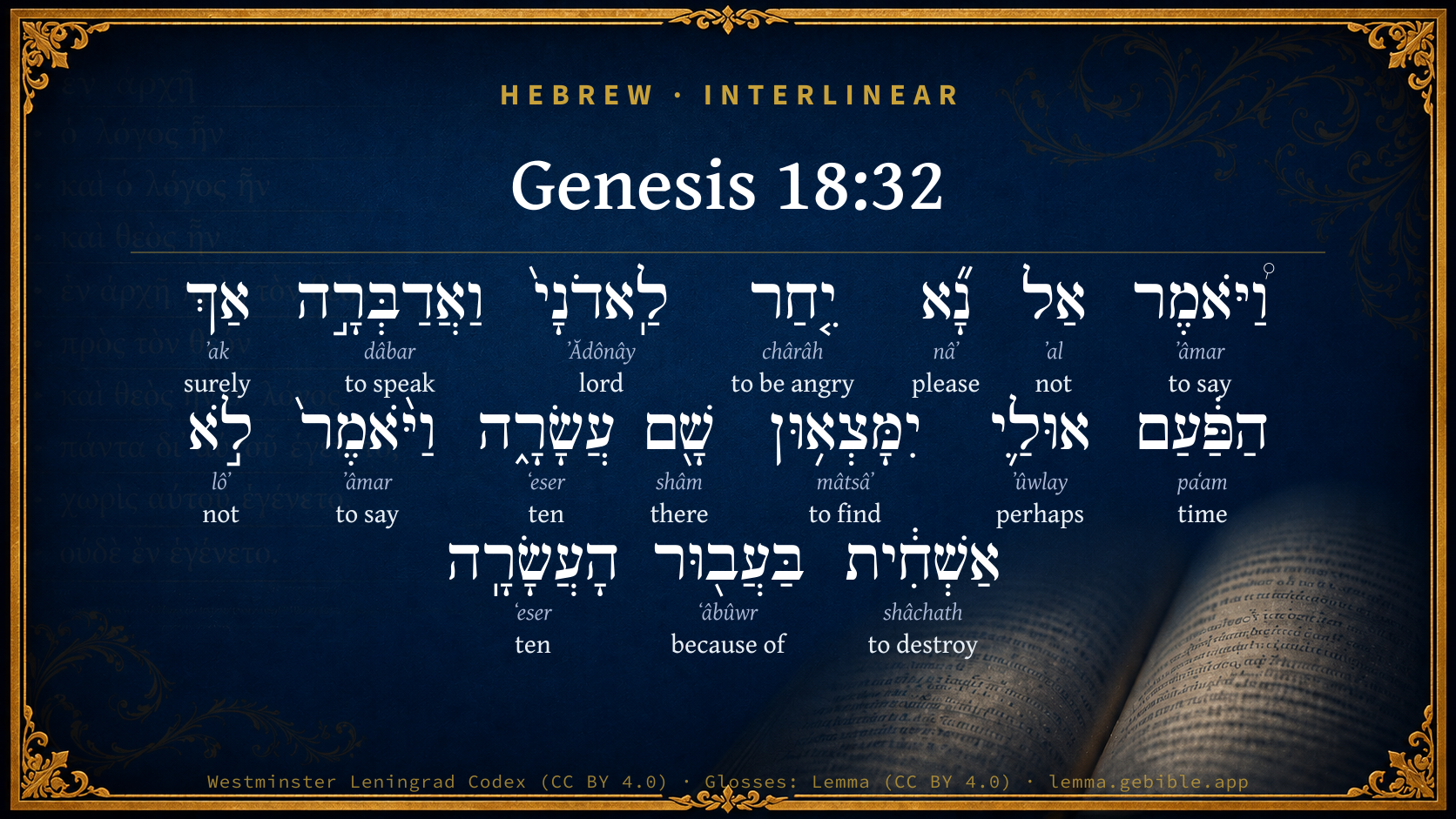
Hebrew (Westminster Leningrad Codex) Genesis 18:32 appears in the Hebrew Old Testament. The text above is from the Westminster Leningrad Codex. Each word links to its Strong’s number, a concise gloss, and parsing drawn from the Open Scriptures Hebrew Bible morphology. Click any word for its full Brown-Driver-Briggs (BDB) entry.
Download image
Cite this verse

Genesis 18:32 (World English Bible). Public Domain. Lemma interlinear Bible study tool, https://lemma.gebible.app/v/genesis/18/32.

Show BibTeX & RIS
BibTeX
RIS
English Translation
He said, "Oh don't let the Lord be angry, and I will speak yet but this once. What if ten are found there?" He said, "I will not destroy it for the ten's sake."
World English Bible · Public Domain
Download a study sheet

One document with this verse’s original text, its word-by-word gloss line, the meaning frame, cross-references with their text, attributed commentary, and full source and license credits — printable, and it pastes into notes with its structure intact.

This verse Autodidact and up

Study sheet (.html) Plain text (.txt)

A passage Seminary Student

Up to 50 verses in one chapter. A passage sheet keeps up to 6 commentary sources and 12 cross-references per verse, in the order this page ranks them, and says so on the sheet whenever that leaves anything out. Ask for a single verse and you get the Autodidact verse sheet above.

Everything on this page stays free to read, with no account — the sheet is a download of what is already on screen, not access to it.

Want to remove ads? Support Godless Engineer
Compare translations 3

The same verse in 3 English versions, stacked beneath the original-language interlinear above. Click any original word for its lexicon entry.

Each is an independent rendering of the whole verse — the interlinear is not word-aligned to these translations.

Highlighted words mark where these versions differ — a whole-verse word diff, not a word-by-word alignment.

  • World English Bible Public Domain
    He said, "Oh don't let the Lord be angry, and I will speak yet but this once. What if ten are found there?" He said, "I will not destroy it for the ten's sake."
  • King James Version Public Domain
    And he said, Oh let not the LORD be angry, and I will speak yet but this once: Peradventure ten shall be found there. And he said, I will not destroy it for ten's sake.
  • unfoldingWord Literal Text CC BY-SA 4.0
    Then he said, “Please do not let my Lord be angry, and let me speak just once more: Suppose ten are found there?” And he said, “I will not destroy it for the sake of the ten.”

unfoldingWord Literal Text — © unfoldingWord, licensed CC BY-SA 4.0. Word-aligned USFM3 via Door43 (git.door43.org/unfoldingWord/en_ult).

Versions to compare (up to 4)

3 of 4 selected

Show all 18 translations

Every available English version of this verse, each an independent rendering of the whole verse.

  • World English Bible Public Domain
    He said, "Oh don't let the Lord be angry, and I will speak yet but this once. What if ten are found there?" He said, "I will not destroy it for the ten's sake."
  • Berean Standard Bible Public Domain
    Finally, Abraham said, “May the Lord not be angry, but let me speak once more. Suppose ten are found there?” And He answered, “On account of the ten, I will not destroy it.”
  • Majority Standard Bible Public Domain
    Finally, Abraham said, “May the Lord not be angry, but let me speak once more. Suppose ten are found there?” And He answered, “On account of the ten, I will not destroy it.”
  • King James Version Public Domain
    And he said, Oh let not the LORD be angry, and I will speak yet but this once: Peradventure ten shall be found there. And he said, I will not destroy it for ten's sake.
  • American Standard Version (1901) Public Domain
    And he said, Oh let not the Lord be angry, and I will speak yet but this once: peradventure ten shall be found there. And he said, I will not destroy it for the ten's sake.
  • Revised Version (1885) Public Domain
    And he said, Oh let not the Lord be angry, and I will speak yet but this once: peradventure ten shall be found there. And he said, I will not destroy it for the ten’s sake.
  • Geneva Bible (1599) Public Domain
    Then he saide, Let not my Lord be nowe angrie, and I will speake but this once, What if tenne be found there? And he answered, I will not destroy it for tennes sake.
  • Douay-Rheims (1899) Public Domain
    Seeing, saith he, I have once begun, I will speak to my Lord. What if twenty be found there? He said: I will not destroy it for the sake of twenty.
  • Young's Literal Translation Public Domain
    And he saith, `Let it not be, I pray Thee, displeasing to the Lord, and I speak only this time: peradventure there are found there ten?' and He saith, `I do not destroy `it', because of the ten.'
  • Literal Standard Version CC BY-SA 4.0
    And he says, “Please let it not be displeasing to the Lord, and I speak only this time: perhaps there are found there ten?” And He says, “I do not destroy [it], because of the ten.”
  • Unlocked Literal Bible CC BY-SA 4.0
    He said, “Please do not be angry, Lord, and I will speak this one last time. Perhaps ten will be found there.” Then he said, “I will not destroy it for the ten's sake.”
  • unfoldingWord Literal Text CC BY-SA 4.0
    Then he said, “Please do not let my Lord be angry, and let me speak just once more: Suppose ten are found there?” And he said, “I will not destroy it for the sake of the ten.”
  • Darby Bible Public Domain
    And he said, Oh, let not the Lord be angry, that I speak yet but this time! Perhaps there may be ten found there. And he said, I will not destroy [it] for the ten's sake.
  • World Messianic Bible Public Domain
    He said, “Oh don’t let the Lord be angry, and I will speak just once more. What if ten are found there?” He said, “I will not destroy it for the ten’s sake.”
  • Webster's Bible Public Domain
    And he said, Oh let not the Lord be angry, and I will speak yet but this once: Peradventure ten will be found there. And he said, I will not destroy it for ten's sake.
  • Free Bible Version CC BY-SA 4.0
    “Please don't get angry with me, my Lord,” Abraham said. “Just let me ask one more thing. What if only ten are found there?” “I won't destroy it for the sake of the ten,” the Lord replied.
  • Bible in Basic English Public Domain
    And he said, O let not the Lord be angry and I will say only one word more: by chance there may be ten there. And he said, I will have mercy because of the ten.
  • JPS Tanakh (1917) Public Domain
    And he said: 'Oh, let not the Lord be angry, and I will speak yet but this once. Peradventure ten shall be found there.' And He said: 'I will not destroy it for the ten's sake.'

Literal Standard Version (2020), Covenant Press — licensed CC BY-SA 4.0. Text via the HelloAO Bible API (eBible.org). Unlocked Literal Bible (unfoldingWord) — licensed CC BY-SA 4.0. Text via the HelloAO Bible API (eBible.org). unfoldingWord Literal Text — © unfoldingWord, licensed CC BY-SA 4.0. Word-aligned USFM3 via Door43 (git.door43.org/unfoldingWord/en_ult). Free Bible Version, Dr. Jonathan Gallagher — licensed CC BY-SA 4.0. Text via the HelloAO Bible API (eBible.org).

Word by word

More ways to search: Search by grammar → Find every occurrence → Compare this word →

Practice this passage: Drill this verse → Learn its vocabulary →

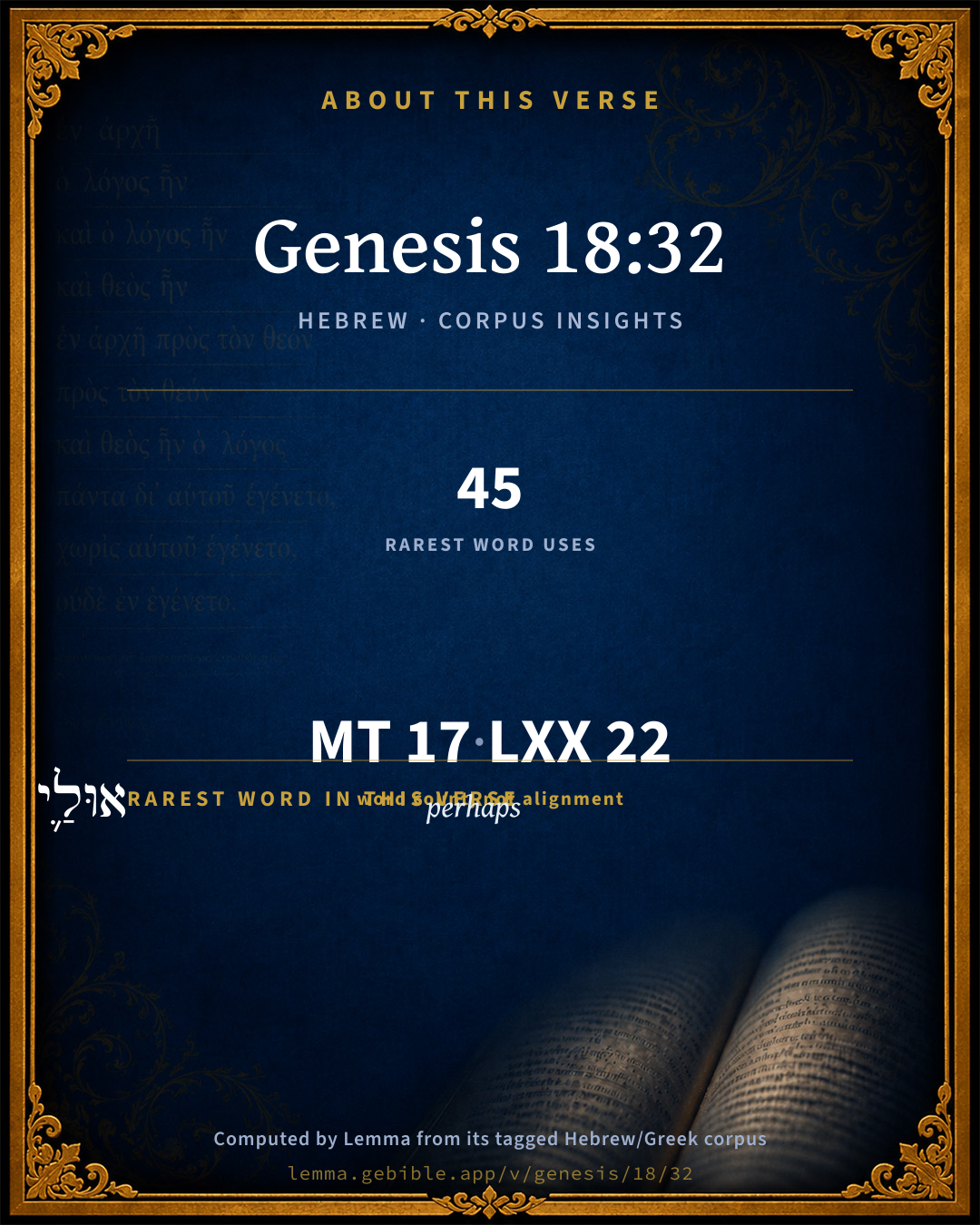
אוּלַ֛י
ʼûwlay
H194
“perhaps”
Adverb
Part of Speech
Adverb
Full BDB Definition

Origin: from H176

TWOT: 46

perhaps, peradventure - if peradventure - unless - suppose
  1. וַ֠יֹּאמֶר ʼâmar H559 “and · to say” Conjunction + Verb, Qal, Sequential Imperfect, 3rd Person, Masculine, Singular
  2. אַל ʼal H408 “not” Particle, Negative
  3. נָ֞א nâʼ H4994 “please” Particle, Exhortation
  4. יִ֤חַר chârâh H2734 “to be angry” Verb, Qal, Jussive, 3rd Person, Masculine, Singular
  5. לַֽאדֹנָי֙ ʼĂdônây H136 “to/for · Lord · my” Preposition + Noun, Common, Masculine, Plural, Construct + Suffix, Personal, 1st Person, Common, Singular
  6. וַאֲדַבְּרָ֣ה dâbar H1696 “and · to speak” Conjunction + Verb, Piel, Cohortative, 1st Person, Common, Singular
  7. אַךְ ʼak H389 “surely” Particle, Accusative
  8. הַפַּ֔עַם paʻam H6471 “the · time” Particle, Definite Article + Noun, Common, Feminine, Singular, Absolute
  9. יִמָּצְא֥וּן mâtsâʼ H4672 “to find” Verb, Niphal, Imperfect, 3rd Person, Masculine, Plural + Suffix, n
  10. שָׁ֖ם shâm H8033 “there” Adverb
  11. עֲשָׂרָ֑ה ʻeser H6235 “ten” Adjective, Cardinal number, Masculine, Singular, Absolute
  12. וַיֹּ֨אמֶר֙ ʼâmar H559 “and · to say” Conjunction + Verb, Qal, Sequential Imperfect, 3rd Person, Masculine, Singular
  13. לֹ֣א lôʼ H3808 “not” Particle, Negative
  14. אַשְׁחִ֔ית shâchath H7843 “to destroy” Verb, Hiphil, Imperfect, 1st Person, Common, Singular
  15. בַּעֲב֖וּר ʻâbûwr H5668 “in/at · because of of” Preposition + Noun, Common, Masculine, Singular, Construct
  16. הָעֲשָׂרָֽה ʻeser H6235 “the · ten” Particle, Definite Article + Adjective, Cardinal number, Masculine, Singular, Absolute

About this verse

These counts appear in no published source. They are computed here, from the morphology-tagged text and Lemma’s own curated glosses. What Lemma adds →

17
words
15
distinct lemmas
Pentateuch
section

Shared distinctive vocabulary

אוּלַ֛י perhaps H194 occurs in 44 verses of the Hebrew Bible. Also found in:

Grammatical profile

  • 6 verbs
  • 3 nouns
  • 2 adjectives
  • 2 adverbs
  • 4 particles

Verb forms

  • וַ֠יֹּאמֶר Qal · Sequential Imperfect
  • יִ֤חַר Qal · Jussive
  • וַאֲדַבְּרָ֣ה Piel · Cohortative
  • יִמָּצְא֥וּן Niphal · Imperfect
  • וַיֹּ֨אמֶר֙ Qal · Sequential Imperfect
  • אַשְׁחִ֔ית Hiphil · Imperfect

Repetition

Words recur within this verse — often emphatic in Hebrew:

  • וַ֠יֹּאמֶר to say H559 ×2
  • עֲשָׂרָ֑ה ten H6235 ×2

Hebrew & Septuagint length

In English translation the verse runs 34 words from the Hebrew and 35 from the Septuagint (LXX English) — closely comparable.

A rough comparison of the two English renderings, which tokenize alike — not a word-level alignment.

Word counts can differ between the Hebrew and the Greek without any difference in meaning — e.g. the Hebrew direct-object marker אֵת has no separate Greek word, and Greek often adds the article ὁ.

In the original languages it is 17 Hebrew tokens and 22 Greek tokens — but the two are counted differently (Hebrew bundles its prefixes and suffixes into one token; the Greek is in lemma form), so that isn’t a like-for-like length.

Cross-references

18

Topical passages linked to Genesis 18:32 in the Treasury of Scripture Knowledge — connected by theme and wording, ordered by reader-vote popularity; previews shown in the World English Bible.

  • James 5:15–17 and the prayer of faith will heal him who is sick, and the Lord will raise him up. If he has committed sins, he will be forgiven.
  • Judges 6:39 Gideon said to God, Don't let your anger be kindled against me, and I will speak but this once: Please let me make a trial just this once with the fleece; let it now be dry only on the fleece, and on all the ground let there be dew.
  • Matthew 7:7 "Ask, and it will be given you. Seek, and you will find. Knock, and it will be opened for you.
  • 1 John 5:15–16 And if we know that he listens to us, whatever we ask, we know that we have the petitions which we have asked of him.
  • Micah 7:18 Who is a God like you, who pardons iniquity, And passes over the disobedience of the remnant of his heritage? He doesn't retain his anger forever, Because he delights in loving kindness.
  • Ephesians 3:20 Now to him who is able to do exceedingly abundantly above all that we ask or think, according to the power that works in us,
  • Genesis 18:30 He said, "Oh don't let the Lord be angry, and I will speak. What if there are thirty found there?" He said, "I will not do it, if I find thirty there."
  • Exodus 32:9–10 Yahweh said to Moses, "I have seen these people, and, behold, they are a stiff-necked people.
  • Exodus 32:14 Yahweh repented of the evil which he said he would do to his people.
  • Exodus 33:13–14 Now therefore, if I have found favor in your sight, please show me now your ways, that I may know you, so that I may find favor in your sight: and consider that this nation is your people."
  • Exodus 34:6–7 Yahweh passed by before him, and proclaimed, "Yahweh! Yahweh, a merciful and gracious God, slow to anger, and abundant in loving kindness and truth,
  • Exodus 34:9–10 He said, "If now I have found favor in your sight, Lord, please let the Lord go in the midst of us; although this is a stiff-necked people; pardon our iniquity and our sin, and take us for your inheritance."
  • Numbers 14:11–20 Yahweh said to Moses, How long will this people despise me? and how long will they not believe in me, for all the signs which I have worked among them?
  • Job 33:23 "If there is beside him an angel, An interpreter, one among a thousand, To show to man what is right for him;
  • Psalms 86:5 For you, Lord, are good, and ready to forgive; Abundant in loving kindness to all those who call on you.
  • Proverbs 15:8 The sacrifice made by the wicked is an abomination to Yahweh, But the prayer of the upright is his delight.
  • Isaiah 42:6–7 I, Yahweh, have called you in righteousness, and will hold your hand, and will keep you, and give you for a covenant of the people, for a light of the Gentiles;
  • Isaiah 65:8 Thus says Yahweh, As the new wine is found in the cluster, and one says, Don't destroy it, for a blessing is in it: so will I do for my servants' sake, that I may not destroy them all.

Cross-references courtesy of OpenBible.info (CC BY 4.0).

Hebrew and Greek witnesses Masoretic Hebrew ↔ Greek Septuagint

The same verse in the two great witnesses to the Old Testament, shown verse-for-verse.

These are two independent witnesses, not word-aligned to each other, and the Septuagint is shown in lemma (dictionary) form.

Hebrew Genesis 18:32 Masoretic · Westminster Leningrad Codex

וַ֠יֹּאמֶר אַל נָ֞א יִ֤חַר לַֽאדֹנָי֙ וַאֲדַבְּרָ֣ה אַךְ הַפַּ֔עַם אוּלַ֛י יִמָּצְא֥וּן שָׁ֖ם עֲשָׂרָ֑ה וַיֹּ֨אמֶר֙ לֹ֣א אַשְׁחִ֔ית בַּעֲב֖וּר הָעֲשָׂרָֽה

He said, "Oh don't let the Lord be angry, and I will speak yet but this once. What if ten are found there?" He said, "I will not destroy it for the ten's sake."

World English Bible · Public Domain

Greek LXX Genesis 18:32 Septuagint · lemma form

καί εἶπον μή τις κύριος ἐάν λαλέω ἔτι ἅπαξ ἐάν δέ εὑρίσκω ἐκεῖ δέκα καί εἶπον οὐ μή ἀποὀλλύω ἕνεκεν ὁ δέκα

And he said, Will there be anything against me, Lord, if I speak yet once? but if there should be found there ten? And he said, I will not destroy it for the ten's sake.

LXX2012 (modern English Septuagint) · Public Domain

Hebrew: Westminster Leningrad Codex (CC BY 4.0). Greek: Septuagint (public domain); English from LXX2012 (modern English Septuagint) (Public Domain). How the Septuagint differs from the Hebrew →

Targum (Aramaic paraphrase)

2

The Targum is the ancient Jewish Aramaic paraphrase of the Hebrew Scriptures — an interpretive translation, not the Hebrew text itself. Onkelos (literal) and Pseudo-Jonathan (expansive) render the Torah, and Jonathan the Prophets. Coverage is partial: where no permissively-licensed English translation exists for a verse, only the Aramaic is shown. This is verse-level text, not a word-by-word alignment to the Hebrew.

  1. Targum Onkelos Torah (Genesis–Deuteronomy)
    וַאֲמַר לָא כְעַן יִתְקֵף קֳדָם יְיָ (נ''י רוּגְזָא דַּיְיָ) וֶאֱמַלֵּל בְּרַם זִמְנָא הָדָא מָאִים יִשְׁתַּכְּחוּן תַּמָּן עַשְׂרָא וַאֲמַר לָא אֲחַבֵּל בְּדִיל עַשְׂרָא

    (no public-domain English translation for this verse)

    Targum Onkelos — Aramaic: “Onkelos Genesis” (public domain); “Onkelos Exodus” (public domain); “Onkelos Leviticus” (public domain); “Onkelos Numbers” (public domain); “Onkelos Deuteronomy” (public domain). English: “Sefaria Community Translation” (CC0 1.0 (public-domain dedication)); “J.W. Etheridge. The Targums of Onkelos and Jonathan Ben Uzziel on the Pentateuch. London: Longmans, Green, 1862” (public domain). Text via Sefaria.

  2. Targum Pseudo-Jonathan Torah (Genesis–Deuteronomy)
    וַאֲמַר בְּבָעוּ בְּרַחֲמִין מִן קֳדָמָךְ לָא כְּדוֹן יִתְקוֹף רוּגְזָא דְרִבּוֹן כָּל עָלְמַיָא יְיָ וַאֲמַלֵיל בְּרַם זִמְנָא הָדָא מָאִים יִשְׁתַּכְּחוּן תַּמָן עֲשָרָה וַנְהִי אֲנָא וְאִינוּן וְנִבְעֵי רַחֲמִין עַל כָּל אַתְרָא וְתִשְׁבּוֹק לְהוֹם וַאֲמַר לָא אֲחַבֵּל בְּגִין זַכְוַות עֲשָרָה

    And he said, I implore mercy before Thee! Let not the anger of the Lord,the Lord of all the world, grow strong, and I will speak only this time. Perhaps ten may be found there; and I and they will pray for mercy upon all the land, and Thou wilt forgive them. And He said, I will not destroy for the sake of the ten who may be innocent.

    Targum Pseudo-Jonathan — Aramaic: “Targum Jonathan on Genesis” (public domain); “Targum Jonathan on Exodus” (public domain); “Targum Jonathan on Leviticus” (public domain); “Targum Jonathan on Numbers” (public domain); “Targum Jonathan on Deuteronomy” (public domain). English: “The Targum of Jonathan ben Uzziel, trans. J. W. Etheridge, London, 1862” (public domain). Text via Sefaria.

Commentary

Notes on Genesis 18:32 from classic Christian and Jewish commentators (each source and its license shown beneath its notes). The classic Christian expositions comment on the surrounding passage and are grouped to its opening verse, so a note may address several verses; the Jewish commentaries on the Tanakh (Rashi and others) are per-verse, so they appear only where the commentator wrote on this verse.

Lemma curates 59 commentaries, every one of them public domain or Creative Commons licensed, each selected and text-cleaned for this edition rather than reprinted as found. About our sources →

Trapp's Complete Commentary

John Trapp

Gen 18:32 And he said, Oh let not the Lord be angry, and I will speak yet but this once: Peradventure ten shall be found there. And he said, I will not destroy [it] for ten’s sake.

Ver. 32. Peradventure ten shall be found there.] Lo, all the slavery and misery they had sustained hath not yet made ten good men in those five bad cities. Till God strike the stroke, and work upon the heart, afflictions, God’s hammers, do but beat upon cold iron. The wicked are no whit better by them, but much the worse; as water becomes more cold after a heat, and naughty boys more stubborn and stupid after a whipping.

John Trapp, A Commentary or Exposition upon All the Books of the Old and New Testament (1647–1656) — public domain. Text from a community e-Sword module.

The Biblical Illustrator

Joseph S. Exell

Gen_18:32

I will not destroy it for tens sake

The incalculable worth of good men

This narrative teaches--

1.

The highest development of genuine philanthropy. Importunate intercession with Heaven on behalf of humanity.

2. The mysterious power of intercessory prayer.

3. The incalculable worth of good men, however few in number.

I. That good men in a community, however few, are HIGHLY ESTEEMED OF GOD.

1. Because of the tender relationship they sustain to Him. His children.

2. Because of the critical position in which they are placed in this life.

3. Because of the beneficent influences they are capable of exercising upon the race.

II. That good men in a community, however few, are of INEXPRESSIBLE SOCIAL WORTH.

1. Prize good men more than all others.

2. Seek to multiply good men.

(1) By endeavouring to convert bad men to goodness by the gospel of Christ.

(2) By indoctrinating the rising generation with the principles and spirit of Christ. (Homilist.)

Gods willingness to save

Those who censure this narrative, asserting that it represents God as wavering and undetermined, should observe that His resolution was not yet taken (Gen_18:21); and even if this had been the case, that it is indeed always open to the repentance and prayer of those whom it concerns; God has no delight in punishing and destroying; He tried the hard-heartedness of Pharaoh by ten successive plagues; He accepted the repentance of the wicked Ninevites; and He ordered a systematic ritual of sacrifices, solely intended to furnish to man the means of restoring his peace with Himself. If we banish this vacillation from the attributes of God, man may tremble before His will; but he can never love Him. But the truth, that the principles on which His government is based are eternal and unalterable, is expressed many times with singular emphasis: God is no man that He should lie, nor a son of man that He should repent. God is, indeed, said to have repented that He had created man, and that He had appointed Saul king over Israel; but these are strong expressions denoting how unworthy the former had proved to bear the

Divine image; and the latter, to be the representative of Divine sovereignty. (M. M.Kalisch, Ph. D.)

.

The Biblical Illustrator, edited by Joseph S. Exell (c. 1880s–1900s) — public domain. Text from a community e-Sword module.

Geneva Bible (1599)

Geneva Bible translators

If God refused not the prayer for the wicked Sodomites, even to the sixth request, how much more will he grant the prayers of the godly for the afflicted Church?

Geneva Bible (1599) marginal notes — public domain. Text via Bolls.life.

Adam Clarke's Commentary

Verse 32. Peradventure ten shall be found there] Knowing that in the family of his nephew the true religion was professed and practised, he could not suppose there could be less than ten righteous persons in the city, he did not think it necessary to urge his supplication farther; he therefore left off his entreaties, and the Lord departed from him. It is highly worthy of observation, that while he continued to pray the presence of God was continued; and when Abraham ended, "the glory of the Lord was lifted up," as the Targum expresses it.

THIS chapter, though containing only the preliminaries to the awful catastrophe detailed in the next, affords us several lessons of useful and important information.

1. The hospitality and humanity of Abraham are worthy, not only of our most serious regard, but also of our imitation. He sat in the door of his tent in the heat of the day, not only to enjoy the current of refreshing air, but that if he saw any weary and exhausted travellers he might invite them to rest and refresh themselves. Hospitality is ever becoming in one human being towards another; for every destitute man is a brother in distress, and demands our most prompt and affectionate assistance, according to that heavenly precept, "What ye would that men should do unto you, do even so unto them." From this conduct of Abraham a Divine precept is formed: "Be not forgetful to entertain strangers, for thereby some have entertained angels unawares. Heb 13:2.

2. Whatever is given on the ground of humanity and mercy is given unto God, and is sure to meet with his approbation and a suitable reward. While Abraham entertained his guests God discovers himself, and reveals to him the counsels of his will, and renews the promise of a numerous posterity. Sarah, though naturally speaking past child-bearing, shall have a son: natural obstacles cannot hinder the purpose of God; nature is his instrument; and as it works not only by general laws, but also by any particular will of God, so it may accomplish that will in any way he may choose to direct. It is always difficult to credit God's promises when they relate to supernatural things, and still more so when they have for their object events that are contrary to the course of nature; but as nothing is too hard for God, so "all things are possible to him that believeth." It is that faith alone which is of the operation of God's Spirit, that is capable of crediting supernatural things; he who does not pray to be enabled to believe, or, if he do, uses not the power when received, can never believe to the saving of the soul.

3. Abraham trusts much in God, and God reposes much confidence in Abraham. He knows that God is faithful, and will fulfil his promises; and God knows that Abraham is faithful, and will command his children and his household after him, and they shall keep the way of the Lord to do justice and judgment; Ge 18:19. No man lives unto himself; and God gives us neither spiritual nor temporal blessings for ourselves alone; our bread we are to divide with the hungry, and to help the stranger in distress. He who understands the way of God should carefully instruct his household in that way; and he who is the father of a family should pray to God to teach him, that he may teach his household. His ignorance of God and salvation can be no excuse for his neglecting his family: it is his indispensable duty to teach them; and God will teach him, if he earnestly seek it, that he may be able to discharge this duty to his family. Reader, if thy children or servants perish through thy neglect, God will judge thee for it in the great day.

4. The sin of Sodom and the cities of the plain was great and grievous; the measure of their iniquity was full, and God determined to destroy them. Judgment is God's strange work, but though rarely done it must be done sometimes, lest men should suppose that right and wrong, vice and virtue, are alike in the eye of God. And these judgments must be dispensed in such a way as to show they are not the results of natural causes, but come immediately from the incensed justice of the Most High.

5. Every man who loves God loves his neighbour also; and he who loves his neighbour will do all in his power to promote the well-being both of his soul and his body. Abraham cannot prevent the men of Sodom from sinning against God; but he can make prayer and intercession for their souls, and plead, if not in arrest, yet in mitigation, of judgment. He therefore intercedes for the transgressors, and God is well pleased with his intercessions. These are the offspring of God's own love in the heart of his servant.

6. How true is that word, The energetic faithful prayer of a righteous man availeth much! Abraham draws near to God by affection and faith, and in the most devout and humble manner makes prayer and supplication; and every petition is answered on the spot. Nor does God cease to promise to show mercy till Abraham ceases to intercede! What encouragement does this hold out to them that fear God, to make prayer and intercession for their sinful neighbours and ungodly relatives! Faith in the Lord Jesus endues prayer with a species of omnipotence; whatsoever a man asks of the Father in his name, he will do it. Prayer has been termed the gate of heaven, but without faith that gate cannot be opened. He who prays as he should, and believes as he ought, shall have the fulness of the blessings of the Gospel of peace.

Adam Clarke's Commentary on the Bible (1810–1826) — public domain. Text from a community e-Sword/MySword module.

John Gill's Exposition

And he said, Oh, let not the Lord be angry, and I will speak yet but this once,.... This should be the last request he should make on this account, and therefore he desired he might be heard without any marks of his displeasure:

Peradventure ten shall be found there: how would the place be dealt with then? would it be consumed or not?

and he said, I will not destroy it for ten's sake; though no more righteous persons were found in it. Some of the Jewish writers say (g), he ended at ten, because he supposed there were ten righteous persons in Lot's family, Lot and his wife, and their four daughters, and their four husbands; but they forgot that two of Lot's daughters were unmarried, and how many he had married is not known; ten they say make a congregation, and wherever there are ten righteous persons, a place is saved for their sakes.

(g) Bereshit Rabba, sect. 49. fol. 44. 3.

John Gill's Exposition of the Whole Bible (1746–1763) — public domain (CC PDM 1.0). Text via the HelloAO Bible API.

Haydock's Catholic Bible Commentary

Ten. Abraham’s chief solicitude was for Lot; though, out of modesty, he does not mention him; trusting, however, in the divine goodness the he would be preserved, unless he had forfeited his justice, he proceeds no farther. God thus challenges Jerusalem to produce one virtuous man, and the city shall be saved for his sake, Jeremias v. 1. (Haydock)

George Leo Haydock (1774–1849), Haydock's Catholic Family Bible and Commentary, 1859 edition — public domain. Excludes Psalms (Douay-Rheims chapter numbering differs from Protestant) and Deuterocanonical books (Catholic canon only).

Matthew Poole's English Annotations

Abraham in modesty could proceed no further; and being a good man himself, he had a charitable opinion of others, and thought there certainly were so many good men in all those cities, especially including Lot and his family. No doubt Abraham remembered Lot in his prayers; but that large and generous soul could not content himself with Lot’s preservation, but aims at the saving of the whole cities, which when he saw was doubtful and unlikely, he prayed for his deliverance out of that common destruction, as may be gathered from Gen 19:29.

Matthew Poole's English Annotations on the Holy Bible (1683–1685) — public domain. Text from a community e-Sword/MySword module.

The Pulpit Commentary

And he said, Oh let not the Lord be angry (vide supra), and I will speak but this once (literally, only this time more, as in: (Exo_10:17) Peradventure ten shall be found there. And he said, I will not destroy it for ten"s sake.

The Pulpit Commentary (1880–1919), ed. H.D.M. Spence-Jones & Joseph S. Exell — public domain. Text from a community e-Sword module.

unfoldingWord translationNotes

Door43 World Missions Community

Perhaps ten will be found there

"Perhaps you will find ten righteous people there"

Perhaps ten

"Perhaps ten righteous people" or "ten good people"

Then he said

"And Yahweh answered"

for the ten's sake

"if I find ten righteous people there"

Yahweh went on his way

Here "went on his way" is an idiom that means he left, or he continued his journey. Yahweh appeared to Abraham in human form as a traveler. AT: "Yahweh departed" or "Yahweh continued on his journey" (See: Idiom)

translationWords

lord

Abraham

Yahweh

unfoldingWord translationNotes — © Distant Shores Media and the Door43 World Missions Community, licensed CC BY-SA 4.0. Source: git.door43.org/Door43/en_tn.

Rashi

Rabbi Shlomo Yitzchaki (Rashi)

אולי ימצאון שם עשרה PERADVENTURE THERE SHALL TEN BE FOUND THERE — For a smaller number he did not plead because he knew already of two instances where less than ten had failed to save the wicked. He said to himself: In the generation of the Flood there were eight righteous people, viz., Noah, his sons and their wives, and they could not save their generation (Genesis Rabbah 49:13), and for nine in association with God he had already pleaded but had found no acceptance.

Rashi on the Tanakh — English translations: “The Judaica Press complete Tanach with Rashi, translated by A. J. Rosenberg” (CC BY 4.0); “Pentateuch with Rashi's commentary by M. Rosenbaum and A.M. Silbermann, 1929-1934” (public domain); “The Metsudah Tanach series, Lakewood, N.J” (CC BY 4.0); and “The Book of Joshua, Metsudah Publications, 1997” (CC BY 4.0). Text via Sefaria.

Radak

Rabbi David Kimhi (Radak)

ויאמר...אך הפעם, Avraham makes clear that if there would not be at least ten righteous people, he would no longer have any argument to present which could be used to help these towns escape their deserved punishment. Significantly, he made no mention of Lot, as he believed that Lot deserved to share the fate of the city having voluntarily associated himself with the wicked inhabitants of that town. Besides, Avraham had no way of knowing if Lot had adopted the perverted lifestyle of the inhabitants of Sodom. He believed that Lot’s only way of saving himself from the doom decreed on the city was to voluntarily depart from that city.

Radak on the Tanakh — English translations: “Sefaria Community Translation” (CC0 1.0 (public-domain dedication)); “Eliyahu Munk, HaChut Hameshulash” (CC BY 4.0); “Rabbi Mike Feuer, Jerusalem Anthology” (CC BY 4.0); and “R. David Kimhi on the first book of Psalms, Translated by R.G. Finch, London, 1919” (public domain). Text via Sefaria.

Lesson kit

Teaching starters — assembled from the data on this page, not authored interpretation. Every prompt links to the verse data it draws on. Edit before teaching.

Genesis, in the Pentateuch, opens this verse with 17 words (15 distinct Hebrew lemmas). Its most distinctive word is ʼûwlay (“perhaps”). A historical commentator’s framing appears above. Read the whole chapter for the surrounding context.

Discussion questions

  1. The word ʼûwlay carries the sense “perhaps.” How does it shape the verse?
  2. Genesis 16:2 shares the word «perhaps» with this verse. How do the two illuminate each other?
  3. “to say” occurs 2× in this one verse. What is the effect of the repetition?
  4. The translations on this page render this verse differently — a whole-verse word diff, not a word-by-word alignment. What might account for the different wordings?
  5. The verb «וַ֠יֹּאמֶר» is Qal Sequential Imperfect. How does its form color the action?
  6. Reading how Trapp's Complete Commentary and The Biblical Illustrator read this verse, where do the two commentators agree and where do they part?

Things to notice

Reading settings

Reading text

Shown beneath each verse's original-language words.

Old Testament
Old Testament edition

Read the OT as the Masoretic Hebrew (MT) or the Greek Septuagint (LXX).

English shown for the Greek Septuagint (in the Hebrew ↔ Greek comparison).

Comparing translations? Open the Compare panel on any verse page to stack up to four side by side.