
1 Samuel 19:4

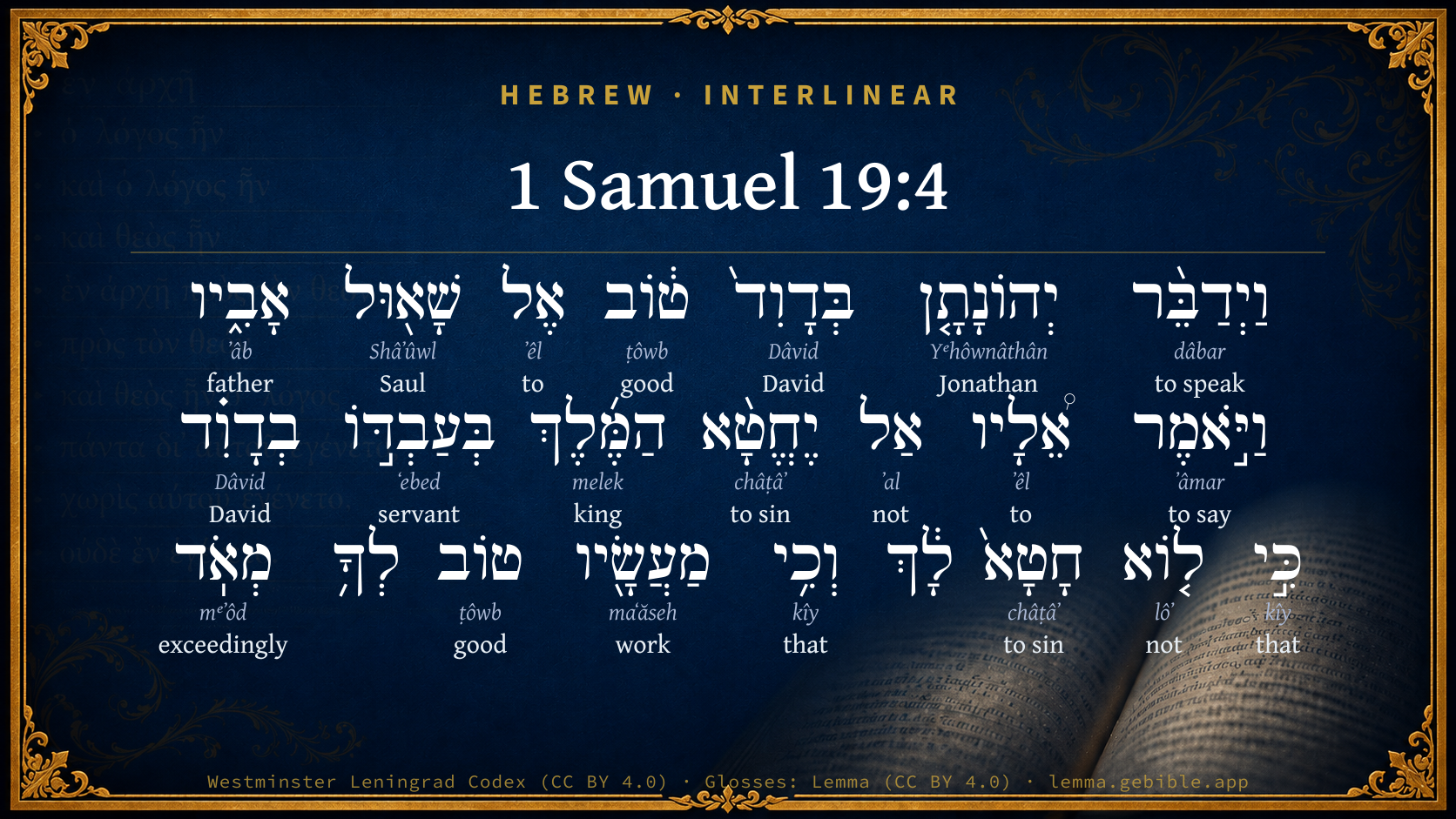
Hebrew (Westminster Leningrad Codex) 1 Samuel 19:4 appears in the Hebrew Old Testament. The text above is from the Westminster Leningrad Codex. Each word links to its Strong’s number, a concise gloss, and parsing drawn from the Open Scriptures Hebrew Bible morphology. Click any word for its full Brown-Driver-Briggs (BDB) entry.
Download image
Cite this verse

1 Samuel 19:4 (World English Bible). Public Domain. Lemma interlinear Bible study tool, https://lemma.gebible.app/v/1-samuel/19/4.

Show BibTeX & RIS
BibTeX
RIS
English Translation
Jonathan spoke good of David to Saul his father, and said to him, Don't let the king sin against his servant, against David; because he has not sinned against you, and because his works have been very good toward you:
World English Bible · Public Domain
Download a study sheet

One document with this verse’s original text, its word-by-word gloss line, the meaning frame, cross-references with their text, attributed commentary, and full source and license credits — printable, and it pastes into notes with its structure intact.

This verse Autodidact and up

Study sheet (.html) Plain text (.txt)

A passage Seminary Student

Up to 50 verses in one chapter. A passage sheet keeps up to 6 commentary sources and 12 cross-references per verse, in the order this page ranks them, and says so on the sheet whenever that leaves anything out. Ask for a single verse and you get the Autodidact verse sheet above.

Everything on this page stays free to read, with no account — the sheet is a download of what is already on screen, not access to it.

Want to remove ads? Support Godless Engineer
Compare translations 3

The same verse in 3 English versions, stacked beneath the original-language interlinear above. Click any original word for its lexicon entry.

Each is an independent rendering of the whole verse — the interlinear is not word-aligned to these translations.

Highlighted words mark where these versions differ — a whole-verse word diff, not a word-by-word alignment.

  • World English Bible Public Domain
    Jonathan spoke good of David to Saul his father, and said to him, Don't let the king sin against his servant, against David; because he has not sinned against you, and because his works have been very good toward you:
  • King James Version Public Domain
    And Jonathan spake good of David unto Saul his father, and said unto him, Let not the king sin against his servant, against David; because he hath not sinned against thee, and because his works have been to thee-ward very good:
  • unfoldingWord Literal Text CC BY-SA 4.0
    And Jonathan spoke well of David to Saul his father, and he said to him, “May the king not sin against his servant, against David, for he has not sinned against you, but surely his deeds very good for you.

unfoldingWord Literal Text — © unfoldingWord, licensed CC BY-SA 4.0. Word-aligned USFM3 via Door43 (git.door43.org/unfoldingWord/en_ult).

Versions to compare (up to 4)

3 of 4 selected

Show all 18 translations

Every available English version of this verse, each an independent rendering of the whole verse.

  • World English Bible Public Domain
    Jonathan spoke good of David to Saul his father, and said to him, Don't let the king sin against his servant, against David; because he has not sinned against you, and because his works have been very good toward you:
  • Berean Standard Bible Public Domain
    Then Jonathan spoke well of David to his father Saul and said to him, “The king should not sin against his servant David; he has not sinned against you. In fact, his actions have been highly beneficial to you.
  • Majority Standard Bible Public Domain
    Then Jonathan spoke well of David to his father Saul and said to him, “The king should not sin against his servant David; he has not sinned against you. In fact, his actions have been highly beneficial to you.
  • King James Version Public Domain
    And Jonathan spake good of David unto Saul his father, and said unto him, Let not the king sin against his servant, against David; because he hath not sinned against thee, and because his works have been to thee-ward very good:
  • American Standard Version (1901) Public Domain
    And Jonathan spake good of David unto Saul his father, and said unto him, Let not the king sin against his servant, against David; because he hath not sinned against thee, and because his works have been to thee-ward very good:
  • Revised Version (1885) Public Domain
    And Jonathan spake good of David unto Saul his father, and said unto him, Let not the king sin against his servant, against David; because he hath not sinned against thee, and because his works have been to thee-ward very good:
  • Geneva Bible (1599) Public Domain
    And Ionathan spake good of Dauid vnto Saul his father, and said vnto him, Let not the King sinne against his seruat, against Dauid: for he hath not sinned against thee, but his works haue bene to thee very good.
  • Douay-Rheims (1899) Public Domain
    And Jonathan spoke good things of David to Saul his father: and said to him: Sin not, O king, against thy servant, David, because he hath not sinned against thee, and his works are very good towards thee.
  • Young's Literal Translation Public Domain
    And Jonathan speaketh good of David unto Saul his father, and saith unto him, `Let not the king sin against his servant, against David, because he hath not sinned against thee, and because his works for thee `are' very good;
  • Literal Standard Version CC BY-SA 4.0
    And Jonathan speaks good of David to his father Saul and says to him, “Do not let the king sin against his servant, against David, because he has not sinned against you, and because his works [are] very good for you;
  • Unlocked Literal Bible CC BY-SA 4.0
    Jonathan spoke well of David to Saul his father and said to him, “Do not let the king sin against his servant David. For he has not sinned against you, and his deeds have brought you good.
  • unfoldingWord Literal Text CC BY-SA 4.0
    And Jonathan spoke well of David to Saul his father, and he said to him, “May the king not sin against his servant, against David, for he has not sinned against you, but surely his deeds very good for you.
  • Darby Bible Public Domain
    And Jonathan spoke good of David to Saul his father, and said to him, Let not the king sin against his servant, against David, because he has not sinned against thee; for also what he did was very advantageous to thee;
  • World Messianic Bible Public Domain
    Jonathan spoke good of David to Saul his father, and said to him, “Don’t let the king sin against his servant, against David; because he has not sinned against you, and because his works have been very good toward you;
  • Webster's Bible Public Domain
    And Jonathan spoke good of David to Saul his father, and said to him, Let not the king sin against his servant, against David; because he hath not sinned against thee, and because his works have been toward thee very good:
  • Free Bible Version CC BY-SA 4.0
    Then Jonathan spoke positively about David to his father Saul, and told him, “The king should not do anything bad to his servant David because he's not done anything bad to you—he has always served you well.
  • Bible in Basic English Public Domain
    And Jonathan gave his father Saul a good account of David, and said to him, Let not the king do wrong against his servant, against David; because he has done you no wrong, and all his acts have had a good outcome for you:
  • JPS Tanakh (1917) Public Domain
    And Jonathan spoke good of David unto Saul his father, and said unto him: 'Let not the king sin against his servant, against David; because he hath not sinned against thee, and because his work hath been very good towards thee;

Literal Standard Version (2020), Covenant Press — licensed CC BY-SA 4.0. Text via the HelloAO Bible API (eBible.org). Unlocked Literal Bible (unfoldingWord) — licensed CC BY-SA 4.0. Text via the HelloAO Bible API (eBible.org). unfoldingWord Literal Text — © unfoldingWord, licensed CC BY-SA 4.0. Word-aligned USFM3 via Door43 (git.door43.org/unfoldingWord/en_ult). Free Bible Version, Dr. Jonathan Gallagher — licensed CC BY-SA 4.0. Text via the HelloAO Bible API (eBible.org).

Word by word

More ways to search: Search by grammar → Find every occurrence → Compare this word →

Practice this passage: Drill this verse → Learn its vocabulary →

יְהוֹנָתָ֤ן
Yᵉhôwnâthân
H3083
“Jonathan”
Noun, Proper
Part of Speech
Noun
Type
Proper
Full BDB Definition

Origin: from H3068 and H5414

TWOT: None

Jonathan or Jehonathan = "Jehovah has given" - a son of king Saul and a friend of David - a son of the high priest Abiathar and the last descendant of Eli of whom we hear - a nephew of David who like David slew a giant of Gath - an uncle of David - one of David's mighty warriors - one of David's treasurers - a scribe in the time of Jeremiah - a Levite and father of Zechariah, a priest who blew the trumpet at the dedication of the wall - a son or descendant of Gershom, the son of Moses, and a priest to the tribe of Dan - a son of Kareah and a brother of Johanan; a Judaite captain after the fall of Jerusalem - another Judaite father of Peleth - father of Ebed in the time of Ezra - son of Asahel in the time of Ezra - a priest of the family of Melicu in the time of Nehemiah - son of Joiada and his successor to the high priesthood in the time of Nehemiah
  1. וַיְדַבֵּ֨ר dâbar H1696 “and · to speak” Conjunction + Verb, Piel, Sequential Imperfect, 3rd Person, Masculine, Singular
  2. בְּדָוִד֙ Dâvid H1732 “in/at · David” Preposition + Noun, Proper
  3. ט֔וֹב ṭôwb H2896 “good” Adjective, Adjective, Masculine, Singular, Absolute
  4. אֶל ʼêl H413 “to” Preposition
  5. שָׁא֖וּל Shâʼûwl H7586 “Saul” Noun, Proper
  6. אָבִ֑יו ʼâb H1 “father · his” Noun, Common, Masculine, Singular, Construct + Suffix, Personal, 3rd Person, Masculine, Singular
  7. וַיֹּ֣אמֶר ʼâmar H559 “and · to say” Conjunction + Verb, Qal, Sequential Imperfect, 3rd Person, Masculine, Singular
  8. אֵ֠לָיו ʼêl H413 “to · him” Preposition + Suffix, Personal, 3rd Person, Masculine, Singular
  9. אַל ʼal H408 “not” Particle, Negative
  10. יֶחֱטָ֨א châṭâʼ H2398 “to sin” Verb, Qal, Jussive, 3rd Person, Masculine, Singular
  11. הַמֶּ֜לֶךְ melek H4428 “the · king” Particle, Definite Article + Noun, Common, Masculine, Singular, Absolute
  12. בְּעַבְדּ֣וֹ ʻebed H5650 “in/at · servant · his” Preposition + Noun, Common, Masculine, Singular, Construct + Suffix, Personal, 3rd Person, Masculine, Singular
  13. בְדָוִ֗ד Dâvid H1732 “in/at · David” Preposition + Noun, Proper
  14. כִּ֣י kîy H3588 “that” Conjunction
  15. ל֤וֹא lôʼ H3808 “not” Particle, Negative
  16. חָטָא֙ châṭâʼ H2398 “to sin” Verb, Qal, Perfect, 3rd Person, Masculine, Singular
  17. וְכִ֥י kîy H3588 “and · that” Conjunction + Conjunction
  18. מַעֲשָׂ֖יו maʻăseh H4639 “works · his” Noun, Common, Masculine, Plural, Construct + Suffix, Personal, 3rd Person, Masculine, Singular
  19. טוֹב ṭôwb H2896 “good” Adjective, Adjective, Masculine, Singular, Absolute
  20. מְאֹֽד mᵉʼôd H3966 “exceedingly” Adverb

About this verse

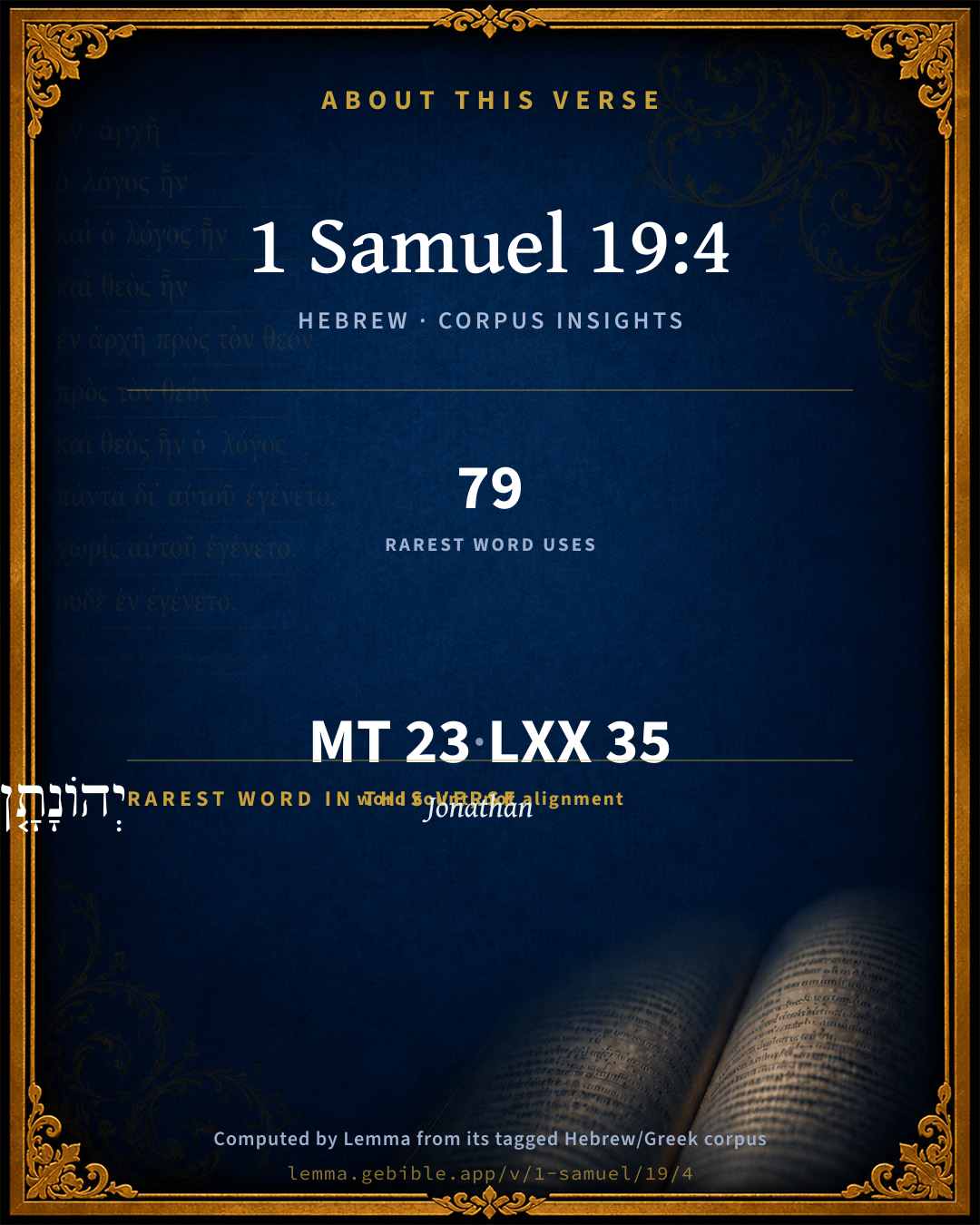
These counts appear in no published source. They are computed here, from the morphology-tagged text and Lemma’s own curated glosses. What Lemma adds →

23
words
16
distinct lemmas
Historical
section

Grammatical profile

  • 4 verbs
  • 8 nouns
  • 2 adjectives
  • 4 prepositions
  • 2 conjunctions
  • 1 adverb
  • 2 particles

Verb forms

  • וַיְדַבֵּ֨ר Piel · Sequential Imperfect
  • וַיֹּ֣אמֶר Qal · Sequential Imperfect
  • יֶחֱטָ֨א Qal · Jussive
  • חָטָא֙ Qal · Perfect

Repetition

Words recur within this verse — often emphatic in Hebrew:

  • בְּדָוִד֙ David H1732 ×2
  • ט֔וֹב good H2896 ×2
  • יֶחֱטָ֨א to sin H2398 ×2
  • אֶל to H413 ×2
  • כִּ֣י that H3588 ×2

Hebrew & Septuagint length

In English translation the verse runs 40 words from the Hebrew and 36 from the Septuagint (LXX English) — closely comparable.

A rough comparison of the two English renderings, which tokenize alike — not a word-level alignment.

Word counts can differ between the Hebrew and the Greek without any difference in meaning — e.g. the Hebrew direct-object marker אֵת has no separate Greek word, and Greek often adds the article ὁ.

In the original languages it is 23 Hebrew tokens and 35 Greek tokens — but the two are counted differently (Hebrew bundles its prefixes and suffixes into one token; the Greek is in lemma form), so that isn’t a like-for-like length.

Cross-references

14

Topical passages linked to 1 Samuel 19:4 in the Treasury of Scripture Knowledge — connected by theme and wording, ordered by reader-vote popularity; previews shown in the World English Bible.

  • Jeremiah 18:20 Shall evil be recompensed for good? for they have dug a pit for my soul. Remember how I stood before you to speak good for them, to turn away your wrath from them.
  • Genesis 42:22 Reuben answered them, saying, "Didn't I tell you, saying, 'Don't sin against the child,' and you wouldn't listen? Therefore also, behold, his blood is required."
  • Proverbs 31:8–9 Open your mouth for the mute, In the cause of all who are left desolate.
  • 1 Samuel 20:32 Jonathan answered Saul his father, and said to him, "Why should he be put to death? What has he done?"
  • Proverbs 17:13 Whoever rewards evil for good, Evil shall not depart from his house.
  • 1 Samuel 22:14 Then Ahimelech answered the king, and said, Who among all your servants is so faithful as David, who is the king's son-in-law, and is taken into your council, and is honorable in your house?
  • Psalms 35:12 They reward me evil for good, To the bereaving of my soul.
  • Psalms 109:4–5 In return for my love, they are my adversaries; But I am in prayer.
  • Genesis 9:6 Whoever sheds man's blood, by man will his blood be shed, for in the image of God made he man.
  • 1 Samuel 2:25 If one man sin against another, God shall judge him; but if a man sin against Yahweh, who shall entreat for him? Notwithstanding, they didn't listen to the voice of their father, because Yahweh was minded to kill them.
  • 2 Chronicles 6:22 If a man sin against his neighbor, and an oath is laid on him to cause him to swear, and he comes and swears before your altar in this house;
  • 1 Corinthians 8:12 Thus, sinning against the brothers, and wounding their conscience when it is weak, you sin against Christ.
  • Proverbs 24:11–12 Rescue those who are being led away to death! Indeed, hold back those who are staggering to the slaughter!
  • 1 John 3:15 Whoever hates his brother is a murderer, and you know that no murderer has eternal life remaining in him.

Cross-references courtesy of OpenBible.info (CC BY 4.0).

Hebrew and Greek witnesses Masoretic Hebrew ↔ Greek Septuagint

The same verse in the two great witnesses to the Old Testament, shown verse-for-verse.

These are two independent witnesses, not word-aligned to each other, and the Septuagint is shown in lemma (dictionary) form.

Hebrew 1 Samuel 19:4 Masoretic · Westminster Leningrad Codex

וַיְדַבֵּ֨ר יְהוֹנָתָ֤ן בְּדָוִד֙ ט֔וֹב אֶל שָׁא֖וּל אָבִ֑יו וַיֹּ֣אמֶר אֵ֠לָיו אַל יֶחֱטָ֨א הַמֶּ֜לֶךְ בְּעַבְדּ֣וֹ בְדָוִ֗ד כִּ֣י ל֤וֹא חָטָא֙ לָ֔ךְ וְכִ֥י מַעֲשָׂ֖יו טוֹב לְךָ֥ מְאֹֽד

Jonathan spoke good of David to Saul his father, and said to him, Don't let the king sin against his servant, against David; because he has not sinned against you, and because his works have been very good toward you:

World English Bible · Public Domain

Greek LXX 1 Samuel 19:4 Septuagint · lemma form

καί λαλέω ιωναθαν περί δαυίδ ἀγαθός πρός σαούλ ὁ πατήρ αὐτός καί εἶπον πρός αὐτός μή ἁμαρτάνω ὁ βασιλεύς εἰς ὁ δοῦλος σύ δαυίδ ὅτι οὐ ἁμαρτάνω εἰς σύ καί ὁ ποίημα αὐτός ἀγαθός σφόδρα

And Jonathan spoke favorably concerning David to Saul his father, and said to him, Let not the king sin against your servant David, for he has not sinned against you, and his deeds are very good.

LXX2012 (modern English Septuagint) · Public Domain

Hebrew: Westminster Leningrad Codex (CC BY 4.0). Greek: Septuagint (public domain); English from LXX2012 (modern English Septuagint) (Public Domain). How the Septuagint differs from the Hebrew →

Targum (Aramaic paraphrase)

1

The Targum is the ancient Jewish Aramaic paraphrase of the Hebrew Scriptures — an interpretive translation, not the Hebrew text itself. Onkelos (literal) and Pseudo-Jonathan (expansive) render the Torah, and Jonathan the Prophets. Coverage is partial: where no permissively-licensed English translation exists for a verse, only the Aramaic is shown. This is verse-level text, not a word-by-word alignment to the Hebrew.

  1. Targum Jonathan Prophets (Joshua–Malachi)
    וּמַלֵיל יְהוֹנָתָן עַל דָוִד פִּתְגָמִין תַּקְנִין קֳדָם שָׁאוּל אֲבוּהִי וַאֲמַר לֵיהּ לָא יֶחֱטֵא מַלְכָּא בְּעַבְדֵיהּ בְּדָוִד אֲרֵי לָא חָטֵי לָךְ וַאֲרֵי עוֹבָדוֹהִי תַּקְנִין לָךְ לַחֲדָא:

    (no public-domain English translation for this verse)

    Targum Jonathan — Aramaic: “Mikraot Gedolot” (public domain). English: “Sefaria Community Translation” (CC0 1.0 (public-domain dedication)); “London "Chaldee Paraphrase," 1871” (public domain). Text via Sefaria.

Commentary

Notes on 1 Samuel 19:4 from classic Christian and Jewish commentators (each source and its license shown beneath its notes). The classic Christian expositions comment on the surrounding passage and are grouped to its opening verse, so a note may address several verses; the Jewish commentaries on the Tanakh (Rashi and others) are per-verse, so they appear only where the commentator wrote on this verse.

Lemma curates 59 commentaries, every one of them public domain or Creative Commons licensed, each selected and text-cleaned for this edition rather than reprinted as found. About our sources →

Trapp's Complete Commentary

John Trapp

1Sa 19:4 And Jonathan spake good of David unto Saul his father, and said unto him, Let not the king sin against his servant, against David; because he hath not sinned against thee, and because his works [have been] to thee-ward very good:

Ver. 4. And Jonathan spake good of David.] Though to the hazard of his own life, as 1Sa 20:32; 1Sa 20:37. The picture of true friendship among the ancients was this, A fair young man, with head uncovered, with bosom open, so that his heart might be seen; whereupon was written, Longe, Prope, Far and Near. In his forehead was written, Aestas, Hyems, Summer and Winter; in the skirt of his garment, Mors et Vita, Death and Life.

And because his works have been to thee-ward very good.] To render evil for evil is brutish: but to render evil for good is devilish. Heathens abhorred ingratitude. Lycurgus would make no law against it, quod prodigiosa res esset beneficium non agnoscere, because he held it a thing monstrous and almost impossible.

John Trapp, A Commentary or Exposition upon All the Books of the Old and New Testament (1647–1656) — public domain. Text from a community e-Sword module.

The Biblical Illustrator

Joseph S. Exell

1Sa_19:4

And Jonathan spake good of David unto Saul his father.

The blessed Peacemaker

I need not tell you how fast weeds grow; your own gardens show you every day: and if you have eyes to look within, your own hearts will show the same sad truth. Sauls evil eye had now grown into continual hatred--he cares not even to conceal from man the murderous desires of his heart; and being disappointed, both in his own skill and craft he now openly speaks to Jonathan and all his servants that they should kill David. Well doth the Holy Ghost testify, Evil men and seducers wax worse and worse. And Jonathan spake good of David unto Saul his father, etc. And Saul hearkened unto the voice of Jonathan, etc. Blessed are the peacemakers! why? They shall be called the children of God. And is this the grand family likeness? how should we covet ill? Ah! surely if there is one feature that shines more brightly than another in our adorable elder brother, it is that of peacemaker. Do angels see their God cradled in a manger? it is as Peacemaker, while flocking multitudes strike up the new anthem which unites forever the choir below with the choir above, Glory to God in the highest, on earth peace, good will towards men. Do they see their maker agonised? a stranger to peace? a man of sorrows? It is that He might make peace forever by the blood of His cross, and proclaim peace to those who were afar off. Does He now appear as a Lamb slain? forever making intercession? For some David He is pleading, for some afflicted one He is interceding. (Helen Plumptre.)

The Biblical Illustrator, edited by Joseph S. Exell (c. 1880s–1900s) — public domain. Text from a community e-Sword module.

Tyndale Open Study Notes

Tyndale Open Resources

19:4 Jonathan addressed his father as the king out of reverence.

Tyndale Open Study Notes — © Tyndale Open Resources, licensed CC BY-SA 4.0. Text via the HelloAO Bible API.

Jamieson, Fausset & Brown

Robert Jamieson, A. R. Fausset & David Brown

Jonathan spake good of David--He told his father he was committing a great sin to plot against the life of a man who had rendered the most invaluable services to his country and whose loyalty had been uniformly steady and devoted. The strong remonstrances of Jonathan produced an effect on the impulsive mind of his father. As he was still susceptible of good and honest impressions, he bound himself by an oath to relinquish his hostile purpose; and thus, through the intervention of the noble-minded prince, a temporary reconciliation was effected, in consequence of which David was again employed in the public service.

Jamieson, Fausset & Brown — Commentary Critical and Explanatory on the Whole Bible (1871) — public domain (CC PDM 1.0). Text via the HelloAO Bible API.

Adam Clarke's Commentary

Verse 4. Jonathan spake good of David] It is evident that Jonathan was satisfied that David was an innocent man; and that his father was most unjustly incensed against him.

Adam Clarke's Commentary on the Bible (1810–1826) — public domain. Text from a community e-Sword/MySword module.

Ellicott's Commentary for English Readers

(4) Jonathan spake good of David.—The heir to the throne—the one above all men likely to be injured by the growing popularity of David—with great power and intense earnestness, represented to his father the king the great virtues, the unrivalled gifts, and, above all, the splendid services of the young soldier whose life Saul was so anxious to cut short. “See,’ urged the eloquent pleader for his friend’s life, “on that ever memorable occasion when he fought the giant, when he aimed the pebble of the brook from his shepherd’s sling, he put his life in his hand. Had he missed a hair’s-breadth, the giant would have slain him, and the deliverance then wrought for Israel would never have been accomplished.”

A Bible Commentary for English Readers, edited by Charles John Ellicott (1878–1897) — public domain. Text from a community e-Sword module.

The Cambridge Bible for Schools and Colleges

gen. ed. J. J. S. Perowne

4. spake good of David] Had Jonathan simply advised David to flee, without endeavouring to bring Saul to a better mind, he would have acted to the prejudice of his father’s interests, by depriving him of the best support of his kingdom.

to thee-ward] “Ward” is used as a termination denoting (a) direction (Exo_37:9), (b) as here, relation.

The Cambridge Bible for Schools and Colleges (gen. ed. J. J. S. Perowne; Cambridge University Press, 1878–1918) — public domain. Text from a community e-Sword module.

John Gill's Exposition

And Jonathan spake good of David unto Saul his father,.... Observed to him what a good man be was, and what good things he had done, what wisdom and prudence he had shown in the management of all his affairs, what valour and courage in all his expeditions, what faithfulness and integrity to his king and country in every instance:

and said unto him, let not the king sin against his servant, against David; by taking away his life; which would have been a great sin indeed, a sin against the law of God, which forbids murder, and which would have been attended with sad aggravations of cruelty and ingratitude:

because he hath not sinned against thee; had not disobeyed any of his orders, but faithfully served him in everything, and much less ever thought to take away his life, or seize his crown, as he might imagine:

and because his works have been to thee-ward very good; by slaying the Philistines, when he and his army were in the utmost terror; by driving away the evil spirit from him, through playing on his harp before him; as well as by commanding his troops, and leading them against the Philistines, and obtaining victory over them.

John Gill's Exposition of the Whole Bible (1746–1763) — public domain (CC PDM 1.0). Text via the HelloAO Bible API.

Matthew Poole's English Annotations

Jonathan spake good of David, which he could not do without hazard to himself. Herein therefore he performed the duty of a true friend, and of a valiant man.

Matthew Poole's English Annotations on the Holy Bible (1683–1685) — public domain. Text from a community e-Sword/MySword module.

The Pulpit Commentary

Vers. 4-7. In the field Jonathan intercedes for David, assures his father of his friend"s innocence, reminds him of his noble exploit, and of Saul"s own joy at it, and beseeches him not to shed innocent blood. And Saul, fickle and selfish, yet not destitute of noble feelings, repents of his purpose, and with characteristic impetuosity takes an oath that David"s life shall be spared. Whereupon a reconciliation takes place, and David resumes his attendance upon the king"s person.

The Pulpit Commentary (1880–1919), ed. H.D.M. Spence-Jones & Joseph S. Exell — public domain. Text from a community e-Sword module.

John Wesley's Explanatory Notes

Spake good - Which he could not do without hazard to himself. Herein therefore he performed the duty of a true friend, and of a valiant man.

John Wesley, Explanatory Notes Upon the Whole Bible (1754–1765) — public domain. Text via the GEBible commentary corpus.

Keil & Delitzsch

C. F. Keil & F. Delitzsch

Jonathan then endeavoured with all the modesty of a son to point out most earnestly to his father the grievous wickedness involved in his conduct towards David. "Let not the king sin against his servant, against David; for he hath not sinned against thee, and his works are very good (i.e., very useful) to thee. He hath risked his life (see at Jdg 12:3), and smitten the Philistines, and Jehovah hath wrought a great salvation of all Israel. Thou hast seen it, and rejoiced; and wherefore wilt thou sin against innocent blood, to slay David without a cause?"

Keil & Delitzsch — Biblical Commentary on the Old Testament (1861–1891) — public domain (CC PDM 1.0). Text via the HelloAO Bible API. (Old Testament only.)

unfoldingWord translationNotes

Door43 World Missions Community

Do not let the king sin against his servant

Jonathan speaks as if Saul is another person to show Saul that Jonathan respects Saul. AT: "Do not sin against your servant" (See: Pronouns)

he took his life in his hand

Here "life in his hand" is an idiom that refers to risking his life. AT: "he risked his life" (See: Idiom)

Why would you sin against innocent blood by killing David for no reason?

Jonathan asks this question to rebuke Saul. This rhetorical question can be translated as a statement. AT: "You should not sin against innocent blood and kill David without cause." (See: Rhetorical Question)

sin against innocent blood

Here "blood" is a metonym for the life of an innocent person. AT: "commit the sin of murder" (See: Metonymy)

translationWords

king

sin

works

good

life

hand

Philistines

Yahweh

Israel

joy

innocent

blood

unfoldingWord translationNotes — © Distant Shores Media and the Door43 World Missions Community, licensed CC BY-SA 4.0. Source: git.door43.org/Door43/en_tn.

Lesson kit

Teaching starters — assembled from the data on this page, not authored interpretation. Every prompt links to the verse data it draws on. Edit before teaching.

1 Samuel, in the Historical, opens this verse with 23 words (16 distinct Hebrew lemmas). Its most distinctive word is Yᵉhôwnâthân (“Jonathan”). A historical commentator’s framing appears above. Read the whole chapter for the surrounding context.

Discussion questions

  1. What does “Jonathan” (Yᵉhôwnâthân) contribute to the verse as a whole?
  2. Jeremiah 18:20 shares this passage’s theme. How do the two illuminate each other?
  3. “David” occurs 2× in this one verse. What is the effect of the repetition?
  4. The translations on this page render this verse differently — a whole-verse word diff, not a word-by-word alignment. What might account for the different wordings?
  5. The verb «וַיְדַבֵּ֨ר» is Piel Sequential Imperfect. How does its form color the action?
  6. Reading how Trapp's Complete Commentary and The Biblical Illustrator read this verse, where do the two commentators agree and where do they part?

Things to notice

Reading settings

Reading text

Shown beneath each verse's original-language words.

Old Testament
Old Testament edition

Read the OT as the Masoretic Hebrew (MT) or the Greek Septuagint (LXX).

English shown for the Greek Septuagint (in the Hebrew ↔ Greek comparison).

Comparing translations? Open the Compare panel on any verse page to stack up to four side by side.