
1 Kings 2:20

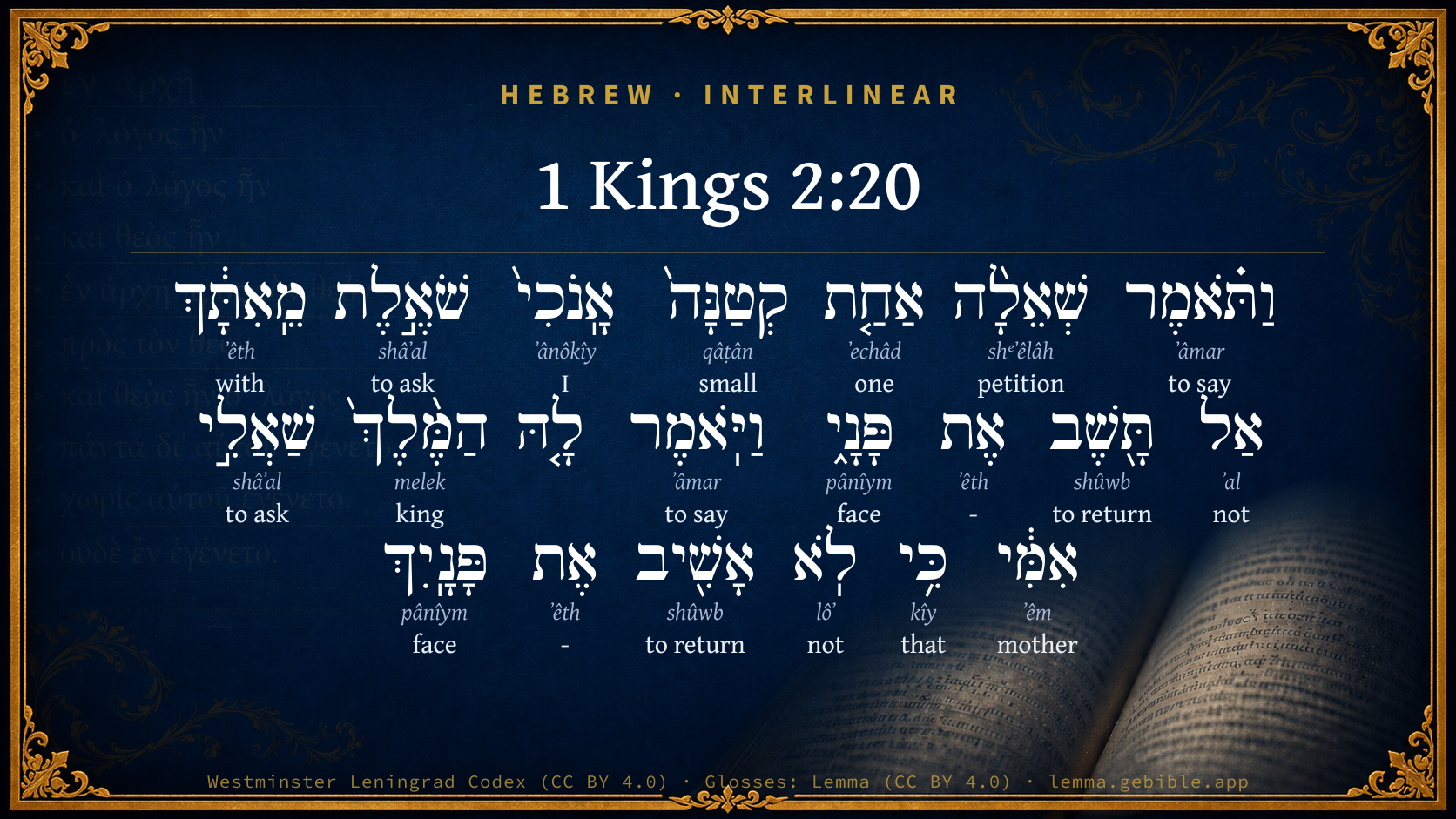
Hebrew (Westminster Leningrad Codex) 1 Kings 2:20 appears in the Hebrew Old Testament. The text above is from the Westminster Leningrad Codex. Each word links to its Strong’s number, a concise gloss, and parsing drawn from the Open Scriptures Hebrew Bible morphology. Click any word for its full Brown-Driver-Briggs (BDB) entry.
Download image
Cite this verse

1 Kings 2:20 (World English Bible). Public Domain. Lemma interlinear Bible study tool, https://lemma.gebible.app/v/1-kings/2/20.

Show BibTeX & RIS
BibTeX
RIS
English Translation
Then she said, I ask one small petition of you; don't deny me. The king said to her, Ask on, my mother; for I will not deny you.
World English Bible · Public Domain
Download a study sheet

One document with this verse’s original text, its word-by-word gloss line, the meaning frame, cross-references with their text, attributed commentary, and full source and license credits — printable, and it pastes into notes with its structure intact.

This verse Autodidact and up

Study sheet (.html) Plain text (.txt)

A passage Seminary Student

Up to 50 verses in one chapter. A passage sheet keeps up to 6 commentary sources and 12 cross-references per verse, in the order this page ranks them, and says so on the sheet whenever that leaves anything out. Ask for a single verse and you get the Autodidact verse sheet above.

Everything on this page stays free to read, with no account — the sheet is a download of what is already on screen, not access to it.

Want to remove ads? Support Godless Engineer
Compare translations 3

The same verse in 3 English versions, stacked beneath the original-language interlinear above. Click any original word for its lexicon entry.

Each is an independent rendering of the whole verse — the interlinear is not word-aligned to these translations.

Highlighted words mark where these versions differ — a whole-verse word diff, not a word-by-word alignment.

  • World English Bible Public Domain
    Then she said, I ask one small petition of you; don't deny me. The king said to her, Ask on, my mother; for I will not deny you.
  • King James Version Public Domain
    Then she said, I desire one small petition of thee; I pray thee, say me not nay. And the king said unto her, Ask on, my mother: for I will not say thee nay.
  • unfoldingWord Literal Text CC BY-SA 4.0
    And she said, “One small request I am requesting from you. Do not turn away my face.” And the king said to her, “Request, my mother, for I will not turn away your face.”

unfoldingWord Literal Text — © unfoldingWord, licensed CC BY-SA 4.0. Word-aligned USFM3 via Door43 (git.door43.org/unfoldingWord/en_ult).

Versions to compare (up to 4)

3 of 4 selected

Show all 18 translations

Every available English version of this verse, each an independent rendering of the whole verse.

  • World English Bible Public Domain
    Then she said, I ask one small petition of you; don't deny me. The king said to her, Ask on, my mother; for I will not deny you.
  • Berean Standard Bible Public Domain
    “I have just one small request of you,” she said. “Do not deny me.” “Make your request, my mother,” the king replied, “for I will not deny you.”
  • Majority Standard Bible Public Domain
    “I have just one small request of you,” she said. “Do not deny me.” “Make your request, my mother,” the king replied, “for I will not deny you.”
  • King James Version Public Domain
    Then she said, I desire one small petition of thee; I pray thee, say me not nay. And the king said unto her, Ask on, my mother: for I will not say thee nay.
  • American Standard Version (1901) Public Domain
    Then she said, I ask one small petition of thee; deny me not. And the king said unto her, Ask on, my mother; for I will not deny thee.
  • Revised Version (1885) Public Domain
    Then she said, I ask one small petition of thee; deny me not. And the king said unto her, Ask on, my mother: for I will not deny thee.
  • Geneva Bible (1599) Public Domain
    Then she sayd, I desire a small request of thee, say me not nay. Then the King sayde vnto her, Aske on, my mother: for I will not say thee nay.
  • Douay-Rheims (1899) Public Domain
    And she said to him: I desire one small petition of thee, do not put me to confusion. And the king said to her: My mother, ask: for I must not turn away thy face.
  • Young's Literal Translation Public Domain
    And she saith, `One small petition I ask of thee, turn not back my face;' and the king saith to her, `Ask, my mother, for I do not turn back thy face.'
  • Literal Standard Version CC BY-SA 4.0
    And she says, “I ask one small petition of you, do not turn back my face”; and the king says to her, “Ask, my mother, for I do not turn back your face.”
  • Unlocked Literal Bible CC BY-SA 4.0
    Then she said, “I wish to ask one small request of you, for you will not turn away from my face.” The king answered her, “Ask, my mother, for I will not turn away from your face.”
  • unfoldingWord Literal Text CC BY-SA 4.0
    And she said, “One small request I am requesting from you. Do not turn away my face.” And the king said to her, “Request, my mother, for I will not turn away your face.”
  • Darby Bible Public Domain
    Then she said, I desire one small petition of thee; refuse me not. And the king said to her, Ask, my mother, for I will not refuse thee.
  • World Messianic Bible Public Domain
    Then she said, “I ask one small petition of you; don’t deny me.” The king said to her, “Ask on, my mother, for I will not deny you.”
  • Webster's Bible Public Domain
    Then she said, I desire one small petition of thee; I pray thee, deny me not. And the king said to her, Ask on, my mother: for I will not deny thee.
  • Free Bible Version CC BY-SA 4.0
    “I have just one small request to ask of you,” she said. “Please don't say no.” The king replied, “Ask away, dear mother. I won't say no to you.”
  • Bible in Basic English Public Domain
    Then she said, I have one small request to make to you; do not say, No, to me. And the king said, Say on, my mother, for I will not say, No, to you.
  • JPS Tanakh (1917) Public Domain
    Then she said: 'I ask one small petition of thee; deny me not.' And the king said unto her: 'Ask on, my mother; for I will not deny thee.'

Literal Standard Version (2020), Covenant Press — licensed CC BY-SA 4.0. Text via the HelloAO Bible API (eBible.org). Unlocked Literal Bible (unfoldingWord) — licensed CC BY-SA 4.0. Text via the HelloAO Bible API (eBible.org). unfoldingWord Literal Text — © unfoldingWord, licensed CC BY-SA 4.0. Word-aligned USFM3 via Door43 (git.door43.org/unfoldingWord/en_ult). Free Bible Version, Dr. Jonathan Gallagher — licensed CC BY-SA 4.0. Text via the HelloAO Bible API (eBible.org).

Word by word

More ways to search: Search by grammar → Find every occurrence → Compare this word →

Practice this passage: Drill this verse → Learn its vocabulary →

שְׁאֵלָ֨ה
shᵉʼêlâh
H7596
“petition”
Noun, Common, Feminine, Singular, Absolute
Part of Speech
Noun
Type
Common
Gender
Feminine
Number
Singular
State
Absolute
Full BDB Definition

Origin: from H7592

TWOT: 2303a

request, thing asked for, demand - request, petition - thing asked for
  1. וַתֹּ֗אמֶר ʼâmar H559 “and · to say” Conjunction + Verb, Qal, Sequential Imperfect, 3rd Person, Feminine, Singular
  2. אַחַ֤ת ʼechâd H259 “one” Adjective, Cardinal number, Feminine, Singular, Absolute
  3. קְטַנָּה֙ qâṭân H6996 “small” Adjective, Adjective, Feminine, Singular, Absolute
  4. אָֽנֹכִי֙ ʼânôkîy H595 “I” Pronoun, Personal, 1st Person, Common, Singular
  5. שֹׁאֶ֣לֶת shâʼal H7592 “asking” Verb, Qal, Participle Active, Feminine, Singular, Absolute
  6. מֵֽאִתָּ֔ךְ ʼêth H854 “from · with · you” Preposition + Preposition + Suffix, Personal, 2nd Person, Feminine, Singular
  7. אַל ʼal H408 “not” Particle, Negative
  8. תָּ֖שֶׁב shûwb H7725 “to return” Verb, Hiphil, Jussive, 2nd Person, Masculine, Singular
  9. אֶת ʼêth H853 “-” Particle, Direct Object
  10. פָּנָ֑י pânîym H6440 “face(s) · my” Noun, Common, Both, Plural, Construct + Suffix, Personal, 1st Person, Common, Singular
  11. וַיֹּֽאמֶר ʼâmar H559 “and · to say” Conjunction + Verb, Qal, Sequential Imperfect, 3rd Person, Masculine, Singular
  12. הַמֶּ֨לֶךְ֙ melek H4428 “the · king” Particle, Definite Article + Noun, Common, Masculine, Singular, Absolute
  13. שַׁאֲלִ֣י shâʼal H7592 “ask” Verb, Qal, Imperative, 2nd Person, Feminine, Singular
  14. אִמִּ֔י ʼêm H517 “mother · my” Noun, Common, Feminine, Singular, Construct + Suffix, Personal, 1st Person, Common, Singular
  15. כִּ֥י kîy H3588 “that” Conjunction
  16. לֹֽא lôʼ H3808 “not” Particle, Negative
  17. אָשִׁ֖יב shûwb H7725 “to return” Verb, Hiphil, Imperfect, 1st Person, Common, Singular
  18. אֶת ʼêth H853 “-” Particle, Direct Object
  19. פָּנָֽיִךְ pânîym H6440 “face(s) · your” Noun, Common, Both, Plural, Construct + Suffix, Personal, 2nd Person, Feminine, Singular

About this verse

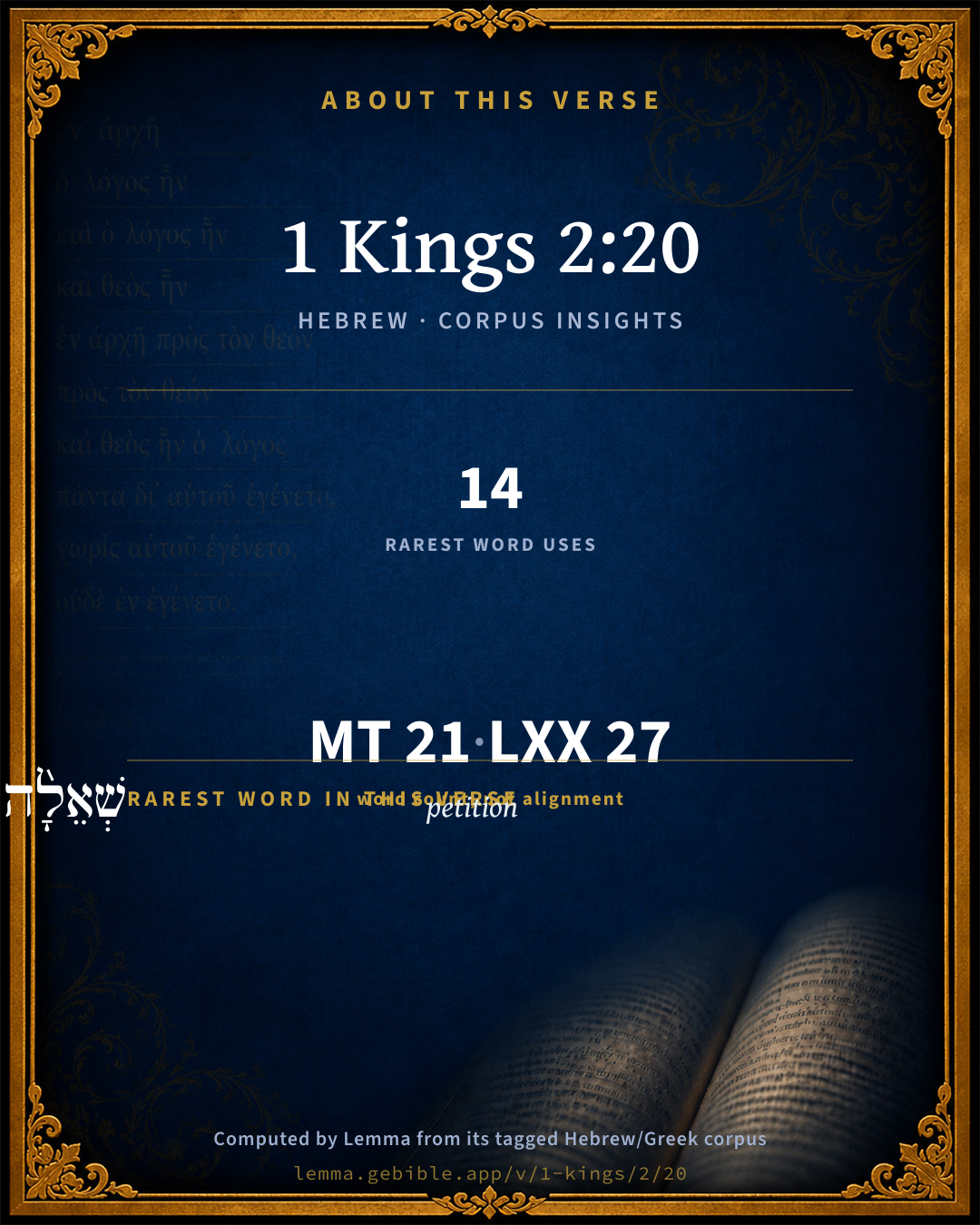
These counts appear in no published source. They are computed here, from the morphology-tagged text and Lemma’s own curated glosses. What Lemma adds →

21
words
15
distinct lemmas
Historical
section

Notable vocabulary

The rarest word here is שְׁאֵלָ֨ה petition H7596 — appearing just 14 times in the whole Hebrew Bible.

Shared distinctive vocabulary

שְׁאֵלָ֨ה petition H7596 occurs in 14 verses of the Hebrew Bible. Also found in:

Grammatical profile

  • 6 verbs
  • 5 nouns
  • 2 adjectives
  • 1 pronoun
  • 2 prepositions
  • 1 conjunction
  • 4 particles

Verb forms

  • וַתֹּ֗אמֶר Qal · Sequential Imperfect
  • שֹׁאֶ֣לֶת Qal · Participle Active
  • תָּ֖שֶׁב Hiphil · Jussive
  • וַיֹּֽאמֶר Qal · Sequential Imperfect
  • שַׁאֲלִ֣י Qal · Imperative
  • אָשִׁ֖יב Hiphil · Imperfect

Repetition

Words recur within this verse — often emphatic in Hebrew:

  • וַתֹּ֗אמֶר to say H559 ×2
  • שֹׁאֶ֣לֶת to ask H7592 ×2
  • תָּ֖שֶׁב to return H7725 ×2
  • פָּנָ֑י face H6440 ×2

Hebrew & Septuagint length

In English translation the verse runs 28 words from the Hebrew and 34 from the Septuagint (LXX English) — closely comparable.

A rough comparison of the two English renderings, which tokenize alike — not a word-level alignment.

Word counts can differ between the Hebrew and the Greek without any difference in meaning — e.g. the Hebrew direct-object marker אֵת has no separate Greek word, and Greek often adds the article ὁ.

In the original languages it is 21 Hebrew tokens and 27 Greek tokens — but the two are counted differently (Hebrew bundles its prefixes and suffixes into one token; the Greek is in lemma form), so that isn’t a like-for-like length.

Cross-references

9

Topical passages linked to 1 Kings 2:20 in the Treasury of Scripture Knowledge — connected by theme and wording, ordered by reader-vote popularity; previews shown in the World English Bible.

  • Matthew 7:7–11 "Ask, and it will be given you. Seek, and you will find. Knock, and it will be opened for you.
  • Matthew 10:35–36 For I came to set a man at odds against his father, and a daughter against her mother, and a daughter-in-law against her mother-in-law.
  • Matthew 11:24 But I tell you that it will be more tolerable for the land of Sodom, on the day of judgment, than for you."
  • Matthew 18:19 Again, assuredly I tell you, that if two of you will agree on earth concerning anything that they will ask, it will be done for them by my Father who is in heaven.
  • Matthew 20:20–21 Then the mother of the sons of Zebedee came to him with her sons, kneeling and asking a certain thing of him.
  • Luke 11:9–10 "I tell you, keep asking, and it will be given you. Keep seeking, and you will find. Keep knocking, and it will be opened to you.
  • John 2:3–4 When the wine ran out, Jesus' mother said to him, "They have no wine."
  • John 14:13–14 Whatever you will ask in my name, that will I do, that the Father may be glorified in the Son.
  • John 15:16 You didn't choose me, but I chose you, and appointed you, that you should go and bear fruit, and that your fruit should remain; that whatever you will ask of the Father in my name, he may give it to you.

Cross-references courtesy of OpenBible.info (CC BY 4.0).

Hebrew and Greek witnesses Masoretic Hebrew ↔ Greek Septuagint

The same verse in the two great witnesses to the Old Testament, shown verse-for-verse.

These are two independent witnesses, not word-aligned to each other, and the Septuagint is shown in lemma (dictionary) form.

Hebrew 1 Kings 2:20 Masoretic · Westminster Leningrad Codex

וַתֹּ֗אמֶר שְׁאֵלָ֨ה אַחַ֤ת קְטַנָּה֙ אָֽנֹכִי֙ שֹׁאֶ֣לֶת מֵֽאִתָּ֔ךְ אַל תָּ֖שֶׁב אֶת פָּנָ֑י וַיֹּֽאמֶר לָ֤הּ הַמֶּ֨לֶךְ֙ שַׁאֲלִ֣י אִמִּ֔י כִּ֥י לֹֽא אָשִׁ֖יב אֶת פָּנָֽיִךְ

Then she said, I ask one small petition of you; don't deny me. The king said to her, Ask on, my mother; for I will not deny you.

World English Bible · Public Domain

Greek LXX 1 Kings 2:20 Septuagint · lemma form

καί εἶπον αὐτός αἴτησις εἷς μικρός ἐγώ αἰτέω παρά σύ μή ἀποστρέφω ὁ πρόσωπον σύ καί εἶπον αὐτός ὁ βασιλεύς αἰτέω μήτηρ ἐμός ὅτι οὐ ἀποστρέφω σύ

And she said to him, I ask of you one little request; turn not away my face from you. And the king said to her, Ask, my mother, and I will not reject you.

LXX2012 (modern English Septuagint) · Public Domain

Hebrew: Westminster Leningrad Codex (CC BY 4.0). Greek: Septuagint (public domain); English from LXX2012 (modern English Septuagint) (Public Domain). How the Septuagint differs from the Hebrew →

Targum (Aramaic paraphrase)

1

The Targum is the ancient Jewish Aramaic paraphrase of the Hebrew Scriptures — an interpretive translation, not the Hebrew text itself. Onkelos (literal) and Pseudo-Jonathan (expansive) render the Torah, and Jonathan the Prophets. Coverage is partial: where no permissively-licensed English translation exists for a verse, only the Aramaic is shown. This is verse-level text, not a word-by-word alignment to the Hebrew.

  1. Targum Jonathan Prophets (Joshua–Malachi)
    וַאֲמַרַת שְׁאָלָא חֲדָא זְעֵירָא אֲנָא שַׁאֲלָא מִנָךְ לָא תְתִיב יַת אַפַּי וַאֲמַר לָהּ מַלְכָּא שְׁאִילִי אִמִי אֲרֵי לָא אֲתִיב יַת אַפָּיִךְ:

    (no public-domain English translation for this verse)

    Targum Jonathan — Aramaic: “Mikraot Gedolot” (public domain). English: “Sefaria Community Translation” (CC0 1.0 (public-domain dedication)); “London "Chaldee Paraphrase," 1871” (public domain). Text via Sefaria.

Commentary

Notes on 1 Kings 2:20 from classic Christian and Jewish commentators (each source and its license shown beneath its notes). The classic Christian expositions comment on the surrounding passage and are grouped to its opening verse, so a note may address several verses; the Jewish commentaries on the Tanakh (Rashi and others) are per-verse, so they appear only where the commentator wrote on this verse.

Lemma curates 59 commentaries, every one of them public domain or Creative Commons licensed, each selected and text-cleaned for this edition rather than reprinted as found. About our sources →

Trapp's Complete Commentary

John Trapp

1Ki 2:20 Then she said, I desire one small petition of thee; [I pray thee], say me not nay. And the king said unto her, Ask on, my mother: for I will not say thee nay.

Ver. 20. I desire one small petition of thee.] Small she called it, but Solomon, who saw further into the matter, judged otherwise of it. {1Ki 2:22} There are depths of the devil which every one cannot dive into.

“ Ut fugias quae sunt noxia, tuta time. ”

John Trapp, A Commentary or Exposition upon All the Books of the Old and New Testament (1647–1656) — public domain. Text from a community e-Sword module.

Joseph Benson's Commentary

1Ki 2:20-21. I desire one small petition of thee — So she esteemed it, because she did not perceive Adonijah’s design in it, nor the circumstances connected with it. I will not say thee nay — Supposing thy request can be lawfully and safely granted, and will be productive of no injury to myself or others. Let Abishag be given to Adonijah thy brother — That is, thy brother by the father’s side, and whom brotherly affection and relation oblige thee to gratify; at least, in small things.

Joseph Benson's Commentary on the Old and New Testaments (1811–1818) — public domain. Text from a community e-Sword module.

The Cambridge Bible for Schools and Colleges

gen. ed. J. J. S. Perowne

20. I desire one small petition of thee] These words seem to confirm what has been said above, that Bath-sheba had not realized the grave import of her request.

I will not say thee nay] i.e. If it be possible for me to grant it. The condition, though unexpressed, is of necessity understood.

The Cambridge Bible for Schools and Colleges (gen. ed. J. J. S. Perowne; Cambridge University Press, 1878–1918) — public domain. Text from a community e-Sword module.

John Gill's Exposition

Then she said, I desire one small petition of thee,.... It was but one, and a little one, and therefore she hoped it would be granted:

I pray thee, say me not nay; do not refuse it, or deny it me, or turn away my thee with shame and disappointment:

and the king said, ask on, my mother, for I will not say thee nay; since it is a small one, as thou sayest, and provided it is fit and lawful to be granted.

John Gill's Exposition of the Whole Bible (1746–1763) — public domain (CC PDM 1.0). Text via the HelloAO Bible API.

Haydock's Catholic Bible Commentary

Thy face, with confusion. He engages to grant her request, if it could be done with any propriety, (Calmet) as a son ought to do. (Worthington)

George Leo Haydock (1774–1849), Haydock's Catholic Family Bible and Commentary, 1859 edition — public domain. Excludes Psalms (Douay-Rheims chapter numbering differs from Protestant) and Deuterocanonical books (Catholic canon only).

Matthew Poole's English Annotations

One small petition; so she esteemed it, because she did not perceive his design in it; and as for that law, Lev 18:7, she might apprehend, that because David knew her not, it was only a contract for marriage, and therefore no impediment of her marriage to any other after his death; which also is the opinion of some of the late learned Hebrew doctors.

I will not say thee nay; supposing thy request be but small, as thou sayest it is, and not unlawful, nor injurious to myself or others.

Matthew Poole's English Annotations on the Holy Bible (1683–1685) — public domain. Text from a community e-Sword/MySword module.

Whedon's Commentary on the Bible

Daniel D. Whedon

20. One small petition — These words show that Bathsheba did not clearly comprehend the treasonable import of Adonijah’s request.

Daniel D. Whedon (gen. ed.), Commentary on the Old and New Testaments (1874–1909) — public domain. Text from a community e-Sword module.

The Pulpit Commentary

Then she said, I desire one small petition of thee. So it seemed, no doubt, to her, in her inexperience and ignorance of Adonijah"s real motives. She thought she held the threads of a love story in her hands, and that it would be a small thing for Solomon to make these handsome lovers happy: I pray thee, say me not nay. And the king said unto her, Ask on, my mother: for I will not say thee nay. The readiness of the king to grant whatever she asked proves that the reasons which induced him to deny her request must have been weighty; i.e., Adonijah"s suit cannot have been devoid of political consequences.

The Pulpit Commentary (1880–1919), ed. H.D.M. Spence-Jones & Joseph S. Exell — public domain. Text from a community e-Sword module.

Lesson kit

Teaching starters — assembled from the data on this page, not authored interpretation. Every prompt links to the verse data it draws on. Edit before teaching.

1 Kings, in the Historical, opens this verse with 21 words (15 distinct Hebrew lemmas). Its most distinctive word is shᵉʼêlâh (“petition”). A historical commentator’s framing appears above. Read the whole chapter for the surrounding context.

Discussion questions

  1. How does “petition” (shᵉʼêlâh) shape what this verse is saying?
  2. How does Judges 8:24, which shares the word «petition», read alongside this verse?
  3. What does the repetition of “to say” (2× in this one verse) do in this verse?
  4. The translations on this page render this verse differently — a whole-verse word diff, not a word-by-word alignment. What might account for the different wordings?
  5. «וַתֹּ֗אמֶר» is a Qal Sequential Imperfect verb. How does that grammatical form shape the action described?
  6. Compare how Trapp's Complete Commentary and Joseph Benson's Commentary read this verse. Where do they agree or differ?

Things to notice

Reading settings

Reading text

Shown beneath each verse's original-language words.

Old Testament
Old Testament edition

Read the OT as the Masoretic Hebrew (MT) or the Greek Septuagint (LXX).

English shown for the Greek Septuagint (in the Hebrew ↔ Greek comparison).

Comparing translations? Open the Compare panel on any verse page to stack up to four side by side.