
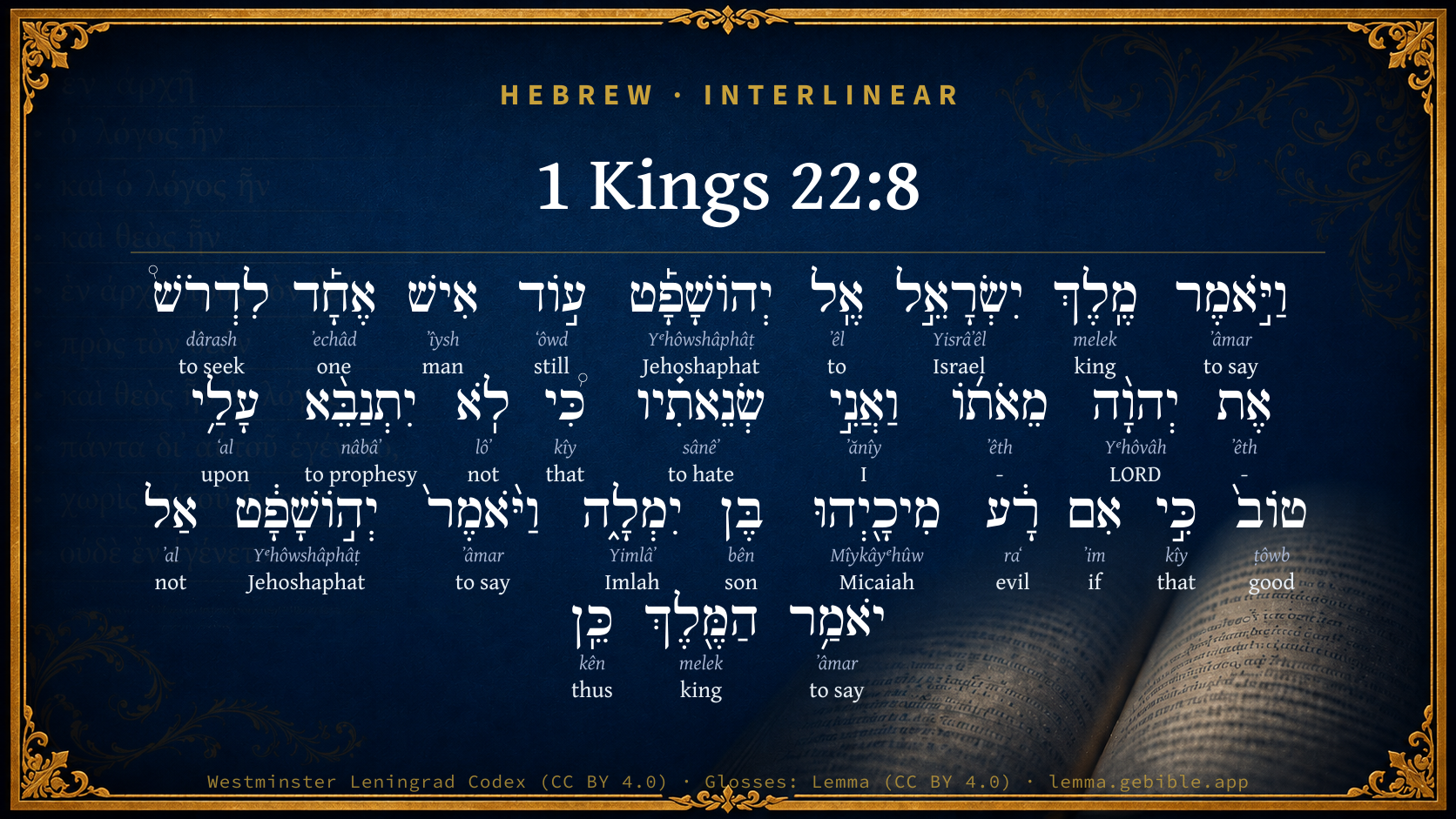
1 Kings 22:8

Hebrew (Westminster Leningrad Codex) 1 Kings 22:8 appears in the Hebrew Old Testament. The text above is from the Westminster Leningrad Codex. Each word links to its Strong’s number, a concise gloss, and parsing drawn from the Open Scriptures Hebrew Bible morphology. Click any word for its full Brown-Driver-Briggs (BDB) entry.
Download image
Cite this verse

1 Kings 22:8 (World English Bible). Public Domain. Lemma interlinear Bible study tool, https://lemma.gebible.app/v/1-kings/22/8.

Show BibTeX & RIS
BibTeX
RIS
English Translation
The king of Israel said to Jehoshaphat, there is yet one man by whom we may inquire of Yahweh, Micaiah the son of Imlah: but I hate him; for he does not prophesy good concerning me, but evil. Jehoshaphat said, "Don't let the king say so."
World English Bible · Public Domain
Highlights
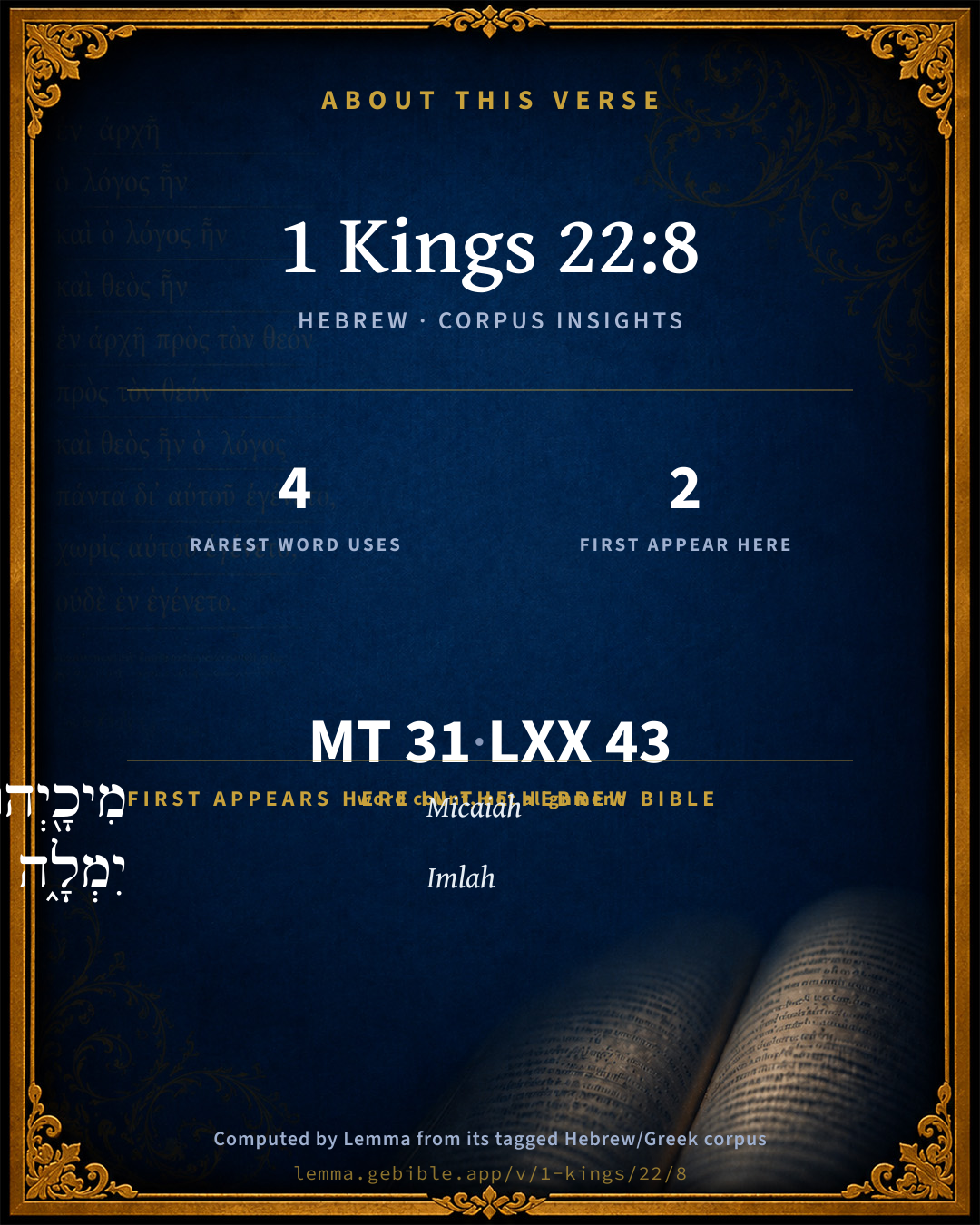
  • 2 first appearances in the Hebrew Bible
Full analysis ↓
Download a study sheet

One document with this verse’s original text, its word-by-word gloss line, the meaning frame, cross-references with their text, attributed commentary, and full source and license credits — printable, and it pastes into notes with its structure intact.

This verse Autodidact and up

Study sheet (.html) Plain text (.txt)

A passage Seminary Student

Up to 50 verses in one chapter. A passage sheet keeps up to 6 commentary sources and 12 cross-references per verse, in the order this page ranks them, and says so on the sheet whenever that leaves anything out. Ask for a single verse and you get the Autodidact verse sheet above.

Everything on this page stays free to read, with no account — the sheet is a download of what is already on screen, not access to it.

Want to remove ads? Support Godless Engineer
Compare translations 3

The same verse in 3 English versions, stacked beneath the original-language interlinear above. Click any original word for its lexicon entry.

Each is an independent rendering of the whole verse — the interlinear is not word-aligned to these translations.

Highlighted words mark where these versions differ — a whole-verse word diff, not a word-by-word alignment.

  • World English Bible Public Domain
    The king of Israel said to Jehoshaphat, there is yet one man by whom we may inquire of Yahweh, Micaiah the son of Imlah: but I hate him; for he does not prophesy good concerning me, but evil. Jehoshaphat said, "Don't let the king say so."
  • King James Version Public Domain
    And the king of Israel said unto Jehoshaphat, There is yet one man, Micaiah the son of Imlah, by whom we may enquire of the LORD: but I hate him; for he doth not prophesy good concerning me, but evil. And Jehoshaphat said, Let not the king say so.
  • unfoldingWord Literal Text CC BY-SA 4.0
    And the king of Israel said to Jehoshaphat, “ still one man for seeking Yahweh from him, but I, I hate him because he does not prophesy good about me, but rather evil, Micaiah, the son of Imlah.” And Jehoshaphat said, “May the king not say thus.”

unfoldingWord Literal Text — © unfoldingWord, licensed CC BY-SA 4.0. Word-aligned USFM3 via Door43 (git.door43.org/unfoldingWord/en_ult).

Versions to compare (up to 4)

3 of 4 selected

Show all 18 translations

Every available English version of this verse, each an independent rendering of the whole verse.

  • World English Bible Public Domain
    The king of Israel said to Jehoshaphat, there is yet one man by whom we may inquire of Yahweh, Micaiah the son of Imlah: but I hate him; for he does not prophesy good concerning me, but evil. Jehoshaphat said, "Don't let the king say so."
  • Berean Standard Bible Public Domain
    The king of Israel answered, “There is still one man who can ask the LORD, but I hate him because he never prophesies anything good for me, but only bad. He is Micaiah son of Imlah.” “The king should not say that!” Jehoshaphat replied.
  • Majority Standard Bible Public Domain
    The king of Israel answered, “There is still one man through whom we can inquire of the LORD, but I hate him because he never prophesies anything good for me, but only bad. He is Micaiah son of Imlah.” “The king should not say that!” Jehoshaphat replied.
  • King James Version Public Domain
    And the king of Israel said unto Jehoshaphat, There is yet one man, Micaiah the son of Imlah, by whom we may enquire of the LORD: but I hate him; for he doth not prophesy good concerning me, but evil. And Jehoshaphat said, Let not the king say so.
  • American Standard Version (1901) Public Domain
    And the king of Israel said unto Jehoshaphat, there is yet one man by whom we may inquire of Jehovah, Micaiah the son of Imlah: but I hate him; for he doth not prophesy good concerning me, but evil. And Jehoshaphat said, Let not the king say so.
  • Revised Version (1885) Public Domain
    And the king of Israel said unto Jehoshaphat, There is yet one man by whom we may inquire of the LORD, Micaiah the son of Imlah: but I hate him; for he doth not prophesy good concerning me, but evil. And Jehoshaphat said, Let not the king say so.
  • Geneva Bible (1599) Public Domain
    And the King of Israel said vnto Iehoshaphat, There is yet one man (Michaiah the sonne of Imlah) by whom we may aske counsel of the Lord, but I hate him: for he doeth not prophecie good vnto me, but euill. And Iehoshaphat sayd, Let not the King say so.
  • Douay-Rheims (1899) Public Domain
    And the king of Israel said to Josaphat: There is one man left, by whom we may inquire of the Lord: Micheas the son of Jemla; but I hate him, for he doth not prophesy good to me, but evil. And Josaphat said: Speak not so, O king.
  • Young's Literal Translation Public Domain
    And the king of Israel saith unto Jehoshaphat, `Yet -- one man to seek Jehovah by him, and I have hated him, for he doth not prophesy concerning me good, but evil -- Micaiah son of Imlah;' and Jehoshaphat saith, `Let not the king say so.'
  • Literal Standard Version CC BY-SA 4.0
    And the king of Israel says to Jehoshaphat, “Yet one man [remains] to seek YHWH from him, and I have hated him, for he does not prophesy good concerning me, but evil—Micaiah son of Imlah”; and Jehoshaphat says, “Do not let the king say so.”
  • Unlocked Literal Bible CC BY-SA 4.0
    The king of Israel said to Jehoshaphat, “There is still one man by whom we may seek advice from Yahweh to help, Micaiah son of Imlah, but I hate him because he does not prophesy anything good about me, but only hardships.” But Jehoshaphat said, “May the king not say that.”
  • unfoldingWord Literal Text CC BY-SA 4.0
    And the king of Israel said to Jehoshaphat, “ still one man for seeking Yahweh from him, but I, I hate him because he does not prophesy good about me, but rather evil, Micaiah, the son of Imlah.” And Jehoshaphat said, “May the king not say thus.”
  • Darby Bible Public Domain
    And the king of Israel said to Jehoshaphat, There is yet one man by whom we may inquire of Jehovah; but I hate him, for he prophesies no good concerning me, but evil: [it is] Micah the son of Imlah. And Jehoshaphat said, Let not the king say so.
  • World Messianic Bible Public Domain
    The king of Israel said to Jehoshaphat, “There is yet one man by whom we may inquire of the LORD, Micaiah the son of Imlah; but I hate him, for he does not prophesy good concerning me, but evil.” Jehoshaphat said, “Don’t let the king say so.”
  • Webster's Bible Public Domain
    And the king of Israel said to Jehoshaphat, There is yet one man, Micaiah the son of Imlah, by whom we may inquire of the LORD: but I hate him; for he doth not prophesy good concerning me, but evil. And Jehoshaphat said, Let not the king say so.
  • Free Bible Version CC BY-SA 4.0
    “Yes, there's another man who could consult the Lord,” the king of Israel replied, “but I don't like him because he never prophesies anything good for me—it's always bad! His name is Micaiah, son of Imlah.” “You shouldn't talk like that,” said Jehoshaphat.
  • Bible in Basic English Public Domain
    And the king of Israel said to Jehoshaphat, There is still one man by whom we may get directions from the Lord, Micaiah, son of Imlah; but I have no love for him, for he is a prophet of evil to me and not of good. And Jehoshaphat said, Let not the king say so.
  • JPS Tanakh (1917) Public Domain
    And the king of Israel said unto Jehoshaphat: 'There is yet one man by whom we may inquire of the LORD, Micaiah the son of Imlah; but I hate him; for he doth not prophesy good concerning me, but evil.' And Jehoshaphat said: 'Let not the king say so.'

Literal Standard Version (2020), Covenant Press — licensed CC BY-SA 4.0. Text via the HelloAO Bible API (eBible.org). Unlocked Literal Bible (unfoldingWord) — licensed CC BY-SA 4.0. Text via the HelloAO Bible API (eBible.org). unfoldingWord Literal Text — © unfoldingWord, licensed CC BY-SA 4.0. Word-aligned USFM3 via Door43 (git.door43.org/unfoldingWord/en_ult). Free Bible Version, Dr. Jonathan Gallagher — licensed CC BY-SA 4.0. Text via the HelloAO Bible API (eBible.org).

Word by word

More ways to search: Search by grammar → Find every occurrence → Compare this word →

Practice this passage: Drill this verse → Learn its vocabulary →

יִמְלָ֑ה
Yimlâʼ
H3229
“Imlah”
Noun, Proper
Part of Speech
Noun
Type
Proper
Full BDB Definition

Origin: from H4390

TWOT: None

Imlah or Imla = "whom God will fill up" - father of Michaiah the prophet
  1. וַיֹּ֣אמֶר ʼâmar H559 “and · to say” Conjunction + Verb, Qal, Sequential Imperfect, 3rd Person, Masculine, Singular
  2. מֶֽלֶךְ melek H4428 “king of” Noun, Common, Masculine, Singular, Construct
  3. יִשְׂרָאֵ֣ל Yisrâʼêl H3478 “Israel” Noun, Proper
  4. אֶֽל ʼêl H413 “to” Preposition
  5. יְהוֹשָׁפָ֡ט Yᵉhôwshâphâṭ H3092 “Jehoshaphat” Noun, Proper
  6. ע֣וֹד ʻôwd H5750 “still” Adverb
  7. אִישׁ ʼîysh H376 “man” Noun, Common, Masculine, Singular, Absolute
  8. אֶחָ֡ד ʼechâd H259 “one” Adjective, Cardinal number, Masculine, Singular, Absolute
  9. לִדְרֹשׁ֩ dârash H1875 “to seek” Preposition + Verb, Qal, Infinitive Construct
  10. אֶת ʼêth H853 “-” Particle, Direct Object
  11. יְהוָ֨ה Yᵉhôvâh H3068 “LORD” Noun, Proper
  12. מֵאֹת֜וֹ ʼêth H853 “from · - · him” Preposition + Particle, Direct Object + Suffix, Personal, 3rd Person, Masculine, Singular
  13. וַאֲנִ֣י ʼănîy H589 “and · I” Conjunction + Pronoun, Personal, 1st Person, Common, Singular
  14. שְׂנֵאתִ֗יו sânêʼ H8130 “to hate · him” Verb, Qal, Perfect, 1st Person, Common, Singular + Suffix, Personal, 3rd Person, Masculine, Singular
  15. כִּ֠י kîy H3588 “that” Conjunction
  16. לֹֽא lôʼ H3808 “not” Particle, Negative
  17. יִתְנַבֵּ֨א nâbâʼ H5012 “to prophesy” Verb, Hithpael, Imperfect, 3rd Person, Masculine, Singular
  18. עָלַ֥י ʻal H5921 “upon · me” Preposition + Suffix, Personal, 1st Person, Common, Singular
  19. טוֹב֙ ṭôwb H2896 “good” Adjective, Adjective, Masculine, Singular, Absolute
  20. כִּ֣י kîy H3588 “that” Conjunction
  21. אִם ʼim H518 “if” Conjunction
  22. רָ֔ע raʻ H7451 “evil” Adjective, Adjective, Masculine, Singular, Absolute
  23. מִיכָ֖יְהוּ Mîykâyᵉhûw H4321 “Micaiah” Noun, Proper
  24. בֶּן bên H1121 “son of” Noun, Common, Masculine, Singular, Construct
  25. וַיֹּ֨אמֶר֙ ʼâmar H559 “and · to say” Conjunction + Verb, Qal, Sequential Imperfect, 3rd Person, Masculine, Singular
  26. יְה֣וֹשָׁפָ֔ט Yᵉhôwshâphâṭ H3092 “Jehoshaphat” Noun, Proper
  27. אַל ʼal H408 “not” Particle, Negative
  28. יֹאמַ֥ר ʼâmar H559 “to say” Verb, Qal, Jussive, 3rd Person, Masculine, Singular
  29. הַמֶּ֖לֶךְ melek H4428 “the · king” Particle, Definite Article + Noun, Common, Masculine, Singular, Absolute
  30. כֵּֽן kên H3651 “thus” Particle, Demonstrative

About this verse

These counts appear in no published source. They are computed here, from the morphology-tagged text and Lemma’s own curated glosses. What Lemma adds →

31
words
25
distinct lemmas
Historical
section

Notable vocabulary

The rarest word here is יִמְלָ֑ה Imlah H3229 — appearing just 4 times in the whole Hebrew Bible.

First appearance in Scripture

These words make their first canonical appearance in the Hebrew Bible here:

  • מִיכָ֖יְהוּ Micaiah H4321
  • יִמְלָ֑ה Imlah H3229

Shared distinctive vocabulary

יִמְלָ֑ה Imlah H3229 occurs in 4 verses of the Hebrew Bible. Also found in:

Grammatical profile

  • 6 verbs
  • 10 nouns
  • 3 adjectives
  • 1 pronoun
  • 2 prepositions
  • 3 conjunctions
  • 1 adverb
  • 5 particles

Verb forms

  • וַיֹּ֣אמֶר Qal · Sequential Imperfect
  • לִדְרֹשׁ֩ Qal · Infinitive Construct
  • שְׂנֵאתִ֗יו Qal · Perfect
  • יִתְנַבֵּ֨א Hithpael · Imperfect
  • וַיֹּ֨אמֶר֙ Qal · Sequential Imperfect
  • יֹאמַ֥ר Qal · Jussive

Repetition

Words recur within this verse — often emphatic in Hebrew:

  • וַיֹּ֣אמֶר to say H559 ×3
  • מֶֽלֶךְ king H4428 ×2
  • יְהוֹשָׁפָ֡ט Jehoshaphat H3092 ×2
  • כִּ֠י that H3588 ×2

Hebrew & Septuagint length

In English translation the verse runs 46 words from the Hebrew and 52 from the Septuagint (LXX English) — closely comparable.

A rough comparison of the two English renderings, which tokenize alike — not a word-level alignment.

Word counts can differ between the Hebrew and the Greek without any difference in meaning — e.g. the Hebrew direct-object marker אֵת has no separate Greek word, and Greek often adds the article ὁ.

In the original languages it is 31 Hebrew tokens and 43 Greek tokens — but the two are counted differently (Hebrew bundles its prefixes and suffixes into one token; the Greek is in lemma form), so that isn’t a like-for-like length.

Cross-references

34

Topical passages linked to 1 Kings 22:8 in the Treasury of Scripture Knowledge — connected by theme and wording, ordered by reader-vote popularity; previews shown in the World English Bible.

  • Amos 5:10 They hate him who reproves in the gate, And they abhor him who speaks blamelessly.
  • John 3:19–21 This is the judgment, that the light has come into the world, and men loved the darkness rather than the light; for their works were evil.
  • John 7:7 The world can't hate you, but it hates me, because I testify about it, that its works are evil.
  • John 17:14 I have given them your word. The world hated them, because they are not of the world, even as I am not of the world.
  • Jeremiah 38:4 Then the princes said to the king, Let this man, we pray you, be put to death; because he weakens the hands of the men of war who remain in this city, and the hands of all the people, in speaking such words to them: for this man doesn't seek the welfare of this people, but the hurt.
  • Micah 2:7 Shall it be said, O house of Jacob: "Is the Spirit of Yahweh angry? Are these his doings? Don't my words do good to him who walks blamelessly?"
  • John 15:18–19 If the world hates you, you know that it has hated me before it hated you.
  • Galatians 4:16 So then, have I become your enemy by telling you the truth?
  • 1 Kings 18:4 for it was so, when Jezebel cut off the prophets of Yahweh, that Obadiah took one hundred prophets, and hid them by fifty in a cave, and fed them with bread and water.)
  • 1 Kings 19:10 He said, I have been very jealous for Yahweh, the God of hosts; for the children of Israel have forsaken your covenant, thrown down your altars, and slain your prophets with the sword: and I, even I only, am left; and they seek my life, to take it away.
  • 1 Kings 19:14 He said, I have been very jealous for Yahweh, the God of hosts; for the children of Israel have forsaken your covenant, thrown down your altars, and slain your prophets with the sword; and I, even I only, am left; and they seek my life, to take it away.
  • 1 Kings 21:20 Ahab said to Elijah, Have you found me, my enemy? He answered, I have found you, because you have sold yourself to do that which is evil in the sight of Yahweh.
  • 1 Kings 21:27–29 It happened, when Ahab heard those words, that he tore his clothes, and put sackcloth on his flesh, and fasted, and lay in sackcloth, and went softly.
  • 1 Kings 22:13 The messenger who went to call Micaiah spoke to him, saying, See now, the words of the prophets [declare] good to the king with one mouth: please let your word be like the word of one of them, and speak you good.
  • 1 Kings 22:27 and say, Thus says the king, Put this fellow in the prison, and feed him with bread of affliction and with water of affliction, until I come in peace.
  • 2 Kings 9:22 It happened, when Joram saw Jehu, that he said, Is it peace, Jehu? He answered, What peace, so long as the prostitution of your mother Jezebel and her witchcraft abound?
  • 2 Chronicles 36:16 but they mocked the messengers of God, and despised his words, and scoffed at his prophets, until the wrath of Yahweh arose against his people, until there was no remedy.
  • Psalms 34:21 Evil shall kill the wicked. Those who hate the righteous shall be condemned.
  • Proverbs 9:8 Don't reprove a scoffer, lest he hate you. Reprove a wise man, and he will love you.
  • Proverbs 15:12 A scoffer doesn't love to be reproved; He will not go to the wise.
  • Isaiah 3:11 Woe to the wicked! Disaster is upon them; For the deeds of his hands will be paid back to him.
  • Isaiah 30:10 who tell the seers, "Don't see;" and to the prophets, "Don't prophesy to us right things, speak to us smooth things, prophesy deceits,
  • Isaiah 49:7 Thus says Yahweh, the Redeemer of Israel, [and] his Holy One, to him whom man despises, to him whom the nation abhors, to a servant of rulers: Kings shall see and arise; princes, and they shall worship; because of Yahweh who is faithful, [even] the Holy One of Israel, who has chosen you.
  • Isaiah 57:19–21 I create the fruit of the lips: Peace, peace, to him who is far off and to him who is near, says Yahweh; and I will heal him.
  • Jeremiah 20:10 For I have heard the defaming of many, terror on every side. Denounce, and we will denounce him, [say] all my familiar friends, those who watch for my fall; peradventure he will be persuaded, and we shall prevail against him, and we shall take our revenge on him.
  • Jeremiah 43:3–4 but Baruch the son of Neriah sets you on against us, to deliver us into the hand of the Chaldeans, that they may put us to death, and carry us away captive to Babylon.
  • Zechariah 11:8 I cut off the three shepherds in one month; for my soul was weary of them, and their soul also loathed me.
  • Matthew 10:22 You will be hated by all men for my name's sake, but he who endures to the end will be saved.
  • Revelation 11:7–10 When they have finished their testimony, the beast that comes up out of the abyss will make war with them, and overcome them, and kill them.
  • 1 Kings 20:35–43 A certain man of the sons of the prophets said to his fellow by the word of Yahweh, Please strike me. The man refused to strike him.
  • Proverbs 5:12–14 And say, "How I have hated instruction, And my heart despised reproof;
  • Jeremiah 18:18 Then said they, Come, and let us devise devices against Jeremiah; for the law shall not perish from the priest, nor counsel from the wise, nor the word from the prophet. Come, and let us strike him with the tongue, and let us not give heed to any of his words.
  • Micah 2:11 If a man walking in a spirit of falsehood lies: 'I will prophesy to you of wine and of strong drink;' He would be the prophet of this people.
  • Genesis 37:8 His brothers said to him, "Will you indeed reign over us? Or will you indeed have dominion over us?" They hated him all the more for his dreams and for his words.

Cross-references courtesy of OpenBible.info (CC BY 4.0).

Hebrew and Greek witnesses Masoretic Hebrew ↔ Greek Septuagint

The same verse in the two great witnesses to the Old Testament, shown verse-for-verse.

These are two independent witnesses, not word-aligned to each other, and the Septuagint is shown in lemma (dictionary) form.

Hebrew 1 Kings 22:8 Masoretic · Westminster Leningrad Codex

וַיֹּ֣אמֶר מֶֽלֶךְ יִשְׂרָאֵ֣ל אֶֽל יְהוֹשָׁפָ֡ט ע֣וֹד אִישׁ אֶחָ֡ד לִדְרֹשׁ֩ אֶת יְהוָ֨ה מֵאֹת֜וֹ וַאֲנִ֣י שְׂנֵאתִ֗יו כִּ֠י לֹֽא יִתְנַבֵּ֨א עָלַ֥י טוֹב֙ כִּ֣י אִם רָ֔ע מִיכָ֖יְהוּ בֶּן יִמְלָ֑ה וַיֹּ֨אמֶר֙ יְה֣וֹשָׁפָ֔ט אַל יֹאמַ֥ר הַמֶּ֖לֶךְ כֵּֽן

The king of Israel said to Jehoshaphat, there is yet one man by whom we may inquire of Yahweh, Micaiah the son of Imlah: but I hate him; for he does not prophesy good concerning me, but evil. Jehoshaphat said, "Don't let the king say so."

World English Bible · Public Domain

Greek LXX 1 Kings 22:8 Septuagint · lemma form

καί εἶπον ὁ βασιλεύς ἰσραήλ πρός ιωσαφατ ἔτι εἰμί ἀνήρ εἷς ὁ ἐπιἐρωτάω ὁ κύριος διά αὐτός καί ἐγώ μισέω αὐτός ὅτι οὐ λαλέω περί ἐγώ καλός ἀλλά ἤ κακός μιχαιας υἱός ιεμλα καί εἶπον ιωσαφατ βασιλεύς ιουδα μή λέγω ὁ βασιλεύς οὕτως

And the king of Israel said to Josaphat, There is one man here for us to enquire of the Lord by; but I hate him, for he does not speak good of me, but only evil; Michaias son of Jemblaa. And Josaphat king of Juda said, Let not the king say so.

LXX2012 (modern English Septuagint) · Public Domain

Hebrew: Westminster Leningrad Codex (CC BY 4.0). Greek: Septuagint (public domain); English from LXX2012 (modern English Septuagint) (Public Domain). How the Septuagint differs from the Hebrew →

Targum (Aramaic paraphrase)

1

The Targum is the ancient Jewish Aramaic paraphrase of the Hebrew Scriptures — an interpretive translation, not the Hebrew text itself. Onkelos (literal) and Pseudo-Jonathan (expansive) render the Torah, and Jonathan the Prophets. Coverage is partial: where no permissively-licensed English translation exists for a verse, only the Aramaic is shown. This is verse-level text, not a word-by-word alignment to the Hebrew.

  1. Targum Jonathan Prophets (Joshua–Malachi)
    וַאֲמַר מַלְכָּא דְיִשְׂרָאֵל לִיהוֹשָׁפָט עוֹד גַבְרָא חַד לְמִתְבַּע יַת פִּתְגָמָא דַייָ מִינֵיהּ וַאֲנָא סְנֵיתֵיהּ אֲרֵי לָא יִתְנַבֵּי עֲלַי טַב אֱלָהֵין בִּישׁ מִיכָה בַּר יִמְלָה וַאֲמַר יְהוֹשָׁפָט לָא יֵימַר מַלְכָּא כֵּן:

    (no public-domain English translation for this verse)

    Targum Jonathan — Aramaic: “Mikraot Gedolot” (public domain). English: “Sefaria Community Translation” (CC0 1.0 (public-domain dedication)); “London "Chaldee Paraphrase," 1871” (public domain). Text via Sefaria.

Commentary

Notes on 1 Kings 22:8 from classic Christian and Jewish commentators (each source and its license shown beneath its notes). The classic Christian expositions comment on the surrounding passage and are grouped to its opening verse, so a note may address several verses; the Jewish commentaries on the Tanakh (Rashi and others) are per-verse, so they appear only where the commentator wrote on this verse.

Lemma curates 59 commentaries, every one of them public domain or Creative Commons licensed, each selected and text-cleaned for this edition rather than reprinted as found. About our sources →

Trapp's Complete Commentary

John Trapp

1Ki 22:8 And the king of Israel said unto Jehoshaphat, [There is] yet one man, Micaiah the son of Imlah, by whom we may enquire of the LORD: but I hate him; for he doth not prophesy good concerning me, but evil. And Jehoshaphat said, Let not the king say so.

Ver. 8. There is yet one man.] Even king Ahab - as bad as he was - kept count of his prophets, and could give account of one that was missing.

But I hate him.] Evildoers hate the light, because it stands in the light of their wicked ways, as the angel did in Balaam’s way to his sin. But, Micaiah, could not you, to avoid Ahab’s hatred, meddle only with toothless truths, as Balak bid Balaam neither curse nor bless at all? Cannot you preach placentia? Know you not that truth breeds hatred?

For he doth not prophesy good concerning me.] Yes, once he did (if at least this were the same, as Pellican holdeth that he was), when he told you once and again that the Syrians should be given into your hands. Howsoever, it is very probable that Micaiah was that disguised prophet who brought to Ahab the fearful message of displeasure and death for dismissing Benhadad, for which he was ever since fast in prison, deep in disgrace.

But evil.] Ahab was not, as Vespasian was said to be, patientissimus veri, {a} most willing to hear the truth.

And Jehoshaphat said, Let not the king say so.] This was a too cold reproof, which should ever be warm, but not scalding.

{a} Quintilian.

John Trapp, A Commentary or Exposition upon All the Books of the Old and New Testament (1647–1656) — public domain. Text from a community e-Sword module.

The Biblical Illustrator

Joseph S. Exell

1Ki_22:8

There is yet one man, Micaiah the son of Imlah.

Loyalty to truth

In all the course of my acquaintance with Sir Robert Peel, I never knew a man in whose truth and justice I had a more lively confidence. In the whole course of my communication with him, I never knew an instance in which he did not show the strongest attachment to truth, and I never saw, in the whole course of my life, the smallest reason for suspecting that he stated anything which he did not firmly believe to be the fact. (The Duke of Wellington.)

Micaiah prophesying evil

I. You are in danger of committing Ahabs folly, in the choice of your acquaintances and friends. You find some ready to give you countenance, by their example and conversation, in all the evil which your heart desires; willing, whatever be your besetting sin, to help you in excusing it to your conscience; forward, however unholy be your enterprise, to say with the false prophets of Samaria, Go up; for the Lord shall deliver it into the hand of the king (Verse 6) There are others who warn you of evil, who recommend you to desist from sinful courses, whose very example is a reproof to you, though their tongue be silent; Now which sort of friends do you most highly esteem?

II. A lively warning against the unwise conduct of many persons in the choice of their religion. But be ye well assured, that one kind of religion only can be right; and that this must be one which prophesieth evil concerning you, which tells you that you are lost if you sin, and which bids you seek for heaven, not by show of piety, not by dissension one with another, not by resorting to images, and saints, and masses; but by secret wrestling with your own desires, by fervent spiritual prayer, and by painful denial of yourselves, in the faith and by the strength of Jesus Christ your Saviour.

III. To profess the right faith is one thing; to apply it rightly in our practice is another. It may be you fall not into the error of running after false systems of faith, and yet regard not as you ought to do the prophets of the truth. And into this error you may fall, either in regard to the public preaching, or to the private exhortations, of the ministers of religion. He doth not prophesy good concerning me, but evil, is a reflection with which you often probably return home from church. (C. Girdlestone, M. A.)

Standing alone

When Archbishop Abbot was visited by one of James I.s emissaries, who came to persuade him to do evil to please the court, he stood boldly in defiance of the royal request, and asked: Shall I, to please King James, and to shelter and satisfy his vile favourites, shall I send my soul to hell? No, I will not do it! So he stood alone in that unholy court, and sought to be true to the King of kings. The price for becoming traitor to God is too great for us to afford (H. O. Mackey.)

.

I hate him, for he doth not prophesy good concerning me, but evil.--

The hated prophet of evil

I. A guilty conscience makes men fear the truth. And yet, how senseless and impolitic is this! Whatever the reality of things may be, is it not better that we should know it, rather than live in a fools paradise of flattering self-delusions, crying, Peace, peace, when there is no peace? It was a wise and noble spirit that said, I will seek after the truth, by which no man was ever injured. We have mastered one of the grandest lessons of life when we have learnt to welcome the truth from whatever quarter it may come.

II. Fear of truth may often develop into personal hate of him who is the messenger and minister of It. I hate him; for he doth not prophesy good concerning me, but evil. There is nothing strange in this. A very subtle connection exists between the conditions of mind here indicated. Fear leads to hate, and is itself a form of hate. The feeling of aversion is readily transferred from the thing dreaded to him who is the means of bringing it upon us;.and when a man hates the light, he is not likely to have much love for the human medium through whom it shines.

III. Divine laws and purposes are surely accomplished, in spite of human fear and hate. The lying spirit in the pretended prophets may utter its persuasive flatteries (verse 22); Zedekiah may add violence to falsity (verse 24); Micaiah may be imprisoned and fed with the bread and water of affliction (verse27),--but the fatal decree has gone forth, and must be fulfilled. The king shall return no more from Ramoth-Gilead. (J. Waite, B. A.)

Hostility to truth lies in the will

Many an objector to Christianity in our day, if he said out what he really thinks, would say, I disbelieve Christianity, because it does not prophecy good concerning me, but evil; it makes such serious demands, it sets up so high a standard, it implies that so much I say and do is a great mistake that I must away with it. I cannot do and be what it enjoins without doing violence to my inclinations, to my fixed habits of life and thought. This, before his conversion, was the case with the great Augustine. Augustine tells us in his Confessions how completely he was enchained by his passions, and how, after lie had become intellectually satisfied of the truth of the creed of the Christian Church, he was held back from conversion by the fear that he would have to give up so much to which he was attached. In the end, we know, through Gods grace he broke his chains--those chains which held poor Ahab captive. In such cases lasting self-deceit is only too easy. Men treat what is only a warp of the will as if it were a difficulty of the understanding, while the real agent--ought I not to say the real culprit?--is almost always the will. The will sees religion advancing to claim the allegiance of the will, it sees that to admit this claim will oblige it to forego much, and to do much that is unwelcome to flesh and blood, and so it makes an effort to clog or to hinder the direct action of the understanding. Its public language is, I cannot accept religion because it makes this or that assertion, which to my mind is open to historical or philosophical or moral objections of a decisive character; but, if it saw deeper into itself, it would say, I dislike this creed, for it doth not prophesy good concerning me, but evil, while I continue to live as I do. (Canon Liddon.)

An unpleasant view blocked up

It was an old joke against Lord Islay, who formerly lived at Hounslow, that ordering his gardener to cut an avenue to open a view, the landscape disclosed a gibbet with a thief on it; and several members of the Campbell family having died with their shoes on, the prospect awoke such ominous and unpleasant reminiscences that Lord Islay instantly ordered the avenue to be closed up again with a clump of thick Scotch firs. The amusing incident has a moral side of it. Certain doctrines of the Gospel bear very heavily upon proud human nature, and therefore many are determined to block up the view which they open up. Curiosity impelled them to hear, but perceiving that the truth condemns them they wish to hear no more. The preachers teaching would be all very well, but it brings sin to remembrance and reveals the hell which will follow it, and therefore the self-convicted hearer cannot abide it. It is, however, no joke to block up our view of eternity. The gibbet is there even if the sinner refuses to see it. (Sword and Trowel.)

Preachers for the times

The class of sermons which, according to Mr. Gladstone, is most needed, is the class one of which so offended Lord Melbourne tong ago. He was one day seen coming from a church in the country in a great fume. Meeting a friend, he exclaimed, It is too bad! I have always been a supporter of the Church, and I have always upheld the clergy. But it is really too bad to have to listen to a sermon like that we have had this morning. Why, the preacher actually insisted upon applying religion to a mans private life! (Quiver.)

Truth most required

The truth which a man or a generation requires most is the truth which he or they like least; and the true Christian teachers adaptation of his message will consist quite as much in opposing the desires and contradicting the lies, as in seeking to meet the felt wants of the world. Nauseous medicines or sharp lancets are adapted to the sick man quite as truly as pleasant food and soothing ointment. (A. Maclaren, D. D.)

Aim in preaching

A sailor just off to a whaling expedition asked where he could hear a good sermon. On his return from the church his friend asked him, How did you like the sermon? Not much, it was like a ship leaving for the whale fishing; everything shipshape; anchors, cordage, sails, and provisions all right, but there were no harpoons on board.

Dislike to the preacher

One excuse a man makes for not heeding the message is, I did not like the man himself; I did not like the minister; I did not like the man who blew the trumpet, I had a personal dislike to him, and so I did not take any notice of what the trumpet said. Verily, God will say to thee at the last, Thou fool, what hadst thou to do with that man; to his own master he stands or falls; thy business was with thyself. What would you think of a man? A man has fallen overboard from a ship, and when he is drowning some sailor throws him a rope, and there it is. Well, he says, in the first place. I do not like that rope; I do not think the rope was made at the best manufactory; there is some tar on it, too; I do not like it; and in the next place, I do not like that sailor that threw the rope over; I do not like the look of him at all, and then comes a gurgle and a groan, and down he is at the bottom of the sea; and when he was drowned, they said that it served him right. On his own head be his blood. And so shall it be with you at the last. You are so busy with criticising the minister and his style, and his doctrine, that your own soul perishes. Remember you may get into hell by criticism, but you will never criticise your soul out of it. (C. H. Spurgeon.)

The Biblical Illustrator, edited by Joseph S. Exell (c. 1880s–1900s) — public domain. Text from a community e-Sword module.

Geneva Bible (1599)

Geneva Bible translators

Whereby we see that the wicked cannot abide to hear the truth, but hate the Prophets of God and molest them.

Geneva Bible (1599) marginal notes — public domain. Text via Bolls.life.

Adam Clarke's Commentary

Verse 8. Micaiah the son of Imlah] The Jews suppose that it was this prophet who reproved Ahab for dismissing Ben-hadad, 1Kg 20:35, &c. And that it was because of the judgments with which he had threatened him, that Ahab hated him: I hate him, for he doth not prophesy good concerning me, but evil.

Adam Clarke's Commentary on the Bible (1810–1826) — public domain. Text from a community e-Sword/MySword module.

Ellicott's Commentary for English Readers

(8) Micaiah (“who is like Jehovah”)—the name being the same as Micah. According to Josephus, he was the prophet of 1Ki_20:35-43, who had “prophesied evil” of Ahab for his rash action towards Benhadad, and had already been imprisoned by him. The whole description, and especially the words of 1Ki_22:26, seem to confirm this account.

A Bible Commentary for English Readers, edited by Charles John Ellicott (1878–1897) — public domain. Text from a community e-Sword module.

The Cambridge Bible for Schools and Colleges

gen. ed. J. J. S. Perowne

8. There is yet one man] In the R.V. immediately after these words are placed ‘by whom we may inquire of the Lord.’ This order of words, which corresponds more nearly with the Hebrew arrangement, shews that Ahab understood what his guest required, and why he was not satisfied with the prophets that had already come before him. Even Ahab recognized the difference between Micaiah and the rest.

Let not the king say so] i.e. That he hates Micaiah.

The Cambridge Bible for Schools and Colleges (gen. ed. J. J. S. Perowne; Cambridge University Press, 1878–1918) — public domain. Text from a community e-Sword module.

John Gill's Exposition

And Zedekiah the son of Chenaanah made him horns of iron,.... Horns are emblems of power and might, and iron ones of greater strength still; the prophets sometimes made use of visible signs, to represent the things they prophesied of should come to pass, see Isa 20:2, and the same method this prophet took:

and he saith, thus saith the Lord; imitating the true prophets: with these shall thou push the Syrians until thou hast consumed them: Abarbinel thinks he had in view the blessing of Joseph by Moses, Deu 33:17 where he is compared to a bullock with horns; and these said to be the ten thousands of Ephraim, and the thousands of Manasseh; and Ahab being of the tribe of Joseph, and ruling in Ephraim and Manasseh, the prophet chose to make use of this emblem for his encouragement.

John Gill's Exposition of the Whole Bible (1746–1763) — public domain (CC PDM 1.0). Text via the HelloAO Bible API.

Albert Barnes' Notes on the Bible

There is yet one man, Micaiah - Elijah, it appears, had withdrawn again after the events of the last chapter, and there was no known prophet of Yahweh within reach of Samaria except Micaiah.

He doth not prophesy good concerning me but evil - Whether the tradition in 1Ki 20:41 note be true or not, it is certain that Ahab had imprisoned him 1Ki 22:26, and probable that the imprisonment was on account of threatening prophecies. Ahab suggests to Jehoshaphat that Micaiah is one who allows his private feelings to determine the utterances which he delivers as if from Yahweh. Hence, the force of Jehoshaphat’s answer, “Let not the king say so;” i. e., “Let not the king suppose that a prophet would be guilty of such impiety,” - an impiety from which even Balaam shrank Num 22:18.

Albert Barnes' Notes on the Bible (1834–1885) — public domain. Text from a community e-Sword/MySword module.

Haydock's Catholic Bible Commentary

One man. Perhaps Micheas alone resided at Samaria. Elias and his disciples were in the country. Josephus and some others think, (Calmet) that the son of Jemla had been cast into prison for what he had said to Achab, when he had dismissed the king of Syria, chap. xx. 43. (Haydock) --- Not so. Good advice should be followed, though it be not pleasant. (Menochius) --- Josaphat justly suspected the schismatical false prophets. (Worthington)

George Leo Haydock (1774–1849), Haydock's Catholic Family Bible and Commentary, 1859 edition — public domain. Excludes Psalms (Douay-Rheims chapter numbering differs from Protestant) and Deuterocanonical books (Catholic canon only).

Matthew Poole's English Annotations

There is yet one, to wit, in this place, for whom I can speedily send; for there were also other prophets elsewhere in the kingdom, as Elijah, Elisha, and others; but these were not at hand for the present occasion.

Micaiah; not one of the twelve prophets, who lived about one hundred and fifty years after this time, but another of that name.

He doth not prophesy good concerning me, but evil; he is always a messenger of evil tidings; which was true, but no sufficient reason why he should hate him, because Micaiah was purely God’s instrument in all his messages; and whatsoever evil he threatened, Ahab himself was the cause and procurer of it.

Let not the king say so; do not presage evil to our enterprise: let us neither hate his person, nor despise his message; but first hear it, and then do as we see cause.

Matthew Poole's English Annotations on the Holy Bible (1683–1685) — public domain. Text from a community e-Sword/MySword module.

Whedon's Commentary on the Bible

Daniel D. Whedon

8. I hate him — Some suppose that it was this Micaiah who uttered against Ahab the oracle recorded 1Ki_20:42. Certain it is that he had spoken concerning Ahab before, and so displeased the king that he had been committed to prison. See 1Ki_22:26-27.

Daniel D. Whedon (gen. ed.), Commentary on the Old and New Testaments (1874–1909) — public domain. Text from a community e-Sword module.

The Pulpit Commentary

And the king of Israel said unto Jehoshaphat, There is yet one man, (Cf. 1Ki_18:22) Micaiah The name (=Who is like Jehovah?) is as appropriate to the man who bore it as Elijah"s name was to 1Ki_17:1; cf. 18:39). But it is not an uncommon name in the Old Testament it is borne by eight different persons. Compare Michael, "Who is like God?" the son of Imiah The chronicler writes the name Imla, almyi, by whom we may inquire of the Lord Ahab evidently had wished Jehoshaphat to understand that the prophets already consulted were prophets of Jehovah, as no doubt they claimed to be. One of them bore a name in which the sacred Jah formed a part: but I hate ytianec (cf. odi), have learned to hate him Ahab had good reasons for not caring to consult a man whom he had put into prison (see ver. 26, and compare, (Mat_14:3) because of his reproofs or unwelcome predictions. Josephus, and Jewish writers generally, identify Micaiah with the nameless prophet of; (1Ki 21) for he doth not prophesy good concerning me, but evil The chronicler adds wymyAlK; i.e., persistently, throughout his whole career. Ahab insinuates that Micaiah is actuated by personal dislike. The commentators refer to Homer. I1. 4., 106-108. And Jehoshaphat said, Let not the king say so. He does not mean that the prophet cannot say just what he will, but suggests that Ahab is prejudiced against him. Perhaps he suspected that there might be a very different reason for Micaiah"s sinister predictions.

The Pulpit Commentary (1880–1919), ed. H.D.M. Spence-Jones & Joseph S. Exell — public domain. Text from a community e-Sword module.

John Wesley's Explanatory Notes

One man - In this place, for whom I can speedily send: for there were also other prophets elsewhere in the kingdom, but these were not at hand. Micaiah - Not one of the twelve prophets, who lived about a hundred and fifty years after this time, but another of that name. Let not, &c. - Let us neither hate his person, nor despise his message; but first hear it, and then do as we see cause.

John Wesley, Explanatory Notes Upon the Whole Bible (1754–1765) — public domain. Text via the GEBible commentary corpus.

Rashi

Rabbi Shlomo Yitzchaki (Rashi)

But only evil. For he said to me, “Because you released the man whom I condemned, etc.”

Rashi on the Tanakh — English translations: “The Judaica Press complete Tanach with Rashi, translated by A. J. Rosenberg” (CC BY 4.0); “Pentateuch with Rashi's commentary by M. Rosenbaum and A.M. Silbermann, 1929-1934” (public domain); “The Metsudah Tanach series, Lakewood, N.J” (CC BY 4.0); and “The Book of Joshua, Metsudah Publications, 1997” (CC BY 4.0). Text via Sefaria.

Lesson kit

Teaching starters — assembled from the data on this page, not authored interpretation. Every prompt links to the verse data it draws on. Edit before teaching.

1 Kings, in the Historical, opens this verse with 31 words (25 distinct Hebrew lemmas). Its most distinctive word is Yimlâʼ (“Imlah”). A historical commentator’s framing appears above. Read the whole chapter for the surrounding context.

Discussion questions

  1. What does “Imlah” (Yimlâʼ) contribute to the verse as a whole?
  2. 2 words make their first appearance in Scripture here. What does this debut establish?
  3. How does 1 Kings 22:9, which shares the word «Imlah», read alongside this verse?
  4. What does the repetition of “to say” (3× in this one verse) do in this verse?
  5. These translations render this verse differently; the difference is in the English rendering, not the original. What questions does that raise?
  6. «וַיֹּ֣אמֶר» is a Qal Sequential Imperfect verb. How does that grammatical form shape the action described?
  7. Compare how Trapp's Complete Commentary and The Biblical Illustrator read this verse. Where do they agree or differ?

Things to notice

Reading settings

Reading text

Shown beneath each verse's original-language words.

Old Testament
Old Testament edition

Read the OT as the Masoretic Hebrew (MT) or the Greek Septuagint (LXX).

English shown for the Greek Septuagint (in the Hebrew ↔ Greek comparison).

Comparing translations? Open the Compare panel on any verse page to stack up to four side by side.