Numbers 12:11

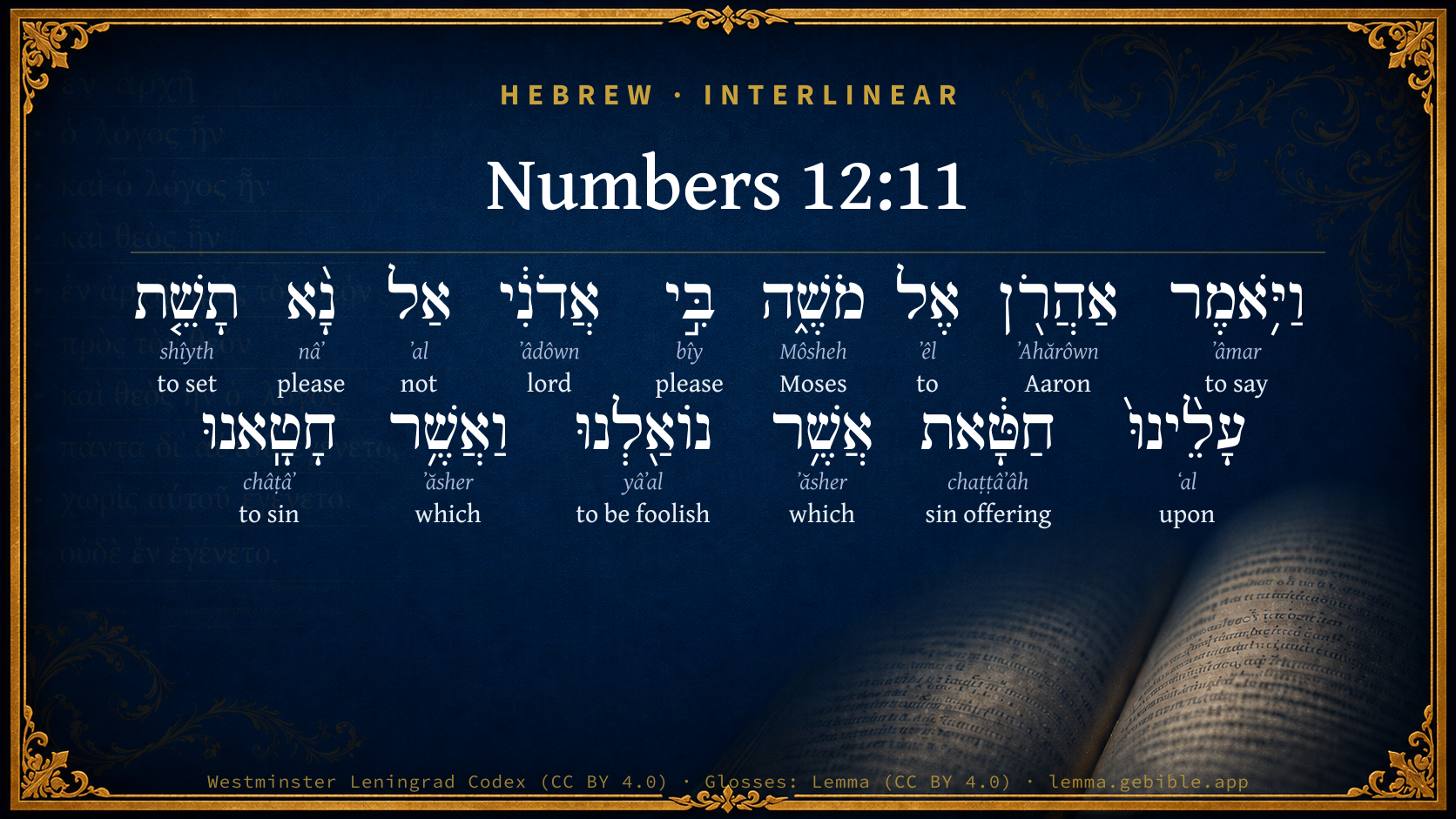
Hebrew (Westminster Leningrad Codex) Numbers 12:11 appears in the Hebrew Old Testament. The text above is from the Westminster Leningrad Codex. Each word links to its Strong’s number, a concise gloss, and parsing drawn from the Open Scriptures Hebrew Bible morphology. Click any word for its full Brown-Driver-Briggs (BDB) entry.
Download image
Cite this verse

Numbers 12:11 (World English Bible). Public Domain. Lemma interlinear Bible study tool, https://lemma.gebible.app/v/numbers/12/11.

Show BibTeX & RIS
BibTeX
RIS
English Translation
Aaron said to Moses, Oh, my lord, please don't lay sin on us, for that we have done foolishly, and for that we have sinned.
World English Bible · Public Domain
Highlights
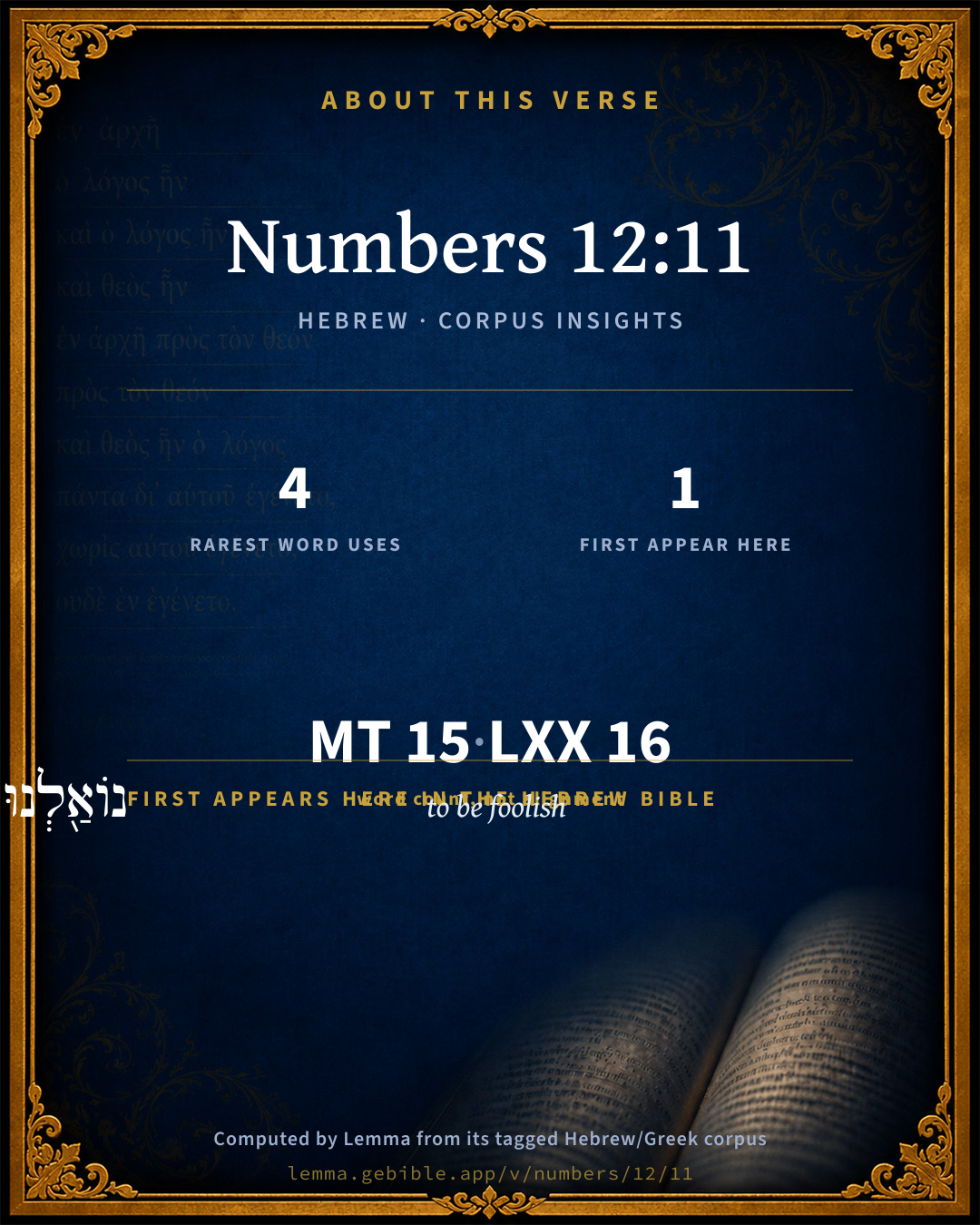
  • 1 first appearance in the Hebrew Bible
Full analysis ↓
Download a study sheet

One document with this verse’s original text, its word-by-word gloss line, the meaning frame, cross-references with their text, attributed commentary, and full source and license credits — printable, and it pastes into notes with its structure intact.

This verse Autodidact and up

Study sheet (.html) Plain text (.txt)

A passage Seminary Student

Up to 50 verses in one chapter. A passage sheet keeps up to 6 commentary sources and 12 cross-references per verse, in the order this page ranks them, and says so on the sheet whenever that leaves anything out. Ask for a single verse and you get the Autodidact verse sheet above.

Everything on this page stays free to read, with no account — the sheet is a download of what is already on screen, not access to it.

Want to remove ads? Support Godless Engineer
Compare translations 3

The same verse in 3 English versions, stacked beneath the original-language interlinear above. Click any original word for its lexicon entry.

Each is an independent rendering of the whole verse — the interlinear is not word-aligned to these translations.

Highlighted words mark where these versions differ — a whole-verse word diff, not a word-by-word alignment.

  • World English Bible Public Domain
    Aaron said to Moses, Oh, my lord, please don't lay sin on us, for that we have done foolishly, and for that we have sinned.
  • King James Version Public Domain
    And Aaron said unto Moses, Alas, my lord, I beseech thee, lay not the sin upon us, wherein we have done foolishly, and wherein we have sinned.
  • unfoldingWord Literal Text CC BY-SA 4.0
    and Aaron said to Moses, “Please, my lord, please do not put upon us sin which we did foolishly and which we sinned.

unfoldingWord Literal Text — © unfoldingWord, licensed CC BY-SA 4.0. Word-aligned USFM3 via Door43 (git.door43.org/unfoldingWord/en_ult).

Versions to compare (up to 4)

3 of 4 selected

Show all 18 translations

Every available English version of this verse, each an independent rendering of the whole verse.

  • World English Bible Public Domain
    Aaron said to Moses, Oh, my lord, please don't lay sin on us, for that we have done foolishly, and for that we have sinned.
  • Berean Standard Bible Public Domain
    and said to Moses, “My lord, please do not hold against us this sin we have so foolishly committed.
  • Majority Standard Bible Public Domain
    and said to Moses, “My lord, please do not hold against us this sin we have so foolishly committed.
  • King James Version Public Domain
    And Aaron said unto Moses, Alas, my lord, I beseech thee, lay not the sin upon us, wherein we have done foolishly, and wherein we have sinned.
  • American Standard Version (1901) Public Domain
    And Aaron said unto Moses, Oh, my lord, lay not, I pray thee, sin upon us, for that we have done foolishly, and for that we have sinned.
  • Revised Version (1885) Public Domain
    And Aaron said unto Moses, Oh my lord, lay not, I pray thee, sin upon us, for that we have done foolishly, and for that we have sinned.
  • Geneva Bible (1599) Public Domain
    Then Aaron saide vnto Moses, Alas, my Lord, I beseech thee, lay not the sinne vpon vs, which we haue foolishly committed and wherein we haue sinned.
  • Douay-Rheims (1899) Public Domain
    He said to Moses: I beseech thee, my lord, lay not upon us this sin, which we have foolishly committed:
  • Young's Literal Translation Public Domain
    And Aaron saith unto Moses, `O, my lord, I pray thee, lay not upon us sin `in' which we have been foolish, and `in' which we have sinned;
  • Literal Standard Version CC BY-SA 4.0
    And Aaron says to Moses, “O my lord, please do not lay [this] sin on us [in] which we have been foolish, and [in] which we have sinned;
  • Unlocked Literal Bible CC BY-SA 4.0
    Aaron said to Moses, “Oh, my master, please do not hold this sin against us. We have spoken foolishly, and we have sinned.
  • unfoldingWord Literal Text CC BY-SA 4.0
    and Aaron said to Moses, “Please, my lord, please do not put upon us sin which we did foolishly and which we sinned.
  • Darby Bible Public Domain
    Then Aaron said to Moses, Alas, my lord, I beseech thee, lay not this sin upon us, wherein we have been foolish, and have sinned!
  • World Messianic Bible Public Domain
    Aaron said to Moses, “Oh, my lord, please don’t count this sin against us, in which we have done foolishly, and in which we have sinned.
  • Webster's Bible Public Domain
    And Aaron said to Moses, Alas, my lord, I beseech thee, lay not the sin upon us, in which we have done foolishly, and in which we have sinned.
  • Free Bible Version CC BY-SA 4.0
    He said to Moses, “My lord, please don't punish us for this sin that we've so stupidly committed.
  • Bible in Basic English Public Domain
    Then Aaron said to Moses, O my lord, let not our sin be on our heads, for we have done foolishly and are sinners.
  • JPS Tanakh (1917) Public Domain
    And Aaron said unto Moses: 'Oh my lord, lay not, I pray thee, sin upon us, for that we have done foolishly, and for that we have sinned.

Literal Standard Version (2020), Covenant Press — licensed CC BY-SA 4.0. Text via the HelloAO Bible API (eBible.org). Unlocked Literal Bible (unfoldingWord) — licensed CC BY-SA 4.0. Text via the HelloAO Bible API (eBible.org). unfoldingWord Literal Text — © unfoldingWord, licensed CC BY-SA 4.0. Word-aligned USFM3 via Door43 (git.door43.org/unfoldingWord/en_ult). Free Bible Version, Dr. Jonathan Gallagher — licensed CC BY-SA 4.0. Text via the HelloAO Bible API (eBible.org).

Word by word

More ways to search: Search by grammar → Find every occurrence → Compare this word →

Practice this passage: Drill this verse → Learn its vocabulary →

נוֹאַ֖לְנוּ
yâʼal
H2973
“to be foolish”
Verb, Niphal, Perfect, 1st Person, Common, Plural
Part of Speech
Verb
Stem
Niphal
Form
Perfect
Person
1st Person
Gender
Common
Number
Plural
Full BDB Definition

Origin: a primitive root

TWOT: 830

to be foolish, become fools, act foolishly, show wicked folly - (Niphal) - to show wicked folly - to become fools
  1. וַיֹּ֥אמֶר ʼâmar H559 “and · to say” Conjunction + Verb, Qal, Sequential Imperfect, 3rd Person, Masculine, Singular
  2. אַהֲרֹ֖ן ʼAhărôwn H175 “Aaron” Noun, Proper
  3. אֶל ʼêl H413 “to” Preposition
  4. מֹשֶׁ֑ה Môsheh H4872 “Moses” Noun, Proper
  5. בִּ֣י bîy H994 “please” Particle, Exhortation
  6. אֲדֹנִ֔י ʼâdôwn H113 “lord · my” Noun, Common, Masculine, Singular, Construct + Suffix, Personal, 1st Person, Common, Singular
  7. אַל ʼal H408 “not” Particle, Negative
  8. נָ֨א nâʼ H4994 “please” Particle, Exhortation
  9. תָשֵׁ֤ת shîyth H7896 “to set” Verb, Qal, Jussive, 2nd Person, Masculine, Singular
  10. עָלֵ֨ינוּ֙ ʻal H5921 “upon · us” Preposition + Suffix, Personal, 1st Person, Common, Plural
  11. חַטָּ֔את chaṭṭâʼâh H2403 “sin offering” Noun, Common, Feminine, Singular, Absolute
  12. אֲשֶׁ֥ר ʼăsher H834 “which” Particle, Relative
  13. וַאֲשֶׁ֥ר ʼăsher H834 “and · which” Conjunction + Particle, Relative
  14. חָטָֽאנוּ châṭâʼ H2398 “to sin” Verb, Qal, Perfect, 1st Person, Common, Plural

About this verse

These counts appear in no published source. They are computed here, from the morphology-tagged text and Lemma’s own curated glosses. What Lemma adds →

15
words
14
distinct lemmas
Pentateuch
section

Notable vocabulary

The rarest word here is נוֹאַ֖לְנוּ to be foolish H2973 — appearing just 4 times in the whole Hebrew Bible.

First appearance in Scripture

This word makes its first canonical appearance in the Hebrew Bible here:

  • נוֹאַ֖לְנוּ to be foolish H2973

Shared distinctive vocabulary

נוֹאַ֖לְנוּ to be foolish H2973 occurs in 4 verses of the Hebrew Bible. Also found in:

Grammatical profile

  • 4 verbs
  • 4 nouns
  • 2 prepositions
  • 5 particles

Verb forms

  • וַיֹּ֥אמֶר Qal · Sequential Imperfect
  • תָשֵׁ֤ת Qal · Jussive
  • נוֹאַ֖לְנוּ Niphal · Perfect
  • חָטָֽאנוּ Qal · Perfect

Repetition

A word recurs within this verse — often emphatic in Hebrew:

  • אֲשֶׁ֥ר which H834 ×2

Hebrew & Septuagint length

In English translation the verse runs 25 words from the Hebrew and 23 from the Septuagint (LXX English) — closely comparable.

A rough comparison of the two English renderings, which tokenize alike — not a word-level alignment.

Word counts can differ between the Hebrew and the Greek without any difference in meaning — e.g. the Hebrew direct-object marker אֵת has no separate Greek word, and Greek often adds the article ὁ.

In the original languages it is 15 Hebrew tokens and 16 Greek tokens — but the two are counted differently (Hebrew bundles its prefixes and suffixes into one token; the Greek is in lemma form), so that isn’t a like-for-like length.

Cross-references

13

Topical passages linked to Numbers 12:11 in the Treasury of Scripture Knowledge — connected by theme and wording, ordered by reader-vote popularity; previews shown in the World English Bible.

  • 2 Samuel 19:19 He said to the king, Don't let my lord impute iniquity to me, neither do you remember that which your servant did perversely the day that my lord the king went out of Jerusalem, that the king should take it to his heart.
  • 2 Samuel 24:10 David's heart struck him after that he had numbered the people. David said to Yahweh, I have sinned greatly in that which I have done: but now, Yahweh, put away, I beg you, the iniquity of your servant; for I have done very foolishly.
  • Proverbs 30:32 "If you have done foolishly in lifting up yourself, Or if you have thought evil, Put your hand over your mouth.
  • Exodus 12:32 Take both your flocks and your herds, as you have said, and be gone; and bless me also!"
  • 1 Samuel 2:30 Therefore Yahweh, the God of Israel, says, I said indeed that your house, and the house of your father, should walk before me forever: but now Yahweh says, Be it far from me; for those who honor me I will honor, and those who despise me shall be lightly esteemed.
  • 1 Samuel 12:19 All the people said to Samuel, Pray for your servants to Yahweh your God, that we not die; for we have added to all our sins [this] evil, to ask us a king.
  • 1 Samuel 15:24–25 Saul said to Samuel, I have sinned; for I have transgressed the commandment of Yahweh, and your words, because I feared the people, and obeyed their voice.
  • 1 Kings 13:6 The king answered the man of God, Entreat now the favor of Yahweh your God, and pray for me, that my hand may be restored me again. The man of God entreated Yahweh, and the king's hand was restored him again, and became as it was before.
  • 2 Chronicles 16:9 For the eyes of Yahweh run back and forth throughout the whole earth, to show himself strong in the behalf of them whose heart is perfect toward him. Herein you have done foolishly; for from henceforth you shall have wars.
  • Psalms 38:1–5 Yahweh, don't rebuke me in your wrath, Neither chasten me in your hot displeasure.
  • Jeremiah 42:2 and said to Jeremiah the prophet, Let, we pray you, our supplication be presented before you, and pray for us to Yahweh your God, even for all this remnant; for we are left but a few of many, as your eyes do see us:
  • Acts 8:24 Simon answered, "Pray for me to the Lord, that none of the things which you have spoken happen to me."
  • Revelation 3:9 Behold, I give of the synagogue of Satan, of those who say they are Jews, and they are not, but lie. Behold, I will make them to come and worship before your feet, and to know that I have loved you.

Cross-references courtesy of OpenBible.info (CC BY 4.0).

Hebrew and Greek witnesses Masoretic Hebrew ↔ Greek Septuagint

The same verse in the two great witnesses to the Old Testament, shown verse-for-verse.

These are two independent witnesses, not word-aligned to each other, and the Septuagint is shown in lemma (dictionary) form.

Hebrew Numbers 12:11 Masoretic · Westminster Leningrad Codex

וַיֹּ֥אמֶר אַהֲרֹ֖ן אֶל מֹשֶׁ֑ה בִּ֣י אֲדֹנִ֔י אַל נָ֨א תָשֵׁ֤ת עָלֵ֨ינוּ֙ חַטָּ֔את אֲשֶׁ֥ר נוֹאַ֖לְנוּ וַאֲשֶׁ֥ר חָטָֽאנוּ

Aaron said to Moses, Oh, my lord, please don't lay sin on us, for that we have done foolishly, and for that we have sinned.

World English Bible · Public Domain

Greek LXX Numbers 12:11 Septuagint · lemma form

καί εἶπον ἀαρών πρός μωυσῆς δέομαι κύριος μή συν ἐπιτίθημι ἐγώ ἁμαρτία διότι ἀγνοέω καθότι ἁμαρτάνω

And Aaron said to Moses, I beseech you, my lord, do not lay sin upon us, for we were ignorant wherein we sinned.

LXX2012 (modern English Septuagint) · Public Domain

On this verse, The Pulpit Commentary discusses the Septuagint’s reading. Read the note in Commentary ↓

Hebrew: Westminster Leningrad Codex (CC BY 4.0). Greek: Septuagint (public domain); English from LXX2012 (modern English Septuagint) (Public Domain). How the Septuagint differs from the Hebrew →

Targum (Aramaic paraphrase)

2

The Targum is the ancient Jewish Aramaic paraphrase of the Hebrew Scriptures — an interpretive translation, not the Hebrew text itself. Onkelos (literal) and Pseudo-Jonathan (expansive) render the Torah, and Jonathan the Prophets. Coverage is partial: where no permissively-licensed English translation exists for a verse, only the Aramaic is shown. This is verse-level text, not a word-by-word alignment to the Hebrew.

  1. Targum Onkelos Torah (Genesis–Deuteronomy)
    וַאֲמַר אַהֲרֹן לְמשֶׁה בְּבָעוּ רִבּוֹנִי לָא כְעַן תְּשַׁוִי עֲלָנָא חוֹבָא דְאִטְפַּשְׁנָא וְדִי סָרֲחְנָא

    (no public-domain English translation for this verse)

    Targum Onkelos — Aramaic: “Onkelos Genesis” (public domain); “Onkelos Exodus” (public domain); “Onkelos Leviticus” (public domain); “Onkelos Numbers” (public domain); “Onkelos Deuteronomy” (public domain). English: “Sefaria Community Translation” (CC0 1.0 (public-domain dedication)); “J.W. Etheridge. The Targums of Onkelos and Jonathan Ben Uzziel on the Pentateuch. London: Longmans, Green, 1862” (public domain). Text via Sefaria.

  2. Targum Pseudo-Jonathan Torah (Genesis–Deuteronomy)
    וַאֲמַר אַהֲרן לְמשֶׁה בְּמָטוּ מִינָךְ רִבּוֹנִי לָא תְשַׁוֵי עֲלָנָא חוֹבָא דֵי אִיטַפַּשְׁנָא וְדִי סְרַחֲנָא

    And Aharon said to Mosheh, I beseech of thee, my lord, not to lay upon us the sin we have foolishly committed, and by which we have transgressed.

    Targum Pseudo-Jonathan — Aramaic: “Targum Jonathan on Genesis” (public domain); “Targum Jonathan on Exodus” (public domain); “Targum Jonathan on Leviticus” (public domain); “Targum Jonathan on Numbers” (public domain); “Targum Jonathan on Deuteronomy” (public domain). English: “The Targum of Jonathan ben Uzziel, trans. J. W. Etheridge, London, 1862” (public domain). Text via Sefaria.

Commentary

Notes on Numbers 12:11 from classic Christian and Jewish commentators (each source and its license shown beneath its notes). The classic Christian expositions comment on the surrounding passage and are grouped to its opening verse, so a note may address several verses; the Jewish commentaries on the Tanakh (Rashi and others) are per-verse, so they appear only where the commentator wrote on this verse.

Lemma curates 59 commentaries, every one of them public domain or Creative Commons licensed, each selected and text-cleaned for this edition rather than reprinted as found. About our sources →

Trapp's Complete Commentary

John Trapp

Num 12:11 And Aaron said unto Moses, Alas, my lord, I beseech thee, lay not the sin upon us, wherein we have done foolishly, and wherein we have sinned.

Ver. 11. And Aaron said unto Moses.] His late sin had choked him, as it were, - as David in like case felt his mouth stopped, {Psa 51:15} - and therefore he requesteth Moses to mediate for Miriam. Our own key may be rusty sometimes, and we glad to make use of another’s key, to open the cabinet of God’s grace, that therehence we may take out mercy for ourselves and others.

John Trapp, A Commentary or Exposition upon All the Books of the Old and New Testament (1647–1656) — public domain. Text from a community e-Sword module.

Joseph Benson's Commentary

Num 12:11-12. Lay not the sin — Let not the guilt and punishment of this sin rest upon us, upon her in this kind, upon me in any other kind, but pray to God for the pardon and removal of it. As one dead — Because part of her flesh was putrefied and dead, and not to be restored but by the mighty power of God. Like a still-born child, that hath been for some time dead in the womb, which, when it comes forth, is putrefied, and part of it consumed.

Joseph Benson's Commentary on the Old and New Testaments (1811–1818) — public domain. Text from a community e-Sword module.

Jamieson, Fausset & Brown

Robert Jamieson, A. R. Fausset & David Brown

On the humble and penitential submission of Aaron, Moses interceded for both the offenders, especially for Miriam, who was restored; not, however, till she had been made, by her exclusion, a public example [Num 12:14-15].

Jamieson, Fausset & Brown — Commentary Critical and Explanatory on the Whole Bible (1871) — public domain (CC PDM 1.0). Text via the HelloAO Bible API.

Ellicott's Commentary for English Readers

(11) Alas, my lord.—The word rendered alas! is an exclamation of entreaty rather than of lamentation. It is used towards superiors in conjunction with adoni (my lord) in Gen_40:20; 1Ki_3:17.

Lay not the sin upon us . . . —Better, lay not sin (i.e., the punishment which is due to it) upon us, for that (or, inasmuch as) we have done foolishly, &c. Aaron does not seek to shift the guilt which had been incurred from himself and Miriam to any others, but prays that they may not be constrained to bear the punishment which their sin had justly deserved. In Zec_14:19 the same word hattath is rendered punishment.

A Bible Commentary for English Readers, edited by Charles John Ellicott (1878–1897) — public domain. Text from a community e-Sword module.

John Gill's Exposition

And Aaron said unto Moses, alas, my lord!.... The word for "alas" is generally interpreted by the Jewish writers as a note of beseeching and entreating, as it is here by the Targums of Onkelos and Jonathan,"I beseech thee, my lord,''or "upon me, my lord" (k), be all the blame; such was his tenderness to his sister, and the compassion he had on her; and such reverence and respect did he show to Moses his brother, though younger than he, because of his superior dignity as a prophet, and chief magistrate, and prime minister, and servant of the Lord, calling him "my lord":

I beseech thee, lay not the sin upon us; the punishment of it, bear not hard upon us, or suffer us to be punished in a rigorous manner, without interceding to the Lord for us, for the abatement of removal of it; such a powerful and prevailing interest he knew he had with God, that by his prayers their punishment would be mitigated, or not laid, or, if laid, removed:

wherein we have done foolishly, and wherein we have sinned; he owns they had sinned, but suggests, and so he would have it understood, that it was not through malice, and purposely and presumptuously, but through and ignorance, inadvertency and weakness, and hoped it would be forgiven.

(k) "in me", Montanus.

John Gill's Exposition of the Whole Bible (1746–1763) — public domain (CC PDM 1.0). Text via the HelloAO Bible API.

Matthew Poole's English Annotations

Let not the guilt and punishment of this sin rest upon us, upon her in this kind, upon me in any other kind, but pray to God for the pardon and removal of it.

Matthew Poole's English Annotations on the Holy Bible (1683–1685) — public domain. Text from a community e-Sword/MySword module.

Whedon's Commentary on the Bible

Daniel D. Whedon

11. I beseech thee — Here we have an instance of a double supplication. Aaron, the anointed high priest, having sympathized with the revolt against Moses, dare not go directly to Jehovah and plead for his partner in sin, but feels that he himself needs a mediator.

We have sinned — Here is Aaron’s confession of complicity in the wrong. The exigency was too great for him to wait till the great day of atonement, in which he could offer a sin offering for himself, and thus become qualified to offer for the sins of the people. Lev_16:11, note.

Daniel D. Whedon (gen. ed.), Commentary on the Old and New Testaments (1874–1909) — public domain. Text from a community e-Sword module.

The Pulpit Commentary

Aaron said unto Moses, Alas, my lord, I beseech thee. Septuagint, deomai Kurie . In thus addressing his brother Aaron acknowledged his superior position, and tacitly abandoned all pretension to equality. Lay not the sin upon us. Aaron speaks to Moses almost as if he were praying to God, so completely does. he recognize in his brother the representative of God (in a far higher sense than himself), who had power to bind and loose in the name and power of God. What Aaron really prays for is that the sin, which he frankly confesses, may not be imputed to them. The Levitical law had taught them to look upon sin as a burden, which in the nature of things the sinner must carry, but which by the goodness of God might be got rid of, or transferred to some one else. (cf. Lev_4:4 Lev_16:21Jo Lev 1:29)

The Pulpit Commentary (1880–1919), ed. H.D.M. Spence-Jones & Joseph S. Exell — public domain. Text from a community e-Sword module.

John Wesley's Explanatory Notes

Lay not the sin - Let not the guilt and punishment of this sin rest upon us, upon her in this kind, upon me in any other kind, but pray to God for the pardon and removal of it.

John Wesley, Explanatory Notes Upon the Whole Bible (1754–1765) — public domain. Text via the GEBible commentary corpus.

Keil & Delitzsch

C. F. Keil & F. Delitzsch

When Aaron saw his sister smitten in this way, he said to Moses, "Alas! my lord, I beseech thee, lay not this sin upon us, for we have done foolishly;" i.e., let us not bear its punishment. "Let her (Miriam) not be as the dead thing, on whose coming out of its mother's womb half its flesh is consumed;" i.e., like a still-born child, which comes into the world half decomposed. His reason for making this comparison was, that leprosy produces decomposition in the living body.

Keil & Delitzsch — Biblical Commentary on the Old Testament (1861–1891) — public domain (CC PDM 1.0). Text via the HelloAO Bible API. (Old Testament only.)

unfoldingWord translationNotes

Door43 World Missions Community

do not hold this sin against us

To hold people's sin against them is to say that they are guilty for their sin. Here it represents punishing them for their sin. (See: Metonymy)

Please do not let her be like a dead newborn whose flesh is half consumed

Miriam's leprosy would cause her body to decay until she died. The flesh being decayed is spoken of as if it were eaten. AT: "Please do not let her be like a dead newborn baby whose flesh is half decayed" (See: Simile and Metaphor)

translationWords

Moses

lord

sin

fool

die

flesh

consume

womb

unfoldingWord translationNotes — © Distant Shores Media and the Door43 World Missions Community, licensed CC BY-SA 4.0. Source: git.door43.org/Door43/en_tn.

Rashi

Rabbi Shlomo Yitzchaki (Rashi)

נואלנו — Understand this as the Targum does: (we have acted foolishly); it is associated in meaning with אויל “a fool”.

Rashi on the Tanakh — English translations: “The Judaica Press complete Tanach with Rashi, translated by A. J. Rosenberg” (CC BY 4.0); “Pentateuch with Rashi's commentary by M. Rosenbaum and A.M. Silbermann, 1929-1934” (public domain); “The Metsudah Tanach series, Lakewood, N.J” (CC BY 4.0); and “The Book of Joshua, Metsudah Publications, 1997” (CC BY 4.0). Text via Sefaria.

Lesson kit

Teaching starters — assembled from the data on this page, not authored interpretation. Every prompt links to the verse data it draws on. Edit before teaching.

Numbers, in the Pentateuch, opens this verse with 15 words (14 distinct Hebrew lemmas). Its most distinctive word is yâʼal (“to be foolish”). A historical commentator’s framing appears above. Read the whole chapter for the surrounding context.

Discussion questions

  1. How does “to be foolish” (yâʼal) shape what this verse is saying?
  2. This is the first place “to be foolish” appears in Scripture (first appears here). What does its debut here establish?
  3. How does Isaiah 19:13, which shares the word «to be foolish», read alongside this verse?
  4. What does the repetition of “which” (2× in this one verse) do in this verse?
  5. These translations render this verse differently. What is at stake in choosing one wording over another?
  6. «וַיֹּ֥אמֶר» is a Qal Sequential Imperfect verb. How does that grammatical form shape the action described?
  7. Compare how Trapp's Complete Commentary and Joseph Benson's Commentary read this verse. Where do they agree or differ?

Things to notice

Reading settings

Reading text

Shown beneath each verse's original-language words.

Old Testament
Old Testament edition

Read the OT as the Masoretic Hebrew (MT) or the Greek Septuagint (LXX).

English shown for the Greek Septuagint (in the Hebrew ↔ Greek comparison).

Comparing translations? Open the Compare panel on any verse page to stack up to four side by side.