
Malachi 2:15

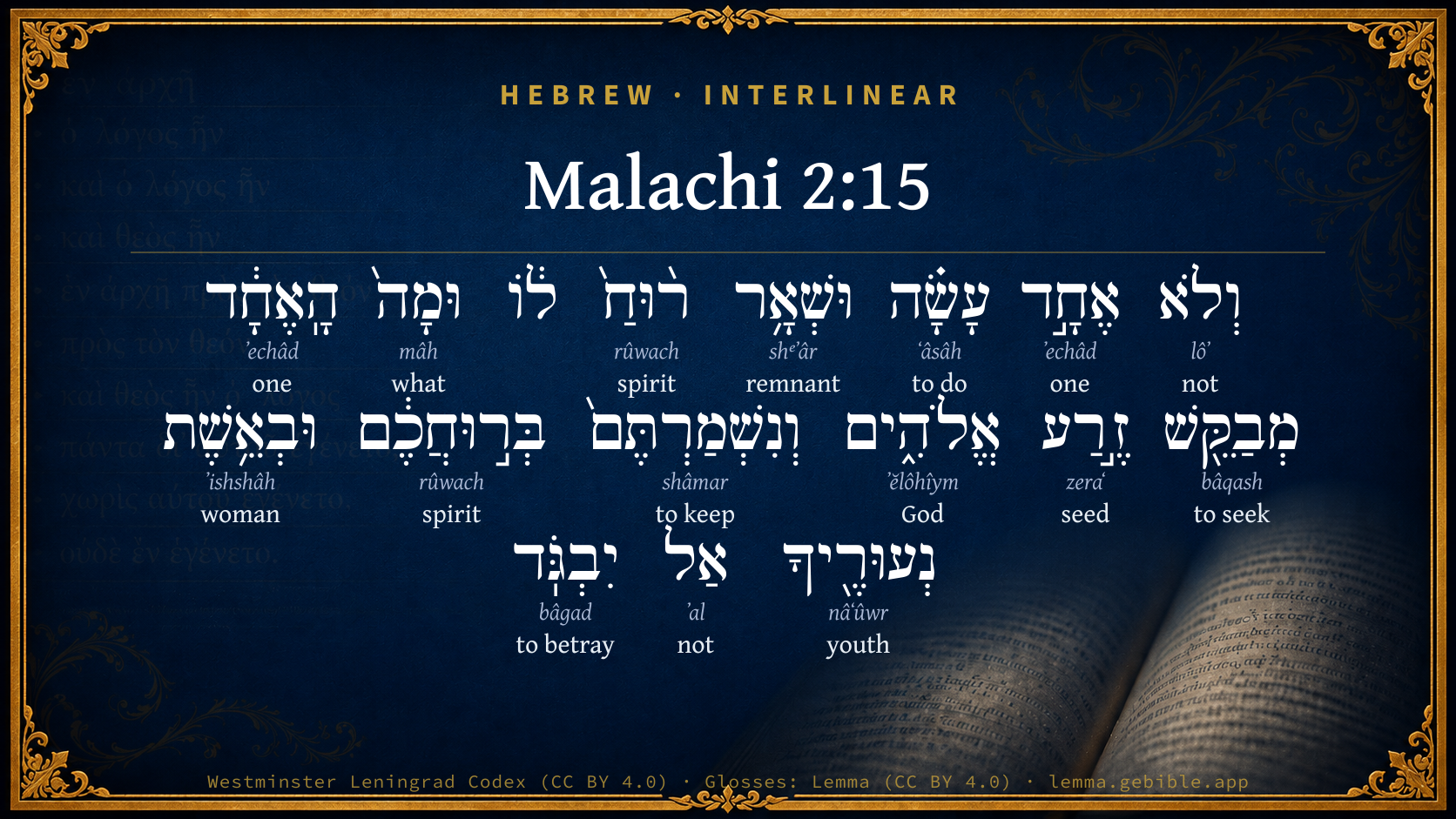
Hebrew (Westminster Leningrad Codex) Malachi 2:15 appears in the Hebrew Old Testament. The text above is from the Westminster Leningrad Codex. Each word links to its Strong’s number, a concise gloss, and parsing drawn from the Open Scriptures Hebrew Bible morphology. Click any word for its full Brown-Driver-Briggs (BDB) entry.
Download image
Cite this verse

Malachi 2:15 (World English Bible). Public Domain. Lemma interlinear Bible study tool, https://lemma.gebible.app/v/malachi/2/15.

Show BibTeX & RIS
BibTeX
RIS
English Translation
Did he not make one, although he had the residue of the Spirit? Why one? He sought a godly seed. Therefore take heed to your spirit, and let none deal treacherously against the wife of his youth.
World English Bible · Public Domain
Download a study sheet

One document with this verse’s original text, its word-by-word gloss line, the meaning frame, cross-references with their text, attributed commentary, and full source and license credits — printable, and it pastes into notes with its structure intact.

This verse Autodidact and up

Study sheet (.html) Plain text (.txt)

A passage Seminary Student

Up to 50 verses in one chapter. A passage sheet keeps up to 6 commentary sources and 12 cross-references per verse, in the order this page ranks them, and says so on the sheet whenever that leaves anything out. Ask for a single verse and you get the Autodidact verse sheet above.

Everything on this page stays free to read, with no account — the sheet is a download of what is already on screen, not access to it.

Want to remove ads? Support Godless Engineer
Compare translations 3

The same verse in 3 English versions, stacked beneath the original-language interlinear above. Click any original word for its lexicon entry.

Each is an independent rendering of the whole verse — the interlinear is not word-aligned to these translations.

Highlighted words mark where these versions differ — a whole-verse word diff, not a word-by-word alignment.

  • World English Bible Public Domain
    Did he not make one, although he had the residue of the Spirit? Why one? He sought a godly seed. Therefore take heed to your spirit, and let none deal treacherously against the wife of his youth.
  • King James Version Public Domain
    And did not he make one? Yet had he the residue of the spirit. And wherefore one? That he might seek a godly seed. Therefore take heed to your spirit, and let none deal treacherously against the wife of his youth.
  • unfoldingWord Literal Text CC BY-SA 4.0
    And did he not make one, and a remnant of spirit to him? And why one? seeking seed of God. So guard yourselves in your spirit, and do not deal treacherously with the wife of your youth.

unfoldingWord Literal Text — © unfoldingWord, licensed CC BY-SA 4.0. Word-aligned USFM3 via Door43 (git.door43.org/unfoldingWord/en_ult).

Versions to compare (up to 4)

3 of 4 selected

Show all 18 translations

Every available English version of this verse, each an independent rendering of the whole verse.

  • World English Bible Public Domain
    Did he not make one, although he had the residue of the Spirit? Why one? He sought a godly seed. Therefore take heed to your spirit, and let none deal treacherously against the wife of his youth.
  • Berean Standard Bible Public Domain
    Has not the LORD made them one, having a portion of the Spirit? And why one? Because He seeks godly offspring. So guard yourselves in your spirit and do not break faith with the wife of your youth.
  • Majority Standard Bible Public Domain
    Has not the LORD made them one, having a portion of the Spirit? And why one? Because He seeks godly offspring. So guard yourselves in your spirit and do not break faith with the wife of your youth.
  • King James Version Public Domain
    And did not he make one? Yet had he the residue of the spirit. And wherefore one? That he might seek a godly seed. Therefore take heed to your spirit, and let none deal treacherously against the wife of his youth.
  • American Standard Version (1901) Public Domain
    And did he not make one, although he had the residue of the Spirit? And wherefore one? He sought a godly seed. Therefore take heed to your spirit, and let none deal treacherously against the wife of his youth.
  • Revised Version (1885) Public Domain
    And did he not make one, although he had the residue of the spirit? And wherefore one? He sought a godly seed. Therefore take heed to your spirit, and let none deal treacherously against the wife of his youth.
  • Geneva Bible (1599) Public Domain
    And did not hee make one? yet had hee abundance of spirit: and wherefore one? because he sought a godly seede: therefore keepe your selues in your spirit, and let none trespasse against the wife of his youth.
  • Douay-Rheims (1899) Public Domain
    Did not one make her, and she is the residue of his spirit? And what doth one seek, but the seed of God? Keep then your spirit, and despise not the wife of thy youth.
  • Young's Literal Translation Public Domain
    And He did not make one `only', And He hath the remnant of the Spirit. And what `is' the one `alone'! He is seeking a godly seed. And ye have been watchful over your spirit, And with the wife of thy youth, None doth deal treacherously.
  • Literal Standard Version CC BY-SA 4.0
    And He did not make one [only], || And a remnant of the Spirit [is] for him. And what [is] the one [alone]! He is seeking a godly seed. And you have been watchful over your spirit, || And with the wife of your youth, || None deal treacherously.
  • Unlocked Literal Bible CC BY-SA 4.0
    Did he not make them one, with a portion of his spirit? Then why did he make you one? Because he was seeking an offspring from God. So guard yourselves in your spirit, and do not be unfaithful to the wife of your youth.
  • unfoldingWord Literal Text CC BY-SA 4.0
    And did he not make one, and a remnant of spirit to him? And why one? seeking seed of God. So guard yourselves in your spirit, and do not deal treacherously with the wife of your youth.
  • Darby Bible Public Domain
    And did not one make [them]? and the remnant of the Spirit was his. And wherefore the one? He sought a seed of God. Take heed then to your spirit, and let none deal unfaithfully against the wife of his youth,
  • World Messianic Bible Public Domain
    Did he not make you one, although he had the residue of the Spirit? Why one? He sought godly offspring. Therefore take heed to your spirit, and let no one deal treacherously against the wife of his youth.
  • Webster's Bible Public Domain
    And did he not make one? Yet had he the residue of the spirit. And why one? That he might seek a godly seed. Therefore take heed to your spirit, and let none deal treacherously against the wife of his youth.
  • Free Bible Version CC BY-SA 4.0
    Did he not make you one, and give some of his Spirit to you? And what does he want? Children of God. So watch what you do, and don't be unfaithful to the wife you married when you were young.
  • Bible in Basic English Public Domain
    ... So give thought to your spirit, and let no one be false to the wife of his early years.
  • JPS Tanakh (1917) Public Domain
    And not one hath done so who had exuberance of spirit! For what seeketh the one? a seed given of God. Therefore take heed to your spirit, and let none deal treacherously against the wife of his youth.

Literal Standard Version (2020), Covenant Press — licensed CC BY-SA 4.0. Text via the HelloAO Bible API (eBible.org). Unlocked Literal Bible (unfoldingWord) — licensed CC BY-SA 4.0. Text via the HelloAO Bible API (eBible.org). unfoldingWord Literal Text — © unfoldingWord, licensed CC BY-SA 4.0. Word-aligned USFM3 via Door43 (git.door43.org/unfoldingWord/en_ult). Free Bible Version, Dr. Jonathan Gallagher — licensed CC BY-SA 4.0. Text via the HelloAO Bible API (eBible.org).

Word by word

More ways to search: Search by grammar → Find every occurrence → Compare this word →

Practice this passage: Drill this verse → Learn its vocabulary →

וּשְׁאָ֥ר
shᵉʼâr
H7605
“and · remnant of”
Conjunction + Noun, Common, Masculine, Singular, Construct
Part of Speech
Conjunction + Noun
Type
Common
Gender
Masculine
Number
Singular
State
Construct
Full BDB Definition

Origin: from H7604

TWOT: 2307a

rest, residue, remnant, remainder
  1. וְלֹא lôʼ H3808 “and · not” Conjunction + Particle, Negative
  2. אֶחָ֣ד ʼechâd H259 “one” Adjective, Cardinal number, Masculine, Singular, Absolute
  3. עָשָׂ֗ה ʻâsâh H6213 “to do” Verb, Qal, Perfect, 3rd Person, Masculine, Singular
  4. ר֨וּחַ֙ rûwach H7307 “spirit” Noun, Common, Both, Singular, Absolute
  5. וּמָה֙ mâh H4100 “and · what” Conjunction + Particle, Interrogative
  6. הָֽאֶחָ֔ד ʼechâd H259 “the · one” Particle, Definite Article + Adjective, Cardinal number, Masculine, Singular, Absolute
  7. מְבַקֵּ֖שׁ bâqash H1245 “seeking” Verb, Piel, Participle Active, Masculine, Singular, Absolute
  8. זֶ֣רַע zeraʻ H2233 “seed of” Noun, Common, Masculine, Singular, Construct
  9. אֱלֹהִ֑ים ʼĕlôhîym H430 “God(s)” Noun, Common, Masculine, Plural, Absolute
  10. וְנִשְׁמַרְתֶּם֙ shâmar H8104 “and · to keep” Conjunction + Verb, Niphal, Sequential Perfect, 2nd Person, Masculine, Plural
  11. בְּר֣וּחֲכֶ֔ם rûwach H7307 “in/at · spirit · your” Preposition + Noun, Common, Both, Singular, Construct + Suffix, Personal, 2nd Person, Masculine, Plural
  12. וּבְאֵ֥שֶׁת ʼishshâh H802 “and · in/at · woman of” Conjunction + Preposition + Noun, Common, Feminine, Singular, Construct
  13. נְעוּרֶ֖יךָ nâʻûwr H5271 “youth · your” Noun, Common, Both, Plural, Construct + Suffix, Personal, 2nd Person, Masculine, Singular
  14. אַל ʼal H408 “not” Particle, Negative
  15. יִבְגֹּֽד bâgad H898 “to betray” Verb, Qal, Jussive, 3rd Person, Masculine, Singular

About this verse

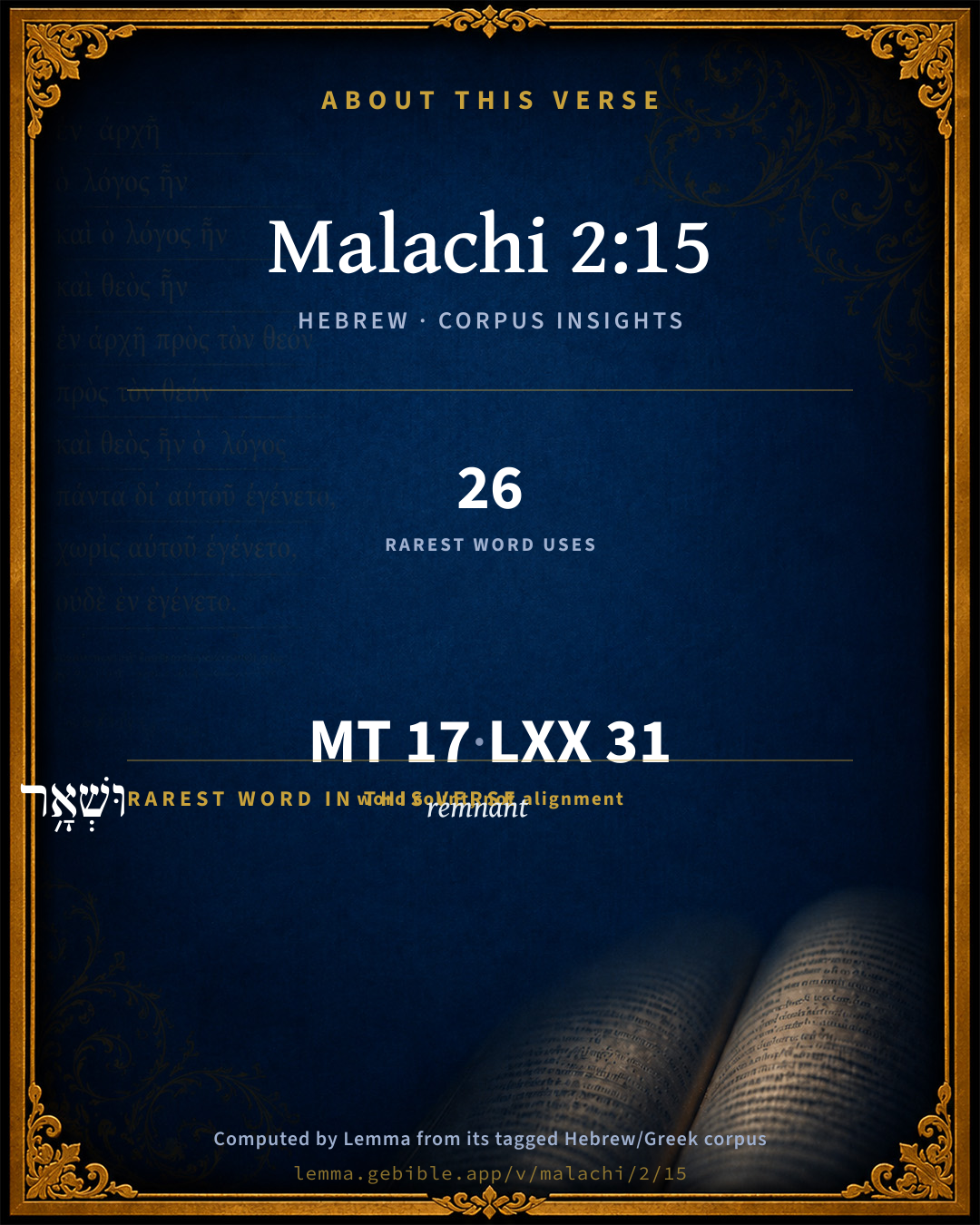
These counts appear in no published source. They are computed here, from the morphology-tagged text and Lemma’s own curated glosses. What Lemma adds →

17
words
14
distinct lemmas
Prophets
section

Shared distinctive vocabulary

וּשְׁאָ֥ר remnant H7605 occurs in 25 verses of the Hebrew Bible. Also found in:

Grammatical profile

  • 4 verbs
  • 7 nouns
  • 2 adjectives
  • 1 preposition
  • 3 particles

Verb forms

  • עָשָׂ֗ה Qal · Perfect
  • מְבַקֵּ֖שׁ Piel · Participle Active
  • וְנִשְׁמַרְתֶּם֙ Niphal · Sequential Perfect
  • יִבְגֹּֽד Qal · Jussive

Repetition

Words recur within this verse — often emphatic in Hebrew:

  • אֶחָ֣ד one H259 ×2
  • ר֨וּחַ֙ spirit H7307 ×2

Hebrew & Septuagint length

In English translation the verse runs 37 words from the Hebrew and 39 from the Septuagint (LXX English) — closely comparable.

A rough comparison of the two English renderings, which tokenize alike — not a word-level alignment.

Word counts can differ between the Hebrew and the Greek without any difference in meaning — e.g. the Hebrew direct-object marker אֵת has no separate Greek word, and Greek often adds the article ὁ.

In the original languages it is 17 Hebrew tokens and 31 Greek tokens — but the two are counted differently (Hebrew bundles its prefixes and suffixes into one token; the Greek is in lemma form), so that isn’t a like-for-like length.

Cross-references

34

Topical passages linked to Malachi 2:15 in the Treasury of Scripture Knowledge — connected by theme and wording, ordered by reader-vote popularity; previews shown in the World English Bible.

  • Matthew 19:4–6 He answered, "Haven't you read that he who made them from the beginning made them male and female,
  • Malachi 2:14 Yet you say, 'Why?' Because Yahweh has been witness between you and the wife of your youth, against whom you have dealt treacherously, though she is your companion, and the wife of your covenant.
  • Mark 10:6–8 But from the beginning of the creation, 'God made them male and female.
  • Genesis 1:27 God created man in his own image. In God's image he created him; male and female he created them.
  • Genesis 2:20–24 The man gave names to all cattle, and to the birds of the sky, and to every animal of the field; but for man there was not found a helper suitable for him.
  • 1 Timothy 3:11–12 Their wives in the same way must be reverent, not slanderers, temperate, faithful in all things.
  • 1 Corinthians 7:14 For the unbelieving husband is sanctified in the wife, and the unbelieving wife is sanctified in the husband. Otherwise your children would be unclean, but now are they holy.
  • 2 Corinthians 6:18 I will be to you a Father. You will be to me sons and daughters,' says the Lord Almighty."
  • Job 27:3 (For the length of my life is still in me, And the spirit of God is in my nostrils);
  • Hosea 1:10 Yet the number of the children of Israel will be as the sand of the sea, which can't be measured nor numbered; and it will come to pass that, in the place where it was said to them, 'You are not my people,' they will be called 'sons of the living God.'
  • 1 Timothy 3:4–5 one who rules his own house well, having children in subjection with all reverence;
  • Titus 1:6 if anyone is blameless, the husband of one wife, having children who believe, who are not accused of loose or unruly behavior.
  • Genesis 6:2 that God's sons saw that men's daughters were beautiful, and they took for themselves wives of all that they chose.
  • Genesis 24:3–7 I will make you swear by Yahweh, the God of heaven and the God of the earth, that you shall not take a wife for my son of the daughters of the Canaanites, among whom I live.
  • Genesis 28:2–4 Arise, go to Paddan Aram, to the house of Bethuel your mother's father. Take a wife from there from the daughters of Laban, your mother's brother.
  • Deuteronomy 7:4 For he will turn away your son from following me, that they may serve other gods: so will the anger of Yahweh be kindled against you, and he will destroy you quickly.
  • Proverbs 6:25 Don't lust after her beauty in your heart, Neither let her captivate you with her eyelids.
  • Proverbs 7:25 Don't let your heart turn to her ways. Don't go astray in her paths,
  • Jeremiah 2:21 Yet I had planted you a noble vine, wholly a right seed: how then are you turned into the degenerate branches of a foreign vine to me?
  • Matthew 5:28–29 but I tell you that everyone who gazes at a woman to lust after her has committed adultery with her already in his heart.
  • Matthew 15:19 For out of the heart come forth evil thoughts, murders, adulteries, sexual sins, thefts, false testimony, and blasphemies.
  • Ephesians 6:4 You fathers, don't provoke your children to wrath, but nurture them in the discipline and instruction of the Lord.
  • James 1:14–15 But each one is tempted, when he is drawn away by his own lust, and enticed.
  • Genesis 2:7 Yahweh God formed man from the dust of the ground, and breathed into his nostrils the breath of life; and man became a living soul.
  • Genesis 24:44 She will tell me, "Drink, and I will also draw for your camels." Let the same be the woman whom Yahweh has appointed for my master's son.'
  • Genesis 26:34–35 When Esau was forty years old, he took as wife Judith, the daughter of Beeri the Hittite, and Basemath, the daughter of Elon the Hittite.
  • Genesis 27:46 Rebekah said to Isaac, "I am weary of my life because of the daughters of Heth. If Jacob takes a wife of the daughters of Heth, such as these, of the daughters of the land, what good will my life do me?"
  • Ezra 9:4 Then were assembled to me everyone who trembled at the words of the God of Israel, because of the trespass of them of the captivity; and I sat confounded until the evening offering.
  • Nehemiah 13:24 and their children spoke half in the speech of Ashdod, and could not speak in the Jews' language, but according to the language of each people.
  • Proverbs 4:23 Keep your heart with all diligence, For out of it is the wellspring of life.
  • Ecclesiastes 12:7 And the dust returns to the earth as it was, And the spirit returns to God who gave it.
  • John 20:22 When he had said this, he breathed on them, and said to them, "Receive the Holy Spirit!
  • Acts 3:25 You are the children of the prophets, and of the covenant which God made with our fathers, saying to Abraham, 'In your seed will all the families of the earth be blessed.'
  • 1 Corinthians 7:2 But, because of sexual immoralities, let each man have his own wife, and let each woman have her own husband.

Cross-references courtesy of OpenBible.info (CC BY 4.0).

Hebrew and Greek witnesses Masoretic Hebrew ↔ Greek Septuagint

The same verse in the two great witnesses to the Old Testament, shown verse-for-verse.

These are two independent witnesses, not word-aligned to each other, and the Septuagint is shown in lemma (dictionary) form.

Hebrew Malachi 2:15 Masoretic · Westminster Leningrad Codex

וְלֹא אֶחָ֣ד עָשָׂ֗ה וּשְׁאָ֥ר ר֨וּחַ֙ ל֔וֹ וּמָה֙ הָֽאֶחָ֔ד מְבַקֵּ֖שׁ זֶ֣רַע אֱלֹהִ֑ים וְנִשְׁמַרְתֶּם֙ בְּר֣וּחֲכֶ֔ם וּבְאֵ֥שֶׁת נְעוּרֶ֖יךָ אַל יִבְגֹּֽד

Did he not make one, although he had the residue of the Spirit? Why one? He sought a godly seed. Therefore take heed to your spirit, and let none deal treacherously against the wife of his youth.

World English Bible · Public Domain

Greek LXX Malachi 2:15 Septuagint · lemma form

καί οὐ ἄλλος ποιέω καί ὑπόλειμμα πνεῦμα αὐτός καί εἶπον τίς ἄλλος ἀλλά ἤ σπέρμα ζητέω ὁ θεός καί φυλάσσω ἐν ὁ πνεῦμα σύ καί γυνή νεότης σύ μή ἐν καταλείπω

And did he not do well? and there was the residue of his spirit. But you⌃ said, What does God seek but a seed? But take you⌃ heed to your spirit, and forsake not the wife of your youth.

LXX2012 (modern English Septuagint) · Public Domain

On this verse, Haydock's Catholic Bible Commentary discusses the Septuagint’s reading. Read the note in Commentary ↓

Hebrew: Westminster Leningrad Codex (CC BY 4.0). Greek: Septuagint (public domain); English from LXX2012 (modern English Septuagint) (Public Domain). How the Septuagint differs from the Hebrew →

Targum (Aramaic paraphrase)

1

The Targum is the ancient Jewish Aramaic paraphrase of the Hebrew Scriptures — an interpretive translation, not the Hebrew text itself. Onkelos (literal) and Pseudo-Jonathan (expansive) render the Torah, and Jonathan the Prophets. Coverage is partial: where no permissively-licensed English translation exists for a verse, only the Aramaic is shown. This is verse-level text, not a word-by-word alignment to the Hebrew.

  1. Targum Jonathan Prophets (Joshua–Malachi)
    הֲלָא חָד הֲוָה אַבְרָהָם יְחִידִי דִי מִנֵיהּ אִתְבְּרִי עַלְמָא וּמַה חַד בָּעֵי אֱלָהֵן דִי יִתְקַיֵם לֵיהּ וְלָד מִן קֳדָם יְיָ וְתִסְתַּמְרוּן בְּנַפְשָׁתְכוֹן וּבְאִתַּת יַנְקוּתָךְ לָא תְשַׁקֵר:

    (no public-domain English translation for this verse)

    Targum Jonathan — Aramaic: “Mikraot Gedolot” (public domain). English: “Sefaria Community Translation” (CC0 1.0 (public-domain dedication)); “London "Chaldee Paraphrase," 1871” (public domain). Text via Sefaria.

Commentary

Notes on Malachi 2:15 from classic Christian and Jewish commentators (each source and its license shown beneath its notes). The classic Christian expositions comment on the surrounding passage and are grouped to its opening verse, so a note may address several verses; the Jewish commentaries on the Tanakh (Rashi and others) are per-verse, so they appear only where the commentator wrote on this verse.

Lemma curates 59 commentaries, every one of them public domain or Creative Commons licensed, each selected and text-cleaned for this edition rather than reprinted as found. About our sources →

Trapp's Complete Commentary

John Trapp

Mal 2:15 And did not he make one? Yet had he the residue of the spirit. And wherefore one? That he might seek a godly seed. Therefore take heed to your spirit, and let none deal treacherously against the wife of his youth.

Ver. 15. And did not he make one] Another forcible argument against polygamy and adultery. See our Saviour’s explanation of it, Mat 19:4-6. {See Trapp on "Mat 19:4"} {See Trapp on "Mat 19:5"} {See Trapp on "Mat 19:6"} The only wise God made but one woman for one man at the first creation; and ordained that those two should be one flesh, two in one flesh, not three or four, or as many wives as a man is able to maintain, as among the Turks, who, as a just hand of God upon them, are grievously vexed with jealousy, not suffering their women to go to church, nor so much as look out at their own windows; or, if they go abroad upon any occasion, they must go muffled, all but the eyes. Sardus tells us, that the old Britons would ten or twelve of them take one woman to wife. Likely, women were rare commodities, with them. As likewise men were in Judaea, when "seven women took hold of one man, saying, We will eat our own bread, and wear our own apparel; only let us be called by thy name, to take away our reproach," Isa 4:1 : that is, we will maintain ourselves and thee; only be thou a husband to us, and let us have children by thee.

Yet had he the residue of the spirit] Or, breath; so that he could as easily have made more, and breathed into their faces the breath of life. And although it is not said of the woman, that God breathed into her the breath of life, as of Adam (whence Tertullian concludes, that she had both body and soul too from Adam), yet Austin rightly gathereth, that their souls were both alike imbreathed by God; otherwise, the Scripture would not have been silent in it, no more than it is in the new manner of the creation of her body. Thence also it is that Adam saith not, This is soul of my soul, but "bone of my bone, and flesh of my flesh," Gen 2:23. Souls are not propagated by the parents, but created of God, and joined to the body, by a hidden or secret operation. Augustine, following Origen, held the contrary for a long time. At length he began to doubt, and after a while changed his opinion; Jerome stoutly defending the contrary against him. Aristotle also understood the truth hereof, and concluded, that the soul was divine, and came from above; and though of nothing, yet is it made a matter more excellent than the matter of the heavens, in nature not inferior to the angels. Lειπεται δε τον νουν μονον θυραθεν επειστεναι και θειον ειναι μονον. Lib. 2, c. 9. An abridgment it is of the invisible world, as the body is of the visible. And why may we not say, that the soul, as it came from God, being divinae particula aurm, so it is like him? One immaterial, immortal, understanding spirit, distinguished into three powers, which all make up one spirit. In this respect it is said, Gen 9:6, that in the image of God made he man. There is a double image of God in the soul. One, in the substance of it; this is never lost, and of this that text is to be understood. The other is the supernatural grace, which is an image of the knowledge, holiness, and righteousness of God, and this is utterly lost, and must be recovered. This the ancient heathens hammered at when they feigned that the soul once had wings; but, those being broken, it fell headlong into the body; where when it hath recovered its wings, it flies up to heaven again. That was very good counsel given by a godly man to his friend, not to busy his brains so much in inquiring how the soul entered into the body as how it may depart comfortably out of the body. And seeing the soul is more excellent than the body (saith another grave divine), like as Jacob laid his right hand upon the younger, but his left upon the elder, so our best care, and the strength of our thoughts, should be for the soul, younger as much as it is than the body; they should be but left hand thoughts for the body.

And wherefore one? that he might seek a godly seed] Heb. a seed of God; not a bastardly brood, a spurious issue, a mamzer, as the Hebrews call such, that is, labes aliens, a strange blot, a "seed of the adulterer and the whore," Isa 57:3; but such as God appointeth and approveth, such as may be holy, with a federal holiness at least, if not sanctified from the womb, as some have been, and are, 1Co 7:14; lastly, such as in and by whom the Church and religion may be propagated, and not idolatry spread and increased.

Therefore take heed to your spirit] That is, to your wife, which is the residue of your spirit; keep and cherish her; so Remigius and Lyra interpret it. But they do better that expound it by that of Solomon, "Keep thy heart with all diligence," Pro 4:23, and by that of the apostle, "Mortify therefore your members which are upon earth, fornication, uncleanness, inordinate affection, evil concupiscence," &c., Col 3:5. These are those that defile the man, Mat 15:19-20. These make his heart a filthy dunghill of all abominable lusts, and his life a long chain of sinful actions, a very continued web of wickedness; "therefore take heed to your spirits," that is, to your affections, keep those pure and chaste; abstain from fleshly lusts that fight against the soul. Take heed where you set gunpowder, since fire is in your heart. Austin thanks God that the heart and temptation did not meet together. Look well to the affections; for by those maids Satan woos the mistress. Look to the cinque ports, the five senses, shut those windows, that death enter not in thereby. Take heed to thy fancy: we allow a horse to prance and skip in a pasture; which if he doth when backed by the rider, we count him an unruly and unbroken jade. So, howsoever in other creatures we deny them not liberty of fancy, yet we may not allow it in ourselves, to frisk and rove at pleasure, but by reason bridle them, and set them their bounds that they shall not pass. The Lord quieteth the sea, and turns the storm into a calm, Psa 107:29. If then the voluptuous humours in our body (which is but as a cup made of the husk of an acorn in respect of the sea) will not be pacified when the Lord saith unto them, Be still, every drop of water in the sea will witness our rebellion and disobedience.

And let none deal treacherously against the wife of his youth] He had convinced them of this sin before, Mal 2:14. Now he admonisheth them to abrenounce and abandon it. Lo, this is the true method and manner of proceeding in administering admonitions. The judgment must be convinced ere the affections can be wrought to anything; like as in the law, the lamps were first lighted before the incense was burned. First know thine iniquity, and then turn from it, Jer 3:13-14. Exhortation is the end of doctrine, science of conscience, reformation of information, conversion of conviction; and woe be to those that being convinced, or reproved, for their faults, get the bit between the teeth, as it were, and run away with their rider. When I would have healed Ephraim, then his iniquity brake out (as if it were to cross me) like the leprosy in his forehead, Hos 7:1. What can such sturdy rebels expect better than that God should resolve, as Eze 24:13, as if he should say, Thou shalt have thy will, but then I will have mine too; I shall take another course with thee, since thou refusest to be reformed, hatest to be healed; thou shalt pine away in thine iniquities, Lev 26:39. Oh fearful!

John Trapp, A Commentary or Exposition upon All the Books of the Old and New Testament (1647–1656) — public domain. Text from a community e-Sword module.

Whedon's Commentary on the Bible

Daniel D. Whedon

Mal_2:15 b is an exhortation to discontinue the practices condemned in Mal_2:14.

Take heed to your spirit — Identical in meaning with “lay to heart” (Mal_2:2) and “take heed to yourselves” (Jer_17:21; Deu_4:15). The Hebrew reads in the last clause “the wife of thy youth,” which should be changed — so the English translations — into “his youth,” or, following some of the ancient versions, the whole sentence should read, “and deal not treacherously with the wife of thy youth.”

Mal_2:16 supports the exhortation of 15b.

That he hateth — Better, R.V., “I hate” (see on Amo_5:21). He hates and must hate abominations of every sort.

Putting away — A common expression for divorcing a wife. In Deu_24:1-5, provision is made for divorce under certain conditions; Malachi seems nearer the spirit of Mat_5:32; Mat_19:3 ff., than Deuteronomy. The condemnation of the custom by Malachi implies that in his day the law was wantonly abused.

For one covereth violence with his garment — R.V., “and him that covereth his garment with violence” — do I hate; literally, and one covers with violence his garment. If the literal translation is accepted Mal_2:16 presents two reasons why the hearers should discontinue their practices: (1) Jehovah hates their conduct; (2) by it they cover themselves with violence or sin. R.V. co-ordinates these words with the preceding clause and renders, “and him that covereth his garment with violence” (by putting away his wife); such a one also Jehovah hates. If his garment could be understood as equivalent to his wife — so after Arabic analogies, Hitzig, Ewald, and others, but Hebrew usage does not favor it — this would give good sense; but the general thought that God hates the sinner, appears out of place in the midst of the specific denunciations of this section. One can hardly suppress a suspicion that here also the text has suffered. The section closes with a repetition of the exhortation to desist from the reprehensible conduct.

Daniel D. Whedon (gen. ed.), Commentary on the Old and New Testaments (1874–1909) — public domain. Text from a community e-Sword module.

Geneva Bible (1599)

Geneva Bible translators

Did not God make man and woman as one flesh and not many?

Contain yourselves within your bounds, and be sober in mind, and bridle your affections.

Such as should be born in lawful and moderate marriage, wherein is no excess of lusts.

By his power and virtue he could have made many women for one man.

Geneva Bible (1599) marginal notes — public domain. Text via Bolls.life.

Jamieson, Fausset & Brown

Robert Jamieson, A. R. Fausset & David Brown

MAURER and HENGSTENBERG explain the verse thus: The Jews had defended their conduct by the precedent of Abraham, who had taken Hagar to the injury of Sarah, his lawful wife; to this Malachi says now, "No one (ever) did so in whom there was a residue of intelligence (discriminating between good and evil); and what did the one (Abraham, to whom you appeal for support) do, seeking a godly seed?" His object (namely, not to gratify passion, but to obtain the seed promised by God) makes the case wholly inapplicable to defend your position. MOORE (from FAIRBAIRN) better explains, in accordance with Mal 2:10, "Did not He make (us Israelites) one? Yet He had the residue of the Spirit (that is, His isolating us from other nations was not because there was no residue of the Spirit left for the rest of the world). And wherefore (that is, why then did He thus isolate us as) the one (people; the Hebrew is 'the one')? In order that He might seek a godly seed"; that is, that He might have "a seed of God," a nation the repository of the covenant, and the stock of the Messiah, and the witness for the one God amidst the surrounding polytheisms. Marriage with foreign women, and repudiation of the wives wedded in the Jewish covenant, utterly set aside this divine purpose. CALVIN thinks "the one" to refer to the conjugal one body formed by the original pair (Gen 2:24). God might have joined many wives as one with the one husband, for He had no lack of spiritual being to impart to others besides Eve; the design of the restriction was to secure a pious offspring: but compare Note, see on Mal 2:10. One object of the marriage relation is to raise a seed for God and for eternity.

Jamieson, Fausset & Brown — Commentary Critical and Explanatory on the Whole Bible (1871) — public domain (CC PDM 1.0). Text via the HelloAO Bible API.

Adam Clarke's Commentary

Verse 15. And did not he make one?] ONE of each kind, Adam and Eve. Yet had he the residue of the Spirit; he could have made millions of pairs, and inspired them all with living souls. Then wherefore one? He made one pair from whom all the rest might proceed, that he might have a holy offspring; that children being a marked property of one man and one woman, proper care might be taken that they should be brought up in the discipline of the Lord. Perhaps the holy or godly seed, זרע אלהים zera Elohim, a seed of God, may refer to the MESSIAH. God would have the whole human race to spring from one pair, that Christ, springing from the same family, might in his sufferings taste death for every man; because he had that nature that was common to the whole human race. Had there been several heads of families in the beginning, Jesus must have been incarnated from each of those heads, else his death could have availed for those only who belonged to the family of which he was incarnated.

Take heed to your spirit] Scrutinize the motives which induce you to put away your wives.

Adam Clarke's Commentary on the Bible (1810–1826) — public domain. Text from a community e-Sword/MySword module.

John Calvin's Commentaries

There is in this verse some obscurity, and hence it has been that no interpreter has come to the meaning of the Prophet. The Rabbins almost all agree that Abraham is spoken of here. Were we to receive this view a two-fold meaning might be given. It may be an objection, — “Has not one done this?” that is, has not Abraham, who is the one father of the nations, given us an example? for he married many wives: and thus many explain the passage, as though the priests raised an objection and defended the corruption just condemned by the example of Abraham, — “Has not one done this while yet an excellency of spirit was in him?” We indeed know how prone men are to pretend the authority of fathers when they wish to cover their own vices.

Others prefer regarding the words as spoken by the Prophet himself, and at the same time say that there is here an anticipation of an objection, and think that an occasion for an excuse is here cut off, as though the Prophet had said, “Did not Abraham, when he was one alone, do this?” For as the Jews might have adduced the example of Abraham, the interpreters, whose opinion I now refer to, think that a difference is here stated, as though he had said, “Ye reason badly, for every one of you is led to polygamy by the lust of your flesh; but it was far otherwise with Abraham, for he was one, that is, alone;” and in Isaiah Abraham is called one on account of his having no children. The meaning then they think is this, “Was not Abraham forced by necessity to take another wife? even because he had no child and no hope of the promised seed. Lust then did not stimulate your father Abraham, as it does you, but a desire of having an offspring.” And they think, that this view is confirmed by what follows, “And why alone seeking the seed of God?” that is, the object of holy Abraham was far otherwise than to indulge his lust; for he sought that holy seed, the hope of which was taken away from him on account of the barrenness of his wife, and of her great age. When therefore Abraham saw that his wife was barren, and that she could no more conceive on account of her old age, he had recourse to the last remedy: hence the mistake of Abraham might have been excused, since his object was right; for he sought the seed of God, the seed in which all nations were to be blessed. Thus far have I told you what others think.

I thought twelve years ago that this passage ought to have been otherwise rendered in the French Bibles, and that, אחד, ached, ought to be read in the objective case; “Has he not made one?” Jerome seems to me to have had a better notion of what the Prophet means than what others have taught; but he could not attain the real meaning, and therefore stopped as it were in the middle of his course. He read the word in the nominative case, “Has not one,” that is, God, “made them? “and then he added, “And in him alone,” that is, Abraham, “was an exuberant spirit.” We see how he dared not to assert anything, nor did he explain what was necessary. The sense is indeed suspended, and is even frigid, if we say, “Has not one made them?” but if we read, “Has he not made one?” there is no ambiguity. It is a common thing in Hebrew, we know, that the name of God is often not expressed, when he is referred to; for so great is He, that his name may be easily understood, though not expressed. It ought not therefore to confuse us, that the Prophet withholds the name of God, and mentions a verb without its subject, for such is the usage, as I have said, of the Hebrew language.

I proceed now to explain the meaning of the Prophet. Has he not made one? that is, Was not God content with one man, when he instituted marriage? and yet the residue of the Spirit was in him. The Rabbins take, שאר, shar, as meaning excellence; but I know not what reason have induced them, except that they ventured to change the sense of the word, because they could not otherwise extricate themselves; for the mistake, that Abraham is spoken of here, had wholly possessed their minds. What then is, שאר רוח, shar ruch? Excellence of Spirit, say they; but, שאר, shar, we know, is residue or remnant: what then remains of anything is called, שאר, shar; for the verb means to remain and to lean. Here then the Prophet takes the residue of the Spirit, so to speak, for overflowing power; for God could have given to one man two or three wives; inasmuch as the Spirit failed him not in forming one woman: as he inspired Eve with life, so also he might have created other women and imparted to them his Spirit. He might then have given two or four or ten women to one man; for there was a spirit remaining in him. We now then understand what the Prophet means at the beginning of this verse.

But before we proceed farther, we must bear in mind his object, which was, to break down all those frivolous pretences by which the Jews sought to cover their perfidy. He says, that in marriage we ought to recognize an ordinance divinely appointed, or, to speak more distinctly, that the institution of marriage is a perpetual law, which it is not right to violate: there is therefore no cause for men to devise for themselves various laws, for God’s authority is here to be regarded alone; and this is more clearly explained in Matthew 19:8; where Christ, refuting the objection of the Jews as to divorce, says, “From the beginning it was not so.” Though the law allowed a bill of divorce to be given to wives, yet Christ denies this to be right, — by what argument? even because the institution was not of that kind; for it was, as it has been said, an inviolable bond. So now our Prophet reasons, Has not God made one? that is, “consider within yourselves whether God, when he created man and instituted marriage, gave many wives to one man? By no means. Ye see then that spurious and contrary to the character of a true and pure marriage is everything, that does not harmonize with its first institution.”

But some one may ask here, why the Prophet says that God made one? for this seems to refer to the man and not to the woman: to this I answer, that man with the woman is called one, according to what Moses says,

“God created man; male and female created he them,” (Genesis 1:17.)

After having said that man was created, he adds by way of explanation, that man, both male and female, was created. Hence when he speaks of man, the male makes as it were one-half, and the female the other; for when we speak of the whole human race, one-half doubtless consists of men, and the other half of women. So also when we come to individuals, the husband is as it were the half of the man, and the woman is the other half. I speak of the ordinary state of things; for if any one objects and says, that bachelors are not then complete or perfect men, the objection is frivolous: but as men were created, that every one should have his own wife, I say, that husband and wife make but one whole man. This then is the reason why the Prophet says, that one man was made by God; for he united the man to the woman, and intended that they should be partners, so to speak, under one yoke. And in this explanation there is nothing strained; for it is evident that the Prophet here calls the attention of the Jews to the true character of marriage; and this could not have been otherwise known than from the very institution of God, which is, as we have said, a perpetual and inviolable law; for God created man, even male and female: and Christ also has repeated this sentence, and carefully explained it in the passage which we have quoted.

And here the Prophet sharply goads the Jews, as though they wished to overcome God, or to be more wise than he; Had he not, he says, an exuberance of spirit? He takes spirit not for wisdom, but for that hidden influence by which God vivifies men. Could not God, he says, have put forth his spirit to create many wives for one man? but his purpose was to create one pair; to make man a husband and a wife: as God then was not without a remaining Spirit, and yet did not exceed this measure; it hence follows, that the law of marriage is violated, when man seeks for himself many wives. The meaning of the Prophet is now, I think, sufficiently clear.

It follows, And wherefore one, ומה האחד, vame, eached? The interrogatory particle, מה, me, refers to the cause, end, form, or manner; we may therefore properly render it, For what, or wherefore, has God made one? even to seek the seed of God. The seed of God is to be taken for what is legitimate; for what is excellent is often called God in Hebrew, and also what is free from all vice and blemish. He sought then the seed of God, that is, he instituted marriage, that legitimate and pure offspring might be brought forth. Hence then the Prophet indirectly shows, that all are spurious who proceed from polygamy, because they cannot be deemed legitimate children; nor ought any to be so counted but those who are born according to God’s institution. When a husband violates his pledged faith to his wife, and takes another; as he subverts the ordinance of marriage, so he cannot be a legitimate father. We now perceive why the Prophet says, that it was God’s purpose to unite only one wife to one man, in order that they might beget legitimate offspring, for he shows by the effect how frivolous were the evasions which the Jews had recourse to; for however they might contend, their very offspring would prove them liars, as it would be spurious.

He then draws this conclusion, Therefore, watch ye over your spirit; that is, “Take heed lest any should deceive the wife of his covenant.” After having shown how perversely they violated the marriage vow who rushed into polygamy, he here counsels and exhorts them; and this is the best mode of teaching, to show first what is right and lawful, and then to add exhortations. The Prophet then endeavored first to convince the Jews that they were guilty of a nefarious crime: for otherwise his exhortation would not have been received, as they would have always a ready objection, “It is lawful for us to do so, for we follow the example of our father Abraham; and further, this has been permitted for a long time, and God would have never suffered it, were it wrong, to prevail for so many ages among the people: it hence follows, that thou condemnest what is lawful.” It was necessary, in the first place, to remove all these false pretences: then follows the exhortation in its proper order, Watch over your spirit; for he speaks of what has been, as it were, sufficiently proved. It now follows

John Calvin's Commentaries (1540-1563) — public domain. Text from the Calvin Translation Society English edition (1840s-50s) via the Christian Classics Ethereal Library (ccel.org). Calvin's coverage is partial (roughly two-thirds of the Bible); uncommented books and verses are honest gaps, never fabricated. The 19th-century editor's footnotes and remarks are omitted so the notes are faithfully Calvin's own voice.

Ellicott's Commentary for English Readers

(15, 16) These are two very difficult verses, which should perhaps, be rendered as follows:—

For did He not make [man and his wife, Gen_2:24] one? and has he [the husband] any superiority of spirit [that he should divorce at will]? And what is this [pair which is become] one? [Answer.] It seeketh a godly seed. Therefore take heed to yourselves [literally, your spirit], and with respect to the wife of thy youth—Let none be faithless.

A Bible Commentary for English Readers, edited by Charles John Ellicott (1878–1897) — public domain. Text from a community e-Sword module.

The Cambridge Bible for Schools and Colleges

gen. ed. J. J. S. Perowne

15. did not he make one?] The interpretation of this very difficult verse follows in the main, though with some variety of detail, one or other of two lines.

(1) By “one” here Abraham is held to be intended, who is called “one” in Isa_51:2 (lit. “for one I called him”; “I called him alone”, A.V.; “when he was but one I called him”, R.V.), and in Eze_33:24 (“Abraham was one”). The words are thus regarded as spoken by the Jews, who seek to shelter themselves from the prophet’s censure under the example of Abraham. “Did not one (Abraham)”, say they, “do it (that of which you complain in us, when he took to wife Hagar, the Egyptian)? And yet he had the residue of the spirit” (comp. Num_27:18 : “Joshua, the son of Nun, a man in whom is the spirit”). “And wherefore”, the prophet replies, “(did) the one (do it)? He was seeking (not as you are the gratification of his lust, but) a seed of God” (the son whom God had promised him. Gen_16:2). “Therefore”, seeing that Abraham’s example avails you nothing, “take head.” If this, however, were the argument, we might have expected the prophet to reply, that so far from divorcing (as they were doing) his proper wife, it was Hagar and not Sarah whom Abraham sent away, so soon as disagreement arose.

(2) The other line of interpretation is that adopted in A.V. and retained in R.V. According to it the prophet recalls them (as our Lord does in His argument with the Jews on the same subject, Mar_10:2-9) to the original institution of marriage and relation of the sexes. “Did not He (God) make one (one man, and out of him one woman, and the twain ‘one flesh’)? And (yet) the residue of the spirit (of life, comp. Gen_7:22 : ‘the breath of the spirit of life’) was His (so that He could, had it pleased Him, have created, for example, one man and many women). And why (did He make) the one? He sought (what only by the purity and integrity of the marriage bond can be secured) a godly seed.”

The Cambridge Bible for Schools and Colleges (gen. ed. J. J. S. Perowne; Cambridge University Press, 1878–1918) — public domain. Text from a community e-Sword module.

John Gill's Exposition

And did not he make one?.... That is, did not God make one man, and out of his rib one woman? did he not make man, male and female? did he not make one pair, one couple, only Adam and Eve, whom he joined together in marriage? or rather, did he not make one woman only, and brought her to Adam to be his wife? which shows that his intention and will were, that one man should have but one wife at a time; the contrary to which was the then present practice of the Jews:

Yet had he the residue of the spirit; it was not for want of power that he made but one woman of Adam's rib, and breathed into her the breath of life, or infused into her a human soul or spirit; he could have made many women at the same time; and as the Father of spirits, having the residue of them with him, or a power left to make as many as he pleased, he could have imparted spirits unto them, and given Adam more wives than one:

And wherefore one? what is the reason why he made but one woman, when he could have made ten thousand, or as many as he pleased? the answer is,

That he might seek a godly seed; or "a seed of God" (d); a noble excellent seed; a legitimate offspring, born in true and lawful wedlock; see Co1 7:14 a seed suitable to the dignity of human nature, made after the image of God, and not like that of brute beasts, promiscuous and uncertain:

Therefore take heed to your spirit; to your affections, that they do not go after other women, and be led thereby to take them in marriage, and to despise and divorce the lawful wife, as it follows:

and let none deal treacherously with the wife of his youth; by marrying another, or divorcing her: these words are differently rendered and interpreted by some; but the sense given seems to be the true one, and most agreeable to the scope of the place. Some render the first clause, "hath not one made?" (e) that is, did not the one God, who is the only living and true God, make one man or one woman? and then the sense is the same as before; or did not that one God make, constitute, and appoint, that the woman should be the man's companion, and the wife of his covenant, as in the latter part of the preceding verse Mal 2:13? or, "did not one do?" (f) that is, so as we have done, take another wife besides the wife of his youth? and so they are the words of the people to the prophets, justifying their practice by example; by the example of Abraham, whom some of the Jewish writers think is intended by the "one", as in Isa 51:2. The Targum is,

"was not one Abraham alone, from whom the world was created?''

or propagated. Kimchi gives it as his own sense, in these words;

"Abraham, who was one, and the father of all that follow him in his faith, did not do as ye have done; for he did not follow his lust, nor even marry Sarah, but so that he might cause the seed of God to remain;''

yet he mentions it as his father's sense, that they are the words of the people to the prophet, expressed in a way of interrogation, saying, did not our father Abraham, who was one, do as we have done? who left his wife, and married Hagar his maid, though he had the residue or excellency of the spirit, and was a prophet; to whom the prophet replies, and what did that one seek? a godly seed; which is, as if it was said, when he married Hagar, it was to seek a seed, because he had no seed of Sarah his wife. A seed was promised him, in which all nations of the earth were to be blessed; he sought not to gratify his lust, but to obtain this seed, the Messiah, to whom the promises were made, as the apostle argues, Gal 3:16 "he saith not, and to seeds as of many; but as of one, and to thy seed, which is Christ"; called here the "godly seed", or the "seed God" (g), as some choose to render the words; that is, that seed which is God, who is a divine Person, God and man in one person; or which is of God, of his immediate production, without the help of a man; which the Jews call the seed that comes from another place, and which they use as a periphrasis of the Messiah. So on those words in Gen 4:25, "she called his name Seth, for God hath appointed me another seed",

"says R. Tanchuma, in the name of R. Samuel, she has respect to that seed which comes from another place; and what is this? this is the King Messiah (h).''

And the same Rabbi elsewhere (i) observes, on those words in Gen 19:32, "that we may preserve seed of our father",

"it is not written, that we may preserve a son of our father, but that we may preserve seed of our father; that seed which is he that comes from another place; and what is this? this is the King Messiah.''

Now as Abraham had the promise of a son, and his wife was barren, he took the method he did that he might have one, the son of the promise, a type of the Messiah, and from whom he should spring; and this is sufficient to justify him in it: besides, he did not deal treacherously with Sarah his wife, for it was with her good will and by her authority he did this thing; but do you take heed to your spirit, that no one of you deal treacherously with the wife of his youth, to leave her, and marry the daughter of a strange God: and much the same sense Jarchi takes notice of as the Agadah, or the interpretation of their ancient Rabbins. Some render the words, "and not one does this"; that is, deals treacherously with the wife of his youth, that has the residue of the spirit, or the least spark of the Spirit of God in him; and how should anyone do it, seeking a godly seed? therefore take heed to your spirit, &c.; so De Dieu. But according to others the sense is,

"there is not one of you that does according to the law, whose spirit remains with him that is not mixed with the daughter of a strange god;''

which is Aben Ezra's note. But according to Abarbinel the sense is, not one only has done this, committed this evil, in marrying more and strange women; not some only, and the rest have the spirit with them, and keep it pure from this sin; so that a godly seed cannot be procreated from you; therefore take heed to your spirit.

(d) "semen Dei", Pagninus, Montanus, Calvin, Junius & Tremellius, Piscator, Cocceius, Burkius. (e) "nonue unus fecit?" V. L. Menochius, Tirinus. (f) "Et ne unus fecit?" Pagninus, Montanus; "et unus ille (Abramus) ita egit?" Grotius; "annon unus hoc fecit?" Tigurine version; so Joseph Kimchi. (g) "semen Deus", Galatin. de Arcan. Cathol. Ver. l. 8. c. 2. p. 550. (h) Bereshit Rabba, sect. 23. fol. 20. 4. Midrash Ruth, fol. 36. 1. (i) Bereshit Rabba, sect. 51. fol. 46. 1. Midrash Ruth, fol. 35. 4.

John Gill's Exposition of the Whole Bible (1746–1763) — public domain (CC PDM 1.0). Text via the HelloAO Bible API.

Albert Barnes' Notes on the Bible

And did not He - , God, of whom he had spoken as the witness between man and his wife, “make one,” namely, Adam first, to mark the oneness of marriage and make it a law of nature, appointing “that out of man (created in His own image and similitude), woman should take her beginning, and, knitting them together, did teach that it should never be lawful to put asunder those, whom He by matrimony had made one?” “Between those two, and consequently between all other married, to be born from them, He willed that there should be one indivisible union, for Adam could be married to no other save Eve, since no other had been created by God, nor could Eve turn to any other man than Adam, since there was no other in the world. ‘Infringe not then this sanction of God, and unity of marriage, and degenerate not from your first parents, Adam and Eve.’” “If divorce had been good, Jesus says, God would not have made one man and one woman, but, having made one Adam, would have made two women, had He meant that he should cast out the one, bring in the other; but now by the mode of creation, He brought in this law, that each should have, throughout, the wife which he had from the beginning. This law is older than that about divorce, as much as Adam is older than Moses.”

Yet had he the residue of the spirit - Gen 2:7, “the breath of life, which He breathed into Adam, and man became a living soul.” All the souls, which God would ever create, are His, and He could have called them into being at once. Yet in order to designate the unity of marriage, He willed to create but one. So our Lord argues against divorce Mat 19:4-6, “Have ye not read, that He which made them at the beginning, made them male and female?” They both together are called “one man” Gen 1:27, and, therefore, should be of one mind and spirit also, the unity of which they ought faithfully to preserve.

And wherefore one? - “Seeking a seed of God,” i. e., worthy of God, for from religious marriage, religious offspring may most be hoped from God; and by violating that law, those before the flood brought in a spurious, unsanctified generation, so that God in His displeasure destroyed them all. “And take heed to your spirit,” which ye too had from God, which was His, and which He willed in time to create. He closes, as he began, with an appeal to man’s natural feeling, “let none deal treacherously against the wife of his youth.”

Albert Barnes' Notes on the Bible (1834–1885) — public domain. Text from a community e-Sword/MySword module.

Haydock's Catholic Bible Commentary

His spirit. Eve received a soul from God, like Adam. Hebrew, "One (Abraham, Chaldean styled one, Ezechiel xxxiii. 24.) did it not, and he had the," &c. Septuagint vary. The text is very obscure. (Calmet) See Cap. Crit. iv. p. 317.; Grabe prologue. --- A strange god did not make women. The human race is best propagated, where polygamy and divorces are rejected. (Haydock)

George Leo Haydock (1774–1849), Haydock's Catholic Family Bible and Commentary, 1859 edition — public domain. Excludes Psalms (Douay-Rheims chapter numbering differs from Protestant) and Deuterocanonical books (Catholic canon only).

Matthew Poole's English Annotations

And did he, God our Creator, not make one, but one man and one woman?

Yet had he the residue of the spirit; yet he could have made more men and women; and if it had been good, and well-pleasing to him, he could have made many women for one man; but though by his power he could, yet in his wisdom, goodness, and holiness he would not make more; from the beginning marriage was ordained to be between one man and one woman alone at once. So Christ argued Mat 19:4-6.

And wherefore one, one couple, and no more?

That he might seek a godly seed; or, a seed of God; either an excellent seed, as the Hebrew expresses the excellency of a thing by the addition of the name God to it; or rather a holy seed, born to God in chaste wedlock, and brought up under the instructions and virtuous examples of parents living in the fear of God, and love of each other, which in polygamy cannot be expected.

Take heed to your spirit; keep your heart from wandering after strange wives, as you tender your life and souls.

Let none deal treacherously against the wife of his youth; though many have done so, let none now do it any more.

Matthew Poole's English Annotations on the Holy Bible (1683–1685) — public domain. Text from a community e-Sword/MySword module.

The Pulpit Commentary

And did not he make one? Yet had he the residue of the spirit. The passage has always been a crux, and has received many interpretations. The Anglican rendering (which, however, is probably not correct) is thus explained: God made at first one man and one woman, to show the oneness of marriage, and God gave man the breath of life and the residue to the woman; he made them both equally living souls; therefore divorce was never contemplated in the first institution of marriage. Others take "one" to mean Abraham, and explain: Abraham did not do so, i.e. did not repudiate his legitimate wife, though barren; and he had a share of the spirit of right, or he had excellence of spirit. But these are very forced interpretations, and do not occur naturally from a consideration of the words. The Hebrew may be translated more satisfactorily, Not any one has done so who has a remnant of the spirit (ruach)." No one acts as you have done who has in him any of that Divine life which God at first breathed into man; in other words, no man of conscience and virtue has ever thus divorced his wife. The reading of the Septuagint varies here, the Vatican manuscript giving, Ou kalohse ; "Did he not well?" and the Alexandrian, ouk allov epoihse : but both seem to imply an interpretation such as we have just given. And wherefore one? That he might seek a godly seed. Why did one act in this way? was it that he might have godly children? Surely not. No one would divorce his lawful Hebrew wife, and marry an idolatress, who wished to leave a holy posterity behind him. Many commentators, thinking that Abraham is here meant, and that the prophet is meeting an objection which might be founded upon his action with regard to Hagar, translate, "And what did the one? He was seeking a godly seed." Abraham at Sarah"s request took Hagar to wife, in order to have the promised seed; he dismissed her in order to carry out the purpose of God in confining the promise to Isaac. Therefore his conduct is no support for those who repudiate their own wives and marry strange women, not to raise up children for God, but to satisfy their carnal lusts. It is difficult, however, to see how the prophet"s hearers could have understood the allusion without further explanation. As Ribera pithily observes (quoted by Knabenbauer), "Neque ita clare ex re allata designatur (Abraham), ut non potius divinatione quam explicatione opus sit ad eum eruendum." It may also be remarked that the reference to the patriarch would not have been altogether successful, if the auditors remembered the Keturahites, who, though sprung from Abraham, were not "a godly seed." The LXX has, Kai eipate, ti allo h sperma zhtei o Yeov ; "And ye said, What else than seed doth God seek?" as if the increase of population, from whatever source, was the only object required. This may have been one thought of the people, but it can hardly be got out of the present Hebrew text. Take heed to your spirit. Beware lest ye lose the spirit which God has given you. By acting thus contrary to conscience and the light vouchsafed to them, they ran the risk of being deprived altogether of this heavenly guide, and losing all distinction between right and wrong.

God served by our meeting family obligations.

This verse is difficult to paraphrase. "Speaker"s Commentary" renders thus: "And hath no one acted thus (in putting away his wife) who yet had a remnant of sense in him?" The prophet makes the people say this in excuse of their conduct, and in allusion to the Patriarch Abraham, who put away his wife Hagar. Wordsworth puts the sentence interrogatively, "And did not one (Abraham) do it (i.e. put away his wife Hagar), and yet he had a remnant of the spirit?" The answer to the question is that Abraham was justified because he acted upon the special direction of God in seeking a seed within the covenant. But the people of Malachi"s days were acting on pure self-willedness, and with no possible excuse of having received Divine directions. They were not serving God. God is served by the fulfilling of family obligations. He cannot be served by the shirking of ordinary obligations at the instance of unbridled passion.

I FAMILY OBLIGATIONS SHOULD BE ENTERED UPON SERIOUSLY. And seriously means with

(1) due self-control;

(2) quietly;

(3) thoughtfully;

(4) prayerfully.

Early marriages are natural, and may be prudent; but when they are the result of impulse, of wrong doing, or of lightness and inconsiderateness, they are a most fruitful source of trouble. No marriage should be consummated unless upon it the Divine blessing can be honestly, sincerely, heartily, and hopefully asked.

II FAMILY OBLIGATIONS SHOULD BE MAINTAINED WITH PATIENT PERSISTENCY. Much occurs in married life to knit hearts together; but much must necessarily occur which, if permitted, would drive hearts asunder. Bearing and forbearing have to be resolute work until they become easy work. And every triumph over self makes every new triumph easier. If each lives for the other, all goes well. If either lives for self, all goes ill. "Let none deal unfaithfully by the wife of his youth.

III FAMILY RELATIONS SHOULD BE BROKEN ONLY WITH EXTREME PAIN. Cases do occur. But every one who is anxious for the moral well being of the nation looks with extreme anxiety on the increasing readiness with which divorces are sought and granted. R.T.

The Pulpit Commentary (1880–1919), ed. H.D.M. Spence-Jones & Joseph S. Exell — public domain. Text from a community e-Sword module.

John Wesley's Explanatory Notes

One - But one man, and one woman. Yet - Yet he could have made more. Wherefore one - One couple, and no more. A godly seed - A holy seed born to God in chaste wedlock, and bred as they were born, in the fear of God. Take heed - Keep your heart from wandering after strange wives.

John Wesley, Explanatory Notes Upon the Whole Bible (1754–1765) — public domain. Text via the GEBible commentary corpus.

Scofield Reference Notes

C. I. Scofield

spirit

Summary of the O.T. doctrine of the Holy Spirit:

(1) The personality and Deity of the Holy Spirit appear from the attributes ascribed to Him, and from His works.

(2) He is revealed as sharing the work of creation and therefore omnipotent Gen 1:2; Job 26:13; Job 33:4; Psa 104:30 as omnipresent Psa 139:7 as striving with men Gen 6:3 as enlightening Job 32:8 enduing with constructive skill; Exo 28:3; Exo 31:3 giving physical strength Jdg 14:6; Jdg 14:19 executive ability and wisdom; Jdg 3:10; Jdg 6:34; Jdg 11:29; Jdg 13:25 enabling men to receive and utter divine revelations; Num 11:25; 2Sa 23:2 and, generally, as empowering the servants of God; Psa 51:12; Joe 2:28; Mic 3:8; Zec 4:6

(3) He is called holy Psa 51:11 good Psa 143:10 the Spirit of judgment and burning Isa 4:4 of Jehovah, of wisdom, understanding, counsel, might, good, knowledge, the fear of the Lord Isa 11:2 and of grace and supplications Zec 12:10.

(4) In the O.T. the Spirit acts in free sovereignty, coming upon men and even upon a dumb beast as He will, nor are the conditions set forth (as in the N.T.) by complying with which any one may receive the Spirit. The indwelling of every believer by the abiding Spirit is a N.T. blessing consequent upon the death and resurrection of Christ Joh 7:39; Joh 16:7; Act 2:33; Gal 3:1-6.

(5) The O.T. contains prediction of a future pouring out of the Spirit upon Israel Exo 37:14; Exo 39:29 and upon "all flesh" Joe 2:28; Joe 2:29. The expectation of Israel, therefore, was twofold--of the coming of Messiah-Immanuel, and of such an effusion of the Spirit as the prophets described. See Mat 1:18.

The Scofield Reference Bible (1917 edition), notes by C. I. Scofield — public domain. Text from a community e-Sword module.

Rashi

Rabbi Shlomo Yitzchaki (Rashi)

Now did He not make one The Holy One, blessed be He, made Adam and Eve first.

the rest of the spirits The spirits and the souls. had Lit., to him were. They all came our from the first man.

Now what does the one seek Now what does the one member of the couple seek to find accusations against his wife, who is his mate, who is the seed of God? What does he claim of her that he disgraces her? This is the wording of Jonathan’s translation, except that Jonathan renders: Now what does the one seek except seed of God? The explanation is correct except for the fact that the word הָאֶחָד is pointed with “zakef” mark, and the mark of the “zakef” separates the word מְבַקֵּש from joining וּמָה הָאֶחָד. It connects it to זֶרַע אֱ-לֹֹהִים. He had a different spirit His intention was not like your intention. He did not cast his eye upon her. He had a different intention. They said to him, “Now what did the one seek?” What was his intention? He said to them: To have seed of the Lord. Jonathan’s translation appeals to me, because neither in Scripture nor in the Mishnah do we find שְׁאָר being used as an expression of “other” - except where a person can explain it as an expression of residue, as in (Dan. 7: 19), “which devoured, broke in pieces, and stamped the residue with his feet.” In the language of the Mishnah (Sanh. 8b), “And others liable to death” - outside of those delineated. But in the expression for which אַחֵר is used, שְׁאָר is not used.

and you shall beware of your spirit, that it shall not deal treacherously with the wife of your youth Your spirit shall not deal treacherously.

Rashi on the Tanakh — English translations: “The Judaica Press complete Tanach with Rashi, translated by A. J. Rosenberg” (CC BY 4.0); “Pentateuch with Rashi's commentary by M. Rosenbaum and A.M. Silbermann, 1929-1934” (public domain); “The Metsudah Tanach series, Lakewood, N.J” (CC BY 4.0); and “The Book of Joshua, Metsudah Publications, 1997” (CC BY 4.0). Text via Sefaria.

Lesson kit

Teaching starters — assembled from the data on this page, not authored interpretation. Every prompt links to the verse data it draws on. Edit before teaching.

Malachi, in the Prophets, opens this verse with 17 words (14 distinct Hebrew lemmas). Its most distinctive word is shᵉʼâr (“remnant”). A historical commentator’s framing appears above. Read the whole chapter for the surrounding context.

Discussion questions

  1. The word shᵉʼâr carries the sense “remnant.” How does it shape the verse?
  2. How does 1 Chronicles 11:8, which shares the word «remnant», read alongside this verse?
  3. What does the repetition of “one” (2× in this one verse) do in this verse?
  4. These translations render this verse differently; the difference is in the English rendering, not the original. What questions does that raise?
  5. «עָשָׂ֗ה» is a Qal Perfect verb. How does that grammatical form shape the action described?
  6. Compare how Trapp's Complete Commentary and Whedon's Commentary on the Bible read this verse. Where do they agree or differ?

Things to notice

Reading settings

Reading text

Shown beneath each verse's original-language words.

Old Testament
Old Testament edition

Read the OT as the Masoretic Hebrew (MT) or the Greek Septuagint (LXX).

English shown for the Greek Septuagint (in the Hebrew ↔ Greek comparison).

Comparing translations? Open the Compare panel on any verse page to stack up to four side by side.