
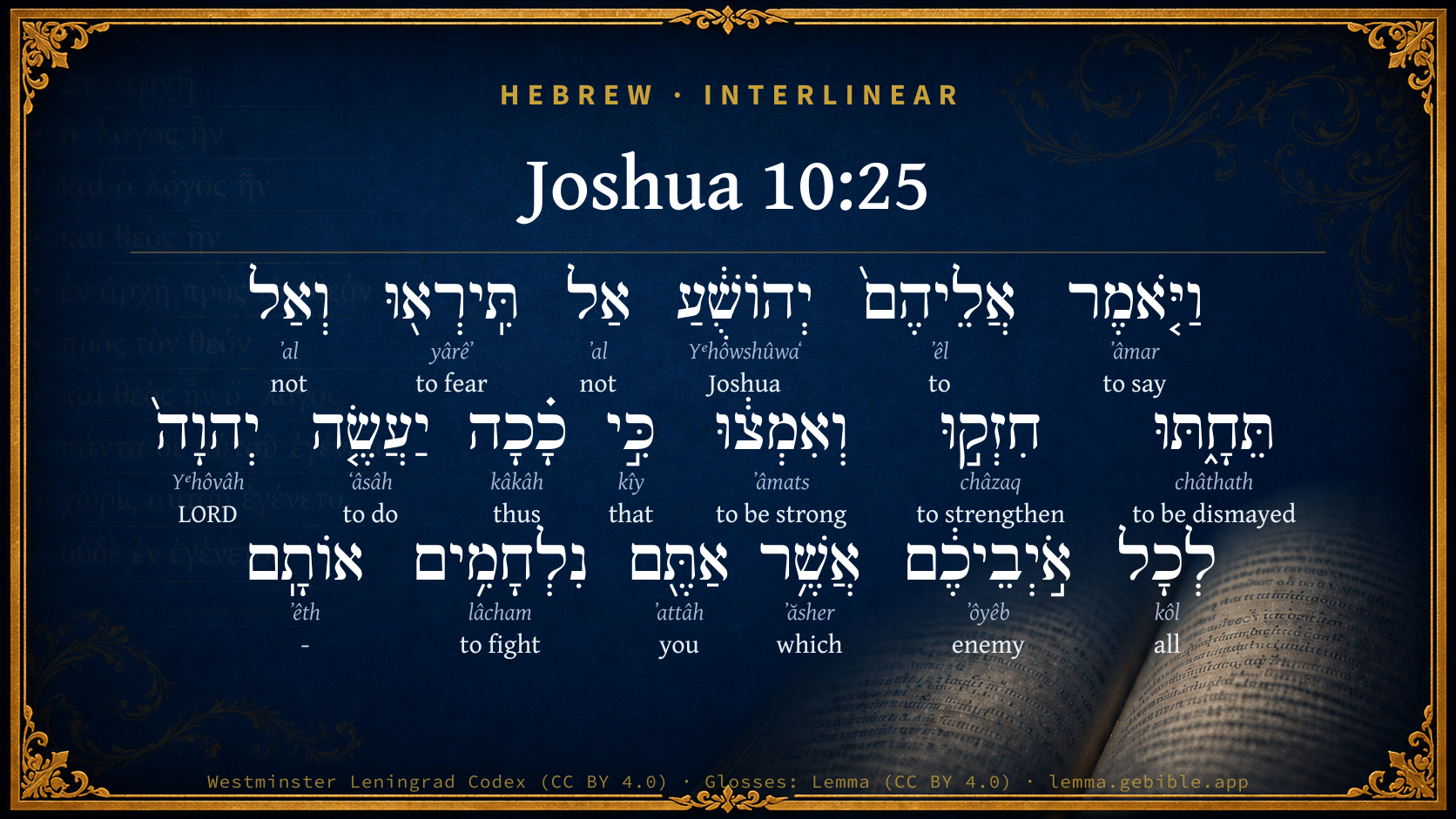
Joshua 10:25

Hebrew (Westminster Leningrad Codex) Joshua 10:25 appears in the Hebrew Old Testament. The text above is from the Westminster Leningrad Codex. Each word links to its Strong’s number, a concise gloss, and parsing drawn from the Open Scriptures Hebrew Bible morphology. Click any word for its full Brown-Driver-Briggs (BDB) entry.
Download image
Cite this verse

Joshua 10:25 (World English Bible). Public Domain. Lemma interlinear Bible study tool, https://lemma.gebible.app/v/joshua/10/25.

Show BibTeX & RIS
BibTeX
RIS
English Translation
Joshua said to them, Don't be afraid, nor be dismayed; be strong and of good courage: for thus shall Yahweh do to all your enemies against whom you fight.
World English Bible · Public Domain
Download a study sheet

One document with this verse’s original text, its word-by-word gloss line, the meaning frame, cross-references with their text, attributed commentary, and full source and license credits — printable, and it pastes into notes with its structure intact.

This verse Autodidact and up

Study sheet (.html) Plain text (.txt)

A passage Seminary Student

Up to 50 verses in one chapter. A passage sheet keeps up to 6 commentary sources and 12 cross-references per verse, in the order this page ranks them, and says so on the sheet whenever that leaves anything out. Ask for a single verse and you get the Autodidact verse sheet above.

Everything on this page stays free to read, with no account — the sheet is a download of what is already on screen, not access to it.

Want to remove ads? Support Godless Engineer
Compare translations 3

The same verse in 3 English versions, stacked beneath the original-language interlinear above. Click any original word for its lexicon entry.

Each is an independent rendering of the whole verse — the interlinear is not word-aligned to these translations.

Highlighted words mark where these versions differ — a whole-verse word diff, not a word-by-word alignment.

  • World English Bible Public Domain
    Joshua said to them, Don't be afraid, nor be dismayed; be strong and of good courage: for thus shall Yahweh do to all your enemies against whom you fight.
  • King James Version Public Domain
    And Joshua said unto them, Fear not, nor be dismayed, be strong and of good courage: for thus shall the LORD do to all your enemies against whom ye fight.
  • unfoldingWord Literal Text CC BY-SA 4.0
    And Joshua said to them, “Do not be afraid and do not be dismayed. Be strong and be courageous, because Yahweh will do thus to all of your enemies with whom you fighting.”

unfoldingWord Literal Text — © unfoldingWord, licensed CC BY-SA 4.0. Word-aligned USFM3 via Door43 (git.door43.org/unfoldingWord/en_ult).

Versions to compare (up to 4)

3 of 4 selected

Show all 18 translations

Every available English version of this verse, each an independent rendering of the whole verse.

  • World English Bible Public Domain
    Joshua said to them, Don't be afraid, nor be dismayed; be strong and of good courage: for thus shall Yahweh do to all your enemies against whom you fight.
  • Berean Standard Bible Public Domain
    “Do not be afraid or discouraged,” Joshua said. “Be strong and courageous, for the LORD will do this to all the enemies you fight.”
  • Majority Standard Bible Public Domain
    “Do not be afraid or discouraged,” Joshua said. “Be strong and courageous, for the LORD will do this to all the enemies you fight.”
  • King James Version Public Domain
    And Joshua said unto them, Fear not, nor be dismayed, be strong and of good courage: for thus shall the LORD do to all your enemies against whom ye fight.
  • American Standard Version (1901) Public Domain
    And Joshua said unto them, Fear not, nor be dismayed; be strong and of good courage: for thus shall Jehovah do to all your enemies against whom ye fight.
  • Revised Version (1885) Public Domain
    And Joshua said unto them, Fear not, nor be dismayed; be strong and of good courage: for thus shall the LORD do to all your enemies against whom ye fight.
  • Geneva Bible (1599) Public Domain
    And Ioshua sayd vnto them, Feare not, nor be faint hearted, but be strong and of a good courage: for thus will the Lord doe to all your enemies, against whome ye fight.
  • Douay-Rheims (1899) Public Domain
    He said again to them: Fear not, neither be ye dismayed, take courage and be strong: for so will the Lord do to all your enemies, against whom you fight.
  • Young's Literal Translation Public Domain
    And Joshua saith unto them, `Fear not, nor be affrighted; be strong and courageous; for thus doth Jehovah do to all your enemies with whom ye are fighting;'
  • Literal Standard Version CC BY-SA 4.0
    And Joshua says to them, “Do not fear, nor be frightened; be strong and courageous; for thus does YHWH do to all your enemies with whom you are fighting”;
  • Unlocked Literal Bible CC BY-SA 4.0
    Then he said to them, “Do not be afraid and do not be dismayed. Be strong and courageous. This is what Yahweh will do to all your enemies you are going to fight.”
  • unfoldingWord Literal Text CC BY-SA 4.0
    And Joshua said to them, “Do not be afraid and do not be dismayed. Be strong and be courageous, because Yahweh will do thus to all of your enemies with whom you fighting.”
  • Darby Bible Public Domain
    And Joshua said to them, Fear not, neither be dismayed; be strong and courageous, for thus will Jehovah do to all your enemies against whom ye fight.
  • World Messianic Bible Public Domain
    Joshua said to them, “Don’t be afraid, nor be dismayed. Be strong and courageous, for the LORD will do this to all your enemies against whom you fight.”
  • Webster's Bible Public Domain
    And Joshua said to them, Fear not, nor be dismayed, be strong and of good courage: for thus shall the LORD do to all your enemies against whom ye fight.
  • Free Bible Version CC BY-SA 4.0
    Joshua said to them, “Don't ever be afraid or discouraged! Be strong and be brave! For the Lord is going to do the same thing to all your enemies that you're going to fight!”
  • Bible in Basic English Public Domain
    And Joshua said to them, Have no fear and do not be troubled; be strong and take heart: for so will the Lord do to all against whom you make war.
  • JPS Tanakh (1917) Public Domain
    And Joshua said unto them: 'Fear not, nor be dismayed; be strong and of good courage; for thus shall the LORD do to all your enemies against whom ye fight.'

Literal Standard Version (2020), Covenant Press — licensed CC BY-SA 4.0. Text via the HelloAO Bible API (eBible.org). Unlocked Literal Bible (unfoldingWord) — licensed CC BY-SA 4.0. Text via the HelloAO Bible API (eBible.org). unfoldingWord Literal Text — © unfoldingWord, licensed CC BY-SA 4.0. Word-aligned USFM3 via Door43 (git.door43.org/unfoldingWord/en_ult). Free Bible Version, Dr. Jonathan Gallagher — licensed CC BY-SA 4.0. Text via the HelloAO Bible API (eBible.org).

Word by word

More ways to search: Search by grammar → Find every occurrence → Compare this word →

Practice this passage: Drill this verse → Learn its vocabulary →

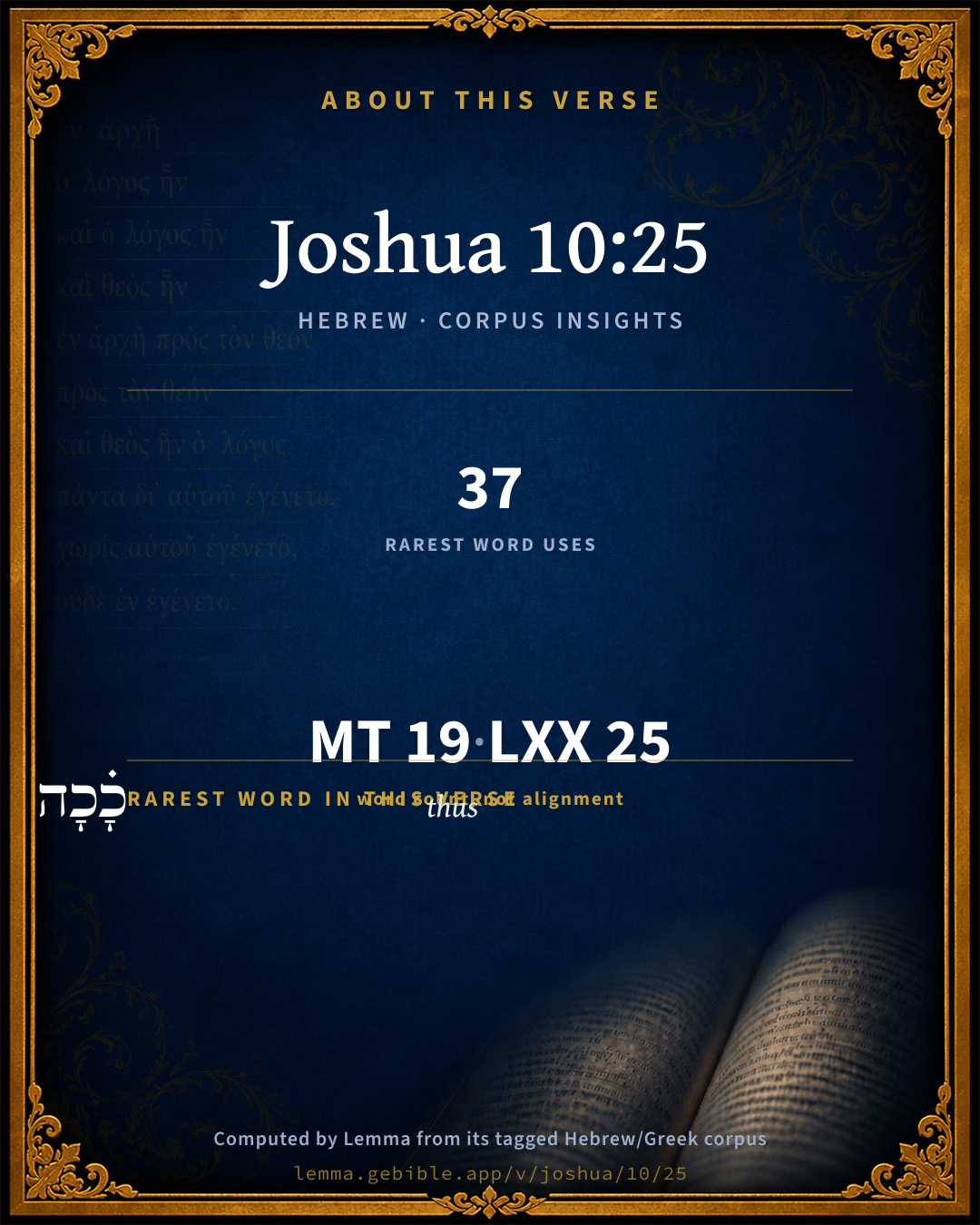
כָ֗כָה
kâkâh
  1. וַיֹּ֤אמֶר ʼâmar H559 “and · to say” Conjunction + Verb, Qal, Sequential Imperfect, 3rd Person, Masculine, Singular
  2. אֲלֵיהֶם֙ ʼêl H413 “to · them” Preposition + Suffix, Personal, 3rd Person, Masculine, Plural
  3. יְהוֹשֻׁ֔עַ Yᵉhôwshûwaʻ H3091 “Joshua” Noun, Proper
  4. אַל ʼal H408 “not” Particle, Negative
  5. תִּֽירְא֖וּ yârêʼ H3372 “to fear” Verb, Qal, Jussive, 2nd Person, Masculine, Plural
  6. וְאַל ʼal H408 “and · not” Conjunction + Particle, Negative
  7. תֵּחָ֑תּוּ châthath H2865 “to be dismayed” Verb, Niphal, Jussive, 2nd Person, Masculine, Plural
  8. חִזְק֣וּ châzaq H2388 “strengthen” Verb, Qal, Imperative, 2nd Person, Masculine, Plural
  9. וְאִמְצ֔וּ ʼâmats H553 “and · be strong” Conjunction + Verb, Qal, Imperative, 2nd Person, Masculine, Plural
  10. כִּ֣י kîy H3588 “that” Conjunction
  11. יַעֲשֶׂ֤ה ʻâsâh H6213 “to do” Verb, Qal, Imperfect, 3rd Person, Masculine, Singular
  12. יְהוָה֙ Yᵉhôvâh H3068 “LORD” Noun, Proper
  13. לְכָל kôl H3605 “to/for · all of” Preposition + Noun, Common, Masculine, Singular, Construct
  14. אֹ֣יְבֵיכֶ֔ם ʼôyêb H341 “enemy · you” Verb, Qal, Participle Active, Masculine, Plural, Construct + Suffix, Personal, 2nd Person, Masculine, Plural
  15. אֲשֶׁ֥ר ʼăsher H834 “which” Particle, Relative
  16. אַתֶּ֖ם ʼattâh H859 “you” Pronoun, Personal, 2nd Person, Masculine, Plural
  17. נִלְחָמִ֥ים lâcham H3898 “fighting” Verb, Niphal, Participle Active, Masculine, Plural, Absolute
  18. אוֹתָֽם ʼêth H853 “- · them” Particle, Direct Object + Suffix, Personal, 3rd Person, Masculine, Plural

About this verse

These counts appear in no published source. They are computed here, from the morphology-tagged text and Lemma’s own curated glosses. What Lemma adds →

19
words
18
distinct lemmas
Historical
section

Shared distinctive vocabulary

כָ֗כָה thus H3602 occurs in 35 verses of the Hebrew Bible. Also found in:

Grammatical profile

  • 8 verbs
  • 3 nouns
  • 1 pronoun
  • 1 preposition
  • 1 conjunction
  • 1 adverb
  • 4 particles

Verb forms

  • וַיֹּ֤אמֶר Qal · Sequential Imperfect
  • תִּֽירְא֖וּ Qal · Jussive
  • תֵּחָ֑תּוּ Niphal · Jussive
  • חִזְק֣וּ Qal · Imperative
  • וְאִמְצ֔וּ Qal · Imperative
  • יַעֲשֶׂ֤ה Qal · Imperfect
  • אֹ֣יְבֵיכֶ֔ם Qal · Participle Active
  • נִלְחָמִ֥ים Niphal · Participle Active

Repetition

A word recurs within this verse — often emphatic in Hebrew:

  • אַל not H408 ×2

Hebrew & Septuagint length

In English translation the verse runs 29 words from the Hebrew and 30 from the Septuagint (LXX English) — closely comparable.

A rough comparison of the two English renderings, which tokenize alike — not a word-level alignment.

Word counts can differ between the Hebrew and the Greek without any difference in meaning — e.g. the Hebrew direct-object marker אֵת has no separate Greek word, and Greek often adds the article ὁ.

In the original languages it is 19 Hebrew tokens and 25 Greek tokens — but the two are counted differently (Hebrew bundles its prefixes and suffixes into one token; the Greek is in lemma form), so that isn’t a like-for-like length.

Cross-references

11

Topical passages linked to Joshua 10:25 in the Treasury of Scripture Knowledge — connected by theme and wording, ordered by reader-vote popularity; previews shown in the World English Bible.

  • Joshua 1:9 Haven't I commanded you? Be strong and of good courage; don't be afraid, neither be dismayed: for Yahweh your God is with you wherever you go.
  • 2 Corinthians 1:10 who delivered us out of so great a death, and does deliver; on whom we have set our hope that he will also still deliver us;
  • Ephesians 6:10 Finally, be strong in the Lord, and in the strength of his might.
  • 1 Samuel 17:37 David said, Yahweh who delivered me out of the paw of the lion, and out of the paw of the bear, he will deliver me out of the hand of this Philistine. Saul said to David, Go, and Yahweh shall be with you.
  • Deuteronomy 7:19 the great trials which your eyes saw, and the signs, and the wonders, and the mighty hand, and the outstretched arm, by which Yahweh your God brought you out: so shall Yahweh your God do to all the peoples of whom you are afraid.
  • Deuteronomy 31:6–8 Be strong and of good courage, don't be afraid, nor be scared of them: for Yahweh your God, he it is who does go with you; he will not fail you, nor forsake you.
  • Romans 8:37 No, in all these things, we are more than conquerors through him who loved us.
  • Deuteronomy 3:21–22 I commanded Joshua at that time, saying, Your eyes have seen all that Yahweh your God has done to these two kings: so shall Yahweh do to all the kingdoms where you go over.
  • 2 Timothy 4:17–18 But the Lord stood by me, and strengthened me, that through me the message might be fully proclaimed, and that all the Gentiles might hear; and I was delivered out of the mouth of the lion.
  • Psalms 63:9 But those who seek my soul, to destroy it, Shall go into the lower parts of the earth.
  • Psalms 77:11 I will remember Yah's deeds; For I will remember your wonders of old.

Cross-references courtesy of OpenBible.info (CC BY 4.0).

Hebrew and Greek witnesses Masoretic Hebrew ↔ Greek Septuagint

The same verse in the two great witnesses to the Old Testament, shown verse-for-verse.

These are two independent witnesses, not word-aligned to each other, and the Septuagint is shown in lemma (dictionary) form.

Hebrew Joshua 10:25 Masoretic · Westminster Leningrad Codex

וַיֹּ֤אמֶר אֲלֵיהֶם֙ יְהוֹשֻׁ֔עַ אַל תִּֽירְא֖וּ וְאַל תֵּחָ֑תּוּ חִזְק֣וּ וְאִמְצ֔וּ כִּ֣י כָ֗כָה יַעֲשֶׂ֤ה יְהוָה֙ לְכָל אֹ֣יְבֵיכֶ֔ם אֲשֶׁ֥ר אַתֶּ֖ם נִלְחָמִ֥ים אוֹתָֽם

Joshua said to them, Don't be afraid, nor be dismayed; be strong and of good courage: for thus shall Yahweh do to all your enemies against whom you fight.

World English Bible · Public Domain

Greek LXX Joshua 10:25 Septuagint · lemma form

καί εἶπον πρός αὐτός ἰησοῦς μή φοβέω αὐτός μηδέ δειλιάω ἀνδρίζομαι καί ἰσχύω ὅτι οὕτως ποιέω κύριος πᾶς ὁ ἐχθρός σύ ὅς σύ καταπολεμέω αὐτός

And Joshua said to them, Do not fear them, neither be cowardly; be courageous and strong, for thus the Lord will do to all your enemies, against whom you⌃ fight.

LXX2012 (modern English Septuagint) · Public Domain

Hebrew: Westminster Leningrad Codex (CC BY 4.0). Greek: Septuagint (public domain); English from LXX2012 (modern English Septuagint) (Public Domain). How the Septuagint differs from the Hebrew →

Targum (Aramaic paraphrase)

1

The Targum is the ancient Jewish Aramaic paraphrase of the Hebrew Scriptures — an interpretive translation, not the Hebrew text itself. Onkelos (literal) and Pseudo-Jonathan (expansive) render the Torah, and Jonathan the Prophets. Coverage is partial: where no permissively-licensed English translation exists for a verse, only the Aramaic is shown. This is verse-level text, not a word-by-word alignment to the Hebrew.

  1. Targum Jonathan Prophets (Joshua–Malachi)
    וַאֲמַר לְהוֹן יְהוֹשֻׁעַ לָא תִדַחֲלוּן וְלָא תִתַּבְּרוּן תַּקִיפוּ וַעֲלִימוּ אֲרֵי כְּדֵין יַעֲבֵּד יְיָ לְכָל בַּעֲלֵי דְבָבֵיכוֹן דְאַתּוּן מַגִיחִין קְרָבָא בְהוֹן:

    (no public-domain English translation for this verse)

    Targum Jonathan — Aramaic: “Mikraot Gedolot” (public domain). English: “Sefaria Community Translation” (CC0 1.0 (public-domain dedication)); “London "Chaldee Paraphrase," 1871” (public domain). Text via Sefaria.

Commentary

Notes on Joshua 10:25 from classic Christian and Jewish commentators (each source and its license shown beneath its notes). The classic Christian expositions comment on the surrounding passage and are grouped to its opening verse, so a note may address several verses; the Jewish commentaries on the Tanakh (Rashi and others) are per-verse, so they appear only where the commentator wrote on this verse.

Lemma curates 59 commentaries, every one of them public domain or Creative Commons licensed, each selected and text-cleaned for this edition rather than reprinted as found. About our sources →

Trapp's Complete Commentary

John Trapp

Jos 10:25 And Joshua said unto them, Fear not, nor be dismayed, be strong and of good courage: for thus shall the LORD do to all your enemies against whom ye fight.

Ver. 25. Fear not, nor be dismayed, &c.] To the like sense saith the Captain of our salvation to his spiritual soldiers, "Watch ye, stand fast in the faith, quit you like men, be strong." {1Co 16:13}

For thus shall the Lord do,] sc., If you do not the work of the Lord deceitfully or slothfully. {Jer 48:10}

John Trapp, A Commentary or Exposition upon All the Books of the Old and New Testament (1647–1656) — public domain. Text from a community e-Sword module.

Tyndale Open Study Notes

Tyndale Open Resources

10:25 Joshua encouraged his men at Makkedah, using the same words God had used to encourage him before Israel crossed the Jordan and again before the battle of Ai (1:9; 8:1).

Tyndale Open Study Notes — © Tyndale Open Resources, licensed CC BY-SA 4.0. Text via the HelloAO Bible API.

John Calvin's Commentaries

25. And Joshua said unto them, Fear not, etc Joshua now triumphs in the persons of the five kings over all the others who remained. For he exhorts his own people to confidence, just as if those who still stood unsubdued were actually prostrate under their feet. Hence we gather, that by the trampling down of a few, the whole people were so elated, that they looked down with contempt on all the others, as if they were already overthrown. And, certainly, we have here a brighter display of the divine power, which could thus inspire confidence for the future.

It is to be observed, however, that the kings were hung up, not for the purpose of exercising greater severity upon them, but merely by way of ignominy, as they were already slain. It was expedient that this memorable act of divine vengeance should be openly displayed in the view of all. Perhaps, also, it was the divine purpose to infuriate the other nations by despair, and drive them to madness, that they might bring down swifter destruction on themselves, whetting the wrath of the Israelites by their obstinacy. The same ignominy is inflicted on the king of Makkedah, though he had not led out his forces, and a similar destruction is executed on the whole people, who had kept quiet within their walls. It is probable, indeed, that they had made some hostile attempt, but the special reason was, that God had passed the same sentence upon all. Why the dead bodies were thrown into the cave at evening, I have elsewhere explained. Moreover, this whole history holds up to us as in a mirror, how, when the Lord is seated on his tribunal, all worldly splendor vanishes before him, and the glory of those who seemed to excel is turned by his judgment into the greatest disgrace.

John Calvin's Commentaries (1540-1563) — public domain. Text from the Calvin Translation Society English edition (1840s-50s) via the Christian Classics Ethereal Library (ccel.org). Calvin's coverage is partial (roughly two-thirds of the Bible); uncommented books and verses are honest gaps, never fabricated. The 19th-century editor's footnotes and remarks are omitted so the notes are faithfully Calvin's own voice.

Ellicott's Commentary for English Readers

(25) Fear not, nor be dismayed, be strong and of good courage.—The very words spoken to Joshua by Jehovah (Jos_1:9) with the exception of the word for fear, which is stronger in Jos_1:9. Even ordinary fear is needless. Alarm is not to be thought of.

A Bible Commentary for English Readers, edited by Charles John Ellicott (1878–1897) — public domain. Text from a community e-Sword module.

The Cambridge Bible for Schools and Colleges

gen. ed. J. J. S. Perowne

25. Fear not] “Take çe coumfort (con and fortis), and be çe stronge,” Wyclif. The proud foes they had so lately seen in all the pomp and circumstance of war lay prostrate at their feet.

for thus] Even as, after the defeat of Sihon and Og, Moses had assured Joshua would be the case, saying, “Thine eyes have seen all that the Lord your God hath done unto these two kings; so shall the Lord do unto all the kingdoms whither thou passest. Ye shall not fear them: for the Lord your God he shall fight for you,” Deu_3:21-22; Exo_14:14.

The Cambridge Bible for Schools and Colleges (gen. ed. J. J. S. Perowne; Cambridge University Press, 1878–1918) — public domain. Text from a community e-Sword module.

John Gill's Exposition

And afterwards Joshua smote them and slew them,.... With the sword; either by his own hands, or by others whom he ordered to slay them:

and hanged them on five trees; to their shame and disgrace, and the terror of others:

and they were hanging upon the trees until the evening; by way of contempt of them, and as a spectacle of terror to others, especially to the inhabitants of Makkedah, and their king they were now besieging.

John Gill's Exposition of the Whole Bible (1746–1763) — public domain (CC PDM 1.0). Text via the HelloAO Bible API.

Whedon's Commentary on the Bible

Daniel D. Whedon

25. Thus shall the Lord do to all your enemies — Unless ye forfeit my favour by your sin, as in the first battle with Ai. Thus every Christian, if faithful to Christ, will “find his latest foe under his feet at last.”

Daniel D. Whedon (gen. ed.), Commentary on the Old and New Testaments (1874–1909) — public domain. Text from a community e-Sword module.

The Pulpit Commentary

Fear not, nor be dismayed. As Keil remarks, these arc the very words which God used to Joshua when He bade him enter upon his great task. See Jos_1:9. So now may the experience of one Christian in the warfare against the powers of evil be imparted as encouragement to another. Ye fight. The word "ye" is emphatic. Perhaps Joshua would convey the idea that the Israelites were not to attribute their success to their leader, or to any Divine favor resting upon him as an individual, but to believe that, as long as they served God faithfully, His presence would be as much with them as it was at that particular time and under that particular leader.

HOMILIES BY W.F. ADENEY Ver. 25. Courage and strength.

I THE DUTY TO BE BRAVE AND STRONG. This is often insisted on in the Book of Joshua. (e.g., Jos_1:6) Christianity gives prominence to gentler graces of humility, mildness, and the forgiving spirit. But it does not therefore exonerate us from the more masculine duties. (1Co_16:13 Eph_6:10)

(1) It is our duty to be brave. Cowardice is a sin in a Christian even more than in a pagan, because the Christian has higher motives for courage. The exhortation, "Fear not," is not only an encouragement to comfort; it is an incitement to duty, because cowardice leads us to shrink from

(a) danger,

(b) responsibility,

(c) pain and loss,

(d) ridicule; and yet all of these may come in the way of our life"s work.

(2) It is our duty to be strong. We should not simply bewail weakness as a calamity; we should repent of it as a failing. Moral weakness comes from moral corruption. It makes us fail in our work of resisting sin and doing good. It is therefore needful that we should overcome it if we are to fulfil our mission.

II THE CALL FOR THE EXERCISE OF THIS DUTY.

(1) We are surrounded by alarming dangers;

(a) in our own sinful hearts;

(b) in the evil of the world, and the troubles and temptations which arise from this;

(c) in the mystery of life.

He who is not brave with God"s courage will sink before these terrors when once he realises their full proportions.

(2) We are called to difficult tasks;

(a) like the Israelites, we are invited to take possession of an inheritance. The kingdom of heaven is not won without fighting; (1Co_9:26)

(b) like the Israelites, we have foes to resist in sin within and temptation without; (1Pe_5:8, 1Pe_5:9)

(c) like the Israelites, we have territory to conquer for God. We have not to fight for our own inheritance and safety only or chiefly, but that we may win the world for Christ. (1Ti_6:12 2Ti_2:3)

III THE SECRET OF COURAGE AND STRENGTH.

(1) They are derived from God. We are not to fear, because God is with us. (Isa_43:1, Isa_43:2) We are to be strong in His strength. (Psa_29:11 Php_4:13) Therefore those naturally most timid and weak can be strong and brave in God. (Isa_40:31 2Co_12:10)

(2) They are encouraged by experience. To us it appears a brutal source of courage those Hebrew captains planting their feet on the necks of the conquered kings in triumph. But rejoicing in the victory, it was well that they should see God"s hand in it, and gain strength from it. We may seek strength and courage in the contemplation of the way in which God has helped us in the past. (Psa_34:6)

(3) They are increased by practice. The text is an exhortation. Though strength and courage come from God, they come through our own efforts to be brave and energetic. We must exercise Divine grace in order to realise its efficiency. (Php_2:12)

(4) They are mutually helpful. Courage and strength are associated. Courage without strength is rash. Strength without courage is futile. We must be strong to justify our courage and brave to use our strength. Thus the various Christian graces are linked together in arming a soul with the whole armour of God. W.F.A. (Eph_6:11)

The Pulpit Commentary (1880–1919), ed. H.D.M. Spence-Jones & Joseph S. Exell — public domain. Text from a community e-Sword module.

Lesson kit

Teaching starters — assembled from the data on this page, not authored interpretation. Every prompt links to the verse data it draws on. Edit before teaching.

Joshua, in the Historical, opens this verse with 19 words (18 distinct Hebrew lemmas). Its most distinctive word is kâkâh (“thus”). A historical commentator’s framing appears above. Read the whole chapter for the surrounding context.

Discussion questions

  1. The word kâkâh carries the sense “thus.” How does it shape the verse?
  2. Exodus 12:11 shares the word «thus» with this verse. How do the two illuminate each other?
  3. “not” occurs 2× in this one verse. What is the effect of the repetition?
  4. The translations on this page render this verse differently — a whole-verse word diff, not a word-by-word alignment. What might account for the different wordings?
  5. The verb «וַיֹּ֤אמֶר» is Qal Sequential Imperfect. How does its form color the action?
  6. Reading how Trapp's Complete Commentary and Tyndale Open Study Notes read this verse, where do the two commentators agree and where do they part?

Things to notice

Reading settings

Reading text

Shown beneath each verse's original-language words.

Old Testament
Old Testament edition

Read the OT as the Masoretic Hebrew (MT) or the Greek Septuagint (LXX).

English shown for the Greek Septuagint (in the Hebrew ↔ Greek comparison).

Comparing translations? Open the Compare panel on any verse page to stack up to four side by side.