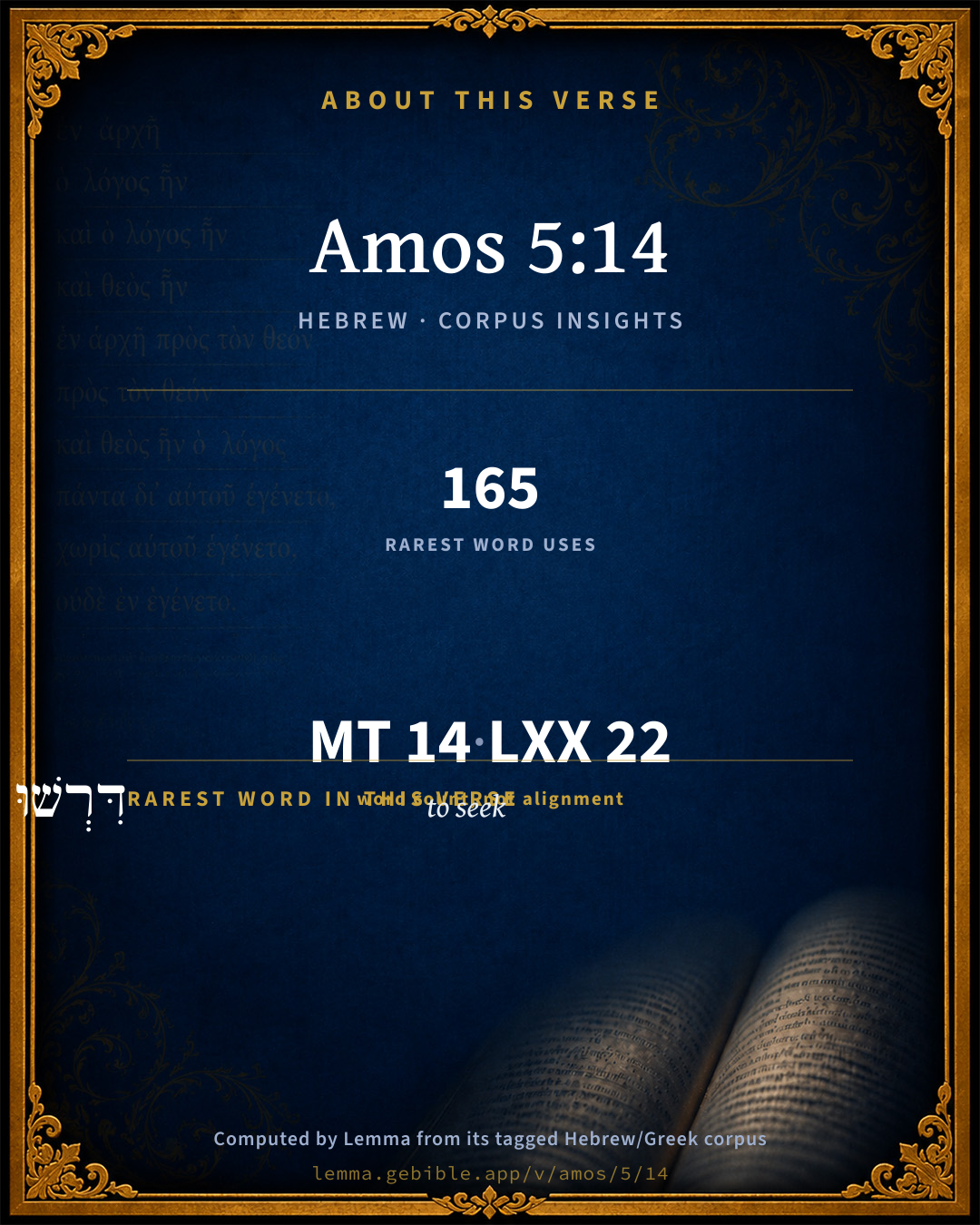
Amos 5:14

Hebrew (Westminster Leningrad Codex) Amos 5:14 appears in the Hebrew Old Testament. The text above is from the Westminster Leningrad Codex. Each word links to its Strong’s number, a concise gloss, and parsing drawn from the Open Scriptures Hebrew Bible morphology. Click any word for its full Brown-Driver-Briggs (BDB) entry.
Download image
Cite this verse

Amos 5:14 (World English Bible). Public Domain. Lemma interlinear Bible study tool, https://lemma.gebible.app/v/amos/5/14.

Show BibTeX & RIS
BibTeX
RIS
English Translation
Seek good, and not evil, That you may live; And so Yahweh, the God of hosts, will be with you, As you say.
World English Bible · Public Domain
Download a study sheet

One document with this verse’s original text, its word-by-word gloss line, the meaning frame, cross-references with their text, attributed commentary, and full source and license credits — printable, and it pastes into notes with its structure intact.

This verse Autodidact and up

Study sheet (.html) Plain text (.txt)

A passage Seminary Student

Up to 50 verses in one chapter. A passage sheet keeps up to 6 commentary sources and 12 cross-references per verse, in the order this page ranks them, and says so on the sheet whenever that leaves anything out. Ask for a single verse and you get the Autodidact verse sheet above.

Everything on this page stays free to read, with no account — the sheet is a download of what is already on screen, not access to it.

Want to remove ads? Support Godless Engineer
Compare translations 3

The same verse in 3 English versions, stacked beneath the original-language interlinear above. Click any original word for its lexicon entry.

Each is an independent rendering of the whole verse — the interlinear is not word-aligned to these translations.

Highlighted words mark where these versions differ — a whole-verse word diff, not a word-by-word alignment.

  • World English Bible Public Domain
    Seek good, and not evil, That you may live; And so Yahweh, the God of hosts, will be with you, As you say.
  • King James Version Public Domain
    Seek good, and not evil, that ye may live: and so the LORD, the God of hosts, shall be with you, as ye have spoken.
  • unfoldingWord Literal Text CC BY-SA 4.0
    Seek good and not evil, so that you may live. So Yahweh, the God of hosts, will really be with you, as you say he is.

unfoldingWord Literal Text — © unfoldingWord, licensed CC BY-SA 4.0. Word-aligned USFM3 via Door43 (git.door43.org/unfoldingWord/en_ult).

Versions to compare (up to 4)

3 of 4 selected

Show all 18 translations

Every available English version of this verse, each an independent rendering of the whole verse.

  • World English Bible Public Domain
    Seek good, and not evil, That you may live; And so Yahweh, the God of hosts, will be with you, As you say.
  • Berean Standard Bible Public Domain
    Seek good, not evil, so that you may live. And the LORD, the God of Hosts, will be with you, as you have claimed.
  • Majority Standard Bible Public Domain
    Seek good, not evil, so that you may live. And the LORD, the God of Hosts, will be with you, as you have claimed.
  • King James Version Public Domain
    Seek good, and not evil, that ye may live: and so the LORD, the God of hosts, shall be with you, as ye have spoken.
  • American Standard Version (1901) Public Domain
    Seek good, and not evil, that ye may live; and so Jehovah, the God of hosts, will be with you, as ye say.
  • Revised Version (1885) Public Domain
    Seek good, and not evil, that ye may live: and so the LORD, the God of hosts, shall be with you, as ye say.
  • Geneva Bible (1599) Public Domain
    Seeke good and not euil, that ye may liue: and the Lord God of hostes shalbe with you, as you haue spoken.
  • Douay-Rheims (1899) Public Domain
    Seek ye good, and not evil, that you may live: and the Lord the God of hosts will be with you, as you have said.
  • Young's Literal Translation Public Domain
    Seek good, and not evil, that ye may live, And it is so; Jehovah, God of Hosts, `is' with you, as ye said.
  • Literal Standard Version CC BY-SA 4.0
    Seek good, and not evil, that you may live, and it is so; YHWH, God of Hosts, [is] with you, as you said.
  • Unlocked Literal Bible CC BY-SA 4.0
    Seek good and not evil, so that you may live. So Yahweh, the God of hosts, will really be with you, as you say he is.
  • unfoldingWord Literal Text CC BY-SA 4.0
    Seek good and not evil, so that you may live. So Yahweh, the God of hosts, will really be with you, as you say he is.
  • Darby Bible Public Domain
    Seek good, and not evil, that ye may live; and so Jehovah, the God of hosts, shall be with you, as ye say.
  • World Messianic Bible Public Domain
    Seek good, and not evil, that you may live; and so the LORD, the God of Hosts, will be with you, as you say.
  • Webster's Bible Public Domain
    Seek good, and not evil, that ye may live: and so the LORD, the God of hosts, shall be with you, as ye have spoken.
  • Free Bible Version CC BY-SA 4.0
    Do what is right, and not evil, so you may live. Then the Lord God of power will be with you, as you claim he is.
  • Bible in Basic English Public Domain
    Go after good and not evil, so that life may be yours: and so the Lord, the God of armies, will be with you, as you say.
  • JPS Tanakh (1917) Public Domain
    Seek good, and not evil, that ye may live; and so the LORD, the God of hosts, will be with you, as ye say.

Literal Standard Version (2020), Covenant Press — licensed CC BY-SA 4.0. Text via the HelloAO Bible API (eBible.org). Unlocked Literal Bible (unfoldingWord) — licensed CC BY-SA 4.0. Text via the HelloAO Bible API (eBible.org). unfoldingWord Literal Text — © unfoldingWord, licensed CC BY-SA 4.0. Word-aligned USFM3 via Door43 (git.door43.org/unfoldingWord/en_ult). Free Bible Version, Dr. Jonathan Gallagher — licensed CC BY-SA 4.0. Text via the HelloAO Bible API (eBible.org).

Word by word

More ways to search: Search by grammar → Find every occurrence → Compare this word →

Practice this passage: Drill this verse → Learn its vocabulary →

דִּרְשׁוּ
dârash
H1875
“seek”
Verb, Qal, Imperative, 2nd Person, Masculine, Plural
Part of Speech
Verb
Stem
Qal
Form
Imperative
Person
2nd Person
Gender
Masculine
Number
Plural
Full BDB Definition

Origin: a primitive root

TWOT: 455

to resort to, seek, seek with care, enquire, require - (Qal) - to resort to, frequent (a place), (tread a place) - to consult, enquire of, seek - of God - of heathen gods, necromancers - to seek deity in prayer and worship - God - heathen deities - to seek (with a demand), demand, require - to investigate, enquire - to ask for, require, demand - to practice, study, follow, seek with application - to seek with care, care for - (Niphal) - to allow oneself to be enquired of, consulted (only of God) - to be sought, be sought out - to be required (of blood)

  1. ט֥וֹב ṭôwb H2896 “good” Adjective, Adjective, Masculine, Singular, Absolute
  2. וְאַל ʼal H408 “and · not” Conjunction + Particle, Negative
  3. רָ֖ע raʻ H7451 “evil” Adjective, Adjective, Masculine, Singular, Absolute
  4. לְמַ֣עַן maʻan H4616 “for the sake of” Preposition
  5. תִּֽחְי֑וּ châyâh H2421 “to live” Verb, Qal, Imperfect, 2nd Person, Masculine, Plural
  6. וִיהִי hâyâh H1961 “and · to be” Conjunction + Verb, Qal, Jussive, 3rd Person, Masculine, Singular
  7. כֵ֞ן kên H3651 “thus” Adverb
  8. יְהוָ֧ה Yᵉhôvâh H3068 “LORD” Noun, Proper
  9. אֱלֹהֵֽי ʼĕlôhîym H430 “God(s) of” Noun, Common, Masculine, Plural, Construct
  10. צְבָא֛וֹת tsâbâʼ H6635 “armies” Noun, Common, Both, Plural, Absolute
  11. אִתְּכֶ֖ם ʼêth H854 “with · you” Preposition + Suffix, Personal, 2nd Person, Masculine, Plural
  12. כַּאֲשֶׁ֥ר ʼăsher H834 “like/as · which” Preposition + Particle, Relative
  13. אֲמַרְתֶּֽם ʼâmar H559 “to say” Verb, Qal, Perfect, 2nd Person, Masculine, Plural

About this verse

These counts appear in no published source. They are computed here, from the morphology-tagged text and Lemma’s own curated glosses. What Lemma adds →

14
words
14
distinct lemmas
Prophets
section

Grammatical profile

  • 4 verbs
  • 3 nouns
  • 2 adjectives
  • 2 prepositions
  • 1 adverb
  • 2 particles

Verb forms

  • דִּרְשׁוּ Qal · Imperative
  • תִּֽחְי֑וּ Qal · Imperfect
  • וִיהִי Qal · Jussive
  • אֲמַרְתֶּֽם Qal · Perfect

Hebrew & Septuagint length

In English translation the verse runs 23 words from the Hebrew and 23 from the Septuagint (LXX English) — the same length.

A rough comparison of the two English renderings, which tokenize alike — not a word-level alignment.

Word counts can differ between the Hebrew and the Greek without any difference in meaning — e.g. the Hebrew direct-object marker אֵת has no separate Greek word, and Greek often adds the article ὁ.

In the original languages it is 14 Hebrew tokens and 22 Greek tokens — but the two are counted differently (Hebrew bundles its prefixes and suffixes into one token; the Greek is in lemma form), so that isn’t a like-for-like length.

Cross-references

24

Topical passages linked to Amos 5:14 in the Treasury of Scripture Knowledge — connected by theme and wording, ordered by reader-vote popularity; previews shown in the World English Bible.

  • Joshua 1:9 Haven't I commanded you? Be strong and of good courage; don't be afraid, neither be dismayed: for Yahweh your God is with you wherever you go.
  • Matthew 6:33 But seek first God's Kingdom, and his righteousness; and all these things will be given to you as well.
  • Micah 6:8 He has shown you, O man, what is good. What does Yahweh require of you, but to act justly, To love mercy, and to walk humbly with your God?
  • Micah 3:11 Her leaders judge for bribes, And her priests teach for a price, And her prophets of it tell forturnes for money: Yet they lean on Yahweh, and say, Isn't Yahweh in the midst of us? No disaster will come on us.
  • Philippians 4:8–9 Finally, brothers, whatever things are true, whatever things are honorable, whatever things are just, whatever things are pure, whatever things are lovely, whatever things are of good report; if there is any virtue, and if there is any praise, think about these things.
  • 2 Timothy 4:22 The Lord Jesus Christ be with your spirit. Grace be with you. Amen.
  • Genesis 39:2–3 Yahweh was with Joseph, and he was a prosperous man. He was in the house of his master the Egyptian.
  • 1 Chronicles 28:20 David said to Solomon his son, Be strong and of good courage, and do it: don't be afraid, nor be dismayed; for Yahweh God, even my God, is with you; he will not fail you, nor forsake you, until all the work for the service of the house of Yahweh is finished.
  • Psalms 34:12–16 Who is someone who desires life, And loves many days, that he may see good?
  • Isaiah 48:1–2 Hear you this, house of Jacob, who are called by the name of Israel, and are come forth out of the waters of Judah; who swear by the name of Yahweh, and make mention of the God of Israel, but not in truth, nor in righteousness
  • Romans 2:7–9 to those who by patience in well-doing seek for glory and honor and incorruptibility, eternal life;
  • Jeremiah 7:3–4 Thus says Yahweh of Hosts, the God of Israel, Amend your ways and your doings, and I will cause you to dwell in this place.
  • Amos 3:3 Do two walk together, Unless they have agreed?
  • Psalms 46:11 Yahweh of Hosts is with us. The God of Jacob is our refuge. Selah.
  • Proverbs 11:27 He who diligently seeks good seeks favor, But he who searches after evil, it shall come to him.
  • Isaiah 55:2 Why do you spend money for that which is not bread? and your labor for that which doesn't satisfy? listen diligently to me, and eat you that which is good, and let your soul delight itself in fatness.
  • Matthew 1:23 "Behold, the virgin shall be with child, And shall bring forth a son. They shall call his name Immanuel;" Which is, being interpreted, "God with us."
  • Genesis 39:23 The keeper of the prison didn't look after anything that was under his hand, because Yahweh was with him; and that which he did, Yahweh made it prosper.
  • Exodus 3:12 He said, "Certainly I will be with you. This will be the token to you, that I have sent you: when you have brought forth the people out of Egypt, you shall serve God on this mountain."
  • Numbers 16:3 and they assembled themselves together against Moses and against Aaron, and said to them, You take too much on you, seeing all the congregation are holy, everyone of them, and Yahweh is among them: why then lift yourselves up above the assembly of Yahweh?
  • 2 Chronicles 15:2 and he went out to meet Asa, and said to him, Hear you me, Asa, and all Judah and Benjamin: Yahweh is with you, while you are with him; and if you seek him, he will be found of you; but if you forsake him, he will forsake you.
  • Isaiah 1:16–17 Wash yourselves, make yourself clean. Put away the evil of your doings from before my eyes; Cease to do evil.
  • Isaiah 8:10 Take counsel together, and it shall be brought to nothing; speak the word, and it shall not stand: for God is with us.
  • Matthew 28:20 teaching them to observe all things that I commanded you. Behold, I am with you always, even to the end of the age." Amen.

Cross-references courtesy of OpenBible.info (CC BY 4.0).

Hebrew and Greek witnesses Masoretic Hebrew ↔ Greek Septuagint

The same verse in the two great witnesses to the Old Testament, shown verse-for-verse.

These are two independent witnesses, not word-aligned to each other, and the Septuagint is shown in lemma (dictionary) form.

Hebrew Amos 5:14 Masoretic · Westminster Leningrad Codex

דִּרְשׁוּ ט֥וֹב וְאַל רָ֖ע לְמַ֣עַן תִּֽחְי֑וּ וִיהִי כֵ֞ן יְהוָ֧ה אֱלֹהֵֽי צְבָא֛וֹת אִתְּכֶ֖ם כַּאֲשֶׁ֥ר אֲמַרְתֶּֽם

Seek good, and not evil, That you may live; And so Yahweh, the God of hosts, will be with you, As you say.

World English Bible · Public Domain

Greek LXX Amos 5:14 Septuagint · lemma form

ἐκζητέω ὁ καλός καί μή ὁ πονηρός ὅπως ζάω καί εἰμί οὕτως μετά σύ κύριος ὁ θεός ὁ παντοκράτωρ ὅς τρόπος εἶπον

Seek good, and not evil, that you⌃ may live: and so the Lord God Almighty shall be with you, as you⌃ have said,

LXX2012 (modern English Septuagint) · Public Domain

Hebrew: Westminster Leningrad Codex (CC BY 4.0). Greek: Septuagint (public domain); English from LXX2012 (modern English Septuagint) (Public Domain). How the Septuagint differs from the Hebrew →

Targum (Aramaic paraphrase)

1

The Targum is the ancient Jewish Aramaic paraphrase of the Hebrew Scriptures — an interpretive translation, not the Hebrew text itself. Onkelos (literal) and Pseudo-Jonathan (expansive) render the Torah, and Jonathan the Prophets. Coverage is partial: where no permissively-licensed English translation exists for a verse, only the Aramaic is shown. This is verse-level text, not a word-by-word alignment to the Hebrew.

  1. Targum Jonathan Prophets (Joshua–Malachi)
    תְּבָעוּ לְאוֹטָבָא וְלָא לְאַבְאָשָׁא בְּדִיל דְתִתְקַיְמוּן וִיהֵי כְעַן מֵימְרָא דַייָ אֱלֹהִים צְבָאוֹת בְּסַעְדְכוֹן כְּמָא דַאֲמַרְתּוּן:

    (no public-domain English translation for this verse)

    Targum Jonathan — Aramaic: “Mikraot Gedolot” (public domain). English: “Sefaria Community Translation” (CC0 1.0 (public-domain dedication)); “London "Chaldee Paraphrase," 1871” (public domain). Text via Sefaria.

Commentary

Notes on Amos 5:14 from classic Christian and Jewish commentators (each source and its license shown beneath its notes). The classic Christian expositions comment on the surrounding passage and are grouped to its opening verse, so a note may address several verses; the Jewish commentaries on the Tanakh (Rashi and others) are per-verse, so they appear only where the commentator wrote on this verse.

Lemma curates 59 commentaries, every one of them public domain or Creative Commons licensed, each selected and text-cleaned for this edition rather than reprinted as found. About our sources →

Trapp's Complete Commentary

John Trapp

Amo 5:14 Seek good, and not evil, that ye may live: and so the LORD, the God of hosts, shall be with you, as ye have spoken.

Ver. 14. Seek good, and not evil, that ye may live] See Amo 5:4; Amo 5:6. Oh seek, seek, seek, saith our prophet; as some of the martyrs cried out, Pray, pray, pray: Mr Sanders and Mrs Askew repeated those words two different times together, Mr Marsh once, adding, Never more need. To seek God is to seek good, and to find life; for with him is the fountain of life, Psa 36:9. To seek evil is to seek the devil, who is that evil one (ο πονηρος): it is, as Solomon saith in a like case, "a vanity tossed to and fro of them that seek death," Pro 21:6.

And so the Lord, the God of hosts, shall be with you] To assist and accept you in seeking good; to protect and provide for you in shunning evil. Deal courageously, therefore, and God shall be with the good, 2Ch 19:11, as your seven-fold shield (επραβοειος), and exceeding great reward, Gen 15:1. {See Trapp on "Gen 15:1"}

As ye have spoken] Ut praedicatis et iactitatis, as ye boast and bear yourselves bold upon; saying, as Mic 2:11, "Is not the Lord among us? none evil can come upon us." But that is as you make it; for ye are upon your behaviour. The fault is not in God, but wholly in yourselves, if ye live not happily, reign not everlastingly, - at Paris ut vivat regnetque beatus Cogi posse negat (Horat. Eph 2:1-22). God is far from men’s hearts; and therefore far from their help: for "can two walk together, except they be agreed?" Amo 3:3.

John Trapp, A Commentary or Exposition upon All the Books of the Old and New Testament (1647–1656) — public domain. Text from a community e-Sword module.

The Biblical Illustrator

Joseph S. Exell

Amo_5:14

Seek good and not evil, that ye may live.

Religion

From these words two things may be inferred concerning religion.

I. It implies a specific pursuit. Seek good, and not evil. Good and evil are both in the world; they work in all human souls; they explain all history.

1. They imply a standard of right. By what do we determine the good and evil in human life? The revealed will of God. What accords with that will is good, what disagrees with it is evil.

2. Their object is a human pursuit. There are those who pursue evil; they follow it for worldly wealth, animal pleasure, secular aggrandisement. There are those who pursue good; and their grand question is, Lord, what wilt Thou have me to do?

3. The pursuit of good is the specific effort of religion. Good in thought, spirit, aim, habit, as embodied in the life of Christ. To get good requires strenuous, persistent, devout, prayerful effort.

II. It involves the highest benediction.

1. The enjoyment of true life. That ye may live. Without goodness you cannot really live: goodness is life. Everlasting goodness is everlasting life.

2. The enjoyment of the Divine friendship. What a benediction this! The Lord God of hosts, the Almighty Creator, Proprietor and Governor of the universe to be with us, to guide, guard, beautify existence. I will walk among you, says He, I will be your God, and ye shall be My people. (Homilist.)

Siding with the good is to be on Gods side

If a man wants to be on the winning side, let him be on the right side. There is no other safe rule to conform to. If a man is on the right side he will be on the winning side, even ii it seems the losing side. The right side is Gods side, and Gods side is sure of a triumph in the end, however it may look to the world just now. It may be said reverently, that Gods trains have the right of way on the roads of universe, and that he who wants to reach his destination surely, and in time, will do well to take his passage on one of those trains. Any other train is liable to a disastrous collision; at the best it is sure to go astray. He who is not going with God is not going Gods way; and no other way is a safe one to travel. (Great Thoughts.)

Habit aids right doin

g:--The force of habit, when enlisted on the side of righteousness, not only strengthens and makes sure our resistance to vice, but facilitates the most arduous performances of virtue. The man whose thoughts, with the purposes and doings to which they lead, are at the bidding of conscience, will, by frequent repetition, at length describe the same track almost spontaneously,--even as in physical education, things, laboriously learned at the first, come to be done at last without the feeling of an effort. And so, in moral education, every new achievement of principle smooths the way to future achievements of the same kind; and the precious fruit or purchase of each moral virtue is to set us on higher and firmer vantage-ground for the conquests of principle in all time coming. He who resolutely bids away the suggestions of avarice, when they come into conflict with the incumbent generosity; or the suggestions of voluptuousness, when they come into conflict with the incumbent self-denial; or the suggestions of anger, when they come into conflict with the incumbent act of magnanimity and forbearance--will at length obtain not a respite only, but a final deliverance from their intrusion. (T. Chalmers.)

The Biblical Illustrator, edited by Joseph S. Exell (c. 1880s–1900s) — public domain. Text from a community e-Sword module.

Joseph Benson's Commentary

Amo 5:14-15. Seek good, and not evil — Give your minds to the practice of true piety and virtue. Do that which is just and good, and endeavour to make others do the same. That ye may live — That it may be well with you, your families, and the whole kingdom. And so the Lord God of hosts — The eternal, glorious God, who is Lord of all, and can help you, having all the hosts of heaven and earth at his disposal; shall be with you — To bless and save you yet, notwithstanding all your former sins. As ye have spoken — You have boasted of his being with you, you think he is with you, and is bound to be with you, and own you: so he will indeed, but it is on condition that you repent and turn from your idols and violence. Hate the evil — Practised either by yourselves or others. And love the good —

Cleave to and practise it yourselves, and commend, encourage, defend, and reward it in others. Let your hearts be toward good things and good men. Establish judgment in the gate — Set up honest and upright judges in the gates of your cities, and see that true judgment be there administered. By this it is evident, that the prophet speaks chiefly to governors and persons in authority among them. It may be the Lord will be gracious to the remnant of Joseph — To those small remains of the ten tribes which the civil wars and the invasions of your enemies have spared. As if he had said, Your case is not so desperate but repentance may yet avert God’s judgments, and he may show himself gracious to those that are left of you.

Joseph Benson's Commentary on the Old and New Testaments (1811–1818) — public domain. Text from a community e-Sword module.

The Preacher's Complete Homiletical Commentary

Joseph S. Exell (gen. ed.)

CRITICAL NOTES.]

Amo_5:14. Spoken] They fancied that God was with them by virtue of the covenant with Abraham (Joh_8:39).

Amo_5:15. Perhaps] indicates difficulty in their case, not uncertainty with God (cf. Gen_16:2; Joe_2:13). Peradventure (Exo_32:3). Remnant] preserved in the approaching judgment, as Joe_3:5; Isa_6:13; Isa_10:21-23.

HOMILETICS

SEEKING GOOD AND ENJOYING GOD.—Amo_5:14-15

These words supplement the previous paragraph, in which Israel were exhorted to renounce idolatry, an offence to God, a crime against man. Now the order is reversed. Good must be sought and evil avoided, that mercy may yet be shown to a remnant of the people.

I. The course recommended. “Seek good and not evil.” The negative and positive side of human duty.

1. Seek the good. Good is needful, and all men seek it. “Who will show us any good?” The soul is formed to know and love the good. As the plant turns towards the sun, so the soul seeks for good. But men seek in the wrong direction. They seek gratification in earthly things, and exclude God from their pursuits. They have a desire for him, a capacity to enjoy him, but move not in the direction to him. Seeking good is defined as loving the good. The right affection must be cherished. Depraved appetites and vitiated tastes must be renewed. A change of disposition is necessary to reformation of life. “Be ye transformed by the renewing of your mind.”

2. Hate the evil. Aversion is needful as well as affection. We have something to hate and something to love. Our sympathies and antipathies are not at variance, they differ in intensity, gain power according to their objects, and greatly influence our conduct. We evince the soundness of conversion by loathing and forsaking what God hates. We cannot love God without hating evil. The fear of the Lord is seen by departing from evil. “Positive virtue,” says one, “promotes negative virtue.” “Ye that love the Lord, hate evil.”

3. Practise justice. “Establish judgment in the gate.” Israel must raise up and firmly support what they had thrown down. In their courts of law and in common practice they must be truthful. Neither bribe nor self-interest should divert men from judgment. The penitent will be just to man. In words and deeds he will give to all their due. Profession without principle is an insult to God. “What a man is in private duties, that he is in the sight of God, and no more,” says Dr Owen. We cannot serve God, unless we are right with men. “Put away the evil of your doings from before mine eyes; cease to do evil; learn to do well.”

“Be what thou seemest, live thy creed,

Hold up to earth the torch Divine,

Be what thou prayest to be made,

Let thy great Master’s steps be thine.”

II. The benefits of adopting this course. Self-interest is not always the right motive to urge; but the benefits of serving God are manifold.

1. Human life is preserved. “Ye shall live.” Calamity would take away their life, but deliverance would preserve it. In general, sin by its own nature and by the judgments of God upon it brings men to an untimely end. The wicked do not live out half their days. Worldliness wears out the spring; but piety contributes to the length and enjoyments of life. Religion promotes temperance and self-control. It redeems body and soul from morbid excitement and moral disease. “Righteousness tendeth to life.”

2. God’s grace is received. “The Lord God of Hosts will be gracious,” &c. The sinner is not only delivered from present danger, but blessed with grace to live a holy life. God’s grace is infinite and free. Former displeasures will not hinder him from bestowing it upon those who seek it. Penitent nations and feeble churches may hope for his returning favour. “God is no respecter of persons; but in every nation, he that feareth him and worketh righteousness is accepted with him.”

3. God’s presence is enjoyed. He “shall be with you as ye have spoken.” Israel boasted of being God’s people, and desired God to be with them in sin. But the “righteous Lord” cannot dwell with an unrighteous people. It is a delusion to talk of God if we do not seek him, to expect his presence when we do not walk in his commands. “If ye were Abraham’s seed ye would do the works of Abraham.” It is only when we repent and return to God that we enjoy his favour. God is always present to protect in the way of duty, as “the God of Hosts.” “Thou meetest him that rejoiceth and worketh righteousness, those that remember thee in thy ways.”

HOMILETIC HINTS AND OUTLINES

Amo_5:15. It may be. I. If so, for what reasons?

1. Men do not deserve deliverance. “The expression ‘perhaps he will show favour’ indicates that the measure of Israel’s sins was full, and no deliverance could be hoped for if God were to proceed to act according to his righteousness” [Keil].

2. God in sovereign mercy has promised it. This is not the language of uncertainty. The difficulty is not with God, but with man. “Except ye repent,” &c. II. If so, on what conditions? Negatively and positively stated.

1. Not by presuming on outward relation to God. God must be sought and found.

2. By pursuing right, (a) Right towards God. “Hate the evil and love the good.” (b) Right towards man. “Establish judgment.” To these conditions the hope, though humiliating to carnal security, is attached: perhaps God will then be gracious to a remnant of Joseph.

The verse sets forth—The relation between the negative and positive duties of life; or—

1. The nature of true penitence—seeking God.

2. The evidence of true penitence—hating evil.

3. The reward of true penitence—God’s protection and favour in life; or,

1. God the object sought.

2. Evil the difficulty in the way.

3. Divine favour and blessings the motive to urge the pursuit.

“God gives encouragement to such as sincerely seek him; yet he would not have them absolutely expect deliverance in temporal judgments, when provocations are come to a height: and he seeth it meet to exercise them with uncertainties that they may be yet more diligent, and prove their real piety by submission in those things” [Hutcheson].

“Temporal promises are made with an, It may be: and our prayers must be made accordingly.”

ILLUSTRATIONS TO CHAPTER 5

Amo_5:14-15. We must not envy the doers of evil, but depart from their spirit and example. As Lot left Sodom without casting a look behind, so must we leave sin. No time or parley is to be held with sin, we must turn away from it without hesitation, and set ourselves practically to work in the opposite direction [Spurgeon].

The Preacher's Complete Homiletical Commentary (gen. ed. Joseph S. Exell; Funk & Wagnalls, c. 1892) — public domain (pre-1929). A full-Bible homiletical/sermon-outline anthology covering 65 of 66 books (2 John is absent from the source module). Text from a community e-Sword module.

Tyndale Open Study Notes

Tyndale Open Resources

5:14 Amos makes his earlier hints (5:4, 6) more explicit: Israel must do what is good and right in order to survive.

Tyndale Open Study Notes — © Tyndale Open Resources, licensed CC BY-SA 4.0. Text via the HelloAO Bible API.

Jamieson, Fausset & Brown

Robert Jamieson, A. R. Fausset & David Brown

and so--on condition of your "seeking good."

shall be with you, as ye have spoken--as ye have boasted; namely, that God is with you, and that you are His people (Mic 3:11).

Jamieson, Fausset & Brown — Commentary Critical and Explanatory on the Whole Bible (1871) — public domain (CC PDM 1.0). Text via the HelloAO Bible API.

Adam Clarke's Commentary

Verse 14. Seek good, and not evil] Is there a greater mystery in the world, than that a mall, instead of seeking good, will seek evil, knowing that it is evil?

And so the Lord] As God is the Fountain of good, so they who seek the supreme good seek him: and they who seek shall find him; for the Lord, the God of hosts, shall be with him.

Adam Clarke's Commentary on the Bible (1810–1826) — public domain. Text from a community e-Sword/MySword module.

John Calvin's Commentaries

The Prophet again repeats, that it was only owing to the Israelites themselves that it was not well with them; for God was ready to grant them his blessing; but they designedly sought a curse for themselves. Inasmuch, then, the hypocrites are wont to put away from themselves the blame of every evil, and to complain of their miseries, as though the Lord afflicted them unjustly, the Prophet here shows, that no evil happened to the Israelites, but what they procured by their vices: and at the same time he exhorts them to repentance, and gives them the hope of pardon, provided they hardened not their hearts to the last. He therefore bids them to seek good; but by adding, seek not evil, his words are full of meaning, as though he had said, that they were so fixed in their own wickedness, that they could not be torn away from it. The import of the whole, then, is this — that the Israelites could not complain of being too severely treated by God, because they suffered not themselves to be kindly dealt with. And the Prophet assigns this as the reason — that they were not only alienated from what was good, but that they also with avidity and eager desire followed what was evil: in the meantime he exhorts them to repentance and adds a promise the more to encourage them.

Seek then good, he says, that ye may live; And then he adds, And thus God will be with you, as ye have said. Here the wickedness of the people is reproved who sought to bind God to themselves; for hypocrites are wont to misapply the promises: when they presumptuously reject God himself, they still wish him to be under an obligation to them. Thus they gloried that they were the children of Abraham, an elect people; circumcision was to them like a royal diadem; they sought to be superior to all other nations: and thus they abused the name of God, and at the same time they petulantly scorned both the word of God and his Prophets. As, then, they ever boasted that God was dwelling in the midst of them, the Prophet says, “Then and thus will God be with you if ye seek what is good or the doing of good;” for to seek good is nothing else than to endeavor to do good; as though he said “Change your nature and your manners; for hitherto iniquity has prevailed among you; you have been violent, and rapacious, and fraudulent: begin now to do good, then God will be with you.”

There is therefore a great emphasis to be laid on the particle כן, can, thus will God be with you: for the Prophet reminds them of what so often occurs in the law, “Be ye holy, for I am holy,” who dwell in the midst of you, (Leviticus 11:44) God shows, in these words, that it could not be that he would dwell with the Israelites except they sanctified themselves, that there might be a mutual agreement. But they had no regard for holiness, and yet wished God to be bound to them. This false confidence the Prophet derides, and says, that a certain condition is fixed in the law, according to which God would dwell in the midst of them. Thus then will God be in the midst of you; that is, when he sees that you strive after uprightness and the doing of good.

I have already explained what this means, as ye have said; for he proves that foolish vaunting to be false which was heard among the Israelites: “Has not the Lord chosen and adopted us as his people? Is not the ark of the covenant a sure pledge of his presence? How then could he depart from us? God would deny himself, were he not to keep his pledged faith; for he covenanted with our fathers, that we should be his flock even to the end of the world.” Since, then, they thus foolishly boasted, and were, at the same time, covenant breakers, the Prophet says, “Ye boast, indeed, by your mouth that God is in the midst of you, but see what he in his turn stipulates and requires from you. If, then, ye respond to his call, he will not surely be wanting to his pledged faith; but as ye willfully depart from him, he must necessarily become alienated from you.” We now then perceive the meaning of the Prophet in these words. It follows —

John Calvin's Commentaries (1540-1563) — public domain. Text from the Calvin Translation Society English edition (1840s-50s) via the Christian Classics Ethereal Library (ccel.org). Calvin's coverage is partial (roughly two-thirds of the Bible); uncommented books and verses are honest gaps, never fabricated. The 19th-century editor's footnotes and remarks are omitted so the notes are faithfully Calvin's own voice.

Ellicott's Commentary for English Readers

(14, 15) Break in like a beam of sunshine in the darkness. The fearful doom, already spoken of, is after all conditional. Let a moral change be wrought in them, and even now Jehovah, God of hosts, may deign to be with them. Enlist your passions on the right side. No virtue is safe till it is enthusiastic.

A Bible Commentary for English Readers, edited by Charles John Ellicott (1878–1897) — public domain. Text from a community e-Sword module.

The Cambridge Bible for Schools and Colleges

gen. ed. J. J. S. Perowne

14–15. Amos reiterates more earnestly the exhortation of Amo_5:4; Amo_5:6 : if Israel will but amend its ways, perchance even yet there may be a remnant to which Jehovah will be gracious.

Seek] The same word as Amo_5:4; Amo_5:6, but followed by an abstract object, in the sense of be studious, anxious about (cf. Isa_1:17, ‘seek judgment.’

and so … as ye say] and Jehovah will then be with you to defend you in reality, exactly as you say (cf. Mic_3:11) that He actually is now. For the thought, cf. Amo_5:18 : the Israelites, so long as their material prosperity continued, imagined that Jehovah was with them, as their patron and defender; Amos replies that the real condition of His being with them is the moral goodness of their lives. Jehovah’s power to defend is hinted at significantly by the title ‘God of hosts’ (on Amo_3:13). So points on to, and strengthens, the following as, exactly as in Exo_10:10.

The Cambridge Bible for Schools and Colleges (gen. ed. J. J. S. Perowne; Cambridge University Press, 1878–1918) — public domain. Text from a community e-Sword module.

John Gill's Exposition

Seek good, and not evil,.... Seek not unto, or after, evil persons and evil things; not the company and conversation of evil men, which is infectious and dangerous; nor anything that is evil, or has the appearance of it, especially the evil of evils, sin; which is hateful to God, contrary to his nature and will; is evil in its own nature, and bad in its consequences, and therefore not to be sought, but shunned and avoided; but seek that which is good, persons and things: seek the "summum bonnum", "the chief good", God, who is essentially, perfectly, immutably, and communicatively good, the fountain of all goodness, and the portion of his people; seek Christ the good Saviour and sacrifice, the good Shepherd, and the good Samaritan, who is good in all his relations, as a father, husband, and friend, and in whom all good things are laid up; seek the good Spirit of God, who works good things in his people, and shows good things to them, and is the Comforter of them; seek to him for assistance in prayer, and to help in the exercise of every grace, and in the discharge of every duty, and as the guide into all truth, and to eternal glory; seek the good ways of God, the way of truth, the path of faith and holiness, and especially the good way to the Father, the way of life and salvation by Christ; seek the good word of God, the Scriptures of truth, the promises contained in them, and the Gospel of them; seek the company of good men, and that good part that shall not be taken away, the true grace of God, the kingdom of God, and his righteousness; seek the glories of another world, the goodness of God laid up, the best things which are reserved to last:

that ye may live; comfortably, spiritually, and eternally, which is the consequence of all this; See Gill on Amo 5:4; See Gill on Amo 5:6;

and so the Lord, the God of hosts, shall be with you, as ye have spoken; as they used to say, and boasted of; though they had not the temple, the ark of the testimony, the symbols of the divine Presence, as Judah had; but this they would have in reality, both his gracious presence here, and his glorious presence hereafter, did they truly and rightly seek those things; than which nothing is more desirable to good men, or can make them more comfortable, or more happy. The Targum is,

"seek to do well, and not to do ill, that ye may live; and then the word of the Lord God of hosts shall be your help, as ye have said.''

John Gill's Exposition of the Whole Bible (1746–1763) — public domain (CC PDM 1.0). Text via the HelloAO Bible API.

Albert Barnes' Notes on the Bible

Seek good and not evil - that is, and “seek not evil.” Amos again takes up his warning, “seek not Bethel; seek the Lord.” Now they not only “did evil,” but they “sought” it diligently; they were diligent in doing it, and so, in bringing it on themselves; they sought it out and the occasions of it. People “cannot seek good without first putting away evil, as it is written, ‘cease to do evil, learn to do well’ Isa 1:16-17.” “Ye cannot serve God and Mammon.” He bids them use the same diligence in seeking good which they now used for evil. Seek it also wholly, not seeking at one while good, at another, evil, but wholly good, and Him who is Good. “He seeketh good, who believeth in Him who saith, ‘I am the Good Shepherd’ Joh 10:11.”

That ye may live - In Him who “is the Life; and so the Lord, the God of hosts shall be with you,” by His holy presence, grace and protection, “as ye have spoken.” Israel looked away from the sins whereby he displeased God, and looked to his half-worship of God as entitling him to all which God had promised to full obedience. : “They gloried in the nobleness of their birth after the flesh, not in imitating the faith and lives of the patriarchs. So then, because they were descended from Abraham, they thought that God must defend them. Such were those Jews, to whom the Saveour said, “If ye were Abraham’s seed, ye would do the works of Abraham” Joh 8:39; and His forerunner, ‘think not to say within yourselves, we have Abraham for our father’ Mat 3:9.” They wished that God should abide with them, that they might “abide in the land” Psa 37:3, but they cared not to abide with God.

Albert Barnes' Notes on the Bible (1834–1885) — public domain. Text from a community e-Sword/MySword module.

Haydock's Catholic Bible Commentary

Said. Probably Amaias took occasion, from the flourishing state of the kingdom, to assert that the Lord approved of their conduct. (Calmet)

George Leo Haydock (1774–1849), Haydock's Catholic Family Bible and Commentary, 1859 edition — public domain. Excludes Psalms (Douay-Rheims chapter numbering differs from Protestant) and Deuterocanonical books (Catholic canon only).

Matthew Poole's English Annotations

Seek good; turn to the law of God, study it, that ye may do the good it requireth in works of piety, justice, and charity.

And not evil: you have devised evil, and done it in works of impiety, injustice, and cruelty. Or this may be the same with Amo 5:4-6, which see.

That ye may live: see Amo 5:4.

The Lord, the God of hosts, shall be with you; the eternal glorious God, who is Lord of all, and can help you, having all the hosts of heaven and earth at his disposal; he will be with you to bless and save you yet, notwithstanding all your former sins.

As ye have spoken; you have boasted his being with you, you think he is bound to be with you and own you; so he will indeed, but it is if you repent, cease from idols and violence.

Matthew Poole's English Annotations on the Holy Bible (1683–1685) — public domain. Text from a community e-Sword/MySword module.

Whedon's Commentary on the Bible

Daniel D. Whedon

14, 15. In spite of the apparent hopelessness, the prophet renews his appeal, declaring that, if the exhortation is heeded, Jehovah may yet be gracious to a remnant of Joseph.

Seek good — Practically the same as “seek Jehovah” (Amo_5:6; compare Amo_5:4). Jehovah is found by him who is anxious about doing good (Isa_1:16-17; Mic_6:8).

Not evil — As they were doing (Amo_5:12).

Live — See on Amo_5:4.

And so — If you seek good.

Jehovah, the God of hosts — See on Amo_3:13.

With you — To bless and protect.

As ye have spoken — See general remarks on Amo_3:1; Amo_4:3 (p. 207; compare Amo_5:18; Mic_3:11). The exhortation is repeated and explained in even stronger terms in Amo_5:15. A complete transformation is needed.

Hate the evil — Not uprightness (Amo_5:10).

Love the good — The morally good instead of an elaborate ceremonial (Amo_5:5; Amo_4:5), or actual wrongdoing (Amo_3:10).

Establish judgment [“justice”] — Enthrone it, instead of trampling it upon the ground (Amo_5:7). This phase of right doing demanded special emphasis in the days of Amos.

In the gate — The place of judgment (Amo_5:10), where it was most persistently outraged (Amo_5:12). If the warning is heeded Jehovah may yet save from utter annihilation.

Joseph — See on Amo_5:6.

Remnant — The prophet undoubtedly has in mind the remnant mentioned frequently in the prophetic writings, of whose future glorification speaks Amo_9:11-15. All the prophets are convinced of the certainty of judgment; and all believe that out of it will be saved a penitent, faithful few, the holy seed (Isa_6:13), which will grow into a new nation of God. Some writers suppose, though without warrant, that the use of the term implies that Israel had already been reduced, at the time of such use, to a remnant, that is, a fragment of its former prestige and power (see general remarks on Hos_2:14-23, and Introduction, pp. 35ff.).

The prophet continues in Amo_5:16-17 as if the people had declared their determination to persist in rebellion, and he proceeds to announce once more the imminent doom.

Therefore — Because of their corruption and unwillingness to heed the warning. Again weight is given to the announcement by the accumulation of divine titles (Amo_3:13).

Wailing… mourning — For the slain (see on Joe_1:13). This wailing will be heard everywhere, in city and country.

Streets — Better, R.V., “the broad ways”; literally, wide places, that is, in the open squares in the cities, especially near the gates (Neh_8:1), where the people were accustomed to gather.

Highways — Literally, as R.V., “streets,” of cities and villages.

Alas! alas! — Hebrew, Ho! ho! probably the usual cry of lamentation.

They shall call — The subject is indefinite — (he) shall be called (G.-K., 144f.).

Husbandman — Who is at work in the fields. He is called to mourn for some loved one. Evidently the judgment is expected to fall suddenly.

And such as are skillful of lamentation to wailing — Literally, and wailing unto those who are skillful of lamentation. In either case the verb “they shall call” must be supplied. The English translators are probably correct in suspecting the accidental transposition of two words. The skillful of lamentation are the professional mourners, ordinarily women, hired, whenever a death occurs, to sing songs of mourning (Jer_9:17; Mat_9:23). The word lamentation used here is a more general term than that in Amo_5:1.

Vineyards — Where joy and gladness are ordinarily looked for (Jdg_9:27; Isa_16:10). The whole land will become a land of mourners. Why this lamentation?

Pass through — In judgment (compare Exo_12:12).

Daniel D. Whedon (gen. ed.), Commentary on the Old and New Testaments (1874–1909) — public domain. Text from a community e-Sword module.

The Pulpit Commentary

He repeats his loving summons to repentance, as in vers. 4, 6, showing that their only hope of safety lay in amendment of life. (comp. Zep_2:3) Seek good, and not evil. Use that diligence and zeal in pursuing what is good which you have hitherto shown in the pursuit of evil. The Lord, the God of hosts, shall be with you, as ye have spoken; or, as ye say. The Israelites fancied that, owing to their covenant relation to God, he would be always with them and ready to help them under any circumstances. Their prosperity under Jeroboam II, as Calmet remarks seemed an argument in their favour, proving that God blessed them, and that they had no cause for fear. (comp. Jer_7:4, etc.; Mat_3:9; Joh_8:39) But really God"s help and favour were conditioned by their obedience.

Vers. 14, 15.

The nation with which God will dwell.

The opening words of this presage imply a history. Israel "not only did evil, but they sought it out and the occasions of it" (Pusey). They gave evil their special attention, never failing to do it when they had opportunity, and seeking opportunities when none presented themselves. In fact, they did it with an amount of method and pains which they are now called upon to direct into a new channel, and apply to the doing of good.

I THE PRESENCE OF GOD WITH MEN IS THE CHIEFEST EXPRESSION OF HIS FAVOUR. It was the original, and remains the normal condition of human life.

1. It is the restoration of acceptance. Separation from God is penal. God "drove out the man" and we remain "afar off" because of sin committed. He will dwell with us again only when our sin is put away. The king will not consort with rebels as such. He will meet them only as subjects and friends. The condition of access to his presence is the equitable recovery of his forfeited favour. In the promise to dwell with Israel was the implied promise to restore them to his favour.

2. It is the restoration of God-likened. "What communion hath light with darkness?" None. The two things are essentially antagonistic, and fellowship between them is impossible. Accordingly, Adam left God"s presence and hid even before he was driven out of the garden. In losing the Divine likeness he had lost all relish or fitness for the Divine presence. The one could be recovered only with the other. Born from above, and made partakers of the Divine nature, we are in affinity with God, and come with relish to his presence.

3. It is the restoration of happiness. "In thy presence is fulness of joy." Sin means loss on the one side and infliction on the other. Its guilt separates from God, with the result that our being is incomplete. Its corruption introduces disorder among our own powers, and disease in each, and so unrest and misery become inevitable. (Isa_48:22 Isa_57:20) In reunion with God these two occasions of unhappiness are removed. By regeneration the old nature is crucified, and the new one is set by faith in union with God, where it has spiritual completeness, and so its ideal of a happy state. Hence the Christian"s aspiration is summed up in one idea to "be with Christ, which is far better.

II ISRAEL HAD A THEORETICAL DIVINE PRESENCE WITH THEM WHICH WAS NOT NOW IN FACT ENJOYED. (Exo_29:45, Exo_29:46) It is implied in God"s offer to be with them under certain circumstances, that he was not with them then.

1. He was not with them in worship. God"s presence at the Jewish national worship was pledged. (Exo_20:24) But the worship must be his worship, conducted according to his appointment. This it now was not. Where not positively idolatrous or profane, the worship of Israel was utterly formal and hollow. In such worship the Divine presence is not desired and is not enjoyed. (Isa_1:13-15) The worship must be real, the heart contrite, in which God promises to be present. Israel failed of God"s promised presence by tailing to claim it on the appointed terms.

2. He was not with them in war. For centuries he had been, (Jud_1:6:16) and victory attended their arms (Jos_24:12, Jos_24:18; 1Ch_17:21) Nothing could withstand them. The nations of Canaan, in whose sight they had felt as grasshoppers, were subdued before them. And God had explicitly connected their victories with his presence and help (Exo_17:11, Exo_17:14; Psa_44:1-3) But there came a time of which the psalmist had to say, "Thou hast cast off and put us to shame, and goest not forth with our armies". (Psa_44:9) The conditions on which the Divine promise of help in the field was suspended were violated or ignored, and God left them to fight with the arm they preferred to his.

3. He was not with them in their daily walk. They did not seek him nor want him, nor were they fit to be near him. The graces to which his presence is congruous, the means by which his presence is secured, were all absent, and so they were a nation given up of God and forsaken. (Jer_7:29) He no longer dwelt with them, nor met them, nor directed them, nor spoke to them. He became, as he does to all under like conditions, "a God afar off, and not a God near at hand;" and the journey of their national existence, begun in such goodly company, was left to be finished alone.

III TO MAKE THE THEORY OF GOD"S PRESENCE FACT, THE THEORY OF ISRAEL"S SEPARATION MUST ALSO BE FACT. God"s withdrawal was the natural reply to Israel"s forsaking. His resumption of relations would synchronize with their return to righteousness.

1. Evil must be rejected. This duty is laid down in three degrees. It is not to be sought, nor done, nor loved. It had been all three. It could cease to be the one only by ceasing to be the others also. The seeking implies that the love and the doing have gone before. The love guarantees that the doing and seeking shall follow in due course. The way to break off" from evil is to be utterly separate. The least link of connection will develop into a mighty chain.

2. Good must be chosen. This is dutiful. Duty has a positive side still more important than its negative one. Mere avoidance of what is wrong would be a colourless thing. God"s Law is not merely a system of restrictions, but a system of commands. There must be actual doing of what is right, with a knowledge that it is right, and because it is right. And this is no more dutiful than natural The qualities that turn away from evil turn instinctively to good. Indeed, the two things are so antagonistic that the love of the one and the hatred of the other are only different aspects of the same feeling. And in this choosing of God, again, there are three phases or degrees answering to those in the avoidance of sin. It is to be loved, as the fairest and most amiable thing on earth. It is to be done, as the only thing that is fitting and right. It is to be sought, as a thing important and desirable in the highest possible degree.

3. Justice must be done. "Established in the gate." Unjust judgment was a prevalent and crying evil. The Jewish character was prone to it, and the experience of it at the hands of strangers only strengthened the tendency. Perversion of justice is one of the most constant elements in natural corruption everywhere. A corrupt man makes a dishonest trader, an unjust judge, and an oppressive master. Fair and upright dealing between man and man has no natural basis, unless in the fear of God. The fear of God, on the other hand, will naturally coordinate itself with regard for man. The man who "does justly and loves mercy" is one who "walks humbly with God.

IV WHAT GOD DOES FOR ISRAEL HE DOES FOR THEM AS BEING "THE REMNANT OF JOSEPH." This form of expression is significant.

1. The remnant. This implies weeding out by previous judgment. Israel had sinned long, and in punishment had been almost decimated. This was necessary as a matter of justice. Until it had been done they could not be saved. Sinners, individually and collectively, must receive for the wrong they have done. God"s original promises were made to Israel as a nation, and not to individuals, and the nation in his eye was the remnant left after his judgments had run their course. To this remnant hope of deliverance is here held out as a Brand plucked from the fire; a thing on which, justice having been vindicated, mercy may now, and not till now, be shown.

2. The remnant of Joseph. This means Israel as the covenant people. Joseph was Israel"s favourite, "the man that was separate from his brethren," and the recipient of the promise (Gen_48:4) given to Abraham (Gen_17:8) and repeated to Isaac and Jacob. Accordingly, the "remnant of Joseph" is equivalent to the "remnant according to the election of grace". (Rom_11:5) God never forgets his covenant, never fails to give its promised blessings, never gives them to the covenant people, but as covenanted mercies. On the broad ground of creaturehood his general mercies are distributed, but special mercies are on the narrower basis of a spiritual relation. All wherein we are made to differ from others is the gift of a God in covenant, and the story of providence is at bottom the story of grace. (Rom_8:32, Rom_8:28)

Vers. 14, 15.

The great alternative.

The coincidence between religion and morality is brought very strikingly before us in such passages as these. How different are such appeals as these, made by the prophet in the name of the Lord, from the requirements of merely formal religion! The highest conception of good is revealed, the noblest standard of right is exhibited; and all the sanctions furnished by the authority and the loving kindness of the Eternal are brought to bear upon human nature to induce to consecration and obedience.

I MAN"S NATURE AND POSITION RENDER NECESSARY A MORAL CHOICE.

1. Man"s emotional nature impels him to adopt an object of supreme love.Human affection may be diffused or it may be concentrated, it may be languid or it may be intense. But in any case it exists and acts as a principle of the moral life.

2. Man"s voluntary and practical nature requires an object of supremequest and endeavour. We seek what we love, we avoid what we hate.

II THE GREAT ALTERNATIVE WHICH PRESENTS ITSELF TO MAN IS THE CHOICE BETWEEN GOOD AND EVIL. This is a real and not a fictitious or conventional distinction. It would be as reasonable to deny the distinction between straight and crooked, between light and darkness, as that between moral good and moral evil. The distinction is vital and eternal, connected with the "nature of things," with the attributes and character of God, with the constitution of man. The choice between pleasure and pain, between worldly prosperity and adversity, is as nothing compared with this choice. The appeals of revelation, from the beginning to the end of the Bible, urge men to choose the good in preference to the evil. There are doubtless inducements to another choice; but this remains the choice enforced by reason, by conscience, by God.

III HOWEVER IT MAY BE REPRESENTED OTHERWISE, THE FACT IS THAT THE PRACTICAL PREFERENCE OF GOOD CONDUCES TO MAN"S WELFARE. The inducements offered to adopt a life of selfishness and of pleasure are many and powerful; there are "pleasures of sin for a season." The way of virtue and religion is a steep and rugged path. Yet it yields a deep and pure satisfaction not to be found in the ways, the broad and primrose paths, of sin. We are not called upon to balance pleasures. The voice of right, of God, is authoritative, and demands obedience without hesitation or calculation. Yet God promises such as listen to and obey his voice that he will "be with" them, that he will be "gracious unto" them, and that they shall "live. T.

Religion.

good, and not evil, that ye may live: and so the Lord, the God of hosts, shall be with you, as ye have spoken." From these words two things may be inferred concerning religion.

I IT IMPLIES A SPECIFIC PURSUIT. "Seek good, and not evil." Good and evil are both in the world; they work in all human souls; they explain all history.

1. They imply a standard of right. By what do we determine the good and evil in human life? The revealed will of God. What accords with that will is good, what disagrees with it is evil.

2. Their object is a human pursuit. There are those who pursue evil; they follow it for worldly wealth, animal pleasure, secular aggrandizement. There are those who pursue good; and their grand question is, "Lord, what wilt thou have me to do?

3. The pursuit of good is the specific effort of religion. Good in thought, spirit, aim, habit, as embodied in the life of Christ. To get good requires strenuous, persistent, devout, prayerful effort.

II IT INVOLVES THE HIGHEST BENEDICTION.

1. The enjoyment of true life. "That ye may live." Without goodness you cannot really live: goodness is life. Everlasting goodness is everlasting life. "This is life eternal, to know thee," etc.. (Joh_17:3)

2. The enjoyment of the Divine friendship. "So the Lord, the God of hosts, shall be with you." What a benediction is this! "The Lord God of hosts," the Almighty Creator, Proprietor, and Governor of the universe to be with us, to guide, guard, beautify existence! "I will walk among you," says he; "I will be your God, and ye shall be my people. D.T.

The Pulpit Commentary (1880–1919), ed. H.D.M. Spence-Jones & Joseph S. Exell — public domain. Text from a community e-Sword module.

John Wesley's Explanatory Notes

With you - To bless and save you yet.

John Wesley, Explanatory Notes Upon the Whole Bible (1754–1765) — public domain. Text via the GEBible commentary corpus.

Keil & Delitzsch

C. F. Keil & F. Delitzsch

"Seek good, and not evil, that ye may live; and so Jehovah the God of hosts may be with you, as ye say. Amo 5:15. Hate evil, and love good, and set up justice in the gate; perhaps Jehovah the God of hosts will show favour to the remnant of Joseph." The command to seek and love good is practically the same as that to seek the Lord in Amo 5:4, Amo 5:6; and therefore the promise is the same, "that ye may live." But it is only in fellowship with God that man has life. This truth the Israelites laid hold of in a perfectly outward sense, fancying that they stood in fellowship with God by virtue of their outward connection with the covenant nation as sons of Israel or Abraham (cf. Joh 8:39), and that the threatened judgment could not reach them, but that God would deliver them in every time of oppression by the heathen (cf. Mic 3:11; Jer 7:10). Amos meets this delusion with the remark, "that Jehovah may be so with you as ye say." כּן neither means "in case ye do so" (Rashi, Baur), nor "in like manner as, i.e., if ye strive after good" (Hitzig). Neither of these meanings can be established, and here they are untenable, for the simple reason that כּן unmistakeably corresponds with the following כּאשׁר. It means nothing more than "so as ye say." The thought is the following: "Seek good, and not evil: then will Jehovah the God of the heavenly hosts be with you as a helper in distress, so as ye say." This implied that in their present condition, so long as they sought good, they ought not to comfort themselves with the certainty of Jehovah's help. Seeking good is explained in v. 15 as loving good, and this is still further defined as setting up justice in the gate, i.e., maintaining a righteous administration of justice at the place of judgment; and to this the hope, so humiliating to carnal security, is attached: perhaps God will then show favour to the remnant of the people. The emphasis in these words is laid as much upon perhaps as upon the remnant of Joseph. The expression "perhaps He will show favour" indicates that the measure of Israel's sins was full, and no deliverance could be hoped for if God were to proceed to act according to His righteousness. The "remnant of Joseph" does not refer to "the existing condition of the ten tribes" (Ros., Hitzig). For although Hazael and Benhadad had conquered the whole of the land of Gilead in the times of Jehu and Jehoahaz, and had annihilated the Israelitish army with the exception of a very small remnant (Kg2 10:32-33; Kg2 13:3, Kg2 13:7), Joash and Jeroboam II had recovered from the Syrians all the conquered territory, and restored the kingdom to its original bounds (Kg2 13:23., Kg2 14:26-28). Consequently Amos could not possibly describe the state of the kingdom of the ten tribes in the time of Jeroboam II as "the remnant of Joseph." As the Syrians had not attempted any deportation, the nation of the ten tribes during the reign of Jeroboam was still, or was once more, all Israel. If, therefore, Amos merely holds out the possibility of the favouring of the remnant of Joseph, he thereby gives distinctly to understand, that in the approaching judgment Israel will perish with the exception of a remnant, which may possibly be preserved after the great chastisement (cf. Amo 5:3), just as Joel (Joe 3:5) and Isaiah (Isa 6:13; Isa 10:21-23) promise only the salvation of a remnant to the kingdom of Judah.

Keil & Delitzsch — Biblical Commentary on the Old Testament (1861–1891) — public domain (CC PDM 1.0). Text via the HelloAO Bible API. (Old Testament only.)

unfoldingWord translationNotes

Door43 World Missions Community

Seek good and not evil

Here "Seek good" represents choosing to do what good. "Good" and "evil" represent good actions and evil actions. AT: "Choose to do what is good and not what is evil" (See: Metaphor)

Hate evil, love good

"Hate evil actions, and love good actions." Here "good" and "evil" represent good actions and evil actions.

establish justice in the city gate

Here "establish justice" represents making sure that justice is done. AT: "make sure that justice is done in the city gates" or "make sure that the judges make just decisions in the city gates" (See: Idiom)

in the city gate

City gates were where business transactions occurred and judgments were made, because city walls were thick enough to have gateways that produced cool shade from the hot sun AT: "in your courts" (See: Assumed Knowledge and Implicit Information)

the remnant of Joseph

Here "remnant" refers to people who are still living in Israel after the others are killed or taken away as captives. Here "Joseph" represents the northern kingdom of Israel, whose two largest tribes were the descendants of Joseph. See how you translated "house of Joseph" in Amos 5:6. AT: "the descendants of Joseph who are still alive" or "those of Israel who survive" (See: Metonymy)

translationWords

good

life

Yahweh of hosts

remnant

Joseph (OT)

unfoldingWord translationNotes — © Distant Shores Media and the Door43 World Missions Community, licensed CC BY-SA 4.0. Source: git.door43.org/Door43/en_tn.

Rashi

Rabbi Shlomo Yitzchaki (Rashi)

and so... shall be etc.—If you do this, the Omnipresent shall be with you as you said in your heart, that you will keep your greatness.

Rashi on the Tanakh — English translations: “The Judaica Press complete Tanach with Rashi, translated by A. J. Rosenberg” (CC BY 4.0); “Pentateuch with Rashi's commentary by M. Rosenbaum and A.M. Silbermann, 1929-1934” (public domain); “The Metsudah Tanach series, Lakewood, N.J” (CC BY 4.0); and “The Book of Joshua, Metsudah Publications, 1997” (CC BY 4.0). Text via Sefaria.

Lesson kit

Teaching starters — assembled from the data on this page, not authored interpretation. Every prompt links to the verse data it draws on. Edit before teaching.

Amos, in the Prophets, opens this verse with 14 words (14 distinct Hebrew lemmas). Its most distinctive word is dârash (“to seek”). A historical commentator’s framing appears above. Read the whole chapter for the surrounding context.

Discussion questions

  1. What does “to seek” (dârash) contribute to the verse as a whole?
  2. Joshua 1:9 shares this passage’s theme. How do the two illuminate each other?
  3. These translations render this verse differently. What is at stake in choosing one wording over another?
  4. The verb «דִּרְשׁוּ» is Qal Imperative. How does its form color the action?
  5. Reading how Trapp's Complete Commentary and The Biblical Illustrator read this verse, where do the two commentators agree and where do they part?

Things to notice

Reading settings

Reading text

Shown beneath each verse's original-language words.

Old Testament
Old Testament edition

Read the OT as the Masoretic Hebrew (MT) or the Greek Septuagint (LXX).

English shown for the Greek Septuagint (in the Hebrew ↔ Greek comparison).

Comparing translations? Open the Compare panel on any verse page to stack up to four side by side.