
Deuteronomy 2:19

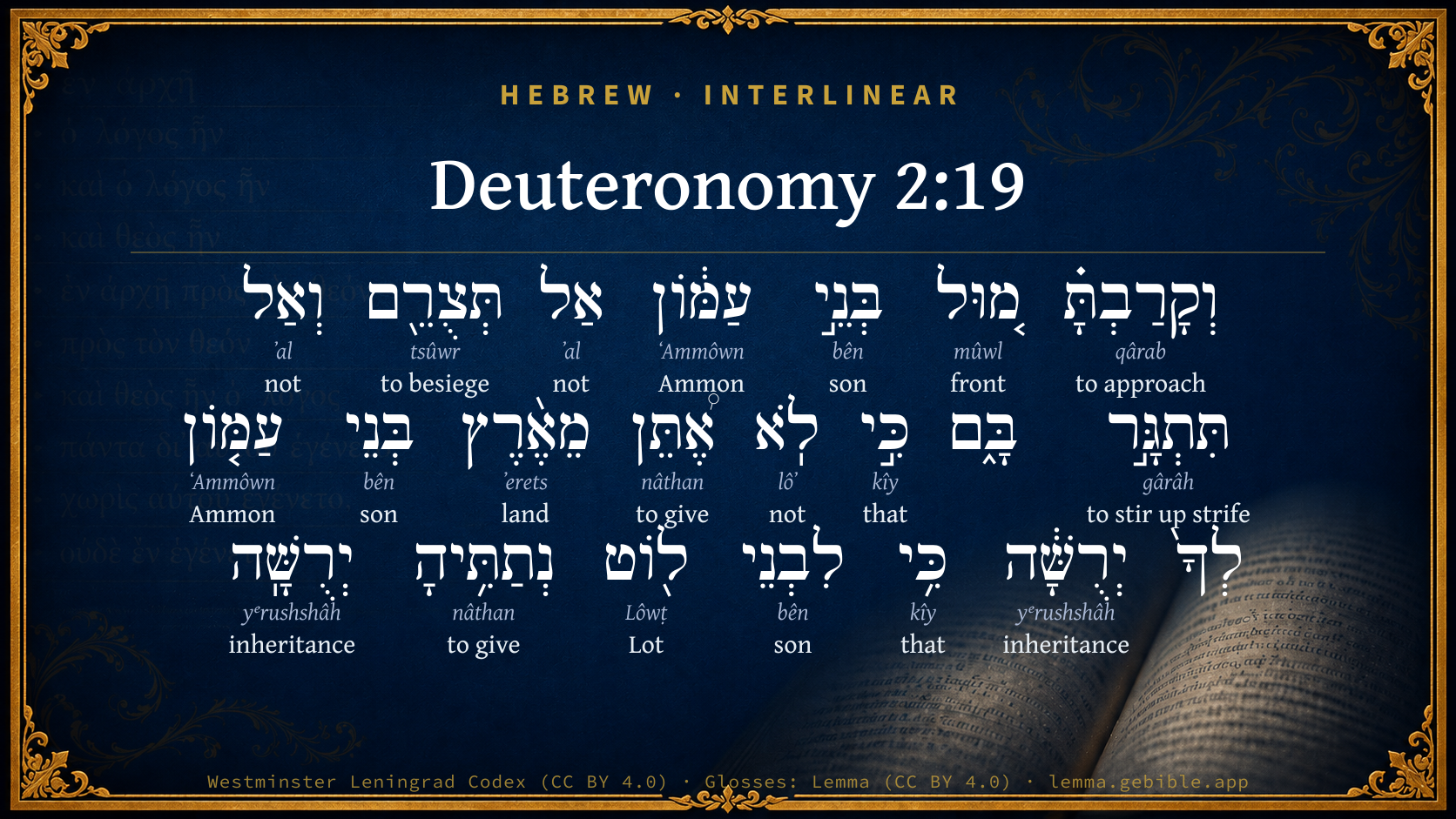
Hebrew (Westminster Leningrad Codex) Deuteronomy 2:19 appears in the Hebrew Old Testament. The text above is from the Westminster Leningrad Codex. Each word links to its Strong’s number, a concise gloss, and parsing drawn from the Open Scriptures Hebrew Bible morphology. Click any word for its full Brown-Driver-Briggs (BDB) entry.
Download image
Cite this verse

Deuteronomy 2:19 (World English Bible). Public Domain. Lemma interlinear Bible study tool, https://lemma.gebible.app/v/deuteronomy/2/19.

Show BibTeX & RIS
BibTeX
RIS
English Translation
and when you come near over against the children of Ammon, don't bother them, nor contend with them; for I will not give you of the land of the children of Ammon for a possession; because I have given it to the children of Lot for a possession.
World English Bible · Public Domain
Download a study sheet

One document with this verse’s original text, its word-by-word gloss line, the meaning frame, cross-references with their text, attributed commentary, and full source and license credits — printable, and it pastes into notes with its structure intact.

This verse Autodidact and up

Study sheet (.html) Plain text (.txt)

A passage Seminary Student

Up to 50 verses in one chapter. A passage sheet keeps up to 6 commentary sources and 12 cross-references per verse, in the order this page ranks them, and says so on the sheet whenever that leaves anything out. Ask for a single verse and you get the Autodidact verse sheet above.

Everything on this page stays free to read, with no account — the sheet is a download of what is already on screen, not access to it.

Want to remove ads? Support Godless Engineer
Compare translations 3

The same verse in 3 English versions, stacked beneath the original-language interlinear above. Click any original word for its lexicon entry.

Each is an independent rendering of the whole verse — the interlinear is not word-aligned to these translations.

Highlighted words mark where these versions differ — a whole-verse word diff, not a word-by-word alignment.

  • World English Bible Public Domain
    and when you come near over against the children of Ammon, don't bother them, nor contend with them; for I will not give you of the land of the children of Ammon for a possession; because I have given it to the children of Lot for a possession.
  • King James Version Public Domain
    And when thou comest nigh over against the children of Ammon, distress them not, nor meddle with them: for I will not give thee of the land of the children of Ammon any possession; because I have given it unto the children of Lot for a possession.
  • unfoldingWord Literal Text CC BY-SA 4.0
    And you will approach on the other side of the sons of Ammon. You shall not trouble them, and you shall not fight them, for I will not give to you from the land of the sons of Ammon a possession, because I have given it to the sons of Lot a possession.’”

unfoldingWord Literal Text — © unfoldingWord, licensed CC BY-SA 4.0. Word-aligned USFM3 via Door43 (git.door43.org/unfoldingWord/en_ult).

Versions to compare (up to 4)

3 of 4 selected

Show all 18 translations

Every available English version of this verse, each an independent rendering of the whole verse.

  • World English Bible Public Domain
    and when you come near over against the children of Ammon, don't bother them, nor contend with them; for I will not give you of the land of the children of Ammon for a possession; because I have given it to the children of Lot for a possession.
  • Berean Standard Bible Public Domain
    But when you get close to the Ammonites, do not harass them or provoke them, for I will not give you any of the land of the Ammonites. I have given it to the descendants of Lot as their possession.”
  • Majority Standard Bible Public Domain
    But when you get close to the Ammonites, do not harass them or provoke them, for I will not give you any of the land of the Ammonites. I have given it to the descendants of Lot as their possession.”
  • King James Version Public Domain
    And when thou comest nigh over against the children of Ammon, distress them not, nor meddle with them: for I will not give thee of the land of the children of Ammon any possession; because I have given it unto the children of Lot for a possession.
  • American Standard Version (1901) Public Domain
    and when thou comest nigh over against the children of Ammon, vex them not, nor contend with them; for I will not give thee of the land of the children of Ammon for a possession; because I have given it unto the children of Lot for a possession.
  • Revised Version (1885) Public Domain
    and when thou comest nigh over against the children of Ammon, vex them not, nor contend with them: for I will not give thee of the land of the children of Ammon for a possession: because I have given it unto the children of Lot for a possession.
  • Geneva Bible (1599) Public Domain
    And thou shalt come neere ouer against the children of Ammon: but shalt not lay siege vnto them, nor moue warre against them: for I will not giue thee of the land of the children of Ammon any possession: for I haue giuen it vnto the children of Lot for a possession.
  • Douay-Rheims (1899) Public Domain
    And when thou comest nigh the frontiers of the children of Ammon, take heed thou fight not against them, nor once move to battle: for I will not give thee of the land of the children of Ammon, because I have given it to the children of Lot for a possession.
  • Young's Literal Translation Public Domain
    and thou hast come near over-against the sons of Ammon, thou dost not distress them, nor stir up thyself against them, for I do not give `any' of the land of the sons of Ammon to thee `for' a possession; for to the sons of Lot I have given it `for' a possession.
  • Literal Standard Version CC BY-SA 4.0
    and [when] you have come near the sons of Ammon, you do not distress them, nor stir yourself up against them, for I do not give [any] of the land of the sons of Ammon to you [for] a possession; for I have given it to the sons of Lot [for] a possession.
  • Unlocked Literal Bible CC BY-SA 4.0
    When you come near opposite the people of Ammon, do not trouble them or fight them; for I will not give you any of the land of the people of Ammon as a possession; because I have given it to the descendants of Lot as a possession.'”
  • unfoldingWord Literal Text CC BY-SA 4.0
    And you will approach on the other side of the sons of Ammon. You shall not trouble them, and you shall not fight them, for I will not give to you from the land of the sons of Ammon a possession, because I have given it to the sons of Lot a possession.’”
  • Darby Bible Public Domain
    and come near over against the children of Ammon; thou shalt not distress them nor attack them; for I will not give thee of the land of the children of Ammon a possession; for unto the children of Lot have I given it as a possession.
  • World Messianic Bible Public Domain
    When you come near the border of the children of Ammon, don’t bother them, nor contend with them; for I will not give you any of the land of the children of Ammon for a possession, because I have given it to the children of Lot for a possession.”
  • Webster's Bible Public Domain
    And when thou comest nigh over against the children of Ammon, distress them not, nor meddle with them: for I will not give thee of the land of the children of Ammon any possession; because I have given it to the children of Lot for a possession.
  • Free Bible Version CC BY-SA 4.0
    However, when you enter Ammonite territory, don't cause them any trouble or fight with them for I'm not going to give you any Ammonite land, because I have given it to the descendants of Lot and it belongs to them.”
  • Bible in Basic English Public Domain
    And when you come near the land of the children of Ammon, give them no cause of trouble and do not make war on them, for I will not give you any of the land of the children of Ammon for your heritage: because I have given it to the children of Lot.
  • JPS Tanakh (1917) Public Domain
    and when thou comest nigh over against the children of Ammon, harass them not, nor contend with them; for I will not give thee of the land of the children of Ammon for a possession; because I have given it unto the children of Lot for a possession. —

Literal Standard Version (2020), Covenant Press — licensed CC BY-SA 4.0. Text via the HelloAO Bible API (eBible.org). Unlocked Literal Bible (unfoldingWord) — licensed CC BY-SA 4.0. Text via the HelloAO Bible API (eBible.org). unfoldingWord Literal Text — © unfoldingWord, licensed CC BY-SA 4.0. Word-aligned USFM3 via Door43 (git.door43.org/unfoldingWord/en_ult). Free Bible Version, Dr. Jonathan Gallagher — licensed CC BY-SA 4.0. Text via the HelloAO Bible API (eBible.org).

Word by word

More ways to search: Search by grammar → Find every occurrence → Compare this word →

Practice this passage: Drill this verse → Learn its vocabulary →

יְרֻשָּׁ֔ה
yᵉrushshâh
H3425
“inheritance”
Noun, Common, Feminine, Singular, Absolute
Part of Speech
Noun
Type
Common
Gender
Feminine
Number
Singular
State
Absolute
Full BDB Definition

Origin: from H3423

TWOT: 920b

possession, inheritance
  1. וְקָרַבְתָּ֗ qârab H7126 “and · to approach” Conjunction + Verb, Qal, Sequential Perfect, 2nd Person, Masculine, Singular
  2. מ֚וּל mûwl H4136 “front” Preposition
  3. בְּנֵ֣י bên H1121 “sons of” Noun, Common, Masculine, Plural, Construct
  4. עַמּ֔וֹן ʻAmmôwn H5983 “Ammon” Noun, Proper
  5. אַל ʼal H408 “not” Particle, Negative
  6. תְּצֻרֵ֖ם tsûwr H6696 “to besiege · them” Verb, Qal, Jussive, 2nd Person, Masculine, Singular + Suffix, Personal, 3rd Person, Masculine, Plural
  7. וְאַל ʼal H408 “and · not” Conjunction + Particle, Negative
  8. תִּתְגָּ֣ר gârâh H1624 “to stir up strife” Verb, Hithpael, Jussive, 2nd Person, Masculine, Singular
  9. כִּ֣י kîy H3588 “that” Conjunction
  10. לֹֽא lôʼ H3808 “not” Particle, Negative
  11. אֶ֠תֵּן nâthan H5414 “to give” Verb, Qal, Imperfect, 1st Person, Common, Singular
  12. מֵאֶ֨רֶץ ʼerets H776 “from · land of” Preposition + Noun, Common, Both, Singular, Construct
  13. בְּנֵי bên H1121 “sons of” Noun, Common, Masculine, Plural, Construct
  14. עַמּ֤וֹן ʻAmmôwn H5983 “Ammon” Noun, Proper
  15. כִּ֥י kîy H3588 “that” Conjunction
  16. לִבְנֵי bên H1121 “to/for · sons of” Preposition + Noun, Common, Masculine, Plural, Construct
  17. ל֖וֹט Lôwṭ H3876 “Lot” Noun, Proper
  18. נְתַתִּ֥יהָ nâthan H5414 “to give · her” Verb, Qal, Perfect, 1st Person, Common, Singular + Suffix, Personal, 3rd Person, Feminine, Singular
  19. יְרֻשָּֽׁה yᵉrushshâh H3425 “inheritance” Noun, Common, Feminine, Singular, Absolute

About this verse

These counts appear in no published source. They are computed here, from the morphology-tagged text and Lemma’s own curated glosses. What Lemma adds →

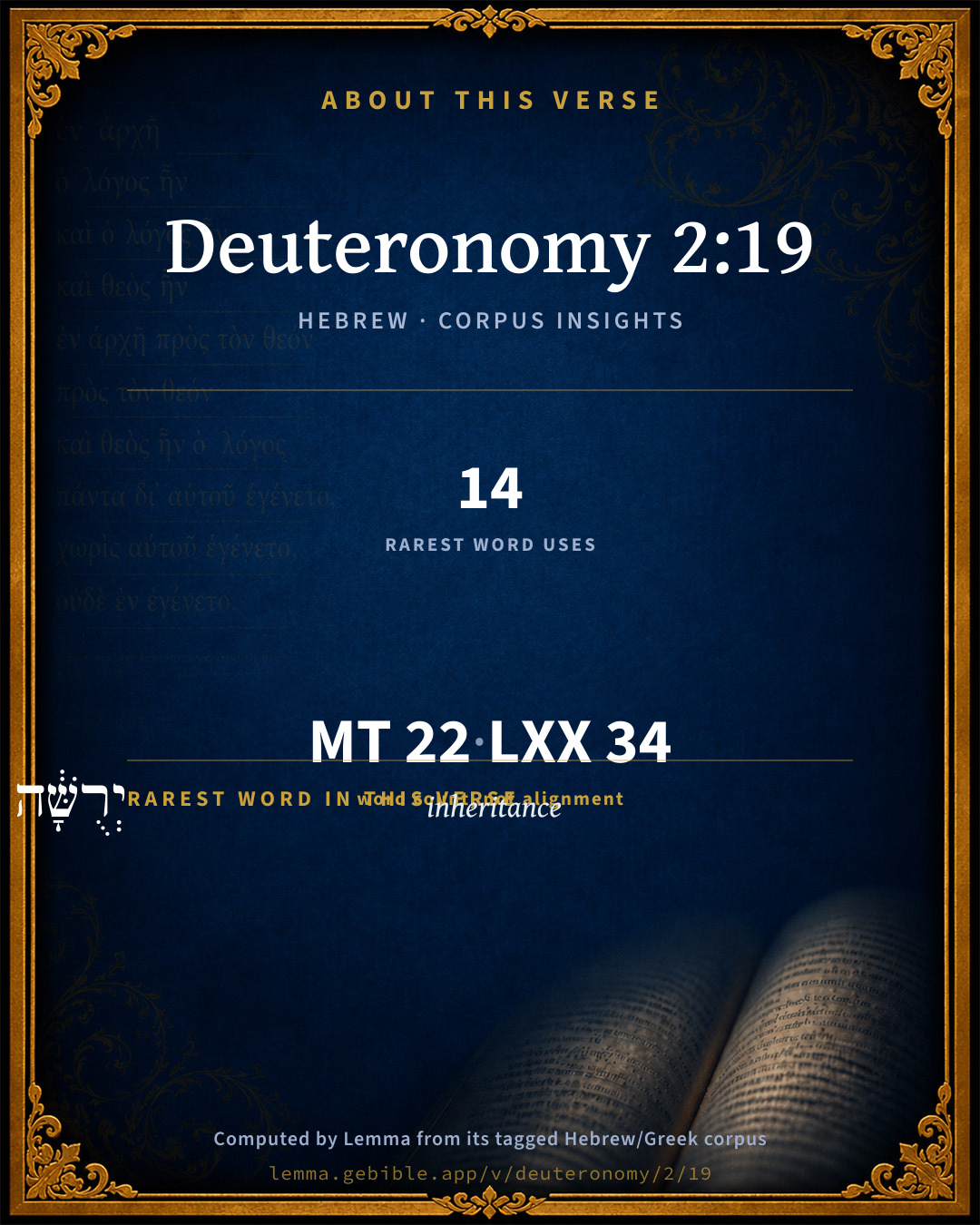
22
words
13
distinct lemmas
Pentateuch
section

Notable vocabulary

The rarest word here is יְרֻשָּׁ֔ה inheritance H3425 — appearing just 14 times in the whole Hebrew Bible.

Shared distinctive vocabulary

יְרֻשָּׁ֔ה inheritance H3425 occurs in 12 verses of the Hebrew Bible. Also found in:

Grammatical profile

  • 5 verbs
  • 9 nouns
  • 3 prepositions
  • 2 conjunctions
  • 3 particles

Verb forms

  • וְקָרַבְתָּ֗ Qal · Sequential Perfect
  • תְּצֻרֵ֖ם Qal · Jussive
  • תִּתְגָּ֣ר Hithpael · Jussive
  • אֶ֠תֵּן Qal · Imperfect
  • נְתַתִּ֥יהָ Qal · Perfect

Repetition

Words recur within this verse — often emphatic in Hebrew:

  • בְּנֵ֣י son H1121 ×3
  • עַמּ֔וֹן Ammon H5983 ×2
  • אֶ֠תֵּן to give H5414 ×2
  • יְרֻשָּׁ֔ה inheritance H3425 ×2
  • אַל not H408 ×2
  • כִּ֣י that H3588 ×2

Hebrew & Septuagint length

In English translation the verse runs 48 words from the Hebrew and 50 from the Septuagint (LXX English) — closely comparable.

A rough comparison of the two English renderings, which tokenize alike — not a word-level alignment.

Word counts can differ between the Hebrew and the Greek without any difference in meaning — e.g. the Hebrew direct-object marker אֵת has no separate Greek word, and Greek often adds the article ὁ.

In the original languages it is 22 Hebrew tokens and 34 Greek tokens — but the two are counted differently (Hebrew bundles its prefixes and suffixes into one token; the Greek is in lemma form), so that isn’t a like-for-like length.

Cross-references

5

Topical passages linked to Deuteronomy 2:19 in the Treasury of Scripture Knowledge — connected by theme and wording, ordered by reader-vote popularity; previews shown in the World English Bible.

  • Deuteronomy 2:9 Yahweh said to me, Don't bother Moab, neither contend with them in battle; for I will not give you of his land for a possession; because I have given Ar to the children of Lot for a possession.
  • Judges 11:13–27 The king of the children of Ammon answered to the messengers of Jephthah, Because Israel took away my land, when he came up out of Egypt, from the Arnon even to the Jabbok, and to the Jordan: now therefore restore those [lands] again peaceably.
  • Genesis 19:36–38 Thus both of Lot's daughters were with child by their father.
  • 2 Chronicles 20:10 Now, behold, the children of Ammon and Moab and Mount Seir, whom you would not let Israel invade, when they came out of the land of Egypt, but they turned aside from them, and didn't destroy them;
  • Deuteronomy 2:5 don't contend with them; for I will not give you of their land, no, not so much as for the sole of the foot to tread on; because I have given Mount Seir to Esau for a possession.

Cross-references courtesy of OpenBible.info (CC BY 4.0).

Hebrew and Greek witnesses Masoretic Hebrew ↔ Greek Septuagint

The same verse in the two great witnesses to the Old Testament, shown verse-for-verse.

These are two independent witnesses, not word-aligned to each other, and the Septuagint is shown in lemma (dictionary) form.

Hebrew Deuteronomy 2:19 Masoretic · Westminster Leningrad Codex

וְקָרַבְתָּ֗ מ֚וּל בְּנֵ֣י עַמּ֔וֹן אַל תְּצֻרֵ֖ם וְאַל תִּתְגָּ֣ר בָּ֑ם כִּ֣י לֹֽא אֶ֠תֵּן מֵאֶ֨רֶץ בְּנֵי עַמּ֤וֹן לְךָ֙ יְרֻשָּׁ֔ה כִּ֥י לִבְנֵי ל֖וֹט נְתַתִּ֥יהָ יְרֻשָּֽׁה

and when you come near over against the children of Ammon, don't bother them, nor contend with them; for I will not give you of the land of the children of Ammon for a possession; because I have given it to the children of Lot for a possession.

World English Bible · Public Domain

Greek LXX Deuteronomy 2:19 Septuagint · lemma form

καί προςἄγω ἐγγύς υἱός αμμαν μή ἐχθραίνω αὐτός καί μή συνἅπτω αὐτός εἰς πόλεμος οὐ γάρ μή δίδωμι ἀπό ὁ γῆ υἱός αμμαν σύ ἐν κλῆρος ὅτι ὁ υἱός λωτ δίδωμι αὐτός ἐν κλῆρος

and you⌃ shall draw near to the children of Amman: do not quarrel with them, nor wage war with them; for I will not give you of the land of the children of Amman for an inheritance, because I have given it to the children of Lot for an inheritance.

LXX2012 (modern English Septuagint) · Public Domain

Hebrew: Westminster Leningrad Codex (CC BY 4.0). Greek: Septuagint (public domain); English from LXX2012 (modern English Septuagint) (Public Domain). How the Septuagint differs from the Hebrew →

Targum (Aramaic paraphrase)

2

The Targum is the ancient Jewish Aramaic paraphrase of the Hebrew Scriptures — an interpretive translation, not the Hebrew text itself. Onkelos (literal) and Pseudo-Jonathan (expansive) render the Torah, and Jonathan the Prophets. Coverage is partial: where no permissively-licensed English translation exists for a verse, only the Aramaic is shown. This is verse-level text, not a word-by-word alignment to the Hebrew.

  1. Targum Onkelos Torah (Genesis–Deuteronomy)
    וְתִקְרַב לָקֳבֵל בְּנֵי עַמוֹן לָא תְצוּר עֲלֵיהוֹן וְלָא תִתְגָרֵי לְמֶעְבַּד עִמְהוֹן קְרָב אֲרֵי לָא אֶתֵּן מֵאַרְעָא בְנֵי עַמוֹן לָךְ יְרֻתָּא אֲרֵי לִבְנֵי לוֹט יְהָבִיתַּהּ יְרֻתָּא

    (no public-domain English translation for this verse)

    Targum Onkelos — Aramaic: “Onkelos Genesis” (public domain); “Onkelos Exodus” (public domain); “Onkelos Leviticus” (public domain); “Onkelos Numbers” (public domain); “Onkelos Deuteronomy” (public domain). English: “Sefaria Community Translation” (CC0 1.0 (public-domain dedication)); “J.W. Etheridge. The Targums of Onkelos and Jonathan Ben Uzziel on the Pentateuch. London: Longmans, Green, 1862” (public domain). Text via Sefaria.

  2. Targum Pseudo-Jonathan Torah (Genesis–Deuteronomy)
    וְתִתְקַרְבוּן לְקָבֵיל בְּנֵי עַמּוֹן לָא תְצוּר עֲלֵיהוֹן וְלָא תִתְגְרֵי בְּהוֹן לְסִדְרֵי קְרָב אֲרוּם לָא אֶתֵּן לְכוֹן מֵאַרַע בְּנֵי עַמּוֹן יְרוּתָא אֲרוּם לִבְנוֹי דְלוֹט מְטוֹל זַכְוָותֵיהּ דְּאַבְרָהָם יְהַבְתָּהּ יְרוּתָּא

    But coming near over against the children of Ammon, you are not to vex, nor provoke them to war; for I have not given you the land of the Beni Ammon for a possession: I have given it an inheritance to the children of Lot, for the sake of Abraham’s righteousness.

    Targum Pseudo-Jonathan — Aramaic: “Targum Jonathan on Genesis” (public domain); “Targum Jonathan on Exodus” (public domain); “Targum Jonathan on Leviticus” (public domain); “Targum Jonathan on Numbers” (public domain); “Targum Jonathan on Deuteronomy” (public domain). English: “The Targum of Jonathan ben Uzziel, trans. J. W. Etheridge, London, 1862” (public domain). Text via Sefaria.

Commentary

Notes on Deuteronomy 2:19 from classic Christian and Jewish commentators (each source and its license shown beneath its notes). The classic Christian expositions comment on the surrounding passage and are grouped to its opening verse, so a note may address several verses; the Jewish commentaries on the Tanakh (Rashi and others) are per-verse, so they appear only where the commentator wrote on this verse.

Lemma curates 59 commentaries, every one of them public domain or Creative Commons licensed, each selected and text-cleaned for this edition rather than reprinted as found. About our sources →

Trapp's Complete Commentary

John Trapp

Deu 2:19 And [when] thou comest nigh over against the children of Ammon, distress them not, nor meddle with them: for I will not give thee of the land of the children of Ammon [any] possession; because I have given it unto the children of Lot [for] a possession.

Ver. 19. Because I have given it.] {See Trapp on "Deu 2:5"}

John Trapp, A Commentary or Exposition upon All the Books of the Old and New Testament (1647–1656) — public domain. Text from a community e-Sword module.

Tyndale Open Study Notes

Tyndale Open Resources

2:19 Like the Moabites, the Ammonites were descendants of the incestuous relationship between Lot and his daughters (see study note on 2:9). Throughout most of their history, the Ammonites lived south and east of the Jabbok River. The nation’s capital was Rabbath Ammon (modern Amman, Jordan). David arranged for Uriah, Bathsheba’s husband, to be slain in the siege of this city (2 Sam 11:1, 14-21).

Tyndale Open Study Notes — © Tyndale Open Resources, licensed CC BY-SA 4.0. Text via the HelloAO Bible API.

Jamieson, Fausset & Brown

Robert Jamieson, A. R. Fausset & David Brown

when thou comest nigh over against the children of Ammon, distress them not, nor meddle with them--The Ammonites, being kindred to the Moabites, were, from regard to the memory of their common ancestor, to remain undisturbed by the Israelites. The territory of this people had been directly north from that of Moab. It extended as far as the Jabbok, having been taken by them from a number of small Canaanitish tribes, namely, the Zamzummins, a bullying, presumptuous band of giants, as their name indicates; and the Avims, the aborigines of the district extending from Hazerim or Hazeroth (El Hudhera) even unto Azzah (Gaza), but of which they had been dispossessed by the Caphtorim (Philistines), who came out of Caphtor (Lower Egypt) and settled in the western coast of Palestine. The limits of the Ammonites were now compressed; but they still possessed the mountainous region beyond the Jabbok (Jos 11:2). What a strange insight does this parenthesis of four verses give into the early history of Palestine! How many successive wars of conquest had swept over its early state--what changes of dynasty among the Canaanitish tribes had taken place long prior to the transactions recorded in this history!

Jamieson, Fausset & Brown — Commentary Critical and Explanatory on the Whole Bible (1871) — public domain (CC PDM 1.0). Text via the HelloAO Bible API.

Ellicott's Commentary for English Readers

(19) And when thou comest nigh.—Compare Note on Deu_2:9.

A Bible Commentary for English Readers, edited by Charles John Ellicott (1878–1897) — public domain. Text from a community e-Sword module.

The Cambridge Bible for Schools and Colleges

gen. ed. J. J. S. Perowne

19. when thou comest nigh over against the children of Ammon] And thou shalt approach to the front of the Bnê ‘Ammôn. The expression is vague and the mention of ‘Ammôn at this stage perplexing. It is true that, acc. to Jdg_11:13, the ‘Ammonites declared to Jephthah that Israel coming out of Egypt took away their land from Arnon even unto Jabboḳ. But the passage to which this belongs, Jdg_11:12-28, generally regarded as late and confused, repels the ‘Ammonite claim and affirms (Deu_2:22) that the land between Arnon and Jabboḳ had been held by the Amorites. This, too, is the testimony of the oldest traditions JE, Num_21:13; Num_21:24; Num_21:31 f., which also relate that the Amorites had taken that territory not from ‘Ammôn, but from Mo’ab (id. Num_21:26-30); cp. the evidence both of JE and P in Numbers 22 ff., that the land N. of Arnon was Moabite. The evidence thus preponderates that ‘Ammôn was confined to a small territory on the upper Jabboḳ, where Rabbath-‘Ammôn (chief town of ‘A.) was situated (though before the ‘Amorite invasion of E. Palestine they may have held the whole course of Jabboḳ immediately S. of that). On the Arnon, therefore, Israel was still some 35 miles from Ammonite territory and the Amorites lay between. The mention of ‘Ammôn at this stage thus appears proleptic, and coinciding as it does with a change to the Sg. address, may plausibly be maintained to be the insertion of a later writer, perhaps influenced by Jdg_11:13. On the other hand it is just possible that the reference to ‘Ammôn at this stage was held by the author of the discourse himself to be necessary, as intended to divert Israel from the due northerly direction which they had been pursuing and which, if continued, would bring them into conflict with ‘Ammôn; and to turn them N.W. through the Amorites to the Jordan.

The Cambridge Bible for Schools and Colleges (gen. ed. J. J. S. Perowne; Cambridge University Press, 1878–1918) — public domain. Text from a community e-Sword module.

John Gill's Exposition

And when thou comest nigh over against the children of Ammon,.... Who dwelt near the Moabites, and were brethren, both descending from Lot, Gen 19:37.

distress them not, nor meddle with them: lay no siege to any of their cities, nor provoke them to war, nor engage in battle with them:

for I will not give thee of the land of the children of Ammon any possession; that is, any part of it which was now in their hands; otherwise half their land was given to the tribe of Gad; but then that was what Sihon king of the Amorites had taken from them, and which Israel retook from him, and so possessed it not as the land of the Ammonites, but of the Amorites, one of the seven nations, whose land they were to inherit; see Jos 13:25,

because I have given it unto the children of Lot for a possession; the Ammonites were the children of Lot by his second daughter, Gen 19:38.

John Gill's Exposition of the Whole Bible (1746–1763) — public domain (CC PDM 1.0). Text via the HelloAO Bible API.

The Pulpit Commentary

Over against the children of Ammon. As the Israelites were passing eastward of Moab; when they crossed the Arnon, the Ammonites, whose dwelling was in the wilderness east of the Jordan, would be almost in front of them. The Israelites came over against them after they conquered Sihon. (cf. Num_21:24)

The Pulpit Commentary (1880–1919), ed. H.D.M. Spence-Jones & Joseph S. Exell — public domain. Text from a community e-Sword module.

Lesson kit

Teaching starters — assembled from the data on this page, not authored interpretation. Every prompt links to the verse data it draws on. Edit before teaching.

Deuteronomy, in the Pentateuch, opens this verse with 22 words (13 distinct Hebrew lemmas). Its most distinctive word is yᵉrushshâh (“inheritance”). A historical commentator’s framing appears above. Read the whole chapter for the surrounding context.

Discussion questions

  1. How does “inheritance” (yᵉrushshâh) shape what this verse is saying?
  2. How does Deuteronomy 2:5, which shares the word «inheritance», read alongside this verse?
  3. What does the repetition of “son” (3× in this one verse) do in this verse?
  4. The translations on this page render this verse differently — a whole-verse word diff, not a word-by-word alignment. What might account for the different wordings?
  5. «וְקָרַבְתָּ֗» is a Qal Sequential Perfect verb. How does that grammatical form shape the action described?
  6. Compare how Trapp's Complete Commentary and Tyndale Open Study Notes read this verse. Where do they agree or differ?

Things to notice

Reading settings

Reading text

Shown beneath each verse's original-language words.

Old Testament
Old Testament edition

Read the OT as the Masoretic Hebrew (MT) or the Greek Septuagint (LXX).

English shown for the Greek Septuagint (in the Hebrew ↔ Greek comparison).

Comparing translations? Open the Compare panel on any verse page to stack up to four side by side.