
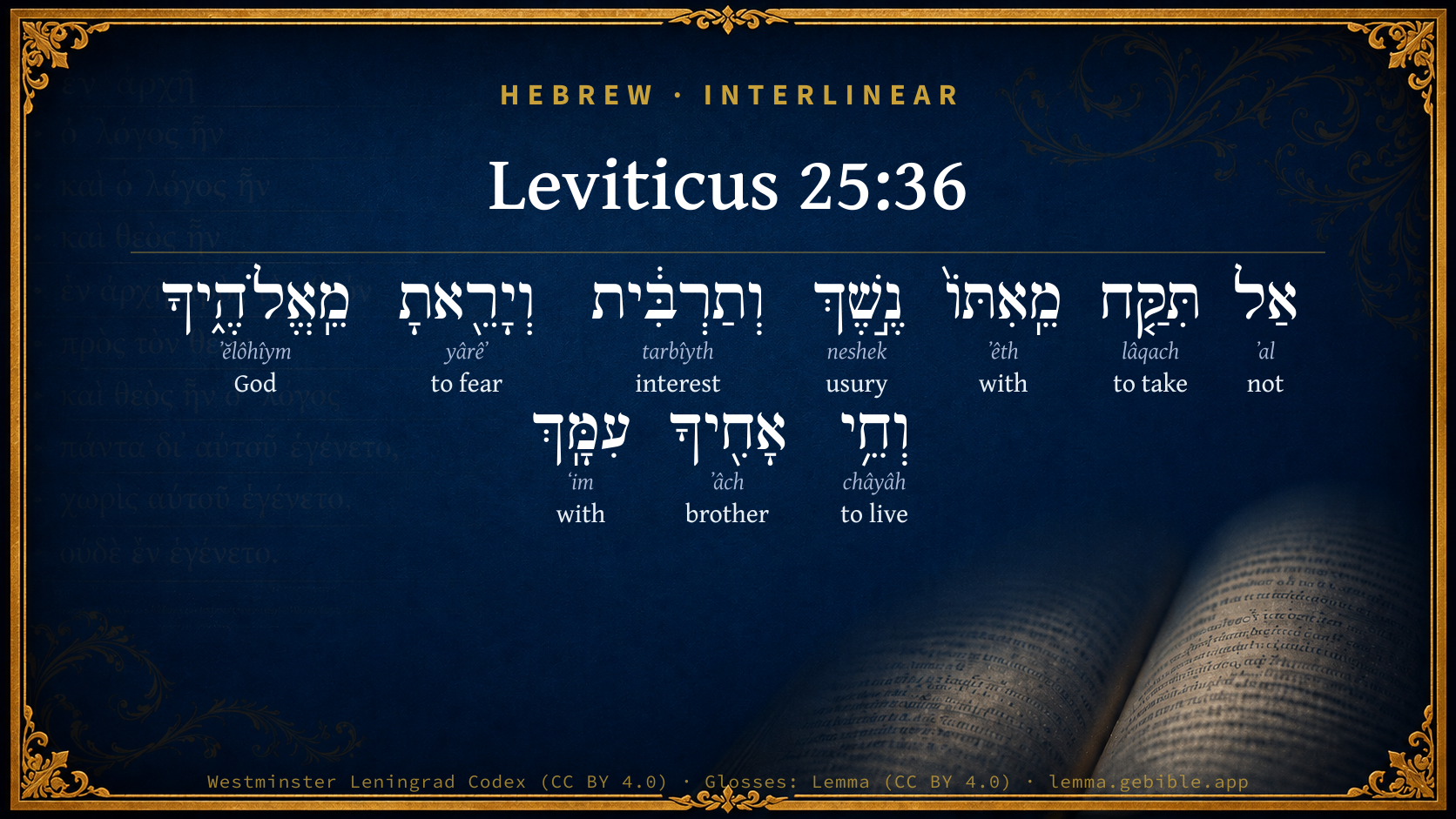
Leviticus 25:36

Hebrew (Westminster Leningrad Codex) Leviticus 25:36 appears in the Hebrew Old Testament. The text above is from the Westminster Leningrad Codex. Each word links to its Strong’s number, a concise gloss, and parsing drawn from the Open Scriptures Hebrew Bible morphology. Click any word for its full Brown-Driver-Briggs (BDB) entry.
Download image
Cite this verse

Leviticus 25:36 (World English Bible). Public Domain. Lemma interlinear Bible study tool, https://lemma.gebible.app/v/leviticus/25/36.

Show BibTeX & RIS
BibTeX
RIS
English Translation
Take no interest from him or profit, but fear your God; that your brother may live among you.
World English Bible · Public Domain
Highlights Full analysis ↓
Download a study sheet

One document with this verse’s original text, its word-by-word gloss line, the meaning frame, cross-references with their text, attributed commentary, and full source and license credits — printable, and it pastes into notes with its structure intact.

This verse Autodidact and up

Study sheet (.html) Plain text (.txt)

A passage Seminary Student

Up to 50 verses in one chapter. A passage sheet keeps up to 6 commentary sources and 12 cross-references per verse, in the order this page ranks them, and says so on the sheet whenever that leaves anything out. Ask for a single verse and you get the Autodidact verse sheet above.

Everything on this page stays free to read, with no account — the sheet is a download of what is already on screen, not access to it.

Want to remove ads? Support Godless Engineer
Compare translations 3

The same verse in 3 English versions, stacked beneath the original-language interlinear above. Click any original word for its lexicon entry.

Each is an independent rendering of the whole verse — the interlinear is not word-aligned to these translations.

Highlighted words mark where these versions differ — a whole-verse word diff, not a word-by-word alignment.

  • World English Bible Public Domain
    Take no interest from him or profit, but fear your God; that your brother may live among you.
  • King James Version Public Domain
    Take thou no usury of him, or increase: but fear thy God; that thy brother may live with thee.
  • unfoldingWord Literal Text CC BY-SA 4.0
    You shall not take from him interest or profit, but you shall fear from your God, and your brother shall live with you.

unfoldingWord Literal Text — © unfoldingWord, licensed CC BY-SA 4.0. Word-aligned USFM3 via Door43 (git.door43.org/unfoldingWord/en_ult).

Versions to compare (up to 4)

3 of 4 selected

Show all 18 translations

Every available English version of this verse, each an independent rendering of the whole verse.

  • World English Bible Public Domain
    Take no interest from him or profit, but fear your God; that your brother may live among you.
  • Berean Standard Bible Public Domain
    Do not take any interest or profit from him, but fear your God, that your countryman may live among you.
  • Majority Standard Bible Public Domain
    Do not take any interest or profit from him, but fear your God, that your countryman may live among you.
  • King James Version Public Domain
    Take thou no usury of him, or increase: but fear thy God; that thy brother may live with thee.
  • American Standard Version (1901) Public Domain
    Take thou no interest of him or increase, but fear thy God; that thy brother may live with thee.
  • Revised Version (1885) Public Domain
    Take thou no usury of him or increase; but fear thy God: that thy brother may live with thee.
  • Geneva Bible (1599) Public Domain
    Thou shalt take no vsurie of him, nor vantage, but thou shalt feare thy God, that thy brother may liue with thee.
  • Douay-Rheims (1899) Public Domain
    Take not usury of him nor more than thou gavest: fear thy God, that thy brother may live with thee.
  • Young's Literal Translation Public Domain
    thou takest no usury from him, or increase; and thou hast been afraid of thy God; and thy brother hath lived with thee;
  • Literal Standard Version CC BY-SA 4.0
    you take no usury or increase from him; and you have been afraid of your God; and your brother has lived with you;
  • Unlocked Literal Bible CC BY-SA 4.0
    Do not charge him interest or try to profit from him in any way, but honor your God so that your brother may keep living with you.
  • unfoldingWord Literal Text CC BY-SA 4.0
    You shall not take from him interest or profit, but you shall fear from your God, and your brother shall live with you.
  • Darby Bible Public Domain
    Thou shalt take no usury nor increase of him; and thou shalt fear thy God; that thy brother may live beside thee.
  • World Messianic Bible Public Domain
    Take no interest from him or profit; but fear your God, that your brother may live among you.
  • Webster's Bible Public Domain
    Take thou no interest of him, or increase; but fear thy God; that thy brother may live with thee.
  • Free Bible Version CC BY-SA 4.0
    Don't make them pay you any interest or demand more than they borrowed, but respect your God so that they can remain living in your area.
  • Bible in Basic English Public Domain
    Take no interest from him, in money or in goods, but have the fear of your God before you, and let your brother make a living among you.
  • JPS Tanakh (1917) Public Domain
    Take thou no interest of him or increase; but fear thy God; that thy brother may live with thee.

Literal Standard Version (2020), Covenant Press — licensed CC BY-SA 4.0. Text via the HelloAO Bible API (eBible.org). Unlocked Literal Bible (unfoldingWord) — licensed CC BY-SA 4.0. Text via the HelloAO Bible API (eBible.org). unfoldingWord Literal Text — © unfoldingWord, licensed CC BY-SA 4.0. Word-aligned USFM3 via Door43 (git.door43.org/unfoldingWord/en_ult). Free Bible Version, Dr. Jonathan Gallagher — licensed CC BY-SA 4.0. Text via the HelloAO Bible API (eBible.org).

Word by word

More ways to search: Search by grammar → Find every occurrence → Compare this word →

Practice this passage: Drill this verse → Learn its vocabulary →

וְתַרְבִּ֔ית
tarbîyth
H8636
“and · interest”
Conjunction + Noun, Common, Feminine, Singular, Absolute
Part of Speech
Conjunction + Noun
Type
Common
Gender
Feminine
Number
Singular
State
Absolute
Full BDB Definition

Origin: from H7235

TWOT: 2103f

increment, usury, interest, bonus
  1. אַל ʼal H408 “not” Particle, Negative
  2. תִּקַּ֤ח lâqach H3947 “to take” Verb, Qal, Jussive, 2nd Person, Masculine, Singular
  3. מֵֽאִתּוֹ֙ ʼêth H854 “from · with · him” Preposition + Preposition + Suffix, Personal, 3rd Person, Masculine, Singular
  4. נֶ֣שֶׁךְ neshek H5392 “usury” Noun, Common, Masculine, Singular, Absolute
  5. וְיָרֵ֖אתָ yârêʼ H3372 “and · to fear” Conjunction + Verb, Qal, Sequential Perfect, 2nd Person, Masculine, Singular
  6. מֵֽאֱלֹהֶ֑יךָ ʼĕlôhîym H430 “from · God(s) · your” Preposition + Noun, Common, Masculine, Plural, Construct + Suffix, Personal, 2nd Person, Masculine, Singular
  7. וְחֵ֥י châyâh H2421 “and · to live” Conjunction + Verb, Qal, Sequential Perfect, 3rd Person, Masculine, Singular
  8. אָחִ֖יךָ ʼâch H251 “brother · your” Noun, Common, Masculine, Singular, Construct + Suffix, Personal, 2nd Person, Masculine, Singular
  9. עִמָּֽךְ ʻim H5973 “with · you” Preposition + Suffix, Personal, 2nd Person, Feminine, Singular

About this verse

These counts appear in no published source. They are computed here, from the morphology-tagged text and Lemma’s own curated glosses. What Lemma adds →

10
words
10
distinct lemmas
Pentateuch
section

Notable vocabulary

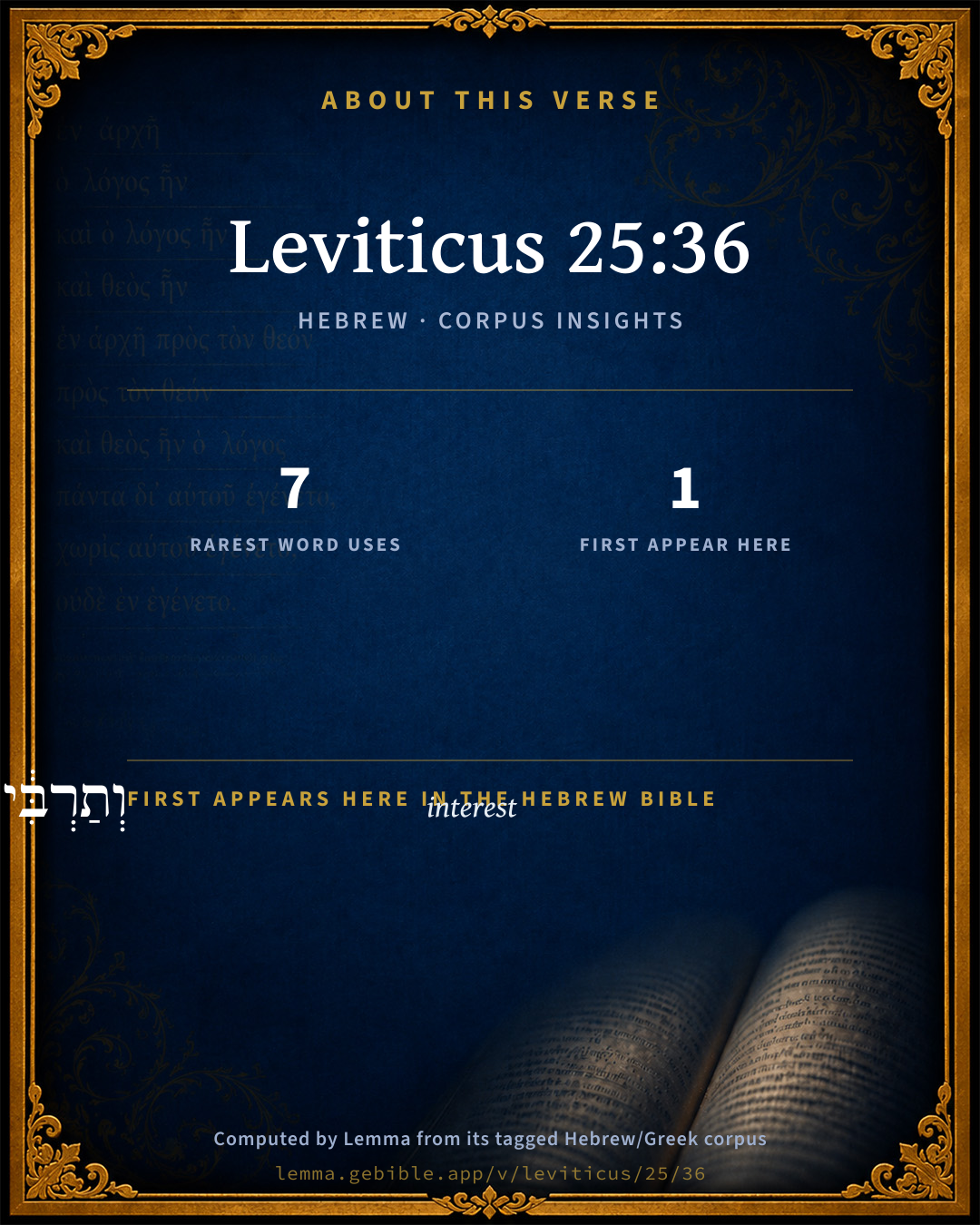
The rarest word here is וְתַרְבִּ֔ית interest H8636 — appearing just 7 times in the whole Hebrew Bible.

First appearance in Scripture

This word makes its first canonical appearance in the Hebrew Bible here:

  • וְתַרְבִּ֔ית interest H8636

Shared distinctive vocabulary

וְתַרְבִּ֔ית interest H8636 occurs in 6 verses of the Hebrew Bible. Also found in:

Grammatical profile

  • 3 verbs
  • 4 nouns
  • 2 prepositions
  • 1 particle

Verb forms

  • תִּקַּ֤ח Qal · Jussive
  • וְיָרֵ֖אתָ Qal · Sequential Perfect
  • וְחֵ֥י Qal · Sequential Perfect

Hebrew & Septuagint length

In English translation the verse runs 18 words from the Hebrew and 26 from the Septuagint (LXX English) — the Septuagint runs noticeably longer here. See the side-by-side →

A rough comparison of the two English renderings, which tokenize alike — not a word-level alignment.

Word counts can differ between the Hebrew and the Greek without any difference in meaning — e.g. the Hebrew direct-object marker אֵת has no separate Greek word, and Greek often adds the article ὁ.

Cross-references

11

Topical passages linked to Leviticus 25:36 in the Treasury of Scripture Knowledge — connected by theme and wording, ordered by reader-vote popularity; previews shown in the World English Bible.

  • Exodus 22:25 "If you lend money to any of my people with you who is poor, you shall not be to him as a creditor; neither shall you charge him interest.
  • Deuteronomy 23:19–20 You shall not lend on interest to your brother; interest of money, interest of food, interest of anything that is lent on interest:
  • Ezekiel 18:8 he who has not given forth on interest, neither has taken any increase, who has withdrawn his hand from iniquity, has executed true justice between man and man,
  • Leviticus 25:17 You shall not wrong one another; but you shall fear your God: for I am Yahweh your God.
  • Ezekiel 18:13 has given forth on interest, and has taken increase; shall he then live? he shall not live: he has done all these abominations; he shall surely die; his blood shall be on him.
  • Ezekiel 18:17 who has withdrawn his hand from the poor, who has not received interest nor increase, has executed my ordinances, has walked in my statutes; he shall not die for the iniquity of his father, he shall surely live.
  • Nehemiah 5:7–10 Then I consulted with myself, and contended with the nobles and the rulers, and said to them, You exact usury, everyone of his brother. I held a great assembly against them.
  • Nehemiah 5:15 But the former governors who were before me were chargeable to the people, and took of them bread and wine, besides forty shekels of silver; yes, even their servants bore rule over the people: but I didn't do so, because of the fear of God.
  • Psalms 15:5 He who doesn't lend out his money for usury, Nor take a bribe against the innocent. He who does these things shall never be shaken.
  • Proverbs 28:8 He who increases his wealth by excessive interest Gathers it for one who has pity on the poor.
  • Ezekiel 22:12 In you have they taken bribes to shed blood; you have taken interest and increase, and you have greedily gained of your neighbors by oppression, and have forgotten me, says the Lord Yahweh.

Cross-references courtesy of OpenBible.info (CC BY 4.0).

Hebrew and Greek witnesses Masoretic Hebrew ↔ Greek Septuagint

The same verse in the two great witnesses to the Old Testament, shown verse-for-verse.

Here the Septuagint runs noticeably longer than the Hebrew — LXX2012 (modern English Septuagint) 26 words vs World English Bible 18. A rough length comparison of the two English translations, not a word-level alignment — read both below.

These are two independent witnesses, not word-aligned to each other, and the Septuagint is shown in lemma (dictionary) form.

Hebrew Leviticus 25:36 Masoretic · Westminster Leningrad Codex

אַל תִּקַּ֤ח מֵֽאִתּוֹ֙ נֶ֣שֶׁךְ וְתַרְבִּ֔ית וְיָרֵ֖אתָ מֵֽאֱלֹהֶ֑יךָ וְחֵ֥י אָחִ֖יךָ עִמָּֽךְ

Take no interest from him or profit, but fear your God; that your brother may live among you.

World English Bible · Public Domain

Greek LXX Leviticus 25:36 Septuagint · lemma form

οὐ λαμβάνω παρά αὐτός τόκος οὐδέ ἐπί πλῆθος καί φοβέω ὁ θεός σύ ἐγώ κύριος καί ζάω ὁ ἀδελφός σύ μετά σύ

You shall not receive from him interest, nor increase: and you shall fear your God: I am the Lord: and your brother shall live with you.

LXX2012 (modern English Septuagint) · Public Domain

Hebrew: Westminster Leningrad Codex (CC BY 4.0). Greek: Septuagint (public domain); English from LXX2012 (modern English Septuagint) (Public Domain). How the Septuagint differs from the Hebrew →

Targum (Aramaic paraphrase)

2

The Targum is the ancient Jewish Aramaic paraphrase of the Hebrew Scriptures — an interpretive translation, not the Hebrew text itself. Onkelos (literal) and Pseudo-Jonathan (expansive) render the Torah, and Jonathan the Prophets. Coverage is partial: where no permissively-licensed English translation exists for a verse, only the Aramaic is shown. This is verse-level text, not a word-by-word alignment to the Hebrew.

  1. Targum Onkelos Torah (Genesis–Deuteronomy)
    לָא תִסַב מִנֵהּ חִבּוּלְיָא וְרִבִּיתָא וְתִדְחַל מֵאֱלָהָךְ וִיחֵי אָחוּךְ עִמָךְ

    (no public-domain English translation for this verse)

    Targum Onkelos — Aramaic: “Onkelos Genesis” (public domain); “Onkelos Exodus” (public domain); “Onkelos Leviticus” (public domain); “Onkelos Numbers” (public domain); “Onkelos Deuteronomy” (public domain). English: “Sefaria Community Translation” (CC0 1.0 (public-domain dedication)); “J.W. Etheridge. The Targums of Onkelos and Jonathan Ben Uzziel on the Pentateuch. London: Longmans, Green, 1862” (public domain). Text via Sefaria.

  2. Targum Pseudo-Jonathan Torah (Genesis–Deuteronomy)
    עַמִי בֵּית יִשְרָאֵל לָא תִיסְבוּן מִנֵיהּ לָא שַׁעֲרִין וְלָא רִיבְיַין וְתִדְחַל מֵאֱלָהָךְ וְיִתְפַּרְנֵס אָחוּךְ עִמָךְ

    My people of the house of Israel you shall not take usuries or remunerations (in his case) but thou shalt fear thy God, and let thy brother have nourishment with thee.

    Targum Pseudo-Jonathan — Aramaic: “Targum Jonathan on Genesis” (public domain); “Targum Jonathan on Exodus” (public domain); “Targum Jonathan on Leviticus” (public domain); “Targum Jonathan on Numbers” (public domain); “Targum Jonathan on Deuteronomy” (public domain). English: “The Targum of Jonathan ben Uzziel, trans. J. W. Etheridge, London, 1862” (public domain). Text via Sefaria.

Commentary

Notes on Leviticus 25:36 from classic Christian and Jewish commentators (each source and its license shown beneath its notes). The classic Christian expositions comment on the surrounding passage and are grouped to its opening verse, so a note may address several verses; the Jewish commentaries on the Tanakh (Rashi and others) are per-verse, so they appear only where the commentator wrote on this verse.

Lemma curates 59 commentaries, every one of them public domain or Creative Commons licensed, each selected and text-cleaned for this edition rather than reprinted as found. About our sources →

Trapp's Complete Commentary

John Trapp

Lev 25:36 Take thou no usury of him, or increase: but fear thy God; that thy brother may live with thee.

Ver. 36. Take thou no usury.] God dispenseth with no usury, but condemns both Neshec the biting, and Tarbith the toothless. In Rome at this day, all usurers are excommunicated monthly. The Jews indeed are permitted to strain up their usury to 18 per cent upon the Christian, for among themselves they nowhere use it, which causeth many of the unconscionable Christians to use these Jews underhandly in improving their unlawful rents to the utmost proportion.

John Trapp, A Commentary or Exposition upon All the Books of the Old and New Testament (1647–1656) — public domain. Text from a community e-Sword module.

Joseph Benson's Commentary

Lev 25:36. Take no usury of him — That is, of thy brother, whether he be Israelite or proselyte. Or increase — All kinds of usury are in this case forbidden, whether of money, or of victuals, or of any thing that is commonly lent by one man to another upon usury, or upon condition of receiving the thing lent with advantage and overplus. If one borrow in his necessity, there can be no doubt this law is binding still. But it cannot be thought to bind where money is borrowed for purchase of lands, trade, or other improvements. For there it is reasonable that the lender should share with the borrower in the profit.

Joseph Benson's Commentary on the Old and New Testaments (1811–1818) — public domain. Text from a community e-Sword module.

Tyndale Open Study Notes

Tyndale Open Resources

25:36-37 The purpose of a loan was to help a poor person get back on their feet, not to make money from their vulnerability. Interest was forbidden on loans to Israelites but permitted on loans to foreigners (Deut 23:19-20).

Tyndale Open Study Notes — © Tyndale Open Resources, licensed CC BY-SA 4.0. Text via the HelloAO Bible API.

Adam Clarke's Commentary

Verse 36. Take thou no usury of him] Usury, at present, signifies unlawful interest for money. Properly, it means the reward or compensation given for the use of a thing, but is principally spoken of money. For the definition of the original term, See Clarke on Ex 22:25.

Adam Clarke's Commentary on the Bible (1810–1826) — public domain. Text from a community e-Sword/MySword module.

Ellicott's Commentary for English Readers

(36) Take thou no usury of him, or increase.—The first thing to be done to the impoverished Israelite is to supply him with the means to recover himself without any interest. The authorities during the second Temple defined the words which are translated “usury” (nesheck) and “increase” (tarbith, or marbith) as follows: If a person lends to another a shekel worth four denarii, and gets in return five denarii, or if he lends him two sacks of wheat, and receives back three, this is usury. If one buys wheat for delivery at the market price of 25 denarii a measure, and when it rises to 30 denarii he says to the vendor, “Deliver me the wheat, for I want to sell it and buy wine,” and the vendor replies,” I will take the wheat at 30 denarii and give thee wine for it,” though he has no wine, this is increase. The “increase” lies in the fact that the vendor has no wine at the time, and that he may possibly lose again by the rise in wine. Accordingly the former is a charge upon money, whilst the latter is on products.

A Bible Commentary for English Readers, edited by Charles John Ellicott (1878–1897) — public domain. Text from a community e-Sword module.

The Cambridge Bible for Schools and Colleges

gen. ed. J. J. S. Perowne

36. usury … increase] The former was interest on money, the latter on food stuffs and paid in kind. For the important part played by such transactions in Babylonia see Johns, Bab. and Assyr. Laws, ch. 23, p. 253.

The Cambridge Bible for Schools and Colleges (gen. ed. J. J. S. Perowne; Cambridge University Press, 1878–1918) — public domain. Text from a community e-Sword module.

John Gill's Exposition

Take thou no usury of him, or increase,.... Not only give him somewhat for his present relief, but lend him money to put him in a way of business, to get his living for the future, without requiring any interest for it; See Gill on Exo 22:25,

but fear thy God; who has given this command, and expects to be obeyed; and who is good, and does good, and should be feared for his goodness' sake; and is omniscient, and knows what is secretly exacted, and will not suffer any exorbitance of this kind to pass unpunished:

that thy brother may live with thee; which it would be still more difficult for him to do, should usury and increase be taken of him.

John Gill's Exposition of the Whole Bible (1746–1763) — public domain (CC PDM 1.0). Text via the HelloAO Bible API.

Matthew Poole's English Annotations

i.e. Of thy brother, whether he be Israelite or proselyte.

Increase: this some conceive relates to the fruits of the earth, food, &c., as usury doth to money. But here may rather seem’ to be two words expressing the same thing,

(1.) To meet with the subtle evasions of crafty and covetous men, who made gain of their poor brethren (for of such only he speaks here, as is evident from Lev 25:35) by the lending of money or other things; and that they may quiet their consciences, and palliate their sin, they disguise it under other names; and,

(2.) To show that all kinds of usury are in this case forbidden, whether of money, or of victuals, or of any thing that is commonly lent by one man to another upon usury, or upon condition of receiving the thing lent with advantage and overplus, as it is said Deu 23:19.

Matthew Poole's English Annotations on the Holy Bible (1683–1685) — public domain. Text from a community e-Sword/MySword module.

Whedon's Commentary on the Bible

Daniel D. Whedon

36. Take no usury — This word in the original signifies interest on money loaned, but in modern English it has come to designate excessive interest, either formally illegal or at least oppressive. When our Authorized Version was made, the term usury was the exact equivalent of the Hebrew neshek, interest.

Thy brother — The prohibition of interest extended only to a brother Hebrew. At first only the poor Hebrew was exempted from interest, (Exo_22:25,) but Jahn thinks that it was found difficult to define the term poor person; hence the prohibition was extended to all Hebrews, so that henceforth interest could be taken only of foreigners.

Deu_23:20. We cannot agree with Davidson, that this would limit their commerce with other nations, and thus conserve their religious faith. This prohibition was flagrantly transgressed by Hebrew capitalists after the return from the captivity, when one per cent. per month was exacted from their brethren. See Neh_5:11, in which “the hundredth” is one per cent. a month, a ruinous rate.

Daniel D. Whedon (gen. ed.), Commentary on the Old and New Testaments (1874–1909) — public domain. Text from a community e-Sword module.

John Wesley's Explanatory Notes

Of him - That is, of thy brother, whether he be Israelite, or proselyte. Or increase - All kinds of usury are in this case forbidden, whether of money, or of victuals, or of any thing that is commonly lent by one man to another upon usury, or upon condition of receiving the thing lent with advantage and overplus. If one borrow in his necessity, there can be no doubt but this law is binding still. But it cannot be thought to bind, where money is borrowed for purchase of lands, trade, or other improvements. For there it is reasonable, that the lender share with the borrower in the profit.

John Wesley, Explanatory Notes Upon the Whole Bible (1754–1765) — public domain. Text via the GEBible commentary corpus.

Scofield Reference Notes

C. I. Scofield

fear

(See Scofield "Psa 19:9")

The Scofield Reference Bible (1917 edition), notes by C. I. Scofield — public domain. Text from a community e-Sword module.

Rashi

Rabbi Shlomo Yitzchaki (Rashi)

נשך ותרבית [TAKE THOU NOT] INTEREST [OF HIM] OR INCREASE — The Rabbis regard them (these two things) as one, but Scripture uses two different words for the same offence in order to prescribe that he who infringes the law, is thereby transgressing two negative commands (Bava Metzia 60b).

ויראת מאלהיך BUT BE AFRAID OF THY GOD — Because man’s thoughts are greatly attracted by the idea of taking interest and it comes difficult to him to keep aloof from it, so that he tries to persuade himself that it is a legitimate act (lit., he decides for himself that it is a permissible matter) on account of the fact that his money will otherwise remain unemployed, Scripture was compelled to state: “But be afraid of thy God!" Or take another case: If one pretends that his money belongs to a non-Jew in order to be able to lend it to an Israelite in an ostensibly legitimate way. This is given only to his heart and thoughts to know the real circumstances of the case; Scripture therefore was compelled to state “But be afraid of thy God!” (Bava Metzia 61b).

Rashi on the Tanakh — English translations: “The Judaica Press complete Tanach with Rashi, translated by A. J. Rosenberg” (CC BY 4.0); “Pentateuch with Rashi's commentary by M. Rosenbaum and A.M. Silbermann, 1929-1934” (public domain); “The Metsudah Tanach series, Lakewood, N.J” (CC BY 4.0); and “The Book of Joshua, Metsudah Publications, 1997” (CC BY 4.0). Text via Sefaria.

Ramban (Nachmanides)

Rabbi Moshe ben Nachman (Ramban / Nachmanides)

TAKE THOU NO ‘NESHECH’ (INTEREST) OF HIM OR ‘RIBITH’ (INCREASE). “The Rabbis explained [these two terms — ‘interest’ and ‘increase’] as one, and [the reason why Scripture mentioned two different words is to teach us that he who transgresses this law] violates two negative commandments.” This is Rashi’s language. The plain meaning of the verse appears to me to be that neshech (interest) is where, [for example], he lends him a hundred [shekels] and [the borrower is] to give him five shekels each year [for the use of the money, without deducting it from the capital sum of the loan]. It is so called [neshech, literally “biting”] because at the last ‘yishach’ (it biteth) like a snake, [the effect of whose bite is not noticed immediately, but which] spurts and increases. Tarbith [or ribith — “increase”], however, is if he lends him [a sum of money] until a certain time, and then [the borrower is to] repay him and give him an increase of five shekels, but [even if the repayment should be delayed], there is no [additional] increase after that time [i.e., there is one fixed sum and not an annual percentage]; this [form of interest] does not “bite”, since it will not go up more than that [fixed] sum, but it is [nonetheless] “an increase.” Therefore He stated, Thou shalt not give him thy money ‘b’neshech’ (upon interest), nor give him thy food ‘b’marbith’ (for increase), for it is customary to lend money for neshech (interest), [the borrower being obliged] to give every year [a certain amount of money for the use of the capital borrowed], but food is [usually] lent until the time of reaping, and then he pays him back out of his granary with a stipulated addition.

Ramban (Nachmanides) on the Tanakh — English translation: “Commentary on the Torah by Ramban (Nachmanides). Translated and annotated by Charles B. Chavel. New York, Shilo Pub. House, 1971-1976” (CC BY 4.0). Text via Sefaria.

Lesson kit

Teaching starters — assembled from the data on this page, not authored interpretation. Every prompt links to the verse data it draws on. Edit before teaching.

Leviticus, in the Pentateuch, opens this verse with 10 words (10 distinct Hebrew lemmas). Its most distinctive word is tarbîyth (“interest”). The Greek Septuagint runs longer here. A historical commentator’s framing appears above. Read the whole chapter for the surrounding context.

Discussion questions

  1. The word tarbîyth carries the sense “interest.” How does it shape the verse?
  2. The word “interest” first appears here in Scripture. What is being introduced at this debut?
  3. Proverbs 28:8 shares the word «interest» with this verse. How do the two illuminate each other?
  4. Compared with the Hebrew, the Septuagint runs longer here. What questions does that raise?
  5. These translations render this verse differently. What is at stake in choosing one wording over another?
  6. The verb «תִּקַּ֤ח» is Qal Jussive. How does its form color the action?
  7. Reading how Trapp's Complete Commentary and Joseph Benson's Commentary read this verse, where do the two commentators agree and where do they part?

Things to notice

  • 1 word makes its first canonical appearance in Scripture here.
  • These translations choose different wording for 8 words in this verse.
  • 10 distinct Hebrew lemmas span 10 words in this verse.

Reading settings

Reading text

Shown beneath each verse's original-language words.

Old Testament
Old Testament edition

Read the OT as the Masoretic Hebrew (MT) or the Greek Septuagint (LXX).

English shown for the Greek Septuagint (in the Hebrew ↔ Greek comparison).

Comparing translations? Open the Compare panel on any verse page to stack up to four side by side.