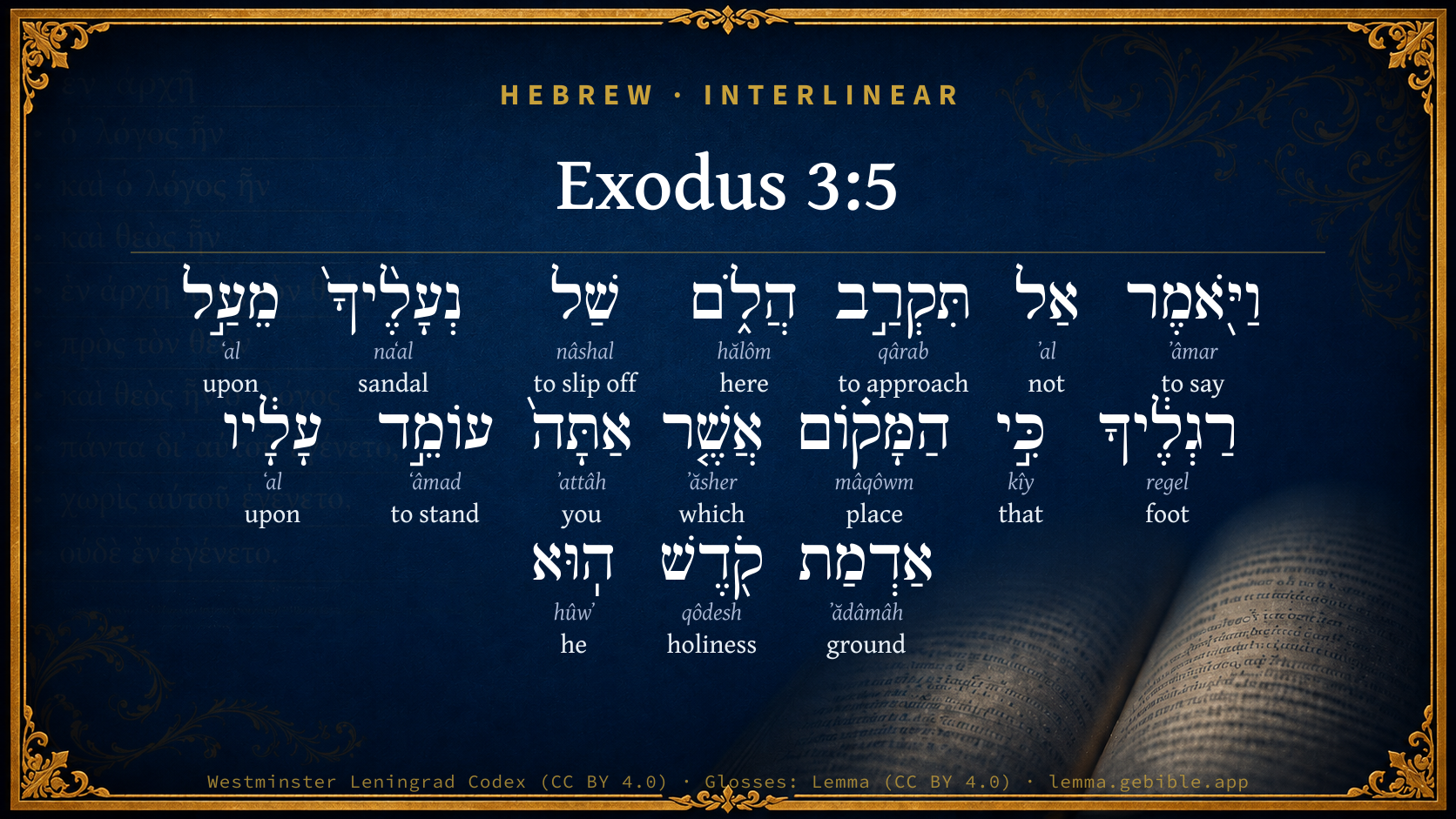
Exodus 3:5

Hebrew (Westminster Leningrad Codex) Exodus 3:5 appears in the Hebrew Old Testament. The text above is from the Westminster Leningrad Codex. Each word links to its Strong’s number, a concise gloss, and parsing drawn from the Open Scriptures Hebrew Bible morphology. Click any word for its full Brown-Driver-Briggs (BDB) entry.
Download image
Cite this verse

Exodus 3:5 (World English Bible). Public Domain. Lemma interlinear Bible study tool, https://lemma.gebible.app/v/exodus/3/5.

Show BibTeX & RIS
BibTeX
RIS
English Translation
He said, "Don't come close. Take off your sandals from off your feet, for the place you are standing on is holy ground."
World English Bible · Public Domain
Highlights
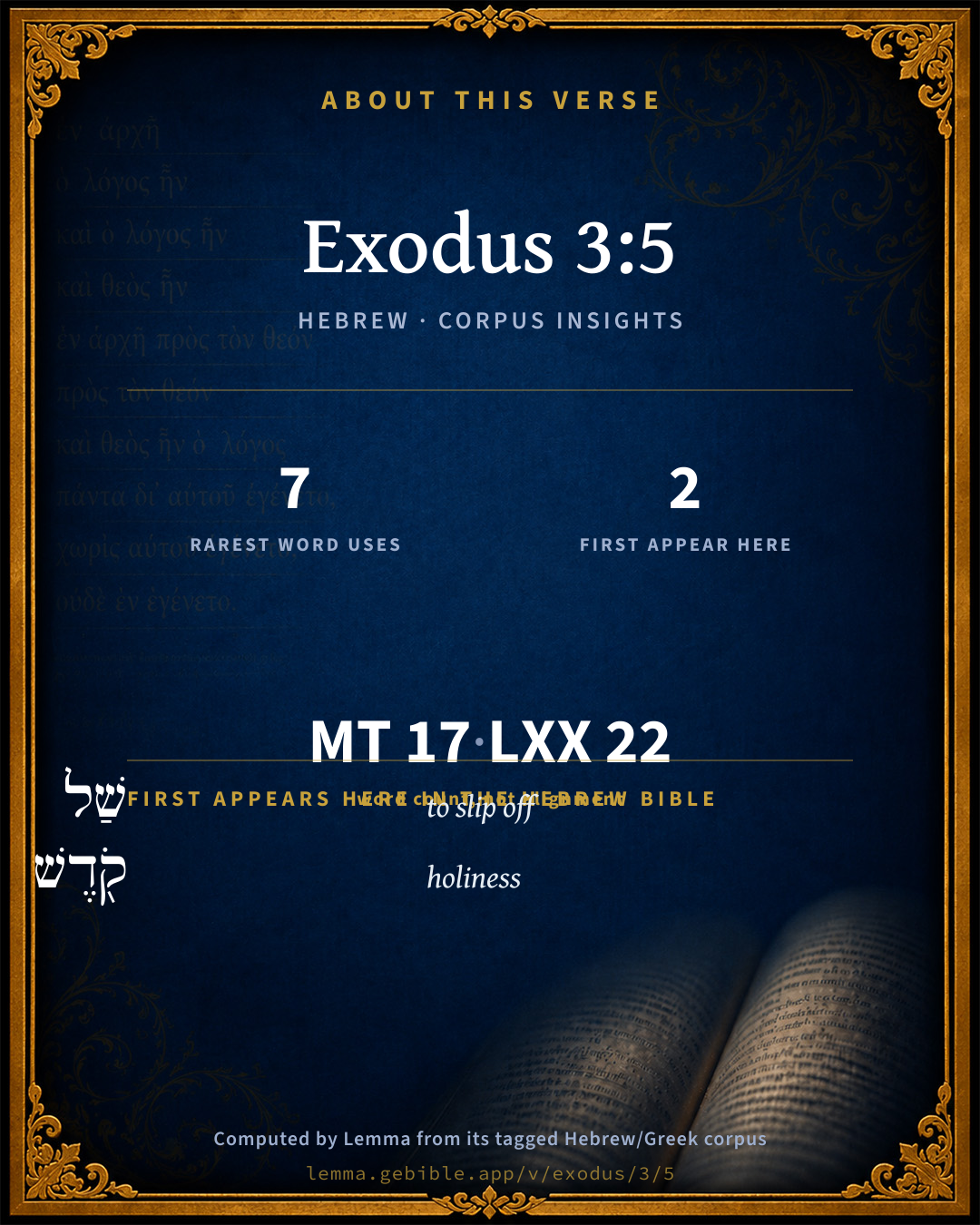
  • 2 first appearances in the Hebrew Bible
Full analysis ↓
Download a study sheet

One document with this verse’s original text, its word-by-word gloss line, the meaning frame, cross-references with their text, attributed commentary, and full source and license credits — printable, and it pastes into notes with its structure intact.

This verse Autodidact and up

Study sheet (.html) Plain text (.txt)

A passage Seminary Student

Up to 50 verses in one chapter. A passage sheet keeps up to 6 commentary sources and 12 cross-references per verse, in the order this page ranks them, and says so on the sheet whenever that leaves anything out. Ask for a single verse and you get the Autodidact verse sheet above.

Everything on this page stays free to read, with no account — the sheet is a download of what is already on screen, not access to it.

Want to remove ads? Support Godless Engineer
Compare translations 3

The same verse in 3 English versions, stacked beneath the original-language interlinear above. Click any original word for its lexicon entry.

Each is an independent rendering of the whole verse — the interlinear is not word-aligned to these translations.

Highlighted words mark where these versions differ — a whole-verse word diff, not a word-by-word alignment.

  • World English Bible Public Domain
    He said, "Don't come close. Take off your sandals from off your feet, for the place you are standing on is holy ground."
  • King James Version Public Domain
    And he said, Draw not nigh hither: put off thy shoes from off thy feet, for the place whereon thou standest is holy ground.
  • unfoldingWord Literal Text CC BY-SA 4.0
    And he said, “You must not come close to here. Take your sandals off from on your feet, for the place on which you are standing, it is holy ground.”

unfoldingWord Literal Text — © unfoldingWord, licensed CC BY-SA 4.0. Word-aligned USFM3 via Door43 (git.door43.org/unfoldingWord/en_ult).

Versions to compare (up to 4)

3 of 4 selected

Show all 18 translations

Every available English version of this verse, each an independent rendering of the whole verse.

  • World English Bible Public Domain
    He said, "Don't come close. Take off your sandals from off your feet, for the place you are standing on is holy ground."
  • Berean Standard Bible Public Domain
    “Do not come any closer,” God said. “Take off your sandals, for the place where you are standing is holy ground.”
  • Majority Standard Bible Public Domain
    “Do not come any closer,” God said. “Take off your sandals, for the place where you are standing is holy ground.”
  • King James Version Public Domain
    And he said, Draw not nigh hither: put off thy shoes from off thy feet, for the place whereon thou standest is holy ground.
  • American Standard Version (1901) Public Domain
    And he said, Draw not nigh hither: put off thy shoes from off thy feet, for the place whereon thou standest is holy ground.
  • Revised Version (1885) Public Domain
    And he said, Draw not nigh hither: put off thy shoes from off thy feet, for the place whereon thou standest is holy ground.
  • Geneva Bible (1599) Public Domain
    Then he saide, Come not hither, put thy shooes off thy feete: for the place whereon thou standest is holy ground.
  • Douay-Rheims (1899) Public Domain
    And he said: Come not nigh hither, put off the shoes from thy feet: for the place whereon thou standest is holy ground.
  • Young's Literal Translation Public Domain
    And He saith, `Come not near hither: cast thy shoes from off thy feet, for the place on which thou art standing is holy ground.'
  • Literal Standard Version CC BY-SA 4.0
    And He says, “Do not come near here. Cast your shoes from off your feet, for the place on which you are standing is holy ground.”
  • Unlocked Literal Bible CC BY-SA 4.0
    God said, “Do not come any closer! Take off your shoes from your feet, for the place where you are standing is ground that is set apart to me.”
  • unfoldingWord Literal Text CC BY-SA 4.0
    And he said, “You must not come close to here. Take your sandals off from on your feet, for the place on which you are standing, it is holy ground.”
  • Darby Bible Public Domain
    And he said, Draw not nigh hither: loose thy sandals from off thy feet, for the place whereon thou standest is holy ground.
  • World Messianic Bible Public Domain
    He said, “Don’t come close. Take off your sandals, for the place you are standing on is holy ground.”
  • Webster's Bible Public Domain
    And he said, Approach not hither: put off thy shoes from thy feet, for the place on which thou standest is holy ground.
  • Free Bible Version CC BY-SA 4.0
    “Don't come any closer!” God told him. “Take off your sandals because you're standing on holy ground.”
  • Bible in Basic English Public Domain
    And he said, Do not come near: take off your shoes from your feet, for the place where you are is holy.
  • JPS Tanakh (1917) Public Domain
    And He said: 'Draw not nigh hither; put off thy shoes from off thy feet, for the place whereon thou standest is holy ground.'

Literal Standard Version (2020), Covenant Press — licensed CC BY-SA 4.0. Text via the HelloAO Bible API (eBible.org). Unlocked Literal Bible (unfoldingWord) — licensed CC BY-SA 4.0. Text via the HelloAO Bible API (eBible.org). unfoldingWord Literal Text — © unfoldingWord, licensed CC BY-SA 4.0. Word-aligned USFM3 via Door43 (git.door43.org/unfoldingWord/en_ult). Free Bible Version, Dr. Jonathan Gallagher — licensed CC BY-SA 4.0. Text via the HelloAO Bible API (eBible.org).

Word by word

More ways to search: Search by grammar → Find every occurrence → Compare this word →

Practice this passage: Drill this verse → Learn its vocabulary →

שַׁל
nâshal
H5394
“slip off”
Verb, Qal, Imperative, 2nd Person, Masculine, Singular
Part of Speech
Verb
Stem
Qal
Form
Imperative
Person
2nd Person
Gender
Masculine
Number
Singular
Full BDB Definition

Origin: a primitive root

TWOT: 1432

to slip off, drop off, clear away, draw off - (Qal) - to slip or drop off - to draw off - to clear away - (Piel) to clear out completely, clear entirely
  1. וַיֹּ֖אמֶר ʼâmar H559 “and · to say” Conjunction + Verb, Qal, Sequential Imperfect, 3rd Person, Masculine, Singular
  2. אַל ʼal H408 “not” Particle, Negative
  3. תִּקְרַ֣ב qârab H7126 “to approach” Verb, Qal, Jussive, 2nd Person, Masculine, Singular
  4. הֲלֹ֑ם hălôm H1988 “here” Adverb
  5. נְעָלֶ֨יךָ֙ naʻal H5275 “sandals · your” Noun, Common, Feminine, Plural, Construct + Suffix, Personal, 2nd Person, Masculine, Singular
  6. מֵעַ֣ל ʻal H5921 “from · upon” Preposition + Preposition
  7. רַגְלֶ֔יךָ regel H7272 “feet · your” Noun, Common, Feminine, Dual, Construct + Suffix, Personal, 2nd Person, Masculine, Singular
  8. כִּ֣י kîy H3588 “that” Conjunction
  9. הַמָּק֗וֹם mâqôwm H4725 “the · place” Particle, Definite Article + Noun, Common, Masculine, Singular, Absolute
  10. אֲשֶׁ֤ר ʼăsher H834 “which” Particle, Relative
  11. אַתָּה֙ ʼattâh H859 “you” Pronoun, Personal, 2nd Person, Masculine, Singular
  12. עוֹמֵ֣ד ʻâmad H5975 “standing” Verb, Qal, Participle Active, Masculine, Singular, Absolute
  13. עָלָ֔יו ʻal H5921 “upon · him” Preposition + Suffix, Personal, 3rd Person, Masculine, Singular
  14. אַדְמַת ʼădâmâh H127 “ground of” Noun, Common, Feminine, Singular, Construct
  15. קֹ֖דֶשׁ qôdesh H6944 “holiness” Noun, Common, Masculine, Singular, Absolute
  16. הֽוּא hûwʼ H1931 “he” Pronoun, Personal, 3rd Person, Masculine, Singular

About this verse

These counts appear in no published source. They are computed here, from the morphology-tagged text and Lemma’s own curated glosses. What Lemma adds →

17
words
16
distinct lemmas
Pentateuch
section

Notable vocabulary

The rarest word here is שַׁל to slip off H5394 — appearing just 7 times in the whole Hebrew Bible.

First appearance in Scripture

These words make their first canonical appearance in the Hebrew Bible here:

  • שַׁל to slip off H5394
  • קֹ֖דֶשׁ holiness H6944

Shared distinctive vocabulary

שַׁל to slip off H5394 occurs in 7 verses of the Hebrew Bible. Also found in:

Grammatical profile

  • 4 verbs
  • 5 nouns
  • 2 pronouns
  • 2 prepositions
  • 1 conjunction
  • 1 adverb
  • 2 particles

Verb forms

  • וַיֹּ֖אמֶר Qal · Sequential Imperfect
  • תִּקְרַ֣ב Qal · Jussive
  • שַׁל Qal · Imperative
  • עוֹמֵ֣ד Qal · Participle Active

Repetition

A word recurs within this verse — often emphatic in Hebrew:

  • מֵעַ֣ל upon H5921 ×2

Hebrew & Septuagint length

In English translation the verse runs 23 words from the Hebrew and 23 from the Septuagint (LXX English) — the same length.

A rough comparison of the two English renderings, which tokenize alike — not a word-level alignment.

Word counts can differ between the Hebrew and the Greek without any difference in meaning — e.g. the Hebrew direct-object marker אֵת has no separate Greek word, and Greek often adds the article ὁ.

In the original languages it is 17 Hebrew tokens and 22 Greek tokens — but the two are counted differently (Hebrew bundles its prefixes and suffixes into one token; the Greek is in lemma form), so that isn’t a like-for-like length.

Cross-references

8

Topical passages linked to Exodus 3:5 in the Treasury of Scripture Knowledge — connected by theme and wording, ordered by reader-vote popularity; previews shown in the World English Bible.

  • Joshua 5:15 The prince of Yahweh's host said to Joshua, Put off your shoe from off your foot; for the place whereon you stand is holy. Joshua did so.
  • Acts 7:33 The Lord said to him, 'Take your sandals off of your feet, for the place where you stand is holy ground.
  • Exodus 19:12 You shall set bounds to the people round about, saying, 'Be careful that you don't go up onto the mountain, or touch its border. Whoever touches the mountain shall be surely put to death.
  • Ecclesiastes 5:1 Guard your steps when you go to God's house; for to draw near to listen is better than to give the sacrifice of fools, for they don't know that they do evil.
  • Genesis 28:16–17 Jacob awakened out of his sleep, and he said, "Surely Yahweh is in this place, and I didn't know it."
  • Hebrews 12:20 for they could not stand that which was commanded, "If even an animal touches the mountain, it shall be stoned;"
  • Exodus 19:21 Yahweh said to Moses, "Go down, charge the people, lest they break through to Yahweh to gaze, and many of them perish.
  • Leviticus 10:3 Then Moses said to Aaron, "This is what Yahweh spoke of, saying, "'I will show myself holy to those who come near me, And before all the people I will be glorified.'" Aaron held his peace.

Cross-references courtesy of OpenBible.info (CC BY 4.0).

Hebrew and Greek witnesses Masoretic Hebrew ↔ Greek Septuagint

The same verse in the two great witnesses to the Old Testament, shown verse-for-verse.

These are two independent witnesses, not word-aligned to each other, and the Septuagint is shown in lemma (dictionary) form.

Hebrew Exodus 3:5 Masoretic · Westminster Leningrad Codex

וַיֹּ֖אמֶר אַל תִּקְרַ֣ב הֲלֹ֑ם שַׁל נְעָלֶ֨יךָ֙ מֵעַ֣ל רַגְלֶ֔יךָ כִּ֣י הַמָּק֗וֹם אֲשֶׁ֤ר אַתָּה֙ עוֹמֵ֣ד עָלָ֔יו אַדְמַת קֹ֖דֶשׁ הֽוּא

He said, "Don't come close. Take off your sandals from off your feet, for the place you are standing on is holy ground."

World English Bible · Public Domain

Greek LXX Exodus 3:5 Septuagint · lemma form

καί εἶπον μή ἐγγίζω ὧδε λύω ὁ ὑπόδημα ἐκ ὁ πούς σύ ὁ γάρ τόπος ἐν ὅς σύ ἵστημι γῆ ἅγιος εἰμί

And he said, Draw not near hither: loose your sandals from off your feet, for the place whereon you stand is holy ground.

LXX2012 (modern English Septuagint) · Public Domain

Hebrew: Westminster Leningrad Codex (CC BY 4.0). Greek: Septuagint (public domain); English from LXX2012 (modern English Septuagint) (Public Domain). How the Septuagint differs from the Hebrew →

Targum (Aramaic paraphrase)

2

The Targum is the ancient Jewish Aramaic paraphrase of the Hebrew Scriptures — an interpretive translation, not the Hebrew text itself. Onkelos (literal) and Pseudo-Jonathan (expansive) render the Torah, and Jonathan the Prophets. Coverage is partial: where no permissively-licensed English translation exists for a verse, only the Aramaic is shown. This is verse-level text, not a word-by-word alignment to the Hebrew.

  1. Targum Onkelos Torah (Genesis–Deuteronomy)
    וַאֲמַר לָא תִקְרַב הַלְכָא שְׁרִי סֵינָךְ מֵעַל רִגְלָךְ אֲרֵי אַתְרָא דְאַתְּ קָאִים עֲלוֹהִי אֲתַר קַדִישׁ הוּא:

    (no public-domain English translation for this verse)

    Targum Onkelos — Aramaic: “Onkelos Genesis” (public domain); “Onkelos Exodus” (public domain); “Onkelos Leviticus” (public domain); “Onkelos Numbers” (public domain); “Onkelos Deuteronomy” (public domain). English: “Sefaria Community Translation” (CC0 1.0 (public-domain dedication)); “J.W. Etheridge. The Targums of Onkelos and Jonathan Ben Uzziel on the Pentateuch. London: Longmans, Green, 1862” (public domain). Text via Sefaria.

  2. Targum Pseudo-Jonathan Torah (Genesis–Deuteronomy)
    וַאֲמַר לָא תִקְרַב הַלְכָא שְׁלוּף סֵינָךְ מֵעַל רִגְלָךְ אֲרוּם אַתְרָא דְאַנְתְּ קָאִים עֲלוֹי אָתַר קַדִישׁ הוּא וְעָלוֹי אַנְתְּ עָתִיד לְקַבָּלָא אוֹרַיְיתָא לְמַלְפָא יָתָהּ לִבְנֵי יִשְרָאֵל

    And He said, Approach not hither, take the shoe from thy feet, for the place on which thou standest is a holy place; and upon it thou art to receive the Law, to teach it to the sons of Israel.

    Targum Pseudo-Jonathan — Aramaic: “Targum Jonathan on Genesis” (public domain); “Targum Jonathan on Exodus” (public domain); “Targum Jonathan on Leviticus” (public domain); “Targum Jonathan on Numbers” (public domain); “Targum Jonathan on Deuteronomy” (public domain). English: “The Targum of Jonathan ben Uzziel, trans. J. W. Etheridge, London, 1862” (public domain). Text via Sefaria.

Commentary

Notes on Exodus 3:5 from classic Christian and Jewish commentators (each source and its license shown beneath its notes). The classic Christian expositions comment on the surrounding passage and are grouped to its opening verse, so a note may address several verses; the Jewish commentaries on the Tanakh (Rashi and others) are per-verse, so they appear only where the commentator wrote on this verse.

Lemma curates 59 commentaries, every one of them public domain or Creative Commons licensed, each selected and text-cleaned for this edition rather than reprinted as found. About our sources →

Trapp's Complete Commentary

John Trapp

Exo 3:5 And he said, Draw not nigh hither: put off thy shoes from off thy feet, for the place whereon thou standest [is] holy ground.

Ver. 5. Draw not nigh.] Be not rash, but reverent. Heathens could say, Non loquendum de Deo sine lumine. God will be sanctified of all that draw nigh unto him. {Lev 10:2}

Put off thy shoes.] Of sensuality and other sins. Quid pedes, saith Erasmus, nisi affectus? Quid pedes calceamentorum onere liberi nisi animus nullis terrenis cupiditatibus oneratus? Affections are the feet of the soul; keep them unclogged.

John Trapp, A Commentary or Exposition upon All the Books of the Old and New Testament (1647–1656) — public domain. Text from a community e-Sword module.

Joseph Benson's Commentary

Exo 3:5. Draw not nigh hither — Keep thy distance. Thus God checks his curiosity and forwardness, and disposes his mind to the greater reverence and humility. Put off thy shoes from thy feet — This is required as a token of his reverence for the Divine Majesty, then and there eminently present; of his humiliation for his sins, which rendered him unworthy to appear before God; of his putting away all sin in his walk or conversation; and of his submission and readiness to obey God’s will; for which reason slaves were wont to approach their masters barefooted. We find the same direction given to Joshua, for the same reason, Jos 5:15. And it seems not improbable that putting off the shoes, as a sign of humiliation and veneration, was a ceremony observed by the patriarchs in their religious worship. Buxtorf says, that to this day the Jews go to their synagogues barefoot on the day of atonement, (Jud. Synag., c. 30, p. 57,) and many learned men suppose that the priests officiated barefoot in the tabernacle and temple. The custom of treading barefoot in holy places seems to have been general in the East: the Egyptians used it: and Pythagoras, who recommends to his disciples to worship, putting off their shoes, (ανυποδητος προσκυνει,) is thought to have learned this rite from them. The Mohammedans observe this ceremony at the present time, as do also the Christians of Abyssinia. The truth seems to be, as Henry observes, that putting off the shoes was then what putting off the hat is now, a token of respect and submission. The ground is holy — Not absolutely, but in relation to him who sanctified it by this peculiar manifestation of his presence. We ought to approach to God with a solemn pause and preparation; and to express our inward reverence by a grave and reverent behaviour in the worship of God, carefully avoiding every thing that looks light or rude.

Joseph Benson's Commentary on the Old and New Testaments (1811–1818) — public domain. Text from a community e-Sword module.

Tyndale Open Study Notes

Tyndale Open Resources

3:5 The soil around the bush was holy ground, while the soil on the bottom of Moses’ sandals was common. The common cannot touch the holy without being transformed or destroyed (see “Clean, Unclean, and Holy” Theme Note). At the outset of the Exodus, God was making it plain that he is absolutely “other” than his creation, a reality that cannot be overlooked in a proper divine-human relationship. The word holy occurs only a few times in the Bible prior to Exod 3:5. It now becomes the central descriptor of God in the Old Testament. In other Semitic languages, the same root occurs infrequently. It does not describe a moral quality in these other languages but simply what is “other than” human. The pagan gods, for instance, were “holy” only in the sense of being “other”—they did everything humans do, good and evil, but on a larger scale. In the Bible, by contrast, moral perfection is a central idea of the term holy. The one true God is the only being in the universe who truly stands apart from this world and is worthy of being called “holy” in this general sense. The true God is perfectly consistent and moral in his character. Here, at the burning bush, God revealed his otherness. Later at Sinai, he revealed his moral character in his requirements for those who would be his covenant partners (see Exod 19:6; 20:1–23:33; see also Lev 11:45; 1 Pet 1:13-16).

Tyndale Open Study Notes — © Tyndale Open Resources, licensed CC BY-SA 4.0. Text via the HelloAO Bible API.

Geneva Bible (1599)

Geneva Bible translators

Resign thyself up to me, Ruth 4:7; Josh. 5:15.

Because of my presence.

Geneva Bible (1599) marginal notes — public domain. Text via Bolls.life.

Jamieson, Fausset & Brown

Robert Jamieson, A. R. Fausset & David Brown

put off thy shoes--The direction was in conformity with a usage which was well known to Moses, for the Egyptian priests observed it in their temples, and it is observed in all Eastern countries where the people take off their shoes or sandals, as we do our hats. But the Eastern idea is not precisely the same as the Western. With us, the removal of the hat is an expression of reverence for the place we enter, or rather of Him who is worshipped there. With them the removal of the shoes is a confession of personal defilement and conscious unworthiness to stand in the presence of unspotted holiness.

Jamieson, Fausset & Brown — Commentary Critical and Explanatory on the Whole Bible (1871) — public domain (CC PDM 1.0). Text via the HelloAO Bible API.

Adam Clarke's Commentary

Verse 5. Put off thy shoes] It is likely that from this circumstance all the eastern nations have agreed to perform all the acts of their religious worship barefooted. All the Mohammedans, Brahmins, and Parsees do so still. The Jews were remarked for this in the time of Juvenal; hence he speaks of their performing their sacred rites barefooted; Sat. vi., ver. 158:

Observant ubi festa mero pede sabbata reges.

The ancient Greeks did the same. Jamblichus, in the life of Pythagoras, tells us that this was one of his maxims, Ανυποδητος θυε και προσκυνει, Offer sacrifice and worship with your shoes off. And Solinus asserts that no person was permitted to enter into the temple of Diana, in Crete, till he had taken off his shoes. "AEdem Numinis (Dianae) praeterquam nudus vestigio nulles licito ingreditur." Tertullian observes, de jejunio, that in a time of drought the worshippers of Jupiter deprecated his wrath, and prayed for rain, walking barefooted. "Cum stupet caelum, et aret annus, nudipedalia, denunciantur." It is probable that נעלים nealim, in the text, signifies sandals, translated by the Chaldee סנדל sandal, and סנדלא sandala, (see Ge 14:23), which was the same as the Roman solea, a sole alone, strapped about the foot As this sole must let in dust, gravel, and sand about the foot in travelling, and render it very uneasy, hence the custom of frequently washing the feet in those countries where these sandals were worn. Pulling off the shoes was, therefore, an emblem of laying aside the pollutions contracted by walking in the way of sin. Let those who name the Lord Jesus Christ depart from iniquity. In our western countries reverence is expressed by pulling off the hat; but how much more significant is the eastern custom! "The natives of Bengal never go into their own houses with their shoes on, nor into the houses of others, but always leave their shoes at the door. It would be a great affront not to attend to this mark of respect when visiting; and to enter a temple without pulling off the shoes would be an unpardonable offence."-Ward.

The place whereon thou standest is holy ground.] It was not particularly sanctified by the Divine presence; but if we may credit Josephus, a general opinion had prevailed that God dwelt on that mountain; and hence the shepherds, considering it as sacred ground, did not dare to feed their flocks there. Moses, however, finding the soil to be rich and the pasturage good, boldly drove his flock thither to feed on it. - Antiq., b. ii., c. xii., s. 1.

Adam Clarke's Commentary on the Bible (1810–1826) — public domain. Text from a community e-Sword/MySword module.

Ellicott's Commentary for English Readers

(5) Put off thy shoes.—Rather, thy sandals. It is doubtful whether shoes were known at this early date. They would certainly not have been worn in Midian. Egyptians before the time of Moses, and Orientals generally, in ancient (as in modern) times, removed their sandals (or their shoes) from their feet on entering any place to which respect was due, as a temple, a palace, and even the private house of a great man. It is worthy of notice that God Himself orders this mark of respect to be shown to the place which His Presence has hallowed. On the reverence due to holy places, see the Note on Gen_28:16-17.

A Bible Commentary for English Readers, edited by Charles John Ellicott (1878–1897) — public domain. Text from a community e-Sword module.

The Cambridge Bible for Schools and Colleges

gen. ed. J. J. S. Perowne

5. shoes] properly (as always) sandals. Cf. Jos_5:15 (J). The removal of the sandals is still the usual mark of reverence, upon entering a mosque, or other holy place, in the East.

The Cambridge Bible for Schools and Colleges (gen. ed. J. J. S. Perowne; Cambridge University Press, 1878–1918) — public domain. Text from a community e-Sword module.

John Gill's Exposition

And he said, draw not nigh hither,.... Keep a proper distance:

put off thy shoes from off thy feet; dust and dirt cleaving to shoes, and these being ordered to be put off from the feet, the instrument of walking, show that those that draw nigh to God, and are worshippers of him, ought to be of pure and holy lives and conversations:

for the place whereon thou standest is holy ground; not that there was any inherent holiness in this spot of ground more than in any other, which ground is not capable of; but a relative holiness on account of the presence of God here at this time, and was not permanent, only while a pure and holy God was there: hence, in after times, the temple being the place of the divine residence, the priests there performed their services barefooted, nor might a common person enter into the temple with his shoes on (k); and to this day the Jews go to their synagogues barefooted on the day of atonement (l), to which Juvenal (m) seems to have respect; and from hence came the Nudipedalia among the Heathens, and that known symbol of Pythagoras (n), "sacrifice and worship with naked feet": in this manner the priests of Diana sacrificed to her among the Cretians and other people (o); and so the priests of Hercules did the same (p); the Brahmans among the Indians never go into their temples without plucking off their shoes (q); so the Ethiopian Christians, imitating Jews and Gentiles, never go into their places of public worship but with naked feet (r), and the same superstition the Turks and Mahometans observe (s).

(k) Misn. Beracot, c. 9. sect. 5. (l) Buxtorf. Jud Synagog. c. 30. p. 571. (m) "Observant ub. festa mero pede Sabbata reges." Satyr. 6. (n) Jamblichus de Vita Pythagor. Symbol. 3. (o) Solin. Polyhistor. c. 16. Strabo, l. 12. p. 370. (p) Silius de Bello Punic, l. 3. (q) Rogerius de Relig. Brachman. l. 2. c. 10. apud Braunium de vest. sacerdot. l. 1. c. 3. p. 66. (r) Damianus a Goes apud Rivet. in loc. (s) Pitts's Account of the Relig. and Manners of the Mahometans, c. 6. p. 38. 81. Georgieviz. de Turc. Moribus, c. 1. p. 11. Sionita de Urb. Oriental. & Relig. c. 7. p. 18. c. 10. p. 34.

John Gill's Exposition of the Whole Bible (1746–1763) — public domain (CC PDM 1.0). Text via the HelloAO Bible API.

Albert Barnes' Notes on the Bible

Put off thy shoes - The reverence due to holy places thus rests upon God’s own command. The custom itself is well known from the observances of the temple, it was almost universally adopted by the ancients, and is retained in the East.

Holy ground - This passage is almost conclusive against the assumption that the place was previously a sanctuary. Moses knew nothing of its holiness after some 40 years spent on the Peninsula. It became holy by the presence of God.

Albert Barnes' Notes on the Bible (1834–1885) — public domain. Text from a community e-Sword/MySword module.

Haydock's Catholic Bible Commentary

Shoes. Juvenal, sat. 6, takes notice of this custom. Observant ubi festa mero pede sabbata reges. (Du Hamel) --- The Ethiopian Christians and the Turks never enter their churches, or mosques, without putting off their shoes. The priests did the like when they entered the temple of Jerusalem, and God ordered them moreover to wash their feet and hands, Exodus xxx. 19. (Calmet) --- We observe the same ceremony, out of respect for Jesus Christ, when we go to kiss the cross. Pythagoras said, "Offer sacrifice and adoration barefoot." (Jamblic. 24.) On such occasions, we ought to have our hearts disengaged from the world. (Haydock) See Leviticus ii. 25.

George Leo Haydock (1774–1849), Haydock's Catholic Family Bible and Commentary, 1859 edition — public domain. Excludes Psalms (Douay-Rheims chapter numbering differs from Protestant) and Deuterocanonical books (Catholic canon only).

Matthew Poole's English Annotations

Draw not nigh hither; keep thy distance; whereby he checks his curiosity and forwardness, and works him to the greater reverence and humility. Compare Exo 19:12,21; Jos 5:15.

Put off thy shoes: this he requires as an act and token,

1. Of his reverence to the Divine Majesty, then and there eminently present.

2. Of his humiliation for his sins, whereby he was unfit and unworthy to appear before God; for this was a posture of humiliation, 2Sa 15:30; Isa 20:2,4; Eze 24:17,23.

3. Of purification from the filth of his feet, or ways, or conversation, that he might be more fit to approach to God. See Joh 13:10; Heb 10:22.

4. Of this submission and readiness to obey God’s will, for which reason slaves used to be bare-footed.

Holy ground; with a relative holiness at this time, because of my special presence in it.

Matthew Poole's English Annotations on the Holy Bible (1683–1685) — public domain. Text from a community e-Sword/MySword module.

Whedon's Commentary on the Bible

Daniel D. Whedon

5. Put off thy shoes — The Orientals drop their shoes or sandals at the door, lest they defile the department by bringing in the dirt of the street; and by this expressive symbolism was Moses taught that he was drawing nigh to Him in whose sight “the heavens are not clean.” The awful holiness of God is the first thought that the praying soul needs, and hence at the threshold of prayer the soul is taught to drop its sandals with “Hallowed be thy name.”

Daniel D. Whedon (gen. ed.), Commentary on the Old and New Testaments (1874–1909) — public domain. Text from a community e-Sword module.

The Pulpit Commentary

Draw not nigh. The awful greatness of the Creator is such that his creatures, until invited to draw near, are bound to stand aloof. Moses, not yet aware that God himself spoke to him, was approaching the bush too close, to examine and see what the "great thing" was. (See ver. 3.) On the general unfitness of man to approach near to holy things, see the comment on Exo_19:12. Put off thy shoes. Rather, "thy sandals. " Shoes were not worn commonly, even by the Egyptians, until a late period, and would certainly not be known in the land of Midian at this time. The practice of putting them off before entering a temple, a palace, or even the private apartments of a house, was, and is, universal in the East the rationale of it being that the shoes or sandals have dust or dirt attaching to them. The command given to Moses at this time was repeated to Joshua. (Jos_5:15) Holy ground. Literally, "ground of holiness ground rendered holy by the presence of God upon it not "an old sanctuary," as some have thought, for then Moses would not have needed the information.

The God of thy father. "Father" here is used collectively, meaning forefathers generally, a usage well known to Hebraists. (Compare Exo_15:2, antioch, Exo_18:4) The God of Abraham, etc., i.e. the God who revealed himself to Abraham, Isaac, and Jacob, and entered into covenant with them. (Gen_15:1-21 Gen_26:2-5 Gen_35:1-12) The conclusion which our Blessed Lord drew from this verse (Mat_22:32) is not directly involved in it, but depends on his minor premiss, "God is not the God of the dead, but of the living." Moses hid his face. A natural instinctive action. So Elijah, on the same site (1Ki_19:13) and the holy angels before God"s throne in heaven. (Isa_6:2) In thereligious system of Rome, the augurs when discharging their office, and all persons when offering a sacrifice, veiled their heads. (See Liv. 1:18; Virg. Aen. 3:405; Juv. 6:390.)

The Pulpit Commentary (1880–1919), ed. H.D.M. Spence-Jones & Joseph S. Exell — public domain. Text from a community e-Sword module.

John Wesley's Explanatory Notes

Put off thy shoes from off thy feet - The putting off the shoe was then what the putting off the hat is now, a token of respect and submission. The ground is holy ground, made so by this special manifestation of the divine presence. We ought to approach to God with a solemn pause and preparation; and to express our inward reverence, by a grave and reverent behaviour in the worship of God, carefully avoiding every thing that looks light, or rude.

John Wesley, Explanatory Notes Upon the Whole Bible (1754–1765) — public domain. Text via the GEBible commentary corpus.

Rashi

Rabbi Shlomo Yitzchaki (Rashi)

של means DRAW OFF and take off. It is of the same root as, (Numbers 19:5) “and the iron-head slippeth off (נשל) from the handle”; (Deuteronomy 28:40) “for thine olives shall drop off (ישל)‎”.

אדמת קדש הוא the place IS HOLY GROUND (i. e. the masculine pronoun הוא refers to the word המקום and not to אדמת, which is feminine).

Rashi on the Tanakh — English translations: “The Judaica Press complete Tanach with Rashi, translated by A. J. Rosenberg” (CC BY 4.0); “Pentateuch with Rashi's commentary by M. Rosenbaum and A.M. Silbermann, 1929-1934” (public domain); “The Metsudah Tanach series, Lakewood, N.J” (CC BY 4.0); and “The Book of Joshua, Metsudah Publications, 1997” (CC BY 4.0). Text via Sefaria.

Ramban (Nachmanides)

Rabbi Moshe ben Nachman (Ramban / Nachmanides)

APPROACH NOT HITHER. Moses had not yet reached the highest degree of prophecy, for at Mount Sinai he drew near unto the thick darkness where G-d was. This also accounts for the hiding of his face [in this instance], for he had not yet reached that high [degree of prophecy of] which it was said of Moses, and the similitude of the Eternal doth he behold.

FOR THE PLACE WHEREON THOU STANDEST IS HOLY GROUND. Even though Moses was far from the bush, the angel warned him [not to approach], for the whole mountain became sanctified when the Divine Presence came down upon the mountain—top, just as it did at the time of the Giving of the Torah. Now Moses was on the mountain for he had ascended thereto, as it is said, and he came to the mountain of G-d, unto Horeb, and the bush was on the top of the mountain., that he was warned not “to approach.” Had he not been on the mountain at all, the warning should have been not “to come up.” Thus the entire site became holy and therefore the wearing of sandals was forbidden. A similar case is found in Joshua. Likewise, the priests ministered in the Sanctuary only while barefoot.

Ramban (Nachmanides) on the Tanakh — English translation: “Commentary on the Torah by Ramban (Nachmanides). Translated and annotated by Charles B. Chavel. New York, Shilo Pub. House, 1971-1976” (CC BY 4.0). Text via Sefaria.

Lesson kit

Teaching starters — assembled from the data on this page, not authored interpretation. Every prompt links to the verse data it draws on. Edit before teaching.

Exodus, in the Pentateuch, opens this verse with 17 words (16 distinct Hebrew lemmas). Its most distinctive word is nâshal (“to slip off”). A historical commentator’s framing appears above. Read the whole chapter for the surrounding context.

Discussion questions

  1. How does “to slip off” (nâshal) shape what this verse is saying?
  2. 2 words here appear for the first time in Scripture. What is being introduced at this debut?
  3. Deuteronomy 7:1 shares the word «to slip off» with this verse. How do the two illuminate each other?
  4. “upon” occurs 2× in this one verse. What is the effect of the repetition?
  5. The translations on this page render this verse differently — a whole-verse word diff, not a word-by-word alignment. What might account for the different wordings?
  6. The verb «וַיֹּ֖אמֶר» is Qal Sequential Imperfect. How does its form color the action?
  7. Reading how Trapp's Complete Commentary and Joseph Benson's Commentary read this verse, where do the two commentators agree and where do they part?

Things to notice

Reading settings

Reading text

Shown beneath each verse's original-language words.

Old Testament
Old Testament edition

Read the OT as the Masoretic Hebrew (MT) or the Greek Septuagint (LXX).

English shown for the Greek Septuagint (in the Hebrew ↔ Greek comparison).

Comparing translations? Open the Compare panel on any verse page to stack up to four side by side.