
Joshua 7:19

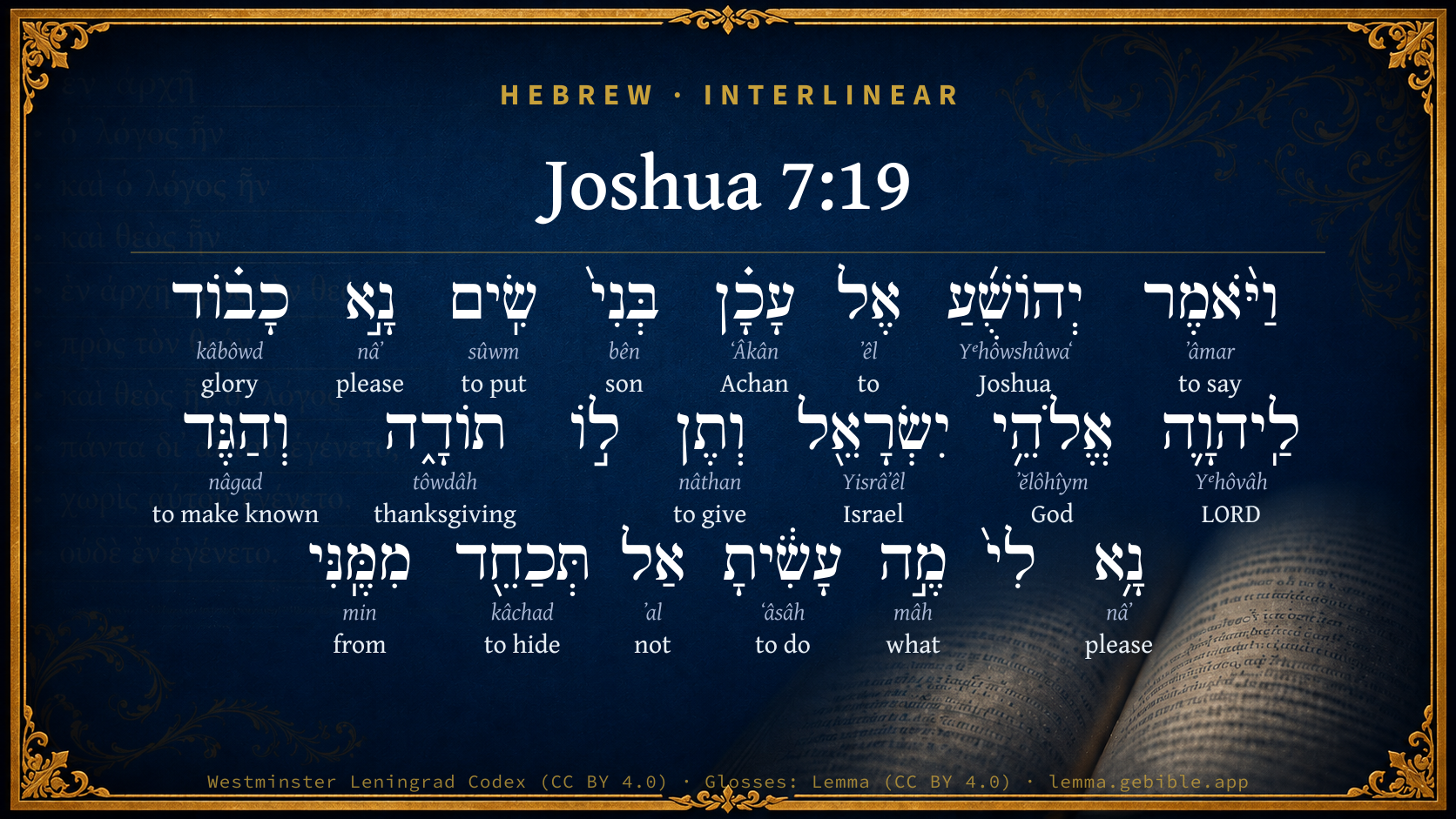
Hebrew (Westminster Leningrad Codex) Joshua 7:19 appears in the Hebrew Old Testament. The text above is from the Westminster Leningrad Codex. Each word links to its Strong’s number, a concise gloss, and parsing drawn from the Open Scriptures Hebrew Bible morphology. Click any word for its full Brown-Driver-Briggs (BDB) entry.
Download image
Cite this verse

Joshua 7:19 (World English Bible). Public Domain. Lemma interlinear Bible study tool, https://lemma.gebible.app/v/joshua/7/19.

Show BibTeX & RIS
BibTeX
RIS
English Translation
Joshua said to Achan, My son, please give glory to Yahweh, the God of Israel, and make confession to him; and tell me now what you have done; don't hide it from me.
World English Bible · Public Domain
Download a study sheet

One document with this verse’s original text, its word-by-word gloss line, the meaning frame, cross-references with their text, attributed commentary, and full source and license credits — printable, and it pastes into notes with its structure intact.

This verse Autodidact and up

Study sheet (.html) Plain text (.txt)

A passage Seminary Student

Up to 50 verses in one chapter. A passage sheet keeps up to 6 commentary sources and 12 cross-references per verse, in the order this page ranks them, and says so on the sheet whenever that leaves anything out. Ask for a single verse and you get the Autodidact verse sheet above.

Everything on this page stays free to read, with no account — the sheet is a download of what is already on screen, not access to it.

Want to remove ads? Support Godless Engineer
Compare translations 3

The same verse in 3 English versions, stacked beneath the original-language interlinear above. Click any original word for its lexicon entry.

Each is an independent rendering of the whole verse — the interlinear is not word-aligned to these translations.

Highlighted words mark where these versions differ — a whole-verse word diff, not a word-by-word alignment.

  • World English Bible Public Domain
    Joshua said to Achan, My son, please give glory to Yahweh, the God of Israel, and make confession to him; and tell me now what you have done; don't hide it from me.
  • King James Version Public Domain
    And Joshua said unto Achan, My son, give, I pray thee, glory to the LORD God of Israel, and make confession unto him; and tell me now what thou hast done; hide it not from me.
  • unfoldingWord Literal Text CC BY-SA 4.0
    And Joshua said to Achan, “My son, please give glory to Yahweh, the God of Israel, and make confession to him. And declare to me please what you have done. Do not hide from me.”

unfoldingWord Literal Text — © unfoldingWord, licensed CC BY-SA 4.0. Word-aligned USFM3 via Door43 (git.door43.org/unfoldingWord/en_ult).

Versions to compare (up to 4)

3 of 4 selected

Show all 18 translations

Every available English version of this verse, each an independent rendering of the whole verse.

  • World English Bible Public Domain
    Joshua said to Achan, My son, please give glory to Yahweh, the God of Israel, and make confession to him; and tell me now what you have done; don't hide it from me.
  • Berean Standard Bible Public Domain
    So Joshua said to Achan, “My son, give glory to the LORD, the God of Israel, and make a confession to Him. I urge you to tell me what you have done; do not hide it from me.”
  • Majority Standard Bible Public Domain
    So Joshua said to Achan, “My son, give glory to the LORD, the God of Israel, and make a confession to Him. I urge you to tell me what you have done; do not hide it from me.”
  • King James Version Public Domain
    And Joshua said unto Achan, My son, give, I pray thee, glory to the LORD God of Israel, and make confession unto him; and tell me now what thou hast done; hide it not from me.
  • American Standard Version (1901) Public Domain
    And Joshua said unto Achan, My son, give, I pray thee, glory to Jehovah, the God of Israel, and make confession unto him; and tell me now what thou hast done; hide it not from me.
  • Revised Version (1885) Public Domain
    And Joshua said unto Achan, My son, give, I pray thee, glory to the LORD, the God of Israel, and make confession unto him; and tell me now what thou hast done; hide it not from me.
  • Geneva Bible (1599) Public Domain
    Then Ioshua said vnto Achan, My sonne, I beseech thee, giue glory to the Lord God of Israel, and make confession vnto him, and shewe me now what thou hast done: hide it not from me.
  • Douay-Rheims (1899) Public Domain
    And Josue said to Achan: My son, give glory to the Lord God of Israel, and confess, and tell me what thou hast done, hide it not.
  • Young's Literal Translation Public Domain
    And Joshua saith unto Achan, `My son, put, I pray thee, honour on Jehovah, God of Israel, and give to Him thanks, and declare, I pray thee, to me, what thou hast done -- hide not from me.'
  • Literal Standard Version CC BY-SA 4.0
    And Joshua says to Achan, “My son, please give glory to YHWH, God of Israel, and give thanks to Him, and now declare to me what you have done—do not hide [it] from me.”
  • Unlocked Literal Bible CC BY-SA 4.0
    Then Joshua said to Achan, “My son, tell the truth before Yahweh, the God of Israel, and give your confession to him. Please tell me what you have done. Do not hide it from me.”
  • unfoldingWord Literal Text CC BY-SA 4.0
    And Joshua said to Achan, “My son, please give glory to Yahweh, the God of Israel, and make confession to him. And declare to me please what you have done. Do not hide from me.”
  • Darby Bible Public Domain
    And Joshua said to Achan, My son, give, I pray thee, glory to Jehovah the God of Israel, and make confession to him: tell me now what thou hast done, keep it not back from me.
  • World Messianic Bible Public Domain
    Joshua said to Achan, “My son, please give glory to the LORD, the God of Israel, and make confession to him. Tell me now what you have done! Don’t hide it from me!”
  • Webster's Bible Public Domain
    And Joshua said to Achan, My son, give, I pray thee, glory to the LORD God of Israel, and make confession to him; and tell me now what thou hast done, hide it not from me.
  • Free Bible Version CC BY-SA 4.0
    Joshua said to Achan, “My son, honor the Lord, the God of Israel, and confess. Tell me what you have done. Don't hide it from me.”
  • Bible in Basic English Public Domain
    And Joshua said to Achan, My son, give glory and praise to the Lord, the God of Israel; give me word now of what you have done, and keep nothing back from me.
  • JPS Tanakh (1917) Public Domain
    And Joshua said unto Achan: 'My son, give, I pray thee, glory to the LORD, the God of Israel, and make confession unto Him; and tell me now what thou hast done; hide nothing from me.'

Literal Standard Version (2020), Covenant Press — licensed CC BY-SA 4.0. Text via the HelloAO Bible API (eBible.org). Unlocked Literal Bible (unfoldingWord) — licensed CC BY-SA 4.0. Text via the HelloAO Bible API (eBible.org). unfoldingWord Literal Text — © unfoldingWord, licensed CC BY-SA 4.0. Word-aligned USFM3 via Door43 (git.door43.org/unfoldingWord/en_ult). Free Bible Version, Dr. Jonathan Gallagher — licensed CC BY-SA 4.0. Text via the HelloAO Bible API (eBible.org).

Word by word

More ways to search: Search by grammar → Find every occurrence → Compare this word →

Practice this passage: Drill this verse → Learn its vocabulary →

עָכָ֗ן
ʻÂkân
H5912
“Achan”
Noun, Proper
Part of Speech
Noun
Type
Proper
Full BDB Definition

Origin: from an unused root meaning to trouble

TWOT: None

Achan = "troubler" - a Judaite who violated God's specific ban on taking any loot from the captured city of Jericho and was stoned to death along with his family for this violation
  1. וַיֹּ֨אמֶר ʼâmar H559 “and · to say” Conjunction + Verb, Qal, Sequential Imperfect, 3rd Person, Masculine, Singular
  2. יְהוֹשֻׁ֜עַ Yᵉhôwshûwaʻ H3091 “Joshua” Noun, Proper
  3. אֶל ʼêl H413 “to” Preposition
  4. בְּנִי֙ bên H1121 “son · my” Noun, Common, Masculine, Singular, Construct + Suffix, Personal, 1st Person, Common, Singular
  5. שִֽׂים sûwm H7760 “put” Verb, Qal, Imperative, 2nd Person, Masculine, Singular
  6. נָ֣א nâʼ H4994 “please” Particle, Exhortation
  7. כָב֗וֹד kâbôwd H3519 “glory” Noun, Common, Both, Singular, Absolute
  8. לַֽיהוָ֛ה Yᵉhôvâh H3068 “to/for · LORD” Preposition + Noun, Proper
  9. אֱלֹהֵ֥י ʼĕlôhîym H430 “God(s) of” Noun, Common, Masculine, Plural, Construct
  10. יִשְׂרָאֵ֖ל Yisrâʼêl H3478 “Israel” Noun, Proper
  11. וְתֶן nâthan H5414 “and · give” Conjunction + Verb, Qal, Imperative, 2nd Person, Masculine, Singular
  12. תוֹדָ֑ה tôwdâh H8426 “thanksgiving” Noun, Common, Feminine, Singular, Absolute
  13. וְהַגֶּד nâgad H5046 “and · make known” Conjunction + Verb, Hiphil, Imperative, 2nd Person, Masculine, Singular
  14. נָ֥א nâʼ H4994 “please” Particle, Exhortation
  15. מֶ֣ה mâh H4100 “what” Particle, Interrogative
  16. עָשִׂ֔יתָ ʻâsâh H6213 “to do” Verb, Qal, Perfect, 2nd Person, Masculine, Singular
  17. אַל ʼal H408 “not” Particle, Negative
  18. תְּכַחֵ֖ד kâchad H3582 “to hide” Verb, Piel, Jussive, 2nd Person, Masculine, Singular
  19. מִמֶּֽנִּי min H4480 “from · me” Preposition + Suffix, Personal, 1st Person, Common, Singular

About this verse

These counts appear in no published source. They are computed here, from the morphology-tagged text and Lemma’s own curated glosses. What Lemma adds →

22
words
19
distinct lemmas
Historical
section

Notable vocabulary

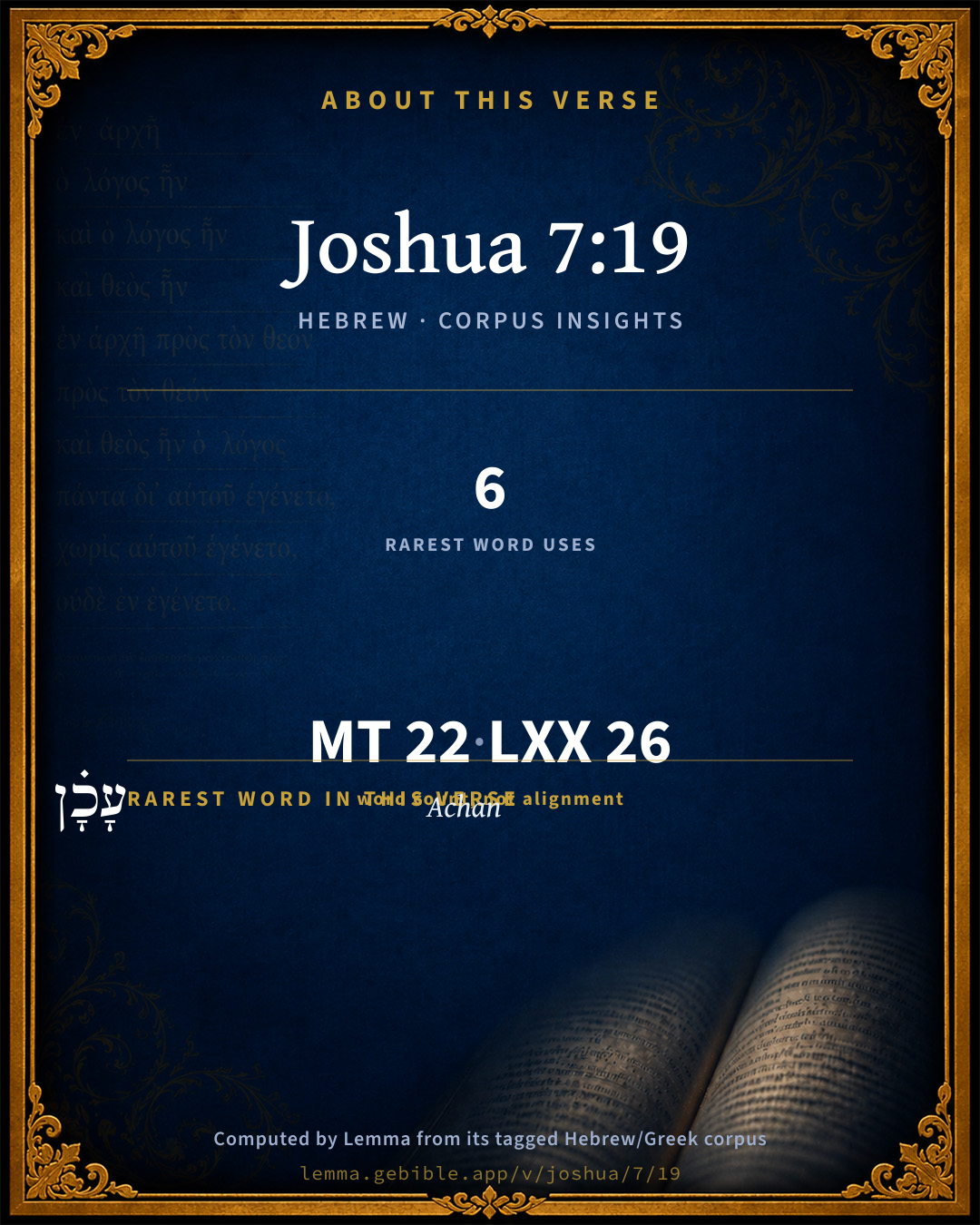
The rarest word here is עָכָ֗ן Achan H5912 — appearing just 6 times in the whole Hebrew Bible.

Shared distinctive vocabulary

עָכָ֗ן Achan H5912 occurs in 6 verses of the Hebrew Bible. Also found in:

Grammatical profile

  • 6 verbs
  • 8 nouns
  • 4 prepositions
  • 4 particles

Verb forms

  • וַיֹּ֨אמֶר Qal · Sequential Imperfect
  • שִֽׂים Qal · Imperative
  • וְתֶן Qal · Imperative
  • וְהַגֶּד Hiphil · Imperative
  • עָשִׂ֔יתָ Qal · Perfect
  • תְּכַחֵ֖ד Piel · Jussive

Repetition

A word recurs within this verse — often emphatic in Hebrew:

  • נָ֣א please H4994 ×2

Hebrew & Septuagint length

In English translation the verse runs 33 words from the Hebrew and 31 from the Septuagint (LXX English) — closely comparable.

A rough comparison of the two English renderings, which tokenize alike — not a word-level alignment.

Word counts can differ between the Hebrew and the Greek without any difference in meaning — e.g. the Hebrew direct-object marker אֵת has no separate Greek word, and Greek often adds the article ὁ.

In the original languages it is 22 Hebrew tokens and 26 Greek tokens — but the two are counted differently (Hebrew bundles its prefixes and suffixes into one token; the Greek is in lemma form), so that isn’t a like-for-like length.

Cross-references

23

Topical passages linked to Joshua 7:19 in the Treasury of Scripture Knowledge — connected by theme and wording, ordered by reader-vote popularity; previews shown in the World English Bible.

  • 1 Samuel 6:5 Therefore you shall make images of your tumors, and images of your mice that mar the land; and you shall give glory to the God of Israel: peradventure he will lighten his hand from off you, and from off your gods, and from off your land.
  • Jeremiah 13:16 Give glory to Yahweh your God, before he cause darkness, and before your feet stumble on the dark mountains, and, while you look for light, he turn it into the shadow of death, and make it gross darkness.
  • John 9:24 So they called the man who was blind a second time, and said to him, "Give glory to God. We know that this man is a sinner."
  • 1 Samuel 14:43 Then Saul said to Jonathan, Tell me what you have done. Jonathan told him, and said, I did certainly taste a little honey with the end of the rod that was in my hand; and, behold, I must die.
  • 2 Chronicles 30:22 Hezekiah spoke comfortably to all the Levites who had good understanding [in the service] of Yahweh. So they ate throughout the feast for the seven days, offering sacrifices of peace-offerings, and making confession to Yahweh, the God of their fathers.
  • Daniel 9:4 I prayed to Yahweh my God, and made confession, and said, Oh, Lord, the great and dreadful God, who keeps covenant and loving kindness with those who love him and keep his commandments,
  • Numbers 5:6–7 "Speak to the children of Israel: When a man or woman commits any sin that men commit, so as to trespass against Yahweh, and that soul is guilty;
  • Psalms 32:5 I acknowledged my sin to you. I didn't hide my iniquity. I said, I will confess my transgressions to Yahweh, And you forgave the iniquity of my sin. Selah.
  • Proverbs 28:13 He who conceals his sins doesn't prosper, But whoever confesses and renounces them finds mercy.
  • 1 John 1:8–10 If we say that we have no sin, we deceive ourselves, and the truth is not in us.
  • 2 Chronicles 33:12–13 When he was in distress, he begged Yahweh his God, and humbled himself greatly before the God of his fathers.
  • Ezra 10:10–11 Ezra the priest stood up, and said to them, You have trespassed, and have married foreign women, to increase the guilt of Israel.
  • Psalms 51:3 For I know my transgressions. My sin is constantly before me.
  • Isaiah 13:12 I will make a man more rare than fine gold, even a man than the pure gold of Ophir.
  • Jeremiah 3:12–13 Go, and proclaim these words toward the north, and say, Return, you backsliding Israel, says Yahweh; I will not look in anger on you; for I am merciful, says Yahweh, I will not keep [anger] forever.
  • Jonah 1:8–10 Then they asked him, "Tell us, please, for whose cause this evil is on us. What is your occupation? Where do you come from? What is your country? Of what people are you?"
  • Luke 17:18 Were there none found who returned to give glory to God, except this stranger?"
  • Romans 10:10 For with the heart, one believes unto righteousness; and with the mouth confession is made unto salvation.
  • 2 Timothy 2:25 in gentleness correcting those who oppose him: perhaps God may give them repentance leading to a full knowledge of the truth,
  • Titus 2:2 that older men should be temperate, sensible, sober-minded, sound in faith, in love, and in patience:
  • James 1:20 for the anger of man doesn't produce the righteousness of God.
  • 1 Peter 3:8–9 Finally, be all like-minded, compassionate, loving as brothers, tenderhearted, courteous,
  • Revelation 16:9 People were scorched with great heat, and people blasphemed the name of God who has the power over these plagues. They didn't repent and give him glory.

Cross-references courtesy of OpenBible.info (CC BY 4.0).

Hebrew and Greek witnesses Masoretic Hebrew ↔ Greek Septuagint

The same verse in the two great witnesses to the Old Testament, shown verse-for-verse.

These are two independent witnesses, not word-aligned to each other, and the Septuagint is shown in lemma (dictionary) form.

Hebrew Joshua 7:19 Masoretic · Westminster Leningrad Codex

וַיֹּ֨אמֶר יְהוֹשֻׁ֜עַ אֶל עָכָ֗ן בְּנִי֙ שִֽׂים נָ֣א כָב֗וֹד לַֽיהוָ֛ה אֱלֹהֵ֥י יִשְׂרָאֵ֖ל וְתֶן ל֣וֹ תוֹדָ֑ה וְהַגֶּד נָ֥א לִי֙ מֶ֣ה עָשִׂ֔יתָ אַל תְּכַחֵ֖ד מִמֶּֽנִּי

Joshua said to Achan, My son, please give glory to Yahweh, the God of Israel, and make confession to him; and tell me now what you have done; don't hide it from me.

World English Bible · Public Domain

Greek LXX Joshua 7:19 Septuagint · lemma form

καί εἶπον ἰησοῦς ὁ αχαρ δίδωμι δόξα σήμερον ὁ κύριος θεός ἰσραήλ καί δίδωμι ὁ ἐξομολόγησις καί ἀναἀγγέλλω ἐγώ τίς ποιέω καί μή κρύπτω ἀπό ἐγώ

And Joshua said to Achar, Give glory this day to the Lord God of Israel, and make confession; and tell me what you have done, and hide it not from me.

LXX2012 (modern English Septuagint) · Public Domain

Hebrew: Westminster Leningrad Codex (CC BY 4.0). Greek: Septuagint (public domain); English from LXX2012 (modern English Septuagint) (Public Domain). How the Septuagint differs from the Hebrew →

Targum (Aramaic paraphrase)

1

The Targum is the ancient Jewish Aramaic paraphrase of the Hebrew Scriptures — an interpretive translation, not the Hebrew text itself. Onkelos (literal) and Pseudo-Jonathan (expansive) render the Torah, and Jonathan the Prophets. Coverage is partial: where no permissively-licensed English translation exists for a verse, only the Aramaic is shown. This is verse-level text, not a word-by-word alignment to the Hebrew.

  1. Targum Jonathan Prophets (Joshua–Malachi)
    וַאֲמַר יְהוֹשֻׁעַ לְעָכָן בְּרִי שַׁוִי כְעַן יְקָרָא קֳדָם יְיָ אֱלָהָא דְיִשְׂרָאֵל וְהַב קֳדָמוֹהִי הוֹדָאָה וְחַוֵי כְּעַן לִי מַה עֲבַדְתָּא לָא תְכַסֵי מִינִי:

    (no public-domain English translation for this verse)

    Targum Jonathan — Aramaic: “Mikraot Gedolot” (public domain). English: “Sefaria Community Translation” (CC0 1.0 (public-domain dedication)); “London "Chaldee Paraphrase," 1871” (public domain). Text via Sefaria.

Commentary

Notes on Joshua 7:19 from classic Christian and Jewish commentators (each source and its license shown beneath its notes). The classic Christian expositions comment on the surrounding passage and are grouped to its opening verse, so a note may address several verses; the Jewish commentaries on the Tanakh (Rashi and others) are per-verse, so they appear only where the commentator wrote on this verse.

Lemma curates 59 commentaries, every one of them public domain or Creative Commons licensed, each selected and text-cleaned for this edition rather than reprinted as found. About our sources →

John Gill's Exposition

And Joshua said unto Achan, my son,.... Treating him in a very humane, affectionate, and respectable manner, though so great a criminal, being a subject of his, and of the same religion and nation:

give, I pray thee, glory to the Lord God of Israel, by acknowledging his omniscience, justice, power, truth, and faithfulness; as in his promises so in his threatenings:

and make confession unto him; of the sin he had been guilty of; this Joshua might urge, partly for his own good, who might more reasonably expect the forgiveness of his sin: so it is said in the Misnah (a), whoever confesses has a part in the world to come, for so we find concerning Achan, Jos 7:19; and partly for the glory of God, this being the instance in which he is directed to give it to him; and partly on account of others, particularly the tribe, family, and household to whom he belonged, who after all might not be satisfied thoroughly that he was guilty, unless he had confessed it: according to Maimonides (b), this was but a temporary law on which Achan was put to death; for, he says, our law condemns no man to death on his own confession, nor on the prophecy of a prophet, who says that he committed such a theft; and it was not on his confession, but by the order of God, determining the affair by lot, that he was put to death: the confession Joshua directs to was not what was made to man, but to God, that is, of the evil of it, and as committed against God, though the fact itself was to be owned before man, as follows:

and tell me now what thou hast done, hide it not from me; what were the particular things he had taken; the lot showed he had taken something, but what that was, as yet was unknown, and where it was; and this Joshua desires him he would inform him of and satisfy him about, and without any reserve openly declare the truth.

(a) Sanhedrin, c. 6. sect. 2. (b) Pirush in ib. & Hilchot Sanhedrin, c. 18. sect. 6.

John Gill's Exposition of the Whole Bible (1746–1763) — public domain (CC PDM 1.0). Text via the HelloAO Bible API.

Trapp's Complete Commentary

John Trapp

Jos 7:19 And Joshua said unto Achan, My son, give, I pray thee, glory to the LORD God of Israel, and make confession unto him; and tell me now what thou hast done; hide [it] not from me.

Ver. 19. My son, give, I pray thee, glory to the Lord.] See for explication of this expression, 1Sa 6:5 Jer 13:16 Joh 9:24. It seemeth to have been a solemn kind of form among that people, whereby a man was urged to confess his sin before the Lord, who knoweth all thy business; wherefore reverence his majesty, and give him the glory of his omniscience; choose rather to tell all openly, than to lie before him, or to keep a senseless silence, as Judas did. {Joh 13:21 Mat 26:24}

And make confession unto him.] That thou mayest have mercy. {Pro 28:13 1Jn 1:9} In men’s courts the best plea, saith Quintilian, is Non feci, Not guilty: but here, Ego feci, miserere. This, good Joshua knew, and was therefore thus earnest with Achan to confess his sin, though he knew it, and was resolved he should die for it.

John Trapp, A Commentary or Exposition upon All the Books of the Old and New Testament (1647–1656) — public domain. Text from a community e-Sword module.

Joseph Benson's Commentary

Jos 7:19. My son — So he calls him, to show that this severe inquisition and sentence did not proceed from any hatred to his person, which he loved as a father doth his son, and as a prince ought to do each of his subjects. Give glory to the Lord God of Israel — As thou hast highly dishonoured him, now take the blame to thyself, and ascribe unto God the glory of his omniscience in knowing thy sin; of his justice in punishing it in thee, and others for thy sake; of his omnipotence, which was obstructed by thee; and of his kindness and faithfulness to his people, which was eclipsed by thy wickedness; all which will now be evident by thy sin confessed and punished.

Joseph Benson's Commentary on the Old and New Testaments (1811–1818) — public domain. Text from a community e-Sword module.

Tyndale Open Study Notes

Tyndale Open Resources

7:19-20 My son: This gentle, compassionate form of address reveals Joshua as a caring leader, sorry for this young man trapped by impulsive greed. Although Joshua and Achan both knew that Achan would die for his crime, Joshua entreated him to repent. Achan responded with a full confession.

Tyndale Open Study Notes — © Tyndale Open Resources, licensed CC BY-SA 4.0. Text via the HelloAO Bible API.

Geneva Bible (1599)

Geneva Bible translators

By declaring truth: for God is glorified when the truth is confessed.

Geneva Bible (1599) marginal notes — public domain. Text via Bolls.life.

Jamieson, Fausset & Brown

Robert Jamieson, A. R. Fausset & David Brown

Joshua said unto Achan, My son, give . . . glory to God--a form of adjuration to tell the truth.

Jamieson, Fausset & Brown — Commentary Critical and Explanatory on the Whole Bible (1871) — public domain (CC PDM 1.0). Text via the HelloAO Bible API.

Adam Clarke's Commentary

Verse 19. My son, give - glory to the Lord God] The person being now detected, Joshua wishes him to acknowledge the omniscience of God, and confess his crime. And doubtless this was designed, not only for the edification of the people, and a vindication of the righteous judgment of God, but in reference to his own salvation; for as his life was now become forfeited to the law, there was the utmost necessity of humiliation before God that his soul might be saved. Give glory to God signifies the same as, Make a thorough confession as in the presence of God, and disguise no part of the truth. In this way and in these very words the Jews adjured the man who had been born blind that he would truly tell who had healed him; for they pretended to believe that Christ was such a sinner that God would not work a miracle by him. Joh 9:24.

Adam Clarke's Commentary on the Bible (1810–1826) — public domain. Text from a community e-Sword/MySword module.

John Calvin's Commentaries

19. And Joshua said unto Achan, etc Although only by lot, which seems to fall out fortuitously, Achan is completely caught; yet, as God has declared that he will point out the guilty party, as if with the finger, Joshua interrogates without having any doubt, and when the discovery is made, urges Achan to confess it. It is probable, indeed, that this was the usual form of adjuration, as we read in John’s Gospel, (John 9:24) that the scribes and priests used the same words in adjuring the blind man whose sight our Savior had restored, to answer concerning the miracle. But there was a special reason why Joshua exhorted Achan to give God the glory, because by denying or equivocating he might have impaired the credit of the decision. The matter had already been determined by lot. Joshua, therefore, simply orders him to subscribe to the divine sentence, and not aggravate the crime by vain denials.

He calls him son, neither ironically nor hypocritically, but truly and sincerely declares that he felt like a father toward him whom he had already doomed to death. By this example, judges are taught that, while they punish crimes, they ought so to temper their severity as not to lay aside the feelings of humanity, and, on the other hand, that they ought to be merciful without being reckless and remiss; that, in short, they ought to be as parents to those they condemn, without substituting undue mildness for the sternness of justice. Many by fawning kindness throw wretched criminals off their guard, pretending that they mean to pardon them, and then, after a confession has been extracted, suddenly hand them over to the executioner, while they were flattering themselves with the hope of impunity. But Joshua, satisfied with having cited the criminal before the tribunal of God, does not at all flatter him with a vain hope of pardon, and is thus more at liberty to pronounce the sentence which God has dictated.

John Calvin's Commentaries (1540-1563) — public domain. Text from the Calvin Translation Society English edition (1840s-50s) via the Christian Classics Ethereal Library (ccel.org). Calvin's coverage is partial (roughly two-thirds of the Bible); uncommented books and verses are honest gaps, never fabricated. The 19th-century editor's footnotes and remarks are omitted so the notes are faithfully Calvin's own voice.

Ellicott's Commentary for English Readers

(19) Give . . . glory to the Lord God of Israel, and make confession unto him; and tell me.—We can hardly read these words of Joshua without being reminded of his great Antitype. In New Testament language, to tell Joshua is to “tell Jesus “—the only way in which confession of sin can bring glory. Joshua could only pronounce sentence of death on Achan. But “if we confess our sins, He is faithful and just to forgive us our sins, and to cleanse us from all unrighteousness.” The Hebrew word for “confession” also means “thanksgiving.” Acknowledgment of sin and mercy are not far apart, in making confession to God. (See Ezr_10:11 for a parallel to the phrase.)

A Bible Commentary for English Readers, edited by Charles John Ellicott (1878–1897) — public domain. Text from a community e-Sword module.

The Cambridge Bible for Schools and Colleges

gen. ed. J. J. S. Perowne

19. My son] “Not said ironically but earnestly, My son; an example of the pity for the Sinner which Justice feels even in punishing the sin.” Bp Wordsworth.

give … glory] Comp. 1Sa_6:5, “Wherefore ye shall make images of your emerods, and images of your mice that mar the land; and ye shall give glory unto the God of Israel; peradventure He will lighten His Hand from off you;” Jer_13:16, “Give glory to the Lord your God, before He cause darkness, and before your feet stumble upon the dark mountains;” Joh_9:24, “Then again called they the man that was blind, and said unto him, Give God the praise; we know that this man is a sinner.” “The Omniscience of Jehovah is proved by this discovery. Give Him the praise, therefore, by a full confession of thy sin.”

The Cambridge Bible for Schools and Colleges (gen. ed. J. J. S. Perowne; Cambridge University Press, 1878–1918) — public domain. Text from a community e-Sword module.

Albert Barnes' Notes on the Bible

Give glory to the Lord - A form of solemn adjuration by which the person addressed was called upon before God to declare the truth. The phrase assumes that the glory of God is always promoted by manifestation of the truth (compare the marginal references).

Albert Barnes' Notes on the Bible (1834–1885) — public domain. Text from a community e-Sword/MySword module.

Haydock's Catholic Bible Commentary

My son. Clemency is the virtue of great souls. --- Give glory. Confess candidly, John ix. 24.

George Leo Haydock (1774–1849), Haydock's Catholic Family Bible and Commentary, 1859 edition — public domain. Excludes Psalms (Douay-Rheims chapter numbering differs from Protestant) and Deuterocanonical books (Catholic canon only).

Matthew Poole's English Annotations

He calls him

my son, to show that this severe inquisition and sentence did not proceed from any hatred to his person, which he loved as a father doth his son, and as a prince ought to do each of his subjects.

Give glory to the Lord God of Israel; as thou hast highly dishonoured him, now take the shame and blame to thyself, and ascribe unto God the glory of his omniscience in knowing thy sin; of his justice in punishing it in thee, and others for thy sake; of his omnipotency, which was obstructed by thee; and of his kindness and faithfulness to his people, which was eclipsed by thy wickedness; all which will now be evident by thy sin confessed and punished.

Matthew Poole's English Annotations on the Holy Bible (1683–1685) — public domain. Text from a community e-Sword/MySword module.

Whedon's Commentary on the Bible

Daniel D. Whedon

19. My son — The expression denotes the pity and tenderness of Joshua’s heart towards the unhappy Achan. He is by the finger of God convicted of an awful crime, but the crime itself is yet unknown to Joshua. The Scriptures abundantly show how both God and his ministers may, in certain relations, be tender towards a criminal, while, in other relations, they must punish with awful severity his crime.

Give… glory to the Lord — This is not a formal judicial oath, but rather a solemn appeal to the conscience of the sinner, in the presence of the all-seeing God, to acknowledge his sin. Confession of sin vindicates the Divine administration, and justifies the infliction of the penalty. Compare Ezr_10:11, which, in the original, reads “give glory,” instead of “make confession.” in the day of judgment “every tongue shall confess,” but, as in the case of Achan, no sweet joy of forgiveness will ensue.

Daniel D. Whedon (gen. ed.), Commentary on the Old and New Testaments (1874–1909) — public domain. Text from a community e-Sword module.

The Pulpit Commentary

My son. This is no mere hypocritical affectation of tenderness. Joshua feels for the criminal, even though he is forced to put him to death. So in cur own day the spectacle is not uncommon of a judge melted to tears as he passes sentence of death on the murderer. The expression seems almost to imply a belief that, though Achan must undergo the extremest penalty of the law in this world, Joshua entertained a hope that he might be forgiven in the next. It certainly proves that, stern as the law of Moses was, it was felt, at least in those early days, to be rather against the sin than the sinner that its severity was directed. In commenting upon the severity of the Mosaic covenant, whether towards offenders against its provisions or against the Canaanites, we must remember Bishop Butler"s caution, that in this world we see but a very small portion of the whole counsel of God. Give glory to the Lord Cod of Israel, and make confession unto Him. Literally, offer (or impute) glory to the Lord God of Israel, and give confession (or praise) unto Him. (cf. Joh_9:24) The meaning is to give honour to God as the all-seeing God, the revealer of secrets, by an open confession before men of what is already known to Him. It may have been a common formula of adjuration, though Masius thinks otherwise.

HOMILIES BY S.R. ALDRIDGE Ver. 19. Sin confessed.

A notable scene. The people of Israel assembled in solemn conclave. In silent excitement the national offender has been detected, and waits to hear his doom from the lips of the great commander. Whilst every eye is bent upon Achan, Joshua addresses him in the language of the text. Note how guilty Joshua speaks, grieving over the offence rather than severely censuring it, calling the criminal "my son," and inviting a full disclosure from his own lips. Out of his own mouth was Achan to be condemned. Yet not with delight did Joshua await the confession. His fatherly heart was sorely pained at such a revelation of iniquity in his erring child.

I CONFESSION IS DUE TO THE HONOUR OF GOD. All sin is committed against God, inflicts a wrong upon His Divine Majesty. To acknowledge this is the least reparation the sinner can make, is a sign of a right disposition, indicates that the basis of God"s government remains firm within the sinner"s bosom, though transgression had clouded it for a time. Confession magnifies the broken law and makes it honourable. Its omission from the Pharisee"s prayer was a fatal defect; whilst the publican went down "justified" because of his proper attitude with reference to a holy God. The penitence of the thief upon the cross was evinced by his utterance, "We indeed justly, for we receive the due reward of our deeds." To confess is, in truth, to "give glory unto God," and hence is required, though not for His information, yet as essential to His character and law.

II CONFESSION RELIEVES THE BURDENED BREAST. One of the clearest proofs that man was designed for companionship is to be seen in the tendency of any strong emotion to create an eager desire to communicate the same feeling unto others In our joys we long for the congratulations of our friends, and we seek their sympathy in our sorrows. And though the consciousness of sin is naturally accompanied at first by an endeavour to screen it from the gaze of our fellows, yet very soon the desire for secrecy is overcome by the more potent wish to speak of the deed which lies so heavily upon the conscience. Otherwise, as with the Spartan boy who, in hiding a fox under his tunic, allowed it to devour his very entrails, we shall discover that our concealment of sin can only end in the destruction of our being. And if it be thus helpful to discharge our woes and our follies into the ear of a fellow creature, how much greater must he our satisfaction when we have poured our tale into the audience of our heavenly Father. Men may view us with loathing, and shrink from future contact with us; they may fail even to make allowance for the strength of the temptation and the difficulties under which we laboured; but our Father is acquainted with all the circumstances, loves us as His children, and, whilst pained at our backsliding, is glad to witness our contrition. In Achan"s confession here are several features worthy of imitation.

1. It was a full confession. There was no more dissembling, but an open declaration of all he had done. No attempt to extenuate his guilt; he laid it bare in all its enormity. The antithesis to confession is covering our sins, which may take place in various ways. We may try to justify them as necessary or excusable, as Saul did when he spared Agag. We may show that the matter was comparatively trifling and unimportant, as when we give names that soften vices and lessen our apprehension of them. Or we may charge other persons or things with the responsibility, shifting the blame from ourselves, pleading the requirements of business, the rules of society, the expectations of our friends, and the solicitations received, as when Adam replied, "The woman thou gavest, she gave me of the tree.

2. It acknowledged that the chief injury had been committed against God. "I have sinned against the Lord God of Israel." He had displayed a spirit of ingratitude and disobedience, and though he had brought evil upon the nation, and deserved their reprobation, he knew that it was the Almighty whom his conduct had especially wronged. So David cried, "Against thee, thee only have I sinned." Jesus Christ joined together the two branches of the moral law; but there are many who seem to think that if they fulfil their duty to their neighbour, their duty to God matters not. They say, "I have never done harm to any, have always paid my debts, been truthful and honest, charitable and upright; what sin, then, have I been guilty of?" We might in answer deny the accuracy of their statements, since due regard to others can hardly be observed apart from regard to God; but it is better, perhaps, to insist upon the obligation resting upon every man to "love the Lord with all his might," and to point out the numerous instances in which the worship and ordinances of God have been uncared for at the same time that selfish pleasures have been indulged in to the full. When the prodigal comes to himself, he does not merely resolve to reform, and that in future he will not join in the rioting of the world, but will live soberly before men; his one thought is to return to his Father and to confess, "Father, I have sinned against heaven and before thee.

3. It was a confession to the people, since they had suffered through his misconduct. Achan"s avowal was made in the face of Israel, and was followed by punishment according to the law. "Confess your faults one to another.

Conclusion. The day approaches when "God shall bring every work into judgment, with every secret thing, whether it be good or whether it be evil. A.

The Pulpit Commentary (1880–1919), ed. H.D.M. Spence-Jones & Joseph S. Exell — public domain. Text from a community e-Sword module.

John Wesley's Explanatory Notes

My son - So he calls him, to shew, that this severe inquisition and sentence did not proceed from any hatred to his person, which he loved as a father doth his son, and as a prince ought to do each of his subjects. The Lord God of Israel - As thou hast highly dishonoured him, now take the blame to thyself, and ascribe unto God the glory of his omniscience in knowing thy sin, of his justice in punishing it in thee, and others for thy sake; of his omnipotency, which was obstructed by thee; and of his kindness and faithfulness to his people, which was eclipsed by thy wickedness; all which will now be evident by thy sin confessed and punished.

John Wesley, Explanatory Notes Upon the Whole Bible (1754–1765) — public domain. Text via the GEBible commentary corpus.

Keil & Delitzsch

C. F. Keil & F. Delitzsch

When Achan had been discovered to be the criminal, Joshua charged him to give honour and praise to the Lord, and to confess without reserve what he had done. It is not ironically, or with dissimulation, that Joshua addresses him as "my son," but with "sincere paternal regard."

(Note: To these remarks Calvin also adds: "This example serves as a lesson to judges, that when punishing crimes they should moderate their rigour, and not lose all the feelings of humanity; and, on the other hand, that whilst merciful they should not be careless or remiss.")

"Give glory to the Lord:" this is a solemn formula of adjuration, by which a person was summoned to confess the truth before the face of God (cf. Joh 9:24). "And give Him praise:" the meaning is not, "make confession," but give praise, as Ezr 10:11 clearly shows. Through a confession of the truth Achan was to render to God, as the Omniscient, the praise and honour that were due.

Keil & Delitzsch — Biblical Commentary on the Old Testament (1861–1891) — public domain (CC PDM 1.0). Text via the HelloAO Bible API. (Old Testament only.)

unfoldingWord translationNotes

Door43 World Missions Community

give your confession to him

The abstract noun "confession" can be expressed with the verb "confess." AT: "confess to him" (See: Abstract Nouns)

Do not hide it from me

Hiding information represents trying to keep someone from knowing it. AT: "Do not try to prevent me from knowing what you have done" (See: Metaphor)

two hundred shekels

This is over two kilograms. (See: Biblical Weight)

fifty shekels

This is over 500 grams. (See: Biblical Weight)

They are hidden in the ground

This can be stated in active form. AT: "I hid them in the ground" (See: Active or Passive)

translationWords

Joshua

son

Yahweh

God

Israel

confess

amen

sin

Babylon

silver

gold

tent

unfoldingWord translationNotes — © Distant Shores Media and the Door43 World Missions Community, licensed CC BY-SA 4.0. Source: git.door43.org/Door43/en_tn.

Rashi

Rabbi Shlomo Yitzchaki (Rashi)

I beseech you, give honor. Ochan began to defame the casting of lots. He said to Yehoshua, “On the basis of casting lots, Are you accusing me? You and Elozer, the Kohein, are the greatest of the generation. If a lot was cast between you, it would certainly fall on one of you.” Yehoshua then said to him, ‘I beseech you, give honor, (etc).’ “I ask you, please do not defame the method of casting lots, for this is the way the land will ultimately be divided.”

Rashi on the Tanakh — English translations: “The Judaica Press complete Tanach with Rashi, translated by A. J. Rosenberg” (CC BY 4.0); “Pentateuch with Rashi's commentary by M. Rosenbaum and A.M. Silbermann, 1929-1934” (public domain); “The Metsudah Tanach series, Lakewood, N.J” (CC BY 4.0); and “The Book of Joshua, Metsudah Publications, 1997” (CC BY 4.0). Text via Sefaria.

Lesson kit

Teaching starters — assembled from the data on this page, not authored interpretation. Every prompt links to the verse data it draws on. Edit before teaching.

Joshua, in the Historical, opens this verse with 22 words (19 distinct Hebrew lemmas). Its most distinctive word is ʻÂkân (“Achan”). A historical commentator’s framing appears above. Read the whole chapter for the surrounding context.

Discussion questions

  1. The word ʻÂkân carries the sense “Achan.” How does it shape the verse?
  2. How does Joshua 7:1, which shares the word «Achan», read alongside this verse?
  3. What does the repetition of “please” (2× in this one verse) do in this verse?
  4. These translations render this verse differently. What is at stake in choosing one wording over another?
  5. «וַיֹּ֨אמֶר» is a Qal Sequential Imperfect verb. How does that grammatical form shape the action described?
  6. Compare how John Gill's Exposition and Trapp's Complete Commentary read this verse. Where do they agree or differ?

Things to notice

Reading settings

Reading text

Shown beneath each verse's original-language words.

Old Testament
Old Testament edition

Read the OT as the Masoretic Hebrew (MT) or the Greek Septuagint (LXX).

English shown for the Greek Septuagint (in the Hebrew ↔ Greek comparison).

Comparing translations? Open the Compare panel on any verse page to stack up to four side by side.