Numbers 10:31

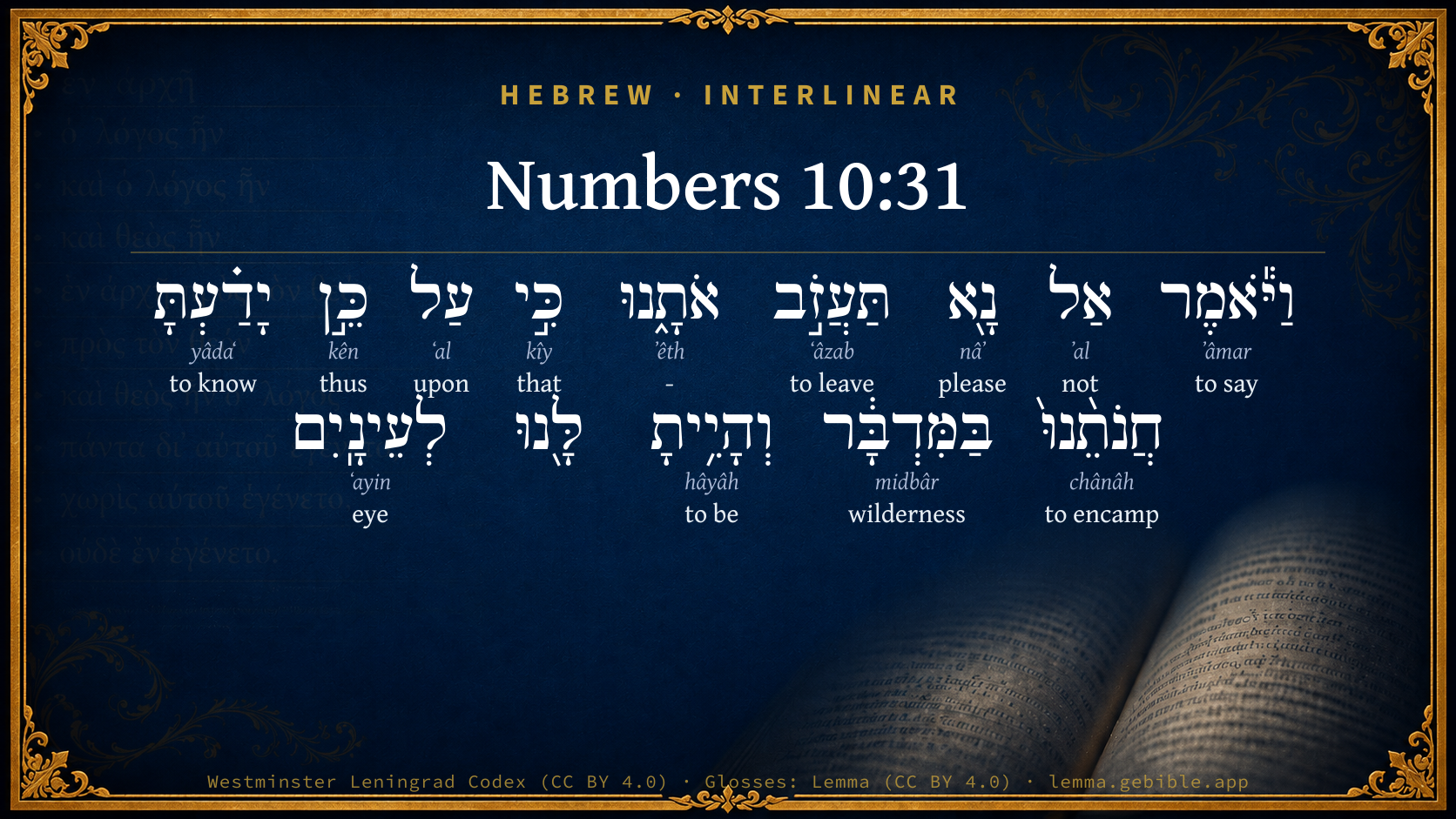
Hebrew (Westminster Leningrad Codex) Numbers 10:31 appears in the Hebrew Old Testament. The text above is from the Westminster Leningrad Codex. Each word links to its Strong’s number, a concise gloss, and parsing drawn from the Open Scriptures Hebrew Bible morphology. Click any word for its full Brown-Driver-Briggs (BDB) entry.
Download image
Cite this verse

Numbers 10:31 (World English Bible). Public Domain. Lemma interlinear Bible study tool, https://lemma.gebible.app/v/numbers/10/31.

Show BibTeX & RIS
BibTeX
RIS
English Translation
He said, Don't leave us, please; because you know how we are to encamp in the wilderness, and you shall be to us instead of eyes.
World English Bible · Public Domain
Download a study sheet

One document with this verse’s original text, its word-by-word gloss line, the meaning frame, cross-references with their text, attributed commentary, and full source and license credits — printable, and it pastes into notes with its structure intact.

This verse Autodidact and up

Study sheet (.html) Plain text (.txt)

A passage Seminary Student

Up to 50 verses in one chapter. A passage sheet keeps up to 6 commentary sources and 12 cross-references per verse, in the order this page ranks them, and says so on the sheet whenever that leaves anything out. Ask for a single verse and you get the Autodidact verse sheet above.

Everything on this page stays free to read, with no account — the sheet is a download of what is already on screen, not access to it.

Want to remove ads? Support Godless Engineer
Compare translations 3

The same verse in 3 English versions, stacked beneath the original-language interlinear above. Click any original word for its lexicon entry.

Each is an independent rendering of the whole verse — the interlinear is not word-aligned to these translations.

Highlighted words mark where these versions differ — a whole-verse word diff, not a word-by-word alignment.

  • World English Bible Public Domain
    He said, Don't leave us, please; because you know how we are to encamp in the wilderness, and you shall be to us instead of eyes.
  • King James Version Public Domain
    And he said, Leave us not, I pray thee; forasmuch as thou knowest how we are to encamp in the wilderness, and thou mayest be to us instead of eyes.
  • unfoldingWord Literal Text CC BY-SA 4.0
    And he said, “Please do not leave us! For upon this, you know our camping in the wilderness, and you will be for us for eyes.

unfoldingWord Literal Text — © unfoldingWord, licensed CC BY-SA 4.0. Word-aligned USFM3 via Door43 (git.door43.org/unfoldingWord/en_ult).

Versions to compare (up to 4)

3 of 4 selected

Show all 18 translations

Every available English version of this verse, each an independent rendering of the whole verse.

  • World English Bible Public Domain
    He said, Don't leave us, please; because you know how we are to encamp in the wilderness, and you shall be to us instead of eyes.
  • Berean Standard Bible Public Domain
    “Please do not leave us,” Moses said, “since you know where we should camp in the wilderness, and you can serve as our eyes.
  • Majority Standard Bible Public Domain
    “Please do not leave us,” Moses said, “since you know where we should camp in the wilderness, and you can serve as our eyes.
  • King James Version Public Domain
    And he said, Leave us not, I pray thee; forasmuch as thou knowest how we are to encamp in the wilderness, and thou mayest be to us instead of eyes.
  • American Standard Version (1901) Public Domain
    And he said, Leave us not, I pray thee; forasmuch as thou knowest how we are to encamp in the wilderness, and thou shalt be to us instead of eyes.
  • Revised Version (1885) Public Domain
    And he said, Leave us not, I pray thee; forasmuch as thou knowest how we are to encamp in the wilderness, and thou shalt be to us instead of eyes.
  • Geneva Bible (1599) Public Domain
    Then he sayd, I pray thee, leaue vs not: for thou knowest our camping places in the wildernesse: therefore thou mayest be our guide.
  • Douay-Rheims (1899) Public Domain
    And he said: Do not leave us: for thou knowest in what places we should encamp in the wilderness, and thou shalt be our guide.
  • Young's Literal Translation Public Domain
    And he saith, `I pray thee, forsake us not, because thou hast known our encamping in the wilderness, and thou hast been to us for eyes;
  • Literal Standard Version CC BY-SA 4.0
    And he says, “Please do not forsake us, because you have known our encamping in the wilderness, and you have been to us for eyes;
  • Unlocked Literal Bible CC BY-SA 4.0
    Then Moses replied, “Please do not leave us. You know how to camp in the wilderness. You must watch out for us.
  • unfoldingWord Literal Text CC BY-SA 4.0
    And he said, “Please do not leave us! For upon this, you know our camping in the wilderness, and you will be for us for eyes.
  • Darby Bible Public Domain
    And he said, Leave me not, I pray thee, because thou knowest where we are to encamp in the wilderness, and thou wilt be to us for eyes.
  • World Messianic Bible Public Domain
    Moses said, “Don’t leave us, please; because you know how we are to encamp in the wilderness, and you can be our eyes.
  • Webster's Bible Public Domain
    And he said, Leave us not, I pray thee; forasmuch as thou knowest how we are to encamp in the wilderness, and thou mayest be to us instead of eyes.
  • Free Bible Version CC BY-SA 4.0
    “Please don't abandon us now,” Moses said, “because you're the one who knows where we should camp in the desert and you can guide us.
  • Bible in Basic English Public Domain
    And he said, Do not go from us; for you will be eyes for us, guiding us to the right places in the waste land to put up our tents.
  • JPS Tanakh (1917) Public Domain
    And he said: 'Leave us not, I pray thee; forasmuch as thou knowest how we are to encamp in the wilderness, and thou shalt be to us instead of eyes.

Literal Standard Version (2020), Covenant Press — licensed CC BY-SA 4.0. Text via the HelloAO Bible API (eBible.org). Unlocked Literal Bible (unfoldingWord) — licensed CC BY-SA 4.0. Text via the HelloAO Bible API (eBible.org). unfoldingWord Literal Text — © unfoldingWord, licensed CC BY-SA 4.0. Word-aligned USFM3 via Door43 (git.door43.org/unfoldingWord/en_ult). Free Bible Version, Dr. Jonathan Gallagher — licensed CC BY-SA 4.0. Text via the HelloAO Bible API (eBible.org).

Word by word

More ways to search: Search by grammar → Find every occurrence → Compare this word →

Practice this passage: Drill this verse → Learn its vocabulary →

חֲנֹתֵ֨נוּ֙
chânâh
H2583
“to encamp · us”
Verb, Qal, Infinitive Construct + Suffix, Personal, 1st Person, Common, Plural
Part of Speech
Verb
Stem
Qal
Form
Infinitive Construct
Full BDB Definition

Origin: a primitive root [compare H2603 ]

TWOT: TWOT- 690

to decline, incline, encamp, bend down, lay siege against - (Qal) - to decline - to encamp
  1. וַיֹּ֕אמֶר ʼâmar H559 “and · to say” Conjunction + Verb, Qal, Sequential Imperfect, 3rd Person, Masculine, Singular
  2. אַל ʼal H408 “not” Particle, Negative
  3. נָ֖א nâʼ H4994 “please” Particle, Exhortation
  4. תַּעֲזֹ֣ב ʻâzab H5800 “to leave” Verb, Qal, Jussive, 2nd Person, Masculine, Singular
  5. אֹתָ֑נוּ ʼêth H853 “- · us” Particle, Direct Object + Suffix, Personal, 1st Person, Common, Plural
  6. כִּ֣י kîy H3588 “that” Conjunction
  7. עַל ʻal H5921 “upon” Preposition
  8. כֵּ֣ן kên H3651 “thus” Particle, Demonstrative
  9. יָדַ֗עְתָּ yâdaʻ H3045 “to know” Verb, Qal, Perfect, 2nd Person, Masculine, Singular
  10. בַּמִּדְבָּ֔ר midbâr H4057 “in/at the · wilderness” Preposition, Determined + Noun, Common, Masculine, Singular, Absolute
  11. וְהָיִ֥יתָ hâyâh H1961 “and · to be” Conjunction + Verb, Qal, Sequential Perfect, 2nd Person, Masculine, Singular
  12. לְעֵינָֽיִם ʻayin H5869 “to/for · eyes” Preposition + Noun, Common, Both, Dual, Absolute

About this verse

These counts appear in no published source. They are computed here, from the morphology-tagged text and Lemma’s own curated glosses. What Lemma adds →

14
words
13
distinct lemmas
Pentateuch
section

Grammatical profile

  • 5 verbs
  • 2 nouns
  • 2 prepositions
  • 1 conjunction
  • 4 particles

Verb forms

  • וַיֹּ֕אמֶר Qal · Sequential Imperfect
  • תַּעֲזֹ֣ב Qal · Jussive
  • יָדַ֗עְתָּ Qal · Perfect
  • חֲנֹתֵ֨נוּ֙ Qal · Infinitive Construct
  • וְהָיִ֥יתָ Qal · Sequential Perfect

Hebrew & Septuagint length

In English translation the verse runs 26 words from the Hebrew and 23 from the Septuagint (LXX English) — closely comparable.

A rough comparison of the two English renderings, which tokenize alike — not a word-level alignment.

Word counts can differ between the Hebrew and the Greek without any difference in meaning — e.g. the Hebrew direct-object marker אֵת has no separate Greek word, and Greek often adds the article ὁ.

In the original languages it is 14 Hebrew tokens and 19 Greek tokens — but the two are counted differently (Hebrew bundles its prefixes and suffixes into one token; the Greek is in lemma form), so that isn’t a like-for-like length.

Cross-references

4

Topical passages linked to Numbers 10:31 in the Treasury of Scripture Knowledge — connected by theme and wording, ordered by reader-vote popularity; previews shown in the World English Bible.

  • Job 29:15 I was eyes to the blind, And feet to the lame.
  • Psalms 32:8 I will instruct you and teach you in the way which you shall go. I will counsel you with my eye on you.
  • 1 Corinthians 12:14–21 For the body is not one member, but many.
  • Galatians 6:2 Bear one another's burdens, and so fulfill the law of Christ.

Cross-references courtesy of OpenBible.info (CC BY 4.0).

Hebrew and Greek witnesses Masoretic Hebrew ↔ Greek Septuagint

The same verse in the two great witnesses to the Old Testament, shown verse-for-verse.

These are two independent witnesses, not word-aligned to each other, and the Septuagint is shown in lemma (dictionary) form.

Hebrew Numbers 10:31 Masoretic · Westminster Leningrad Codex

וַיֹּ֕אמֶר אַל נָ֖א תַּעֲזֹ֣ב אֹתָ֑נוּ כִּ֣י עַל כֵּ֣ן יָדַ֗עְתָּ חֲנֹתֵ֨נוּ֙ בַּמִּדְבָּ֔ר וְהָיִ֥יתָ לָּ֖נוּ לְעֵינָֽיִם

He said, Don't leave us, please; because you know how we are to encamp in the wilderness, and you shall be to us instead of eyes.

World English Bible · Public Domain

Greek LXX Numbers 10:31 Septuagint · lemma form

καί εἶπον μή ἐν καταλείπω ἐγώ ὅς εἵνεκεν εἰμί μετά ἐγώ ἐν ὁ ἔρημος καί εἰμί ἐν ἐγώ πρεσβύτης

And he said, Leave us not, because you have been with us in the wilderness, and you shall be an elder among us.

LXX2012 (modern English Septuagint) · Public Domain

On this verse, Joseph Benson's Commentary discusses the Septuagint’s reading. Read the note in Commentary ↓

Hebrew: Westminster Leningrad Codex (CC BY 4.0). Greek: Septuagint (public domain); English from LXX2012 (modern English Septuagint) (Public Domain). How the Septuagint differs from the Hebrew →

Targum (Aramaic paraphrase)

2

The Targum is the ancient Jewish Aramaic paraphrase of the Hebrew Scriptures — an interpretive translation, not the Hebrew text itself. Onkelos (literal) and Pseudo-Jonathan (expansive) render the Torah, and Jonathan the Prophets. Coverage is partial: where no permissively-licensed English translation exists for a verse, only the Aramaic is shown. This is verse-level text, not a word-by-word alignment to the Hebrew.

  1. Targum Onkelos Torah (Genesis–Deuteronomy)
    וַאֲמַר לָא כְעַן תִּשְׁבּוֹק יָתָנָא אֲרֵי עַל כֵּן יְדַעַתְּ כַּד הֲוֵינָא שָׁרַן בְּמַדְבְּרָא וּגְבוּרָן דְאִתְעֲבִידָן לָנָא חֲזֵיתָא בְעֵינָיִךְ

    (no public-domain English translation for this verse)

    Targum Onkelos — Aramaic: “Onkelos Genesis” (public domain); “Onkelos Exodus” (public domain); “Onkelos Leviticus” (public domain); “Onkelos Numbers” (public domain); “Onkelos Deuteronomy” (public domain). English: “Sefaria Community Translation” (CC0 1.0 (public-domain dedication)); “J.W. Etheridge. The Targums of Onkelos and Jonathan Ben Uzziel on the Pentateuch. London: Longmans, Green, 1862” (public domain). Text via Sefaria.

  2. Targum Pseudo-Jonathan Torah (Genesis–Deuteronomy)
    וַאֲמַר לָא כְדוּן תִּשְׁבּוֹק יָתָנָא אֲרוּם בְּגִין כֵּן דִידַעְתְּ כַּד הֲוֵינָן שְׁרַן בְּמַדְבְּרָא לְמִידַן וְאַלִיפַת לָנָא עֵיסַק דִינָא וַהֲוָיַת חָבִיב עֲלָן כְּבָבַת עֵינָנָא

    But he said, Do not now leave us; for when we were encamped in the wilderness, thou knewest how to judge, and didst teach us the method (or business) of judgment, and thou art dear to us as the apple of our eyes.

    Targum Pseudo-Jonathan — Aramaic: “Targum Jonathan on Genesis” (public domain); “Targum Jonathan on Exodus” (public domain); “Targum Jonathan on Leviticus” (public domain); “Targum Jonathan on Numbers” (public domain); “Targum Jonathan on Deuteronomy” (public domain). English: “The Targum of Jonathan ben Uzziel, trans. J. W. Etheridge, London, 1862” (public domain). Text via Sefaria.

Commentary

Notes on Numbers 10:31 from classic Christian and Jewish commentators (each source and its license shown beneath its notes). The classic Christian expositions comment on the surrounding passage and are grouped to its opening verse, so a note may address several verses; the Jewish commentaries on the Tanakh (Rashi and others) are per-verse, so they appear only where the commentator wrote on this verse.

Lemma curates 59 commentaries, every one of them public domain or Creative Commons licensed, each selected and text-cleaned for this edition rather than reprinted as found. About our sources →

Trapp's Complete Commentary

John Trapp

Num 10:31 And he said, Leave us not, I pray thee; forasmuch as thou knowest how we are to encamp in the wilderness, and thou mayest be to us instead of eyes.

Ver. 31. Instead of eyes.] To descry unto us the commodities and discommodities of the country, which is well known to thee. Herein thou mayest be of singular use unto us, though we have God going visibly before us. The Jews had a kind of officers at their feasts, called οφθαλμοι, the eyes of the feast, et praefecti morum. {a}

{a} Gaudentius. Casaubon.

John Trapp, A Commentary or Exposition upon All the Books of the Old and New Testament (1647–1656) — public domain. Text from a community e-Sword module.

Joseph Benson's Commentary

Num 10:31. Thou mayest be to us instead of eyes — A very significant expression, importing that he should be to them as a guide to the blind. Several ancient versions, however, give a different turn to these words, probably in order to reconcile them with the promise of the divine conduct. The Chaldaic Paraphrase explains it thus: Thou knowest how we have encamped in the wilderness, and thine eyes have seen the miracles which have been wrought for us. The Samaritan thus: Thou knowest our encampments, and hast been to us instead of eyes. But this cannot be a just interpretation, for Hobab had not yet followed their camp. The Syriac thus: Thou shalt be dear to us as our eyes. The LXX., εση εν ημιν πρεσβυτης, Thou shalt be a senator among us; the counsellors of princes being sometimes called their eyes. But our translation seems most exactly to express the sense of the Hebrew, and certainly implies nothing inconsistent with the promise of the divine guidance; for though the cloud determined them to a general place, yet many particulars might be unknown to Moses, wherein Hobab, having long lived in those parts, might be able to advise him; as concerning the conveniences of water for their cattle; concerning the safety or danger of the several parts, by reason of serpents, or wild beasts, or enemies, in the parts adjoining to them, that so they might guard themselves better against them. Or, this is to be understood of his directing them not so much in their way, as about great and difficult matters, wherein the counsel Moses had from God did not exclude the advice of men, as we see in Hobab’s father, Jethro, Exodus 18. And it is probable this was the wise son of a wise father.

Joseph Benson's Commentary on the Old and New Testaments (1811–1818) — public domain. Text from a community e-Sword module.

Geneva Bible (1599)

Geneva Bible translators

Hebrew, eyes unto us.

Geneva Bible (1599) marginal notes — public domain. Text via Bolls.life.

Jamieson, Fausset & Brown

Robert Jamieson, A. R. Fausset & David Brown

Leave us not, I pray thee . . . and thou mayest be to us instead of eyes--The earnest importunity of Moses to secure the attendance of this man, when he enjoyed the benefit of the directing cloud, has surprised many. But it should be recollected that the guidance of the cloud, though it showed the general route to be taken through the trackless desert, would not be so special and minute as to point out the places where pasture, shade, and water were to be obtained and which were often hid in obscure spots by the shifting sands. Besides, several detachments were sent off from the main body; the services of Hobab, not as a single Arab, but as a prince of a powerful clan, would have been exceedingly useful.

Jamieson, Fausset & Brown — Commentary Critical and Explanatory on the Whole Bible (1871) — public domain (CC PDM 1.0). Text via the HelloAO Bible API.

Adam Clarke's Commentary

Verse 31. Thou mayest be to us instead of eyes.] But what need had they of Hobab, when they had the pillar and fire continually to point out their way? Answer: The cloud directed their general journeys, but not their particular excursions. Parties took several journeys while the grand army lay still. (See chap. xiii., xx., xxxi., xxxii., c.) They therefore needed such a person as Hobab, who was well acquainted with the desert, to direct these particular excursions to point them out watering places, and places where they might meet with fuel, c., c. What man cannot, under the direction of God's providence, do for himself, God will do in the way of especial mercy. He could have directed them to the fountains and to the places of fuel, but Hobab can do this, therefore let Hobab be employed and let Hobab know for his encouragement that, while he is serving others in the way of God's providence, he is securing his own best interests. On these grounds Hobab should be invited, and for this reason Hobab should go. Man cannot do God's work and God will not do the work which he has qualified and commanded man to perform. Thus then the Lord is ever seen, even while he is helping man by man. See some valuable observations on this subject in Harmer, vol. ii., 286. Instead of, And thou mayest be to us instead of eyes, the Septuagint translate the passage thus: Και εσῃ εν ἡμιν πρεσβυτης, And thou shalt be an elder among us. But Moses probably refers to Hobab's accurate knowledge of the wilderness, and to the assistance he could give them as a guide.

Adam Clarke's Commentary on the Bible (1810–1826) — public domain. Text from a community e-Sword/MySword module.

Ellicott's Commentary for English Readers

(31) How we are to encamp . . . —It is clear from these words, as well as from many indications of the same nature, that notwithstanding the direct guidance which was vouchsafed from heaven, and the miraculous interpositions of Providence which the Israelites experienced throughout their journeys, Moses did not neglect to take advantage of all the ordinary precautions of which it was incumbent upon him as the leader of his people to avail himself. The line of march and the places of encampment were clearly marked out by the cloud, but many difficulties would arise in the course of the journeys, and at the places of encampment, which Hobab’s familiarity with the desert would enable him to meet.

A Bible Commentary for English Readers, edited by Charles John Ellicott (1878–1897) — public domain. Text from a community e-Sword module.

The Cambridge Bible for Schools and Colleges

gen. ed. J. J. S. Perowne

31. instead of eyes] his presence would obviate the necessity of searching for halting places.

The Cambridge Bible for Schools and Colleges (gen. ed. J. J. S. Perowne; Cambridge University Press, 1878–1918) — public domain. Text from a community e-Sword module.

John Gill's Exposition

And it came to pass, when the ark set forward,.... Carried by the Kohathites, Num 10:21,

that Moses said; in prayer, as both the Targums of Jonathan and Jerusalem express it; and it was a prayer of faith, and prophetic of what would be done, and might serve greatly to encourage and animate the children of Israel in their journeys; for the following prayer was put up not only at this time, but at all times when the ark set forward; and so Ben Gersom says, it was the custom of Moses, at whatsoever time the ark was moved, to pray as follows:

rise up, Lord, and let thine enemies be scattered; the Jerusalem Targum is,"rise up now, O Word of the Lord;''and the Targum of Jonathan,"be revealed now, O Word of the Lord;''the essential Word of God, the Messiah, to whom these words may be applied; either to his incarnation and manifestation in the flesh, his end in, which was to destroy all his and his people's enemies, particularly the devil and his works, Heb 2:14; or to his resurrection from the dead, these words standing at the head of a prophecy of his ascension to heaven, which supposes his resurrection from the dead, Psa 68:1; at the death of Christ all the spiritual enemies of his people were defeated, scattered, confounded, and conquered; Satan and his principalities were spoiled, sin was made an end of, death was abolished, and the world overcome; at his resurrection the keepers of the sepulchre fled; and after his ascension wrath came upon the Jewish nation, those enemies of his, that would not have him to rule over them, and they were scattered about on the face of the whole earth, as they are to this day:

and let them that hate thee flee before thee; the same petition expressed in different words, but to the same sense; enemies, and those that hate the Lord, are the same, as their defeat, conclusion, and destruction, are signified by their flight and dispersion; and it may be observed, that those who were the enemies and haters of Israel were reckoned the enemies and haters of God himself; as the enemies of Christ's people, and those that hate them, are accounted Christ's enemies, and such that hate him. Perhaps Moses may have a special respect to the Canaanites, whose land was promised unto Israel, and they were going to dispossess them of it, in order to inherit it, and Moses might expect it would be quickly done, at the end of these three days; which brought them to the wilderness of Paran, so near the good land that they sent from thence spies into it, and in all probability they would have then entered the possession of it, had it not been for their complaints and murmurs, and the ill report brought on the good land, on which account they were stopped thirty eight years in the wilderness.

John Gill's Exposition of the Whole Bible (1746–1763) — public domain (CC PDM 1.0). Text via the HelloAO Bible API.

Albert Barnes' Notes on the Bible

Thou mayest be to us instead of eyes - A proverbial expression still in use in the East. Hobab would indicate the spots where water, fuel, and pasture might be found, or warn them of the dangers from hurricanes, and point out localities infested by robbers.

Albert Barnes' Notes on the Bible (1834–1885) — public domain. Text from a community e-Sword/MySword module.

Haydock's Catholic Bible Commentary

Guide, being well acquainted with the country, and consequently able to point out the best places for pasturage and for water, and to inform us what sort of people we are near. Hebrew, "thou shalt serve us for eyes." Septuagint, "as a senator." The Persians had officers who had the title of eyes and ears of the king. (Brisson 1.) Some suppose that Moses stood in no need of Hobab, having lived himself in that country 40 years, with Jethro; and that he only wished to keep his kinsman with him, that he might observe the true religion. He supposed at that time that they would presently obtain possession of Chanaan. But the sins of the people caused almost all to perish in the desert. Hobab probably accepted of the proposal, as we find the Cineans, descendants of Jethro, holding a portion of the land, Judges i. 16. (Calmet) His posterity, the Rechabites, were noted for more than usual piety; and were the same with the Essenes, according to Serarius, and the first authors of a monastic life, Jeremias xxxv. (Tirinus)

George Leo Haydock (1774–1849), Haydock's Catholic Family Bible and Commentary, 1859 edition — public domain. Excludes Psalms (Douay-Rheims chapter numbering differs from Protestant) and Deuterocanonical books (Catholic canon only).

Matthew Poole's English Annotations

To direct and guide us; for though the cloud determined them to a general place, yet many particulars might be uncertain and unknown to Moses, wherein Hobab, having long lived in those parts, might be able to advise him, as concerning the conveniences of water for their cattle, concerning the safety or danger of the several parts by reason of serpents or wild beasts, or enemies, in the parts adjoining to them, that so they might guard themselves better against them. Or this to be understood of his directing them not so much in their way, as about great and difficult matters, wherein the counsel he had from God did not exclude the advice of men, as we see in Hobab’s father Jethro, Exo 18. And it is probable this was the wise son of a wise father.

Matthew Poole's English Annotations on the Holy Bible (1683–1685) — public domain. Text from a community e-Sword/MySword module.

Whedon's Commentary on the Bible

Daniel D. Whedon

31. Leave us not — Even a decided refusal may be overcome by earnest persuasion. For we infer from Jdg_1:16; Jdg_4:11; 1Sa_15:6, where the descendants of Hobab, called Kenites, are abiding with Israel, even down to the time of Saul, that the entreaty of Moses prevailed, and that Hobab, after a visit to his own land, returned and accompanied the Hebrews into Canaan. “It is always pleasant to read the indications of a return to the way of life on the part of those who have at one time seemed resolved to forsake it. We hail with delight every instance where the man who at first refuses to enter the vineyard afterward repents and goes.” — Bush.

Thou mayest be to us instead of eyes — Though Jehovah had promised to lead Israel in the desert, yet no promise of divine guidance is designed to supersede the use of the best natural means within their reach. God usually helps men in the manner best adapted to the development of their own self-reliance. In this case “the cloud directed their general journeys, but not their particular excursions. Parties took several journeys while the grand army lay still.” — A. Clarke. The best camping grounds might not always be near to springs of water and pasturage. An experienced guide would be necessary to point out these. Similar service would be required in the commercial intercourse of Israel with the nomad tribes which lay along their path. Hence the Septuagint rendering is, “Thou shall be among us a presbutes” — an ambassador, legate, or negotiator. Says Bruce, in speaking of guides in the desert: “They are men of great consideration, knowing perfectly the situation and properties of all kinds of water to be met on the route, the distance of the wells, whether occupied by enemies or not, and, if so, the way to avoid them with the least inconvenience.” From their connexion with powerful tribes they are able to conciliate their favour. “As no further refusal is mentioned on the part of Hobab, and the departure of Israel is related immediately afterward, he probably consented.” — Knobel.

Daniel D. Whedon (gen. ed.), Commentary on the Old and New Testaments (1874–1909) — public domain. Text from a community e-Sword module.

The Pulpit Commentary

Forasmuch as thou knowest how we are to encamp in the wilderness, and thou mayest be to us instead of eyes. It is an obvious conclusion, from the reasons here urged by Moses, that the many and wonderful promises of Divine guidance and Divine direction did not supersede in his eyes the use of all available human aids. It is not indeed easy to say where any room was left for the good offices and experience of Hobab; the cloud of the Divine Presence seemed to control absolutely the journeying and encamping of the people; yet if we really knew in detail the actual ordering of that wondrous march, we should doubtless find that the heavenly guidance did but give unity and certainty to all the wisdom, caution, and endeavour of its earthly leaders. Indeed if we recall to mind that the host is calculated at more than two millions of people, it is quite evident that even during the march to Kadesh (and much more in the long wanderings which followed) it must have been extremely difficult to keep the various divisions together. In the broken and difficult country which they were to traverse, which had been familiar to Hobab from his youth, there would be scope enough for all his ability as a guide. And it would seem that it was just this prospect of being really useful to the people of Israel that prevailed with Hobab. He must indeed have felt assured that a wonderful future awaited a nation whose past and present were, even within his own knowledge, so wonderful. But that alone could not move him to leave his own land and his own kindred, a firing so unspeakably repugnant to the feelings and traditions of his age and country. Doubtless to the child of the desert, whose life was a never-ending struggle with the dangers and vicissitudes of the wilderness, the land of promise, flowing with milk and honey, watered with the rain of heaven, seemed like the garden of Eden. Yet the offer of a heritage within that land moved him not so much, it would appear, as the claim upon his own good offices in helping the chosen people to reach their own abode. The Septuagint translation, or rather paraphrase, of this verse is, "Leave us not, forasmuch as thou wast with us in the wilderness, and thou shalt be an elder among us." This seems, on the one hand, to identify Hobab with Jethro; on the other, to imply that he was shortly afterwards one of the seventy elders upon whom the spirit came. This, however, is not likely. Hobab does indeed seem to have gone with the people, but his descendants were not incorporated into Israel; they were with them, but not of them.

A fresh appeal.

Moses has failed in appealing to Hobab by a regard for his own best interests, but he has a second arrow in his quiver. He will touch Hobab"s sense of friendship, his manliness, anything that was chivalrous in him; he will put him on his honour to render just the one service he was able to render. Note

I THE SERVICES WHICH THE WORLD CAN RENDER TO THE CHURCH. We may fairly assume, considering Jud_1:16, that Hobab went with Moses after all. (Mat_21:29) He will help Moses the man, when he cares nothing for Moses the prophet of God. There may be a certain sense of duty even when there is none of sin and spiritual need, a certain power to help, even though the highest power be utterly lacking.

The peculiar strength of the Church is in God; when it does spiritual work with spiritual instruments; but the world may also be tributary in its own way. The wealth of the world is not a spiritual thing, but it has been helpful to the Church. Men of the world have neither the Christ-like love nor the self-denial to initiate enterprises, which, nevertheless, they will generously support. In person they will do nothing; in purse they will do much. The printer who cares nothing for Christ, who to-day prints the scoffs and quibbles of an atheist, or some frivolous fiction, may to-morrow print a Bible, or a precious biography of some departed saint. Places of worship have been built by men who had no religion in them. Fishers" boats ferried Jesus across the lake of Galilee; trading ships took Paul on his missionary journey; and soldiers of Caesar conveyed him to Rome, where for so long a time he had panted to preach the gospel.

II THE HOLD WHICH THE CHURCH KEEPS ON THIS WORLD. Hobab said very bluntly he would not go with Moses; but he had not thought of all the considerations that might be brought to bear upon him. The grasp of Moses was firmer than he thought. Let no worldly man despise what he deems the dreams and delusions of the Christian. They may have a greater power on him in the end than at present he has any conception of. Human friendships and old associations are part of the bait with which Christ furnishes his fishers of men. Those who will not read the Scriptures for salvation, and who laugh at the schemes of doctrine draw, from them yet find in the same Scriptures too much of poetry and interest to be slightingly passed by. What a strange thing, too, to hear men, even in all their vehement denials of the supernatural, extolling Jesus of Nazareth, admiring his spirit, and recommending his ethics. However they try, they cannot get away from him. "I, if I be lifted up, will draw all men unto me." We must not despair of unbelievers, even after many refusals. (Luk_13:6-9) In connection with Moses and Hobab, a reference-to Tennyson"s "In Memoriam," 63, "Dost thou look back on what hath been?" etc., may be found homiletically helpful. Y.

The Pulpit Commentary (1880–1919), ed. H.D.M. Spence-Jones & Joseph S. Exell — public domain. Text from a community e-Sword module.

John Wesley's Explanatory Notes

Thou mayest be to us instead of eyes - To direct and guide us: for though the cloud determined them to a general place, yet many particulars might be unknown to Moses, wherein Hobab, having long lived in those parts, might be able to advise him, as concerning the conveniences of water for their cattle, concerning the safety or danger of the several parts, by reason of serpents or wild-beasts, or enemies, in the parts adjoining to them, that so they might guard themselves better against them. Or, this is to be understood of his directing them not so much in their way. as about great and difficult matters, wherein the counsel he had from God did not exclude the advice of men, as we see in Hobab's father Jethro, Exod. xviii, 19-27. And it is probable, this was the wise son of a wise father.

John Wesley, Explanatory Notes Upon the Whole Bible (1754–1765) — public domain. Text via the GEBible commentary corpus.

Scofield Reference Notes

C. I. Scofield

thou mayest

But see Exo 13:21; Exo 13:22 What need had Moses of Hobab’s eyes? Cf. Jer 17:5.

The Scofield Reference Bible (1917 edition), notes by C. I. Scofield — public domain. Text from a community e-Sword module.

unfoldingWord translationNotes

Door43 World Missions Community

You must watch out for us

The phrase "watch out" means to guide and to take care of. AT: "You can guide us and show us how to live in the desert" (See: Idiom)

translationWords

desert

unfoldingWord translationNotes — © Distant Shores Media and the Door43 World Missions Community, licensed CC BY-SA 4.0. Source: git.door43.org/Door43/en_tn.

Rashi

Rabbi Shlomo Yitzchaki (Rashi)

אל נא תעזב LEAVE [US] NOT, I PRAY THEE — The word נא is an expression of entreaty. Here it means: I beg of you, not to leave usin order that people should not say, “Jethro did not become a proselyte out of pure love for the Jewish faith. He believed that the proselytes, too, would have a portion in the Land; now, however, that he saw that they will have no portion in it he has deserted them and gone his own way (Sifrei Bamidbar 80).

כי על כן ידעת FOR THOU KNOWEST OUR ENCAMPMENT IN THE WILDERNESS] — For (כי) it is fitting for you to do this, because (על כן) you have known our encampments in the wilderness and you have seen the miracles and the mighty deeds that have been wrought for us.

כי על כן ידעת — This is similar to על אשר ידעת, like (Genesis 38:26) “For (כי) she has acted rightly, because (על כן) I did not give her to Selah, my son”; (Genesis 19:8): “For (כי) this kindness please do out of respect to me, because (על כן) they have come under the shadow of my roof”; (Genesis 33:10): “For (כי) it is fitting and proper for you to accept my present, because (על כן) I have seen your face."

והיית לנו לעינים — The verb is in the past tense and we have to understand it just as the Targum renders it: and all the mighty deeds that have been wrought for us thou hast seen with thine own eyes. Another explanation is that it is the future tense: whatever things will be hidden from our eyes, you will enlighten our eyes about it. Still another explanation is that the passage means that you will be held in affection by us as our “very eye-balls”. as it is said, (Deuteronomy 10:19) “and ye shall love the stranger” (Sifrei Bamidbar 80).

Rashi on the Tanakh — English translations: “The Judaica Press complete Tanach with Rashi, translated by A. J. Rosenberg” (CC BY 4.0); “Pentateuch with Rashi's commentary by M. Rosenbaum and A.M. Silbermann, 1929-1934” (public domain); “The Metsudah Tanach series, Lakewood, N.J” (CC BY 4.0); and “The Book of Joshua, Metsudah Publications, 1997” (CC BY 4.0). Text via Sefaria.

Lesson kit

Teaching starters — assembled from the data on this page, not authored interpretation. Every prompt links to the verse data it draws on. Edit before teaching.

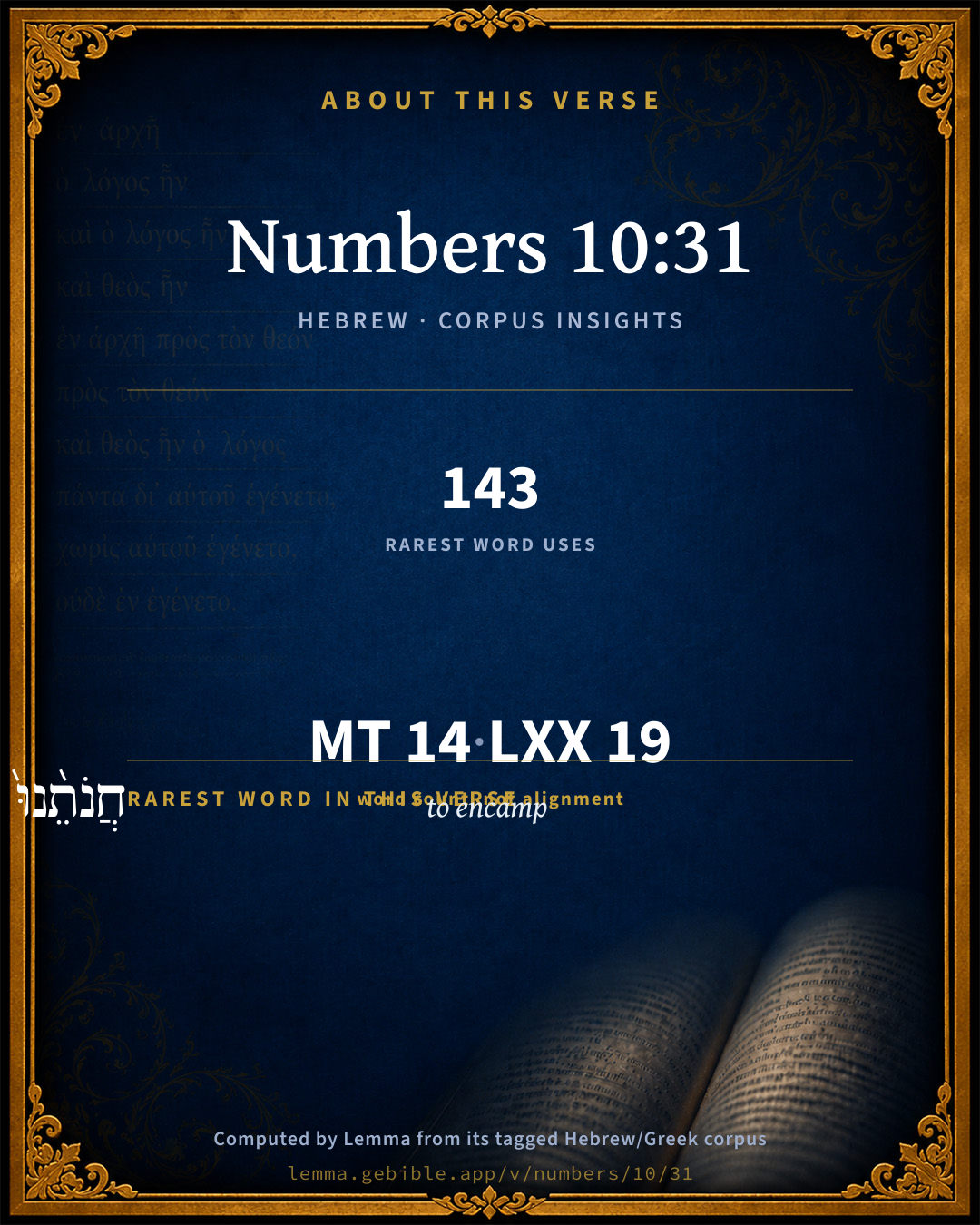
Numbers, in the Pentateuch, opens this verse with 14 words (13 distinct Hebrew lemmas). Its most distinctive word is chânâh (“to encamp”). A historical commentator’s framing appears above. Read the whole chapter for the surrounding context.

Discussion questions

  1. What does “to encamp” (chânâh) contribute to the verse as a whole?
  2. How does Job 29:15, which shares this passage’s theme, read alongside this verse?
  3. These translations render this verse differently; the difference is in the English rendering, not the original. What questions does that raise?
  4. «וַיֹּ֕אמֶר» is a Qal Sequential Imperfect verb. How does that grammatical form shape the action described?
  5. Compare how Trapp's Complete Commentary and Joseph Benson's Commentary read this verse. Where do they agree or differ?

Things to notice

Reading settings

Reading text

Shown beneath each verse's original-language words.

Old Testament
Old Testament edition

Read the OT as the Masoretic Hebrew (MT) or the Greek Septuagint (LXX).

English shown for the Greek Septuagint (in the Hebrew ↔ Greek comparison).

Comparing translations? Open the Compare panel on any verse page to stack up to four side by side.