
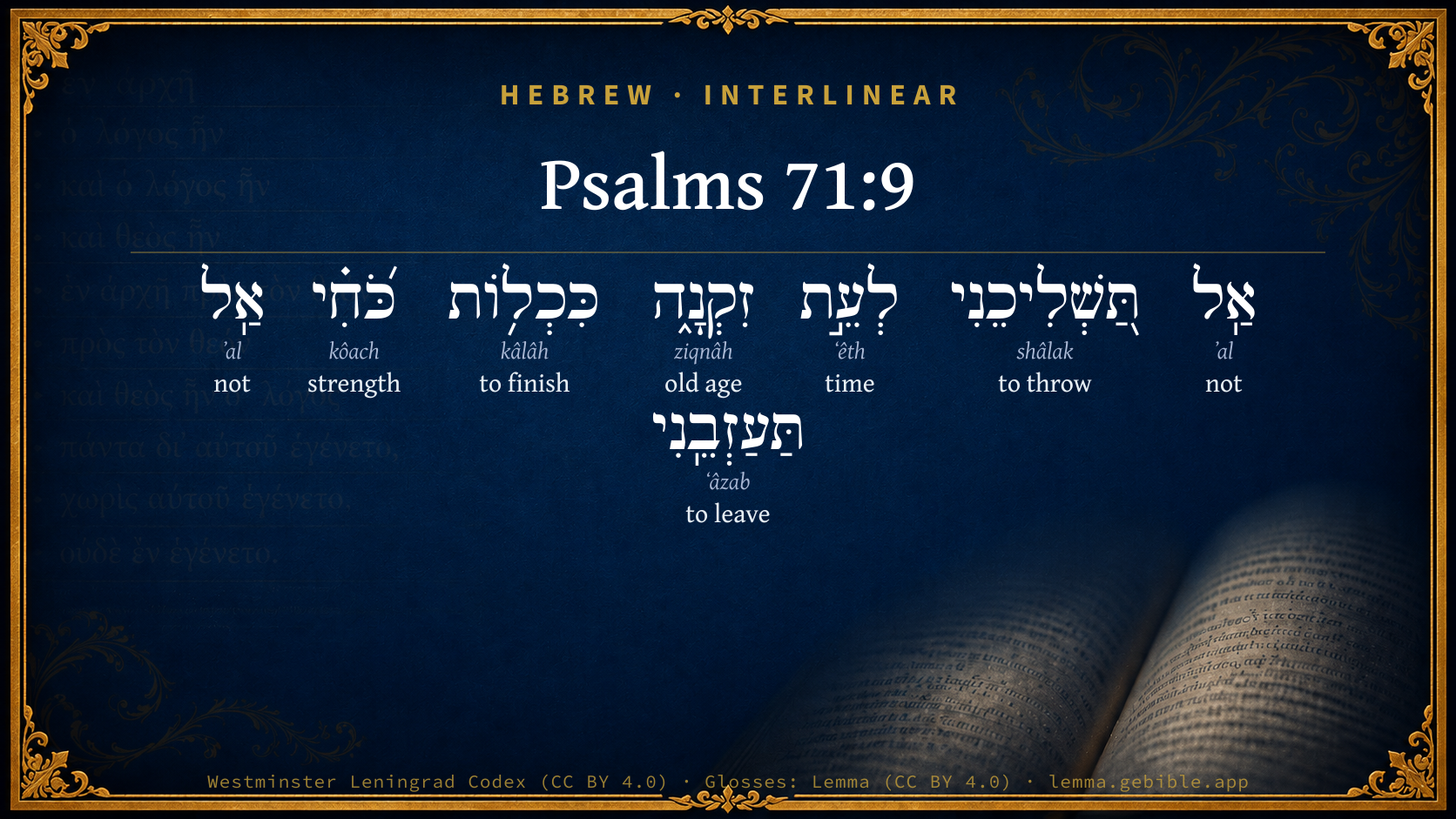
Psalms 71:9

Hebrew (Westminster Leningrad Codex) Psalms 71:9 appears in the Hebrew Old Testament. The text above is from the Westminster Leningrad Codex. Each word links to its Strong’s number, a concise gloss, and parsing drawn from the Open Scriptures Hebrew Bible morphology. Click any word for its full Brown-Driver-Briggs (BDB) entry.
Download image
Cite this verse

Psalms 71:9 (World English Bible). Public Domain. Lemma interlinear Bible study tool, https://lemma.gebible.app/v/psalms/71/9.

Show BibTeX & RIS
BibTeX
RIS
English Translation
Don't reject me in my old age. Don't forsake me when my strength fails.
World English Bible · Public Domain
Download a study sheet

One document with this verse’s original text, its word-by-word gloss line, the meaning frame, cross-references with their text, attributed commentary, and full source and license credits — printable, and it pastes into notes with its structure intact.

This verse Autodidact and up

Study sheet (.html) Plain text (.txt)

A passage Seminary Student

Up to 50 verses in one chapter. A passage sheet keeps up to 6 commentary sources and 12 cross-references per verse, in the order this page ranks them, and says so on the sheet whenever that leaves anything out. Ask for a single verse and you get the Autodidact verse sheet above.

Everything on this page stays free to read, with no account — the sheet is a download of what is already on screen, not access to it.

Want to remove ads? Support Godless Engineer
Compare translations 3

The same verse in 3 English versions, stacked beneath the original-language interlinear above. Click any original word for its lexicon entry.

Each is an independent rendering of the whole verse — the interlinear is not word-aligned to these translations.

Highlighted words mark where these versions differ — a whole-verse word diff, not a word-by-word alignment.

  • World English Bible Public Domain
    Don't reject me in my old age. Don't forsake me when my strength fails.
  • King James Version Public Domain
    Cast me not off in the time of old age; forsake me not when my strength faileth.
  • unfoldingWord Literal Text CC BY-SA 4.0
    May you not cast me away in the time of old age; may you not forsake me when my strength fails.

unfoldingWord Literal Text — © unfoldingWord, licensed CC BY-SA 4.0. Word-aligned USFM3 via Door43 (git.door43.org/unfoldingWord/en_ult).

Versions to compare (up to 4)

3 of 4 selected

Show all 18 translations

Every available English version of this verse, each an independent rendering of the whole verse.

  • World English Bible Public Domain
    Don't reject me in my old age. Don't forsake me when my strength fails.
  • Berean Standard Bible Public Domain
    Do not discard me in my old age; do not forsake me when my strength fails.
  • Majority Standard Bible Public Domain
    Do not discard me in my old age; do not forsake me when my strength fails.
  • King James Version Public Domain
    Cast me not off in the time of old age; forsake me not when my strength faileth.
  • American Standard Version (1901) Public Domain
    Cast me not off in the time of old age; Forsake me not when my strength faileth.
  • Revised Version (1885) Public Domain
    Cast me not off in the time of old age; forsake me not when my strength faileth.
  • Geneva Bible (1599) Public Domain
    Cast mee not off in the time of age: forsake me not when my strength faileth.
  • Douay-Rheims (1899) Public Domain
    Cast me not off in the time of old age: when my strength shall fail, do not thou forsake me.
  • Young's Literal Translation Public Domain
    Cast me not off at the time of old age, According to the consumption of my power forsake me not.
  • Literal Standard Version CC BY-SA 4.0
    Do not cast me off at the time of old age, || Do not forsake me according to the consumption of my power.
  • Unlocked Literal Bible CC BY-SA 4.0
    Do not throw me away in my time of old age; do not abandon me when my strength fails.
  • unfoldingWord Literal Text CC BY-SA 4.0
    May you not cast me away in the time of old age; may you not forsake me when my strength fails.
  • Darby Bible Public Domain
    Cast me not off in the time of old age; forsake me not when my strength faileth.
  • World Messianic Bible Public Domain
    Don’t reject me in my old age. Don’t forsake me when my strength fails.
  • Webster's Bible Public Domain
    Cast me not off in the time of old age; forsake me not when my strength faileth.
  • Free Bible Version CC BY-SA 4.0
    Don't reject me now I'm getting old. When my strength is gone, please don't abandon me.
  • Bible in Basic English Public Domain
    Do not give me up when I am old; be my help even when my strength is gone.
  • JPS Tanakh (1917) Public Domain
    Cast me not off in the time of old age; when my strength faileth, forsake me not.

Literal Standard Version (2020), Covenant Press — licensed CC BY-SA 4.0. Text via the HelloAO Bible API (eBible.org). Unlocked Literal Bible (unfoldingWord) — licensed CC BY-SA 4.0. Text via the HelloAO Bible API (eBible.org). unfoldingWord Literal Text — © unfoldingWord, licensed CC BY-SA 4.0. Word-aligned USFM3 via Door43 (git.door43.org/unfoldingWord/en_ult). Free Bible Version, Dr. Jonathan Gallagher — licensed CC BY-SA 4.0. Text via the HelloAO Bible API (eBible.org).

Word by word

More ways to search: Search by grammar → Find every occurrence → Compare this word →

Practice this passage: Drill this verse → Learn its vocabulary →

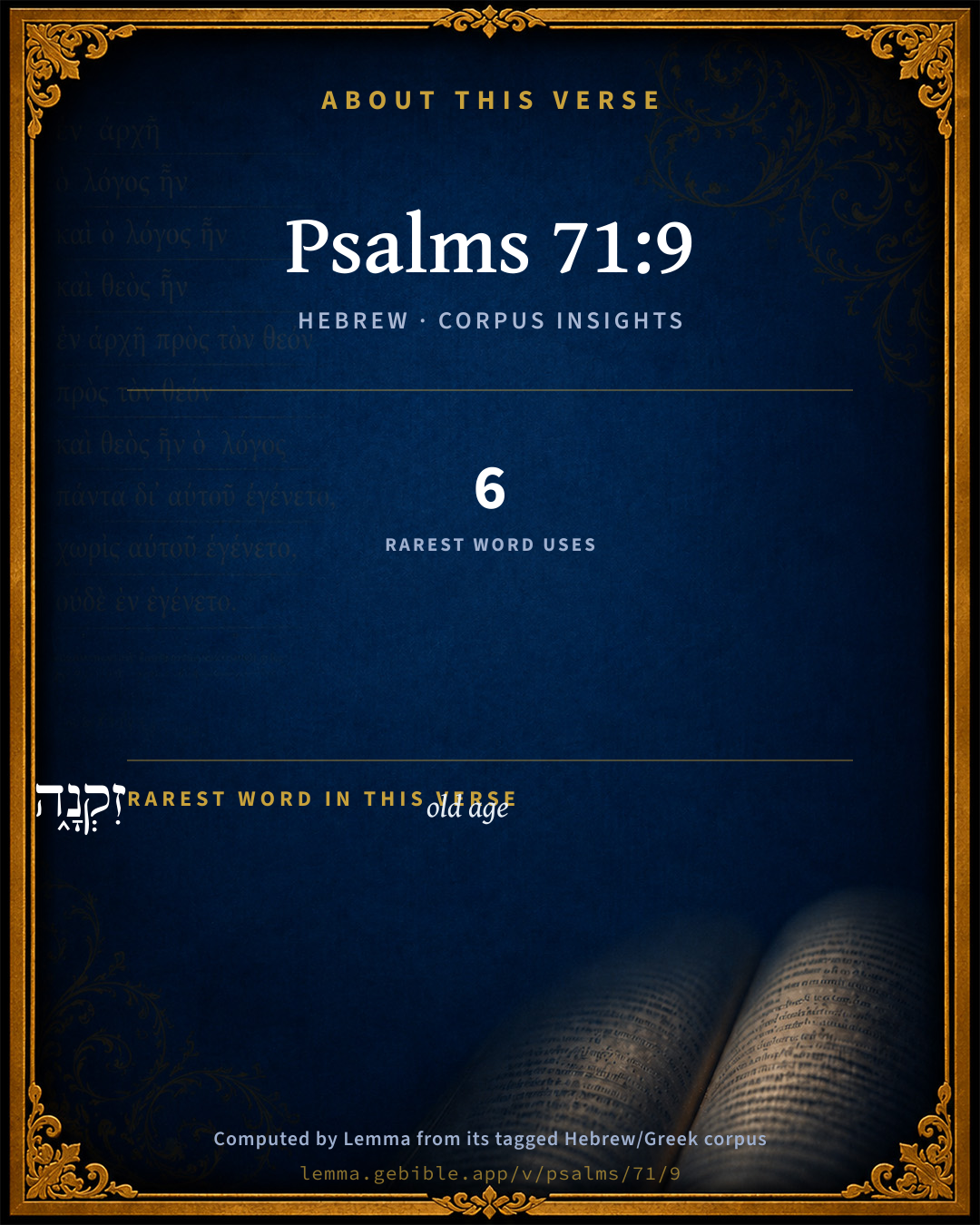
About this verse

These counts appear in no published source. They are computed here, from the morphology-tagged text and Lemma’s own curated glosses. What Lemma adds →

8
words
7
distinct lemmas
Wisdom
section

Notable vocabulary

The rarest word here is זִקְנָ֑ה old age H2209 — appearing just 6 times in the whole Hebrew Bible.

Shared distinctive vocabulary

זִקְנָ֑ה old age H2209 occurs in 6 verses of the Hebrew Bible. Also found in:

Grammatical profile

  • 3 verbs
  • 3 nouns
  • 2 particles

Verb forms

  • תַּ֭שְׁלִיכֵנִי Hiphil · Jussive
  • כִּכְל֥וֹת Qal · Infinitive Construct
  • תַּעַזְבֵֽנִי Qal · Jussive

Repetition

A word recurs within this verse — often emphatic in Hebrew:

  • אַֽל not H408 ×2

Hebrew & Septuagint length

In English translation the verse runs 14 words from the Hebrew and 17 from the Septuagint (LXX English) — closely comparable.

A rough comparison of the two English renderings, which tokenize alike — not a word-level alignment.

Word counts can differ between the Hebrew and the Greek without any difference in meaning — e.g. the Hebrew direct-object marker אֵת has no separate Greek word, and Greek often adds the article ὁ.

Cross-references

10

Topical passages linked to Psalms 71:9 in the Treasury of Scripture Knowledge — connected by theme and wording, ordered by reader-vote popularity; previews shown in the World English Bible.

  • Isaiah 46:4 and even to old age I am he, and even to gray hairs will I carry you. I have made, and I will bear; yes, I will carry, and will deliver.
  • 2 Timothy 1:12 For this cause I suffer also these things. Yet I am not ashamed, for I know him whom I have believed, and I am persuaded that he is able to guard that which I have committed to him against that day.
  • Psalms 71:18 Yes, even when I am old and gray-haired, God, don't forsake me, Until I have declared your strength to the next generation, Your might to everyone who is to come.
  • Psalms 90:10 The days of our years are seventy, Or even by reason of strength eighty years; Yet their pride is but labor and sorrow, For it passes quickly, and we fly away.
  • Psalms 92:13–15 They are planted in Yahweh's house. They will flourish in our God's courts.
  • Psalms 73:26 My flesh and my heart fails, But God is the strength of my heart and my portion forever.
  • Ecclesiastes 12:1–7 Remember also your Creator in the days of your youth, Before the evil days come, and the years draw near, When you will say, "I have no pleasure in them;"
  • 2 Timothy 4:18 And the Lord will deliver me from every evil work, and will preserve me for his heavenly Kingdom; to whom be the glory forever and ever. Amen.
  • 2 Samuel 19:35 I am this day eighty years old: can I discern between good and bad? can your servant taste what I eat or what I drink? can I hear any more the voice of singing men and singing women? why then should your servant be yet a burden to my lord the king?
  • 2 Samuel 21:15–17 The Philistines had war again with Israel; and David went down, and his servants with him, and fought against the Philistines. David grew faint;

Cross-references courtesy of OpenBible.info (CC BY 4.0).

Hebrew and Greek witnesses Masoretic Hebrew ↔ Greek Septuagint

The same verse in the two great witnesses to the Old Testament, shown verse-for-verse.

You’re reading Greek Psalm 70 (Hebrew Psalm 71). The Septuagint counts the superscription, so verse numbers can differ from the Hebrew — chapter-level alignment, not verse-by-verse. Numbering follows Rahlfs.

These are two independent witnesses, not word-aligned to each other, and the Septuagint is shown in lemma (dictionary) form.

Hebrew Psalms 71:9 Masoretic · Westminster Leningrad Codex

אַֽל תַּ֭שְׁלִיכֵנִי לְעֵ֣ת זִקְנָ֑ה כִּכְל֥וֹת כֹּ֝חִ֗י אַֽל תַּעַזְבֵֽנִי

Don't reject me in my old age. Don't forsake me when my strength fails.

World English Bible · Public Domain

Greek LXX Greek Psalm 70:9 Septuagint · lemma form

μή ἀποῥίπτω ἐγώ εἰς καιρός γῆρας ἐν ὁ ἐκλείπω ὁ ἰσχύς ἐγώ μή ἐν καταλείπω ἐγώ

Cast me not off at the time of old age; forsake me not when my strength fails.

LXX2012 (modern English Septuagint) · Public Domain

Hebrew: Westminster Leningrad Codex (CC BY 4.0). Greek: Septuagint (public domain); English from LXX2012 (modern English Septuagint) (Public Domain). How the Septuagint differs from the Hebrew →

Commentary

Notes on Psalms 71:9 from classic Christian and Jewish commentators (each source and its license shown beneath its notes). The classic Christian expositions comment on the surrounding passage and are grouped to its opening verse, so a note may address several verses; the Jewish commentaries on the Tanakh (Rashi and others) are per-verse, so they appear only where the commentator wrote on this verse.

Lemma curates 59 commentaries, every one of them public domain or Creative Commons licensed, each selected and text-cleaned for this edition rather than reprinted as found. About our sources →

Trapp's Complete Commentary

John Trapp

Psa 71:9 Cast me not off in the time of old age; forsake me not when my strength faileth.

Ver. 9. Cast me not off in the time of old age] For now I have most need of thee. The white rose is soonest cankered, so is the white head soonest corrupted.

Saepe nigrum cor est, caput album -

Satan maketh a prey of old Solomon, Asa, Lot, others; whom when young he could never so deceive. The heathens, therefore, well warn us to look well to our old age, as that which cometh not alone, but is infested with many diseases both of body and mind. This David knew, and therefore prayed, as here, "Cast me not off in the time of old age; forsake me not when my strength faileth." He is a rare old man that can say with Caleb, Jos 14:10-11. Omnia fert aetas, animum quoque.

John Trapp, A Commentary or Exposition upon All the Books of the Old and New Testament (1647–1656) — public domain. Text from a community e-Sword module.

The Biblical Illustrator

Joseph S. Exell

Psa_71:9

Cast me not off in the time of old age: forsake me not when my strength faileth.

The cry of the aged

This is the cry of trembling, tottering age to man as well as God. Among the very saddest of human experiences is the decay which is the harbinger of death. If death were always a swift, sudden translation, like that of Enoch or Elijah, we could understand it better. The long act of dying is the darkest part of death.

I. The phenomenon of human decay. At both ends of life man is the weakest and most helpless of creatures. The noblest of created beings and the most Godlike is cast more utterly, in birth and death, on the care of his fellows, than the weakest of the creatures which God made to be his satellites. Alas for the old and weary among the great mass of mankind; how utterly sad their lot, not only the body but the mind failing also.

II. Why is this? Partly--

1. To drive home the lessons God is ever teaching us about sin.

2. To develop the noblest qualities of the human spirit by the ministries which sickness, suffering and decay call forth.

3. That He may strengthen faith and hope in immortality. Death is terrible that life may be beautiful. By faith and hope in Christ we can transmute death into blessing and the germ of everlasting joy.

III. The duties which spring out of these facts.

1. The tender care of the aged.

2. The pressing on them with double earnestness the Gospel which brings to light life and immortality. (J. Baldwin Brown, B. A.)

To the aged

Old men do not always put up this petition. If the desires of many were put into words, they would be for money, power, and many other things. Covetousness is peculiarly the sin of old age. But the favour and presence of God should be our supreme desire. For--

I. There are some peculiar circumstances of old age which render this blessing necessary.

1. There is little natural enjoyment (2Sa_19:35).

2. The troubles of life often increase. Poverty. Misery of our children, or their evil courses. Loss of friends. Results of the evil training of our children. See Davids sorrow.

3. And as troubles increase we are less able to bear them. Jacob could bear the Padan-Aram hardships--he was young; but not the loss of Rachel when he was old.

4. Old age is not always treated with due respect, but often with neglect.

5. Death and eternity are near.

II. When may we hope for this blessing? Not all old men enjoy it. Oh, the misery of a wicked old age! But if we have been Gods servants from our youth, or have become so since we were old, or if now we cast ourselves upon the Lord, then this prayer shall be fulfilled. (Andrew Fuller.)

The time of old age

The time of old age is--

I. Specially the time for prayer.

1. On account of personal need. The text is an appeal to the Divine compassion. This the heavenly Father always welcomes and honours. It is in the supreme distinction of His nature. How He proclaims it! The Lord God merciful and gracious. It is a frequent title in the Psalms, full of compassion. To what else can weakness turn so hopefully, so trustfully, so joyfully? Human life is compared to a journey. Men grow tired after long walking. All pilgrims find it so. But to come in then with timely help is altogether Divine. Mans extremity is Gods opportunity.

2. By reason of past memories. The psalmist calls to mind what God had done for him: Thou hast taught me from my youth. Well, he makes that a ground of expectation that God would carry on and complete what He had begun. That is the logic of the heart. A child can understand it.

II. The time of harvest. If youth is passed in listless frivolity, old age will be childish or idiotic; but if it be passed in careful research and thoughtful study, it will be ripe in knowledge and understanding. If youth is passed in storing the false, the foul, the malicious, old age will be like the land of Egypt, hideous and loathsome, with its frogs and gadfly; but if it be passed in fellowship with the true, the pure, the loving, old age will be like Eden, with warbling songs and fragrant flowers, and ruddy and pulpy fruits. If in youth the passions are unbridled and burning, they will grow into tormenting fiends. If ruled and hallowed by the life of Christ, they will grow into bright angels with heavenly music.

III. The time of fixedness. In earlier days men prepare the facilities and the forces of later days. How absurd it would be to send people to apprenticeship at seventy years of age! They could not learn. So in every event of life the same rule will be found to apply. When men get old their passions cool; but their affections grow firmer, and their will grows stubborn. That sapling may be easily trained. That grown tree must be cut down. The old man will often see a better way, and sigh to enter it; but Nature cries: Too late! too late! In everything the law is imperative and irrevocable. If Wisdom speak, it is by this rule: They that seek me early shall find me. In Grace, as in Nature, now is the accepted time; now is the day of salvation. The Lord meets every one at the threshold and says: My son, my daughter, give Me thy heart.

IV. The time of testimony. Those to whom we refer have had discipline and experience. They ought to have knowledge and conviction, and they ought to bear testimony of this for the honour of the Most High, and for the advantage of those with whom they have to do. It was so with the psalmist. He acted on this rule as every one ought to act. In his day the trial of faith was this--it was a dispensation of temporal rewards and punishments; yet they saw sometimes the wicked man prospering and the godly man seeming to suffer. Still he bore his testimony and said: I have been young, and now am old; yet have I not seen the righteous forsaken, nor his seed begging bread. The trial of faith in these days would rather seem to be in the pride and prevalence of unbelief. I own that it does not move me. You ask me why. Well, the work of the Good Spirit in every mans own heart must for that man be the most personal and perfect and abiding ground of confidence. Yet, apart from that, this fixes and satisfies me--that the Gospel in itself, in its teaching, and in its effects is only goodness. There is none good but one, that is God; and goodness can come from Him and from Him alone.

V. The time of farewell and welcome, giving up and getting. I say it is the time of farewell. There is one expression used by the Apostle Paul: Though our outward man perish. Then it does perish: all biography tells us that. The inward man is renewed day by day. Yes--the flesh decays; the spirit lives. The senses grow dull; but thought grows clearer and convictions grow stronger. Dreary memories lose their bitterness; holy ones get lighted up with a heavenly gladness. The simplest things in Nature shine with a heavenly light. The bloom and freshness and vigour seem an image of the untainted land. Earth Ceases to distract and to dazzle. Strength declines but ambitions die, and the soul is even as a weaned child. The hectic has gone from the cheek, but the fever has gone from the heart. The days work is well nigh done, but then home is near, and homes rest and safety and gladness and love. (J. Aldis.)

Remorseful reflection on growing old

John Foster, he who sprang into celebrity from one essay, Popular Ignorance, had a diseased feeling against growing old, which seems to us to be very prevalent. He was sorry to lose every parting hour. I have seen a fearful sight to-day, he would say--I have seen a buttercup. To others the sight would only give visions of the coming spring and future summer; to him it told of the past year, the last Christmas, the days which would never come again--the so many days nearer the grave. Thackeray continually expressed the same feeling. He reverts to the merry old time when George III. was king. He looks back with a regretful mind to his own youth. The black care constantly rides behind his chariot. Ah, my friends, he says, how beautiful was youth! We are growing old. Springtime and summer are past. We near the winter of our days. We shall never feel as we have felt. We approach the inevitable grave. Few men, indeed, know how to grow old gracefully, as Mme. de Stael very truly observed.

The Biblical Illustrator, edited by Joseph S. Exell (c. 1880s–1900s) — public domain. Text from a community e-Sword module.

J. A. Alexander on Psalms

Joseph Addison Alexander

Psa 71:9. Cast me not off, at the time of old age; as my strength fails, literally according to the failure of my strength, leave me not, do thou not abandon or forsake me. He here prays that the grace which he experienced in youth, and which he has already acknowledged in the foregoing context, may be continued and extended to his old age. Compare Isa 46:3-4.

Joseph Addison Alexander, The Psalms Translated and Explained (1850) — public domain. Text from a community e-Sword module.

Tyndale Open Study Notes

Tyndale Open Resources

71:9-18 The aging believer turns to the Lord for hope. As questions from his adversaries get under his skin and his own strength fails, he asks God to answer his prayers. He does not seek answers to prayer for himself but so that he can tell the story to the next generation.

71:9 The poet prays for continued fellowship with God (see 9:10; 51:11). In his weakness, he needs the Lord’s strength even more (see 143:7).

Tyndale Open Study Notes — © Tyndale Open Resources, licensed CC BY-SA 4.0. Text via the HelloAO Bible API.

Geneva Bible (1599)

Geneva Bible translators

Thou that didst help me in my youth, when I had more strength, help me now so much the more in mine old age and weakness.

Geneva Bible (1599) marginal notes — public domain. Text via Bolls.life.

Adam Clarke's Commentary

Verse 9. Cast me not off in the time of old age] The original might be translated and paraphrased thus: "Thou wilt not cast me off till the time of old age; and according to the failure of my flesh, thou wilt not forsake me." My expectation of rest and happiness will not be deferred till the time that I shall be an aged man, Thou wilt not withdraw thy presence from me as my flesh decays, and as my natural strength abates; but, on the contrary, as my outward man decays, my inward man shall be renewed day by day. It was in David's old age that the rebellion of Absalom took place.

Adam Clarke's Commentary on the Bible (1810–1826) — public domain. Text from a community e-Sword/MySword module.

John Calvin's Commentaries

9. Cast me not off in the time of my old age. David having just now declared that God had been the protector of his life at his birth, and afterwards his foster-father in his childhood, and the guardian of his welfare during the whole course of his past existence; being now worn out with age, casts himself anew into the fatherly bosom of God. In proportion as our strength fails us — and then necessity itself impels us to seek God — in the same proportion should our hope in the willingness and readiness of God to succor us become strong. David’s prayer, in short, amounts to this: “Do thou, O Lord, who hast sustained me vigorous and strong in the flower of my youth, not forsake me now, when I am decayed and almost withered, but the more I stand in need of thy help, let the decrepitude and infirmities of age move thee to compassionate me the more.” From this verse expositors, not without good reason, conclude that the conspiracy of Absalom is the subject treated of in this psalm. And certainly it was a horrible and tragical spectacle, which tended to lead, not only the common people, but also those who excelled in authority, to turn away their eyes from him, as they would from a detestable monster, when the son, having driven his father from the kingdom, pursued him even through the very deserts to put him to death.

John Calvin's Commentaries (1540-1563) — public domain. Text from the Calvin Translation Society English edition (1840s-50s) via the Christian Classics Ethereal Library (ccel.org). Calvin's coverage is partial (roughly two-thirds of the Bible); uncommented books and verses are honest gaps, never fabricated. The 19th-century editor's footnotes and remarks are omitted so the notes are faithfully Calvin's own voice.

Ellicott's Commentary for English Readers

(9-11) This piece may be compared with Psa_41:6-8. The formal “saying” (Psa_71:11), introducing a quotation, is an indication of a late date, the early literature employing no signs of quotation. (See, e.g., Psa_68:12; Psa_68:26.)

A Bible Commentary for English Readers, edited by Charles John Ellicott (1878–1897) — public domain. Text from a community e-Sword module.

The Cambridge Bible for Schools and Colleges

gen. ed. J. J. S. Perowne

9. Cast me not of] Or, cast me not away, from Thy presence (Psa_51:11), though for the time the nation as a whole is so cast out (Deu_29:28; Jer_7:15).

9–13. Repeated deprecations and prayers.

The Cambridge Bible for Schools and Colleges (gen. ed. J. J. S. Perowne; Cambridge University Press, 1878–1918) — public domain. Text from a community e-Sword module.

John Gill's Exposition

Cast me not off in the time of old age,.... The Lord never casts off nor casts away his people, whom he foreknew; they are near unto him; they are on his heart, and are engraven on the palms of his hands; and they shall never be removed from his heart's love, nor out of his arms, nor out of his covenant, and shall always be the objects of his care: he bears and carries them to old age, and even to hoary hairs: the Lord had been the guide of David's youth, and his trust then, Psa 71:5; and now he desires he would be the staff of his old age; at which age he was when Absalom rebelled against him;

forsake me not when my strength faileth: as it does when old age comes on; then the keepers of the house tremble, and the strong men bow themselves, and especially at death, when flesh and heart fail; but God will never forsake his people, neither in youth nor in old age, neither in life nor at death.

John Gill's Exposition of the Whole Bible (1746–1763) — public domain (CC PDM 1.0). Text via the HelloAO Bible API.

Albert Barnes' Notes on the Bible

Cast me not off in the time of old age - When old age comes with its infirmities; its weaknesses; its trials. When my strength fails me; when my eyes grow dim; when my knees totter; when my friends have died; when I am no longer able to labor for my support; when the buoyant feelings of earlier years are no more; when my old companions and associates are gone, and I am left alone. Thou who didst watch over me in infancy; who didst guard me in childhood and youth; who hast defended me in manhood; who hast upheld me in the days of sickness, danger, bereavement, trouble - do thou not leave me when, in advanced years, I have special need of thy care; when I have reason to apprehend that there may come upon me, in that season of my life, troubles that I have never known before; when I shall not have the strength, the buoyancy, the elasticity, the ardor, the animal spirits of other years, to enable me to meet those troubles; and when I shall have none of the friends to cheer me whom I had in the earlier periods of my course. It is not unnatural or improper for a man who sees old age coming upon him to pray for special grace, and special strength, to enable him to meet what he cannot ward off, and what he cannot but dread; for who can look upon the infirmities of old age as coming upon himself but with sad and pensive feelings? Who would wish “to be” an old man? Who can look upon a man tottering with years, and broken down with infirmities - a man whose sight and hearing are gone - a man who is alone amidst the graves of all the friends that he had in early life - a man who is a burden to himself and to the world, a man who has reached the “last scene of all, that ends the strange eventful history,” that scene of

“Second childishness and mere oblivion,

Sans teeth, sans eyes, sans taste, sans everything,” -

That scene when one can say,

“I have lived long enough; my way of life

Is fallen into the sear, the yellow leaf;

And that which should accompany old age,

As honor, love, obedience, troops of friends,

I must not look to have,”

Who can think of all this, and not pray for special grace for himself should he live to see those days of infirmity and weakness? And who, in view of such infirmities, can fail to see the propriety of seeking the favor of God in early years? Compare Ecc 12:1-6.

Forsake me not when my strength faileth - As I may expect it to do, when I grow old. A man can lay up nothing better for the infirmities of old age than the favor of God sought, by earnest prayer, in the days of his youth and his maturer years.

Albert Barnes' Notes on the Bible (1834–1885) — public domain. Text from a community e-Sword/MySword module.

Matthew Poole's English Annotations

When I am most feeble, and most need thy help, and one who is grown old in thy service.

Matthew Poole's English Annotations on the Holy Bible (1683–1685) — public domain. Text from a community e-Sword/MySword module.

The Treasury of David

Charles H. Spurgeon

Ver. 9. Cast me not off in the time of old age. David was not tired of his Master, and his only fear was lest his Master should be tired of him. The Amalekite in the Bible history left his Egyptian servant to famish when he grew old and sick, but not so the Lord of saints; even to hoar hairs he bears and carries us. Alas for us, if we were abandoned by our God, as many a courtier has been by his prince! Old age robs us of personal beauty, and deprives us of strength for active service; but it does not lower us in the love and favour of God. An ungrateful country leaves its worn out defenders to starve upon a scanty pittance, but the pensioners of heaven are satisfied with good things.

Forsake me not when my strength faileth. Bear with me, and endure my infirmities. To be forsaken of God is the worst of all conceivable ills, and if the believer can be but clear of that grievous fear, he is happy: no saintly heart need be under any apprehension upon this point.

Ver. 9. Cast me not off in the time of old age, etc.; for now I have most need of thee. The white rose is soonest cankered; so is the white head soonest corrupted. Saepe nigrum cor est, caput album. Satan maketh a prey of old Solomon, Asa, Lot, others; whom when young he could never so deceive. The heathens, therefore, well warn us to look well to our old age, as that which cometh not alone, but is infested with many diseases, both of body and mind. This David knew, and, therefore, prayed as here: Cast me not off in the time of old age; forsake me not when my strength faileth. He is a rare old man that can say with Caleb (Jos 14:10, 14), "Behold, the Lord hath kept me alive, "etc. John Trapp.

Ver. 9. Cast me not off in the time of old age, etc. It is not unnatural or improper for a man who sees old age coming upon him to pray for special grace, and special strength, to enable him to meet what he cannot ward off, and what he cannot but dread; for who can look upon the infirmities of old age, as coming upon himself, but with sad and pensive feelings? Who would wish to be an old man? Who can look upon a man tottering with years, and broken down with infirmities; a man whose sight and hearing are gone; a man who is alone amidst the graves of all the friends that he had in early life; a man who is a burden to himself, and to the world; a man who has reached the "Last scene of all that ends the strange, eventful history" --that scene of

"Second childishness, and mere oblivion,

Sans teeth, sans eyes, sans taste, sans everything; "

that scene when one can say--

"I have lived long enough; my way of life

Is fallen into the sear, the yellow leaf;

And that which should accompany old age,

As honour, love, obedience, troops of friends,

I must not look to have; "

Who can think of all this and not pray for special grace for himself, should he live to see those days of infirmity and weakness? And who, in view of such infirmities, can fail to see the propriety of seeking the favour of God in early years? Albert Barnes.

Ver. 9. Cast me not off in the time of old age, etc. David, mindful of the noble actions which, through God's assistance, he had achieved in his youth, beseeches him not to desert his servant, when persecuted by a rebellious son, in his old age. The weakness and temptations peculiar to that time of life, render this a petition necessary for all to make, before we are overtaken by it. The church findeth but too much occasion to make the same, now that she is sunk in years; when faith languisheth, charity waxeth cold, and the infirmities of a spiritual old age are coming fast upon her. George Horne.

Ver. 9. Cast me not off. God had cast of his predecessor, Saul, and things looked as if he now meant to cast him off. His people also seemed disposed, by their joining with Absalom, to cast him off: hence the force of the petition. Andrew Fuller.

Ver. 9. Forsake me not when my strength faileth. Neither will Christ forsake his church in the latter days of its age, when the weakness of faith becomes more prevalent. W. Wilson.

Ver. 9. Forsake me not when my strength faileth. June 28. This day I enter on my eighty-sixth year. I now find I grow old:

(1) My sight is decayed, so that I cannot read a small

print, unless in a strong light.

(2) My strength is decayed, so that I walk much slower

than I did some years since.

(3) My memory of names, whether of persons, or places, is

decayed, till I stop a little to recollect them.

What I should be afraid of, is, if I took thought for the morrow, that my body should weigh down my mind, and create either stubbornness, by the decrease of my understanding, or peevishness, by the increase of bodily infirmities; But thou shalt answer for me, O Lord my God. John Wesley.

Ver. 9. There are some peculiar circumstances of old age which render this blessing--the favour and presence of God--necessary.

I. Old age is a time of but little natural enjoyment, as

Barzillai acknowledged, 2Sa 19:35.

II. It is a time of life in which the troubles of life

are often known to increase.

III. Old age is a time in which the troubles of life not

only increase, but become less tolerable.

IV. Old age is a time which ought to command respect, and

does so among dutiful children and all serious

Christians: but it is often known to be attended with

neglect. This is the case especially where they are

poor and dependent. It has been the case where

public characters have lost their youthful vivacity,

and the brilliancy of their talents. A. Fuller.

Ver. 9. There is,

I. Fear, mixed with faith.

1. Natural to old age.

2. Suggested by the usage of the world. II. Faith mixed with fear: "Cast me not, "etc.

1. Old age is not a sin.

2. It is a crown of glory if found, etc.

Psalms 71:10*

Charles H. Spurgeon's The Treasury of David (1869–1885) — public domain. Psalms only. Text from a community e-Sword/MySword module.

Whedon's Commentary on the Bible

Daniel D. Whedon

9. In the time of old age—According to Usher, David was now sixty-two years old; according to Hale, sixty-four years; and such a life as his had been must have already made its mark upon his physical frame. He died at the age of seventy. The word does not necessarily denote extreme old age, but he had entered the period of old age. “He is already an old man, though only just at the beginning of old age.”—Delitzsch. That he had still before him a hopeful future appears from Psa_71:18

Daniel D. Whedon (gen. ed.), Commentary on the Old and New Testaments (1874–1909) — public domain. Text from a community e-Sword module.

The Pulpit Commentary

Cast me not off in the lime of old age. This expression, combined with the allusion to old age and grey hairs in ver. 18, indicates that the writer was drawing near to the natural term of human life, and already felt the infirmities of old age creeping upon him. This note of date suits better the time of Adonijah"s rebellion than that of Absalom"s. Forsake me not when my strength faileth. An appeal to the Divine compassion. If God was his "Rock and Fortress" (ver. 3), his "strong Refuge" (ver. 7), when he was in his full vigour, much more will he support and befriend him when be is weak and helpless.

The Pulpit Commentary (1880–1919), ed. H.D.M. Spence-Jones & Joseph S. Exell — public domain. Text from a community e-Sword module.

Rashi

Rabbi Shlomo Yitzchaki (Rashi)

at the time of old age If I have aged with sins, meaning, I have sinned exceedingly.

Rashi on the Tanakh — English translations: “The Judaica Press complete Tanach with Rashi, translated by A. J. Rosenberg” (CC BY 4.0); “Pentateuch with Rashi's commentary by M. Rosenbaum and A.M. Silbermann, 1929-1934” (public domain); “The Metsudah Tanach series, Lakewood, N.J” (CC BY 4.0); and “The Book of Joshua, Metsudah Publications, 1997” (CC BY 4.0). Text via Sefaria.

Lesson kit

Teaching starters — assembled from the data on this page, not authored interpretation. Every prompt links to the verse data it draws on. Edit before teaching.

Psalms, in the Wisdom, opens this verse with 8 words (7 distinct Hebrew lemmas). Its most distinctive word is ziqnâh (“old age”). A historical commentator’s framing appears above. Read the whole chapter for the surrounding context.

Discussion questions

  1. How does “old age” (ziqnâh) shape what this verse is saying?
  2. How does Genesis 24:36, which shares the word «old age», read alongside this verse?
  3. What does the repetition of “not” (2× in this one verse) do in this verse?
  4. The translations on this page render this verse differently — a whole-verse word diff, not a word-by-word alignment. What might account for the different wordings?
  5. «תַּ֭שְׁלִיכֵנִי» is a Hiphil Jussive verb. How does that grammatical form shape the action described?
  6. Compare how Trapp's Complete Commentary and The Biblical Illustrator read this verse. Where do they agree or differ?

Things to notice

Reading settings

Reading text

Shown beneath each verse's original-language words.

Old Testament
Old Testament edition

Read the OT as the Masoretic Hebrew (MT) or the Greek Septuagint (LXX).

English shown for the Greek Septuagint (in the Hebrew ↔ Greek comparison).

Comparing translations? Open the Compare panel on any verse page to stack up to four side by side.