
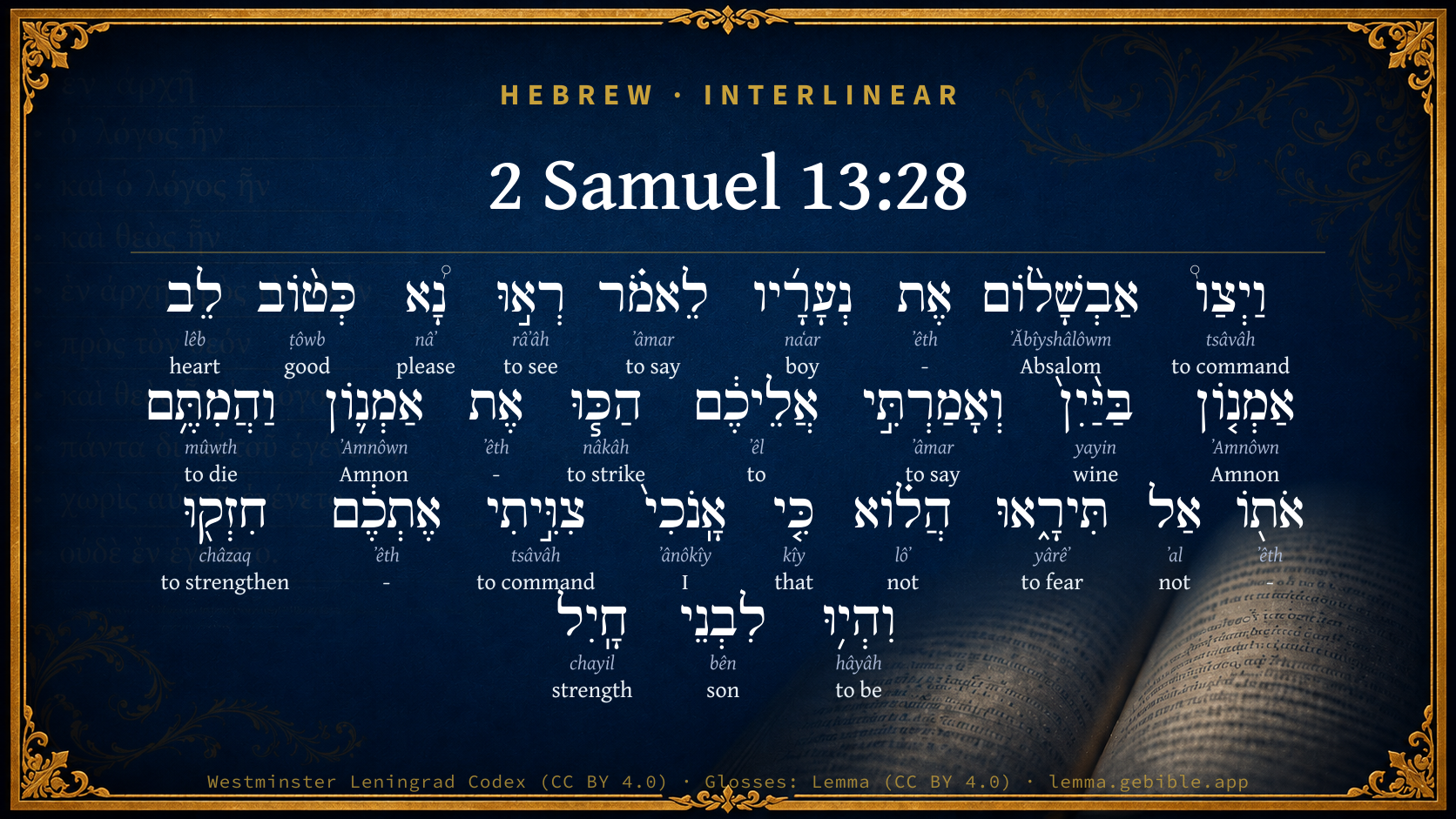
2 Samuel 13:28

Hebrew (Westminster Leningrad Codex) 2 Samuel 13:28 appears in the Hebrew Old Testament. The text above is from the Westminster Leningrad Codex. Each word links to its Strong’s number, a concise gloss, and parsing drawn from the Open Scriptures Hebrew Bible morphology. Click any word for its full Brown-Driver-Briggs (BDB) entry.
Download image
Cite this verse

2 Samuel 13:28 (World English Bible). Public Domain. Lemma interlinear Bible study tool, https://lemma.gebible.app/v/2-samuel/13/28.

Show BibTeX & RIS
BibTeX
RIS
English Translation
Absalom commanded his servants, saying, Mark you now, when Amnon's heart is merry with wine; and when I tell you, Smite Amnon, then kill him; don't be afraid; haven't I commanded you? be courageous, and be valiant.
World English Bible · Public Domain
Download a study sheet

One document with this verse’s original text, its word-by-word gloss line, the meaning frame, cross-references with their text, attributed commentary, and full source and license credits — printable, and it pastes into notes with its structure intact.

This verse Autodidact and up

Study sheet (.html) Plain text (.txt)

A passage Seminary Student

Up to 50 verses in one chapter. A passage sheet keeps up to 6 commentary sources and 12 cross-references per verse, in the order this page ranks them, and says so on the sheet whenever that leaves anything out. Ask for a single verse and you get the Autodidact verse sheet above.

Everything on this page stays free to read, with no account — the sheet is a download of what is already on screen, not access to it.

Want to remove ads? Support Godless Engineer
Compare translations 3

The same verse in 3 English versions, stacked beneath the original-language interlinear above. Click any original word for its lexicon entry.

Each is an independent rendering of the whole verse — the interlinear is not word-aligned to these translations.

Highlighted words mark where these versions differ — a whole-verse word diff, not a word-by-word alignment.

  • World English Bible Public Domain
    Absalom commanded his servants, saying, Mark you now, when Amnon's heart is merry with wine; and when I tell you, Smite Amnon, then kill him; don't be afraid; haven't I commanded you? be courageous, and be valiant.
  • King James Version Public Domain
    Now Absalom had commanded his servants, saying, Mark ye now when Amnon's heart is merry with wine, and when I say unto you, Smite Amnon; then kill him, fear not: have not I commanded you? be courageous, and be valiant.
  • unfoldingWord Literal Text CC BY-SA 4.0
    And Absalom commanded his young men, saying, “See, now, when Amnon good of heart with wine, and I say to you, ‘Strike Amnon!’ then you shall kill him. Do not fear. not that I, I have commanded you? Be courageous and be sons of valor.”

unfoldingWord Literal Text — © unfoldingWord, licensed CC BY-SA 4.0. Word-aligned USFM3 via Door43 (git.door43.org/unfoldingWord/en_ult).

Versions to compare (up to 4)

3 of 4 selected

Show all 18 translations

Every available English version of this verse, each an independent rendering of the whole verse.

  • World English Bible Public Domain
    Absalom commanded his servants, saying, Mark you now, when Amnon's heart is merry with wine; and when I tell you, Smite Amnon, then kill him; don't be afraid; haven't I commanded you? be courageous, and be valiant.
  • Berean Standard Bible Public Domain
    Now Absalom had ordered his young men, “Watch Amnon until his heart is merry with wine, and when I order you to strike Amnon down, you are to kill him. Do not be afraid. Have I not commanded you? Be courageous and valiant!”
  • Majority Standard Bible Public Domain
    Now Absalom had ordered his young men, “Watch Amnon until his heart is merry with wine, and when I order you to strike Amnon down, you are to kill him. Do not be afraid. Have I not commanded you? Be courageous and valiant!”
  • King James Version Public Domain
    Now Absalom had commanded his servants, saying, Mark ye now when Amnon's heart is merry with wine, and when I say unto you, Smite Amnon; then kill him, fear not: have not I commanded you? be courageous, and be valiant.
  • American Standard Version (1901) Public Domain
    And Absalom commanded his servants, saying, Mark ye now, when Amnon's heart is merry with wine; and when I say unto you, Smite Amnon, then kill him; fear not; have not I commanded you? be courageous, and be valiant.
  • Revised Version (1885) Public Domain
    And Absalom commanded his servants, saying, Mark ye now, when Amnon’s heart is merry with wine; and when I say unto you, smite Amnon, then kill him, fear not: have not I commanded you? be courageous, and be valiant.
  • Geneva Bible (1599) Public Domain
    Now had Absalom commanded his seruants, saying, Marke now when Amnons heart is merry with wine, and when I say vnto you, Smite Amnon, kill him, feare not, for haue not I commanded you? be bold therefore, and play the men.
  • Douay-Rheims (1899) Public Domain
    And Absalom had commanded his servants, saying: Take notice when Amnon shall be drunk with wine, and when I shall say to you: Strike him, and kill him, fear not: for it is I that command you: take courage, and be valiant men.
  • Young's Literal Translation Public Domain
    And Absalom commandeth his young men, saying, `See, I pray thee, when the heart of Amnon `is' glad with wine, and I have said unto you, Smite Amnon, that ye have put him to death; fear not; is it not because I have commanded you? be strong, yea, become sons of valour.'
  • Literal Standard Version CC BY-SA 4.0
    And Absalom commands his young men, saying, “Now see, when the heart of Amnon [is] glad with wine, and I have said to you, Strike Amnon, that you have put him to death; do not fear; is it not because I have commanded you? Be strong, indeed, become sons of valor.”
  • Unlocked Literal Bible CC BY-SA 4.0
    Absalom commanded his servants saying, “Listen closely. When Amnon begins to be affected by the wine, and when I say to you, 'Attack Amnon,' then kill him. Do not be afraid. Have I not commanded you? Be courageous and brave.”
  • unfoldingWord Literal Text CC BY-SA 4.0
    And Absalom commanded his young men, saying, “See, now, when Amnon good of heart with wine, and I say to you, ‘Strike Amnon!’ then you shall kill him. Do not fear. not that I, I have commanded you? Be courageous and be sons of valor.”
  • Darby Bible Public Domain
    And Absalom commanded his servants, saying, Mark ye now when Amnon's heart is merry with wine, and when I say to you, Smite Amnon; then slay him, fear not: have not I commanded you? be courageous, and be valiant.
  • World Messianic Bible Public Domain
    Absalom commanded his servants, saying, “Mark now, when Amnon’s heart is merry with wine; and when I tell you, ‘Strike Amnon,’ then kill him. Don’t be afraid. Haven’t I commanded you? Be courageous, and be valiant!”
  • Webster's Bible Public Domain
    Now Absalom had commanded his servants, saying, Mark ye now when Amnon's heart is merry with wine, and when I say to you, Smite Amnon; then kill him, fear not: have I not commanded you? be courageous, and be valiant.
  • Free Bible Version CC BY-SA 4.0
    Absalom gave orders to his men, saying, “Pay attention! When Amnon is feeling happy from drinking wine and I tell you, ‘Attack Amnon!’ then kill him. Don't be afraid. I myself am giving you this order. Be strong and be brave.”
  • Bible in Basic English Public Domain
    Now Absalom had given orders to his servants, saying, Now take note when Amnon's heart is glad with wine; and when I say to you, Make an attack on Amnon, then put him to death without fear: have I not given you orders? be strong and without fear.
  • JPS Tanakh (1917) Public Domain
    And Absalom commanded his servants, saying: 'Mark ye now, when Amnon's heart is merry with wine; and when I say unto you: Smite Amnon, then kill him, fear not; have not I commanded you? be courageous, and be valiant.'

Literal Standard Version (2020), Covenant Press — licensed CC BY-SA 4.0. Text via the HelloAO Bible API (eBible.org). Unlocked Literal Bible (unfoldingWord) — licensed CC BY-SA 4.0. Text via the HelloAO Bible API (eBible.org). unfoldingWord Literal Text — © unfoldingWord, licensed CC BY-SA 4.0. Word-aligned USFM3 via Door43 (git.door43.org/unfoldingWord/en_ult). Free Bible Version, Dr. Jonathan Gallagher — licensed CC BY-SA 4.0. Text via the HelloAO Bible API (eBible.org).

Word by word

More ways to search: Search by grammar → Find every occurrence → Compare this word →

Practice this passage: Drill this verse → Learn its vocabulary →

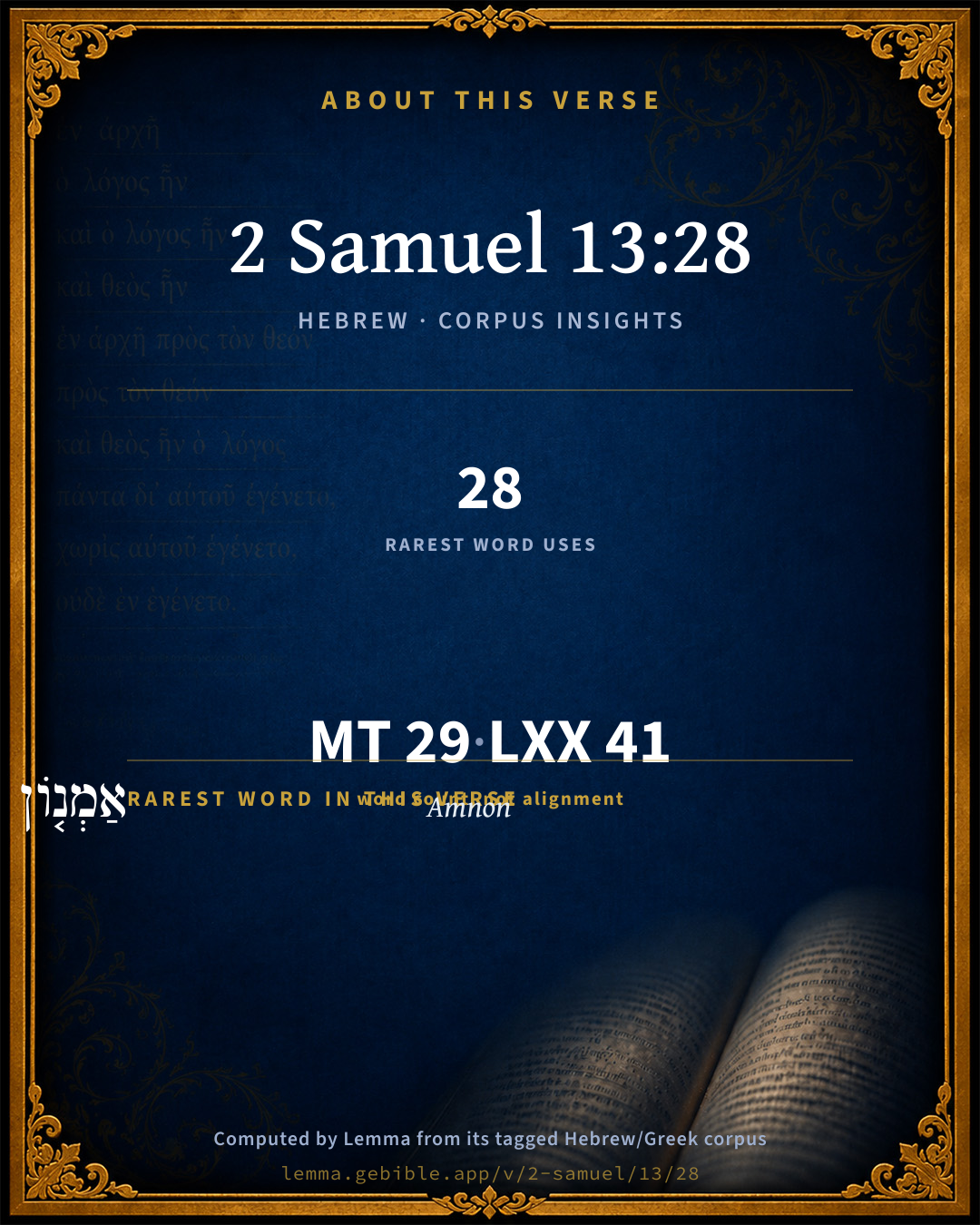
אַמְנ֤וֹן
ʼAmnôwn
H550
“Amnon”
Noun, Proper
Part of Speech
Noun
Type
Proper
Full BDB Definition

Origin: from H539

TWOT: None

Amnon = "faithful" - oldest son of David, rapist of Tamar, slain by Absalom - a son of Shimon (of Caleb's clan)
  1. וַיְצַו֩ tsâvâh H6680 “and · to command” Conjunction + Verb, Piel, Sequential Imperfect, 3rd Person, Masculine, Singular
  2. אַבְשָׁל֨וֹם ʼĂbîyshâlôwm H53 “Absalom” Noun, Proper
  3. אֶת ʼêth H853 “-” Particle, Direct Object
  4. נְעָרָ֜יו naʻar H5288 “boys · his” Noun, Common, Masculine, Plural, Construct + Suffix, Personal, 3rd Person, Masculine, Singular
  5. לֵאמֹ֗ר ʼâmar H559 “to say” Preposition + Verb, Qal, Infinitive Construct
  6. רְא֣וּ râʼâh H7200 “see” Verb, Qal, Imperative, 2nd Person, Masculine, Plural
  7. נָ֠א nâʼ H4994 “please” Particle, Exhortation
  8. כְּט֨וֹב ṭôwb H2896 “like/as · good” Preposition + Verb, Qal, Infinitive Construct
  9. לֵב lêb H3820 “heart of” Noun, Common, Masculine, Singular, Construct
  10. בַּיַּ֨יִן֙ yayin H3196 “in/at the · wine” Preposition, Determined + Noun, Common, Masculine, Singular, Absolute
  11. וְאָמַרְתִּ֣י ʼâmar H559 “and · to say” Conjunction + Verb, Qal, Sequential Perfect, 1st Person, Common, Singular
  12. אֲלֵיכֶ֔ם ʼêl H413 “to · you” Preposition + Suffix, Personal, 2nd Person, Masculine, Plural
  13. הַכּ֧וּ nâkâh H5221 “strike” Verb, Hiphil, Imperative, 2nd Person, Masculine, Plural
  14. אֶת ʼêth H853 “-” Particle, Direct Object
  15. אַמְנ֛וֹן ʼAmnôwn H550 “Amnon” Noun, Proper
  16. וַהֲמִתֶּ֥ם mûwth H4191 “and · to die” Conjunction + Verb, Hiphil, Sequential Perfect, 2nd Person, Masculine, Plural
  17. אֹת֖וֹ ʼêth H853 “- · him” Particle, Direct Object + Suffix, Personal, 3rd Person, Masculine, Singular
  18. אַל ʼal H408 “not” Particle, Negative
  19. תִּירָ֑אוּ yârêʼ H3372 “to fear” Verb, Qal, Jussive, 2nd Person, Masculine, Plural
  20. הֲל֗וֹא lôʼ H3808 “not” Particle, Interrogative + Particle, Negative
  21. כִּ֤י kîy H3588 “that” Conjunction
  22. אָֽנֹכִי֙ ʼânôkîy H595 “I” Pronoun, Personal, 1st Person, Common, Singular
  23. צִוִּ֣יתִי tsâvâh H6680 “to command” Verb, Piel, Perfect, 1st Person, Common, Singular
  24. אֶתְכֶ֔ם ʼêth H853 “- · you” Particle, Direct Object + Suffix, Personal, 2nd Person, Masculine, Plural
  25. חִזְק֖וּ châzaq H2388 “strengthen” Verb, Qal, Imperative, 2nd Person, Masculine, Plural
  26. וִהְי֥וּ hâyâh H1961 “and · be” Conjunction + Verb, Qal, Imperative, 2nd Person, Masculine, Plural
  27. לִבְנֵי bên H1121 “to/for · sons of” Preposition + Noun, Common, Masculine, Plural, Construct
  28. חָֽיִל chayil H2428 “strength” Noun, Common, Masculine, Singular, Absolute

About this verse

These counts appear in no published source. They are computed here, from the morphology-tagged text and Lemma’s own curated glosses. What Lemma adds →

29
words
23
distinct lemmas
Historical
section

Shared distinctive vocabulary

אַמְנ֤וֹן Amnon H550 occurs in 22 verses of the Hebrew Bible. Also found in:

Grammatical profile

  • 11 verbs
  • 8 nouns
  • 1 pronoun
  • 1 preposition
  • 1 conjunction
  • 7 particles

Verb forms

  • וַיְצַו֩ Piel · Sequential Imperfect
  • לֵאמֹ֗ר Qal · Infinitive Construct
  • רְא֣וּ Qal · Imperative
  • כְּט֨וֹב Qal · Infinitive Construct
  • וְאָמַרְתִּ֣י Qal · Sequential Perfect
  • הַכּ֧וּ Hiphil · Imperative
  • וַהֲמִתֶּ֥ם Hiphil · Sequential Perfect
  • תִּירָ֑אוּ Qal · Jussive
  • צִוִּ֣יתִי Piel · Perfect
  • חִזְק֖וּ Qal · Imperative
  • וִהְי֥וּ Qal · Imperative

Repetition

Words recur within this verse — often emphatic in Hebrew:

  • וַיְצַו֩ to command H6680 ×2
  • לֵאמֹ֗ר to say H559 ×2
  • אַמְנ֤וֹן Amnon H550 ×2

Hebrew & Septuagint length

In English translation the verse runs 37 words from the Hebrew and 43 from the Septuagint (LXX English) — closely comparable.

A rough comparison of the two English renderings, which tokenize alike — not a word-level alignment.

Word counts can differ between the Hebrew and the Greek without any difference in meaning — e.g. the Hebrew direct-object marker אֵת has no separate Greek word, and Greek often adds the article ὁ.

In the original languages it is 29 Hebrew tokens and 41 Greek tokens — but the two are counted differently (Hebrew bundles its prefixes and suffixes into one token; the Greek is in lemma form), so that isn’t a like-for-like length.

Cross-references

25

Topical passages linked to 2 Samuel 13:28 in the Treasury of Scripture Knowledge — connected by theme and wording, ordered by reader-vote popularity; previews shown in the World English Bible.

  • Judges 19:6 So they sat down, and ate and drink, both of them together: and the young lady's father said to the man, Please be pleased to stay all night, and let your heart be merry.
  • Judges 19:9 When the man rose up to depart, he, and his concubine, and his servant, his father-in-law, the young lady's father, said to him, Behold, now the day draws toward evening, please stay all night: behold, the day grows to an end, lodge here, that your heart may be merry; and tomorrow get you early on your way, that you may go home.
  • Judges 19:22 As they were making their hearts merry, behold, the men of the city, certain base fellows, beset the house round about, beating at the door; and they spoke to the master of the house, the old man, saying, Bring forth the man who came into your house, that we may know him.
  • Ruth 3:7 When Boaz had eaten and drunk, and his heart was merry, he went to lie down at the end of the heap of grain: and she came softly, and uncovered his feet, and laid her down.
  • 1 Samuel 25:36–38 Abigail came to Nabal; and, behold, he held a feast in his house, like the feast of a king; and Nabal's heart was merry within him, for he was very drunken: therefore she told him nothing, less or more, until the morning light.
  • Nahum 1:10 For entangled like thorns, and drunken as with their drink, they are consumed utterly like dry stubble.
  • Genesis 9:21 He drank of the wine, and got drunk. He was uncovered within his tent.
  • Genesis 19:32–35 Come, let's make our father drink wine, and we will lie with him, that we may preserve our father's seed."
  • Exodus 1:16–17 and he said, "When you perform the duty of a midwife to the Hebrew women, and see them on the birth stool; if it is a son, then you shall kill him; but if it is a daughter, then she shall live."
  • Numbers 22:16–17 They came to Balaam, and said to him, Thus says Balak the son of Zippor, Please let nothing hinder you from coming to me:
  • Joshua 1:9 Haven't I commanded you? Be strong and of good courage; don't be afraid, neither be dismayed: for Yahweh your God is with you wherever you go.
  • 1 Samuel 22:17–18 The king said to the guard who stood about him, Turn, and kill the priests of Yahweh; because their hand also is with David, and because they knew that he fled, and didn't disclose it to me. But the servants of the king wouldn't put forth their hand to fall on the priests of Yahweh.
  • 1 Samuel 28:13 The king said to her, Don't be afraid: for what do you see? The woman said to Saul, I see a god coming up out of the earth.
  • 2 Samuel 11:13 When David had called him, he ate and drink before him; and he made him drunk: and at even he went out to lie on his bed with the servants of his lord, but didn't go down to his house.
  • 2 Samuel 11:15 He wrote in the letter, saying, Set Uriah in the forefront of the hottest battle, and retire you from him, that he may be struck, and die.
  • 1 Kings 20:16 They went out at noon. But Ben Hadad was drinking himself drunk in the pavilions, he and the kings, the thirty-two kings who helped him.
  • Esther 1:10 On the seventh day, when the heart of the king was merry with wine, he commanded Mehuman, Biztha, Harbona, Bigtha, and Abagtha, Zethar, and Carcass, the seven chamberlains who ministered in the presence of Ahasuerus the king,
  • Psalms 104:15 Wine that makes glad the heart of man, Oil to make his face to shine, And bread that strengthens man's heart.
  • Ecclesiastes 9:7 Go your way--eat your bread with joy, and drink your wine with a merry heart; for God has already accepted your works.
  • Ecclesiastes 10:19 A feast is made for laughter, And wine makes the life glad; And money is the answer for all things.
  • Daniel 5:2–6 Belshazzar, while he tasted the wine, commanded to bring the golden and silver vessels which Nebuchadnezzar his father had taken out of the temple which was in Jerusalem; that the king and his lords, his wives and his concubines, might drink from it.
  • Daniel 5:30 In that night Belshazzar the Chaldean King was slain.
  • Luke 21:34 "So be careful, or your hearts will be loaded down with carousing, drunkenness, and cares of this life, and that day will come on you suddenly.
  • Acts 5:29 But Peter and the apostles answered, "We must obey God rather than men.
  • 1 Samuel 28:10 Saul swore to her by Yahweh, saying, As Yahweh lives, there shall no punishment happen to you for this thing.

Cross-references courtesy of OpenBible.info (CC BY 4.0).

Hebrew and Greek witnesses Masoretic Hebrew ↔ Greek Septuagint

The same verse in the two great witnesses to the Old Testament, shown verse-for-verse.

These are two independent witnesses, not word-aligned to each other, and the Septuagint is shown in lemma (dictionary) form.

Hebrew 2 Samuel 13:28 Masoretic · Westminster Leningrad Codex

וַיְצַו֩ אַבְשָׁל֨וֹם אֶת נְעָרָ֜יו לֵאמֹ֗ר רְא֣וּ נָ֠א כְּט֨וֹב לֵב אַמְנ֤וֹן בַּיַּ֨יִן֙ וְאָמַרְתִּ֣י אֲלֵיכֶ֔ם הַכּ֧וּ אֶת אַמְנ֛וֹן וַהֲמִתֶּ֥ם אֹת֖וֹ אַל תִּירָ֑אוּ הֲל֗וֹא כִּ֤י אָֽנֹכִי֙ צִוִּ֣יתִי אֶתְכֶ֔ם חִזְק֖וּ וִהְי֥וּ לִבְנֵי חָֽיִל

Absalom commanded his servants, saying, Mark you now, when Amnon's heart is merry with wine; and when I tell you, Smite Amnon, then kill him; don't be afraid; haven't I commanded you? be courageous, and be valiant.

World English Bible · Public Domain

Greek LXX 2 Samuel 13:28 Septuagint · lemma form

καί ἐντέλλω αβεσσαλωμ ὁ παιδάριον αὐτός λέγω ὁράω ὡς ἄν ἀγαθύνω ὁ καρδία αμνων ἐν ὁ οἶνος καί εἶπον πρός σύ πατάσσω ὁ αμνων καί θανατόω αὐτός μή φοβέω ὅτι οὐ ἐγώ εἰμί ἐντέλλω σύ ἀνδρίζομαι καί γίγνομαι εἰς υἱός δύναμις

And Abessalom charged his servants, saying, Mark when the heart of Amnon shall be merry with wine, and I shall say to you, Strike Amnon, and kill him: fear not; for is it not I that command you? Be courageous, and be valiant.

LXX2012 (modern English Septuagint) · Public Domain

On this verse, Keil & Delitzsch discusses the Septuagint’s reading. Read the note in Commentary ↓

Hebrew: Westminster Leningrad Codex (CC BY 4.0). Greek: Septuagint (public domain); English from LXX2012 (modern English Septuagint) (Public Domain). How the Septuagint differs from the Hebrew →

Targum (Aramaic paraphrase)

1

The Targum is the ancient Jewish Aramaic paraphrase of the Hebrew Scriptures — an interpretive translation, not the Hebrew text itself. Onkelos (literal) and Pseudo-Jonathan (expansive) render the Torah, and Jonathan the Prophets. Coverage is partial: where no permissively-licensed English translation exists for a verse, only the Aramaic is shown. This is verse-level text, not a word-by-word alignment to the Hebrew.

  1. Targum Jonathan Prophets (Joshua–Malachi)
    וּפַקֵיד אַבְשָׁלוֹם יַת עוּלֵימוֹהִי לְמֵימָר חֲזוֹ כְעַן כַּד יִשְׁפַּר לִבָּא דְאַמְנוֹן בְּחַמְרָא וְאֵימַר לְכוֹן קְטוּלוּ יַת אַמְנוֹן וְתִקְטְלוּן יָתֵיהּ לָא תִדְחֲלוּן הֲלָא אֲרֵי אֲנָא פַקְדִית יַתְכוֹן אִתְקִיפוּ וַהֲווֹ לְגַבְרִין גִבָּרִין:

    (no public-domain English translation for this verse)

    Targum Jonathan — Aramaic: “Mikraot Gedolot” (public domain). English: “Sefaria Community Translation” (CC0 1.0 (public-domain dedication)); “London "Chaldee Paraphrase," 1871” (public domain). Text via Sefaria.

Commentary

Notes on 2 Samuel 13:28 from classic Christian and Jewish commentators (each source and its license shown beneath its notes). The classic Christian expositions comment on the surrounding passage and are grouped to its opening verse, so a note may address several verses; the Jewish commentaries on the Tanakh (Rashi and others) are per-verse, so they appear only where the commentator wrote on this verse.

Lemma curates 59 commentaries, every one of them public domain or Creative Commons licensed, each selected and text-cleaned for this edition rather than reprinted as found. About our sources →

Jamieson, Fausset & Brown

Robert Jamieson, A. R. Fausset & David Brown

AMNON IS SLAIN. (Sa2 13:28-36)

Absalom had commanded his servants, saying . . . when Amnon's heart is merry with wine . . . kill him, fear not--On a preconcerted signal from their master, the servants, rushing upon Amnon, slew him at the table, while the rest of the brothers, horror-struck, and apprehending a general massacre, fled in affrighted haste to Jerusalem.

Jamieson, Fausset & Brown — Commentary Critical and Explanatory on the Whole Bible (1871) — public domain (CC PDM 1.0). Text via the HelloAO Bible API.

Trapp's Complete Commentary

John Trapp

2Sa 13:28 Now Absalom had commanded his servants, saying, Mark ye now when Amnon’s heart is merry with wine, and when I say unto you, Smite Amnon; then kill him, fear not: have not I commanded you? be courageous, and be valiant.

Ver. 28. Now Absalom had commanded his servants.] His assassins, whom some conceive to have been Geshurites of his mother’s country, ready to flee thither with him, as 2Sa 13:37.

When Amnon’s heart is merry with wine.] See on 2Sa 13:13.

And when I say unto you, Smite Amnon.] So cowardly he was that he durst not do it himself, saith Pellican.

Then kill him, fear not.] This bloody command he uttered in plainer terms than did Tarlton, bishop of Winchester, when he gave order for the death of King Edward in these words unpointed, and therefore of doubtful interpretation, Edvardum occidere nolite timere bonum est.

Have not I commanded you?] Am not I the next heir to the crown? and so shall be able both to secure you and reward you.

John Trapp, A Commentary or Exposition upon All the Books of the Old and New Testament (1647–1656) — public domain. Text from a community e-Sword module.

Joseph Benson's Commentary

2Sa 13:28-29. When Amnon’s heart is merry — When he least suspects, and will be most unable to prevent the evil. Have not I commanded you? — I who am the king’s son, and, when Amnon is dead, next heir to the crown, and who therefore can easily stand between you and the danger of your being called to an account for what you do, or can obtain pardon for you, and not only so, but have it in my power to reward you. The servants did as Absalom had commanded — And Amnon fell. Thus did Absalom at one blow revenge himself upon his sister’s ravisher, and rid himself of his rival in his father’s favour, and only obstacle, as he apprehended, to his crown. Now is the threatened sword drawn in David’s house, which will not depart from it. His eldest son falls by it, through his own wickedness, and his father, by conniving at that wickedness, is accessory to his death. Then all the king’s sons arose and fled — Terrified at what they saw, they started up from the table, seized every man his mule, and fled home as fast as they could. But fast as they fled, fame reached the palace before them, and told David that Absalom had destroyed all his sons.

Joseph Benson's Commentary on the Old and New Testaments (1811–1818) — public domain. Text from a community e-Sword module.

Geneva Bible (1599)

Geneva Bible translators

Such is the pride of the wicked masters, that in all their wicked commandments they think to be obeyed.

Geneva Bible (1599) marginal notes — public domain. Text via Bolls.life.

The Cambridge Bible for Schools and Colleges

gen. ed. J. J. S. Perowne

28. Now Absalom had commanded] And Absalom commanded. Absalom felt himself bound in honour to avenge his sister’s wrong, and moreover welcomed the pretext for getting rid of Amnon, who stood between himself and the succession to the throne.

The Cambridge Bible for Schools and Colleges (gen. ed. J. J. S. Perowne; Cambridge University Press, 1878–1918) — public domain. Text from a community e-Sword module.

John Gill's Exposition

Now Absalom had commanded his servants,.... Before he and his guests were set down to the entertainment:

saying, mark ye now when Amnon's heart is merry with wine; as he was determined to make him if possible, and as he supposed he would be, knowing his inclination to drink:

and when I say unto you, smite Amnon, then kill him; smite him that he die, and be sure he is dead before you leave him:

fear not, have not I commanded you? who am your lord, the king's son, and will then be heir to the crown; fear not, I will protect you; let all the blame be laid to me, if any; I will be answerable for it, you have nothing to do but to obey my commands:

be courageous, and be valiant; show yourselves to be men of courage and valour, not fearing the king's sons, or any in company, or what will be the consequences of it; do your business effectually, and leave all with me; it is very reasonably supposed that Absalom had not only in view to revenge the rape of his sister, but to get himself next heir to the crown.

John Gill's Exposition of the Whole Bible (1746–1763) — public domain (CC PDM 1.0). Text via the HelloAO Bible API.

Haydock's Catholic Bible Commentary

It is I: the blame will fall on me; I will rescue all from danger. These servants were probably infidels, of Gessur, and fled with their master. (Menochius)

George Leo Haydock (1774–1849), Haydock's Catholic Family Bible and Commentary, 1859 edition — public domain. Excludes Psalms (Douay-Rheims chapter numbering differs from Protestant) and Deuterocanonical books (Catholic canon only).

Matthew Poole's English Annotations

When Amnon’s heart is merry with wine; when he least suspects, and will be most unable to prevent the evil.

Have not I commanded you; I who am the king’s son, and, when Amnon is gone, his heir; who therefore shall easily obtain pardon for you, and will liberally reward you?

Matthew Poole's English Annotations on the Holy Bible (1683–1685) — public domain. Text from a community e-Sword/MySword module.

Whedon's Commentary on the Bible

Daniel D. Whedon

28. Have not I commanded you — No guilt will be on you, for I take all the responsibility on myself; only obey you my orders.

Daniel D. Whedon (gen. ed.), Commentary on the Old and New Testaments (1874–1909) — public domain. Text from a community e-Sword module.

The Pulpit Commentary

Smite Amnon. The order was given before the banquet began, and every arrangement made to render the attack successful. Though Tamar"s wrong was the mainspring of Absalom"s conduct, yet neither he nor his men would forget that Amnon stood between him and the crown; and Amnon, entirely off his guard, never very wise at his best, and with his senses made dull by wine, seems to have fallen an easy prey. And as soon as the murder was committed, the rest of the king"s sons, though all had attendants with them, fled in dismay, not knowing what might be the extent of Absalom"s purpose. It is said that they fled on mules, this being the first place in which this animal is mentioned, as the word so translated in Gen_36:24 really means "hot springs," and is so translated in the Revised Version. The breeding of hybrids was forbidden in Lev_19:19, and probably they were procured, as were horses, by trade. Up to this time the ass had been used for riding; but now David had a favourite, (1Ki_1:33) and Solomon received mules as tribute. (1Ki_10:25) Horses seem to have been used chiefly for chariots.

The Pulpit Commentary (1880–1919), ed. H.D.M. Spence-Jones & Joseph S. Exell — public domain. Text from a community e-Sword module.

John Wesley's Explanatory Notes

Merry - When he least suspects, and will be most unable to prevent the evil. I - I who am the king's son, and, when Amnon is gone, his heir: who therefore shall easily obtain pardon for you, and will liberally reward you.

John Wesley, Explanatory Notes Upon the Whole Bible (1754–1765) — public domain. Text via the GEBible commentary corpus.

Keil & Delitzsch

C. F. Keil & F. Delitzsch

Absalom then commanded his servants to put Amnon to death without fear, as he had commanded, as soon as his heart should become merry with wine and he (Absalom) should tell them to smite him. The arrangement of the meal is passed over as being quite subdrdinate to the main purpose of the narrative; and the clause added by the lxx at the close of Sa2 13:27, καὶ ἐποίησεν ἈβεσσαλὼϚ πότον κατὰ τὸν τοῦ βασιλέως, is nothing more than an explanatory gloss, formed according to Sa1 25:36. The words "Have not I commanded you?" implied that Absalom would take the responsibility upon himself.

Keil & Delitzsch — Biblical Commentary on the Old Testament (1861–1891) — public domain (CC PDM 1.0). Text via the HelloAO Bible API. (Old Testament only.)

Lesson kit

Teaching starters — assembled from the data on this page, not authored interpretation. Every prompt links to the verse data it draws on. Edit before teaching.

2 Samuel, in the Historical, opens this verse with 29 words (23 distinct Hebrew lemmas). Its most distinctive word is ʼAmnôwn (“Amnon”). A historical commentator’s framing appears above. Read the whole chapter for the surrounding context.

Discussion questions

  1. How does “Amnon” (ʼAmnôwn) shape what this verse is saying?
  2. How does 2 Samuel 3:2, which shares the word «Amnon», read alongside this verse?
  3. What does the repetition of “to command” (2× in this one verse) do in this verse?
  4. These translations render this verse differently. What is at stake in choosing one wording over another?
  5. «וַיְצַו֩» is a Piel Sequential Imperfect verb. How does that grammatical form shape the action described?
  6. Compare how Jamieson, Fausset & Brown and Trapp's Complete Commentary read this verse. Where do they agree or differ?

Things to notice

Reading settings

Reading text

Shown beneath each verse's original-language words.

Old Testament
Old Testament edition

Read the OT as the Masoretic Hebrew (MT) or the Greek Septuagint (LXX).

English shown for the Greek Septuagint (in the Hebrew ↔ Greek comparison).

Comparing translations? Open the Compare panel on any verse page to stack up to four side by side.