
Exodus 36:6

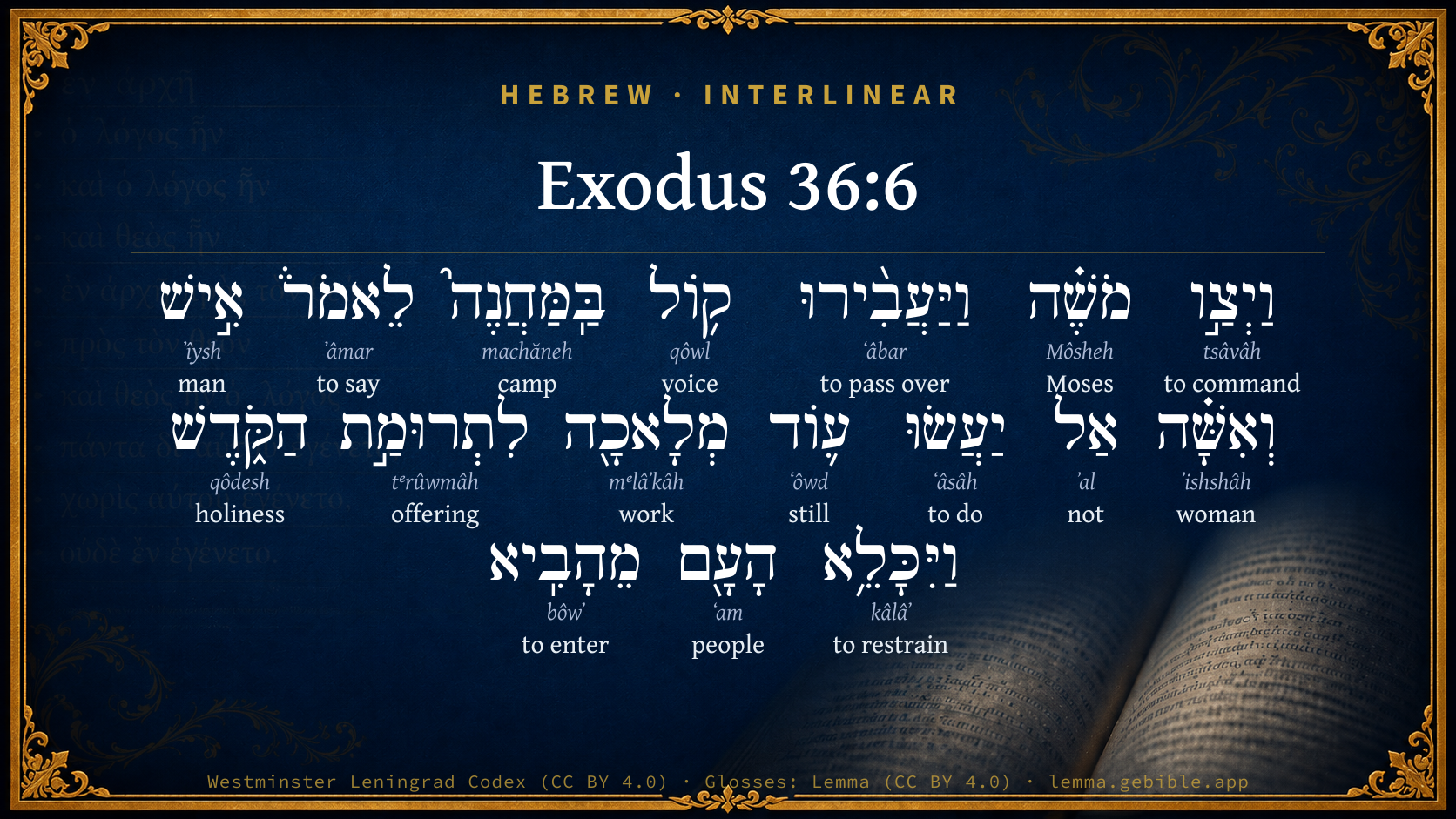
Hebrew (Westminster Leningrad Codex) Exodus 36:6 appears in the Hebrew Old Testament. The text above is from the Westminster Leningrad Codex. Each word links to its Strong’s number, a concise gloss, and parsing drawn from the Open Scriptures Hebrew Bible morphology. Click any word for its full Brown-Driver-Briggs (BDB) entry.
Download image
Cite this verse

Exodus 36:6 (World English Bible). Public Domain. Lemma interlinear Bible study tool, https://lemma.gebible.app/v/exodus/36/6.

Show BibTeX & RIS
BibTeX
RIS
English Translation
Moses gave commandment, and they caused it to be proclaimed throughout the camp, saying, "Let neither man nor woman make anything else for the offering for the sanctuary." So the people were restrained from bringing.
World English Bible · Public Domain
Download a study sheet

One document with this verse’s original text, its word-by-word gloss line, the meaning frame, cross-references with their text, attributed commentary, and full source and license credits — printable, and it pastes into notes with its structure intact.

This verse Autodidact and up

Study sheet (.html) Plain text (.txt)

A passage Seminary Student

Up to 50 verses in one chapter. A passage sheet keeps up to 6 commentary sources and 12 cross-references per verse, in the order this page ranks them, and says so on the sheet whenever that leaves anything out. Ask for a single verse and you get the Autodidact verse sheet above.

Everything on this page stays free to read, with no account — the sheet is a download of what is already on screen, not access to it.

Want to remove ads? Support Godless Engineer
Compare translations 3

The same verse in 3 English versions, stacked beneath the original-language interlinear above. Click any original word for its lexicon entry.

Each is an independent rendering of the whole verse — the interlinear is not word-aligned to these translations.

Highlighted words mark where these versions differ — a whole-verse word diff, not a word-by-word alignment.

  • World English Bible Public Domain
    Moses gave commandment, and they caused it to be proclaimed throughout the camp, saying, "Let neither man nor woman make anything else for the offering for the sanctuary." So the people were restrained from bringing.
  • King James Version Public Domain
    And Moses gave commandment, and they caused it to be proclaimed throughout the camp, saying, Let neither man nor woman make any more work for the offering of the sanctuary. So the people were restrained from bringing.
  • unfoldingWord Literal Text CC BY-SA 4.0
    And Moses commanded, and they caused a sound to pass through in the camp, saying, “A man and a woman shall not make any more work for the contribution of the Holy Place.” And the people were restrained from bringing.

unfoldingWord Literal Text — © unfoldingWord, licensed CC BY-SA 4.0. Word-aligned USFM3 via Door43 (git.door43.org/unfoldingWord/en_ult).

Versions to compare (up to 4)

3 of 4 selected

Show all 18 translations

Every available English version of this verse, each an independent rendering of the whole verse.

  • World English Bible Public Domain
    Moses gave commandment, and they caused it to be proclaimed throughout the camp, saying, "Let neither man nor woman make anything else for the offering for the sanctuary." So the people were restrained from bringing.
  • Berean Standard Bible Public Domain
    After Moses had given an order, they sent a proclamation throughout the camp: “No man or woman should make anything else as an offering for the sanctuary.” So the people were restrained from bringing more,
  • Majority Standard Bible Public Domain
    After Moses had given an order, they sent a proclamation throughout the camp: “No man or woman should make anything else as an offering for the sanctuary.” So the people were restrained from bringing more,
  • King James Version Public Domain
    And Moses gave commandment, and they caused it to be proclaimed throughout the camp, saying, Let neither man nor woman make any more work for the offering of the sanctuary. So the people were restrained from bringing.
  • American Standard Version (1901) Public Domain
    And Moses gave commandment, and they caused it to be proclaimed throughout the camp, saying, Let neither man nor woman make any more work for the offering of the sanctuary. So the people were restrained from bringing.
  • Revised Version (1885) Public Domain
    And Moses gave commandment, and they caused it to be proclaimed throughout the camp, saying, Let neither man nor woman make any more work for the offering of the sanctuary. So the people were restrained from bringing.
  • Geneva Bible (1599) Public Domain
    Then Moses gaue a commandement, and they caused it to be proclaymed throughout the hoste, saying, Let neither man nor woman prepare any more worke for the oblation of the Sanctuarie. So the people were stayed from offring.
  • Douay-Rheims (1899) Public Domain
    Moses therefore commanded proclamation to be made by the crier's voice: Let neither man nor woman offer any more for the work of the sanctuary. And so they ceased from offering gifts,
  • Young's Literal Translation Public Domain
    And Moses commandeth, and they cause a voice to pass over through the camp, saying, `Let not man or woman make any more work for the heave-offering of the sanctuary;' and the people are restrained from bringing,
  • Literal Standard Version CC BY-SA 4.0
    And Moses commands, and they cause a voice to pass over through the camp, saying, “Do not let man or woman make anymore work for the raised-offering of the holy place”; and the people are restrained from bringing,
  • Unlocked Literal Bible CC BY-SA 4.0
    So Moses instructed that no one in the camp should bring any more offerings for the construction of the holy place. Then the people stopped bringing these gifts.
  • unfoldingWord Literal Text CC BY-SA 4.0
    And Moses commanded, and they caused a sound to pass through in the camp, saying, “A man and a woman shall not make any more work for the contribution of the Holy Place.” And the people were restrained from bringing.
  • Darby Bible Public Domain
    Then Moses gave commandment, and they caused it to be proclaimed through the camp, saying, Let neither man nor woman make any more work for the heave-offering of the sanctuary! So the people were restrained from bringing;
  • World Messianic Bible Public Domain
    Moses gave a commandment, and they caused it to be proclaimed throughout the camp, saying, “Let neither man nor woman make anything else for the offering for the sanctuary.” So the people were restrained from bringing.
  • Webster's Bible Public Domain
    And Moses gave commandment, and they caused it to be proclaimed throughout the camp, saying, Let neither man nor woman make any more work for the offering of the sanctuary. So the people were restrained from bringing.
  • Free Bible Version CC BY-SA 4.0
    Moses gave the order, and an announcement was made throughout the camp: “Men and women, don't bring anything more as an offering for the sanctuary.” So the people were stopped from bringing anything more,
  • Bible in Basic English Public Domain
    So Moses made an order and had it given out through all the tents, saying, Let no man or woman make any more offerings for the holy place. So the people were kept from giving more.
  • JPS Tanakh (1917) Public Domain
    And Moses gave commandment, and they caused it to be proclaimed throughout the camp, saying: 'Let neither man nor woman make any more work for the offering of the sanctuary.' So the people were restrained from bringing.

Literal Standard Version (2020), Covenant Press — licensed CC BY-SA 4.0. Text via the HelloAO Bible API (eBible.org). Unlocked Literal Bible (unfoldingWord) — licensed CC BY-SA 4.0. Text via the HelloAO Bible API (eBible.org). unfoldingWord Literal Text — © unfoldingWord, licensed CC BY-SA 4.0. Word-aligned USFM3 via Door43 (git.door43.org/unfoldingWord/en_ult). Free Bible Version, Dr. Jonathan Gallagher — licensed CC BY-SA 4.0. Text via the HelloAO Bible API (eBible.org).

Word by word

More ways to search: Search by grammar → Find every occurrence → Compare this word →

Practice this passage: Drill this verse → Learn its vocabulary →

וַיִּכָּלֵ֥א
kâlâʼ
H3607
“and · to restrain”
Conjunction + Verb, Niphal, Sequential Imperfect, 3rd Person, Masculine, Singular
Part of Speech
Conjunction + Verb
Stem
Niphal
Form
Sequential Imperfect
Person
3rd Person
Gender
Masculine
Number
Singular
Full BDB Definition

Origin: a primitive root

TWOT: 980

to restrict, restrain, withhold, shut up, keep back, refrain, forbid - (Qal) - to shut up - to restrain - to withhold - (Niphal) to be restrained - (Piel) to finish
  1. וַיְצַ֣ו tsâvâh H6680 “and · to command” Conjunction + Verb, Piel, Sequential Imperfect, 3rd Person, Masculine, Singular
  2. מֹשֶׁ֗ה Môsheh H4872 “Moses” Noun, Proper
  3. וַיַּעֲבִ֨ירוּ ʻâbar H5674 “and · to pass over” Conjunction + Verb, Hiphil, Sequential Imperfect, 3rd Person, Masculine, Plural
  4. ק֥וֹל qôwl H6963 “voice” Noun, Common, Masculine, Singular, Absolute
  5. בַּֽמַּחֲנֶה֮ machăneh H4264 “in/at the · camp” Preposition, Determined + Noun, Common, Both, Singular, Absolute
  6. לֵאמֹר֒ ʼâmar H559 “to say” Preposition + Verb, Qal, Infinitive Construct
  7. אִ֣ישׁ ʼîysh H376 “man” Noun, Common, Masculine, Singular, Absolute
  8. וְאִשָּׁ֗ה ʼishshâh H802 “and · woman” Conjunction + Noun, Common, Feminine, Singular, Absolute
  9. אַל ʼal H408 “not” Particle, Negative
  10. יַעֲשׂוּ ʻâsâh H6213 “to do” Verb, Qal, Jussive, 3rd Person, Masculine, Plural
  11. ע֛וֹד ʻôwd H5750 “still” Adverb
  12. מְלָאכָ֖ה mᵉlâʼkâh H4399 “work” Noun, Common, Feminine, Singular, Absolute
  13. לִתְרוּמַ֣ת tᵉrûwmâh H8641 “to/for · offering of” Preposition + Noun, Common, Feminine, Singular, Construct
  14. הַקֹּ֑דֶשׁ qôdesh H6944 “the · holiness” Particle, Definite Article + Noun, Common, Masculine, Singular, Absolute
  15. הָעָ֖ם ʻam H5971 “the · people” Particle, Definite Article + Noun, Common, Masculine, Singular, Absolute
  16. מֵהָבִֽיא bôwʼ H935 “from · to enter” Preposition + Verb, Hiphil, Infinitive Construct

About this verse

These counts appear in no published source. They are computed here, from the morphology-tagged text and Lemma’s own curated glosses. What Lemma adds →

17
words
17
distinct lemmas
Pentateuch
section

Notable vocabulary

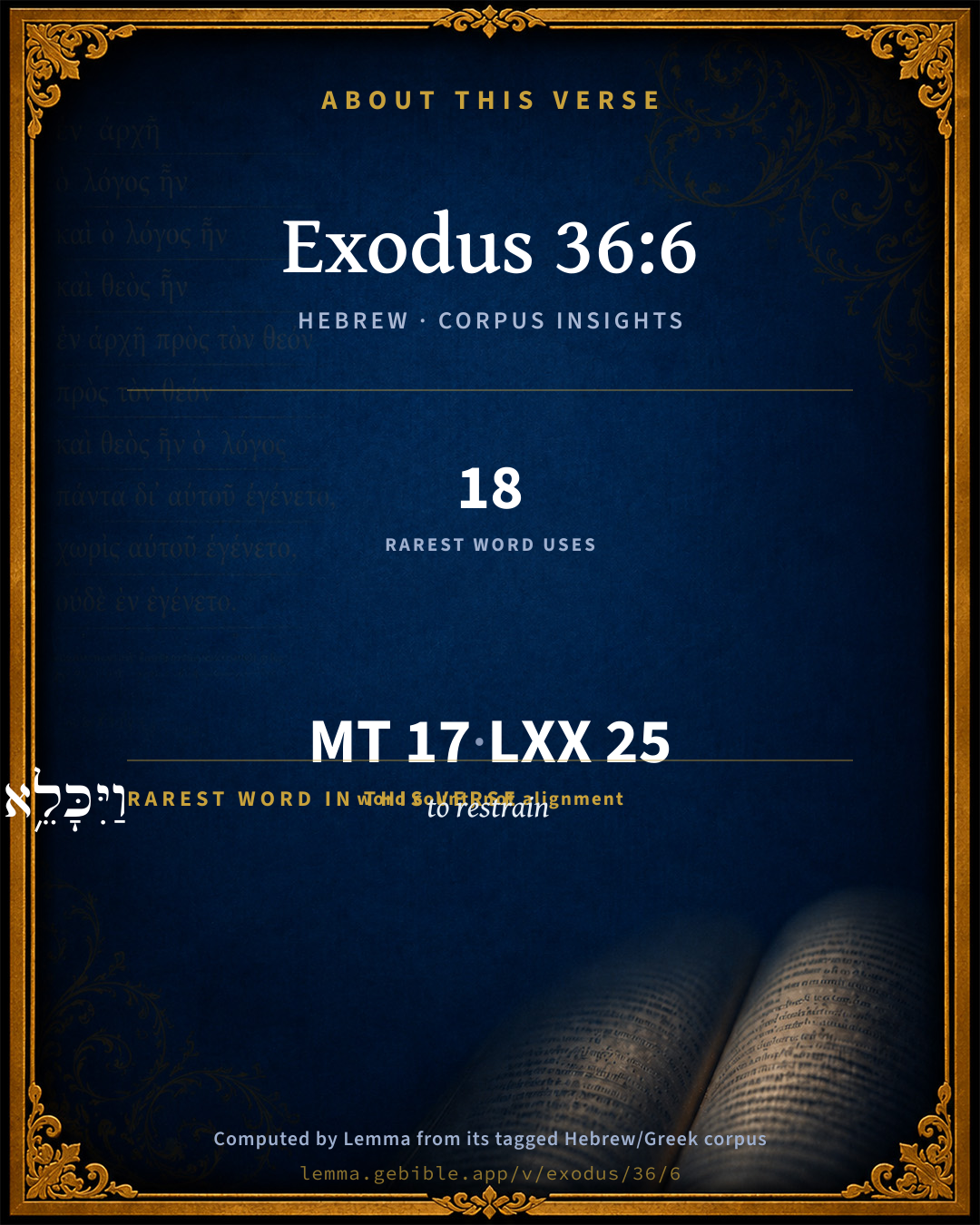
The rarest word here is וַיִּכָּלֵ֥א to restrain H3607 — appearing just 18 times in the whole Hebrew Bible.

Shared distinctive vocabulary

וַיִּכָּלֵ֥א to restrain H3607 occurs in 17 verses of the Hebrew Bible. Also found in:

Grammatical profile

  • 6 verbs
  • 9 nouns
  • 1 adverb
  • 1 particle

Verb forms

  • וַיְצַ֣ו Piel · Sequential Imperfect
  • וַיַּעֲבִ֨ירוּ Hiphil · Sequential Imperfect
  • לֵאמֹר֒ Qal · Infinitive Construct
  • יַעֲשׂוּ Qal · Jussive
  • וַיִּכָּלֵ֥א Niphal · Sequential Imperfect
  • מֵהָבִֽיא Hiphil · Infinitive Construct

Hebrew & Septuagint length

In English translation the verse runs 35 words from the Hebrew and 32 from the Septuagint (LXX English) — closely comparable.

A rough comparison of the two English renderings, which tokenize alike — not a word-level alignment.

Word counts can differ between the Hebrew and the Greek without any difference in meaning — e.g. the Hebrew direct-object marker אֵת has no separate Greek word, and Greek often adds the article ὁ.

In the original languages it is 17 Hebrew tokens and 25 Greek tokens — but the two are counted differently (Hebrew bundles its prefixes and suffixes into one token; the Greek is in lemma form), so that isn’t a like-for-like length.

Hebrew and Greek witnesses Masoretic Hebrew ↔ Greek Septuagint

The same verse in the two great witnesses to the Old Testament, shown verse-for-verse.

These are two independent witnesses, not word-aligned to each other, and the Septuagint is shown in lemma (dictionary) form.

Hebrew Exodus 36:6 Masoretic · Westminster Leningrad Codex

וַיְצַ֣ו מֹשֶׁ֗ה וַיַּעֲבִ֨ירוּ ק֥וֹל בַּֽמַּחֲנֶה֮ לֵאמֹר֒ אִ֣ישׁ וְאִשָּׁ֗ה אַל יַעֲשׂוּ ע֛וֹד מְלָאכָ֖ה לִתְרוּמַ֣ת הַקֹּ֑דֶשׁ וַיִּכָּלֵ֥א הָעָ֖ם מֵהָבִֽיא

Moses gave commandment, and they caused it to be proclaimed throughout the camp, saying, "Let neither man nor woman make anything else for the offering for the sanctuary." So the people were restrained from bringing.

World English Bible · Public Domain

Greek LXX Exodus 36:6 Septuagint · lemma form

καί προςτάσσω μωυσῆς καί κηρύσσω ἐν ὁ παρεμβολή λέγω ἀνήρ καί γυνή μηκέτι ἐργάζομαι εἰς ὁ ἀπαρχή ὁ ἅγιος καί κωλύω ὁ λαός ἔτι προςφέρω

And Moses commanded, and proclaimed in the camp, saying, Let neither man nor woman any longer labor for the offerings of the sanctuary; and the people were restrained from bringing any more.

LXX2012 (modern English Septuagint) · Public Domain

Hebrew: Westminster Leningrad Codex (CC BY 4.0). Greek: Septuagint (public domain); English from LXX2012 (modern English Septuagint) (Public Domain). How the Septuagint differs from the Hebrew →

Targum (Aramaic paraphrase)

2

The Targum is the ancient Jewish Aramaic paraphrase of the Hebrew Scriptures — an interpretive translation, not the Hebrew text itself. Onkelos (literal) and Pseudo-Jonathan (expansive) render the Torah, and Jonathan the Prophets. Coverage is partial: where no permissively-licensed English translation exists for a verse, only the Aramaic is shown. This is verse-level text, not a word-by-word alignment to the Hebrew.

  1. Targum Onkelos Torah (Genesis–Deuteronomy)
    וּפַקֵד משֶׁה וַאַעֲבַרוּ כְרוֹזָא בְּמַשְׁרִיתָא לְמֵימַר גְבַר וְאִתְּתָא לָא יַעַבְדוּן עוֹד עִבִדְתָּא לְאַפְרָשׁוּת קוּדְשָׁא וּפְסַק עַמָא מִלְאַיְתָאָה:

    (no public-domain English translation for this verse)

    Targum Onkelos — Aramaic: “Onkelos Genesis” (public domain); “Onkelos Exodus” (public domain); “Onkelos Leviticus” (public domain); “Onkelos Numbers” (public domain); “Onkelos Deuteronomy” (public domain). English: “Sefaria Community Translation” (CC0 1.0 (public-domain dedication)); “J.W. Etheridge. The Targums of Onkelos and Jonathan Ben Uzziel on the Pentateuch. London: Longmans, Green, 1862” (public domain). Text via Sefaria.

  2. Targum Pseudo-Jonathan Torah (Genesis–Deuteronomy)
    וּפַקֵּיד משֶׁה וְאַעֲבָרוּ כְרוֹזָא בְּמַשְׁרִיתָא לְמֵימָר גְּבַר וְאִתְּתָא לָא יַעַבְדוּן תּוּב עִיבִידְתָּא לְאַפְרָשׁוּת קוּדְשָׁא וּפְסַק עַמָּא מִלְאַיְתָאָה

    And Mosheh commanded, and they made proclamation through the camp, saying, Neither man nor woman may make any more work for the holy separation: and the people ceased from bringing.

    Targum Pseudo-Jonathan — Aramaic: “Targum Jonathan on Genesis” (public domain); “Targum Jonathan on Exodus” (public domain); “Targum Jonathan on Leviticus” (public domain); “Targum Jonathan on Numbers” (public domain); “Targum Jonathan on Deuteronomy” (public domain). English: “The Targum of Jonathan ben Uzziel, trans. J. W. Etheridge, London, 1862” (public domain). Text via Sefaria.

Commentary

Notes on Exodus 36:6 from classic Christian and Jewish commentators (each source and its license shown beneath its notes). The classic Christian expositions comment on the surrounding passage and are grouped to its opening verse, so a note may address several verses; the Jewish commentaries on the Tanakh (Rashi and others) are per-verse, so they appear only where the commentator wrote on this verse.

Lemma curates 59 commentaries, every one of them public domain or Creative Commons licensed, each selected and text-cleaned for this edition rather than reprinted as found. About our sources →

Ellicott's Commentary for English Readers

(6) So the people were restrained from giving.—Moses felt it necessary to interfere, and forbid further offerings. By the expression, “Let neither man nor woman make any more work, it would seem that the superfluous offerings were chiefly such things as were produced by labour—thread, goats’ hair yarn, and the like. (See Exo_35:25-26.) The humblest class of contributors would thus appear to have shown itself the most zealous. When will Christian liberality be so excessive as to require to be “restrained”?

A Bible Commentary for English Readers, edited by Charles John Ellicott (1878–1897) — public domain. Text from a community e-Sword module.

John Gill's Exposition

And Moses gave commandment,.... Orders to some proper person or persons about him:

and they caused it to be proclaimed throughout the camp, or "caused a voice to pass"; a crier or herald, as the Targums, who went through the camp and published in every quarter:

saying, let neither man nor woman make any more work for the offering of the sanctuary; as the men in cutting shittim wood, and planing it, and the women in spinning blue, purple, and scarlet yarn and goats' hair:

so the people were restrained from bringing; that is, any more: instead of a spur to liberality, which most want, a restraint was laid upon these to check it, and prevent an excess in it, of which there is rarely any danger; so eager, forward, and zealous were they in this good work.

John Gill's Exposition of the Whole Bible (1746–1763) — public domain (CC PDM 1.0). Text via the HelloAO Bible API.

Matthew Poole's English Annotations

The women did part of this work as well as the men. See Exo 35:25

Matthew Poole's English Annotations on the Holy Bible (1683–1685) — public domain. Text from a community e-Sword/MySword module.

The Pulpit Commentary

Moses accordingly had proclamation made through the camp, and so put a stop to further offerings.

The Pulpit Commentary (1880–1919), ed. H.D.M. Spence-Jones & Joseph S. Exell — public domain. Text from a community e-Sword module.

Rashi

Rabbi Shlomo Yitzchaki (Rashi)

ויכלא is an expression for withholding.

Rashi on the Tanakh — English translations: “The Judaica Press complete Tanach with Rashi, translated by A. J. Rosenberg” (CC BY 4.0); “Pentateuch with Rashi's commentary by M. Rosenbaum and A.M. Silbermann, 1929-1934” (public domain); “The Metsudah Tanach series, Lakewood, N.J” (CC BY 4.0); and “The Book of Joshua, Metsudah Publications, 1997” (CC BY 4.0). Text via Sefaria.

Ramban (Nachmanides)

Rabbi Moshe ben Nachman (Ramban / Nachmanides)

LET NEITHER MAN NOR WOMAN MAKE ANY MORE ‘MLACHAH’ (WORK). Money [and possessions] are called mlachah. Similarly: whether he have not put his hand ‘bimlecheth’ (the goods of) his neighbor; according to the pace of ‘hamlachah’ (the cattle) that are before me; ‘v’chol hamlachah’ (but everything) that was of no account and feeble, that they destroyed utterly. Thus the meaning of this verse is that they should not bring anything more for the sacred work. Scripture, however, states, Let them not make any more ‘mlachah’ [using the verb “to make”] in order to include therein the women, that they should no longer spin the goats’ hair. Thus even the act of bringing is here referred to as “making,” and [it was now Moses’ wish] to restrain them altogether [from bringing more donations, and from making any work in their homes, as explained].

Ramban (Nachmanides) on the Tanakh — English translation: “Commentary on the Torah by Ramban (Nachmanides). Translated and annotated by Charles B. Chavel. New York, Shilo Pub. House, 1971-1976” (CC BY 4.0). Text via Sefaria.

Lesson kit

Teaching starters — assembled from the data on this page, not authored interpretation. Every prompt links to the verse data it draws on. Edit before teaching.

Exodus, in the Pentateuch, opens this verse with 17 words (17 distinct Hebrew lemmas). Its most distinctive word is kâlâʼ (“to restrain”). A historical commentator’s framing appears above. Read the whole chapter for the surrounding context.

Discussion questions

  1. What does “to restrain” (kâlâʼ) contribute to the verse as a whole?
  2. How does Genesis 8:2, which shares the word «to restrain», read alongside this verse?
  3. The translations on this page render this verse differently — a whole-verse word diff, not a word-by-word alignment. What might account for the different wordings?
  4. «וַיְצַ֣ו» is a Piel Sequential Imperfect verb. How does that grammatical form shape the action described?
  5. Compare how Ellicott's Commentary for English Readers and John Gill's Exposition read this verse. Where do they agree or differ?

Things to notice

Reading settings

Reading text

Shown beneath each verse's original-language words.

Old Testament
Old Testament edition

Read the OT as the Masoretic Hebrew (MT) or the Greek Septuagint (LXX).

English shown for the Greek Septuagint (in the Hebrew ↔ Greek comparison).

Comparing translations? Open the Compare panel on any verse page to stack up to four side by side.