
Genesis 45:24

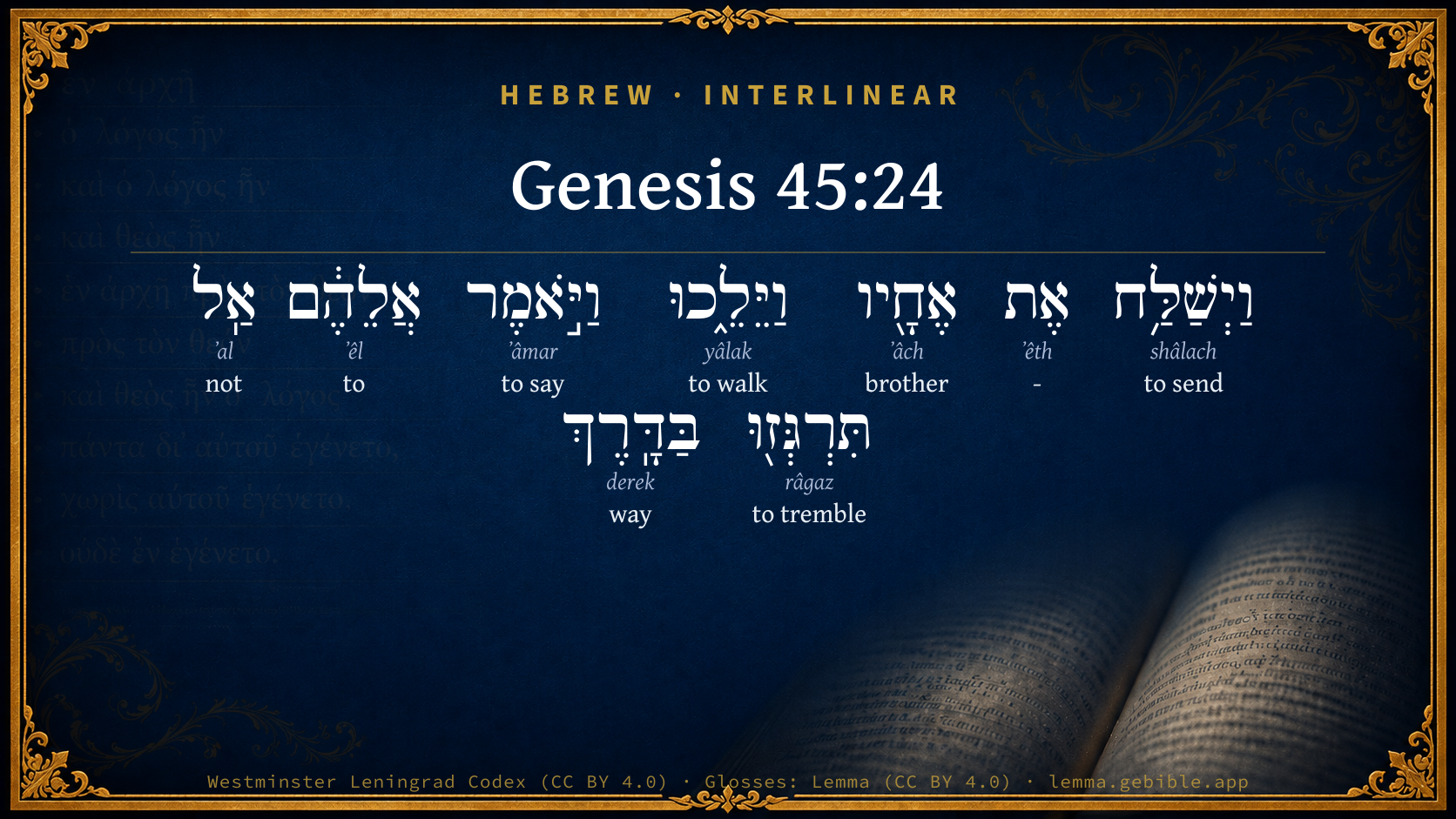
Hebrew (Westminster Leningrad Codex) Genesis 45:24 appears in the Hebrew Old Testament. The text above is from the Westminster Leningrad Codex. Each word links to its Strong’s number, a concise gloss, and parsing drawn from the Open Scriptures Hebrew Bible morphology. Click any word for its full Brown-Driver-Briggs (BDB) entry.
Download image
Cite this verse

Genesis 45:24 (World English Bible). Public Domain. Lemma interlinear Bible study tool, https://lemma.gebible.app/v/genesis/45/24.

Show BibTeX & RIS
BibTeX
RIS
English Translation
So he sent his brothers away, and they departed. He said to them, "See that you don't quarrel on the way."
World English Bible · Public Domain
Highlights
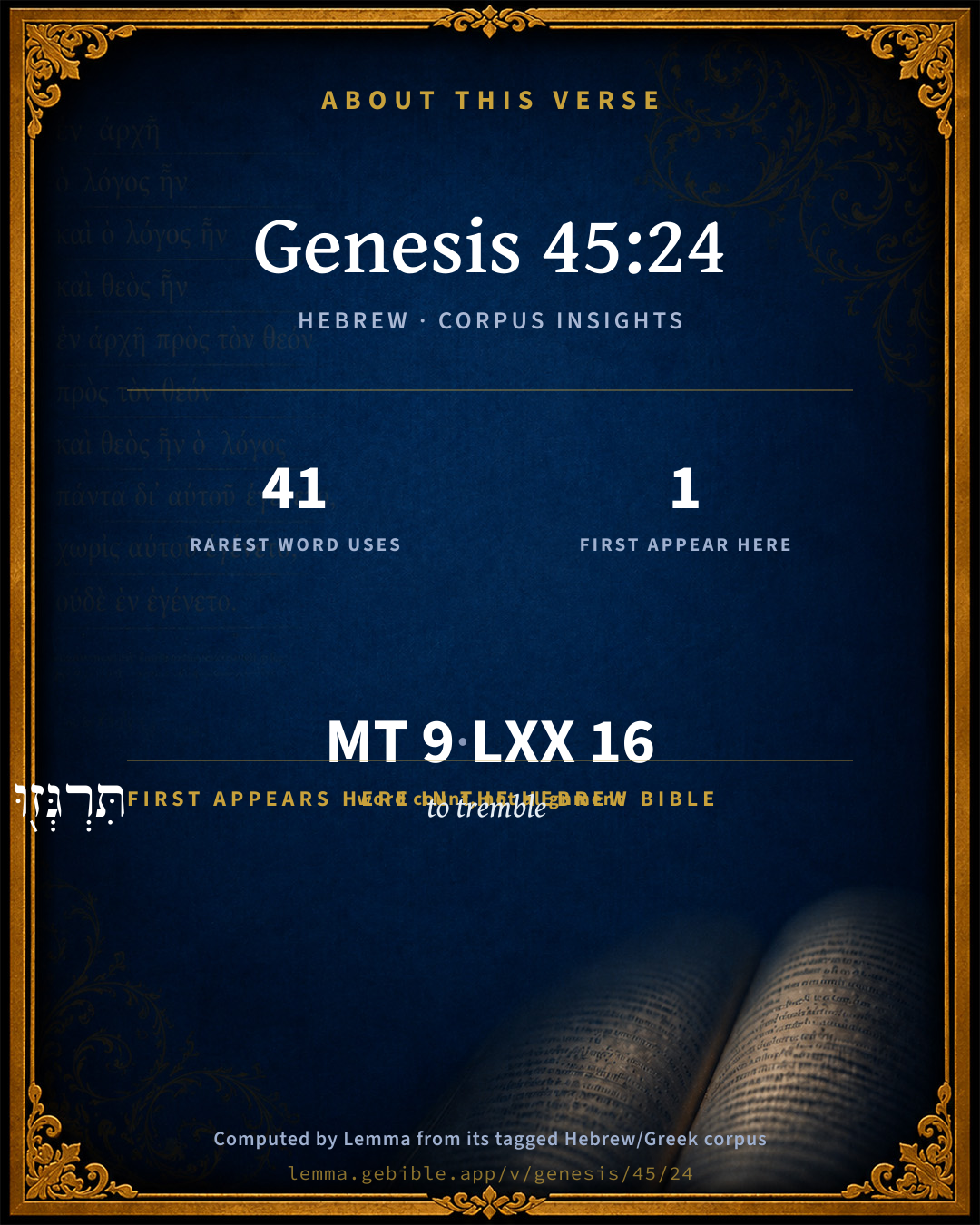
  • 1 first appearance in the Hebrew Bible
Full analysis ↓
Download a study sheet

One document with this verse’s original text, its word-by-word gloss line, the meaning frame, cross-references with their text, attributed commentary, and full source and license credits — printable, and it pastes into notes with its structure intact.

This verse Autodidact and up

Study sheet (.html) Plain text (.txt)

A passage Seminary Student

Up to 50 verses in one chapter. A passage sheet keeps up to 6 commentary sources and 12 cross-references per verse, in the order this page ranks them, and says so on the sheet whenever that leaves anything out. Ask for a single verse and you get the Autodidact verse sheet above.

Everything on this page stays free to read, with no account — the sheet is a download of what is already on screen, not access to it.

Want to remove ads? Support Godless Engineer
Compare translations 3

The same verse in 3 English versions, stacked beneath the original-language interlinear above. Click any original word for its lexicon entry.

Each is an independent rendering of the whole verse — the interlinear is not word-aligned to these translations.

Highlighted words mark where these versions differ — a whole-verse word diff, not a word-by-word alignment.

  • World English Bible Public Domain
    So he sent his brothers away, and they departed. He said to them, "See that you don't quarrel on the way."
  • King James Version Public Domain
    So he sent his brethren away, and they departed: and he said unto them, See that ye fall not out by the way.
  • unfoldingWord Literal Text CC BY-SA 4.0
    Then he sent his brothers, and they left, then he said to them, “Do not quarrel on the road.”

unfoldingWord Literal Text — © unfoldingWord, licensed CC BY-SA 4.0. Word-aligned USFM3 via Door43 (git.door43.org/unfoldingWord/en_ult).

Versions to compare (up to 4)

3 of 4 selected

Show all 18 translations

Every available English version of this verse, each an independent rendering of the whole verse.

  • World English Bible Public Domain
    So he sent his brothers away, and they departed. He said to them, "See that you don't quarrel on the way."
  • Berean Standard Bible Public Domain
    Then Joseph sent his brothers on their way, and as they were leaving, he said to them, “Do not quarrel on the way!”
  • Majority Standard Bible Public Domain
    Then Joseph sent his brothers on their way, and as they were leaving, he said to them, “Do not quarrel on the way!”
  • King James Version Public Domain
    So he sent his brethren away, and they departed: and he said unto them, See that ye fall not out by the way.
  • American Standard Version (1901) Public Domain
    So he sent his brethren away, and they departed: and he said unto them, See that ye fall not out by the way.
  • Revised Version (1885) Public Domain
    So he sent his brethren away, and they departed: and he said unto them, See that ye fall not out by the way.
  • Geneva Bible (1599) Public Domain
    So sent he his brethren away, and they departed: and he sayde vnto them, Fall not out by the way.
  • Douay-Rheims (1899) Public Domain
    So he sent away his brethren, and at their departing said to them: Be not angry in the way.
  • Young's Literal Translation Public Domain
    And he sendeth his brethren away, and they go; and he saith unto them, `Be not angry in the way.'
  • Literal Standard Version CC BY-SA 4.0
    And he sends his brothers away, and they go; and he says to them, “Do not be angry in the way.”
  • Unlocked Literal Bible CC BY-SA 4.0
    So he sent his brothers away and they left. He said to them, “See that you do not quarrel on the journey.”
  • unfoldingWord Literal Text CC BY-SA 4.0
    Then he sent his brothers, and they left, then he said to them, “Do not quarrel on the road.”
  • Darby Bible Public Domain
    And he sent his brethren away, and they departed. And he said to them, Do not quarrel on the way.
  • World Messianic Bible Public Domain
    So he sent his brothers away, and they departed. He said to them, “See that you don’t quarrel on the way.”
  • Webster's Bible Public Domain
    So he sent his brethren away, and they departed: and he said to them, See that ye contend not by the way.
  • Free Bible Version CC BY-SA 4.0
    Then he saw his brothers off, and as they left he told them, “Don't argue on the way!”
  • Bible in Basic English Public Domain
    And he sent his brothers on their way, and said to them, See that you have no argument on the road.
  • JPS Tanakh (1917) Public Domain
    So he sent his brethren away, and they departed; and he said unto them: 'See that ye fall not out by the way.'

Literal Standard Version (2020), Covenant Press — licensed CC BY-SA 4.0. Text via the HelloAO Bible API (eBible.org). Unlocked Literal Bible (unfoldingWord) — licensed CC BY-SA 4.0. Text via the HelloAO Bible API (eBible.org). unfoldingWord Literal Text — © unfoldingWord, licensed CC BY-SA 4.0. Word-aligned USFM3 via Door43 (git.door43.org/unfoldingWord/en_ult). Free Bible Version, Dr. Jonathan Gallagher — licensed CC BY-SA 4.0. Text via the HelloAO Bible API (eBible.org).

Word by word

More ways to search: Search by grammar → Find every occurrence → Compare this word →

Practice this passage: Drill this verse → Learn its vocabulary →

תִּרְגְּז֖וּ
râgaz
H7264
“to tremble”
Verb, Qal, Jussive, 2nd Person, Masculine, Plural
Part of Speech
Verb
Stem
Qal
Form
Jussive
Person
2nd Person
Gender
Masculine
Number
Plural
Full BDB Definition

Origin: a primitive root

TWOT: 2112

tremble, quake, rage, quiver, be agitated, be excited, be perturbed - (Qal) to quake, be disquieted, be excited, be perturbed - (Hiphil) to cause to quake, disquiet, enrage, disturb - (Hithpael) to excite oneself
  1. וַיְשַׁלַּ֥ח shâlach H7971 “and · to send” Conjunction + Verb, Piel, Sequential Imperfect, 3rd Person, Masculine, Singular
  2. אֶת ʼêth H853 “-” Particle, Direct Object
  3. אֶחָ֖יו ʼâch H251 “brothers · his” Noun, Common, Masculine, Plural, Construct + Suffix, Personal, 3rd Person, Masculine, Singular
  4. וַיֵּלֵ֑כוּ yâlak H3212 “and · to walk” Conjunction + Verb, Qal, Sequential Imperfect, 3rd Person, Masculine, Plural
  5. וַיֹּ֣אמֶר ʼâmar H559 “and · to say” Conjunction + Verb, Qal, Sequential Imperfect, 3rd Person, Masculine, Singular
  6. אֲלֵהֶ֔ם ʼêl H413 “to · them” Preposition + Suffix, Personal, 3rd Person, Masculine, Plural
  7. אַֽל ʼal H408 “not” Particle, Negative
  8. בַּדָּֽרֶךְ derek H1870 “in/at the · way” Preposition, Determined + Noun, Common, Both, Singular, Absolute

About this verse

These counts appear in no published source. They are computed here, from the morphology-tagged text and Lemma’s own curated glosses. What Lemma adds →

9
words
9
distinct lemmas
Pentateuch
section

First appearance in Scripture

This word makes its first canonical appearance in the Hebrew Bible here:

  • תִּרְגְּז֖וּ to tremble H7264

Shared distinctive vocabulary

תִּרְגְּז֖וּ to tremble H7264 occurs in 40 verses of the Hebrew Bible. Also found in:

Grammatical profile

  • 4 verbs
  • 2 nouns
  • 1 preposition
  • 2 particles

Verb forms

  • וַיְשַׁלַּ֥ח Piel · Sequential Imperfect
  • וַיֵּלֵ֑כוּ Qal · Sequential Imperfect
  • וַיֹּ֣אמֶר Qal · Sequential Imperfect
  • תִּרְגְּז֖וּ Qal · Jussive

Hebrew & Septuagint length

In English translation the verse runs 21 words from the Hebrew and 20 from the Septuagint (LXX English) — closely comparable.

A rough comparison of the two English renderings, which tokenize alike — not a word-level alignment.

Word counts can differ between the Hebrew and the Greek without any difference in meaning — e.g. the Hebrew direct-object marker אֵת has no separate Greek word, and Greek often adds the article ὁ.

In the original languages it is 9 Hebrew tokens and 16 Greek tokens — but the two are counted differently (Hebrew bundles its prefixes and suffixes into one token; the Greek is in lemma form), so that isn’t a like-for-like length.

Cross-references

8

Topical passages linked to Genesis 45:24 in the Treasury of Scripture Knowledge — connected by theme and wording, ordered by reader-vote popularity; previews shown in the World English Bible.

  • 1 Thessalonians 5:13 and to respect and honor them in love for their work's sake. Be at peace among yourselves.
  • Genesis 42:21–22 They said one to another, "We are most assuredly guilty concerning our brother, in that we saw the distress of his soul, when he begged us, and we wouldn't listen. Therefore this distress has come on us."
  • Psalms 133:1–3 See how good and how pleasant it is For brothers to live together in unity!
  • John 13:34–35 A new commandment I give to you, that you love one another, just like I have loved you; that you also love one another.
  • Ephesians 4:31–32 Let all bitterness, wrath, anger, outcry, and slander, be put away from you, with all malice.
  • Philippians 2:2–5 make my joy full, by being like-minded, having the same love, being of one accord, of one mind;
  • Colossians 3:12–13 Put on therefore, as God's chosen ones, holy and beloved, a heart of compassion, kindness, lowliness, humility, and perseverance;
  • Genesis 37:22 Reuben said to them, "Shed no blood. Throw him into this pit that is in the wilderness, but lay no hand on him"-- that he might deliver him out of their hand, to restore him to his father.

Cross-references courtesy of OpenBible.info (CC BY 4.0).

Hebrew and Greek witnesses Masoretic Hebrew ↔ Greek Septuagint

The same verse in the two great witnesses to the Old Testament, shown verse-for-verse.

These are two independent witnesses, not word-aligned to each other, and the Septuagint is shown in lemma (dictionary) form.

Hebrew Genesis 45:24 Masoretic · Westminster Leningrad Codex

וַיְשַׁלַּ֥ח אֶת אֶחָ֖יו וַיֵּלֵ֑כוּ וַיֹּ֣אמֶר אֲלֵהֶ֔ם אַֽל תִּרְגְּז֖וּ בַּדָּֽרֶךְ

So he sent his brothers away, and they departed. He said to them, "See that you don't quarrel on the way."

World English Bible · Public Domain

Greek LXX Genesis 45:24 Septuagint · lemma form

ἐκ ἀποστέλλω δέ ὁ ἀδελφός αὐτός καί πορεύομαι καί εἶπον αὐτός μή ὀργίζω ἐν ὁ ὁδός

And he sent away his brethren, and they went; and he said to them, Be not angry by the way.

LXX2012 (modern English Septuagint) · Public Domain

On this verse, The Cambridge Bible for Schools and Colleges discusses the Septuagint’s reading. Read the note in Commentary ↓

Hebrew: Westminster Leningrad Codex (CC BY 4.0). Greek: Septuagint (public domain); English from LXX2012 (modern English Septuagint) (Public Domain). How the Septuagint differs from the Hebrew →

Targum (Aramaic paraphrase)

2

The Targum is the ancient Jewish Aramaic paraphrase of the Hebrew Scriptures — an interpretive translation, not the Hebrew text itself. Onkelos (literal) and Pseudo-Jonathan (expansive) render the Torah, and Jonathan the Prophets. Coverage is partial: where no permissively-licensed English translation exists for a verse, only the Aramaic is shown. This is verse-level text, not a word-by-word alignment to the Hebrew.

  1. Targum Onkelos Torah (Genesis–Deuteronomy)
    וְשַׁלַּח יָת אֲחוֹהִי וַאֲזָלוּ וַאֲמַר לְהוֹן לָא תִתְנַצוּן בְּאָרְחָא

    (no public-domain English translation for this verse)

    Targum Onkelos — Aramaic: “Onkelos Genesis” (public domain); “Onkelos Exodus” (public domain); “Onkelos Leviticus” (public domain); “Onkelos Numbers” (public domain); “Onkelos Deuteronomy” (public domain). English: “Sefaria Community Translation” (CC0 1.0 (public-domain dedication)); “J.W. Etheridge. The Targums of Onkelos and Jonathan Ben Uzziel on the Pentateuch. London: Longmans, Green, 1862” (public domain). Text via Sefaria.

  2. Targum Pseudo-Jonathan Torah (Genesis–Deuteronomy)
    וְשָׁדַר יַת אָחוֹי וְעַיְילוּ וַאֲמַר לְהוֹם לָא תִתְנְצוּן עַל עֵיסַק זַבִּנְתִּי דִלְמָא יִרְגְזוּן בְּכוֹן עָבְרֵי אוֹרְחָא

    And he dismissed his brothers to go, and said to them, Do not contend about my having been sold, lest you quarrel in passing along the way.

    Targum Pseudo-Jonathan — Aramaic: “Targum Jonathan on Genesis” (public domain); “Targum Jonathan on Exodus” (public domain); “Targum Jonathan on Leviticus” (public domain); “Targum Jonathan on Numbers” (public domain); “Targum Jonathan on Deuteronomy” (public domain). English: “The Targum of Jonathan ben Uzziel, trans. J. W. Etheridge, London, 1862” (public domain). Text via Sefaria.

Commentary

Notes on Genesis 45:24 from classic Christian and Jewish commentators (each source and its license shown beneath its notes). The classic Christian expositions comment on the surrounding passage and are grouped to its opening verse, so a note may address several verses; the Jewish commentaries on the Tanakh (Rashi and others) are per-verse, so they appear only where the commentator wrote on this verse.

Lemma curates 59 commentaries, every one of them public domain or Creative Commons licensed, each selected and text-cleaned for this edition rather than reprinted as found. About our sources →

Trapp's Complete Commentary

John Trapp

Gen 45:24 So he sent his brethren away, and they departed: and he said unto them, See that ye fall not out by the way.

Ver. 24. Fall not out by the way.] Such a charge layeth Christ upon all his, to love one another, and to "keep the unity of the Spirit in the bond of peace." Si collidimur, frangimur; If we clash, we are broken; according to the old fable of the two earthen pots swimming in the sea. The daughter of dissension is dissolution, said Nazianzen. And every subdivision in point of religion is a strong weapon in the hand of the contrary party, as he upon the Council of Trent wisely observed. {a} Castor and Pollux, if they appear not together, it presages a storm.

{a} Hist. of Coun. of Trent, fol. 49.

John Trapp, A Commentary or Exposition upon All the Books of the Old and New Testament (1647–1656) — public domain. Text from a community e-Sword module.

The Biblical Illustrator

Joseph S. Exell

Gen_45:24

See that ye fall not out by the way

Good advice to Christians

I.

THE RELATIONSHIP OF CHRISTIANS. They are brethren.

II. THE COURSE OF CHRISTIANS. On their way from Egypt to Canaan, from house of bondage to Fathers house above.

III. THE DANGER OF CHRISTIANS. Falling out by the way--disagreeing, quarrelling, separating.

IV. THE DUTY OF CHRISTIANS. To watch against this danger. Why?

1. Because brethren.

2. Because travelling to a place where there is no falling out.

3. Because you cant fall out without falling down--lowering Christian character.

4. Because you cant fall out without disobeying your Father, who tells you to love one another.

5. Because you cant fall out without giving your enemies occasion to triumph. Fall out with yourselves, and with Satan, but not with one another. (J. F. Smythe.)

Christians walking harmoniously on the road of life

They whom Joseph thus addressed were all--

I. MEMBERS OF THE SAME FAMILY. Brethren: the relations Christians bear to each other (1Pe_3:6; Rom_12:10; Heb_13:1).

II. PARTAKERS OF THE SAME GRACE. Forgiven ourselves, we are to be forgiving.

III. ASSOCIATES IN THE SAME SERVICE. Concerted action is required of us.

IV. TRAVELLING TO THE SAME HOME. (J. F. Poulter, B. A.)

Christian agreement

Well would this text apply to that quarrelling among nations, which under the name of war has been thought honourable and often profitable, whereas it must ever be in the end most ruinous and disgraceful to the whole family of mankind. See then that in this respect ye fall not out by the way. See that you never be tempted, by any supposed honour or profit of war, to speak of it as desirable, or to wish for it in your hearts. Well would this text in like manner apply to natives of the same country, members of the same political community; and to the tumult, and strife, which of late years more especially have distracted the peace of society. Well does this rule apply also to those who esteem themselves members of the same household of faith. What can be more scandalous in the eyes of the scoffer, what can be more inconsistent with true piety in ourselves, than that all we, who would fain hope that we are going to the same heaven, and going by the same road of true faith in Christ, should embitter our few and evil days on earth by religious, or rather irreligious, contentions with each other. I might go on to apply the text to the variances and disputes, which arise often to mar the peace of a neighbourhood, the harmony of a parish, or the union of a charitable or friendly society. I speak to you of your brethren and sisters, of your parents or children, of your masters or servants, of your husbands or wives. And of these severally, whatever members you may each have, in the household to which you belong, of these severally I say, See that ye fall not out by the way.

1. Be humble. The more you are aware of your own failings, the more allowances you will make for those you live with. The less you will be disposed to fret at their selfishness and pride, the more heartily you are vexed at your own.

2. Be not selfish. Next to pride, if it be not the very same thing, stands selfishness, as the fruitful source of ill-temper. Look not, then, every man on his own things, but every man also on the things of others Php_2:4).

3. Set in watch over your lips. And when an angry thought arises, for a while be resolutely silent. Words are to anger, as air to kindle flame. Without them it soon dies for want of vent.

4. Avoid whatever you have found to be your usual provocations to anger.

5. Take, then, in the last place, this one direction more, Overcome evil with good. A soft answer turneth away wrath. (E. Blencowe, M. A.)

Josephs charge to his brethren

Prevention is better than cure. Better keep out of debt than let someone pay your bills; better for a family to take care that all causes of difference and disagreement should be removed, than to be constantly making up quarrels. Joseph then would say, See that ye fall not out by the way--

1. Because ye are brethren.

2. Because ye are passing through an enemys country.

3. Because ye are the bearers of precious treasure.

4. Because ye are representative men. All these thoughts will apply to the Church of Christ. (A. F. Barfield.)

See that ye fall not out by the way!--a necessary warning

How well he knew human nature! They were going home with news which would reveal to their father that they had been the cause of their brothers disappearance, and had imposed on him with a deliberate falsehood; and for anything they knew, he might turn upon them and upbraid them with their cruelty and deceit. What so likely, therefore, as that they should begin to accuse each other--that crimination should lead to recrimination, and words to blows? Reuben might say again, It was not my fault, for I sought to save his life, and I went back to the pit hoping to find him and restore him to our father. Judah might respond, But for me he would have died, and it is to my happy suggestion to sell him to the Ishmaelites that we are indebted for all the good fortune that seems now to be coming to us; while the rest, conscious of their share in the nefarious transaction, might have sought to still the upbraidings of their consciences by uttering bitter things against each other. All that might have happened on their journey home, and so Joseph was not giving unnecessary counsel when he said, See that ye fall not out by the way. And they heeded his advice, for they reached home in peace; and it may be that, so far from quarrelling, they spent some of their time as they rode in conversing on the marvellous manner in which, in spite of their antagonism, and without their consciousness of anything in the least degree out of the way, the dreams of their brother had been fulfilled, and they had done obeisance at his feet. (W. M. Taylor, D. D.)

Luthers prayer

Controversy may be sometimes needful; but the love of disputation is a serious evil. Luther, who contended earnestly for the truth, used to pray: From a vainglorious doctor, a contentious pastor, and nice questions, the Lord deliver His Church!

Melancthon and his mother

Philip Melancthon, being at the conferences at Spire, in 1529, made a little journey to Bretten, to see his mother. This good woman asked him what she must believe amidst so many disputes, and repeated to him her prayers, which contained nothing superstitious. Go on, mother, said he, to believe and pray as you have done, and never trouble yourself about religious controversies.

Fraternal affection

Fraternal affection approaches very nearly to self-love, for there is but a short remove from our own concerns and happiness to theirs who came from the same stock, and are partakers of the same blood. Nothing, therefore, can be more unnatural than discord and animosity among members so allied, and nothing so beautiful as harmony and love. (L. N. Stretch.)

Church contention

When Caesar solicited the consulship he found Crassus and Pompey at variance, so that he could not apply to either of them for help, lest he should make the other his enemy. He determined to reconcile them by representing that if instead of fighting against each other, and thus raising enemies that might be formidable against them both, they would act in concert, by their united counsels and interest they might subdue all opposition. The scheme was successful, and Caesar by their help attained a pinnacle of power; and though neither Crassus nor Pompey gained any particular advantage by the league, if they had but used their united power wisely they might have affected great good. He who can bind together those who are at variance may procure for the state or for the Church a marvellous blessing. Never is a foe so ready to advance as when he sees those who should be one to attack him wounding and slaying each other. The battle of the sects has not only provoked ill blood in the Church of Christ, but has weakened her for offensive movements, because when she ought to have been increasing her armaments and completing her equipments for an aggression on the enemys territory, she has rather been engaged in quarrelling over some trivial point of doctrine, or perhaps some piece of church furniture, to her own dishonour and the enemys triumph. (New Handbook of Illustration.)

Trivial dissensions

Dr. Cannon was once appealed to by a certain church where there was a great commotion in regard to the point, whether in newly painting their church edifice the colour should be white or yellow. When the committee had stated their case, and with an emphasis, not to say acrimony, which gave sad proof of the existence of a fearful feud upon the unimportant question, the doctor quietly said, I should advise you, on the whole, to paint the house black. It is cheap, and a good colour to wear, and eminently appropriate for a body that ought to go in mourning over such a foolish quarrel among its members. (Homiletic Encylopoedia.)

The Biblical Illustrator, edited by Joseph S. Exell (c. 1880s–1900s) — public domain. Text from a community e-Sword module.

Joseph Benson's Commentary

Gen 45:24. See that ye fall not out by the way — He knew that they were but too apt to be quarrelsome; and that what had lately passed, as it revived the remembrance of what they had done formerly against their brother, might give them occasion to quarrel. Now Joseph, having forgiven them all, lays this obligation upon them, not to upbraid one another. This charge our Lord Jesus has given to us, that we love one another, that we live in peace, that whatever occurs, or whatever former occurrences are remembered, we fall not out. For, 1st, We are brethren; we have all one Father. 2d, We are his brethren; and we shame our relation to him, who is our peace, if we fall out. 3d, We are all guilty, verily guilty, and, instead of quarrelling with one another, have a great deal of reason to fall out with ourselves. 4th, We are forgiven of God, whom we have all offended, and therefore should be ready to forgive one another. 5th, We are by the way, a way that lies through the land of Egypt, where we have many eyes upon us, that seek occasion and advantage against us; a way that leads to Canaan, where we hope to be for ever in perfect peace.

Joseph Benson's Commentary on the Old and New Testaments (1811–1818) — public domain. Text from a community e-Sword module.

Tyndale Open Study Notes

Tyndale Open Resources

45:24 Don’t quarrel about all this along the way! When they were away from Joseph, they might begin to accuse one another about the past or argue about how to explain what had happened to Jacob. It was now time to put the past behind them and enjoy the reunion.

Tyndale Open Study Notes — © Tyndale Open Resources, licensed CC BY-SA 4.0. Text via the HelloAO Bible API.

Geneva Bible (1599)

Geneva Bible translators

Seeing he had remitted the fault done toward him, he would not that they should accuse one another.

Geneva Bible (1599) marginal notes — public domain. Text via Bolls.life.

Jamieson, Fausset & Brown

Robert Jamieson, A. R. Fausset & David Brown

so he sent his brethren away--In dismissing them on their homeward journey, he gave them this particular admonition:

See that ye fall not out by the way--a caution that would be greatly needed; for not only during the journey would they be occupied in recalling the parts they had respectively acted in the events that led to Joseph's being sold into Egypt, but their wickedness would soon have to come to the knowledge of their venerable father.

Next: Genesis Chapter 46

Jamieson, Fausset & Brown — Commentary Critical and Explanatory on the Whole Bible (1871) — public domain (CC PDM 1.0). Text via the HelloAO Bible API.

Adam Clarke's Commentary

Verse 24. See that ye fall not out by the way.] This prudent caution was given by Joseph, to prevent his brethren from accusing each other for having sold him; and to prevent them from envying Benjamin, for the superior favour shown him by his brother. It is strange, but so it is, that children of the same parents are apt to envy each other, fall out, and contend; and therefore the exhortation in this verse must be always seasonable in a large family. But a rational, religious education will, under God, prevent every thing of this sort.

Adam Clarke's Commentary on the Bible (1810–1826) — public domain. Text from a community e-Sword/MySword module.

John Calvin's Commentaries

24. See that ye fall not out by the way. Some explain the passage as meaning, that Joseph asks his brethren to be of tranquil mind, and not to disturb themselves with needless fear; he rather exhorts them, however, to mutual peace. For, since the word רגז (ragaz) sometimes signifies to tremble or be afraid, and sometimes, to make a tumult, the latter sense is the more appropriate: for we know that the children of God are not only easily appeased, if any one has injured them, but that they also desire others should live together in concord. Joseph was pacified towards his brethren; but at the same time he admonishes them not to stir up any strife among themselves. For there was reason to fear lest each, in attempting to excuse himself, should try to lay the blame on others, and thus contention would arise. We ought to imitate this kindness of Joseph; that we may prevent, as much as possible, quarrels and strifes of words; for Christ requires of his disciples, not only that they should be lovers of peace, but also that they should be peace-makers. Wherefore, it is our duty to remove, in time, all matter and occasion of strife. Besides, we must know, that what Joseph taught his brethren, is the command of the Spirit of God to us all; namely, that we should not be angry with each other. And because it generally happens that, in faults common to different parties, one maliciously accuses another; let each of us learn to acknowledge and confess his own fault, lest altercations should end in combats.

John Calvin's Commentaries (1540-1563) — public domain. Text from the Calvin Translation Society English edition (1840s-50s) via the Christian Classics Ethereal Library (ccel.org). Calvin's coverage is partial (roughly two-thirds of the Bible); uncommented books and verses are honest gaps, never fabricated. The 19th-century editor's footnotes and remarks are omitted so the notes are faithfully Calvin's own voice.

Ellicott's Commentary for English Readers

(24) See that ye fall not out by the way.—Heb., do not get angry on the journey. Joseph feared that they might reproach one another for their treatment of him, and try to throw the blame on the one or two chiefly guilty, and that so quarrels might ensue. This is the meaning given to the passage in all the versions, and agrees with Joseph’s efforts to quiet their fears, and convince them of his good intentions. Several modern commentators, however, translate “Be not afraid of the journey,” but on insufficient grounds.

A Bible Commentary for English Readers, edited by Charles John Ellicott (1878–1897) — public domain. Text from a community e-Sword module.

The Cambridge Bible for Schools and Colleges

gen. ed. J. J. S. Perowne

24. See that ye fall not out] The precise meaning of Joseph’s parting words has sometimes been misunderstood. The Heb. word which he uses is not common. It occurs in Psa_4:4, “Stand in awe” (R.V. marg. be ye angry). So here LXX μὴ ὀργίζεσθε; Lat. ne irascamini. The meaning then will be, “do not get excited, quarrel not, and dispute not” with one another about the degree of your guilt in your treatment of me. Cf. Reuben’s reproaches in Gen_42:22. The suggestion that he warns them against being indignant at the especial favours and gifts lavished upon Benjamin is not probable. A different rendering, “be not alarmed,” in the sense of “do not give way to the fear that I am nursing my revenge and am meditating an outbreak of wrath against you at a later time,” is hardly warranted, either by the use of the verb or by the context. But see Gen_50:15-21.

The Cambridge Bible for Schools and Colleges (gen. ed. J. J. S. Perowne; Cambridge University Press, 1878–1918) — public domain. Text from a community e-Sword module.

John Gill's Exposition

So he sent his brethren away, and they departed,.... From Egypt to Canaan with the wagons, asses, and rich presents:

and he said unto them, see that ye fall not out by the way; the Targum of Jonathan adds, about the affair of selling me; which he had reason to fear they would, from what they, and particularly Reuben, had said in his presence, Gen 42:21; he was jealous this would be the subject of their discourse by the way, and that they would be blaming one another about it, and so fall into contentions and quarrels; that one would say it was owing to the reports of such an one concerning him, that they entertained hatred against him; that it was such an one that advised to kill him, and such an one that stripped him of his clothes, and such an one that put him into the pit, and such an one that was the cause of his being sold; and thus shifting of things from one to another, and aggravating each other's concern in this matter, they might stir up and provoke one another to wrath and anger, as the word used signifies, which might have a bad issue; to prevent which Joseph gives them this kind and good advice; and especially there was the more reason to attend to it, since he was reconciled unto them, and was desirous the whole should be buried in oblivion.

John Gill's Exposition of the Whole Bible (1746–1763) — public domain (CC PDM 1.0). Text via the HelloAO Bible API.

Haydock's Catholic Bible Commentary

Angry. A prudent admonition at all times, but particularly now, to Joseph’s brethren; lest reflecting on his excessive kindness, they should each wish to remove from themselves the stigma of cruelty towards him, by throwing it upon others. (Haydock) --- Hebrew may be rendered, "fear not." (Calmet)

George Leo Haydock (1774–1849), Haydock's Catholic Family Bible and Commentary, 1859 edition — public domain. Excludes Psalms (Douay-Rheims chapter numbering differs from Protestant) and Deuterocanonical books (Catholic canon only).

Matthew Poole's English Annotations

Or contend one with another, each vindicating himself, and laying the blame upon his brother.

Matthew Poole's English Annotations on the Holy Bible (1683–1685) — public domain. Text from a community e-Sword/MySword module.

Whedon's Commentary on the Bible

Daniel D. Whedon

24. See that ye fall not out by the way — “Do not accuse one another of guilt, and so fall into unbrotherly contention. It was natural that in talking over this strange history each should seek to clear himself of blame. Three several times Joseph tells them that God had overruled their sin for good to all the family, and tenderly endeavours to alleviate thus the sorrow of their repentance” — Newhall.

Daniel D. Whedon (gen. ed.), Commentary on the Old and New Testaments (1874–1909) — public domain. Text from a community e-Sword module.

The Pulpit Commentary

So (literally, and) he sent his brethren away, and they departed: and he said unto them, See that ye fall not out by the way. The verb gr signifies to be moved or disturbed with any violent emotion, but in particular with anger, Pro_29:9; Isa_28:21; cf. Sanser. rag, to move oneself, Gr. ojrgh anger, Lat. frango, Gerregen and is here generally understood as an admonition against quarrelling (LXX, mh orgizesqe; Vulgate, ne irascimini) (Calvin, Dathius, Rosenm Keil, Mur phy, Lange, Alford, et alii), although by others (Tuch, Baumgarten, Michaelis, Gesenius, Kalisch) it is regarded as a dissuasive against fear of any future plot on the part of Joseph.

The Pulpit Commentary (1880–1919), ed. H.D.M. Spence-Jones & Joseph S. Exell — public domain. Text from a community e-Sword module.

John Wesley's Explanatory Notes

See that ye fall not out by the way - He knew they were but too apt to be quarrelsome; and what had lately passed, which revived the remembrance of what they had done formerly against their brother, might give them occasion to quarrel. Now Joseph having forgiven them all, lays this obligation upon them, not to upbraid one another. This charge our Lord Jesus has given to us, that we love one another, that we live in peace, that whatever occurs, or whatever former occurrences are remembered, we fall not out. For,

1. We are brethren, we have all one father.

2. We are his brethren; and we shame, our relation to him, who is our peace, if we fall out.

3. We are all guilty, verily guilty, and instead of quarrelling with one another, have a great deal of reason to fall out with ourselves.

4. We are forgiven of God, whom we have all offended, and therefore should be ready to forgive one another.

5. We are by the way, a way that lies through the land of Egypt, where we have many eyes upon us, that seek occasion and advantage against us; a way that leads to Canaan, where we hope to be forever in perfect peace.

John Wesley, Explanatory Notes Upon the Whole Bible (1754–1765) — public domain. Text via the GEBible commentary corpus.

unfoldingWord translationNotes

Door43 World Missions Community

do not quarrel

Possible meanings include 1) "do not argue" and 2) "do not become afraid"

went up out of Egypt

It was common to use the word "up" when speaking of traveling from Egypt to Canaan.

he is ruler over all the land of Egypt

Here "land of Egypt" stands for the people of Egypt. AT: "he rules all the people of Egypt" (See: Metonymy)

His heart was astonished

Here "heart" stands for the whole person. AT: "and he was astonished" or "he was very surprised" (See: Synecdoche)

he could not believe what they told him

"he did not accept that what they said was true"

translationWords

Canaan

rule

heart

amazed

believe

unfoldingWord translationNotes — © Distant Shores Media and the Door43 World Missions Community, licensed CC BY-SA 4.0. Source: git.door43.org/Door43/en_tn.

Rashi

Rabbi Shlomo Yitzchaki (Rashi)

אל תרגזו בדרך BE NOT AGITATED BY THE WAY — Do not busy yourselves with Halachic discussions lest the road become unsteady for you (i.e. lest you lose your way). Another explanation is: Do not take very long steps and enter the town where you will stay over night while the sun is still shining (Taanit 10b). According to the plain sense of the verse, however, it must be explained thus: Because they felt ashamed he feared that they might quarrel on the way about his having been sold, arguing one with another. One would say: “It was through you he was sold”. Another: “It was you who made slanderous statements about him and caused us to hate him”.

Rashi on the Tanakh — English translations: “The Judaica Press complete Tanach with Rashi, translated by A. J. Rosenberg” (CC BY 4.0); “Pentateuch with Rashi's commentary by M. Rosenbaum and A.M. Silbermann, 1929-1934” (public domain); “The Metsudah Tanach series, Lakewood, N.J” (CC BY 4.0); and “The Book of Joshua, Metsudah Publications, 1997” (CC BY 4.0). Text via Sefaria.

Ramban (Nachmanides)

Rabbi Moshe ben Nachman (Ramban / Nachmanides)

DO NOT ‘TIRG’ZU’ BY THE WAY. Rogez is an expression of trembling and movement, and is usually applied when the trembling is a result of fear, as for example, a heart ‘ragaz’ (that is trembling); ‘V’ragzu’ (and they shall tremble), and be in anguish;, 2:25. And where I stand ‘ergaz’ (I tremble); And drink thy water ‘b’ragzah’ (with trembling) and with anxiety. Therefore, the correct interpretation of this verse is, in my opinion, that Joseph said to them, “Do not fear by the way,” and the purport thereof is that since they were carrying corn and bread and sustenance and the best of Egypt in the days of the famine, they might fear lest robbers attack them while they travelled on their journey to Canaan, and the moreso when they return to Egypt with all their possessions, and thus they will not hasten the matter. Therefore he told them that they should go quickly and hurry to come there, as it is said, Hasten ye, and go up to my father, and they should have no fear at all on the way as his name is upon them. Since he is the ruler of the entire land of Egypt, and the lives of the peoples of those countries are in his hand, and all are fearful of his awe, they will travel and arrive in peace.

Ramban (Nachmanides) on the Tanakh — English translation: “Commentary on the Torah by Ramban (Nachmanides). Translated and annotated by Charles B. Chavel. New York, Shilo Pub. House, 1971-1976” (CC BY 4.0). Text via Sefaria.

Radak

Rabbi David Kimhi (Radak)

אל תרגזו בדרך, do not quarrel with one another on the journey concerning your having sold me, blaming each other for the decision taken at the time.

Radak on the Tanakh — English translations: “Sefaria Community Translation” (CC0 1.0 (public-domain dedication)); “Eliyahu Munk, HaChut Hameshulash” (CC BY 4.0); “Rabbi Mike Feuer, Jerusalem Anthology” (CC BY 4.0); and “R. David Kimhi on the first book of Psalms, Translated by R.G. Finch, London, 1919” (public domain). Text via Sefaria.

Lesson kit

Teaching starters — assembled from the data on this page, not authored interpretation. Every prompt links to the verse data it draws on. Edit before teaching.

Genesis, in the Pentateuch, opens this verse with 9 words (9 distinct Hebrew lemmas). Its most distinctive word is râgaz (“to tremble”). A historical commentator’s framing appears above. Read the whole chapter for the surrounding context.

Discussion questions

  1. How does “to tremble” (râgaz) shape what this verse is saying?
  2. This is the first place “to tremble” appears in Scripture (first appears here). What does its debut here establish?
  3. How does Exodus 15:14, which shares the word «to tremble», read alongside this verse?
  4. These translations render this verse differently. What is at stake in choosing one wording over another?
  5. «וַיְשַׁלַּ֥ח» is a Piel Sequential Imperfect verb. How does that grammatical form shape the action described?
  6. Compare how Trapp's Complete Commentary and The Biblical Illustrator read this verse. Where do they agree or differ?

Things to notice

Reading settings

Reading text

Shown beneath each verse's original-language words.

Old Testament
Old Testament edition

Read the OT as the Masoretic Hebrew (MT) or the Greek Septuagint (LXX).

English shown for the Greek Septuagint (in the Hebrew ↔ Greek comparison).

Comparing translations? Open the Compare panel on any verse page to stack up to four side by side.