
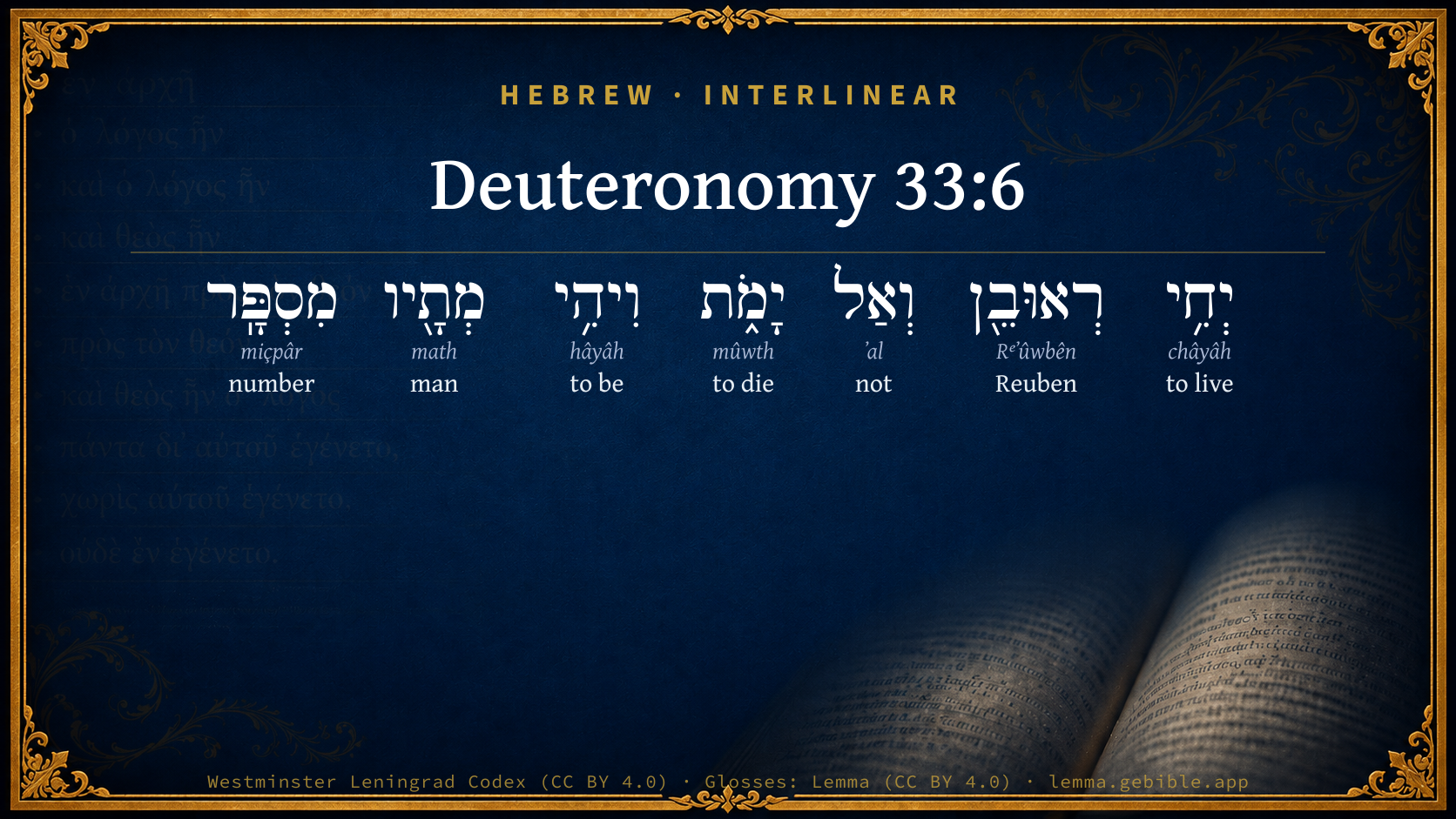
Deuteronomy 33:6

Hebrew (Westminster Leningrad Codex) Deuteronomy 33:6 appears in the Hebrew Old Testament. The text above is from the Westminster Leningrad Codex. Each word links to its Strong’s number, a concise gloss, and parsing drawn from the Open Scriptures Hebrew Bible morphology. Click any word for its full Brown-Driver-Briggs (BDB) entry.
Download image
Cite this verse

Deuteronomy 33:6 (World English Bible). Public Domain. Lemma interlinear Bible study tool, https://lemma.gebible.app/v/deuteronomy/33/6.

Show BibTeX & RIS
BibTeX
RIS
English Translation
Let Reuben live, and not die; Nor let his men be few.
World English Bible · Public Domain
Download a study sheet

One document with this verse’s original text, its word-by-word gloss line, the meaning frame, cross-references with their text, attributed commentary, and full source and license credits — printable, and it pastes into notes with its structure intact.

This verse Autodidact and up

Study sheet (.html) Plain text (.txt)

A passage Seminary Student

Up to 50 verses in one chapter. A passage sheet keeps up to 6 commentary sources and 12 cross-references per verse, in the order this page ranks them, and says so on the sheet whenever that leaves anything out. Ask for a single verse and you get the Autodidact verse sheet above.

Everything on this page stays free to read, with no account — the sheet is a download of what is already on screen, not access to it.

Want to remove ads? Support Godless Engineer
Compare translations 3

The same verse in 3 English versions, stacked beneath the original-language interlinear above. Click any original word for its lexicon entry.

Each is an independent rendering of the whole verse — the interlinear is not word-aligned to these translations.

Highlighted words mark where these versions differ — a whole-verse word diff, not a word-by-word alignment.

  • World English Bible Public Domain
    Let Reuben live, and not die; Nor let his men be few.
  • King James Version Public Domain
    Let Reuben live, and not die; and let not his men be few.
  • unfoldingWord Literal Text CC BY-SA 4.0
    Let Reuben live and not die, but let his men be few.”

unfoldingWord Literal Text — © unfoldingWord, licensed CC BY-SA 4.0. Word-aligned USFM3 via Door43 (git.door43.org/unfoldingWord/en_ult).

Versions to compare (up to 4)

3 of 4 selected

Show all 18 translations

Every available English version of this verse, each an independent rendering of the whole verse.

  • World English Bible Public Domain
    Let Reuben live, and not die; Nor let his men be few.
  • Berean Standard Bible Public Domain
    Let Reuben live and not die, nor his men be few.”
  • Majority Standard Bible Public Domain
    Let Reuben live and not die, nor his men be few.”
  • King James Version Public Domain
    Let Reuben live, and not die; and let not his men be few.
  • American Standard Version (1901) Public Domain
    Let Reuben live, and not die; Nor let his men be few.
  • Revised Version (1885) Public Domain
    Let Reuben live, and not die; Yet let his men be few.
  • Geneva Bible (1599) Public Domain
    Let Reuben liue, and not die, though his men be a small nomber.
  • Douay-Rheims (1899) Public Domain
    Let Ruben live, and not die, and be he small in number.
  • Young's Literal Translation Public Domain
    Let Reuben live, and not die, And let his men be a number.
  • Literal Standard Version CC BY-SA 4.0
    Let Reuben live, and not die, || And let his men be an [incalculable] number.
  • Unlocked Literal Bible CC BY-SA 4.0
    Let Reuben live and not die, but may his men be few.
  • unfoldingWord Literal Text CC BY-SA 4.0
    Let Reuben live and not die, but let his men be few.”
  • Darby Bible Public Domain
    Let Reuben live, and not die; And let his men be few.
  • World Messianic Bible Public Domain
    “Let Reuben live, and not die; Nor let his men be few.”
  • Webster's Bible Public Domain
    Let Reuben live, and not die; and let not his men be few.
  • Free Bible Version CC BY-SA 4.0
    To Reuben he said, “May he live and not die, but may he only have a few men.”
  • Bible in Basic English Public Domain
    Let life not death be Reuben's, let not the number of his men be small.
  • JPS Tanakh (1917) Public Domain
    Let Reuben live, and not die in that his men become few.

Literal Standard Version (2020), Covenant Press — licensed CC BY-SA 4.0. Text via the HelloAO Bible API (eBible.org). Unlocked Literal Bible (unfoldingWord) — licensed CC BY-SA 4.0. Text via the HelloAO Bible API (eBible.org). unfoldingWord Literal Text — © unfoldingWord, licensed CC BY-SA 4.0. Word-aligned USFM3 via Door43 (git.door43.org/unfoldingWord/en_ult). Free Bible Version, Dr. Jonathan Gallagher — licensed CC BY-SA 4.0. Text via the HelloAO Bible API (eBible.org).

Word by word

More ways to search: Search by grammar → Find every occurrence → Compare this word →

Practice this passage: Drill this verse → Learn its vocabulary →

About this verse

These counts appear in no published source. They are computed here, from the morphology-tagged text and Lemma’s own curated glosses. What Lemma adds →

7
words
7
distinct lemmas
Pentateuch
section

Notable vocabulary

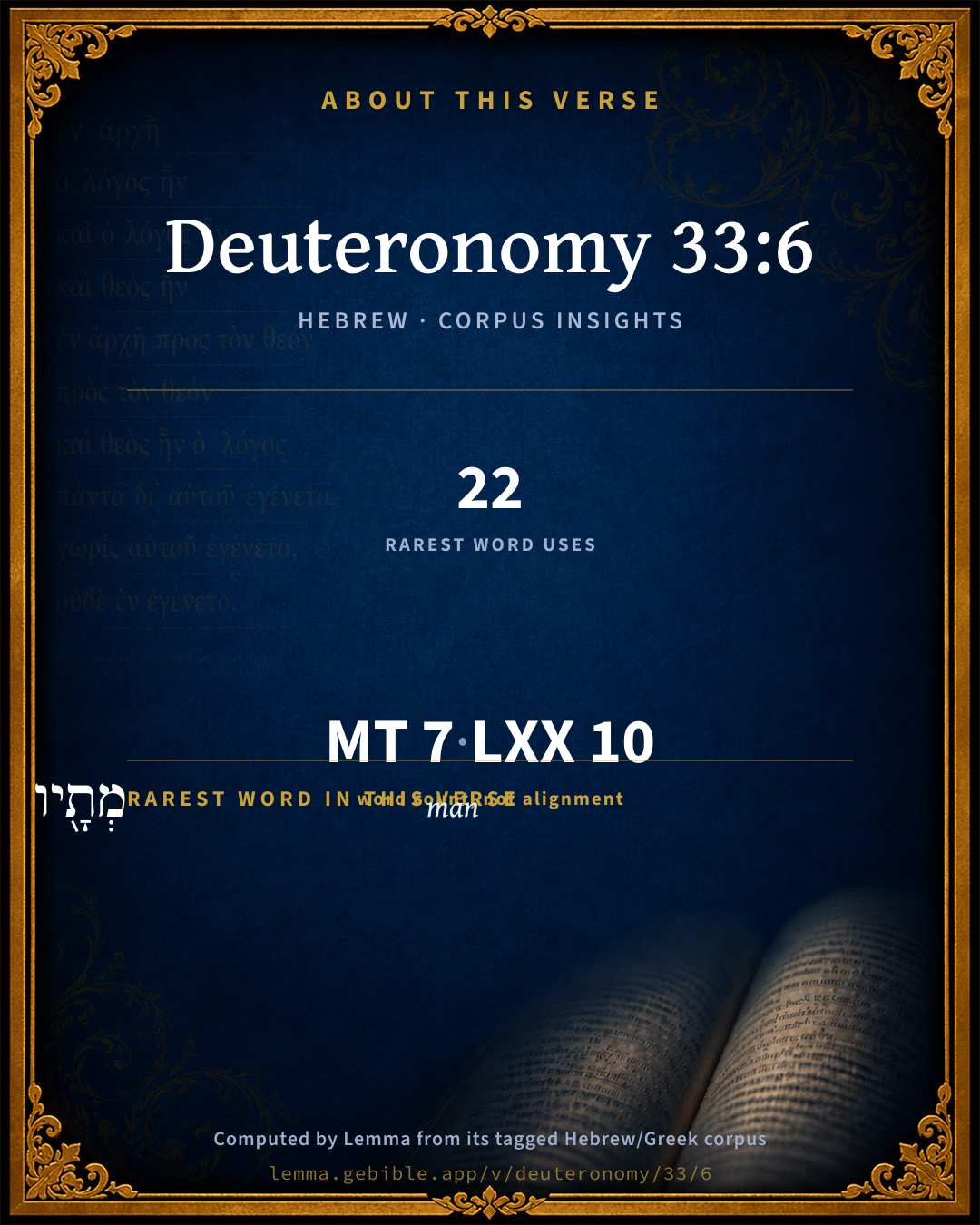
The rarest word here is מְתָ֖יו man H4962 — appearing just 22 times in the whole Hebrew Bible.

Shared distinctive vocabulary

מְתָ֖יו man H4962 occurs in 21 verses of the Hebrew Bible. Also found in:

Grammatical profile

  • 3 verbs
  • 3 nouns
  • 1 particle

Verb forms

  • יְחִ֥י Qal · Jussive
  • יָמֹ֑ת Qal · Jussive
  • וִיהִ֥י Qal · Jussive

Hebrew & Septuagint length

In English translation the verse runs 12 words from the Hebrew and 13 from the Septuagint (LXX English) — closely comparable.

A rough comparison of the two English renderings, which tokenize alike — not a word-level alignment.

Word counts can differ between the Hebrew and the Greek without any difference in meaning — e.g. the Hebrew direct-object marker אֵת has no separate Greek word, and Greek often adds the article ὁ.

In the original languages it is 7 Hebrew tokens and 10 Greek tokens — but the two are counted differently (Hebrew bundles its prefixes and suffixes into one token; the Greek is in lemma form), so that isn’t a like-for-like length.

Cross-references

4

Topical passages linked to Deuteronomy 33:6 in the Treasury of Scripture Knowledge — connected by theme and wording, ordered by reader-vote popularity; previews shown in the World English Bible.

  • Genesis 49:8 "Judah, your brothers will praise you: Your hand will be on the neck of your enemies; Your father's sons will bow down before you.
  • Numbers 32:31–32 The children of Gad and the children of Reuben answered, saying, As Yahweh has said to your servants, so will we do.
  • Joshua 22:1–9 Then Joshua called the Reubenites, and the Gadites, and the half-tribe of Manasseh,
  • Genesis 49:3–4 "Reuben, you are my firstborn, my might, and the beginning of my strength; The pre-eminence of dignity, and the pre-eminence of power.

Cross-references courtesy of OpenBible.info (CC BY 4.0).

Hebrew and Greek witnesses Masoretic Hebrew ↔ Greek Septuagint

The same verse in the two great witnesses to the Old Testament, shown verse-for-verse.

These are two independent witnesses, not word-aligned to each other, and the Septuagint is shown in lemma (dictionary) form.

Hebrew Deuteronomy 33:6 Masoretic · Westminster Leningrad Codex

יְחִ֥י רְאוּבֵ֖ן וְאַל יָמֹ֑ת וִיהִ֥י מְתָ֖יו מִסְפָּֽר

Let Reuben live, and not die; Nor let his men be few.

World English Bible · Public Domain

Greek LXX Deuteronomy 33:6 Septuagint · lemma form

ζάω ρουβην καί μή ἀποθνήσκω καί εἰμί πολύς ἐν ἀριθμός

Let Ruben live, and not die; and let him be many in number.

LXX2012 (modern English Septuagint) · Public Domain

On this verse, Matthew Henry's Commentary discusses the Septuagint’s reading. Read the note in Commentary ↓

Hebrew: Westminster Leningrad Codex (CC BY 4.0). Greek: Septuagint (public domain); English from LXX2012 (modern English Septuagint) (Public Domain). How the Septuagint differs from the Hebrew →

Targum (Aramaic paraphrase)

2

The Targum is the ancient Jewish Aramaic paraphrase of the Hebrew Scriptures — an interpretive translation, not the Hebrew text itself. Onkelos (literal) and Pseudo-Jonathan (expansive) render the Torah, and Jonathan the Prophets. Coverage is partial: where no permissively-licensed English translation exists for a verse, only the Aramaic is shown. This is verse-level text, not a word-by-word alignment to the Hebrew.

  1. Targum Onkelos Torah (Genesis–Deuteronomy)
    יְחִי רְאוּבֵן לְחַיֵי עַלְמָא וּמוֹתָא תִנְיָנָא לָא יְמוּת וִיקַבְּלוּן בְּנוֹהִי אַחֲסַנְתְּהוֹן בְּמִנְיָנְהוֹן

    (no public-domain English translation for this verse)

    Targum Onkelos — Aramaic: “Onkelos Genesis” (public domain); “Onkelos Exodus” (public domain); “Onkelos Leviticus” (public domain); “Onkelos Numbers” (public domain); “Onkelos Deuteronomy” (public domain). English: “Sefaria Community Translation” (CC0 1.0 (public-domain dedication)); “J.W. Etheridge. The Targums of Onkelos and Jonathan Ben Uzziel on the Pentateuch. London: Longmans, Green, 1862” (public domain). Text via Sefaria.

  2. Targum Pseudo-Jonathan Torah (Genesis–Deuteronomy)
    יֵיחֵי רְאוּבֵן בְּעַלְמָא הָדֵין וְלָא יֵימוּת בְּמִיתוּתָא דְמַיְיתִין בָּהּ רַשִׁיעַיָא לְעַלְמָא דְאָתֵי וִיהֵי עוּלֵימוֹי מִתְמַנְיָין עִם עוּלֵימֵיהוֹן דְאָחוֹי בֵּית יִשְרָאֵל

    Let Reuben live in this world, nor die the second death which the wicked die in the world to come; and let his youths be numbered with the young men of his brethren of Beth Israel.

    Targum Pseudo-Jonathan — Aramaic: “Targum Jonathan on Genesis” (public domain); “Targum Jonathan on Exodus” (public domain); “Targum Jonathan on Leviticus” (public domain); “Targum Jonathan on Numbers” (public domain); “Targum Jonathan on Deuteronomy” (public domain). English: “The Targum of Jonathan ben Uzziel, trans. J. W. Etheridge, London, 1862” (public domain). Text via Sefaria.

Commentary

Notes on Deuteronomy 33:6 from classic Christian and Jewish commentators (each source and its license shown beneath its notes). The classic Christian expositions comment on the surrounding passage and are grouped to its opening verse, so a note may address several verses; the Jewish commentaries on the Tanakh (Rashi and others) are per-verse, so they appear only where the commentator wrote on this verse.

Lemma curates 59 commentaries, every one of them public domain or Creative Commons licensed, each selected and text-cleaned for this edition rather than reprinted as found. About our sources →

Matthew Henry's Commentary

Here is, I. The blessing of Reuben. Though Reuben had lost the honour of his birthright, yet Moses begins with him; for we should not insult over those that are disgraced, nor desire to perpetuate marks of infamy upon any, though ever so justly fastened at first, Deu 33:6. Moses desires and foretels, 1. The preserving of this tribe. Though a frontier tribe on the other side Jordan, yet, "Let it live, and not be either ruined by its neighbours or lost among them." And perhaps he refers to those chosen men of that tribe who, having had their lot assigned them already, left their families in it, and were now ready to go over armed before their brethren, Num 32:27. "Let them be protected in this noble expedition, and have their heads covered in the day of battle." 2. Let it be a numerous tribe; though their other honours be lost, so that they shall not excel, yet let them multiply." Let Reuben live and not die, though his men be few; so bishop Patrick, thinks it may be rendered. "Though he must not expect to flourish (Gen 49:4), yet let him not perish." All the Chaldee paraphrasts refer this to the other world: Let Reuben live in life eternal, and not die the second death, so Onkelos. Let Reuben live in this world, and not die that death which the wicked die in the world to come, so Jonathan and the Jerusalem Targum.

II. The blessing of Judah, which is put before Levi because our Loud sprang out of Judah, and (as Dr. Lightfoot says) because of the dignity of the kingdom above the priesthood. The blessing (Deu 33:7) may refer either, 1. To the whole tribe in general. Moses prays for, and prophesies, the great prosperity of that tribe., That God would hear his prayers (see an instance, Ch2 13:14, Ch2 13:15), settle him in his lot, prosper him in all his affairs, and give him victory over his enemies. It is taken for granted that the tribe of Judah would be both a praying tribe and an active tribe. "Lord," says Moses, "hear his prayers, and give success to all his undertakings: let his hands be sufficient for him both in husbandry and in war." The voice of prayer should always be attended with the hand of endeavour, and then we may expect prosperity. Or, 2. It may refer in particular to David, as a type of Christ, that God would hear his prayers, Psa 20:1 (and Christ was heard always, Joh 11:42), that he would give him victory over his enemies, and success in his great undertakings. See Psa 89:20 etc. And that prayer that God would bring him to his people seems to refer to Jacob's prophecy concerning Shiloh, That to him should the gathering of the people be, Gen 49:10. The tribe of Simeon is omitted in the blessing, because Jacob had left it under a brand, and it had never done any thing, as Levi had done, to retrieve its honour. It was lessened in the wilderness more than any other of the tribes; and Zimri, who was so notoriously guilty in the matter of Peor but the other day, was of that tribe. Or, because the lot of Simeon was an appendage to that of Judah, that tribe is included in the blessing of Judah. Some copies of the Septuagint join Simeon with Reuben: Let Reuben live and not die; and let Simeon be many in number.

Matthew Henry's Commentary on the Whole Bible (1708–1710) — public domain (CC PDM 1.0). Text via the HelloAO Bible API.

Trapp's Complete Commentary

John Trapp

Deu 33:6 Let Reuben live, and not die; and let [not] his men be few.

Ver. 6. Let Reuben live, and not die.] Let him have a nail and a name in God’s house, notwithstanding the heinousness of his sin, and the severity of Jacob’s sentence. {Gen 49:4} {See Trapp on "Gen 49:4"}

John Trapp, A Commentary or Exposition upon All the Books of the Old and New Testament (1647–1656) — public domain. Text from a community e-Sword module.

The Biblical Illustrator

Joseph S. Exell

Deu_33:6

Let Reuben live, and not die.

Reuben

The name of Reuben stands first in the blessing of Moses, but this recognition of his natural place among the tribes is almost sadder in its suggestiveness than would have been the putting of his name farther down. When the substance of a high and ancient dignity has been withdrawn, the continuance of its hollow outward semblance becomes a pitiable spectacle. Reuben had outraged the most sacred principles of patriarchal law and primitive morality, Moses could not disregard the curse which behaviour so flagrant had provoked. Nay, in Reuben and his tribe Moses recognised an inherent vice which forbade them ever to excel, He could therefore only pray that Reuben might live and not die--not become extinct and cast out from Jehovahs inheritance, as it seemed only too likely he might become. The fatal flaw which Moses thus discerned in the fortunes of Jacobs firstborn arose from the instability of his character; a fault which seems by no means to have been corrected, bur rather to have been perpetuated and confirmed in the character of his descendants. A practical lesson of warning for ourselves is surely not far to seek. The impulsive yet irresolute disposition of Reuben is painfully common amongst ourselves. Too many a young man, the excellency of his fathers dignity, and the centre of highest hopes, both for this world and the next, is at this moment the subject of sorely anxious prayers, such as this which Moses uttered. And too many a Christian convert, who has been baptized like Reuben unto Gods high calling, in the cloud and in the sea, is seeming at this moment to his pastor to be coming short of the promised reward, because of his unstable will, and his fickle yielding to influences that lie outside the boundaries of Jehovahs covenant. Not even the loving intercessions of a Moses can deliver such souls from death, if they make not an end of their wavering and indecision, and engage not themselves to seek the life of God with all their hearts. God Himself can only mourn over them, saying, What shall I do unto thee? for thy goodness is like the morning cloud, and like the dew which early goeth away. (T. G. Rooke, B. A.)

The omission of Simeon

The Alexandrian manuscript of the Greek Old Testament contains a remarkable interpolation in the clause of Reubens blessing. It introduces the name of Simeon, and refers to that tribe the prayer of Moses that his men may not be few. The suggestion cannot possibly be entertained; although, if it be rejected, the very singular fact stares us in the face that the tribe of Simeon is passed over in absolute silence. This omission has been used to support the theory of a later origin of the Book of Deuteronomy. It has been said that the Simeonites had disappeared from the soil of Canaan in the reign of Josiah, and that therefore the writer thought it needless to make allusion to them. But the same reason would have caused him to pass over all the tribes comprised in the northern kingdom of Israel; for they had been recently rooted out of their possessions in the land of promise, and carried away captive into Assyria. Moreover, as a matter of historical fact, there were flourishing settlements of the Simeonites within the territory of Judah so near to Josiahs time as the reign of Hezekiah (1Ch_4:34-43), and the heroine of the apocryphal book of Judith was a daughter of Simeon: a fact which, even with all allowance for the license of historic fiction, obliges us to recognise the continuance of Simeon as a tribe in the very latest period of Jewish national existence. The true reason why Simeons name is passed over in this blessing was the deep and righteous indignation which the inspired prophet felt in regard to the recent sin of Israel at Shittim. Simeon had headed the foul apostasy which cast the glory of Jehovahs chosen people at the feet of Moabs vilest idol; and the bulk of the twenty-four thousand victims of Gods avenging plague were men of this guilty tribe. With such recollections fresh in his mind, it was impossible for Moses to utter words of blessing upon Simeon, or to mitigate in any sense the curse which Jacob had already pronounced upon his posterity (Gen_49:5; Gen_49:7). (T. G. Rooke, B. A.)

The Biblical Illustrator, edited by Joseph S. Exell (c. 1880s–1900s) — public domain. Text from a community e-Sword module.

Joseph Benson's Commentary

Deu 33:6. Let Reuben live, and not die — Though Reuben deserve to be cut off, or greatly diminished and obscured, according to Jacob’s prediction, (Gen 49:4,) yet God will spare them, and give them a name and portion among the tribes of Israel. All the ancient paraphrasts refer this to the other world, so far were they from expecting temporal blessings only. “Let Reuben live in life eternal,” says Onkelos, “and not die the second death.” “Let Reuben live in this world,” so Jonathan and the Jerusalem Targum, “and not die that death which the wicked die in the world to come.” Let not his men be few — As the word not is wanting in the Hebrew, we may render the clause more properly, Though his men be few. This best agrees with Jacob’s prophecy, (Gen 49:4,) that he should not excel, and yet live, that is, should still subsist, and be in some measure a flourishing tribe, though less numerous than some others. Le Clerc renders it, Let his dead men (מתיו, methaiv, mortales ejus) be few. Which prayer, he thinks, Moses put up for them, because this tribe appear to have been greatly diminished in the wilderness, see on Num 26:7. Here is no mention of Simeon; but this tribe is thought by some to be included in the blessing of Reuben, to whom Simeon was next in birth, and who stood most in need of the same blessing, for no tribe was more impaired in the wilderness than Simeon’s. See on Num 26:14. Others think that tribe is included in the blessing of Judah, with whose possessions theirs were mixed, Jos 19:1. And what makes this the more probable, is, that he was joined with Judah in those wars against the Canaanites, in which the divine aid is implored for Judah. But the Alexandrian MS. of the Septuagint reads this verse thus, Let Reuben live, and not die, and let the men of Simeon be many, or not few.

Joseph Benson's Commentary on the Old and New Testaments (1811–1818) — public domain. Text from a community e-Sword module.

Whedon's Commentary on the Bible

Daniel D. Whedon

BLESSINGS UPON THE TRIBES, Deu_33:6-25.

6. The blessing of Reuben.

Let not his men be few — The negative is not in the Hebrew. We prefer to read the whole verse as follows:

“Let Reuben live and not die,

And let his men be few.”

The dying Jacob (Gen_49:4) had said of this, his firstborn, “Unstable as water, thou shalt not excel.” Moses’s prayer is, that the tribe may live on, though few.

The tribe of Simeon, which would come next in order, is not named. According to Gen_49:7, this tribe was to be scattered. In the division of the land it received a number of towns in the territory of Judah. See Jos_19:2-9. “The omission of the mention of Simeon in the blessings which Moses pronounced upon the tribes has given rise to no little speculation. If we turn back to the twenty-fifth chapter of Numbers a reason will be found for this omission which is entirely satisfactory. We read in the chapter referred to that a terrible plague smote the camp of Israel. Twenty thousand died of the plague before it was stayed. This terrible calamity was caused by the act of Zimri, son of Salu, a prince of the chief house of the Simeonites. It appears, also, that the plague was confined to the tribe of Simeon; for we find in the census taken but a short time after that this tribe had diminished thirty-seven thousand. It is not at all wonderful, therefore, that Moses should omit to bless such a tribe when their diminished numbers were a standing witness of God’s displeasure.” — STEBBINS, Study of the Pentateuch, p. 202.

Daniel D. Whedon (gen. ed.), Commentary on the Old and New Testaments (1874–1909) — public domain. Text from a community e-Sword module.

Keil & Delitzsch

C. F. Keil & F. Delitzsch

The blessings upon the tribes commence with this verse. "Let Reuben live and not die, and there be a (small) number of his men." The rights of the first-born had been withheld from Reuben in the blessing of Jacob (Gen 49:3); Moses, however, promises this tribe continuance and prosperity. The words, "and let his men become a number," have been explained in very different ways. מספּר in this connection cannot mean a large number (πολὺς ἐν ἀριθμῷ, lxx), but, like מספּר מתי (Deu 4:27; Gen 34:30; Jer 44:28), simply a small number, that could easily be counted (cf. Deu 28:62). The negation must be carried on to the last clause. This the language will allow, as the rule that a negation can only be carried forward when it stands with emphatic force at the very beginning (Ewald, 351) is not without exceptions; see for example Pro 30:2-3, where three negative clauses follow a positive one, and in the last the לא is omitted, without the particle of negation having been placed in any significant manner at the beginning. - Simeon was the next in age to Reuben; but he is passed over entirely, because according to Jacob's blessing (Gen 49:7) he was to be scattered abroad in Israel, and lost his individuality as a tribe in consequence of this dispersion, in accordance with which the Simeonites simply received a number of towns within the territory of Judah (Jos 19:2-9), and, "having no peculiar object of its own, took part, as far as possible, in the fate and objects of the other tribes, more especially of Judah" (Schultz). Although, therefore, it is by no means to be regarded as left without a blessing, but rather as included in the general blessings in Deu 33:1 and Deu 33:29, and still more in the blessing upon Judah, yet it could not receive a special blessing like the tribe of Reuben, because, as Ephraim Syrus observes, the Simeonites had not endeavoured to wipe out the stain of the crime which Jacob cursed, but had added to it by fresh crimes (more especially the audacious prostitution of Zimri, Num 25). Even the Simeonites did not become extinct, but continued to live in the midst of the tribe of Judah, so that as late as the eighth century, in the reign of Hezekiah, thirteen princes are enumerated with their families, whose fathers' houses had increased greatly (Ch1 4:34.); and these families effected conquests in the south, even penetrating into the mountains of Seir, for the purpose of seeking fresh pasture (Ch1 4:39-43). Hence the assertion that the omission of Simeon is only conceivable from the circumstances of a later age, is as mistaken as the attempt made in some of the MSS of the Septuagint to interpolate the name of Simeon in the second clause of Deu 33:6.

Keil & Delitzsch — Biblical Commentary on the Old Testament (1861–1891) — public domain (CC PDM 1.0). Text via the HelloAO Bible API. (Old Testament only.)

Tyndale Open Study Notes

Tyndale Open Resources

33:6 Moses said this about the tribe of Reuben: The NLT adds this line for clarity (cp. 33:7, 8, 12, etc.). • Reuben was Jacob’s eldest son by Leah (see Gen 29:32). His sin against his father (Gen 35:22) might explain his tribe’s lack of prominence (Gen 49:3-4).

Tyndale Open Study Notes — © Tyndale Open Resources, licensed CC BY-SA 4.0. Text via the HelloAO Bible API.

Geneva Bible (1599)

Geneva Bible translators

Reuben shall be one of the tribes of God’s people, though for his sin his honor be diminished, and his family but small.

Geneva Bible (1599) marginal notes — public domain. Text via Bolls.life.

Jamieson, Fausset & Brown

Robert Jamieson, A. R. Fausset & David Brown

Let Reuben live, and not die--Although deprived of the honor and privileges of primogeniture, he was still to hold rank as one of the tribes of Israel. He was more numerous than several other tribes (Num 1:21; Num 2:11). Yet gradually he sank into a mere nomadic tribe, which had enough to do merely "to live and not die." Many eminent biblical scholars, resting on the most ancient and approved manuscripts of the Septuagint, consider the latter clause as referring to Simeon; "and Simeon, let his men be few," a reading of the text which is in harmony with other statements of Scripture respecting this tribe (Num 25:6-14; Num 1:23; Num 26:14; Jos 19:1).

Jamieson, Fausset & Brown — Commentary Critical and Explanatory on the Whole Bible (1871) — public domain (CC PDM 1.0). Text via the HelloAO Bible API.

Adam Clarke's Commentary

Verse 6. Let Reuben live, and not die] Though his life and his blessings have been forfeited by his transgression with his father's concubine, Ge 49:3-4; and in his rebellion with Korah, Nu 16:1-3, c., let him not become extinct as a tribe in Israel. "It is very usual," says Mr. Ainsworth, "in the Scripture, to set down things of importance and earnestness, by affirmation of the one part, and denial of the other Isa 38:1: Thou shalt die, and not live; Nu 4:19: That they may live, and not die; Ps 118:17: I shall not die, but live; Ge 43:8: That we may live, and not die; Jer 20:14: Cursed be the day - let not that day be blessed; 1Jo 2:4: He is a liar, and the truth is not in him; 1Jo 2:27: Is truth, and no lie; Joh 1:20: He confessed, and denied not; 1Sa 1:11: Remember me, and not forget thy handmaid; De 9:7: Remember, forget not; De 32:6: O foolish people, and unwise. In all these places it is evident that there is a peculiar emphasis in this form of expression, as if he had said, Let him not only not die, but let him live in great and increasing peace and prosperity. Do not only not forget me, but keep me continually in remembrance. He denied not, but confessed FULLY and PARTICULARLY. O foolish people - silly and stupid, and unwise - destitute of all true wisdom."

And let not his men be few.] It is possible that this clause belongs to Simeon. In the Alexandrian copy of the Septuagint the clause stands thus: Και Συμεων εστω πολυς εν αριτμῳ, and let SIMEON be very numerous, but none of the other versions insert the word. As the negative particle is not in the Hebrew, but is supplied in our translation, and the word Simeon is found in one of the most ancient and most authentic copies of the Septuagint version; and as Simeon is nowhere else mentioned here, if not implied in this place, probably the clause anciently stood: Let Reuben live, and not die; but let the men of Simeon be few. That this tribe was small when compared with the rest, and with what it once was, is evident enough from the first census, taken after they came out of Egypt, and that in the plains of Moab nearly forty years after. In the first, Simeon was 59,300; in the last, 22,200, a decrease of 37,100 men!

Adam Clarke's Commentary on the Bible (1810–1826) — public domain. Text from a community e-Sword/MySword module.

Ellicott's Commentary for English Readers

(6) Let Reuben live, and not die.—“‘Live’ in this world.” says Rashi, “and ‘not die’ in the world to come.” That his misdeed should not be remembered (Gen_35:22). Rashi also notices the juxtaposition of this record with the sentence, “the sons of Jacob were twelve.” Reuben was not cut off, but he was disinherited (1Ch_5:1), and his father’s blessing had so much in it of disapproval, that Moses’ prayer for him was not unnecessary.

And let not his men be few.—The sentence is difficult. The LXX. insert Simeon, “let Simeon be many in number.” But there is no need for this. The most terrible destruction ever wrought in Israel by the word of Moses came on Dathan and Abiram (who were Reubenites), when “they and all that appertained to them went down alive into the pit.” We cannot say how far the tribe was diminished by this terrible visitation and the plague that followed (Numbers 16), but the fighting men of the tribe had slightly decreased in the second census (Num_1:21; Num_26:7), and only two of all the twelve tribes had a smaller force than Reuben

at this time. It seems best, therefore, to take the whole verse as applying to Reuben, and the negative in the first clause as covering the second clause also. “Let not his men be a (small) number.” The omission of Simeon may be accounted for by his coming within the inheritance of Judah, in Canaan, and enjoying the blessing and protection of that most distinguished tribe. Rashi also takes this view.

A Bible Commentary for English Readers, edited by Charles John Ellicott (1878–1897) — public domain. Text from a community e-Sword module.

The Cambridge Bible for Schools and Colleges

gen. ed. J. J. S. Perowne

6. Thou shalt not seek, etc.] So Ezr_9:12 of the peoples of the land. But Jeremiah (Jer_29:7) counselled the exiled Jews to seek the peace of Babylonia. The spirit of his counsel is as much in advance of the spirit of this law, as Isa_56:3 ff. is in advance of Deu_33:1.

7, 8 (8, 9). Edomites and Egyptians are not to be abominated; the one people is Israel’s blood-brother (unlike Moab and Ammon), the other was his host; their third generation may enter the congregation.—Here too there is no reason against an early date.

The political hostility of Israel to Edom, fierce before the Exile, was then and after still fiercer. But their kinship was an old tradition and this law like the others of the group reflects not a political situation but a religious principle. The attitude to Egypt appears to conflict with the feeling usual in D that the Egyptians had only been the enslavers of Israel—house of bondmen, fiery furnace, etc. Yet D also elsewhere remembers that the poor and weak nomad, who was the father of Israel, became in Egypt a great nation (Deu_26:5); and further the admission into Israel of the third generation of an Egyptian was apparently already allowed in the 7th cent. b.c. (see on Deu_33:8). Thus the Maccabean date, proposed for this law by Berth., is unnecessary.

6. On the whole this seems the most probable rendering of a—perhaps intentionally—ambiguous oracle. Others take the second line differently:—but let his men be few as reflecting the actual condition of the tribe (Driver); nor let his men be few (Graf) continuing the influence of the previous negative, but see Driver’s note against this; so that his men be few (Dillm., Steuern., etc.), which is much the same as the paraphrase above. Heb. let his men be a number, an idiom elsewhere used only of a small number (see on Deu_4:27) so that the suggested let his men be numerous (cp. LXX) is improbable.—In Gen_49:4 Reuben though the firstborn shall not have the excellency; see the notes there. In Jdg_5:16 the tribe is scorned for its failure to join the others against the Canaanites, and except for 1Ch_5:3-10 does not again appear in Israel’s history. Nor does Mesha of Moab, 9th cent. b.c., name it. The oracle is therefore probably earlier than that date.

LXX A, etc., read Let Simeon be many in number, and Heilprin (Hist. Poetry of the Ancient Hebrews. i. 113 ff.) supported by Bacon (Triple Tradition of the Exodus, 271 f.) conjectures that the first couplet of the next blessing in Judah was originally of Simeon with a play upon his name: Hear—shema‘—the voice of Shime‘on and bring him in unto his people, and takes the rest of 7 along with Deu_33:11 as the original oracle on Judah, in a place more suitable to that tribe, after Levi and immediately before Benjamin. The hypothesis is clever. Yet the introduction of Simeon in a few codd. of the LXX may be a later attempt to fill up the number of the 12 tribes; while on the other hand the absence of Simeon from the poem is explicable by the fortunes of the tribe; cursed in Gen_49:7; absorbed in Judah, Jos_19:1-9, 1Ch_4:24 ff., and otherwise absent from the history of Israel. Had Simeon been mentioned originally, he could hardly have dropped out.

7 And this of Judah, and he said:—

Hear, Lord, the voice of Judah!

And bring him in to his people.

His own hands have striven for him,

But Thou shalt be help from his foes.

6–25. The Blessing Proper

6 Re’ubén, may he live and not die,

Though few be his men.

The Cambridge Bible for Schools and Colleges (gen. ed. J. J. S. Perowne; Cambridge University Press, 1878–1918) — public domain. Text from a community e-Sword module.

John Gill's Exposition

And this is the blessing of Judah,.... Which follows; the same supplement of the words is made in the Targums of Jonathan and Jerusalem; but Aben Ezra thinks it refers to what goes before, that this, the same thing prayed for or prophesied of Reuben, belongs also to Judah, that he should live and not die; it may be in the wars in which that tribe would be and was engaged:

and he said, hear, Lord, the voice of Judah; in prayer, as all the Targums paraphrase it, which was eminently fulfilled in David, Asa, Jehoshaphat, Hezekiah, and other kings, which were of this tribe; who, when in distress, lifted up their voice in prayer to God, and were heard and delivered, as the Lord's people in all ages are: Judah signifies professing, confessing, praising, &c. this tribe was both a praying and praising people, as all good men be; they profess the name of the Lord, and their faith in him; they confess their sins and unworthiness; they praise the Lord for his mercies, temporal and spiritual, and pray to him for what they want; and their voice is heard with pleasure, and answered: particularly Judah was a type of Christ, who was of this tribe, and whose voice in prayer for his people has been always heard:

and bring him unto his people; in peace, often engaged war, so all the Targums: and as it may refer to Christ his antitype, it may respect his incarnation, when he came to his own and was not received by them; and to his resurrection from the dead, when he appeared to his disciples, to their great joy; and to the ministry of the Gospel among the Gentiles, when to him was the gathering of the people; and will be further accomplished at the last day, when he shall return and appear to them that look for him, a second time, without sin unto salvation:

let his hands be sufficient for him; both to work with, and provide for themselves all the necessaries of life, and to fight with their enemies, and defend themselves against them; so Christ's hands have been sufficient, or he has had a sufficiency of power and strength in his hands, to combat with and overcome all his and our enemies, to work out the salvation of his people, and to supply all their wants:

and be thou an help to him from his enemies: which this tribe often experienced in their wars with their enemies, being very warlike and courageous, successful and victorious, both before they had kings and in the several kings of their tribe, as David, Jehoshaphat, and others; and was remarkably fulfilled in Christ, whose helper the Lord was as man and Mediator, see Isa 1:7; no mention is made of Simeon, because of the affair of Baalpeor, in which that tribe had a great concern, Num 25:1; as Aben Ezra observes; or because, according to Jacob's prophecy, it was to be scattered in Israel; though the same is also said of Levi, who yet is here blessed; rather therefore the reason is, because Simeon had his inheritance in the midst of the tribe of Judah, and so was blessed in it, see Jos 19:1; thus the Targum of Jonathan expresses it here,"and he joined in his portion and in his blessing, Simeon his brother;''some copies of the Septuagint version, as that in the king of Spain's Bible, make mention of him at the end of Reuben's blessing,"and let Simeon be much in number.''

John Gill's Exposition of the Whole Bible (1746–1763) — public domain (CC PDM 1.0). Text via the HelloAO Bible API.

Albert Barnes' Notes on the Bible

Let not his men be few - literally, “a number,” i. e., “a small number,” such as could be easily counted (compare Gen 34:30 note). While the verse promises that the tribe shall endure and prosper, yet it is so worded as to carry with it a warning. The Reubenites, occupied with their herds and flocks, appear, soon after the days of Joshua, to have lost their early energy, until in later times its numbers, even when counted with the Gadites and the half of Manasseh, were fewer than that of the Reubenites alone at the census of Num. 1 (Compare 1Ch 5:18 with Num 1:20.) No judge, prophet, or national hero arose out of this tribe.

The tribe of Simeon, which would according to the order of birth come next, is not here named. This omission is explained by reference to the words of Jacob concerning Simeon Gen 49:7. This tribe with Levi was to he “scattered in Israel.” The fulfillment of this prediction was in the case of Levi so ordered as to carry with it honor and blessing; but no such reversal of punishment was granted to Simeon. Rather had this latter tribe added new sins to those which Jacob denounced (compare Num 26:5 note). Accordingly, though very numerous at the Exodus, it had surprisingly diminished before the death of Moses (compare Num 1:22-23 with Num 26:12-14); and eventually it found territory adequate for its wants within the limits of another tribe, Judah. Compare Jos 19:2-9.

Albert Barnes' Notes on the Bible (1834–1885) — public domain. Text from a community e-Sword/MySword module.

Haydock's Catholic Bible Commentary

Number. This is conformable to the prophecy of Jacob, who deprived Ruben of his birth-right, on account of incest. He is even treated with indulgence, in being permitted to form one of the tribes. Yet some copies of the Septuagint, Syriac, (Theodoret q. 42,) and many interpreters, take this in quite a contrary sense, "let him be numerous, or not few;" the negation being supplied from the former part of the verse, which is not unusual in Hebrew. See Genesis ii. 6., Psalm ix. 19., and Proverbs xxxi. 1, &c. The tribe of Ruben was in effect more numerous than those of Gad, Joseph, or Benjamin. Simeon receives no blessing, probably on account of the crimes for which so many of that tribe were exterminated, (Numbers i. 23., and xxvi. 14.; Calmet,) and particularly Zambri, one of the chief princes, Numbers xxv. (Worthington) --- But Grabe’s Septuagint applies to Simeon what the rest apply to Ruben. "And let Simeon be many in number." No solid reason can be given why he should be passed over entirely, as, notwithstanding the infidelity of some of his children, and his own cruelty in not endeavouring to rescue Joseph, &c., he was to form a tribe among his brethren. (Haydock) --- Some, therefore, imagine that he was to share in the blessings of Ruben, or of Levi, (with whom he is joined by Jacob, Genesis xlix. 5,) or of Juda, near whom he had his allotment of the promised land. Part of the tribe of Simeon afterwards dwelt in the territories of Juda, Josue xix. 1., 1 Paralipomenon iv. 42., and Judges i. 3. But (Calmet) it is more likely that the name has been omitted or changed in the original, by the mistake of some early transcriber, in like manner as the tribe of Manasses, included in that of Joseph, seems to have been placed for that of Dan, which otherwise would be omitted, Apocalypse vii. 6, 8. Some have recourse to a mystery in both these places. (Haydock)

George Leo Haydock (1774–1849), Haydock's Catholic Family Bible and Commentary, 1859 edition — public domain. Excludes Psalms (Douay-Rheims chapter numbering differs from Protestant) and Deuterocanonical books (Catholic canon only).

Matthew Poole's English Annotations

Though Reuben deserve to be cut off, or greatly diminished and obscured, according to Jacob’s prediction, Gen 49:4; yet God will spare them, and give them a name and portion among the tribes of Israel, and bless them with increase of their numbers.

Matthew Poole's English Annotations on the Holy Bible (1683–1685) — public domain. Text from a community e-Sword/MySword module.

The Pulpit Commentary

Vers. 6-25. Blessings on the tribes individually. With these may be compared the blessing which Jacob pronounced on his sons as representing the tribes of which they were the heads. The two resemble each other in many points; the differences are such as naturally arose from the different relations of the speakers to the objects of their address, and the changes in the condition and prospects of the tribes which during the lapse of centuries had come to pass.

And let not his men be few. The negative, though not expressed in the Hebrew, is to be carried into this clause from the preceding. Though the rights of primogeniture had been withdrawn from Reuben, and Jacob had declared that he should not excel, Moses here assures the tribe of continuance, and even prosperity. Their number was not to be small; which was, perhaps, said to comfort them, in view of the fact that their numbers had greatly diminished in the course of their wanderings in the desert. (comp. Num_1:21 with Num_26:7) At no time, however, was this tribe numerous as compared with the others; nor was it ever distinguished either by the enterprise of its members or by the eminence of any of them in the councils of the nation or the management of affairs.

The blessing of Reuben; or, life impoverished through ancestral sins.

For a blessing, there seems something unusually weak in that pronounced on Reuben. Continuance a preservation from being blotted out of existence is all that the man of God seems to hope or expect from him. The English reader may wonder to see that the word "not" is in italics, as not being in the Hebrew, but supplied by the translators. It is, however, wisely done in this case, as will be seen if the reader will put stress sufficient on the word not" in the following rendering to carry the force of the negative on to the end of the sentence: Reuben live; and not die and his men be few;" i.e. if his men became a mere handful, the tribe would be virtually extinct; and Moses desires that this may not be the case; so that, according to English idiom, the insertion of the italic not is required to preserve the meaning of the original. The gist of the blessing then is, let not the tribe have such a paucity of men as to sink out of sight altogether. Bare continuance; this is all that is prophesied concerning that tribe. This is, as far as we can follow its history, in strict correspondence with its after experience. There may be noted again and again a decrease in its numbers; Num_1:21 Num_26:7; 1Ch_5:18, from which it appears "that the tribe had decreased since the Exodus, and also that in later times its numbers, even when counted with the Gadites and the half of Manasseh, were fewer than that of the Reubenites alone at the census of Nu 1.

They took possession of a large and fertile district east of Jordan. Occupied with their flocks and herds, they appear soon after the days of Joshua to have lost their early energy: they could not be roused to take part in the national rising against Jabin. (Jud_1:5:15, 16) They do not seem to have cared to complete the conquest of their own territory; and even the cities assigned them were wrested from them by the Moabites. While from this tribe no judge, prophet, or national hero arose" to redeem it from insignificance (see "Speaker"s Commentary," in loc., to which we are indebted for the above details). We are not at a loss to account for this. The gross wickedness of the head of this tribe left a stain upon its name which not generation after generation could wipe out, and "destroyed at once the prestige of birth, and the spirit of leadership" (J.L. Porter). Hence our topic for homiletic treatment a topic which no teacher who desires to declare the "whole counsel of God" can forbear to touch upon in due season. It is thisLife impoverished through ancestral sins. (see Gen_35:22 Gen_49:4)

I THERE ARE CERTAIN SINS SINS OF THE FLESH TO WHICH MEN GENERALLY ARE LIABLE; WHICH TO SOME CONSTITUTIONS PRESENT THEMSELVES AS TEMPTATIONS SPECIALLY STRONG. In every one there is some weak point, at which seductive influences may easily enter: "Every one is tempted, when he is drawn away of his own lust (uJpoav ejpiqumiav) and enticed.

II THERE ARE NO SINS WHICH WORK GREATER HAVOC IN A MAN THAN THOSE TO WHICH REUBEN GAVE WAY. The desperately wicked act recorded of him indicates with too much certainty a previously formed habit of self-indulgence, in which he had suffered the reins of self-control and self-respect to fall from his hands. The effect of such habits in a physiological point of view is disastrous. But more grievous still are their moral issues. They lower the man himself in his own eyes. They lower his view of mankind at large. They lead inevitably to the association of thought with what is lowest in human nature, rather than with what is highest and best. And, unless renounced, these sins will drag the whole man after them, and make of him a wreck and a ruin. Hence the terrific warning of our Savior in Mat_5:29. Nothing will sooner becloud and deaden the moral sense than indulgence in sensual sins.

III THE EVIL EFFECT OF SUCH SINS STOPS NOT WITH THE MAN HIMSELF. With regard to those whose good opinion and respect are most worth having, it is impossible for them to look on one who indulges in such sins otherwise than with profoundest pity and shame, and even with disgust! They see that one who by his sex is meant to be the guardian of woman"s purity, honor, and joy, is basely tampering with them all! Not even Jacob, though the tenderness of the old patriarch under such circumstances must have been at its height, could bring himself to pronounce a rich blessing even on his firstborn, whose life had been thus disfigured and disgraced. Reuben"s whole family and tribe shared in the stigma of their father"s sin; not as being guilty in like manner, but because the name of their sire could not henceforth be dissociated from the thought of base and treacherous lust.

IV NOR DOES THE ILL EFFECT OF SUCH SINS EXPIRE WITH THE GENERATION IN WHICH THEY WERE COMMITTED. The foul odor of Reuben"s crime rises up before Moses. "Tis not named indeed. But he has no blessing for his tribe of any richness or depth. "May he not become so weak as to be lost sight of altogether!" Such is the gist of it. The descendants of Jacob"s firstborn were long, long under the gloomy shadow cast on them by the sins of their sire! There is nothing in this record of the Word of God which does not frequently find its counterpart in the generations of men now. Many, many there are who inherit some physical ill, some mental weakness, or some moral incapacity or obliquity, through a constitutional taint from sins long gone by!

Learn

1. We know not whence, on the physical and moral side of cur constitution, a mightier argument can be drawn for purity of life and manners, than from such a theme as that suggested by the text. If men have little care for themselves, let them at least guard against shading with sadness or marring with weakness the lives of those who may hereafter owe their existence to them.

2. Maybe some who may read these words may be disposed to say, "If I may possibly be the possessor of an enfeebled constitution on account of some sins which preceded me, then how can I or any one judge of my measure of responsibility before God as to how far it is affected thereby?" We reply:

(1) No living man can gauge exactly another"s responsibility, or even his own; but God can. He does, and he makes all allowances that equity requires. He who is most just is most kind.

(2) God invites every man to come to him through his Son Jesus Christ, that sin, as guilt, may be forgiven; and that, as disease, it may be cured.

(3) Wherever God"s invitation is accepted, his grace will cancel guilt and cure corruption; thus imparting health and soundness for the life that now is, and promising the life to come.

(4) To this each one may well be urged, not only on the ground of his individual well-being, but also on the ground that the streams of purifying grace, cleansing his nature, may do much to check the onward flow of the poison he inherits, and to help towards a sounder life in those who shall follow him.

Vers. 6, 7. Reuben and Judah.

The tribe without a destiny and the tribe with one.

I THE PRESERVATION AND INCREASE OF EVERY PART OF THE CHURCH IS OF INTEREST TO EVERY OTHER. Reuben"s sins had incurred the forfeiture of privilege. His numbers were diminishing. It had been predicted of him that he would not excel. (Gen_49:4) But Moses desires that his tribe should not perish. He prays for its preservation and revival. Or, on another view, he prays that, though its numbers are few, it may not utterly die out. So ought we to pray for any part of the Church that seems in a dwindling condition.

II THE STRENGTH OF THE STRONG IS STILL TO BE SOUGHT FROM GOD. Judah, though strong, with great promises behind and great hopes before, was yet to recognize that his help and sufficiency were of God. That there may be strength, there must be prayer, "Hear, Lord, the voice of Judah," etc. J.O.

Vers. 6-25. Watchwords for the tribes.

The blessings authoritatively pronounced by these old worthies amounted to watchwords for their future development. They were divinely suggested ideas regarding their future courses. We shall look at the ideals thus presented in their order.

I THE UNOSTENTATIOUS DEVELOPMENT OF REUBEN. Deposed from the primacy among the brethren, because of his self-indulgence, he is to content himself with pastoral progress amid the mountains of Moab. The blessing is a good one, quiet life and progress.

II THE SOVEREIGNTY THROUGH SUFFERING OF JUDAH. In ver. 7 we have clearly the regal strain. It is the struggle and the victory and the reign. The brunt of battle is to fall on Judah, and the sovereignty in the end. That it refers to Messiah ultimately is, we think, quite reasonable. Indeed, Kennicott regards ver. 5 as referring to the Messiah and not to Moses, and consistently therewith he would have the words "bring him to his people" to refer to the king, Shiloh, of Judah"s tribe. However this may be, we can discern in this watchword of Judah the keynote of the Savior"s suffering life.

III THE SELF-DENIAL AND DEVOTEDNESS OF LEVI The treasure of the oracle was to be with the Levites, and, in prosecuting the work of God, they were to show that they loved their Master more than even father or mother, sister or brother, sons or daughters. In prosecuting their ministerial work, they were to illustrate discipleship as a giving unto God the first place above the nearest and the dearest (cf. Luk_14:26) Moreover, in this holy work the sons of Levi shall need the Lord"s blessing on their substance, since they lived by voluntary contributions, and the Lord"s help against calamities. A special blessing is thus locked for in connection with special work, of a self-denying character. And the same is applicable to the ministry still.

IV THE SHADOW OF GOD FOR BENJAMIN. This powerful tribe was to afford shelter to the central government and worship in the time of the monarchy. The Divine presence thus was specially to overshadow the descendants of Benjamin. As Joseph so tenderly overshadowed his brother, so will the central government and worship his seed.

V THE SPLENDID SUCCESS AND PROWESS OF JOSEPH. All the fatness of the earth and the favor of God and the power to push successfully their way against all opposing forces are to belong to Ephraim and to Manasseh. From Joppa unto Carmel, on the sea across to the pastures of Gilead, the two half-tribes were destined to hold sway, and to enjoy all the wealth this encircled. It was the magnificent central province of Samaria, with any amount of pasture-land beyond the Jordan.

VI THE HIGHWAY OF ZEBULUN. Its outlets are to be peculiarly important, as we know they proved between the Great Sea and the sea of Tiberias. Through Zebulun the traffic passed from the great Eastern kingdoms. Their situation, mercantilely regarded, was superb.

VII THE CONFIDENCE AND CONSOLIDATION OF ISSACHAR. Settled beside Zebulun, with a series of mountain fastnesses behind, and Esdraelon"s plain down to the sands of the Mediterranean as their coast, the children of Issachar were to feel settled and secure in their tents. The mountain tracts will nurse the piety of the people, while the sea shall yield its abundance, and the sand become a source of treasure. No better home could be found for a trading, manufacturing people.

VIII THE VANTAGE-GROUND OF GAD. This tribe is represented as hemmed in like a lion at bay, and thus compelled to take a prominent part in critical affairs. Lying between the mountains and the Jordan, it became the battle-ground of the monarchy, and at Ramoth-Gilead and Mahanaim important issues were decided. The watchword was vigilance, because of the vantage-ground.

IX THE COURAGE OF DAY. He is represented as a lion"s whelp, full of courage, though small in size. Leaping from Bashan, he made his lair northwards, but ever ready to shift to better quarters if he heard of them. He found a lair too at the sea, in the borders Of Philistia.

X EASY-GOING NAPHTALI This tribe is represented as taking a south-west location after the northernmost Danites, and as rejoicing there in the manifold goodness of God.

XI BLESSED BY DAME AND NATURE AS ASHER. This tribe is to be blessed, as the very name implies, in domestic relations, in fraternal relations, in the olive-yards yielding such magnificent oil, and in the iron and brass with which, instead of the ordinary wooden bars, they could protect themselves. To this tribe was given the oft-quoted promise, "As thy days, so shall thy strength be." They were to have "strength proportioned to their work.

It does not appear why to Simeon no blessing is assigned; and yet it is noticeable that this tribe played but a small part in the drama of Israelitish history. R.M.E.

A prayer for the firstborn.

The personal character of Reuben had not been exemplary. His salient features were coarse. Moral qualities were entailed to posterity; and the tribe, generation after generation, occupied a low place in the history of the nation. Nothing noble seems ever to have been achieved by it.

I PRIORITY OF PLACE DOES NOT ENSURE NOBLENESS OF CHARACTER. Reuben was, in Jacob"s household, first in the order of time, but not first in native dignity. "Many that are first shall be last." The king has not always the most royal character in the empire. The palace does not always contain the noblest society. The most obscure may yet become the purest and the best. Moral rottenness has often been on the throne, and real royalty on the gibbet.

II PRESENT LIFE DOES NOT SECURE CONTINUOUS LIFE. Human life is not self-created; it is sustained through every hour by a Divine hand; and whenever Divine wisdom sees Best, that life is brought to a close. As life, with all its advantages, is a trust from God, which may be terminated any moment, we should use every moment well, in order to deserve its continuance. In proportion to the precariousness of life is the value of every moment increased. So, too, in the life beyond the grave, the same dependence on God remains. We hang on him for continued life. Christ is our life. Through eternity we live (if we live at all) by faith on the Son of God. Hourly the prayer ought to ascend, "Let me live, and not die.

III PRESENT UNITS MAY BECOME FUTURE MYRIADS. At the time of Moses" dissolution, the number of Reuben seems to have been small. Possibly this may have been a penalty for Reuben"s incest. In this case it would be an appeal to God"s mercy to remove the curse. Beneath the benediction of God, "a little one soon becomes a thousand." Prolific increase is a sign of Divine approval. All the oak forests on the globe sprang from a single germ. D.

The Pulpit Commentary (1880–1919), ed. H.D.M. Spence-Jones & Joseph S. Exell — public domain. Text from a community e-Sword module.

Rashi

Rabbi Shlomo Yitzchaki (Rashi)

יחי ראובן LET REUBEN LIVE, in this world,

ואל ימת AND LET HIM NOT DIE, in the world to come (Sifrei Devarim 347:1): that the incident of Bilhah be not remembered unto him (Sifrei Devarim 347:3).

ויהי מתיו מספר lit., AND LET HIS MEN BE A NUMBER — let him be counted amongst the number of his other brothers. This is exactly similar to the idea that is expressed in the text, (Genesis 35:22) “[And Reuben went] and lay with Bilhah [his father’s wife]” … “And the sons of Jacob were twelve”, which suggests that he was not excluded from the number of Jacob’s sons.

Rashi on the Tanakh — English translations: “The Judaica Press complete Tanach with Rashi, translated by A. J. Rosenberg” (CC BY 4.0); “Pentateuch with Rashi's commentary by M. Rosenbaum and A.M. Silbermann, 1929-1934” (public domain); “The Metsudah Tanach series, Lakewood, N.J” (CC BY 4.0); and “The Book of Joshua, Metsudah Publications, 1997” (CC BY 4.0). Text via Sefaria.

Ramban (Nachmanides)

Rabbi Moshe ben Nachman (Ramban / Nachmanides)

LET REUBEN LIVE. Rabbi Abraham ibn Ezra commented that “he began with Reuben because he was the firstborn. He did not mention Simeon because of the sin of [Baal] Peor, because the worshippers were Simeonites, the proof being their numbers, 26:14), a decrease of 37,100 people. In the opinion of Ibn Ezra the decrease would be accounted for by the 24,000 people that died in the plague because of the Peor affair (ibid., 25:9) thus indicating that the idol-worshippers were exclusive of that tribe. On this point, Ramban will comment that even assuming that all 24,000 who died in the plague were from the tribe of Simeon, there are still 13,100 people unaccounted for, a discrepancy that cannot be explained by Ibn Ezra’s theory. and their prince, too, being killed [in the affair].” In my opinion, the numbers are no proof because over thirteen thousand are still unaccounted for, aside from those who died in the plague., 26:14), a decrease of 37,100 people. In the opinion of Ibn Ezra the decrease would be accounted for by the 24,000 people that died in the plague because of the Peor affair (ibid., 25:9) thus indicating that the idol-worshippers were exclusive of that tribe. On this point, Ramban will comment that even assuming that all 24,000 who died in the plague were from the tribe of Simeon, there are still 13,100 people unaccounted for, a discrepancy that cannot be explained by Ibn Ezra’s theory. In addition, other tribes as well diminished in population, for the sons of Gad lost five thousand, 26:18) — a decrease of 5,150. — And so perhaps we should assume that these deaths resulted from the plague because of Peor. and the sons of Ephraim, eight thousand!, 26:37) — a decrease of 8000. Moreover, from the verse which states, And Israel attached himself unto Baal-peor, and it is said again, Take all the chiefs of the people, Verse 4. it would appear that there were some among them from all the tribes, and that all their judges passed sentence on them. And similarly He said, so that I consumed not the children of Israel in My jealousy., Verse 11. Now do not rejoin against me from the affair of Achan where He said, Israel hath sinned. — For the significance thereof see Ramban further. [although it was but a single individual who sinned; similarly we can say that it was the tribe of Simeon alone that sinned in the affair of Peor yet Scripture describes it as if the entire nation sinned. This rejoinder is not valid, for] there, [the details of] the sin had not yet been revealed, so He mentioned Israel generally [but in the case of Peor the facts of the sin were clearly given and still He spoke of all Israel, which shows that people from all the tribes were among the worshippers of Peor]. Similarly, the identity of the victim [i.e., Zimri, a leader of the Simeonites] is no proof [that only his tribe sinned, as Ibn Ezra argues], for he [Zimri, the son of Salu] was only a prince of a fathers’ house of that tribe, not the prince of the [entire] tribe. Those who assembled against G-d in the congregation of Korach were greater and more honorable people than he [Zimri], for they were princes of the congregation, 16:2. yet all their tribes did not follow them! Additionally, the psalm [that relates the sins of the wilderness] mentions Dathan and Abiram and their affair by name, saying, The earth opened and swallowed up Dathan, and covered the company of Abiram; were in the company of Korach, the general population did not follow them, for the psalm specifies the participants in the strife. and it [the same psalm] mentions They attached themselves also unto Baal-peor, Verse 28. together with Moreover, they scorned the desirable Land, Verse 24. which applies to the general population! Forbid it also that Moses should refrain from blessing the tribe of Simeon, [when it is said] that a tribe be not blotted out from Israel! For all those who had joined Baal-peor had already died, as it is said, for all the men that followed Baal-peor, the Eternal thy G-d hath destroyed from the midst of thee, and it is written of those who survived, But ye that did cleave unto the Eternal your G-d are alive every one of you this day., Verse 4. And why should he not bless them? They all made the [golden] calf and sinned in the affair of the spies, yet they were forgiven, and he blessed them!Now, I have seen in Midrash Rabbah the following text: “Six families were eliminated because of the immorality caused by Balaam’s advice [that Israel could be corrupted through seduction], and so Scripture listed one family less of Simeon and five less of Benjamin.” Thus, according to the opinion of the Rabbis [the tribe of] Benjamin had a greater part in the sin than did the tribe of Simeon — yet Benjamin is included in the blessing! In my opinion, the correct interpretation is that Scripture considers the tribes of Israel as only twelve. So it stated in Jacob’s blessing, All these are the twelve tribes of Israel. Now Jacob mentioned his twelve sons and considered Joseph to be one tribe, Verses 22-26. [instead of enumerating Ephraim and Menasheh separately as is sometimes done]. Moses saw fit to consider Joseph as two tribes, as he said, And they are the ten thousands of Ephraim, and they are the thousands of Menasheh. This was for two reasons: one, since the Holy One, blessed be He, commanded and made them two tribes regarding the dedication of the altar, the flags, 2:18-21. [designating the tribal encampments in the wilderness], and the inheritance of the Land, 34:23-24. he [Moses] had to count them as two [separate tribes] for their blessing. Secondly, he referred to Joshua, who would make them possess the Land, and he was from Ephraim, the younger son [of Joseph], therefore Moses had to mention his brother [Menasheh] who was older than him. Now, he also wanted to bless [the tribe of] Levi, for, through his blessing, all Israel would be blessed, in that his offerings shall be acceptable before G-d on their behalf. Hence it was necessary to omit one of the tribes, for nowhere [in Scripture] are they enumerated except as twelve, corresponding to the twelve constellations in the firmament, the twelve months of the year, and the twelve “border diagonals” concerning which the Rabbis have said in the Midrash that they are the everlasting arms. As the Sages mentioned in Tractate Berachoth: “The Holy One, blessed be He, said to the prophet, Go and tell the congregation of Israel: My daughter, I have created twelve constellations in the firmament to correspond to the twelve tribes.” Similarly, at Mount Gerizim and Mount Ebal where Scripture counts Levi, Joseph is not mentioned as two tribes [because, there Simeon is mentioned]. Likewise you will see in the distributions of Ezekiel that he counts Joseph as two tribes with reference to the apportioning of the Land and did not mention Levi. On the other hand, in enumerating the city exits [of Jerusalem] he mentioned, the gate of Levi, one, Verse 31. and did not list the tribe of Joseph as two tribes; instead he said, the gate of Joseph, one, Verse 32. since the tribes are always counted as only twelve. I have already mentioned this in the section Vayikach Korach. Accordingly, Simeon was left out [of Moses’ blessings] since his tribe was not large and it was not the intention of the blessing of Jacob, their father, that they become numerous. Instead he divided them in Jacob and scattered them in Israel, and to that extent they, too, were blessed through the blessing of the rest of the tribes among whom they were.Now the order of this blessing [of Moses] was by [dictate of] Ruach Hakodesh (the Holy Spirit) according to their inheritance. He began with Reuben for he occupied his inheritance first; and, also, for he was the firstborn, and Moses prayed for him that his name not be blotted out because of his sin; therefore, in his blessing, he accorded him the right of the firstborn. Then he mentioned Judah for he was the first to inherit within the Land [proper] and of him came he that is the prince, and he was the first to advance to war [against the Canaanites], concerning which Moses blessed him [saying, his hands shall contend for him, and Thou shalt be a help against his adversaries]. Thus Judah’s blessing embraces all Israel. Then Moses blessed Levi — who dwelled with the children of Judah in Jerusalem, and there their offerings should be acceptable. Afterwards he blessed Benjamin because their inheritance was with the children of Judah, and, [because] the city of Jerusalem and the Sanctuary were between the children of Judah and the children of Benjamin, and the Levites abode with both of them. Then he blessed the children of Joseph for such was their inheritance, as it is said, And the lot of the tribe of the children of Benjamin came up according to their families; and the border of their lot went out between the children of Judah and the children of Joseph. Afterwards he continued to bless the children of the mistresses, and mentioned Zebulun before Issachar as Jacob had done. So, too, [in the division of the Land] the third lot fell to the children of Zebulun, Verse 17 (Issachar). and the fourth lot to the children of Issachar., Verse 17 (Issachar). Then he blessed the children of the handmaids — Dan, Naphtali, and Asher — in order of their birth, and they were also [encamped] under the same standard. He mentioned Gad [born after Naphtali] before all the children of the handmaids, because he occupied his inheritance earlier with Reuben, the first of all, and he was [encamped under] Reuben’s standard. Let Reuben live, and not die. “The meaning thereof is that his tribe shall live and never die. And let his men be a number. This is like the verse, And I have not learned wisdom and the knowledge of the Holy One I have [where the word not from the first part of the verse, applies to the second part as well – ‘and the knowledge of the Holy One I have not.’ Here, too, the word not from the expression and ‘not’ die applies to the second part, thus meaning] ‘and let his men not be a number,’ that they may not become few, for whatever can be counted, is few. So also, and I am few in number.” This is the language of Rabbi Abraham ibn Ezra.It is more correct to explain: “Let Reuben live in Israel; and not die, that his tribe at no time should be cut off, and that his numbers always be among the count of the children of Israel.” He prayed for him that his name not be cut off from Israel because of the anger with which his father was wroth with him when he defiled his couch., 49:4. This is similar to what is stated there, and Reuben went and lay with Bilhah his father’s concubine; and Israel heard of it. Now the sons of Jacob were twelve;, 35:22. Scripture made it be known that he was not excluded from that number on account of his sin. Rashi also explained it this way. And the meaning of his men [and let ‘his men’ be numbered among the men of Israel] is that all his men should deserve this [to be included in the ranks of Israel], and not even part of their tribe be cut off because of his [Reuben’s] sin. Perhaps the expression his men refers to the heads of the four families [of the tribe of Reuben — Hanoch, Pallu, Hezron, and Carmi], and the meaning of the word mispar (number) is like b’mispar [with the prefix beth meaning “in the number,” the verse stating: “and let his men be ‘in’ the number” of the children of Israel]. Similarly, to play the harlot ‘beith’ [literally: “the house of”] her father [means b’veith — “in the house of” her father]; they shall wash ‘mayim’ [literally: “water,” means b’mayim — “with water”]. There are many similar cases. Or it may be that the meaning thereof is that in the census of Israel his men be counted first as is the right of the firstborn, for number one is the unit from which all numbers originate. Onkelos rendered it: “And his children will receive their inheritance among their numbers.” He meant what we have explained, saying that Reuben will live and not be cut off [from Israel] and his men will be counted among their numbers forever. His tribe will not be blotted out from Israel but they will not be counted on account of their large numbers as forming two tribes. Thus he deprived him of the birthright [that awards the firstborn with a double share], but he assured him of being forever one tribe.And some commentators when he will pass over the Jordan armed before the children of Israel. And his men be a number — in the same number that they will pass over there [into the land of Canaan] may they return, without a single one lacking.” explain that this blessing refers to the conquest of the Land, the verse stating that the Reubenites will live when crossing [the Jordan] armed for war before the children of Israel. And the purport thereof is that they will prevail, and not be defeated, similar in meaning to the expression, and by thy sword shalt thou live. And let him not die, that none of them should die in battle, and his men be a number that they should return to their homes in their [original] number, there lacking not one man of them. Similarly, in the blessing of Gad his companion [under the same standard] Moses mentioned this subject. This interpretation is likely [to be true]. But the first one appears to me to be more correct, for Moses’ blessing corresponds to the manner and thought that Jacob mentioned.And by way of the Truth, [the mystic teachings of the Cabala], the expression Let [Reuben] live and not die is associated with visiting the iniquity of the fathers upon the children and there I alluded to its secret. Moses’ blessing helped Reuben gain atonement for the affair of Bilhah, that he not be cut off and be denied [the World to Come] for it, forever. However, He visited upon him, along with the rest of the tribes [the sin of] the sale of Joseph, according to the narrative in Pirkei Heichaloth.

Ramban (Nachmanides) on the Tanakh — English translation: “Commentary on the Torah by Ramban (Nachmanides). Translated and annotated by Charles B. Chavel. New York, Shilo Pub. House, 1971-1976” (CC BY 4.0). Text via Sefaria.

Lesson kit

Teaching starters — assembled from the data on this page, not authored interpretation. Every prompt links to the verse data it draws on. Edit before teaching.

Deuteronomy, in the Pentateuch, opens this verse with 7 words (7 distinct Hebrew lemmas). Its most distinctive word is math (“man”). A historical commentator’s framing appears above. Read the whole chapter for the surrounding context.

Discussion questions

  1. What does “man” (math) contribute to the verse as a whole?
  2. How does Genesis 34:30, which shares the word «man», read alongside this verse?
  3. «יְחִ֥י» is a Qal Jussive verb. How does that grammatical form shape the action described?
  4. Compare how Matthew Henry's Commentary and Trapp's Complete Commentary read this verse. Where do they agree or differ?

Things to notice

Reading settings

Reading text

Shown beneath each verse's original-language words.

Old Testament
Old Testament edition

Read the OT as the Masoretic Hebrew (MT) or the Greek Septuagint (LXX).

English shown for the Greek Septuagint (in the Hebrew ↔ Greek comparison).

Comparing translations? Open the Compare panel on any verse page to stack up to four side by side.