
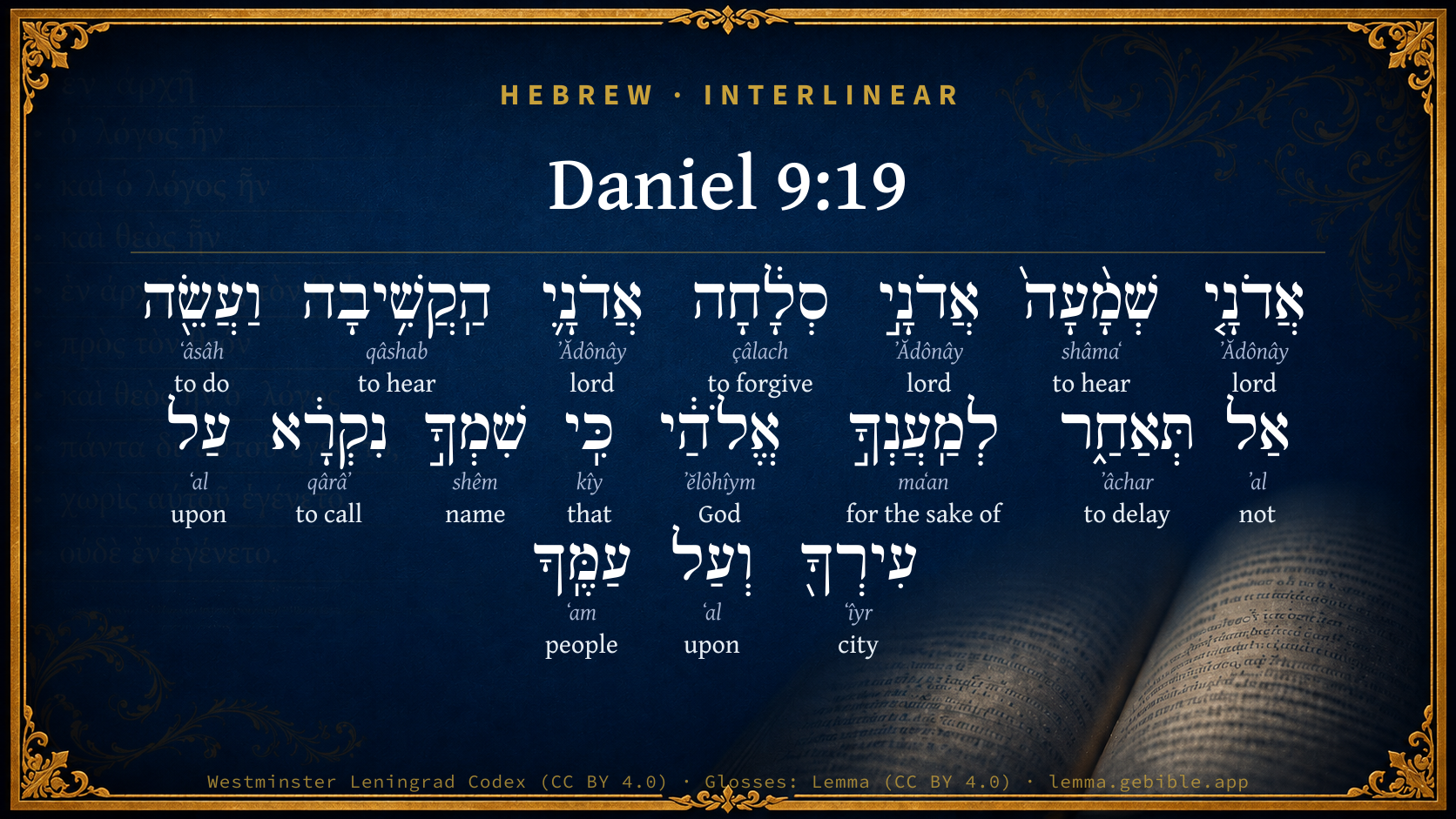
Daniel 9:19

Hebrew (Westminster Leningrad Codex) Daniel 9:19 appears in the Hebrew Old Testament. The text above is from the Westminster Leningrad Codex. Each word links to its Strong’s number, a concise gloss, and parsing drawn from the Open Scriptures Hebrew Bible morphology. Click any word for its full Brown-Driver-Briggs (BDB) entry.
Download image
Cite this verse

Daniel 9:19 (World English Bible). Public Domain. Lemma interlinear Bible study tool, https://lemma.gebible.app/v/daniel/9/19.

Show BibTeX & RIS
BibTeX
RIS
English Translation
Lord, hear; Lord, forgive; Lord, listen and do; don't defer, for your own sake, my God, because your city and your people are called by your name.
World English Bible · Public Domain
Download a study sheet

One document with this verse’s original text, its word-by-word gloss line, the meaning frame, cross-references with their text, attributed commentary, and full source and license credits — printable, and it pastes into notes with its structure intact.

This verse Autodidact and up

Study sheet (.html) Plain text (.txt)

A passage Seminary Student

Up to 50 verses in one chapter. A passage sheet keeps up to 6 commentary sources and 12 cross-references per verse, in the order this page ranks them, and says so on the sheet whenever that leaves anything out. Ask for a single verse and you get the Autodidact verse sheet above.

Everything on this page stays free to read, with no account — the sheet is a download of what is already on screen, not access to it.

Want to remove ads? Support Godless Engineer
Compare translations 3

The same verse in 3 English versions, stacked beneath the original-language interlinear above. Click any original word for its lexicon entry.

Each is an independent rendering of the whole verse — the interlinear is not word-aligned to these translations.

Highlighted words mark where these versions differ — a whole-verse word diff, not a word-by-word alignment.

  • World English Bible Public Domain
    Lord, hear; Lord, forgive; Lord, listen and do; don't defer, for your own sake, my God, because your city and your people are called by your name.
  • King James Version Public Domain
    O Lord, hear; O Lord, forgive; O Lord, hearken and do; defer not, for thine own sake, O my God: for thy city and thy people are called by thy name.
  • unfoldingWord Literal Text CC BY-SA 4.0
    O Lord, hear! O Lord, forgive! O Lord, pay attention and take action! For your own sake, do not delay, my God, because your city and your people are called by your name.”

unfoldingWord Literal Text — © unfoldingWord, licensed CC BY-SA 4.0. Word-aligned USFM3 via Door43 (git.door43.org/unfoldingWord/en_ult).

Versions to compare (up to 4)

3 of 4 selected

Show all 18 translations

Every available English version of this verse, each an independent rendering of the whole verse.

  • World English Bible Public Domain
    Lord, hear; Lord, forgive; Lord, listen and do; don't defer, for your own sake, my God, because your city and your people are called by your name.
  • Berean Standard Bible Public Domain
    O Lord, listen! O Lord, forgive! O Lord, hear and act! For Your sake, O my God, do not delay, because Your city and Your people bear Your name.”
  • Majority Standard Bible Public Domain
    O Lord, listen! O Lord, forgive! O Lord, hear and act! For Your sake, O my God, do not delay, because Your city and Your people bear Your name.”
  • King James Version Public Domain
    O Lord, hear; O Lord, forgive; O Lord, hearken and do; defer not, for thine own sake, O my God: for thy city and thy people are called by thy name.
  • American Standard Version (1901) Public Domain
    O Lord, hear; O Lord, forgive; O Lord, hearken and do; defer not, for thine own sake, O my God, because thy city and thy people are called by thy name.
  • Revised Version (1885) Public Domain
    O Lord, hear; O Lord, forgive; O Lord, hearken and do; defer not; for thine own sake, O my God, because thy city and thy people are called by thy name.
  • Geneva Bible (1599) Public Domain
    O Lord, heare, O Lord forgiue, O Lord consider, and doe it: deferre not, for thine owne sake, O my God: for thy Name is called vpon thy citie, and vpon thy people.
  • Douay-Rheims (1899) Public Domain
    O Lord, hear: O Lord, be appeased: hearken and do: delay not for thy own sake, O my God: because thy name is invocated upon thy city, and upon thy people.
  • Young's Literal Translation Public Domain
    O lord, hear, O Lord, forgive; O Lord, attend and do; do not delay, for Thine own sake, O my God, for Thy name is called on Thy city, and on Thy people.'
  • Literal Standard Version CC BY-SA 4.0
    O Lord, hear, O Lord, forgive; O Lord, attend and do; do not delay, for Your own sake, O my God, for Your Name is called on Your city, and on Your people.
  • Unlocked Literal Bible CC BY-SA 4.0
    Lord, listen! Lord, forgive! Lord, pay attention and take action! For your own sake, do not delay, my God, for your city and your people are called by your name.”
  • unfoldingWord Literal Text CC BY-SA 4.0
    O Lord, hear! O Lord, forgive! O Lord, pay attention and take action! For your own sake, do not delay, my God, because your city and your people are called by your name.”
  • Darby Bible Public Domain
    Lord, hear! Lord, forgive! Lord, hearken and do! defer not, for thine own sake, O my God! for thy city and thy people are called by thy name.
  • World Messianic Bible Public Domain
    Lord, hear. Lord, forgive. Lord, listen and do. Don’t defer, for your own sake, my God, because your city and your people are called by your name.”
  • Webster's Bible Public Domain
    O Lord, hear; O Lord, forgive; O Lord, hearken and do; defer not, for thy own sake, O my God: for thy city and thy people are called by thy name.
  • Free Bible Version CC BY-SA 4.0
    Lord, please listen! Lord, please forgive! Please pay attention and do something! For your own sake, my God, don't delay, for your city and your people are identified by your name.”
  • Bible in Basic English Public Domain
    O Lord, give ear; O Lord, have forgiveness; O Lord, take note and do; let there be no more waiting; for the honour of your name, O my God, because your town and your people are named by your name.
  • JPS Tanakh (1917) Public Domain
    O Lord, hear, O Lord, forgive, O Lord, attend and do, defer not; for Thine own sake, O my God, because Thy name is called upon Thy city and Thy people.'

Literal Standard Version (2020), Covenant Press — licensed CC BY-SA 4.0. Text via the HelloAO Bible API (eBible.org). Unlocked Literal Bible (unfoldingWord) — licensed CC BY-SA 4.0. Text via the HelloAO Bible API (eBible.org). unfoldingWord Literal Text — © unfoldingWord, licensed CC BY-SA 4.0. Word-aligned USFM3 via Door43 (git.door43.org/unfoldingWord/en_ult). Free Bible Version, Dr. Jonathan Gallagher — licensed CC BY-SA 4.0. Text via the HelloAO Bible API (eBible.org).

Word by word

More ways to search: Search by grammar → Find every occurrence → Compare this word →

Practice this passage: Drill this verse → Learn its vocabulary →

תְּאַחַ֑ר
ʼâchar
H309
“to delay”
Verb, Piel, Jussive, 2nd Person, Masculine, Singular
Part of Speech
Verb
Stem
Piel
Form
Jussive
Person
2nd Person
Gender
Masculine
Number
Singular
Full BDB Definition

Origin: a primitive root

TWOT: 68

to delay, hesitate, tarry, defer, remain behind - (Qal) - to delay, tarry (intensive) - to cause one to delay, hinder, keep back - (Piel) to delay, wait, stay behind (but not in hope)
  1. אֲדֹנָ֤י ʼĂdônây H136 “Lord · my” Noun, Common, Masculine, Plural, Construct + Suffix, Personal, 1st Person, Common, Singular
  2. שְׁמָ֨עָה֙ shâmaʻ H8085 “hear” Verb, Qal, Imperative, 2nd Person, Masculine, Singular + Suffix, h
  3. אֲדֹנָ֣י ʼĂdônây H136 “Lord · my” Noun, Common, Masculine, Plural, Construct + Suffix, Personal, 1st Person, Common, Singular
  4. סְלָ֔חָה çâlach H5545 “forgive” Verb, Qal, Imperative, 2nd Person, Masculine, Singular + Suffix, h
  5. אֲדֹנָ֛י ʼĂdônây H136 “Lord · my” Noun, Common, Masculine, Plural, Construct + Suffix, Personal, 1st Person, Common, Singular
  6. הַֽקֲשִׁ֥יבָה qâshab H7181 “hear” Verb, Hiphil, Imperative, 2nd Person, Masculine, Singular + Suffix, h
  7. וַעֲשֵׂ֖ה ʻâsâh H6213 “and · do” Conjunction + Verb, Qal, Imperative, 2nd Person, Masculine, Singular
  8. אַל ʼal H408 “not” Particle, Negative
  9. לְמַֽעֲנְךָ֣ maʻan H4616 “for the sake of · you” Preposition + Suffix, Personal, 2nd Person, Masculine, Singular
  10. אֱלֹהַ֔י ʼĕlôhîym H430 “God(s) · my” Noun, Common, Masculine, Plural, Construct + Suffix, Personal, 1st Person, Common, Singular
  11. כִּֽי kîy H3588 “that” Conjunction
  12. שִׁמְךָ֣ shêm H8034 “name · your” Noun, Common, Masculine, Singular, Construct + Suffix, Personal, 2nd Person, Masculine, Singular
  13. נִקְרָ֔א qârâʼ H7121 “to call” Verb, Niphal, Perfect, 3rd Person, Masculine, Singular
  14. עַל ʻal H5921 “upon” Preposition
  15. עִירְךָ֖ ʻîyr H5892 “city · your” Noun, Common, Feminine, Singular, Construct + Suffix, Personal, 2nd Person, Masculine, Singular
  16. וְעַל ʻal H5921 “and · upon” Conjunction + Preposition
  17. עַמֶּֽךָ ʻam H5971 “people · your” Noun, Common, Masculine, Singular, Construct + Suffix, Personal, 2nd Person, Masculine, Singular

About this verse

These counts appear in no published source. They are computed here, from the morphology-tagged text and Lemma’s own curated glosses. What Lemma adds →

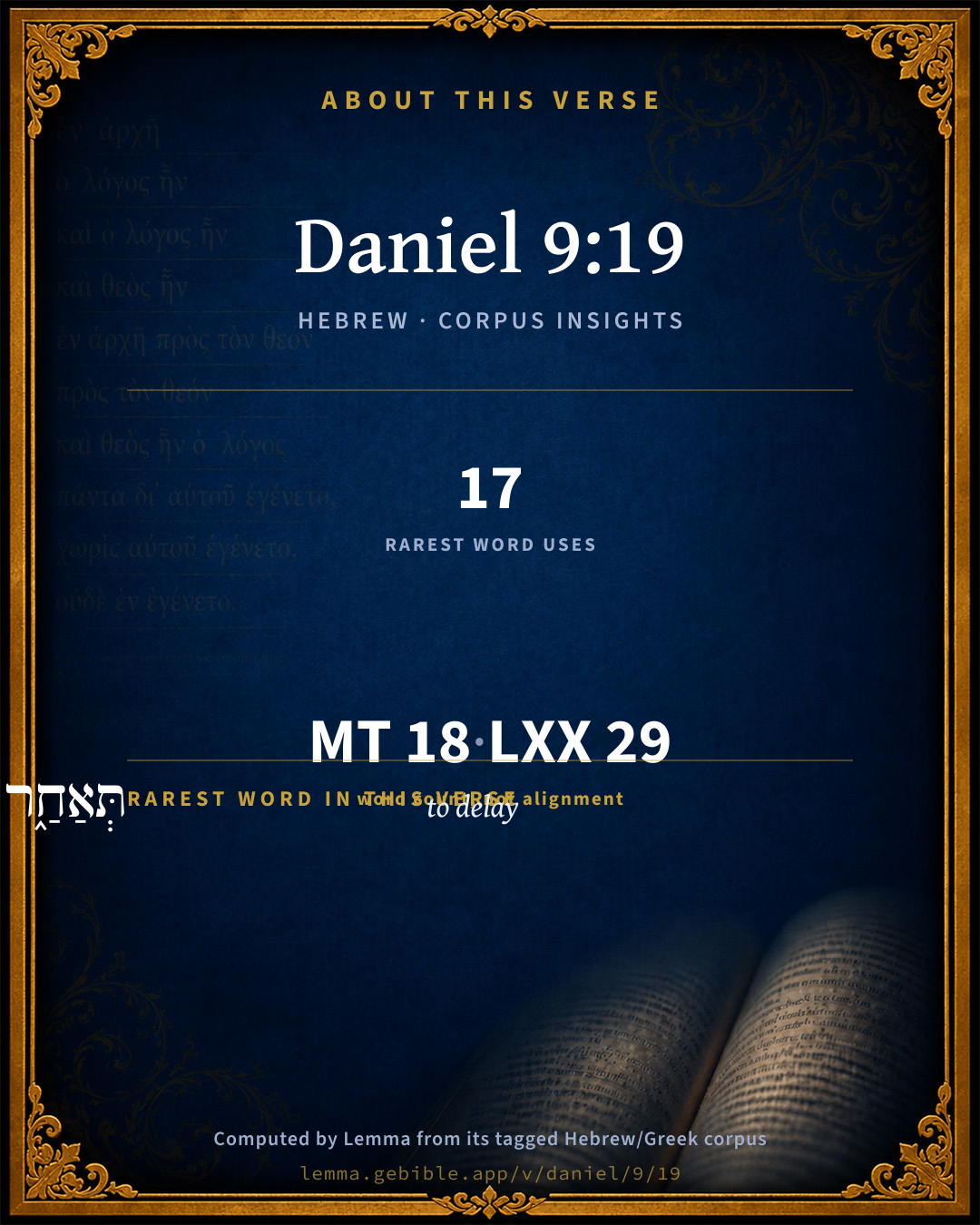
18
words
15
distinct lemmas
Prophets
section

Notable vocabulary

The rarest word here is תְּאַחַ֑ר to delay H309 — appearing just 17 times in the whole Hebrew Bible.

Shared distinctive vocabulary

תְּאַחַ֑ר to delay H309 occurs in 17 verses of the Hebrew Bible. Also found in:

Grammatical profile

  • 6 verbs
  • 7 nouns
  • 3 prepositions
  • 1 conjunction
  • 1 particle

Verb forms

  • שְׁמָ֨עָה֙ Qal · Imperative
  • סְלָ֔חָה Qal · Imperative
  • הַֽקֲשִׁ֥יבָה Hiphil · Imperative
  • וַעֲשֵׂ֖ה Qal · Imperative
  • תְּאַחַ֑ר Piel · Jussive
  • נִקְרָ֔א Niphal · Perfect

Repetition

Words recur within this verse — often emphatic in Hebrew:

  • אֲדֹנָ֤י lord H136 ×3
  • עַל upon H5921 ×2

Hebrew & Septuagint length

In English translation the verse runs 27 words from the Hebrew and 31 from the Septuagint (LXX English) — closely comparable.

A rough comparison of the two English renderings, which tokenize alike — not a word-level alignment.

Word counts can differ between the Hebrew and the Greek without any difference in meaning — e.g. the Hebrew direct-object marker אֵת has no separate Greek word, and Greek often adds the article ὁ.

In the original languages it is 18 Hebrew tokens and 29 Greek tokens — but the two are counted differently (Hebrew bundles its prefixes and suffixes into one token; the Greek is in lemma form), so that isn’t a like-for-like length.

Cross-references

29

Topical passages linked to Daniel 9:19 in the Treasury of Scripture Knowledge — connected by theme and wording, ordered by reader-vote popularity; previews shown in the World English Bible.

  • Daniel 9:18 My God, turn your ear, and hear; open your eyes, and see our desolations, and the city which is called by your name: for we do not present our petitions before you for our righteousness, but for your great mercies' sake.
  • Jeremiah 14:9 Why should you be like a scared man, as a mighty man who can't save? yet you, Yahweh, are in the midst of us, and we are called by your name; don't leave us.
  • Amos 7:2 It happened that, when they made an end of eating the grass of the land, then I said, "Lord Yahweh, forgive, I beg you! How could Jacob stand? For he is small."
  • Luke 11:8 I tell you, although he will not rise and give it to him because he is his friend, yet because of his persistence, he will get up and give him as many as he needs.
  • Ephesians 1:12 to the end that we should be to the praise of his glory, we who had before hoped in Christ:
  • Numbers 14:19 Pardon, Please, the iniquity of this people according to the greatness of your loving kindness, and according as you have forgiven this people, from Egypt even until now.
  • 2 Chronicles 6:25–30 then hear from heaven, and forgive the sin of your people Israel, and bring them again to the land which you gave to them and to their fathers.
  • Jeremiah 14:7 Though our iniquities testify against us, work you for your name's sake, Yahweh; for our backslidings are many; we have sinned against you.
  • Ephesians 3:10 to the intent that now through the assembly the manifold wisdom of God might be made known to the principalities and the powers in the heavenly places,
  • 1 Kings 8:30–39 Listen you to the supplication of your servant, and of your people Israel, when they shall pray toward this place: yes, hear in heaven, your dwelling-place; and when you hear, forgive.
  • 2 Chronicles 6:39 then hear from heaven, even from your dwelling-place, their prayer and their petitions, and maintain their cause, and forgive your people who have sinned against you.
  • Psalms 44:23–26 Wake up! Why do you sleep, Lord? Arise! Don't reject us forever.
  • Psalms 74:9–11 We see no miraculous signs. There is no longer any prophet, Neither is there among us anyone who knows how long.
  • Psalms 79:5–6 How long, Yahweh? Will you be angry forever? Will your jealousy burn like fire?
  • Psalms 79:8–10 Don't hold the iniquities of our forefathers against us. Let your tender mercies speedily meet us, For we are in desperate need.
  • Psalms 85:5–6 Will you be angry with us forever? Will you draw out your anger to all generations?
  • Psalms 102:13–16 You will arise and have mercy on Zion; For it is time to have pity on her. Yes, the set time has come.
  • Psalms 115:1–2 Not to us, Yahweh, not to us, But to your name give glory, For your loving kindness, and for your truth's sake.
  • Isaiah 63:16–19 For you are our Father, though Abraham doesn't know us, and Israel does not acknowledge us: you, Yahweh, are our Father; our Redeemer from everlasting is your name.
  • Isaiah 64:9–12 Don't be angry very sore, Yahweh, neither remember iniquity forever: see, look, we beg you, we are all your people.
  • Jeremiah 14:20–21 We acknowledge, Yahweh, our wickedness, and the iniquity of our fathers; for we have sinned against you.
  • Jeremiah 25:29 For, behold, I begin to work evil at the city which is called by my name; and should you be utterly unpunished? You shall not be unpunished; for I will call for a sword on all the inhabitants of the earth, says Yahweh of Hosts.
  • Ezekiel 20:9 But I worked for my name's sake, that it should not be profaned in the sight of the nations, among which they were, in whose sight I made myself known to them, in bringing them forth out of the land of Egypt.
  • Ezekiel 20:14 But I worked for my name's sake, that it should not be profaned in the sight of the nations, in whose sight I brought them out.
  • Ezekiel 20:22 Nevertheless I withdrew my hand, and worked for my name's sake, that it should not be profaned in the sight of the nations, in whose sight I brought them forth.
  • Ezekiel 36:22 Therefore tell the house of Israel, Thus says the Lord Yahweh: I don't do [this] for your sake, house of Israel, but for my holy name, which you have profaned among the nations, where you went.
  • Ezekiel 39:25 Therefore thus says the Lord Yahweh: Now will I bring back the captivity of Jacob, and have mercy on the whole house of Israel; and I will be jealous for my holy name.
  • Ephesians 1:6 to the praise of the glory of his grace, by which he freely bestowed favor on us in the Beloved,
  • 2 Chronicles 6:21 Listen you to the petitions of your servant, and of your people Israel, when they shall pray toward this place: yes, hear from your dwelling-place, even from heaven; and when you hear, forgive.

Cross-references courtesy of OpenBible.info (CC BY 4.0).

Hebrew and Greek witnesses Masoretic Hebrew ↔ Greek Septuagint

The same verse in the two great witnesses to the Old Testament, shown verse-for-verse.

These are two independent witnesses, not word-aligned to each other, and the Septuagint is shown in lemma (dictionary) form.

Hebrew Daniel 9:19 Masoretic · Westminster Leningrad Codex

אֲדֹנָ֤י שְׁמָ֨עָה֙ אֲדֹנָ֣י סְלָ֔חָה אֲדֹנָ֛י הַֽקֲשִׁ֥יבָה וַעֲשֵׂ֖ה אַל תְּאַחַ֑ר לְמַֽעֲנְךָ֣ אֱלֹהַ֔י כִּֽי שִׁמְךָ֣ נִקְרָ֔א עַל עִירְךָ֖ וְעַל עַמֶּֽךָ

Lord, hear; Lord, forgive; Lord, listen and do; don't defer, for your own sake, my God, because your city and your people are called by your name.

World English Bible · Public Domain

Greek LXX Daniel 9:19 Septuagint · lemma form

κύριος σύ ἱλατεύω κύριος ἐπιἀκούω καί ποιέω καί μή χρονίζω ἕνεκα σεαυτοῦ δεσπότης ὅτι ὁ ὄνομα σύ ἐπικαλέω ἐπί ὁ πόλις σύ σιων καί ἐπί ὁ λαός σύ ἰσραήλ

Listen, O Lord; be propitious, O Lord; attend, O Lord; delay not, O my God, for your own sake: for your name is called upon your city and upon your people.

LXX2012 (modern English Septuagint) · Public Domain

Hebrew: Westminster Leningrad Codex (CC BY 4.0). Greek: Septuagint (public domain); English from LXX2012 (modern English Septuagint) (Public Domain). How the Septuagint differs from the Hebrew →

Commentary

Notes on Daniel 9:19 from classic Christian and Jewish commentators (each source and its license shown beneath its notes). The classic Christian expositions comment on the surrounding passage and are grouped to its opening verse, so a note may address several verses; the Jewish commentaries on the Tanakh (Rashi and others) are per-verse, so they appear only where the commentator wrote on this verse.

Lemma curates 59 commentaries, every one of them public domain or Creative Commons licensed, each selected and text-cleaned for this edition rather than reprinted as found. About our sources →

Trapp's Complete Commentary

John Trapp

Dan 9:19 O Lord, hear; O Lord, forgive; O Lord, hearken and do; defer not, for thine own sake, O my God: for thy city and thy people are called by thy name.

Ver. 19. O Lord, hear; O Lord, forgive.] This was to pray, yea, this was to strive in prayer; {Luk 13:12} to strive, as those of old did, in the Grecian exercises, some whereof were with fists and bats; to strive and struggle, even to an agony, as the Greek word signifieth, and as the Lord Christ did, who, "being in an agony, prayed yet the more earnestly"; {εκτενεστερον, Luk 22:44} he sweat and sweltered out, as it were, his soul, through his body in prayer. Be we now "followers herein of Christ as dear children," and of Daniel here, who is a worthy pattern to pray by. Cold suitors, who want the aspiration of the spirit to pronounce Shibboleth, do but beg a denial.

O Lord, hearken and do; defer not.] This is coelum tundere, preces fundere, misericordiam extorquere, {a} as those primitive Christians did; to bounce at heaven gates, to tug hard with God, to wring the blessing out of his hands, who looks to be importuned, and counts it for a kindness to be asked forgiveness, as Ambrose {b} saith of Theodosius the emperor.

{a} Tertul.

{b} Beneficium se putabit accepisse, cum rogaretur ignoscere. - Ambr., Orat. de Exit. Theod.

John Trapp, A Commentary or Exposition upon All the Books of the Old and New Testament (1647–1656) — public domain. Text from a community e-Sword module.

Tyndale Open Study Notes

Tyndale Open Resources

9:19 listen and act! . . . do not delay: Daniel prayed this prayer in 539 BC (see study note on 9:1). Shortly thereafter (in 538 BC), King Cyrus gave his decree allowing the Jewish people to return to Judea (Ezra 1:1-4). The new Temple in Jerusalem was completed in 515 BC (Ezra 6:15). God returned the Israelites from exile in response to their prayers and repentance, just as the Exile had been his response to his people’s sins and rebellion. • your people and your city bear your name: God’s reputation was associated with Jerusalem (Neh 1:9) and his people, Israel (Exod 5:22–6:1).

Tyndale Open Study Notes — © Tyndale Open Resources, licensed CC BY-SA 4.0. Text via the HelloAO Bible API.

Geneva Bible (1599)

Geneva Bible translators

Thus he could not content himself with any vehemence of words: for he was so led with a fervent zeal considering God’s promise made to the city in respect of his Church, and for the advancement of God’s glory.

Geneva Bible (1599) marginal notes — public domain. Text via Bolls.life.

Jamieson, Fausset & Brown

Robert Jamieson, A. R. Fausset & David Brown

The short broken ejaculations and repetitions show the intense fervor of his supplications.

defer not--He implies that the seventy years are now all but complete.

thine own sake--often repeated, as being the strongest plea (Jer 14:21).

Jamieson, Fausset & Brown — Commentary Critical and Explanatory on the Whole Bible (1871) — public domain (CC PDM 1.0). Text via the HelloAO Bible API.

Adam Clarke's Commentary

Verse 19. Thy city and thy people are called by thy name.] The holy city, the city of the great King. I think it scarcely possible for any serious man to read these impressive and pleading words without feeling a measure of the prophet's earnestness.

Adam Clarke's Commentary on the Bible (1810–1826) — public domain. Text from a community e-Sword/MySword module.

John Calvin's Commentaries

Here vehemence is better expressed, as I have previously observed. For Daniel does not display his eloquence, as hypocrites usually do, but simply teaches by his example the true law and method of prayer. Without doubt, he was impelled by singular zeal for the purpose of drawing others with him. God, therefore, worked in the Prophet by his Spirit, to render him a guide to all the rest, and his prayer as a kind of common form to the whole Church. With this intention, Daniel now relates his own conceptions. He had prayed without any witness, but he now calls together the whole Church, and wishes it to become a witness of his zeal and fervor, and invites all men to follow this prescription, proceeding as it does not from himself but from God. O Lord, hear, says he; and next, O Lord, be propitious By this second clause he implies the continual and intentional deafness of the Almighty, because he was deservedly angry with the people. And we ought to observe this, because we foolishly wonder at God’s not answering our prayers as soon as the wish has proceeded from our lips. Its reason, too, must be noticed. God’s slowness springs from our coldness and dullness, while our iniquities interpose an obstacle between ourselves and his ear. Be thou, therefore, propitious, O Lord, that thou mayest hear. So the sentence ought to be resolved. He afterwards adds, O Lord, attend By this word Daniel means to convey, that while the people had in many ways and for a length of time provoked God’s anger, they were unworthily oppressed by impious and cruel enemies, and that this severe calamity ought to incline God to pity them. O Lord, therefore, he says, attend and do not delay Already God had cast away his people for seventy years, and had suffered them to be so oppressed by their enemies, as to cause the faithful the utmost mental despondency. Thus we perceive how in this passage the holy Prophet wrestled boldly with the severest temptation. He requests God not to delay or put off. Seventy years had already passed away since God had formally cast off his people, and had refused them every sign of his good will towards them.

The practical inference from this passage is the impossibility of our praying acceptably, unless we rise superior to whatever befalls us; and if we estimate God’s favor according to our own condition, we shall lose the very desire for prayer, nay, we shall wear away a hundred times over in the midst of our calamities, and be totally unable to raise our minds up to God. Lastly, whenever God seems to have delayed for a great length of time, he must be constantly entreated not to delay He next adds, For thine own sake, O, my God. Again, Daniel reduces to nothing those sources of confidence by which hypocrites imagine themselves able to obtain God’s favor. Even if one clause of the sentence is not actually the opposite of the other, as it was before, yet when he says, for thy sake, we may understand the inference to be, therefore not for our own sakes. He confirms this view by the remainder of the context, For thy sake, O my God, because thy name has been invoked upon thy city, says he, and upon thy people We observe, then, how Daniel left no means untried for obtaining his request, although he relied on his gratuitous adoption, and never doubted God’s propitious feelings towards his own people. He finds indeed no cause for them either in mortals or in their merits, but he wishes mankind perpetually to behold his benefits and to continue steadfast to the end. It follows: —

John Calvin's Commentaries (1540-1563) — public domain. Text from the Calvin Translation Society English edition (1840s-50s) via the Christian Classics Ethereal Library (ccel.org). Calvin's coverage is partial (roughly two-thirds of the Bible); uncommented books and verses are honest gaps, never fabricated. The 19th-century editor's footnotes and remarks are omitted so the notes are faithfully Calvin's own voice.

The Cambridge Bible for Schools and Colleges

gen. ed. J. J. S. Perowne

19. hear … forgive] The combination is, no doubt, suggested by 1Ki_8:30 b, 34, 36, 39.

hearken] attend, as the word is often rendered in the Psa_17:1; Psa_55:2; Psa_61:1; Psa_86:6; Psa_142:6.

and do] cf. Jer_14:7, ‘though our iniquities testify against us, O Jehovah do for thy name’s sake’: see also on Dan_8:12.

defer not: for thine own sake, O my God, because, &c. (R.V.). The Hebrew accentuation places the main break in the verse at defer not.

defer not] as Psa_40:17 (= Psa_70:5 : in A.V., R.V., make no long tarrying).

for thine own sake] see on Dan_9:17, end.

because thy name hath been called over thy city and thy people] see on Dan_9:18.

The Cambridge Bible for Schools and Colleges (gen. ed. J. J. S. Perowne; Cambridge University Press, 1878–1918) — public domain. Text from a community e-Sword module.

John Gill's Exposition

O Lord, hear; O Lord, forgive,.... That is, hear the prayers and supplications that have been presented, and forgive the sins that have been confessed; show both, by removing present calamities, and restoring to former prosperity and privileges:

O Lord, hearken, and do; not only listen to what has been said, and give an answer by speaking, but work salvation and deliverance:

defer not, for thine own sake, O my God; these words seem to be directed to Christ the Son of God, and who is the true God, and the God of his people; who is three times in this verse before called Adonai, for whose sake prayer and supplication were made, Dan 9:17 and here again, for his own sake, he is entreated not to "defer" the fulfilment of the promise of delivering the Jews from their captivity in Babylon, the seventy years being now up, or just expiring; and also that he would not defer his own coming for the redemption of his people, which no doubt Daniel had in his mind, and was wishing and waiting for:

for thy city and thy people are called by thy name; Jerusalem, the city of the great King, Christ, and a type of his church and people, who are also called by his name, and call upon him.

John Gill's Exposition of the Whole Bible (1746–1763) — public domain (CC PDM 1.0). Text via the HelloAO Bible API.

Albert Barnes' Notes on the Bible

O Lord, hear ... - The language in this verse does not require any particular explanation. The repetition - the varied forms of expression - indicate a mind intent on the object; a heart greatly interested; an earnestness that cannot be denied. It is language that is respectful, solemn, devout, but deeply earnest. It is not vain repetition, for its force is not in the “words” employed, but in the manifest fervour, earnestness, and sincerity of spirit which pervade the pleading. It is earnest intercession and supplication that God would hear - that he would forgive, that he would hearken and do, that he would not defer his gracious interposition. The sins of the people; the desolation of the city; the promises of God; the reproach that the nation was suffering - all these come rushing over the soul, and prompt to the most earnest pleading that perhaps ever proceeded from human lips.

And these things justified that earnest pleading - for the prayer was that of a prophet, a man of God, a man that loved his country, a man that was intent on the promotion of the Divine glory as the supreme object of his life. Such earnest intercession; such confession of sin; such a dwelling on arguments why a prayer should be heard, is at all times acceptable to God; and though it cannot be supposed that the Divine Mind needs to be instructed, or that our arguments will convince God or influence him as arguments do men, yet it is undoubtedly proper to urge them as if they would, for it may be only in this way that our own minds can be brought into a proper state. The great argument which we are to urge why our prayers should be heard is the sacrifice which has been made for sin by the Redeemer, and the fact that he has purchased for us the blessings which we need; but in connection with that it is proper to urge our own sins and necessities; the wants of our friends or our country; our own danger and that of others; the interposition of God in times past in behalf of his people, and his own gracious promises and purposes. If we have the spirit, the faith, the penitence, the earnestness of Daniel, we may be sure that our prayers will be heard as his was.

Albert Barnes' Notes on the Bible (1834–1885) — public domain. Text from a community e-Sword/MySword module.

Matthew Poole's English Annotations

Here,

1. We have the effectual fervent prayer of a righteous man prevailing: he never gave over till he got it.

2. The Lord allows and loves importunity in prayer.

3. He and the people of God were under a sore trial, for the seventy years’ captivity were expired. Therefore he saith, Defer not now, Lord, it is high time for thee to have mercy upon Zion, yea, the set time is come: Lord, hear for thine own sake, though not for ours. What! hast thou forgotten? O Lord, remember.

Matthew Poole's English Annotations on the Holy Bible (1683–1685) — public domain. Text from a community e-Sword/MySword module.

Rashi

Rabbi Shlomo Yitzchaki (Rashi)

O Lord, hear our supplications.

O Lord, forgive our sins.

O Lord, hearken Your ear to our cry.

and do our request and do not delay.

Rashi on the Tanakh — English translations: “The Judaica Press complete Tanach with Rashi, translated by A. J. Rosenberg” (CC BY 4.0); “Pentateuch with Rashi's commentary by M. Rosenbaum and A.M. Silbermann, 1929-1934” (public domain); “The Metsudah Tanach series, Lakewood, N.J” (CC BY 4.0); and “The Book of Joshua, Metsudah Publications, 1997” (CC BY 4.0). Text via Sefaria.

Lesson kit

Teaching starters — assembled from the data on this page, not authored interpretation. Every prompt links to the verse data it draws on. Edit before teaching.

Daniel, in the Prophets, opens this verse with 18 words (15 distinct Hebrew lemmas). Its most distinctive word is ʼâchar (“to delay”). A historical commentator’s framing appears above. Read the whole chapter for the surrounding context.

Discussion questions

  1. The word ʼâchar carries the sense “to delay.” How does it shape the verse?
  2. Genesis 24:56 shares the word «to delay» with this verse. How do the two illuminate each other?
  3. “lord” occurs 3× in this one verse. What is the effect of the repetition?
  4. The translations on this page render this verse differently — a whole-verse word diff, not a word-by-word alignment. What might account for the different wordings?
  5. The verb «שְׁמָ֨עָה֙» is Qal Imperative. How does its form color the action?
  6. Reading how Trapp's Complete Commentary and Tyndale Open Study Notes read this verse, where do the two commentators agree and where do they part?

Things to notice

Reading settings

Reading text

Shown beneath each verse's original-language words.

Old Testament
Old Testament edition

Read the OT as the Masoretic Hebrew (MT) or the Greek Septuagint (LXX).

English shown for the Greek Septuagint (in the Hebrew ↔ Greek comparison).

Comparing translations? Open the Compare panel on any verse page to stack up to four side by side.