Genesis 35:17

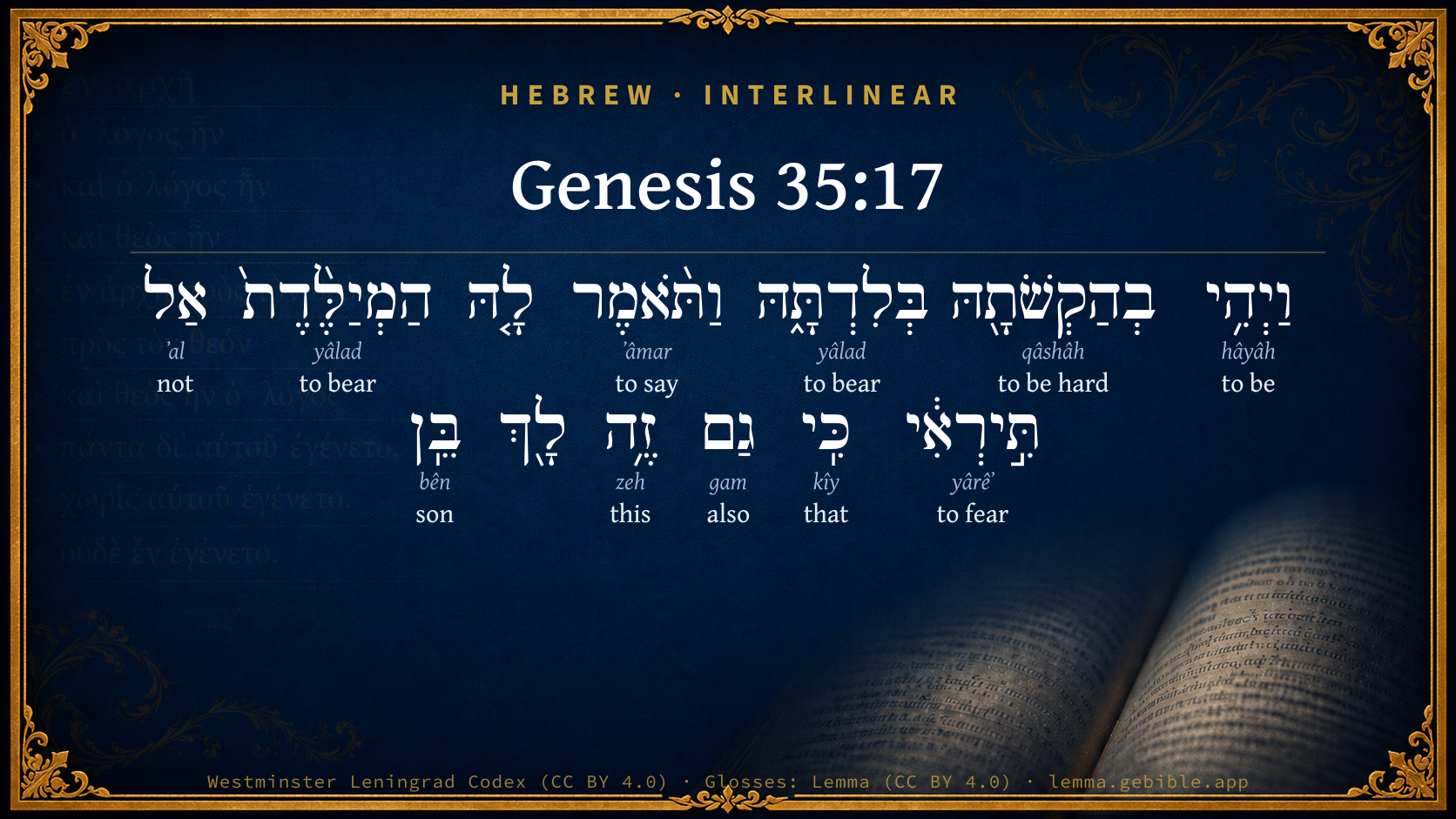
Hebrew (Westminster Leningrad Codex) Genesis 35:17 appears in the Hebrew Old Testament. The text above is from the Westminster Leningrad Codex. Each word links to its Strong’s number, a concise gloss, and parsing drawn from the Open Scriptures Hebrew Bible morphology. Click any word for its full Brown-Driver-Briggs (BDB) entry.
Download image
Cite this verse

Genesis 35:17 (World English Bible). Public Domain. Lemma interlinear Bible study tool, https://lemma.gebible.app/v/genesis/35/17.

Show BibTeX & RIS
BibTeX
RIS
English Translation
It happened that, when she was in hard labor, that the midwife said to her, "Don't be afraid, for now you will have another son."
World English Bible · Public Domain
Download a study sheet

One document with this verse’s original text, its word-by-word gloss line, the meaning frame, cross-references with their text, attributed commentary, and full source and license credits — printable, and it pastes into notes with its structure intact.

This verse Autodidact and up

Study sheet (.html) Plain text (.txt)

A passage Seminary Student

Up to 50 verses in one chapter. A passage sheet keeps up to 6 commentary sources and 12 cross-references per verse, in the order this page ranks them, and says so on the sheet whenever that leaves anything out. Ask for a single verse and you get the Autodidact verse sheet above.

Everything on this page stays free to read, with no account — the sheet is a download of what is already on screen, not access to it.

Want to remove ads? Support Godless Engineer
Compare translations 3

The same verse in 3 English versions, stacked beneath the original-language interlinear above. Click any original word for its lexicon entry.

Each is an independent rendering of the whole verse — the interlinear is not word-aligned to these translations.

Highlighted words mark where these versions differ — a whole-verse word diff, not a word-by-word alignment.

  • World English Bible Public Domain
    It happened that, when she was in hard labor, that the midwife said to her, "Don't be afraid, for now you will have another son."
  • King James Version Public Domain
    And it came to pass, when she was in hard labor, that the midwife said unto her, Fear not; thou shalt have this son also.
  • unfoldingWord Literal Text CC BY-SA 4.0
    And it happened when she was in hard labor, then the midwife said to her, “Do not be afraid, because this also a son for you!”

unfoldingWord Literal Text — © unfoldingWord, licensed CC BY-SA 4.0. Word-aligned USFM3 via Door43 (git.door43.org/unfoldingWord/en_ult).

Versions to compare (up to 4)

3 of 4 selected

Show all 18 translations

Every available English version of this verse, each an independent rendering of the whole verse.

  • World English Bible Public Domain
    It happened that, when she was in hard labor, that the midwife said to her, "Don't be afraid, for now you will have another son."
  • Berean Standard Bible Public Domain
    During her severe labor, the midwife said to her, “Do not be afraid, for you are having another son.”
  • Majority Standard Bible Public Domain
    During her severe labor, the midwife said to her, “Do not be afraid, for you are having another son.”
  • King James Version Public Domain
    And it came to pass, when she was in hard labor, that the midwife said unto her, Fear not; thou shalt have this son also.
  • American Standard Version (1901) Public Domain
    And it came to pass, when she was in hard labor, that the midwife said unto her, Fear not; for now thou shalt have another son.
  • Revised Version (1885) Public Domain
    And it came to pass, when she was in hard labour, that the midwife said unto her, Fear not; for now thou shalt have another son.
  • Geneva Bible (1599) Public Domain
    And whe she was in paines of her labour, the midwife saide vnto her, Feare not: for thou shalt haue this sonne also.
  • Douay-Rheims (1899) Public Domain
    By reason of her hard labor she began to be in danger, and the midwife said to her: Fear not, for thou shalt have this son also.
  • Young's Literal Translation Public Domain
    and it cometh to pass, in her being sharply pained in her bearing, that the midwife saith to her, `Fear not, for this also `is' a son for thee.'
  • Literal Standard Version CC BY-SA 4.0
    and it comes to pass, in her being sharply pained in her bearing, that the midwife says to her, “Do not fear, for this also [is] a son for you.”
  • Unlocked Literal Bible CC BY-SA 4.0
    While she was in hardest labor, the midwife said to her, “Do not be afraid, for now you will have another son.”
  • unfoldingWord Literal Text CC BY-SA 4.0
    And it happened when she was in hard labor, then the midwife said to her, “Do not be afraid, because this also a son for you!”
  • Darby Bible Public Domain
    And it came to pass when it went hard with her in her childbearing, that the midwife said to her, Fear not; for this also is a son for thee.
  • World Messianic Bible Public Domain
    When she was in hard labor, the midwife said to her, “Don’t be afraid, for now you will have another son.”
  • Webster's Bible Public Domain
    And it came to pass when she was in hard labor, that the midwife said to her, Fear not; thou shalt have this son also.
  • Free Bible Version CC BY-SA 4.0
    When she was in the worst birth-pains, the midwife told her, “Don't give up—you have another son!”
  • Bible in Basic English Public Domain
    And when her pain was very great, the woman who was helping her said, Have no fear; for now you will have another son.
  • JPS Tanakh (1917) Public Domain
    And it came to pass, when she was in hard labour, that the mid-wife said unto her: 'Fear not; for this also is a son for thee.'

Literal Standard Version (2020), Covenant Press — licensed CC BY-SA 4.0. Text via the HelloAO Bible API (eBible.org). Unlocked Literal Bible (unfoldingWord) — licensed CC BY-SA 4.0. Text via the HelloAO Bible API (eBible.org). unfoldingWord Literal Text — © unfoldingWord, licensed CC BY-SA 4.0. Word-aligned USFM3 via Door43 (git.door43.org/unfoldingWord/en_ult). Free Bible Version, Dr. Jonathan Gallagher — licensed CC BY-SA 4.0. Text via the HelloAO Bible API (eBible.org).

Word by word

More ways to search: Search by grammar → Find every occurrence → Compare this word →

Practice this passage: Drill this verse → Learn its vocabulary →

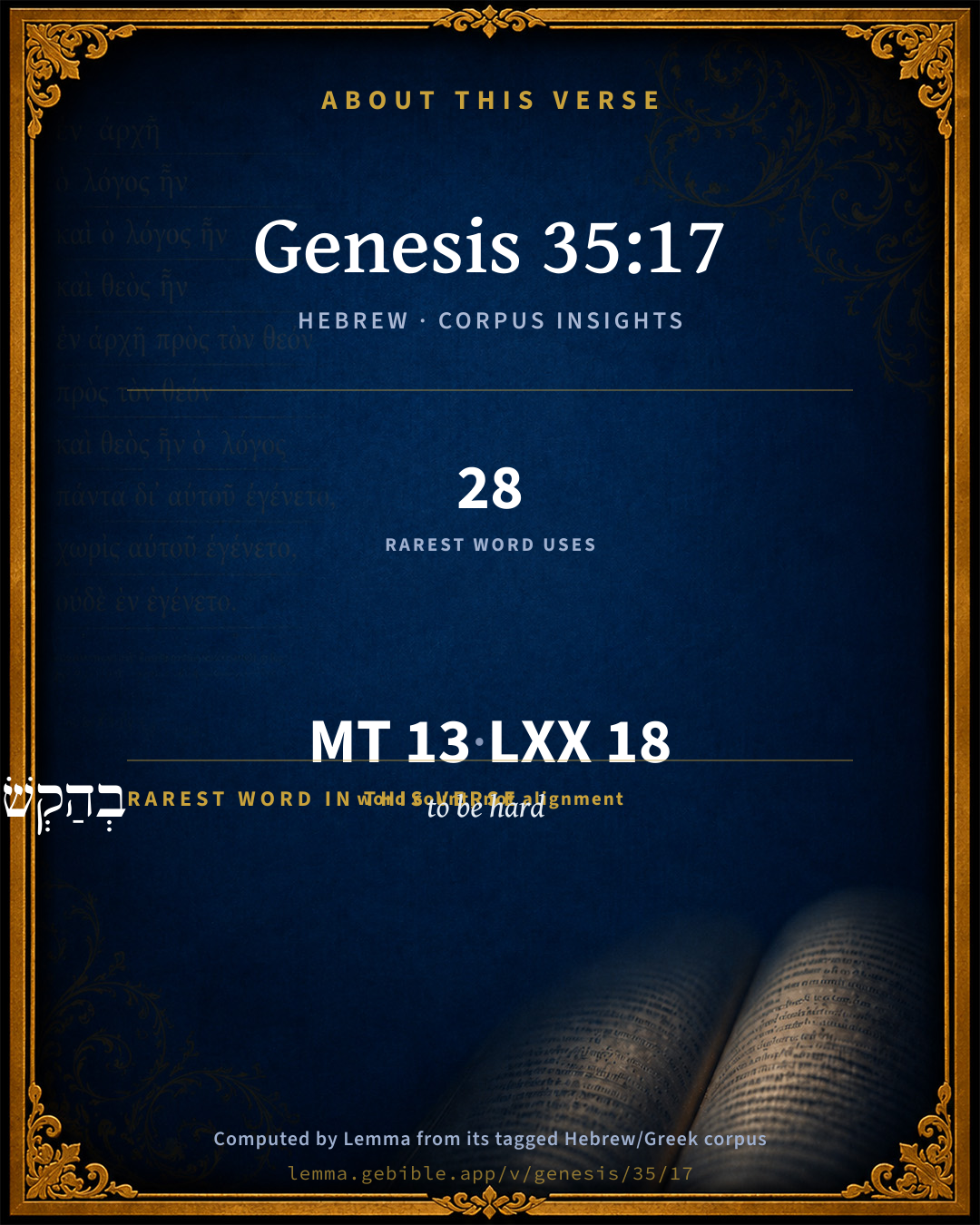
בְהַקְשֹׁתָ֖הּ
qâshâh
H7185
“in/at · to be hard · her”
Preposition + Verb, Hiphil, Infinitive Construct + Suffix, Personal, 3rd Person, Feminine, Singular
Part of Speech
Preposition + Verb
Stem
Hiphil
Form
Infinitive Construct
Full BDB Definition

Origin: a primitive root

TWOT: 2085

to be hard, be severe, be fierce, be harsh - (Qal) - to be hard, be difficult - to be hard, be severe - (Niphal) - to be ill-treated - to be hard pressed - (Piel) to have severe labour (of women) - (Hiphil) - to make difficult, make difficulty - to make severe, make burdensome - to make hard, make stiff, make stubborn - of obstinacy (figuratively) - to show stubbornness
  1. וַיְהִ֥י hâyâh H1961 “and · to be” Conjunction + Verb, Qal, Sequential Imperfect, 3rd Person, Masculine, Singular
  2. בְּלִדְתָּ֑הּ yâlad H3205 “in/at · to bear · her” Preposition + Verb, Qal, Infinitive Construct + Suffix, Personal, 3rd Person, Feminine, Singular
  3. וַתֹּ֨אמֶר ʼâmar H559 “and · to say” Conjunction + Verb, Qal, Sequential Imperfect, 3rd Person, Feminine, Singular
  4. הַמְיַלֶּ֨דֶת֙ yâlad H3205 “the · bearing” Particle, Definite Article + Verb, Piel, Participle Active, Feminine, Singular, Absolute
  5. אַל ʼal H408 “not” Particle, Negative
  6. תִּ֣ירְאִ֔י yârêʼ H3372 “to fear” Verb, Qal, Jussive, 2nd Person, Feminine, Singular
  7. כִּֽי kîy H3588 “that” Conjunction
  8. גַם gam H1571 “also” Adverb
  9. זֶ֥ה zeh H2088 “this” Pronoun, Demonstrative, Masculine, Singular
  10. בֵּֽן bên H1121 “son” Noun, Common, Masculine, Singular, Absolute

About this verse

These counts appear in no published source. They are computed here, from the morphology-tagged text and Lemma’s own curated glosses. What Lemma adds →

13
words
10
distinct lemmas
Pentateuch
section

Shared distinctive vocabulary

בְהַקְשֹׁתָ֖הּ to be hard H7185 occurs in 28 verses of the Hebrew Bible. Also found in:

Grammatical profile

  • 6 verbs
  • 1 noun
  • 1 pronoun
  • 2 prepositions
  • 1 conjunction
  • 1 adverb
  • 1 particle

Verb forms

  • וַיְהִ֥י Qal · Sequential Imperfect
  • בְהַקְשֹׁתָ֖הּ Hiphil · Infinitive Construct
  • בְּלִדְתָּ֑הּ Qal · Infinitive Construct
  • וַתֹּ֨אמֶר Qal · Sequential Imperfect
  • הַמְיַלֶּ֨דֶת֙ Piel · Participle Active
  • תִּ֣ירְאִ֔י Qal · Jussive

Repetition

A word recurs within this verse — often emphatic in Hebrew:

  • בְּלִדְתָּ֑הּ to bear H3205 ×2

Hebrew & Septuagint length

In English translation the verse runs 25 words from the Hebrew and 26 from the Septuagint (LXX English) — closely comparable.

A rough comparison of the two English renderings, which tokenize alike — not a word-level alignment.

Word counts can differ between the Hebrew and the Greek without any difference in meaning — e.g. the Hebrew direct-object marker אֵת has no separate Greek word, and Greek often adds the article ὁ.

In the original languages it is 13 Hebrew tokens and 18 Greek tokens — but the two are counted differently (Hebrew bundles its prefixes and suffixes into one token; the Greek is in lemma form), so that isn’t a like-for-like length.

Cross-references

2

Topical passages linked to Genesis 35:17 in the Treasury of Scripture Knowledge — connected by theme and wording, ordered by reader-vote popularity; previews shown in the World English Bible.

  • Genesis 30:24 She named him Joseph, saying, "May Yahweh add another son to me."
  • 1 Samuel 4:19–21 His daughter-in-law, Phinehas' wife, was with child, near to be delivered: and when she heard the news that the ark of God was taken, and that her father-in-law and her husband were dead, she bowed herself and brought forth; for her pains came on her.

Cross-references courtesy of OpenBible.info (CC BY 4.0).

Hebrew and Greek witnesses Masoretic Hebrew ↔ Greek Septuagint

The same verse in the two great witnesses to the Old Testament, shown verse-for-verse.

These are two independent witnesses, not word-aligned to each other, and the Septuagint is shown in lemma (dictionary) form.

Hebrew Genesis 35:17 Masoretic · Westminster Leningrad Codex

וַיְהִ֥י בְהַקְשֹׁתָ֖הּ בְּלִדְתָּ֑הּ וַתֹּ֨אמֶר לָ֤הּ הַמְיַלֶּ֨דֶת֙ אַל תִּ֣ירְאִ֔י כִּֽי גַם זֶ֥ה לָ֖ךְ בֵּֽן

It happened that, when she was in hard labor, that the midwife said to her, "Don't be afraid, for now you will have another son."

World English Bible · Public Domain

Greek LXX Genesis 35:17 Septuagint · lemma form

γίγνομαι δέ ἐν ὁ σκληρῶς αὐτός τίκτω εἶπον αὐτός ὁ μαῖα θαρρέω καί γάρ οὗτος σύ εἰμί υἱός

And it came to pass in her hard labor, that the midwife said to her, Be of good courage, for you shall also have this son.

LXX2012 (modern English Septuagint) · Public Domain

Hebrew: Westminster Leningrad Codex (CC BY 4.0). Greek: Septuagint (public domain); English from LXX2012 (modern English Septuagint) (Public Domain). How the Septuagint differs from the Hebrew →

Targum (Aramaic paraphrase)

2

The Targum is the ancient Jewish Aramaic paraphrase of the Hebrew Scriptures — an interpretive translation, not the Hebrew text itself. Onkelos (literal) and Pseudo-Jonathan (expansive) render the Torah, and Jonathan the Prophets. Coverage is partial: where no permissively-licensed English translation exists for a verse, only the Aramaic is shown. This is verse-level text, not a word-by-word alignment to the Hebrew.

  1. Targum Onkelos Torah (Genesis–Deuteronomy)
    וַהֲוָה בְקַשְׁיוּתַהּ בְּמֵילְדַהּ וַאֲמֶרֶת לַהּ חָיְתָא לָא תִדְחֲלִי אֲרֵי אַף דֵּין לִיךְ בָּר

    (no public-domain English translation for this verse)

    Targum Onkelos — Aramaic: “Onkelos Genesis” (public domain); “Onkelos Exodus” (public domain); “Onkelos Leviticus” (public domain); “Onkelos Numbers” (public domain); “Onkelos Deuteronomy” (public domain). English: “Sefaria Community Translation” (CC0 1.0 (public-domain dedication)); “J.W. Etheridge. The Targums of Onkelos and Jonathan Ben Uzziel on the Pentateuch. London: Longmans, Green, 1862” (public domain). Text via Sefaria.

  2. Targum Pseudo-Jonathan Torah (Genesis–Deuteronomy)
    וַהֲוָה בְּקַשְׁיוּתָהּ בְּמֵילְדָהּ וַאֲמָרַת לָהּ חַיְיתָא לָא תִדְחָלִין אֲרוּם אוּף דֵין לִיךְ בַּר דְכַר

    And it was in the hardness of her travail that the midwife said to her, Fear not, for this also is to thee a male child.

    Targum Pseudo-Jonathan — Aramaic: “Targum Jonathan on Genesis” (public domain); “Targum Jonathan on Exodus” (public domain); “Targum Jonathan on Leviticus” (public domain); “Targum Jonathan on Numbers” (public domain); “Targum Jonathan on Deuteronomy” (public domain). English: “The Targum of Jonathan ben Uzziel, trans. J. W. Etheridge, London, 1862” (public domain). Text via Sefaria.

Commentary

Notes on Genesis 35:17 from classic Christian and Jewish commentators (each source and its license shown beneath its notes). The classic Christian expositions comment on the surrounding passage and are grouped to its opening verse, so a note may address several verses; the Jewish commentaries on the Tanakh (Rashi and others) are per-verse, so they appear only where the commentator wrote on this verse.

Lemma curates 59 commentaries, every one of them public domain or Creative Commons licensed, each selected and text-cleaned for this edition rather than reprinted as found. About our sources →

Trapp's Complete Commentary

John Trapp

Gen 35:17 And it came to pass, when she was in hard labour, that the midwife said unto her, Fear not; thou shalt have this son also.

Ver. 18. As her soul was in departing,] viz., To God that gave it. It is a spiritual, immortal substance, distinct from the body; and can subsist of itself; {a} as the mariner can, when the ship is broken.

For she died.] In our birth, we rent our mothers, to death sometimes, whom before we had burdened; so far nature witnessing our viperous generation, because of sin, which we bring into the world.

But his father called him Benjamin.] Lest the former name should be a daily reminder of his loss. Let men make their burdens as light as they can, and not increase their worldly sorrow by sight of sad objects. It will come, as we say of foul weather, soon enough; we need not send for it. What should dropsy men do eating salt meats?

{a} Epicharmium est illud; concretum fuit et discretum est, rediitque unde venerat, terra deorsum, spiritus sursum.

John Trapp, A Commentary or Exposition upon All the Books of the Old and New Testament (1647–1656) — public domain. Text from a community e-Sword module.

John Calvin's Commentaries

17. The midwife said unto her. We know that the ancients were very desirous of offspring, especially of male offspring. Since Rachel therefore does not accept this kind of consolation when offered, we infer that she was completely oppressed with pain. She therefore died in agonies, thinking of nothing but her sad childbirth and her own sorrows: from the feeling of which she gave a name to her son; but Jacob afterwards corrected the error. For the chance of the name sufficiently shows, that, in his judgment, the excess of sorrow in his wife was wrong; seeing that she had branded his son with a sinister and opprobrious name; for that sadness is not free from ingratitude, which so occupies our minds in adversity that the kindness of God does not exhilarate them; or, at least, does not infuse some portion of sweetness to mitigate our grief. Then her burial is mentioned; to which the holy fathers could not have attended with such religious care, except on account of their hope of the future resurrection. Whenever, therefore, we read concerning their burying the dead, as if they were anxious about the performance of some extraordinary duty, let us think of that end of which I have spoken; for it was no foolish ceremony, but a lively symbol of the future resurrection. I acknowledge, indeed, that profane and degenerate men at that time, in various places, vainly incurred much expense and toil in burying their dead, only as an empty solace of their grief. But although they had declined from the original institution into gross errors, yet the Lord caused that this rite should remain entire among his own people. Moreover, he designed that a testimony should exist among unbelievers, by which they might be rendered inexcusable. For since, independently of instruction, this sentiment was innate in all men, that to bury the dead was one of the offices of piety, nature has clearly dictated to them that the human body is formed for immortality; and, therefore, that, by sinking into death, it does not utterly perish. The statue or monument, erected by him, signifies the same thing. He reared no citadel which might stand as a token of his glory among his posterity: but he took care to raise the memorial of a sepulcher, which might be a witness to all ages that he was more devoted to the life to come; and, by the providence of God, this memorial remained standing, till the people returned out of Egypt.

John Calvin's Commentaries (1540-1563) — public domain. Text from the Calvin Translation Society English edition (1840s-50s) via the Christian Classics Ethereal Library (ccel.org). Calvin's coverage is partial (roughly two-thirds of the Bible); uncommented books and verses are honest gaps, never fabricated. The 19th-century editor's footnotes and remarks are omitted so the notes are faithfully Calvin's own voice.

The Cambridge Bible for Schools and Colleges

gen. ed. J. J. S. Perowne

17. another son] Lit. “for this also is a son for thee.” Perhaps the reference is to Rachel’s prayer (Gen_30:24), “the Lord add to me another son,” when Joseph was born.

The Cambridge Bible for Schools and Colleges (gen. ed. J. J. S. Perowne; Cambridge University Press, 1878–1918) — public domain. Text from a community e-Sword module.

John Gill's Exposition

And it came to pass, as her soul was in departing, for she died,.... In childbirth; she had most passionately desired children, without which she could not live with ease and peace of mind, and now she dies by having one; see Gen 30:1; and by this account of her death it appears, that death is the separation and disunion of soul and body; that at death the soul departs from the body; that the soul does not die with it, but goes elsewhere, and lives in a separate state, and never dies; it goes into another world, a world of spirits, even unto God that gave it, Ecc 12:7,

that she called his name Benoni; which signifies "the son of my sorrow", having borne and brought him forth in sorrow, and now about to leave him as soon as born, which might increase her sorrow; or "the son, of my mourning"; as Aben Ezra and Ben Gersom interpret it; or "the son of my strength", all her strength being exhausted in bringing him forth:

but his father called him Benjamin; that is, "the son of the right hand", being as dear to him, and as beloved by him as his right hand; or who would be as the right hand to him, his staff and support in his old age; or else as being the son of her who was as his right hand, dear and assisting to him. Some render it, "the son of days", or years, that is, the son of his old age, as he is called, Gen 44:20; Jarchi and Ben Gerson interpret it, "the son of the south"; the right hand being put for the south; and they think this son was so called, because he only was born in the land of Canaan, which lay, they say, to the south with respect to Mesopotamia, where the rest were born; but be the etymology of the word as it will, the change of the name seems to be made by Jacob, because that which Rachel gave her son would have perpetually put Jacob in mind of the sorrow of his beloved Rachel, and therefore gave him a name more pleasant and agreeable. The Jews say (c) he was born the eleventh of October, and lived one hundred and eleven years.

(c) Shalshalet Hakabala, fol. 4. 1.

John Gill's Exposition of the Whole Bible (1746–1763) — public domain (CC PDM 1.0). Text via the HelloAO Bible API.

Whedon's Commentary on the Bible

Daniel D. Whedon

17. Thou shalt have this son also — Rather, for this also is to thee a son; apparently in allusion to her wish at Joseph’s birth.

Daniel D. Whedon (gen. ed.), Commentary on the Old and New Testaments (1874–1909) — public domain. Text from a community e-Sword module.

The Pulpit Commentary

And it came to pass, when she was in hard labor (literally, in her laboring hard in her parturition), that the midwife said unto her, Fear not; thou shalt have this son also literally, for also this to thee a son; meaning either that she would certainly have strength to bring forth another son, or, what is more probable, that the child was already born, and that it was a son.

The Pulpit Commentary (1880–1919), ed. H.D.M. Spence-Jones & Joseph S. Exell — public domain. Text from a community e-Sword module.

John Wesley's Explanatory Notes

Rachel had said when she bore Joseph, God shall give me another son, which now the midwife remembers, and tells her, her words were made good. Yet this did not avail; unless God command away fear, no one else can. We are apt in extreme perils to comfort ourselves and our friends with the hopes of a temporal deliverance, in which we may be disappointed; we had better ground our comforts on that which cannot fail us, the hope of eternal life. Rachel had passionately said, Give me children, or else I die; and now she had children (for this was her second) she died.

John Wesley, Explanatory Notes Upon the Whole Bible (1754–1765) — public domain. Text via the GEBible commentary corpus.

Rashi

Rabbi Shlomo Yitzchaki (Rashi)

כי גם זה FOR THIS ALSO — also means additional to you, over and above Joseph. Our Rabbis explained that with each of Jacob’s sons a twin-sister was born, whilst with Benjamin an additional twin sister was born (Genesis Rabbah 82:8).

Rashi on the Tanakh — English translations: “The Judaica Press complete Tanach with Rashi, translated by A. J. Rosenberg” (CC BY 4.0); “Pentateuch with Rashi's commentary by M. Rosenbaum and A.M. Silbermann, 1929-1934” (public domain); “The Metsudah Tanach series, Lakewood, N.J” (CC BY 4.0); and “The Book of Joshua, Metsudah Publications, 1997” (CC BY 4.0). Text via Sefaria.

Radak

Rabbi David Kimhi (Radak)

כי גם זה לך בן, “as you had said when you gave birth to Joseph, when you asked G’d to grant you another son. (30,24.) Now get hold of yourself.”

Radak on the Tanakh — English translations: “Sefaria Community Translation” (CC0 1.0 (public-domain dedication)); “Eliyahu Munk, HaChut Hameshulash” (CC BY 4.0); “Rabbi Mike Feuer, Jerusalem Anthology” (CC BY 4.0); and “R. David Kimhi on the first book of Psalms, Translated by R.G. Finch, London, 1919” (public domain). Text via Sefaria.

Lesson kit

Teaching starters — assembled from the data on this page, not authored interpretation. Every prompt links to the verse data it draws on. Edit before teaching.

Genesis, in the Pentateuch, opens this verse with 13 words (10 distinct Hebrew lemmas). Its most distinctive word is qâshâh (“to be hard”). A historical commentator’s framing appears above. Read the whole chapter for the surrounding context.

Discussion questions

  1. What does “to be hard” (qâshâh) contribute to the verse as a whole?
  2. Genesis 35:16 shares the word «to be hard» with this verse. How do the two illuminate each other?
  3. “to bear” occurs 2× in this one verse. What is the effect of the repetition?
  4. These translations render this verse differently. What is at stake in choosing one wording over another?
  5. The verb «וַיְהִ֥י» is Qal Sequential Imperfect. How does its form color the action?
  6. Reading how Trapp's Complete Commentary and John Calvin's Commentaries read this verse, where do the two commentators agree and where do they part?

Things to notice

Reading settings

Reading text

Shown beneath each verse's original-language words.

Old Testament
Old Testament edition

Read the OT as the Masoretic Hebrew (MT) or the Greek Septuagint (LXX).

English shown for the Greek Septuagint (in the Hebrew ↔ Greek comparison).

Comparing translations? Open the Compare panel on any verse page to stack up to four side by side.