
Exodus 32:22

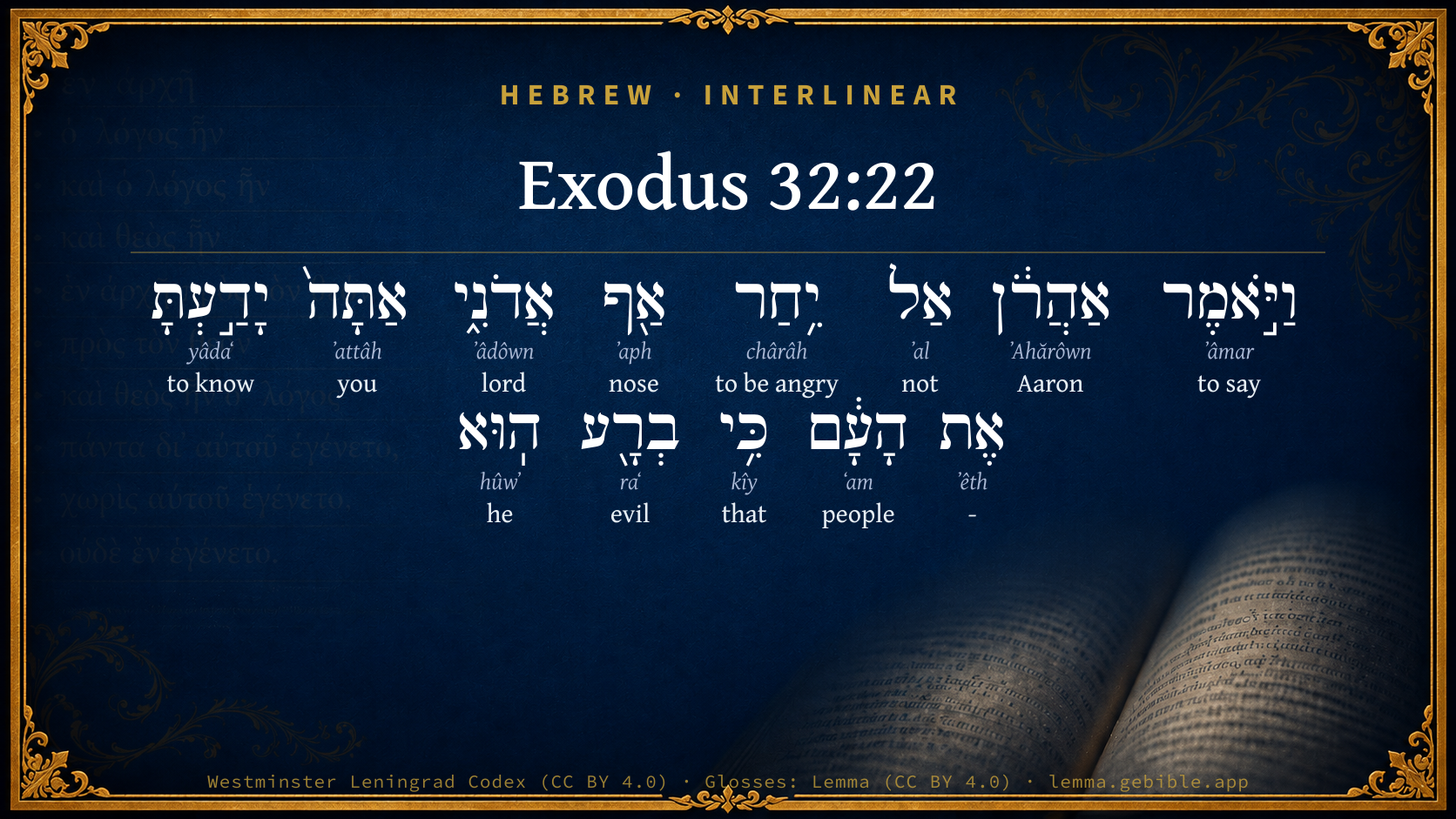
Hebrew (Westminster Leningrad Codex) Exodus 32:22 appears in the Hebrew Old Testament. The text above is from the Westminster Leningrad Codex. Each word links to its Strong’s number, a concise gloss, and parsing drawn from the Open Scriptures Hebrew Bible morphology. Click any word for its full Brown-Driver-Briggs (BDB) entry.
Download image
Cite this verse

Exodus 32:22 (World English Bible). Public Domain. Lemma interlinear Bible study tool, https://lemma.gebible.app/v/exodus/32/22.

Show BibTeX & RIS
BibTeX
RIS
English Translation
Aaron said, "Don't let the anger of my lord grow hot. You know the people, that they are set on evil.
World English Bible · Public Domain
Download a study sheet

One document with this verse’s original text, its word-by-word gloss line, the meaning frame, cross-references with their text, attributed commentary, and full source and license credits — printable, and it pastes into notes with its structure intact.

This verse Autodidact and up

Study sheet (.html) Plain text (.txt)

A passage Seminary Student

Up to 50 verses in one chapter. A passage sheet keeps up to 6 commentary sources and 12 cross-references per verse, in the order this page ranks them, and says so on the sheet whenever that leaves anything out. Ask for a single verse and you get the Autodidact verse sheet above.

Everything on this page stays free to read, with no account — the sheet is a download of what is already on screen, not access to it.

Want to remove ads? Support Godless Engineer
Compare translations 3

The same verse in 3 English versions, stacked beneath the original-language interlinear above. Click any original word for its lexicon entry.

Each is an independent rendering of the whole verse — the interlinear is not word-aligned to these translations.

Highlighted words mark where these versions differ — a whole-verse word diff, not a word-by-word alignment.

  • World English Bible Public Domain
    Aaron said, "Don't let the anger of my lord grow hot. You know the people, that they are set on evil.
  • King James Version Public Domain
    And Aaron said, Let not the anger of my lord wax hot: thou knowest the people, that they are set on mischief.
  • unfoldingWord Literal Text CC BY-SA 4.0
    And Aaron said, “Do not let nose burn, my lord. You know the people, that it in evil.

unfoldingWord Literal Text — © unfoldingWord, licensed CC BY-SA 4.0. Word-aligned USFM3 via Door43 (git.door43.org/unfoldingWord/en_ult).

Versions to compare (up to 4)

3 of 4 selected

Show all 18 translations

Every available English version of this verse, each an independent rendering of the whole verse.

  • World English Bible Public Domain
    Aaron said, "Don't let the anger of my lord grow hot. You know the people, that they are set on evil.
  • Berean Standard Bible Public Domain
    “Do not be enraged, my lord,” Aaron replied. “You yourself know that the people are intent on evil.
  • Majority Standard Bible Public Domain
    “Do not be enraged, my lord,” Aaron replied. “You yourself know that the people are intent on evil.
  • King James Version Public Domain
    And Aaron said, Let not the anger of my lord wax hot: thou knowest the people, that they are set on mischief.
  • American Standard Version (1901) Public Domain
    And Aaron said, Let not the anger of my lord wax hot: thou knowest the people, that they are `set' on evil.
  • Revised Version (1885) Public Domain
    And Aaron said, Let not the anger of my lord wax hot: thou knowest the people, that they are set on evil.
  • Geneva Bible (1599) Public Domain
    Then Aaron answered, Let not the wrath of my Lord waxe fearce: Thou knowest this people, that they are euen set on mischiefe.
  • Douay-Rheims (1899) Public Domain
    And he answered him: Let not my lord be offended: for thou knowest this people, that they are prone to evil.
  • Young's Literal Translation Public Domain
    and Aaron saith, `Let not the anger of my lord burn; thou -- thou hast known the people that it `is' in evil;
  • Literal Standard Version CC BY-SA 4.0
    And Aaron says, “Do not let the anger of my lord burn; you have known the people, that it [is beset] with evil;
  • Unlocked Literal Bible CC BY-SA 4.0
    Aaron said, “Do not let your anger burn hot, my master. You know these people, how they are set on doing evil.
  • unfoldingWord Literal Text CC BY-SA 4.0
    And Aaron said, “Do not let nose burn, my lord. You know the people, that it in evil.
  • Darby Bible Public Domain
    And Aaron said, Let not the anger of my lord burn! thou knowest the people, that they are [set] on mischief.
  • World Messianic Bible Public Domain
    Aaron said, “Don’t let the anger of my lord grow hot. You know the people, that they are set on evil.
  • Webster's Bible Public Domain
    And Aaron said, Let not the anger of my lord wax hot: thou knowest the people that they are set on mischief.
  • Free Bible Version CC BY-SA 4.0
    “Please don't get angry with me, my lord,” Aaron replied, “You yourself know how liable these people are to do evil.
  • Bible in Basic English Public Domain
    And Aaron said, Let not my lord be angry; you have seen how the purposes of this people are evil.
  • JPS Tanakh (1917) Public Domain
    And Aaron said: 'Let not the anger of my lord wax hot; thou knowest the people, that they are set on evil.

Literal Standard Version (2020), Covenant Press — licensed CC BY-SA 4.0. Text via the HelloAO Bible API (eBible.org). Unlocked Literal Bible (unfoldingWord) — licensed CC BY-SA 4.0. Text via the HelloAO Bible API (eBible.org). unfoldingWord Literal Text — © unfoldingWord, licensed CC BY-SA 4.0. Word-aligned USFM3 via Door43 (git.door43.org/unfoldingWord/en_ult). Free Bible Version, Dr. Jonathan Gallagher — licensed CC BY-SA 4.0. Text via the HelloAO Bible API (eBible.org).

Word by word

More ways to search: Search by grammar → Find every occurrence → Compare this word →

Practice this passage: Drill this verse → Learn its vocabulary →

יִ֥חַר
chârâh
H2734
“to be angry”
Verb, Qal, Jussive, 3rd Person, Masculine, Singular
Part of Speech
Verb
Stem
Qal
Form
Jussive
Person
3rd Person
Gender
Masculine
Number
Singular
Full BDB Definition

Origin: a primitive root [compare H2787 ]

TWOT: 736

to be hot, furious, burn, become angry, be kindled - (Qal) to burn, kindle (anger) - (Niphal) to be angry with, be incensed - (Hiphil) to burn, kindle - (Hithpael) to heat oneself in vexation
  1. וַיֹּ֣אמֶר ʼâmar H559 “and · to say” Conjunction + Verb, Qal, Sequential Imperfect, 3rd Person, Masculine, Singular
  2. אַהֲרֹ֔ן ʼAhărôwn H175 “Aaron” Noun, Proper
  3. אַל ʼal H408 “not” Particle, Negative
  4. אַ֖ף ʼaph H639 “nose” Particle, Accusative
  5. אֲדֹנִ֑י ʼâdôwn H113 “lord · my” Noun, Common, Masculine, Singular, Construct + Suffix, Personal, 1st Person, Common, Singular
  6. אַתָּה֙ ʼattâh H859 “you” Pronoun, Personal, 2nd Person, Masculine, Singular
  7. יָדַ֣עְתָּ yâdaʻ H3045 “to know” Verb, Qal, Perfect, 2nd Person, Masculine, Singular
  8. אֶת ʼêth H853 “-” Particle, Direct Object
  9. הָעָ֔ם ʻam H5971 “the · people” Particle, Definite Article + Noun, Common, Masculine, Singular, Absolute
  10. כִּ֥י kîy H3588 “that” Conjunction
  11. בְרָ֖ע raʻ H7451 “in/at · evil” Preposition + Adjective, Adjective, Masculine, Singular, Absolute
  12. הֽוּא hûwʼ H1931 “he” Pronoun, Personal, 3rd Person, Masculine, Singular

About this verse

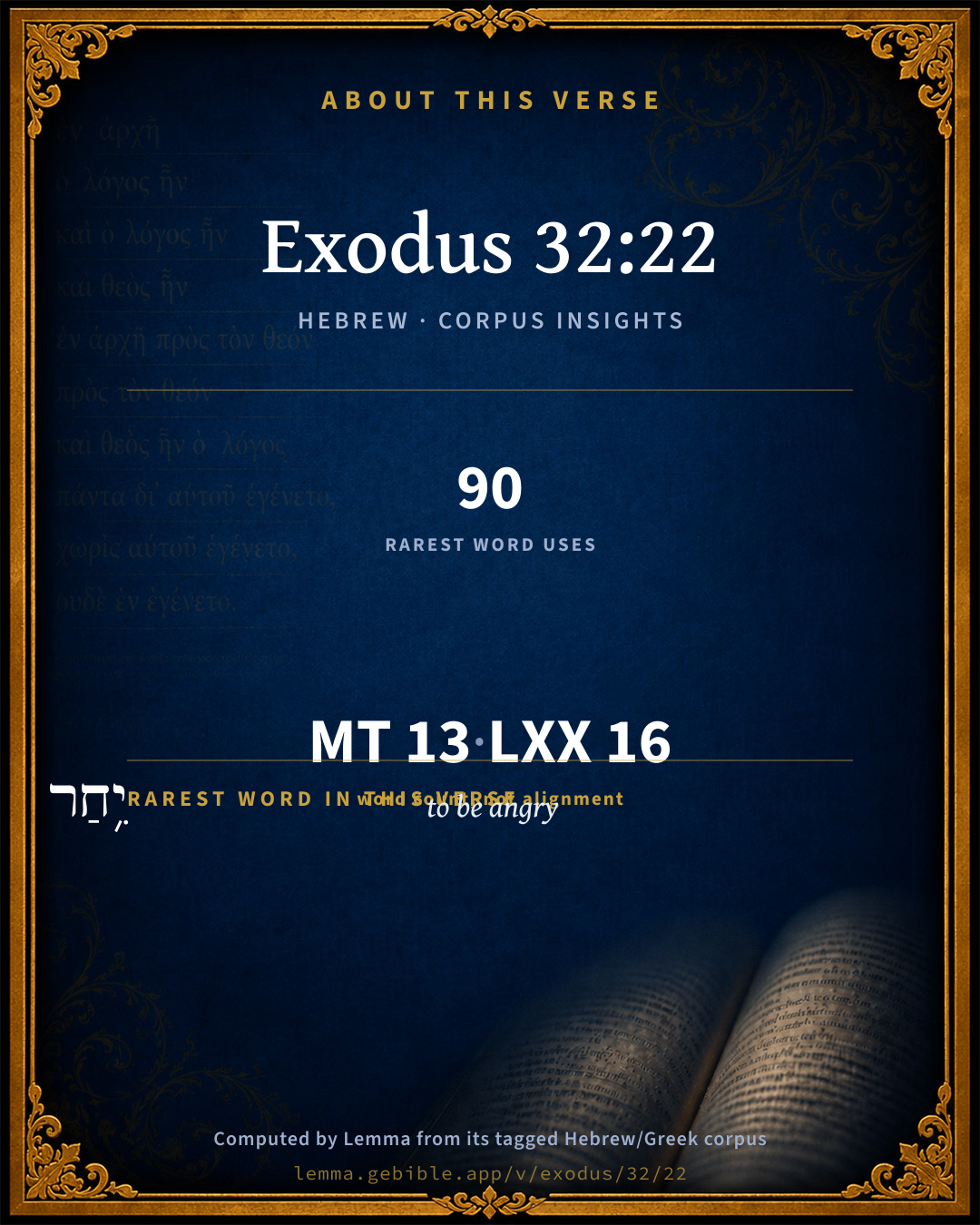
These counts appear in no published source. They are computed here, from the morphology-tagged text and Lemma’s own curated glosses. What Lemma adds →

13
words
13
distinct lemmas
Pentateuch
section

Grammatical profile

  • 3 verbs
  • 3 nouns
  • 1 adjective
  • 2 pronouns
  • 1 conjunction
  • 3 particles

Verb forms

  • וַיֹּ֣אמֶר Qal · Sequential Imperfect
  • יִ֥חַר Qal · Jussive
  • יָדַ֣עְתָּ Qal · Perfect

Hebrew & Septuagint length

In English translation the verse runs 21 words from the Hebrew and 18 from the Septuagint (LXX English) — closely comparable.

A rough comparison of the two English renderings, which tokenize alike — not a word-level alignment.

Word counts can differ between the Hebrew and the Greek without any difference in meaning — e.g. the Hebrew direct-object marker אֵת has no separate Greek word, and Greek often adds the article ὁ.

In the original languages it is 13 Hebrew tokens and 16 Greek tokens — but the two are counted differently (Hebrew bundles its prefixes and suffixes into one token; the Greek is in lemma form), so that isn’t a like-for-like length.

Cross-references

12

Topical passages linked to Exodus 32:22 in the Treasury of Scripture Knowledge — connected by theme and wording, ordered by reader-vote popularity; previews shown in the World English Bible.

  • Deuteronomy 9:24 You have been rebellious against Yahweh from the day that I knew you.
  • Exodus 14:11 They said to Moses, "Because there were no graves in Egypt, have you taken us away to die in the wilderness? Why have you treated us this way, to bring us forth out of Egypt?
  • Exodus 15:24 The people murmured against Moses, saying, "What shall we drink?"
  • Exodus 16:20 Notwithstanding they didn't listen to Moses, but some of them left of it until the morning, and it bred worms, and became foul: and Moses was angry with them.
  • 1 Samuel 15:24 Saul said to Samuel, I have sinned; for I have transgressed the commandment of Yahweh, and your words, because I feared the people, and obeyed their voice.
  • Psalms 36:4 He plots iniquity on his bed. He sets himself in a way that is not good; He doesn't abhor evil.
  • Proverbs 4:16 For they don't sleep, unless they do evil. Their sleep is taken away, unless they make someone fall.
  • Exodus 16:2–4 The whole congregation of the children of Israel murmured against Moses and against Aaron in the wilderness;
  • Exodus 16:28 Yahweh said to Moses, "How long do you refuse to keep my commandments and my laws?
  • Exodus 17:2–4 Therefore the people quarreled with Moses, and said, "Give us water to drink." Moses said to them, "Why do you quarrel with me? Why do you test Yahweh?"
  • Deuteronomy 9:7 Remember, don't forget, how you provoked Yahweh your God to wrath in the wilderness: from the day that you went forth out of the land of Egypt, until you came to this place, you have been rebellious against Yahweh.
  • Deuteronomy 31:27 For I know your rebellion, and your stiff neck: behold, while I am yet alive with you this day, you have been rebellious against Yahweh; and how much more after my death?

Cross-references courtesy of OpenBible.info (CC BY 4.0).

Hebrew and Greek witnesses Masoretic Hebrew ↔ Greek Septuagint

The same verse in the two great witnesses to the Old Testament, shown verse-for-verse.

These are two independent witnesses, not word-aligned to each other, and the Septuagint is shown in lemma (dictionary) form.

Hebrew Exodus 32:22 Masoretic · Westminster Leningrad Codex

וַיֹּ֣אמֶר אַהֲרֹ֔ן אַל יִ֥חַר אַ֖ף אֲדֹנִ֑י אַתָּה֙ יָדַ֣עְתָּ אֶת הָעָ֔ם כִּ֥י בְרָ֖ע הֽוּא

Aaron said, "Don't let the anger of my lord grow hot. You know the people, that they are set on evil.

World English Bible · Public Domain

Greek LXX Exodus 32:22 Septuagint · lemma form

καί εἶπον ααρων πρός μωυσῆς μή ὀργίζω κύριος σύ γάρ οἶδα ὁ ὅρμημα ὁ λαός οὗτος

And Aaron said to Moses, Be not angry, my lord, for you know the impetuosity of this people.

LXX2012 (modern English Septuagint) · Public Domain

Hebrew: Westminster Leningrad Codex (CC BY 4.0). Greek: Septuagint (public domain); English from LXX2012 (modern English Septuagint) (Public Domain). How the Septuagint differs from the Hebrew →

Targum (Aramaic paraphrase)

2

The Targum is the ancient Jewish Aramaic paraphrase of the Hebrew Scriptures — an interpretive translation, not the Hebrew text itself. Onkelos (literal) and Pseudo-Jonathan (expansive) render the Torah, and Jonathan the Prophets. Coverage is partial: where no permissively-licensed English translation exists for a verse, only the Aramaic is shown. This is verse-level text, not a word-by-word alignment to the Hebrew.

  1. Targum Onkelos Torah (Genesis–Deuteronomy)
    וַאֲמַר אַהֲרֹן לָא יִתְקֵף רוּגְזָא דְרִבּוֹנִי אַתְּ יְדַעְתְּ יָת עַמָא אֲרֵי בְּבִישׁ הוּא:

    (no public-domain English translation for this verse)

    Targum Onkelos — Aramaic: “Onkelos Genesis” (public domain); “Onkelos Exodus” (public domain); “Onkelos Leviticus” (public domain); “Onkelos Numbers” (public domain); “Onkelos Deuteronomy” (public domain). English: “Sefaria Community Translation” (CC0 1.0 (public-domain dedication)); “J.W. Etheridge. The Targums of Onkelos and Jonathan Ben Uzziel on the Pentateuch. London: Longmans, Green, 1862” (public domain). Text via Sefaria.

  2. Targum Pseudo-Jonathan Torah (Genesis–Deuteronomy)
    וַאֲמַר אַהֲרן לָא יִתְקֵיף רוּגְזָא דְרִבּוֹנִי אַנְתְּ יַדְעָת יַת עַמָּא אֲרוּם בְּנֵי צַדִּיקַיָא אִינוּן בְּרַם יִצְרָא בִּישָׁא הוּא דְאַטְעִינוּן

    And Aharon said, Let not my lord's anger be strong: thou knowest the people, that they are the children of the Just; but evil concupiscence hath made them to err:

    Targum Pseudo-Jonathan — Aramaic: “Targum Jonathan on Genesis” (public domain); “Targum Jonathan on Exodus” (public domain); “Targum Jonathan on Leviticus” (public domain); “Targum Jonathan on Numbers” (public domain); “Targum Jonathan on Deuteronomy” (public domain). English: “The Targum of Jonathan ben Uzziel, trans. J. W. Etheridge, London, 1862” (public domain). Text via Sefaria.

Commentary

Notes on Exodus 32:22 from classic Christian and Jewish commentators (each source and its license shown beneath its notes). The classic Christian expositions comment on the surrounding passage and are grouped to its opening verse, so a note may address several verses; the Jewish commentaries on the Tanakh (Rashi and others) are per-verse, so they appear only where the commentator wrote on this verse.

Lemma curates 59 commentaries, every one of them public domain or Creative Commons licensed, each selected and text-cleaned for this edition rather than reprinted as found. About our sources →

Trapp's Complete Commentary

John Trapp

Exo 32:22 And Aaron said, Let not the anger of my lord wax hot: thou knowest the people, that they [are set] on mischief.

Ver. 22. That they are set on mischief.] The whole world is so. {1Jn 2:16; 1Jn 5:19} Quomodo Plautus, "In fermento toto iacet uxor."

John Trapp, A Commentary or Exposition upon All the Books of the Old and New Testament (1647–1656) — public domain. Text from a community e-Sword module.

Jamieson, Fausset & Brown

Robert Jamieson, A. R. Fausset & David Brown

And Aaron said, Let not the anger of my lord wax hot--Aaron cuts a poor figure, making a shuffling excuse and betraying more dread of the anger of Moses than of the Lord (compare Deu 9:20).

Jamieson, Fausset & Brown — Commentary Critical and Explanatory on the Whole Bible (1871) — public domain (CC PDM 1.0). Text via the HelloAO Bible API.

Adam Clarke's Commentary

Verse 22. Thou knowest the people] He excuses himself by the wicked and seditious spirit of the people, intimating that he was obliged to accede to their desires.

Adam Clarke's Commentary on the Bible (1810–1826) — public domain. Text from a community e-Sword/MySword module.

Ellicott's Commentary for English Readers

(22-24) Aaron’s conduct was really without excuse; but he attempts two pleas—the first insufficient, the second false and fatuous. (1) The people compelled him; they were “set on mischief;” they made the proposal—they would have it so. (2) He threw the gold into the furnace, and “it came out a calf,” as if he had not ordered the construction of the mould. In Deuteronomy, Moses informs us that Aaron’s whole conduct so angered God that God would have destroyed him but for his own intercession (Deu_9:20).

A Bible Commentary for English Readers, edited by Charles John Ellicott (1878–1897) — public domain. Text from a community e-Sword module.

The Cambridge Bible for Schools and Colleges

gen. ed. J. J. S. Perowne

22. Aaron first excuses himself by casting the blame upon the people: they are set on evil, and he merely (v. 33) responded to their request.

my lord] as Num_11:28; Num_12:11.

The Cambridge Bible for Schools and Colleges (gen. ed. J. J. S. Perowne; Cambridge University Press, 1878–1918) — public domain. Text from a community e-Sword module.

John Gill's Exposition

For they said unto me, make us gods, which shall go before us,.... Which was true, Exo 32:1 but then he should have told them, that gods were not to be made; that what were made with hands were no gods, and could not go before them; that the making of any image, similitude, or representation of God, was forbidden by him, as they had lately heard from his own mouth; he should have dissuaded from such idolatry, by showing them the evil nature of the sin, and the ruin they exposed themselves to by it:

for as for this Moses, the man that brought us up out of the land of Egypt, we wot not what is become of him; their words he truly recites, and perhaps might choose the rather to mention them, because they carried in them some reflection on Moses for staying so long in the mount; and as if that contributed much to this affair, and which put the people on forming such a scheme, they concluding he must be dead through famine; or, as the Targum of Jonathan, be burnt with flaming fire from the Lord.

John Gill's Exposition of the Whole Bible (1746–1763) — public domain (CC PDM 1.0). Text via the HelloAO Bible API.

Haydock's Catholic Bible Commentary

Evil. Aaron answers his younger brother with humility, being now touched with repentance; on which account, God still grants him the high priesthood. (Haydock)

George Leo Haydock (1774–1849), Haydock's Catholic Family Bible and Commentary, 1859 edition — public domain. Excludes Psalms (Douay-Rheims chapter numbering differs from Protestant) and Deuterocanonical books (Catholic canon only).

Matthew Poole's English Annotations

Heb. are in evil, i.e. are altogether wicked, addicted to, or bent upon wickedness, so that it was impossible for me to stop or divert their course.

Matthew Poole's English Annotations on the Holy Bible (1683–1685) — public domain. Text from a community e-Sword/MySword module.

The Pulpit Commentary

Let not the anger of my lord wax hot. Aaron"s humility is extreme, and the result of a consciousness of guilt. He nowhere else addresses Moses as "my lord." Set on mischief. Or "inclined to evil" (Kalisch).

HOMILETICS.

Vers. 22-24. Aaron"s excuses.

We are all ready enough to condemn Aaron for his insincere and shifty answer; but do not the apostle"s words occur to any of us? thou art inexcusable, O man, whosoever thou art that judgest, for wherein thou judgest another, thou condemnest thyself; for thou that judgest doest the same things". (Rom_2:1) Do not we all, when we are taxed with faults, seek to shift the blame of them elsewhere? e.g. :

I ON THE PEOPLE WITH WHOM WE LIVE. Society, we say, is corrupt is "set on mischief." Its customs are wrong, we know; but it is too strong for us. We must conform to its ways. There is no use in resisting them. Public men say and such changes in the law would be bad we know it we admit it but the people ask for them, so we must lend ourselves to their wishes, and take steps to get the changes made." Or again or that war would be unjust, iniquitous, a flying in the face of Christian principle. To engage in it would be a crime a disgrace to the age we live in." But let the popular voice call for the war a little loudly and the public man yields, silences the remonstrances of his conscience, and becomes an active agent in bringing the war about. And the case is the same in private life. Ask a man why he spends on entertainments twice as much as he spends in charity, and he will immediately lay the blame on others one does it." Ask him why he wastes his whole time in frivolous pursuits, newspaper-reading, club-gossiping, card-playing, party-going, and his reply is the same. Descend a little in the social scale, and ask the manufacturer why he scamps his goods; the shopkeeper why he adulterates; the ship-owner why he insures ships that he knows to be unseaworthy and sends out to be wrecked and his answer is parallel one in his line of business does the same." They compel him to follow their bad example. Descend again, ask the confidential servant why he takes "commission" from tradesmen; the cook, why she hides fresh joints among the broken victuals; the footman, why he purloins wine and cigars; they defend themselves with the same plea is wrong, they know: but their class has established the practice." "We are all the victims of our social surroundings; it is not we who are in fault, but the crowd that pushes us on.

II ON THE NATURE THAT GOD HAS GIVEN US, ON THE CIRCUMSTANCES IN WHICH WE ARE PLACED. Sins of temper and sins of impurity are constantly set down by those who commit them to their nature. Their tempers are naturally so bad, their passions naturally so strong. As if they had no power over their nature; as if again, they did not voluntarily excite their passions, work themselves up into rages; "make provision for the flesh, to fulfil the lusts thereof." In thus doing they construct the mould into which the sins run. Sins of dishonesty are commonly attributed to circumstances: the temptation came in their way, men say, without their seeking it, and was too much for them, was not to be resisted. So with drunkenness, idleness, and the other sins connected with evil companionship; men"s plea is they were brought into contact with persons who dragged them, almost forced them into evil courses. Had they been more happily circumstanced it would have been different. As if a man did not to a large extent make his own circumstances, choose his companions, construct his own way of life. We are not forced to company with any men, much less any women, out of business hours. We are not compelled to go to places of public amusement where we are tempted. The "circumstances" which lead to sin are usually circumstances which we might easily have avoided, if we had chosen, as Aaron might have avoided making the mould, or even asking for the ornaments.

The Pulpit Commentary (1880–1919), ed. H.D.M. Spence-Jones & Joseph S. Exell — public domain. Text from a community e-Sword module.

Rashi

Rabbi Shlomo Yitzchaki (Rashi)

כי ברע הוא [THOU KNOWEST THE PEOPLE] THAT THEY ARE SET ON EVIL — They always go on the wrong way and with temptations, before the Omnipresent.

Rashi on the Tanakh — English translations: “The Judaica Press complete Tanach with Rashi, translated by A. J. Rosenberg” (CC BY 4.0); “Pentateuch with Rashi's commentary by M. Rosenbaum and A.M. Silbermann, 1929-1934” (public domain); “The Metsudah Tanach series, Lakewood, N.J” (CC BY 4.0); and “The Book of Joshua, Metsudah Publications, 1997” (CC BY 4.0). Text via Sefaria.

Ramban (Nachmanides)

Rabbi Moshe ben Nachman (Ramban / Nachmanides)

THOU KNOWEST THE PEOPLE, THAT THEY ARE SET ON EVIL. Aaron is saying: “They proceeded along the path of evil. They told me to make them a guide in the place of my lord until he returns to me, for perhaps he will return, and then they gave me the gold and I cast it into the fire and behold there came out this calf for them, for they had an evil intention as to the gold, [and wanted] to worship it and sacrifice to it.” But because Aaron did not want to speak at length about their corruption, he spoke briefly and said, and there came out this calf, meaning, “there came out for them this evil matter that my lord sees.”

Ramban (Nachmanides) on the Tanakh — English translation: “Commentary on the Torah by Ramban (Nachmanides). Translated and annotated by Charles B. Chavel. New York, Shilo Pub. House, 1971-1976” (CC BY 4.0). Text via Sefaria.

Lesson kit

Teaching starters — assembled from the data on this page, not authored interpretation. Every prompt links to the verse data it draws on. Edit before teaching.

Exodus, in the Pentateuch, opens this verse with 13 words (13 distinct Hebrew lemmas). Its most distinctive word is chârâh (“to be angry”). A historical commentator’s framing appears above. Read the whole chapter for the surrounding context.

Discussion questions

  1. The word chârâh carries the sense “to be angry.” How does it shape the verse?
  2. How does Deuteronomy 9:24, which shares this passage’s theme, read alongside this verse?
  3. These translations render this verse differently. What is at stake in choosing one wording over another?
  4. «וַיֹּ֣אמֶר» is a Qal Sequential Imperfect verb. How does that grammatical form shape the action described?
  5. Compare how Trapp's Complete Commentary and Jamieson, Fausset & Brown read this verse. Where do they agree or differ?

Things to notice

Reading settings

Reading text

Shown beneath each verse's original-language words.

Old Testament
Old Testament edition

Read the OT as the Masoretic Hebrew (MT) or the Greek Septuagint (LXX).

English shown for the Greek Septuagint (in the Hebrew ↔ Greek comparison).

Comparing translations? Open the Compare panel on any verse page to stack up to four side by side.