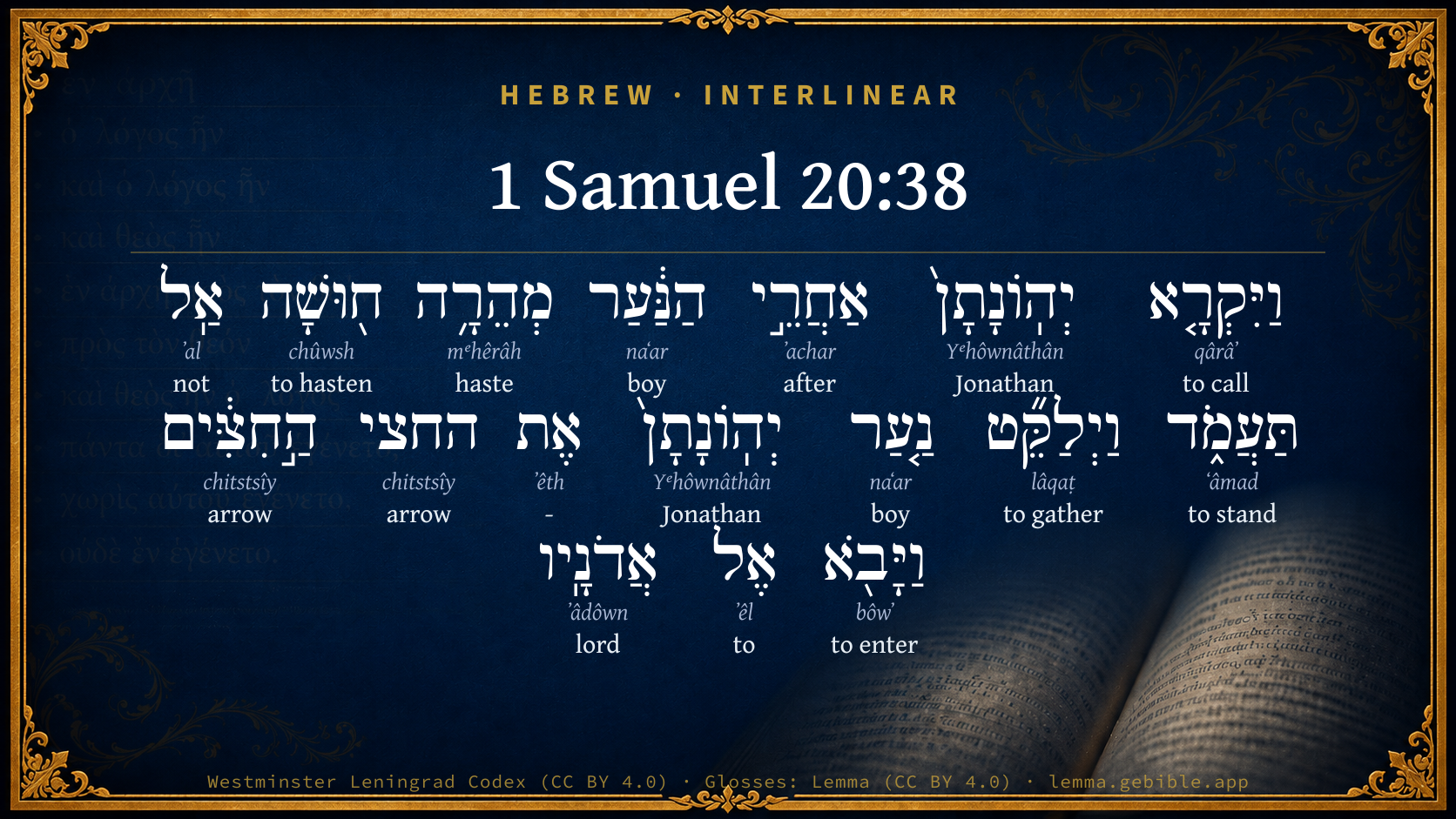
1 Samuel 20:38

Hebrew (Westminster Leningrad Codex) 1 Samuel 20:38 appears in the Hebrew Old Testament. The text above is from the Westminster Leningrad Codex. Each word links to its Strong’s number, a concise gloss, and parsing drawn from the Open Scriptures Hebrew Bible morphology. Click any word for its full Brown-Driver-Briggs (BDB) entry.
Download image
Cite this verse

1 Samuel 20:38 (World English Bible). Public Domain. Lemma interlinear Bible study tool, https://lemma.gebible.app/v/1-samuel/20/38.

Show BibTeX & RIS
BibTeX
RIS
English Translation
Jonathan cried after the boy, Go fast! Hurry! Don't delay! Jonathan's boy gathered up the arrows, and came to his master.
World English Bible · Public Domain
Download a study sheet

One document with this verse’s original text, its word-by-word gloss line, the meaning frame, cross-references with their text, attributed commentary, and full source and license credits — printable, and it pastes into notes with its structure intact.

This verse Autodidact and up

Study sheet (.html) Plain text (.txt)

A passage Seminary Student

Up to 50 verses in one chapter. A passage sheet keeps up to 6 commentary sources and 12 cross-references per verse, in the order this page ranks them, and says so on the sheet whenever that leaves anything out. Ask for a single verse and you get the Autodidact verse sheet above.

Everything on this page stays free to read, with no account — the sheet is a download of what is already on screen, not access to it.

Want to remove ads? Support Godless Engineer
Compare translations 3

The same verse in 3 English versions, stacked beneath the original-language interlinear above. Click any original word for its lexicon entry.

Each is an independent rendering of the whole verse — the interlinear is not word-aligned to these translations.

Highlighted words mark where these versions differ — a whole-verse word diff, not a word-by-word alignment.

  • World English Bible Public Domain
    Jonathan cried after the boy, Go fast! Hurry! Don't delay! Jonathan's boy gathered up the arrows, and came to his master.
  • King James Version Public Domain
    And Jonathan cried after the lad, Make speed, haste, stay not. And Jonathan's lad gathered up the arrows, and came to his master.
  • unfoldingWord Literal Text CC BY-SA 4.0
    And Jonathan called after the boy, “Quickly, hurry! Do not stay!” And the boy of Jonathan picked up the arrows and came to his master.

unfoldingWord Literal Text — © unfoldingWord, licensed CC BY-SA 4.0. Word-aligned USFM3 via Door43 (git.door43.org/unfoldingWord/en_ult).

Versions to compare (up to 4)

3 of 4 selected

Show all 18 translations

Every available English version of this verse, each an independent rendering of the whole verse.

  • World English Bible Public Domain
    Jonathan cried after the boy, Go fast! Hurry! Don't delay! Jonathan's boy gathered up the arrows, and came to his master.
  • Berean Standard Bible Public Domain
    Then Jonathan cried out, “Hurry! Make haste! Do not delay!” So the boy picked up the arrow and returned to his master.
  • Majority Standard Bible Public Domain
    Then Jonathan cried out, “Hurry! Make haste! Do not delay!” So the boy picked up the arrow and returned to his master.
  • King James Version Public Domain
    And Jonathan cried after the lad, Make speed, haste, stay not. And Jonathan's lad gathered up the arrows, and came to his master.
  • American Standard Version (1901) Public Domain
    And Jonathan cried after the lad, Make speed, haste, stay not. And Jonathan's lad gathered up the arrows, and came to his master.
  • Revised Version (1885) Public Domain
    And Jonathan cried after the lad, Make speed, haste, stay not. And Jonathan’s lad gathered up the arrows, and came to his master.
  • Geneva Bible (1599) Public Domain
    And Ionathan cryed after the boy, Make speede, haste and stand not still: and Ionathans boy gathered vp the arrowes, and came to his master,
  • Douay-Rheims (1899) Public Domain
    And Jonathan cried again after the boy, saying: Make haste speedily, stand not. And Jonathan's boy gathered up the arrows, and brought them to his master:
  • Young's Literal Translation Public Domain
    and Jonathan calleth after the youth, `Speed, haste, stand not;' and Jonathan's youth gathereth the arrows, and cometh unto his lord.
  • Literal Standard Version CC BY-SA 4.0
    And Jonathan calls after the youth, “Speed, hurry, do not stand”; and Jonathan’s youth gathers the arrows, and comes to his lord.
  • Unlocked Literal Bible CC BY-SA 4.0
    Then Jonathan called after the young man, “Hurry, be quick, do not stay!” So Jonathan's young man gathered up the arrows and came to his master.
  • unfoldingWord Literal Text CC BY-SA 4.0
    And Jonathan called after the boy, “Quickly, hurry! Do not stay!” And the boy of Jonathan picked up the arrows and came to his master.
  • Darby Bible Public Domain
    And Jonathan cried after the lad, Make speed, haste, stay not! And Jonathan's lad gathered up the arrows, and came to his master.
  • World Messianic Bible Public Domain
    Jonathan cried after the boy, “Go fast! Hurry! Don’t delay!” Jonathan’s boy gathered up the arrows, and came to his master.
  • Webster's Bible Public Domain
    And Jonathan cried after the lad, Make speed, haste, stay not. And Jonathan's lad gathered up the arrows, and came to his master.
  • Free Bible Version CC BY-SA 4.0
    Hurry up! Do it quickly! Don't wait!” The boy picked up the arrows and took them back to his master.
  • Bible in Basic English Public Domain
    And Jonathan went on crying out after the boy, Be quick, do not keep waiting about, go quickly. And Jonathan's boy got the arrow and came back to his master.
  • JPS Tanakh (1917) Public Domain
    And Jonathan cried after the lad: 'Make speed, hasten, stay not.' And Jonathan's lad gathered up the arrows, and came to his master.

Literal Standard Version (2020), Covenant Press — licensed CC BY-SA 4.0. Text via the HelloAO Bible API (eBible.org). Unlocked Literal Bible (unfoldingWord) — licensed CC BY-SA 4.0. Text via the HelloAO Bible API (eBible.org). unfoldingWord Literal Text — © unfoldingWord, licensed CC BY-SA 4.0. Word-aligned USFM3 via Door43 (git.door43.org/unfoldingWord/en_ult). Free Bible Version, Dr. Jonathan Gallagher — licensed CC BY-SA 4.0. Text via the HelloAO Bible API (eBible.org).

Word by word

More ways to search: Search by grammar → Find every occurrence → Compare this word →

Practice this passage: Drill this verse → Learn its vocabulary →

החצי
chitstsîy
H2678
“the · arrow”
Particle, Definite Article + Noun, Common, Masculine, Singular, Absolute
Part of Speech
Particle + Noun
Type
Common
Gender
Masculine
Number
Singular
State
Absolute
Full BDB Definition

Origin: prolongation from H2671

TWOT: 719c , 721b

arrow
  1. וַיִּקְרָ֤א qârâʼ H7121 “and · to call” Conjunction + Verb, Qal, Sequential Imperfect, 3rd Person, Masculine, Singular
  2. יְהֽוֹנָתָן֙ Yᵉhôwnâthân H3083 “Jonathan” Noun, Proper
  3. אַחֲרֵ֣י ʼachar H310 “after” Preposition
  4. הַנַּ֔עַר naʻar H5288 “the · boy” Particle, Definite Article + Noun, Common, Masculine, Singular, Absolute
  5. מְהֵרָ֥ה mᵉhêrâh H4120 “haste” Noun, Common, Feminine, Singular, Absolute
  6. ח֖וּשָׁה chûwsh H2363 “hasten” Verb, Qal, Imperative, 2nd Person, Masculine, Singular + Suffix, h
  7. אַֽל ʼal H408 “not” Particle, Negative
  8. תַּעֲמֹ֑ד ʻâmad H5975 “to stand” Verb, Qal, Jussive, 2nd Person, Masculine, Singular
  9. וַיְלַקֵּ֞ט lâqaṭ H3950 “and · to gather” Conjunction + Verb, Piel, Sequential Imperfect, 3rd Person, Masculine, Singular
  10. נַ֤עַר naʻar H5288 “boy of” Noun, Common, Masculine, Singular, Construct
  11. יְהֽוֹנָתָן֙ Yᵉhôwnâthân H3083 “Jonathan” Noun, Proper
  12. אֶת ʼêth H853 “-” Particle, Direct Object
  13. הַ֣חִצִּ֔ים chitstsîy H2678 “the · arrows” Particle, Definite Article + Noun, Common, Masculine, Plural, Absolute
  14. וַיָּבֹ֖א bôwʼ H935 “and · to enter” Conjunction + Verb, Qal, Sequential Imperfect, 3rd Person, Masculine, Singular
  15. אֶל ʼêl H413 “to” Preposition
  16. אֲדֹנָֽיו ʼâdôwn H113 “lords · his” Noun, Common, Masculine, Plural, Construct + Suffix, Personal, 3rd Person, Masculine, Singular

About this verse

These counts appear in no published source. They are computed here, from the morphology-tagged text and Lemma’s own curated glosses. What Lemma adds →

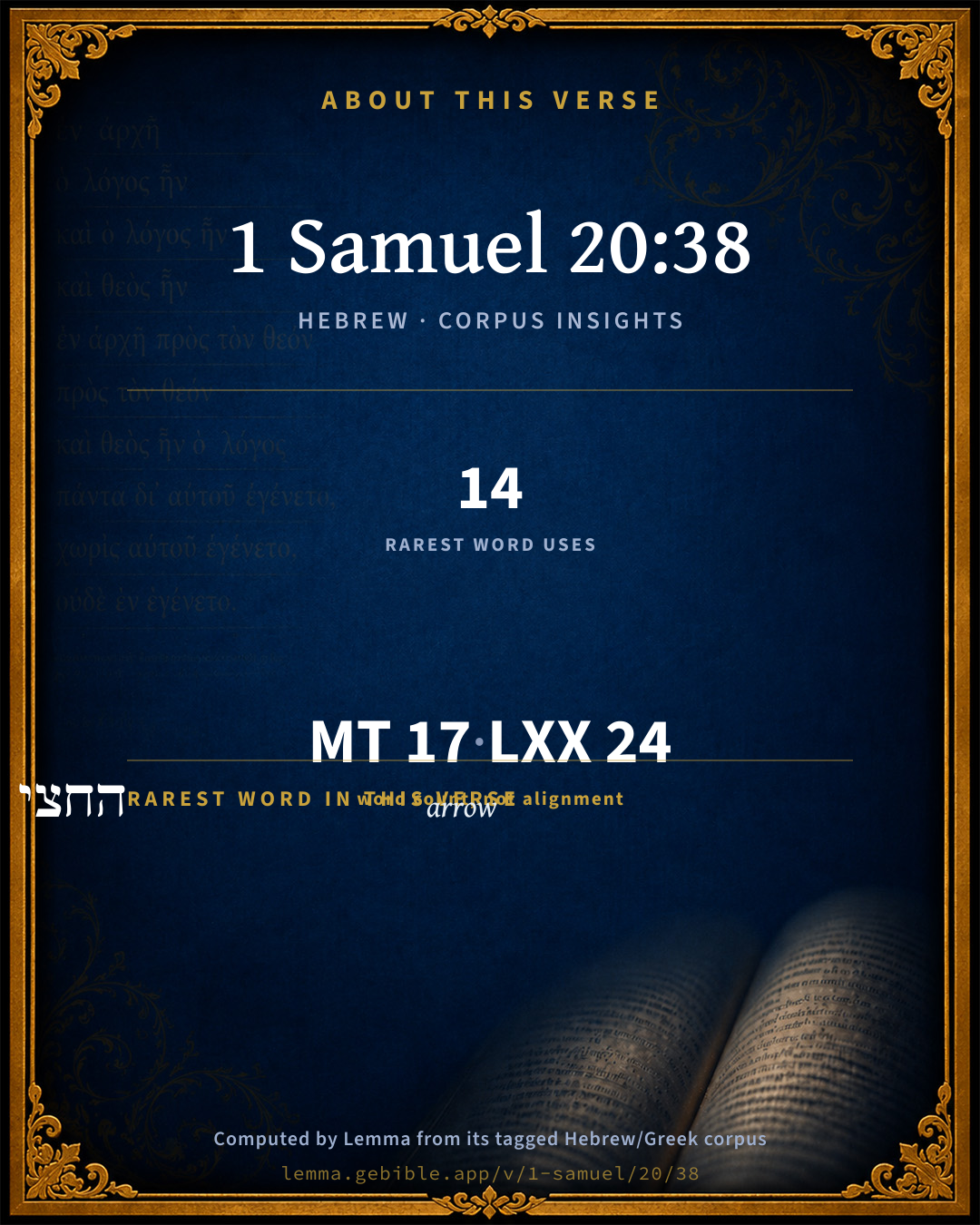
17
words
14
distinct lemmas
Historical
section

Notable vocabulary

The rarest word here is החצי arrow H2678 — appearing just 14 times in the whole Hebrew Bible.

Shared distinctive vocabulary

החצי arrow H2678 occurs in 10 verses of the Hebrew Bible. Also found in:

Grammatical profile

  • 5 verbs
  • 8 nouns
  • 2 prepositions
  • 2 particles

Verb forms

  • וַיִּקְרָ֤א Qal · Sequential Imperfect
  • ח֖וּשָׁה Qal · Imperative
  • תַּעֲמֹ֑ד Qal · Jussive
  • וַיְלַקֵּ֞ט Piel · Sequential Imperfect
  • וַיָּבֹ֖א Qal · Sequential Imperfect

Repetition

Words recur within this verse — often emphatic in Hebrew:

  • יְהֽוֹנָתָן֙ Jonathan H3083 ×2
  • הַנַּ֔עַר boy H5288 ×2
  • החצי arrow H2678 ×2

Hebrew & Septuagint length

In English translation the verse runs 21 words from the Hebrew and 28 from the Septuagint (LXX English) — closely comparable.

A rough comparison of the two English renderings, which tokenize alike — not a word-level alignment.

Word counts can differ between the Hebrew and the Greek without any difference in meaning — e.g. the Hebrew direct-object marker אֵת has no separate Greek word, and Greek often adds the article ὁ.

In the original languages it is 17 Hebrew tokens and 24 Greek tokens — but the two are counted differently (Hebrew bundles its prefixes and suffixes into one token; the Greek is in lemma form), so that isn’t a like-for-like length.

Cross-references

5

Topical passages linked to 1 Samuel 20:38 in the Treasury of Scripture Knowledge — connected by theme and wording, ordered by reader-vote popularity; previews shown in the World English Bible.

  • Psalms 55:6–9 I said, "Oh that I had wings like a dove! Then I would fly away, and be at rest.
  • Proverbs 6:4–5 Give no sleep to your eyes, Nor slumber to your eyelids.
  • Matthew 24:16–18 then let those who are in Judea flee to the mountains.
  • Mark 13:14–16 But when you see the abomination of desolation, spoken of by Daniel the prophet, standing where it ought not (let the reader understand), then let those who are in Judea flee to the mountains,
  • Luke 17:31–32 In that day, he who will be on the housetop, and his goods in the house, let him not go down to take them away. Let him who is in the field likewise not turn back.

Cross-references courtesy of OpenBible.info (CC BY 4.0).

Hebrew and Greek witnesses Masoretic Hebrew ↔ Greek Septuagint

The same verse in the two great witnesses to the Old Testament, shown verse-for-verse.

These are two independent witnesses, not word-aligned to each other, and the Septuagint is shown in lemma (dictionary) form.

Hebrew 1 Samuel 20:38 Masoretic · Westminster Leningrad Codex

וַיִּקְרָ֤א יְהֽוֹנָתָן֙ אַחֲרֵ֣י הַנַּ֔עַר מְהֵרָ֥ה ח֖וּשָׁה אַֽל תַּעֲמֹ֑ד וַיְלַקֵּ֞ט נַ֤עַר יְהֽוֹנָתָן֙ אֶת החצי הַ֣חִצִּ֔ים וַיָּבֹ֖א אֶל אֲדֹנָֽיו

Jonathan cried after the boy, Go fast! Hurry! Don't delay! Jonathan's boy gathered up the arrows, and came to his master.

World English Bible · Public Domain

Greek LXX 1 Samuel 20:38 Septuagint · lemma form

καί ἀναβοάω ιωναθαν ὀπίσω ὁ παιδάριον αὐτός λέγω ταχύνω σπεύδω καί μή ἵστημι καί ἀναλέγω ὁ παιδάριον ιωναθαν ὁ σχίζα πρός ὁ κύριος αὐτός

And Jonathan cried out after his boy, saying, Make all speed, and stay not. And Jonathan's boy gathered up the arrows, and brought the arrows to his master.

LXX2012 (modern English Septuagint) · Public Domain

Hebrew: Westminster Leningrad Codex (CC BY 4.0). Greek: Septuagint (public domain); English from LXX2012 (modern English Septuagint) (Public Domain). How the Septuagint differs from the Hebrew →

Targum (Aramaic paraphrase)

1

The Targum is the ancient Jewish Aramaic paraphrase of the Hebrew Scriptures — an interpretive translation, not the Hebrew text itself. Onkelos (literal) and Pseudo-Jonathan (expansive) render the Torah, and Jonathan the Prophets. Coverage is partial: where no permissively-licensed English translation exists for a verse, only the Aramaic is shown. This is verse-level text, not a word-by-word alignment to the Hebrew.

  1. Targum Jonathan Prophets (Joshua–Malachi)
    וּקְרָא יְהוֹנָתָן בָּתַר עוּלֵימָא אוֹחִי בִּפְרִיעַ לָא תִתְעַכֵּב וּלְקֵיט עוּלֵימָא דִיהוֹנָתָן יַת גִירַיָא וַאֲתָא לְוַת רִבּוֹנֵיהּ:

    (no public-domain English translation for this verse)

    Targum Jonathan — Aramaic: “Mikraot Gedolot” (public domain). English: “Sefaria Community Translation” (CC0 1.0 (public-domain dedication)); “London "Chaldee Paraphrase," 1871” (public domain). Text via Sefaria.

Commentary

Notes on 1 Samuel 20:38 from classic Christian and Jewish commentators (each source and its license shown beneath its notes). The classic Christian expositions comment on the surrounding passage and are grouped to its opening verse, so a note may address several verses; the Jewish commentaries on the Tanakh (Rashi and others) are per-verse, so they appear only where the commentator wrote on this verse.

Lemma curates 59 commentaries, every one of them public domain or Creative Commons licensed, each selected and text-cleaned for this edition rather than reprinted as found. About our sources →

Trapp's Complete Commentary

John Trapp

1Sa 20:38 And Jonathan cried after the lad, Make speed, haste, stay not. And Jonathan’s lad gathered up the arrows, and came to his master.

Ver. 38. Make speed, haste, stay not.] Habent Aulae suum Cito, Cito. Sic et Amicitia. See 1Sa 20:37.

John Trapp, A Commentary or Exposition upon All the Books of the Old and New Testament (1647–1656) — public domain. Text from a community e-Sword module.

Geneva Bible (1599)

Geneva Bible translators

By these words he admonished David what he ought to do.

Geneva Bible (1599) marginal notes — public domain. Text via Bolls.life.

Adam Clarke's Commentary

Verse 38. Make speed, haste, stay not.] Though these words appear to be addressed to the lad, yet they were spoken to David, indicating that his life was at stake, and only a prompt flight could save him.

Adam Clarke's Commentary on the Bible (1810–1826) — public domain. Text from a community e-Sword/MySword module.

Ellicott's Commentary for English Readers

(38) Make speed, haste, stay not.—Although Jonathan, of course, trusted to a certain extent the youth (probably an armour-bearer) who was with him, still he hurried this attendant away, that he might not see David, who was close by in hiding, and who, after the sign, would presently appear in sight. The next clause (1Sa_20:39) expressly tells us how this meeting was unknown and unwitnessed. The youth was sent to the city that Jonathan might be alone once more with David.

A Bible Commentary for English Readers, edited by Charles John Ellicott (1878–1897) — public domain. Text from a community e-Sword module.

The Cambridge Bible for Schools and Colleges

gen. ed. J. J. S. Perowne

38. the arrows] It is implied that the three arrows agreed upon were shot, but the narrator does not think it necessary to repeat full details thrice.

The Cambridge Bible for Schools and Colleges (gen. ed. J. J. S. Perowne; Cambridge University Press, 1878–1918) — public domain. Text from a community e-Sword module.

John Gill's Exposition

And Jonathan cried after the lad, make speed, haste, stay not,.... But bring the arrows to him directly, that he might dismiss him; for, observing that no man was passing by, he was desirous of embracing the opportunity for a few minutes to have an interview with David alone before he fled:

and Jonathan's lad gathered up the arrows; for though the textual reading is singular, the marginal is plural, to show, as Kimchi observes, that he cast three arrows, as he said he would, Sa1 20:20;

and came to his master; with them.

John Gill's Exposition of the Whole Bible (1746–1763) — public domain (CC PDM 1.0). Text via the HelloAO Bible API.

Matthew Poole's English Annotations

Haste, stay not; so he bids him, because finding the coast clear, he made haste to take the opportunity-to speak with his dearly beloved David.

Matthew Poole's English Annotations on the Holy Bible (1683–1685) — public domain. Text from a community e-Sword/MySword module.

unfoldingWord translationNotes

Door43 World Missions Community

called after the young man, "Hurry

"called out to the young man, who was running away from him, 'Hurry"

translationWords

Jonathan

lord

know

unfoldingWord translationNotes — © Distant Shores Media and the Door43 World Missions Community, licensed CC BY-SA 4.0. Source: git.door43.org/Door43/en_tn.

Lesson kit

Teaching starters — assembled from the data on this page, not authored interpretation. Every prompt links to the verse data it draws on. Edit before teaching.

1 Samuel, in the Historical, opens this verse with 17 words (14 distinct Hebrew lemmas). Its most distinctive word is chitstsîy (“arrow”). A historical commentator’s framing appears above. Read the whole chapter for the surrounding context.

Discussion questions

  1. The word chitstsîy carries the sense “arrow.” How does it shape the verse?
  2. How does 1 Samuel 20:20, which shares the word «arrow», read alongside this verse?
  3. What does the repetition of “Jonathan” (2× in this one verse) do in this verse?
  4. The translations on this page render this verse differently — a whole-verse word diff, not a word-by-word alignment. What might account for the different wordings?
  5. «וַיִּקְרָ֤א» is a Qal Sequential Imperfect verb. How does that grammatical form shape the action described?
  6. Compare how Trapp's Complete Commentary and Geneva Bible (1599) read this verse. Where do they agree or differ?

Things to notice

Reading settings

Reading text

Shown beneath each verse's original-language words.

Old Testament
Old Testament edition

Read the OT as the Masoretic Hebrew (MT) or the Greek Septuagint (LXX).

English shown for the Greek Septuagint (in the Hebrew ↔ Greek comparison).

Comparing translations? Open the Compare panel on any verse page to stack up to four side by side.