
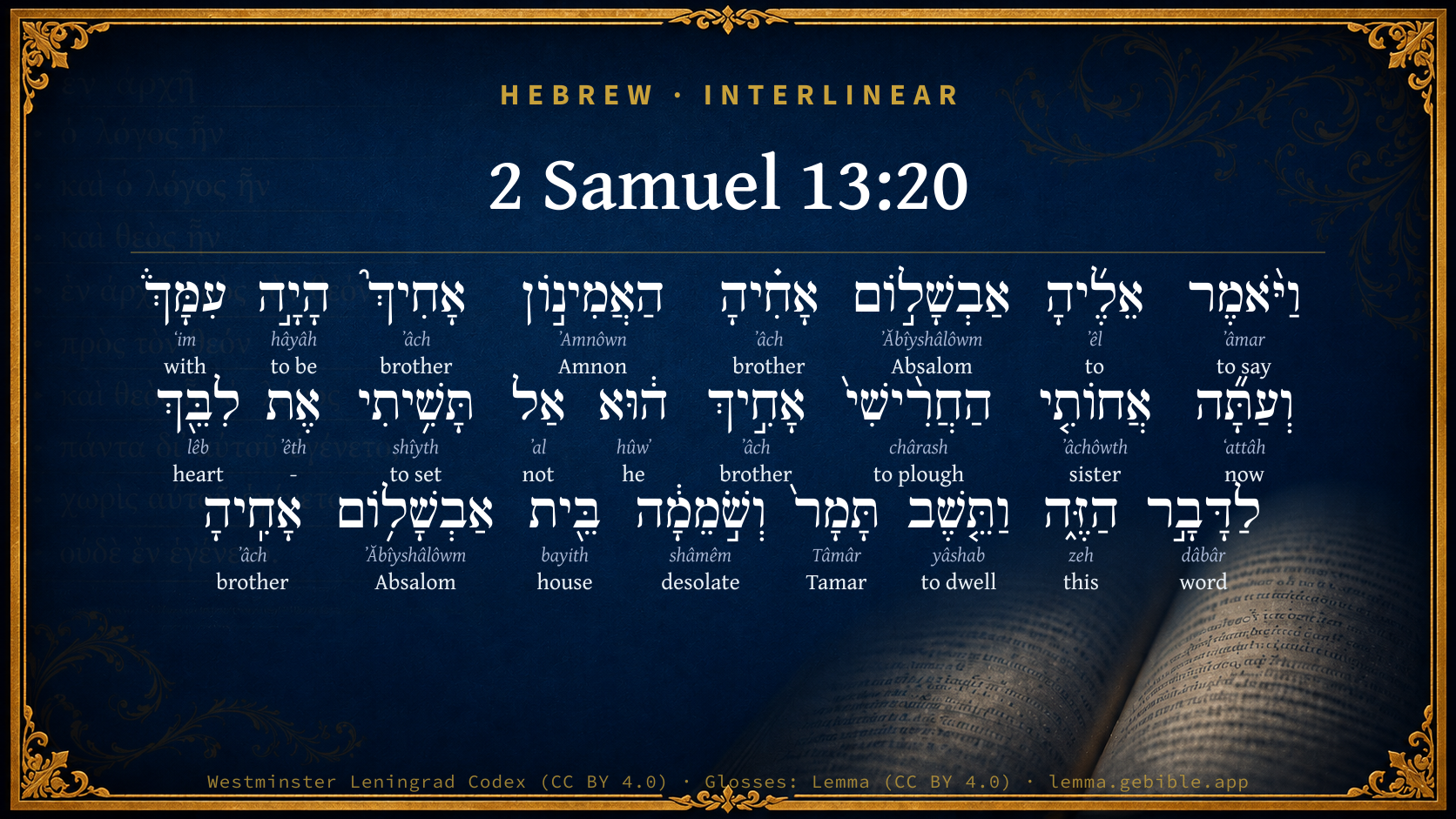
2 Samuel 13:20

Hebrew (Westminster Leningrad Codex) 2 Samuel 13:20 appears in the Hebrew Old Testament. The text above is from the Westminster Leningrad Codex. Each word links to its Strong’s number, a concise gloss, and parsing drawn from the Open Scriptures Hebrew Bible morphology. Click any word for its full Brown-Driver-Briggs (BDB) entry.
Download image
Cite this verse

2 Samuel 13:20 (World English Bible). Public Domain. Lemma interlinear Bible study tool, https://lemma.gebible.app/v/2-samuel/13/20.

Show BibTeX & RIS
BibTeX
RIS
English Translation
Absalom her brother said to her, Has Amnon your brother been with you? but now hold your peace, my sister: he is your brother; don't take this thing to heart. So Tamar remained desolate in her brother Absalom's house.
World English Bible · Public Domain
Highlights
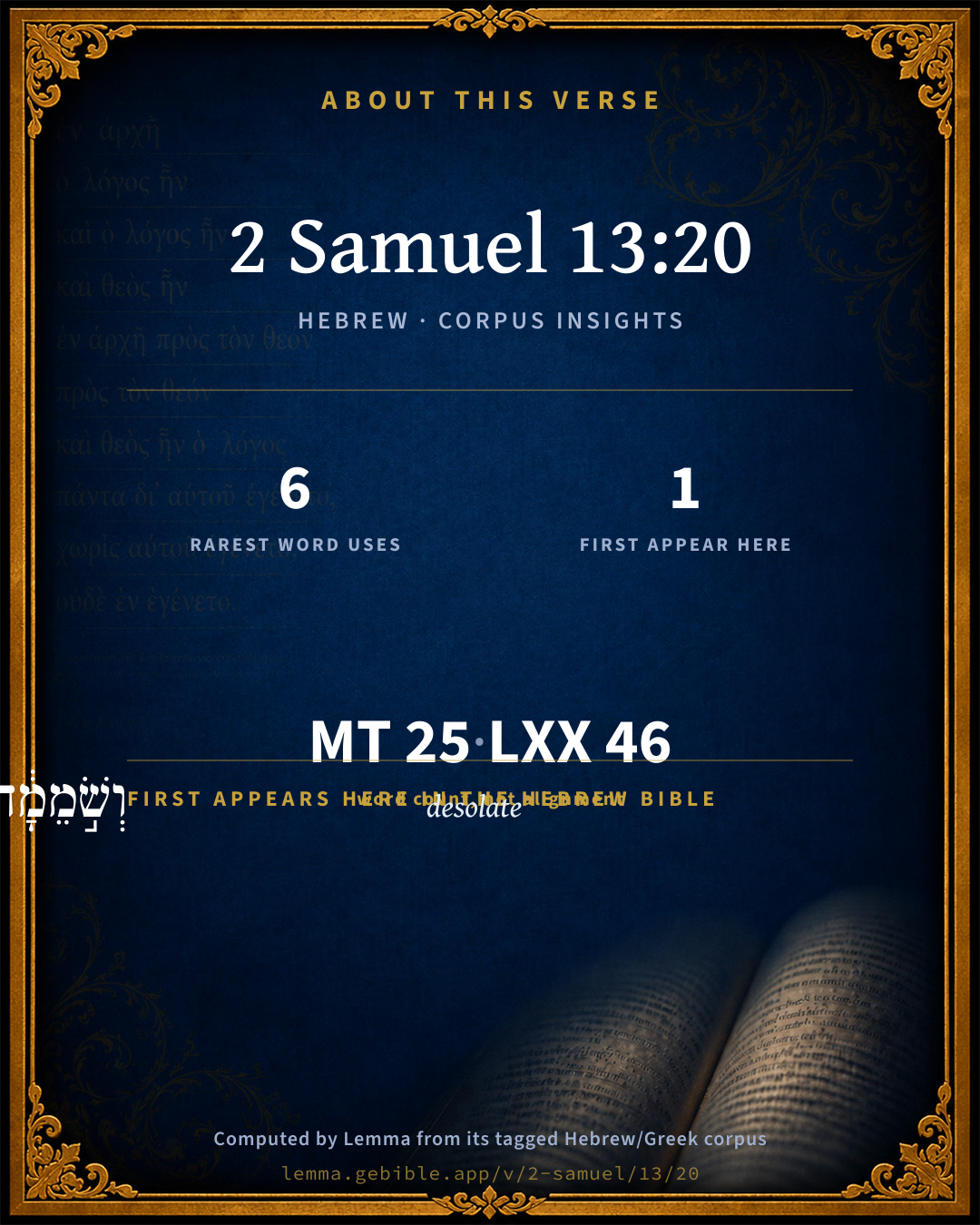
  • 1 first appearance in the Hebrew Bible
Full analysis ↓
Download a study sheet

One document with this verse’s original text, its word-by-word gloss line, the meaning frame, cross-references with their text, attributed commentary, and full source and license credits — printable, and it pastes into notes with its structure intact.

This verse Autodidact and up

Study sheet (.html) Plain text (.txt)

A passage Seminary Student

Up to 50 verses in one chapter. A passage sheet keeps up to 6 commentary sources and 12 cross-references per verse, in the order this page ranks them, and says so on the sheet whenever that leaves anything out. Ask for a single verse and you get the Autodidact verse sheet above.

Everything on this page stays free to read, with no account — the sheet is a download of what is already on screen, not access to it.

Want to remove ads? Support Godless Engineer
Compare translations 3

The same verse in 3 English versions, stacked beneath the original-language interlinear above. Click any original word for its lexicon entry.

Each is an independent rendering of the whole verse — the interlinear is not word-aligned to these translations.

Highlighted words mark where these versions differ — a whole-verse word diff, not a word-by-word alignment.

  • World English Bible Public Domain
    Absalom her brother said to her, Has Amnon your brother been with you? but now hold your peace, my sister: he is your brother; don't take this thing to heart. So Tamar remained desolate in her brother Absalom's house.
  • King James Version Public Domain
    And Absalom her brother said unto her, Hath Amnon thy brother been with thee? but hold now thy peace, my sister: he is thy brother; regard not this thing. So Tamar remained desolate in her brother Absalom's house.
  • unfoldingWord Literal Text CC BY-SA 4.0
    And Absalom her brother said to her, “Has Amnon your brother been with you? And now, my sister, keep silent, he your brother. Do not set your heart to this matter.” And Tamar dwelled and was desolate the house of Absalom her brother.

unfoldingWord Literal Text — © unfoldingWord, licensed CC BY-SA 4.0. Word-aligned USFM3 via Door43 (git.door43.org/unfoldingWord/en_ult).

Versions to compare (up to 4)

3 of 4 selected

Show all 18 translations

Every available English version of this verse, each an independent rendering of the whole verse.

  • World English Bible Public Domain
    Absalom her brother said to her, Has Amnon your brother been with you? but now hold your peace, my sister: he is your brother; don't take this thing to heart. So Tamar remained desolate in her brother Absalom's house.
  • Berean Standard Bible Public Domain
    Her brother Absalom said to her, “Has your brother Amnon been with you? Be quiet for now, my sister. He is your brother. Do not take this thing to heart.” So Tamar lived as a desolate woman in the house of her brother Absalom.
  • Majority Standard Bible Public Domain
    Her brother Absalom said to her, “Has your brother Amnon been with you? Be quiet for now, my sister. He is your brother. Do not take this thing to heart.” So Tamar lived as a desolate woman in the house of her brother Absalom.
  • King James Version Public Domain
    And Absalom her brother said unto her, Hath Amnon thy brother been with thee? but hold now thy peace, my sister: he is thy brother; regard not this thing. So Tamar remained desolate in her brother Absalom's house.
  • American Standard Version (1901) Public Domain
    And Absalom her brother said unto her, Hath Amnon thy brother been with thee? but now hold thy peace, my sister: he is thy brother; take not this thing to heart. So Tamar remained desolate in her brother Absalom's house.
  • Revised Version (1885) Public Domain
    And Absalom her brother said unto her, Hath Amnon thy brother been with thee? but now hold thy peace, my sister: he is thy brother; take not this thing to heart. So Tamar remained desolate in her brother Absalom’s house.
  • Geneva Bible (1599) Public Domain
    And Absalom her brother sayd vnto her, Hath Amnon thy brother bene with thee? Now yet be still, my sister: he is thy brother: let not this thing grieue thine heart. So Tamar remayned desolate in her brother Absaloms house.
  • Douay-Rheims (1899) Public Domain
    And Absalom her brother said to her: Hath thy brother Amnon lain with thee? but now, sister, hold thy peace, he is thy brother: and afflict not thy heart for this thing. So Thamar remained pining away in the house of Absalom her brother.
  • Young's Literal Translation Public Domain
    and Absalom her brother saith unto her, `Hath Amnon thy brother been with thee? and now, my sister, keep silent, he `is' thy brother; set not thy heart to this thing;' and Tamar dwelleth -- but desolate -- in the house of Absalom her brother.
  • Literal Standard Version CC BY-SA 4.0
    and her brother Absalom says to her, “Has your brother Amnon been with you? And now, my sister, keep silent, he [is] your brother; do not set your heart to this thing”; and Tamar dwells—but desolate—in the house of her brother Absalom.
  • Unlocked Literal Bible CC BY-SA 4.0
    Absalom her brother said to her, “Has Amnon your brother been with you? But now keep quiet, my sister. He is your brother. Do not take this thing to heart.” So Tamar remained alone in her brother Absalom's house.
  • unfoldingWord Literal Text CC BY-SA 4.0
    And Absalom her brother said to her, “Has Amnon your brother been with you? And now, my sister, keep silent, he your brother. Do not set your heart to this matter.” And Tamar dwelled and was desolate the house of Absalom her brother.
  • Darby Bible Public Domain
    And Absalom her brother said to her, Has Amnon thy brother been with thee? and now, my sister, be still: he is thy brother; take not this thing to heart. And Tamar remained, and [that] desolate, in her brother Absalom's house.
  • World Messianic Bible Public Domain
    Absalom her brother said to her, “Has Amnon your brother been with you? But now hold your peace, my sister. He is your brother. Don’t take this thing to heart.” So Tamar remained desolate in her brother Absalom’s house.
  • Webster's Bible Public Domain
    And Absalom her brother said to her, Hath Amnon thy brother been with thee? but hold now thy peace, my sister: he is thy brother; regard not this thing. So Tamar remained desolate in her brother Absalom's house.
  • Free Bible Version CC BY-SA 4.0
    Her brother Absalom found her and asked, “Has brother Amnon been with you? Keep quiet for the moment, my sister. He's your brother. Don't be so upset about it.” So Tamar lived as a ruined and abandoned woman in her brother Absalom's home.
  • Bible in Basic English Public Domain
    And her brother Absalom said to her, Has your brother Amnon been with you? but now, let there be an end to your crying, my sister: he is your brother, do not take this thing to heart. So Tamar went on living uncomforted in her brother's house.
  • JPS Tanakh (1917) Public Domain
    And Absalom her brother said unto her: 'Hath Amnon thy brother been with thee? but now hold thy peace, my sister: he is thy brother; take not this thing to heart.' So Tamar remained desolate in her brother Absalom's house.

Literal Standard Version (2020), Covenant Press — licensed CC BY-SA 4.0. Text via the HelloAO Bible API (eBible.org). Unlocked Literal Bible (unfoldingWord) — licensed CC BY-SA 4.0. Text via the HelloAO Bible API (eBible.org). unfoldingWord Literal Text — © unfoldingWord, licensed CC BY-SA 4.0. Word-aligned USFM3 via Door43 (git.door43.org/unfoldingWord/en_ult). Free Bible Version, Dr. Jonathan Gallagher — licensed CC BY-SA 4.0. Text via the HelloAO Bible API (eBible.org).

Word by word

More ways to search: Search by grammar → Find every occurrence → Compare this word →

Practice this passage: Drill this verse → Learn its vocabulary →

וְשֹׁ֣מֵמָ֔ה
shâmêm
H8076
“and · desolate”
Conjunction + Verb, Qal, Participle Active, Feminine, Singular, Absolute
Part of Speech
Conjunction + Verb
Stem
Qal
Form
Participle Active
Gender
Feminine
Number
Singular
State
Absolute
Full BDB Definition

Origin: from H8074

TWOT: 2409a

devastated, deserted, desolate
  1. וַיֹּ֨אמֶר ʼâmar H559 “and · to say” Conjunction + Verb, Qal, Sequential Imperfect, 3rd Person, Masculine, Singular
  2. אֵלֶ֜יהָ ʼêl H413 “to · her” Preposition + Suffix, Personal, 3rd Person, Feminine, Singular
  3. אַבְשָׁל֣וֹם ʼĂbîyshâlôwm H53 “Absalom” Noun, Proper
  4. אָחִ֗יהָ ʼâch H251 “brother · her” Noun, Common, Masculine, Singular, Construct + Suffix, Personal, 3rd Person, Feminine, Singular
  5. הַאֲמִינ֣וֹן ʼAmnôwn H550 “Amnon” Particle, Interrogative + Noun, Proper
  6. אָחִיךְ֮ ʼâch H251 “brother · your” Noun, Common, Masculine, Singular, Construct + Suffix, Personal, 2nd Person, Feminine, Singular
  7. הָיָ֣ה hâyâh H1961 “to be” Verb, Qal, Perfect, 3rd Person, Masculine, Singular
  8. עִמָּךְ֒ ʻim H5973 “with · you” Preposition + Suffix, Personal, 2nd Person, Feminine, Singular
  9. וְעַתָּ֞ה ʻattâh H6258 “and · now” Conjunction + Adverb
  10. אֲחוֹתִ֤י ʼâchôwth H269 “sister · my” Noun, Common, Feminine, Singular, Construct + Suffix, Personal, 1st Person, Common, Singular
  11. הַחֲרִ֨ישִׁי֙ chârash H2790 “plough” Verb, Hiphil, Imperative, 2nd Person, Feminine, Singular
  12. אָחִ֣יךְ ʼâch H251 “brother · your” Noun, Common, Masculine, Singular, Construct + Suffix, Personal, 2nd Person, Feminine, Singular
  13. ה֔וּא hûwʼ H1931 “he” Pronoun, Personal, 3rd Person, Masculine, Singular
  14. אַל ʼal H408 “not” Particle, Negative
  15. תָּשִׁ֥יתִי shîyth H7896 “to set” Verb, Qal, Jussive, 2nd Person, Feminine, Singular
  16. אֶת ʼêth H853 “-” Particle, Direct Object
  17. לִבֵּ֖ךְ lêb H3820 “heart · your” Noun, Common, Masculine, Singular, Construct + Suffix, Personal, 2nd Person, Feminine, Singular
  18. לַדָּבָ֣ר dâbâr H1697 “to/for the · word” Preposition, Determined + Noun, Common, Masculine, Singular, Absolute
  19. הַזֶּ֑ה zeh H2088 “the · this” Particle, Definite Article + Pronoun, Demonstrative, Masculine, Singular
  20. וַתֵּ֤שֶׁב yâshab H3427 “and · to dwell” Conjunction + Verb, Qal, Sequential Imperfect, 3rd Person, Feminine, Singular
  21. תָּמָר֙ Tâmâr H8559 “Tamar” Noun, Proper
  22. בֵּ֖ית bayith H1004 “house of” Noun, Common, Masculine, Singular, Construct
  23. אַבְשָׁל֥וֹם ʼĂbîyshâlôwm H53 “Absalom” Noun, Proper
  24. אָחִֽיהָ ʼâch H251 “brother · her” Noun, Common, Masculine, Singular, Construct + Suffix, Personal, 3rd Person, Feminine, Singular

About this verse

These counts appear in no published source. They are computed here, from the morphology-tagged text and Lemma’s own curated glosses. What Lemma adds →

25
words
21
distinct lemmas
Historical
section

Notable vocabulary

The rarest word here is וְשֹׁ֣מֵמָ֔ה desolate H8076 — appearing just 6 times in the whole Hebrew Bible.

First appearance in Scripture

This word makes its first canonical appearance in the Hebrew Bible here:

  • וְשֹׁ֣מֵמָ֔ה desolate H8076

Shared distinctive vocabulary

וְשֹׁ֣מֵמָ֔ה desolate H8076 occurs in 6 verses of the Hebrew Bible. Also found in:

Grammatical profile

  • 6 verbs
  • 12 nouns
  • 2 pronouns
  • 2 prepositions
  • 1 adverb
  • 2 particles

Verb forms

  • וַיֹּ֨אמֶר Qal · Sequential Imperfect
  • הָיָ֣ה Qal · Perfect
  • הַחֲרִ֨ישִׁי֙ Hiphil · Imperative
  • תָּשִׁ֥יתִי Qal · Jussive
  • וַתֵּ֤שֶׁב Qal · Sequential Imperfect
  • וְשֹׁ֣מֵמָ֔ה Qal · Participle Active

Repetition

Words recur within this verse — often emphatic in Hebrew:

  • אָחִ֗יהָ brother H251 ×4
  • אַבְשָׁל֣וֹם Absalom H53 ×2

Hebrew & Septuagint length

In English translation the verse runs 39 words from the Hebrew and 45 from the Septuagint (LXX English) — closely comparable.

A rough comparison of the two English renderings, which tokenize alike — not a word-level alignment.

Word counts can differ between the Hebrew and the Greek without any difference in meaning — e.g. the Hebrew direct-object marker אֵת has no separate Greek word, and Greek often adds the article ὁ.

In the original languages it is 25 Hebrew tokens and 46 Greek tokens — but the two are counted differently (Hebrew bundles its prefixes and suffixes into one token; the Greek is in lemma form), so that isn’t a like-for-like length.

Cross-references

4

Topical passages linked to 2 Samuel 13:20 in the Treasury of Scripture Knowledge — connected by theme and wording, ordered by reader-vote popularity; previews shown in the World English Bible.

  • Romans 12:19 Don't seek revenge yourselves, beloved, but give place to God's wrath. For it is written, "Vengeance belongs to me; I will repay, says the Lord."
  • Genesis 34:2 Shechem the son of Hamor the Hivite, the prince of the land, saw her. He took her, lay with her, and humbled her.
  • Genesis 46:15 These are the sons of Leah, whom she bore to Jacob in Paddan Aram, with his daughter Dinah. All the souls of his sons and his daughters were thirty-three.
  • Proverbs 26:24 A malicious man disguises himself with his lips, But he harbors evil in his heart.

Cross-references courtesy of OpenBible.info (CC BY 4.0).

Hebrew and Greek witnesses Masoretic Hebrew ↔ Greek Septuagint

The same verse in the two great witnesses to the Old Testament, shown verse-for-verse.

These are two independent witnesses, not word-aligned to each other, and the Septuagint is shown in lemma (dictionary) form.

Hebrew 2 Samuel 13:20 Masoretic · Westminster Leningrad Codex

וַיֹּ֨אמֶר אֵלֶ֜יהָ אַבְשָׁל֣וֹם אָחִ֗יהָ הַאֲמִינ֣וֹן אָחִיךְ֮ הָיָ֣ה עִמָּךְ֒ וְעַתָּ֞ה אֲחוֹתִ֤י הַחֲרִ֨ישִׁי֙ אָחִ֣יךְ ה֔וּא אַל תָּשִׁ֥יתִי אֶת לִבֵּ֖ךְ לַדָּבָ֣ר הַזֶּ֑ה וַתֵּ֤שֶׁב תָּמָר֙ וְשֹׁ֣מֵמָ֔ה בֵּ֖ית אַבְשָׁל֥וֹם אָחִֽיהָ

Absalom her brother said to her, Has Amnon your brother been with you? but now hold your peace, my sister: he is your brother; don't take this thing to heart. So Tamar remained desolate in her brother Absalom's house.

World English Bible · Public Domain

Greek LXX 2 Samuel 13:20 Septuagint · lemma form

καί εἶπον πρός αὐτός αβεσσαλωμ ὁ ἀδελφός αὐτός μή αμνων ὁ ἀδελφός σύ γίγνομαι μετά σύ καί νῦν ἀδελφή ἐγώ κωφεύω ὅτι ἀδελφός σύ εἰμί μή τίθημι ὁ καρδία σύ ὁ λαλέω εἰς ὁ ῥῆμα οὗτος καί καταἵζω θημαρ χηρεύω ἐν οἶκος αβεσσαλωμ ὁ ἀδελφός αὐτός

And Abessalom her brother said to her, Has your brother Amnon been with you? now then, my sister, be silent, for he is your brother: be not careful to mention this matter. So Themar lived as a widow in the house of her brother Abessalom.

LXX2012 (modern English Septuagint) · Public Domain

On this verse, Haydock's Catholic Bible Commentary discusses the Septuagint’s reading. Read the note in Commentary ↓

Hebrew: Westminster Leningrad Codex (CC BY 4.0). Greek: Septuagint (public domain); English from LXX2012 (modern English Septuagint) (Public Domain). How the Septuagint differs from the Hebrew →

Targum (Aramaic paraphrase)

1

The Targum is the ancient Jewish Aramaic paraphrase of the Hebrew Scriptures — an interpretive translation, not the Hebrew text itself. Onkelos (literal) and Pseudo-Jonathan (expansive) render the Torah, and Jonathan the Prophets. Coverage is partial: where no permissively-licensed English translation exists for a verse, only the Aramaic is shown. This is verse-level text, not a word-by-word alignment to the Hebrew.

  1. Targum Jonathan Prophets (Joshua–Malachi)
    וַאֲמַר לָהּ אַבְשָׁלוֹם אֲחוּהָא הַאֲמִינוֹן אֲחוּךְ הֲוָה עִמֵךְ וּכְעַן אֲחָתִי שְׁתוּקִי אֲחוּךְ הוּא לָא תְשַׁוִין יַת לִבֵּךְ לְפִתְגָמָא הָדֵין וִיתִיבַת תָּמָר וְצַדְיָא בֵּית אַבְשָׁלוֹם אֲחוּהָא:

    (no public-domain English translation for this verse)

    Targum Jonathan — Aramaic: “Mikraot Gedolot” (public domain). English: “Sefaria Community Translation” (CC0 1.0 (public-domain dedication)); “London "Chaldee Paraphrase," 1871” (public domain). Text via Sefaria.

Commentary

Notes on 2 Samuel 13:20 from classic Christian and Jewish commentators (each source and its license shown beneath its notes). The classic Christian expositions comment on the surrounding passage and are grouped to its opening verse, so a note may address several verses; the Jewish commentaries on the Tanakh (Rashi and others) are per-verse, so they appear only where the commentator wrote on this verse.

Lemma curates 59 commentaries, every one of them public domain or Creative Commons licensed, each selected and text-cleaned for this edition rather than reprinted as found. About our sources →

Trapp's Complete Commentary

John Trapp

2Sa 13:20 And Absalom her brother said unto her, Hath Amnon thy brother been with thee? but hold now thy peace, my sister: he [is] thy brother; regard not this thing. So Tamar remained desolate in her brother Absalom’s house.

Ver. 20. And Absalom her brother said unto her.] For to him she addressed herself, and not to her father, against whom haply she was exasperated in her mind, for sending her to Amnon’s house; which was not the wisest act that ever he did. {See Trapp on "2Sa 13:7"}

Hath Amnon thy brother been with thee?] Synechdoehe generis verecunda, a modest expression of an immodest action.

He is thy brother.] Whereby Absalom meant not, that therefore he might do to her as he did - Clodia indeed, that impudent strumpet, to excuse her incest, said, that she lay with Metellus as a husband, but with Clodius as with a brother; this covering was too short - but that the less blame could be laid upon her for being alone with him, and that she had the less cause to suspect him. Besides, by blazoning his folly, she should set a blur upon the whole family. {a}

Regard not this thing.] Do not grieve too much for that which, being now done, cannot be undone; but make the best of an ill matter: let that which is past cure, be past care.

{a} Fratrem sine propria infamia accusare non potes.

John Trapp, A Commentary or Exposition upon All the Books of the Old and New Testament (1647–1656) — public domain. Text from a community e-Sword module.

Joseph Benson's Commentary

2Sa 13:20. And Absalom her brother said to her — To whose house she had passed on, in the condition just mentioned, with ashes on her head, &c., oppressed with sorrow, and overwhelmed with shame. Hath Amnon thy brother been with thee? — A modest expression for the foul rape he had committed. Thus Absalom covers the gross injury which he suspected she had received, under the veil of the most decent and distant phrase that could hint his suspicion to her. And to save her blushes, and let her see that he understood her distress, he stopped her short from attempting any answer, by begging her to say nothing of the matter, but endeavour to forget the injury, since it was a brother that had done it. Hold now thy peace, my sister: he is thy brother — Therefore thou must forgive and forget the injury; for thy disgracing of him will be a blot to us all; and thou wilt not get right from thy father against him, because he is as near and dear to him as thou; therefore, also, thy dishonour is the less, because thou wast not abused by any mean person, but by a king’s son; and, as this evil cannot be revenged, it must be borne. Thus he covers his design of taking vengeance upon Amnon at the first opportunity. Regard not — So as to torment thyself. So Tamar remained desolate — Through shame and dejection of mind, giving herself up to solitude and retirement. “And, in all probability, she continued so her whole life long; unmarried and undone. And Amnon had the horror of reflecting, that for one moment’s base and brutal indulgence, he had made his nearest kinswoman, an amiable and innocent sister, miserable to the last moment of her life.” Such are generally the sad products of sin!

Joseph Benson's Commentary on the Old and New Testaments (1811–1818) — public domain. Text from a community e-Sword module.

Whedon's Commentary on the Bible

Daniel D. Whedon

ABSALOM’S REVENGE, 2Sa_13:20-36.

20. Absalom… said unto her — He seems to have met her while in the sad plight described in 2Sa_13:19, and took her at once to his own house.

Regard not this thing — Thus he tried to soothe her troubled spirit, though he himself felt most keenly her disgrace, and planned a deadly purpose of revenge.

Remained desolate — Literally, Tamar remained and was desolate. That is, she stayed at Absalom’s house, and did not go home to her father’s.

Desolate — Was never married.

Daniel D. Whedon (gen. ed.), Commentary on the Old and New Testaments (1874–1909) — public domain. Text from a community e-Sword module.

Tyndale Open Study Notes

Tyndale Open Resources

13:20 keep quiet for now . . . Don’t you worry about it: Absalom’s words of comfort seem hollow in light of her disgrace and mourning; this toned-down response hid Absalom’s rage (13:22) from the already distraught Tamar. • as a desolate woman: See study note on 13:16.

Tyndale Open Study Notes — © Tyndale Open Resources, licensed CC BY-SA 4.0. Text via the HelloAO Bible API.

Geneva Bible (1599)

Geneva Bible translators

For though he conceived sudden vengeance in his heart, yet he dissembled it till occasion served, and comforted his sister.

Geneva Bible (1599) marginal notes — public domain. Text via Bolls.life.

Jamieson, Fausset & Brown

Robert Jamieson, A. R. Fausset & David Brown

So Tamar remained desolate in her brother Absalom's house--He was her natural protector, and the children of polygamists lived by themselves, as if they constituted different families.

Jamieson, Fausset & Brown — Commentary Critical and Explanatory on the Whole Bible (1871) — public domain (CC PDM 1.0). Text via the HelloAO Bible API.

Ellicott's Commentary for English Readers

(20) Hath Amnon.—The Hebrew, by a clerical error, has here Aminon. Absalom at once sees how the case stands, comforts his sister, but counsels silence as necessary to the purpose of revenge he had at once formed, and takes his desolate sister to his own house.

A Bible Commentary for English Readers, edited by Charles John Ellicott (1878–1897) — public domain. Text from a community e-Sword module.

The Cambridge Bible for Schools and Colleges

gen. ed. J. J. S. Perowne

20. Amnon] The Heb. form here, and here only, is Aminon, which has been explained as a diminutive intended to express contempt, but may possibly be only an accidental variation.

hold now thy peace] Absalom urged her to bear the outrage patiently, and avoid a public scandal; feeling sure that David would not be persuaded to inflict an adequate punishment on Amnon, and intending to watch his own opportunity for revenge. To him, according to Oriental custom, belonged the duty of avenging his sister’s wrongs. Cp. Gen_34:27.

desolate] Ruined and deserted. Cp. Isa_54:1, where “the desolate” is contrasted with the married wife.

The Cambridge Bible for Schools and Colleges (gen. ed. J. J. S. Perowne; Cambridge University Press, 1878–1918) — public domain. Text from a community e-Sword module.

John Gill's Exposition

And Absalom her brother said unto her,.... Either meeting her in the street, or rather when come to his house:

hath Amnon thy brother been with thee? been rude with thee, and lain with thee, which is the meaning of this modest expression; which he guessed at, having heard of her being sent to his house, and knowing his lustful disposition, and seeing her in such a forlorn condition: he calls him Aminon, for so it is in the Hebrew text, and not Amnon, by way of contempt, as Kimchi observes:

but hold now thy peace, my sister; be silent, take no notice of this matter, say nothing of it to the king, nor any other, keep it in thine own breast, and make thyself easy:

he is thy brother, regard not this thing; it is thy brother that has done it, and not so disgraceful as a meaner person, done in the heat of lust, and a youthful one, and should be forgiven; besides, to divulge it would bring disgrace upon the whole family, and no recompence would be obtained by telling the king of it, since he was his son, his firstborn, and heir to the crown; this he said not out of love of Amnon, but as desirous of gratifying private revenge upon him for it when opportunity should serve.

So Tamar remained desolate in her brother Absalom's house; not seeing any company, being filled with grief and shame, and none applying to her as a suitor, knowing she was vitiated; how long she continued here, or lived after this, is not certain; no mention is made of her afterwards.

John Gill's Exposition of the Whole Bible (1746–1763) — public domain (CC PDM 1.0). Text via the HelloAO Bible API.

Haydock's Catholic Bible Commentary

Brother. His disgrace will fall upon the whole royal family, and the king will not bring him to punishment, like another. (Calmet) --- Away. Hebrew and Chaldean, "desolate." (Menochius) --- Septuagint, "like a widow."

George Leo Haydock (1774–1849), Haydock's Catholic Family Bible and Commentary, 1859 edition — public domain. Excludes Psalms (Douay-Rheims chapter numbering differs from Protestant) and Deuterocanonical books (Catholic canon only).

Matthew Poole's English Annotations

Been with thee, i.e. lain with thee. Behold, and imitate the modesty of Scripture expressions.

He is thy brother; therefore thou must forgive and forget the injury; therefore thy disgracing of him will be a blot to us all; therefore thou wilt not get right from David against him, because he is as near and dear to him as thou; therefore thy dishonour is the less, because thou wast not abused by any mean person, but by a king’s son; therefore this evil must be borne, because it cannot be revenged. And thus he covers his design of taking vengeance upon him at the first opportunity.

Regard not this thing, so as to torment thyself.

Desolate; neglected and forsaken by others, none now seeking her in marriage; and through shame and dejection of mind, giving herself up to solitude and retirement.

Matthew Poole's English Annotations on the Holy Bible (1683–1685) — public domain. Text from a community e-Sword/MySword module.

The Pulpit Commentary

Hath Amnon? The Hebrew has Aminon, a diminutive, which some authorities regard as expressive of contempt. More probably it is an accidental variety of spelling. Hold now thy peace. We must not suppose that Absalom did not comfort his sister, and make her conscious of his love. He was, in fact, so indignant at her treatment as to have purposed the sternest vengeance. But this he concealed from her, and counselled patience, net merely because she would have dissuaded him from a course so full of danger to himself, but because it was the duty of both to wait and see what course David would take. Where polygamy is permitted, it is the duty especially of the brothers to defend their sisters" honour. (Gen_34:31) But David was both her father and the chief magistrate; and, moreover, he had been made an instrument in his daughter"s wrong. They must be patient, and only if David failed in his duty would Absalom"s turn come. Meanwhile, Tamar dwelt in his house desolate, as one whose honour and happiness had been laid waste.

The Pulpit Commentary (1880–1919), ed. H.D.M. Spence-Jones & Joseph S. Exell — public domain. Text from a community e-Sword module.

John Wesley's Explanatory Notes

Been with thee - Behold, and imitate the modesty of scripture expressions. Brother - Wherefore thou must forgive and forgot the injury; therefore thy disgracing of him will be a blot to us all; therefore thou wilt not get right from David against him, because he is as near and dear to him as thou; therefore thy dishonour is the less, because thou wast not abused by any mean person, but by a king's son; therefore this evil must be born, because it cannot be revenged: and thus he covers his design of taking vengeance upon him at the first opportunity. Regard not - So as to torment thyself. Desolate - Through shame and dejection of mind, giving her self up to solitude and retirement.

John Wesley, Explanatory Notes Upon the Whole Bible (1754–1765) — public domain. Text via the GEBible commentary corpus.

unfoldingWord translationNotes

Door43 World Missions Community

Has Amnon your brother been with you?

This is a polite way to ask is Amnon has had sexual relations with her. AT: "Has Amnon your brother slept with you?" (See: Euphemism)

keep quiet

This means to not tell anyone about something. AT: "do not tell anyone about this" (See: Idiom)

Do not take this thing to heart

The phrase "take something to heart" means "to worry about it." AT: "Do not worry about what has happened" (See: Idiom)

So Tamar remained alone

This means that she did not marry.

said nothing

"did not speak"

translationWords

Absalom

brother

heart

anger

unfoldingWord translationNotes — © Distant Shores Media and the Door43 World Missions Community, licensed CC BY-SA 4.0. Source: git.door43.org/Door43/en_tn.

Lesson kit

Teaching starters — assembled from the data on this page, not authored interpretation. Every prompt links to the verse data it draws on. Edit before teaching.

2 Samuel, in the Historical, opens this verse with 25 words (21 distinct Hebrew lemmas). Its most distinctive word is shâmêm (“desolate”). A historical commentator’s framing appears above. Read the whole chapter for the surrounding context.

Discussion questions

  1. How does “desolate” (shâmêm) shape what this verse is saying?
  2. This is the first place “desolate” appears in Scripture (first appears here). What does its debut here establish?
  3. How does Jeremiah 12:11, which shares the word «desolate», read alongside this verse?
  4. What does the repetition of “brother” (4× in this one verse) do in this verse?
  5. These translations render this verse differently; the difference is in the English rendering, not the original. What questions does that raise?
  6. «וַיֹּ֨אמֶר» is a Qal Sequential Imperfect verb. How does that grammatical form shape the action described?
  7. Compare how Trapp's Complete Commentary and Joseph Benson's Commentary read this verse. Where do they agree or differ?

Things to notice

Reading settings

Reading text

Shown beneath each verse's original-language words.

Old Testament
Old Testament edition

Read the OT as the Masoretic Hebrew (MT) or the Greek Septuagint (LXX).

English shown for the Greek Septuagint (in the Hebrew ↔ Greek comparison).

Comparing translations? Open the Compare panel on any verse page to stack up to four side by side.