

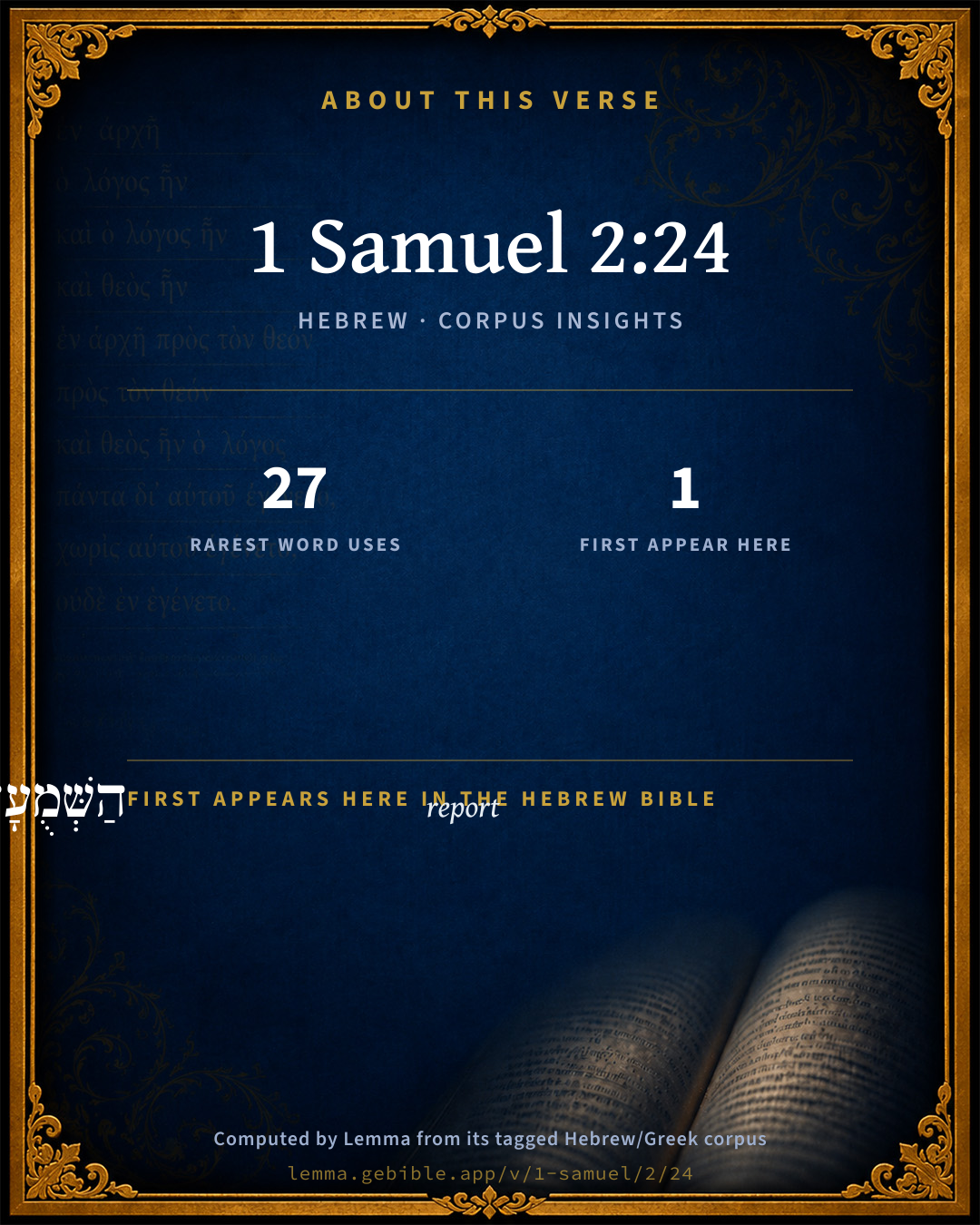
1 Samuel 2:24

Hebrew (Westminster Leningrad Codex) 1 Samuel 2:24 appears in the Hebrew Old Testament. The text above is from the Westminster Leningrad Codex. Each word links to its Strong’s number, a concise gloss, and parsing drawn from the Open Scriptures Hebrew Bible morphology. Click any word for its full Brown-Driver-Briggs (BDB) entry.
Download image
Cite this verse

1 Samuel 2:24 (World English Bible). Public Domain. Lemma interlinear Bible study tool, https://lemma.gebible.app/v/1-samuel/2/24.

Show BibTeX & RIS
BibTeX
RIS
English Translation
No, my sons; for it is no good report that I hear: you make Yahweh's people to disobey.
World English Bible · Public Domain
Highlights Full analysis ↓
Download a study sheet

One document with this verse’s original text, its word-by-word gloss line, the meaning frame, cross-references with their text, attributed commentary, and full source and license credits — printable, and it pastes into notes with its structure intact.

This verse Autodidact and up

Study sheet (.html) Plain text (.txt)

A passage Seminary Student

Up to 50 verses in one chapter. A passage sheet keeps up to 6 commentary sources and 12 cross-references per verse, in the order this page ranks them, and says so on the sheet whenever that leaves anything out. Ask for a single verse and you get the Autodidact verse sheet above.

Everything on this page stays free to read, with no account — the sheet is a download of what is already on screen, not access to it.

Want to remove ads? Support Godless Engineer
Compare translations 3

The same verse in 3 English versions, stacked beneath the original-language interlinear above. Click any original word for its lexicon entry.

Each is an independent rendering of the whole verse — the interlinear is not word-aligned to these translations.

Highlighted words mark where these versions differ — a whole-verse word diff, not a word-by-word alignment.

  • World English Bible Public Domain
    No, my sons; for it is no good report that I hear: you make Yahweh's people to disobey.
  • King James Version Public Domain
    Nay, my sons; for it is no good report that I hear: ye make the LORD's people to transgress.
  • unfoldingWord Literal Text CC BY-SA 4.0
    No, my sons! For the report not good that I am hearing the people of Yahweh passing on.

unfoldingWord Literal Text — © unfoldingWord, licensed CC BY-SA 4.0. Word-aligned USFM3 via Door43 (git.door43.org/unfoldingWord/en_ult).

Versions to compare (up to 4)

3 of 4 selected

Show all 18 translations

Every available English version of this verse, each an independent rendering of the whole verse.

  • World English Bible Public Domain
    No, my sons; for it is no good report that I hear: you make Yahweh's people to disobey.
  • Berean Standard Bible Public Domain
    No, my sons; it is not a good report I hear circulating among the LORD’s people.
  • Majority Standard Bible Public Domain
    No, my sons; it is not a good report I hear circulating among the LORD’s people.
  • King James Version Public Domain
    Nay, my sons; for it is no good report that I hear: ye make the LORD's people to transgress.
  • American Standard Version (1901) Public Domain
    Nay, my sons; for it is no good report that I hear: ye make Jehovah's people to transgress.
  • Revised Version (1885) Public Domain
    Nay, my sons; for it is no good report that I hear: ye make the LORD’S people to transgress.
  • Geneva Bible (1599) Public Domain
    Do no more, my sonnes, for it is no good report that I heare, which is, that ye make the Lords people to trespasse.
  • Douay-Rheims (1899) Public Domain
    Do not so, my sons: for it is no good report that I hear, that you make the people of the Lord to transgress.
  • Young's Literal Translation Public Domain
    Nay, my sons; for the report which I am hearing is not good causing the people of Jehovah to transgress. --
  • Literal Standard Version CC BY-SA 4.0
    No, my sons; for the report which I am hearing is not good, causing the people of YHWH to transgress.
  • Unlocked Literal Bible CC BY-SA 4.0
    No, my sons; for it is not a good report that I hear. You make Yahweh's people disobey.
  • unfoldingWord Literal Text CC BY-SA 4.0
    No, my sons! For the report not good that I am hearing the people of Yahweh passing on.
  • Darby Bible Public Domain
    No, my sons, for it is no good report that I hear: ye make Jehovah's people transgress.
  • World Messianic Bible Public Domain
    No, my sons; for it is not a good report that I hear! You make the LORD’s people disobey.
  • Webster's Bible Public Domain
    No, my sons; for it is no good report that I hear: ye make the LORD'S people to transgress.
  • Free Bible Version CC BY-SA 4.0
    No, my sons, the report I hear about you from the Lord's people isn't good.
  • Bible in Basic English Public Domain
    No, my sons, the account which is given me, which the Lord's people are sending about, is not good.
  • JPS Tanakh (1917) Public Domain
    Nay, my sons; for it is no good report which I hear the LORD'S people do spread abroad.

Literal Standard Version (2020), Covenant Press — licensed CC BY-SA 4.0. Text via the HelloAO Bible API (eBible.org). Unlocked Literal Bible (unfoldingWord) — licensed CC BY-SA 4.0. Text via the HelloAO Bible API (eBible.org). unfoldingWord Literal Text — © unfoldingWord, licensed CC BY-SA 4.0. Word-aligned USFM3 via Door43 (git.door43.org/unfoldingWord/en_ult). Free Bible Version, Dr. Jonathan Gallagher — licensed CC BY-SA 4.0. Text via the HelloAO Bible API (eBible.org).

Word by word

More ways to search: Search by grammar → Find every occurrence → Compare this word →

Practice this passage: Drill this verse → Learn its vocabulary →

הַשְּׁמֻעָה֙
shᵉmûwʻâh
H8052
“the · report”
Particle, Definite Article + Noun, Common, Feminine, Singular, Absolute
Part of Speech
Particle + Noun
Type
Common
Gender
Feminine
Number
Singular
State
Absolute
Full BDB Definition

Origin: pass part of H8074

TWOT: 2412d

report, news, rumour - report, news, tidings - mention
  1. אַ֖ל ʼal H408 “not” Particle, Negative
  2. בָּנָ֑י bên H1121 “sons · my” Noun, Common, Masculine, Plural, Construct + Suffix, Personal, 1st Person, Common, Singular
  3. כִּ֠י kîy H3588 “that” Conjunction
  4. לֽוֹא lôʼ H3808 “not” Particle, Negative
  5. טוֹבָ֤ה ṭôwb H2896 “good” Adjective, Adjective, Feminine, Singular, Absolute
  6. אֲשֶׁ֣ר ʼăsher H834 “which” Particle, Relative
  7. אָנֹכִ֣י ʼânôkîy H595 “I” Pronoun, Personal, 1st Person, Common, Singular
  8. שֹׁמֵ֔עַ shâmaʻ H8085 “hearing” Verb, Qal, Participle Active, Masculine, Singular, Absolute
  9. מַעֲבִרִ֖ים ʻâbar H5674 “passing over” Verb, Hiphil, Participle Active, Masculine, Plural, Absolute
  10. עַם ʻam H5971 “people of” Noun, Common, Masculine, Singular, Construct
  11. יְהוָֽה Yᵉhôvâh H3068 “LORD” Noun, Proper

About this verse

These counts appear in no published source. They are computed here, from the morphology-tagged text and Lemma’s own curated glosses. What Lemma adds →

12
words
12
distinct lemmas
Historical
section

First appearance in Scripture

This word makes its first canonical appearance in the Hebrew Bible here:

  • הַשְּׁמֻעָה֙ report H8052

Shared distinctive vocabulary

הַשְּׁמֻעָה֙ report H8052 occurs in 24 verses of the Hebrew Bible. Also found in:

Grammatical profile

  • 2 verbs
  • 4 nouns
  • 1 adjective
  • 1 pronoun
  • 1 conjunction
  • 3 particles

Verb forms

  • שֹׁמֵ֔עַ Qal · Participle Active
  • מַעֲבִרִ֖ים Hiphil · Participle Active

Hebrew & Septuagint length

In English translation the verse runs 18 words from the Hebrew and 32 from the Septuagint (LXX English) — the Septuagint runs noticeably longer here. See the side-by-side →

A rough comparison of the two English renderings, which tokenize alike — not a word-level alignment.

Word counts can differ between the Hebrew and the Greek without any difference in meaning — e.g. the Hebrew direct-object marker אֵת has no separate Greek word, and Greek often adds the article ὁ.

Cross-references

14

Topical passages linked to 1 Samuel 2:24 in the Treasury of Scripture Knowledge — connected by theme and wording, ordered by reader-vote popularity; previews shown in the World English Bible.

  • Exodus 32:21 Moses said to Aaron, "What did these people do to you, that you have brought a great sin on them?"
  • 1 Samuel 2:17 The sin of the young men was very great before Yahweh; for the men despised the offering of Yahweh.
  • 1 Samuel 2:22 Now Eli was very old; and he heard all that his sons did to all Israel, and how that they lay with the women who served at the door of the tent of meeting.
  • 1 Kings 13:18–21 He said to him, I also am a prophet as you are; and an angel spoke to me by the word of Yahweh, saying, Bring him back with you into your house, that he may eat bread and drink water. [But] he lied to him.
  • 1 Kings 15:30 for the sins of Jeroboam which he sinned, and with which he made Israel to sin, because of his provocation with which he provoked Yahweh, the God of Israel, to anger.
  • 2 Kings 10:31 But Jehu took no heed to walk in the law of Yahweh, the God of Israel, with all his heart: he didn't depart from the sins of Jeroboam, with which he made Israel to sin.
  • Malachi 2:8 But you have turned aside out of the way. You have caused many to stumble in the law. You have corrupted the covenant of Levi," says Yahweh of Hosts.
  • Matthew 18:7 "Woe to the world because of occasions of stumbling! For it must be that the occasions come, but woe to that person through whom the occasion comes!
  • Acts 6:3 Therefore select from among you, brothers, seven men of good report, full of the Holy Spirit and of wisdom, whom we may appoint over this business.
  • 2 Corinthians 6:8 by glory and dishonor, by evil report and good report; as deceivers, and yet true;
  • 1 Timothy 3:7 Moreover he must have good testimony from those who are outside, to avoid falling into reproach and the snare of the devil.
  • 2 Peter 2:18 For, uttering great swelling words of emptiness, they entice in the lusts of the flesh, by licentiousness, those who are indeed escaping from those who live in error;
  • 3 John 1:12 Demetrius has the testimony of all, and of the truth itself; yes, we also testify, and you know that our testimony is true.
  • Revelation 2:20 But I have this against you, that you tolerate your woman, Jezebel, who calls herself a prophetess. She teaches and seduces my servants to commit sexual immorality, and to eat things sacrificed to idols.

Cross-references courtesy of OpenBible.info (CC BY 4.0).

Hebrew and Greek witnesses Masoretic Hebrew ↔ Greek Septuagint

The same verse in the two great witnesses to the Old Testament, shown verse-for-verse.

Here the Septuagint runs noticeably longer than the Hebrew — LXX2012 (modern English Septuagint) 32 words vs World English Bible 18. A rough length comparison of the two English translations, not a word-level alignment — read both below.

These are two independent witnesses, not word-aligned to each other, and the Septuagint is shown in lemma (dictionary) form.

Hebrew 1 Samuel 2:24 Masoretic · Westminster Leningrad Codex

אַ֖ל בָּנָ֑י כִּ֠י לֽוֹא טוֹבָ֤ה הַשְּׁמֻעָה֙ אֲשֶׁ֣ר אָנֹכִ֣י שֹׁמֵ֔עַ מַעֲבִרִ֖ים עַם יְהוָֽה

No, my sons; for it is no good report that I hear: you make Yahweh's people to disobey.

World English Bible · Public Domain

Greek LXX 1 Samuel 2:24 Septuagint · lemma form

μή τέκνον ὅτι οὐ ἀγαθός ὁ ἀκοή ὅς ἐγώ ἀκούω μή ποιέω οὕτως ὅτι οὐ ἀγαθός ὁ ἀκοή ὅς ἐγώ ἀκούω ὁ μή δουλεύω λαός θεός

Nay my sons, for the report which I hear is not good; do not so, for the reports which I hear are not good, so that the people do not serve God.

LXX2012 (modern English Septuagint) · Public Domain

Hebrew: Westminster Leningrad Codex (CC BY 4.0). Greek: Septuagint (public domain); English from LXX2012 (modern English Septuagint) (Public Domain). How the Septuagint differs from the Hebrew →

Targum (Aramaic paraphrase)

1

The Targum is the ancient Jewish Aramaic paraphrase of the Hebrew Scriptures — an interpretive translation, not the Hebrew text itself. Onkelos (literal) and Pseudo-Jonathan (expansive) render the Torah, and Jonathan the Prophets. Coverage is partial: where no permissively-licensed English translation exists for a verse, only the Aramaic is shown. This is verse-level text, not a word-by-word alignment to the Hebrew.

  1. Targum Jonathan Prophets (Joshua–Malachi)
    לָא בְּנַי אֲרֵי לָא תַקְנָא שְׁמוּעֲתָא דִי אֲנָא שְׁמַע דְרַנְנִין עַמָא דַיָי:

    (no public-domain English translation for this verse)

    Targum Jonathan — Aramaic: “Mikraot Gedolot” (public domain). English: “Sefaria Community Translation” (CC0 1.0 (public-domain dedication)); “London "Chaldee Paraphrase," 1871” (public domain). Text via Sefaria.

Commentary

Notes on 1 Samuel 2:24 from classic Christian and Jewish commentators (each source and its license shown beneath its notes). The classic Christian expositions comment on the surrounding passage and are grouped to its opening verse, so a note may address several verses; the Jewish commentaries on the Tanakh (Rashi and others) are per-verse, so they appear only where the commentator wrote on this verse.

Lemma curates 59 commentaries, every one of them public domain or Creative Commons licensed, each selected and text-cleaned for this edition rather than reprinted as found. About our sources →

Trapp's Complete Commentary

John Trapp

1Sa 2:24 Nay, my sons; for [it is] no good report that I hear: ye make the LORD’S people to transgress.

Ver. 24. Nay, my sons.] Too mild all along. He should have said as Isa 57:3-4, "Draw near hither, ye sons of the sorceress, the seed of the adulterer and the whore," &c., ye degenerate brood and sons of Belial, and not of Eli; ye brats of fathomless perdition, &c.

For it is no good report that I hear.] He should have said, It is stark stinking naught that I hear, and woe is me that I yet live to hear it; it had been better that I had died long since, or that you had been buried alive, than thus to live and stink above ground. But he saith only, "I hear ill of you by all the people": as if he went only upon hearsay; and were put on by the people thus to check them.

Ye make the Lord’s people to transgress.] Or, To cry out: to transgress, even to a cry, by their abhorring the sacrifices, - see 1Sa 2:17 - which they did, but ought not to have done, - for the evil lives of those profligate priests.

John Trapp, A Commentary or Exposition upon All the Books of the Old and New Testament (1647–1656) — public domain. Text from a community e-Sword module.

Geneva Bible (1599)

Geneva Bible translators

Because they contemn their duty to God, verse 17.

Geneva Bible (1599) marginal notes — public domain. Text via Bolls.life.

Ellicott's Commentary for English Readers

(24) Ye make the Lord’s people to transgress.—The life led by the priests publicly in the sanctuary, with their evident scornful unbelief in the divinely established holy ordinances on the one hand, and their unblushing immorality on the other, corrupted the inner religious life of the whole people.

A Bible Commentary for English Readers, edited by Charles John Ellicott (1878–1897) — public domain. Text from a community e-Sword module.

John Gill's Exposition

If one man sin against another, the judge shall judge him, &c. When one man does an injury to another in his person and property, the case is brought before the judge, he hears it, examines into it, and determines upon it, and does justice, orders that the injured person have satisfaction made him, and so the matter is ended:

but if a man sin against the Lord, who shall entreat for him? all sin is in some sense against God, as it is contrary to his nature, and a breach of his law, and especially bold, daring, presumptuous sins; but there are some sins that are more immediately and particularly against God, as sins against the first table of the law, which relate to the worship of God, and such were the sins of Eli's sons in the affair of sacrifices; all sin against God is aggravated by the perfections of his nature, and made tremendous, as being against a God of strict justice, of unspotted purity and holiness, and who is omniscient, omnipresent, and omnipotent; and by the relation and connection there is between God and men, he is their Creator and Preserver, the God of their lives and mercies, and of all the blessings they enjoy, and yet sin against him! who will entreat the favour of God for such persons, ask pardon for them, and beseech the Lord to be propitious and merciful to them? who on earth will do it? such persons are scarce and rare, few care to stand up in the gap between God and sinners; in some cases they ought not, in others they cannot. Eli suggests by this question, that he could not, even for his own sons; and who in heaven can or will do it? not saints departed, who know nothing of what is done below, nor angels, only the Lord Jesus Christ; he is the only Mediator between God and men, who has engaged his heart to approach unto God, and interpose between him and sinful men, and has made peace and reconciliation by his blood, and is become the propitiation for sin, and ever lives to make intercession for transgressors, and is always prevalent and successful in his mediation and intercession; excepting him, there is none to entreat for those that have sinned against the Lord, see Jo1 2:1. In answer to this question, who shall entreat for him? the Jews say (x) repentance and good works; but these are insufficient advocates for a sinner, without the atoning sacrifice of Christ, who is propitiation for sin, and upon which a plea can only be founded:

notwithstanding, they hearkened not unto the voice of their father; to his reproofs and counsels, his reasonings and expostulations; though his rebukes were so gentle, and this last reasoning of his so close and strong, so nervous and striking:

because the Lord would slay them; it was his purpose and decree, his will and pleasure, to cut them off for their wickedness; wherefore he gave them up to a judicial blindness, and hardness of heart, as he did Pharaoh, so that they were proof against all advice, admonitions, and arguments used with them: some choose to read the words, "therefore the Lord would slay them" (y), because they were disobedient to the voice of their father; but the former sense is best; for his will to destroy them was not so much for their disregard to the reproofs of their father in which he himself was culpable, as for their breach of his laws.

(x) T. Bab. Yoma, fol. 87. 1. (y) "ideo", Noldius, p. 395. No. 1342. "idcirco vel quapropter", Quistorp, so Patrick.

John Gill's Exposition of the Whole Bible (1746–1763) — public domain (CC PDM 1.0). Text via the HelloAO Bible API.

Matthew Poole's English Annotations

Words too mild for such diabolical actions.

Ye make the Lord’s people to transgress; either,

1. The women that by your instigation were drawn to folly. Or,

2. Others who are easily brought to follow your pernicious example. Or,

3. Other persons of pious and honest minds, whom therefore he calls the

Lord’s people by way of distinction from the children of Belial, who were so highly offended. with the great dishonour done to God and to his worship, and with the horrible wickedness of the priests, that upon that occasion they were hurried into the other extreme, and lived in the neglect and contempt of their own indispensable duty of offering sacrifices, because they came through the priests’ hands.

Matthew Poole's English Annotations on the Holy Bible (1683–1685) — public domain. Text from a community e-Sword/MySword module.

The Pulpit Commentary

Vers. 24, 25. Ye make, etc. Eli"s words are very obscure, but "Ye make Jehovah"s people to transgress" is upon the whole the best rendering of the clause. Both the Sept. and Syriac have a different reading: "Ye make Jehovah"s people cease to worship him" In the next verse there is no sufficient reason for supposing that Elohim, God, here means a judge. Elohim was the head of the theocracy, the ruler of Israel in all things, and he would set to rights these delinquencies of "one man against another" by the ordinary exercise of his judicial functions. So far all is easy, and we must translate, "If one man sin against another, God shall judge him." But in the last clause there is one of those plays upon words to which the Hebrew language, with its numerous conjugations, so readily lends itself; (see on 1Sa_1:28) and it is rarely possible to transfer to another language the force of passages in which the sense depends upon the terms in the original having a double meaning. The verb rendered shall judge in the first clause is used again by Eli in the second, but in a different conjugation, in which its usual meaning is to pray. According to the lexicon, therefore, we must translate: "If a man sin against Jehovah, who shall pray for him?" But surely it was just the occasion in which the only remedy left was intercessory prayer. Bearing then in remembrance the use made by Eli of the verb in the first clause, we must translate: "Who shall act as judge for him?" "Who shall interpose as arbitrator between him and Jehovah to settle the quarrel?" The verb itself, moreover, is a rare and old-fashioned one, and apparently means to settle a dispute. So it is used of Phinehas, who by his righteous zeal put an end to the rebellion against God"s laws; and accordingly in Psa_106:30, where our version renders "executed judgment," the, Vulgate has placavit, appeased Jehovah"s anger.

The sense then is, In case of wrong done between man and man, God as the supreme Arbitrator settles the dispute; but where the two parties are God and man, what third power is there which can interfere? The quarrel must go on to the bitter end, and God, who is your opponent, will also punish you. The same idea is found in Job_9:33. Naturally to so mild a remonstrance, and founded upon so low a view of the Divine nature, the sons of Eli paid but slight attention, and by thus hardening themselves in sin they made their punishment inevitable, "because it pleased Jehovah to slay them." Man can bring upon himself neither good nor evil except by the working of God"s will, and the punishment of sin is as thoroughly a part of God"s will as the rewarding of righteousness. An intense conviction of the personality of God was the very foundation of the religious life of the Israelites, and lies at the root of the words of Eli here and of those of Job; and it was this which made them ascribe to God that hardening of the wicked in sin which is the sure means of their punishment. We ascribe it to the working of natural laws, which after all is but saying the same thing in a round about way; for the laws of nature, in things moral as well as in the physical world, are the laws of God. In ver. 26, in contrast with Eli"s sons ripening for punishment, and daily more abhorred to God and man, we have Samuel set before us advancing in age and "in favour with Jehovah and also with men," like him of whom in so many respects he was a type, (Luk_2:52) our blessed Lord.

The Pulpit Commentary (1880–1919), ed. H.D.M. Spence-Jones & Joseph S. Exell — public domain. Text from a community e-Sword module.

Keil & Delitzsch

C. F. Keil & F. Delitzsch

בּני אל, "Not, my sons," i.e., do not such things, "for the report which I hear is not good; they make the people of Jehovah to transgress." מערים is written without the pronoun אתּם in an indefinite construction, like משׁלּחים in Sa1 6:3 (Maurer). Ewald's rendering as given by Thenius, "The report which I hear the people of God bring," is just as inadmissible as the one proposed by Bttcher, "The report which, as I hear, the people of God are spreading." The assertion made by Thenius, that העביר, without any further definition, cannot mean to cause to sin or transgress, is correct enough no doubt; but it does not prove that this meaning is inadmissible in the passage before us, since the further definition is actually to be found in the context.

Keil & Delitzsch — Biblical Commentary on the Old Testament (1861–1891) — public domain (CC PDM 1.0). Text via the HelloAO Bible API. (Old Testament only.)

Rashi

Rabbi Shlomo Yitzchaki (Rashi)

That I hear being passed on by Adonoy's people. The rumor which השם's people are spreading about you, an expression similar to, "and they proclaimed [וַיַעֲבִירוּ] throughout the camp; meaning, they let out a rumor about you which is not good.

Rashi on the Tanakh — English translations: “The Judaica Press complete Tanach with Rashi, translated by A. J. Rosenberg” (CC BY 4.0); “Pentateuch with Rashi's commentary by M. Rosenbaum and A.M. Silbermann, 1929-1934” (public domain); “The Metsudah Tanach series, Lakewood, N.J” (CC BY 4.0); and “The Book of Joshua, Metsudah Publications, 1997” (CC BY 4.0). Text via Sefaria.

Lesson kit

Teaching starters — assembled from the data on this page, not authored interpretation. Every prompt links to the verse data it draws on. Edit before teaching.

1 Samuel, in the Historical, opens this verse with 12 words (12 distinct Hebrew lemmas). Its most distinctive word is shᵉmûwʻâh (“report”). The Greek Septuagint runs longer here. A historical commentator’s framing appears above. Read the whole chapter for the surrounding context.

Discussion questions

  1. The word shᵉmûwʻâh carries the sense “report.” How does it shape the verse?
  2. The word “report” first appears here in Scripture. What is being introduced at this debut?
  3. 1 Samuel 4:19 shares the word «report» with this verse. How do the two illuminate each other?
  4. Compared with the Hebrew, the Septuagint runs longer here. What questions does that raise?
  5. These translations render this verse differently; the difference is in the English rendering, not the original. What questions does that raise?
  6. The verb «שֹׁמֵ֔עַ» is Qal Participle Active. How does its form color the action?
  7. Reading how Trapp's Complete Commentary and Geneva Bible (1599) read this verse, where do the two commentators agree and where do they part?

Things to notice

Reading settings

Reading text

Shown beneath each verse's original-language words.

Old Testament
Old Testament edition

Read the OT as the Masoretic Hebrew (MT) or the Greek Septuagint (LXX).

English shown for the Greek Septuagint (in the Hebrew ↔ Greek comparison).

Comparing translations? Open the Compare panel on any verse page to stack up to four side by side.