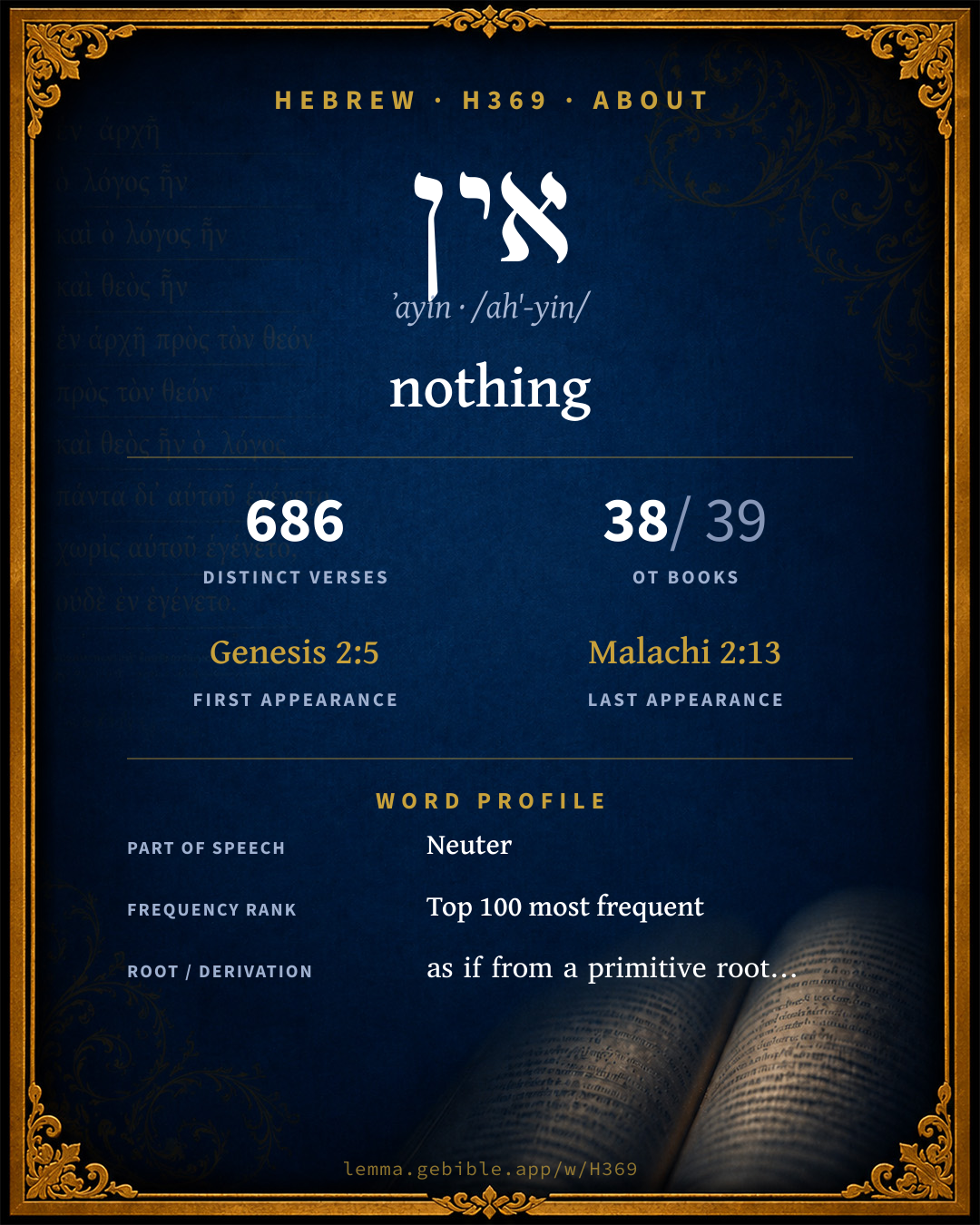
אַ֫יִן
nothing
also: not, nought fuller range ↓
Full lexicon entry — Brown-Driver-Briggs (BDB)
From Brown-Driver-Briggs (BDB)
Where this word appears
Grammar key — what these labels mean
Part of speech
- Particle
- A short function word — article, negation, interrogative, the sign of the direct object, and the like.
Noun type
- Common
- A common noun — a general class of person, place, or thing (“king,” “city,” “water”), not a specific name.
State
- Absolute
- The independent form of a noun, not bound to a following word.
Gender
- Masculine
- Grammatically masculine.
Number
- Singular
- One.
Grammatical forms
- Particle, Negative 786 times (99%)
- Noun, Common, Masculine, Singular, Absolute 3 times (0%)
- Particle, Interrogative 1 time (0%)
Parsed forms decoded from the imported morphology (morphhb / Westminster Leningrad Codex — WLC text public domain, morphhb tagging CC BY 4.0), counted across 790 parsed occurrences — not distinct verses.
Page 1 of 4 — showing verses 1–200 of 686 distinct verses where H369 appears, across 38 books. Click any verse to open its interlinear word-by-word view. Verse text shown in the World English Bible for context — . Each verse’s Hebrew form is shown with its reference; the English is not keyword-highlighted, since the data carries no word-level English alignment. Use “Compare translations” on any verse to read it across multiple English versions. This concordance covers the Hebrew Bible; Septuagint (Greek Old Testament) occurrences are not indexed here.
Genesis 36 verses
- Genesis 2:5 אַ֔יִן ptcl neg No plant of the field was yet in the earth, and no herb of the field had yet sprung up; for Yahweh God had not caused it to rain on the earth. There was not a man to till the ground,
- Genesis 5:24 וְ/אֵינֶ֕/נּוּ conj + ptcl neg + sfx pers 3ms Enoch walked with God, and he was not, for God took him.
- Genesis 7:8 אֵינֶ֖נָּ/ה ptcl neg + sfx pers 3fs Clean animals, animals that are not clean, birds, and everything that creeps on the ground
- Genesis 11:30 אֵ֥ין ptcl neg Sarai was barren. She had no child.
- Genesis 19:31 אֵ֤ין ptcl neg The firstborn said to the younger, "Our father is old, and there is not a man in the earth to come in to us after the manner of all the earth.
- Genesis 20:7 אֵֽינְ/ךָ֣ ptcl neg + sfx pers 2ms Now therefore, restore the man's wife. For he is a prophet, and he will pray for you, and you will live. If you don't restore her, know for sure that you will die, you, and all who are yours."
- Genesis 20:11 אֵין ptcl neg Abraham said, "Because I thought, 'Surely the fear of God is not in this place. They will kill me for my wife's sake.'
- Genesis 28:17 אֵ֣ין ptcl neg He was afraid, and said, "How dreadful is this place! This is none other than God's house, and this is the gate of heaven."
- Genesis 30:1 אַ֖יִן ptcl neg When Rachel saw that she bore Jacob no children, Rachel envied her sister. She said to Jacob, "Give me children, or else I will die."
- Genesis 30:33 אֵינֶ/נּוּ֩ ptcl neg + sfx pers 3ms So my righteousness will answer for me hereafter, when you come concerning my hire that is before you. Everyone that is not speckled and spotted among the goats, and black among the sheep, that might be with me, will be counted stolen."
- Genesis 31:2 אֵינֶ֛/נּוּ ptcl neg + sfx pers 3ms Jacob saw the expression on Laban's face, and, behold, it was not toward him as before.
- Genesis 31:5 אֵינֶ֥/נּוּ ptcl neg + sfx pers 3ms and said to them, "I see the expression on your father's face, that it is not toward me as before; but the God of my father has been with me.
- Genesis 31:50 אֵ֥ין ptcl neg If you will afflict my daughters, and if you will take wives besides my daughters, no man is with us; behold, God is witness between me and you."
- Genesis 37:24 אֵ֥ין ptcl neg and they took him, and threw him into the pit. The pit was empty. There was no water in it.
- Genesis 37:29 אֵין ptcl neg Reuben returned to the pit; and saw that Joseph wasn't in the pit; and he tore his clothes.
- Genesis 37:30 אֵינֶ֔/נּוּ ptcl neg + sfx pers 3ms He returned to his brothers, and said, "The child is no more; and I, where will I go?"
- Genesis 39:9 אֵינֶ֨/נּוּ ptcl neg + sfx pers 3ms He isn't greater in this house than I, neither has he kept back anything from me but you, because you are his wife. How then can I do this great wickedness, and sin against God?"
- Genesis 39:11 וְ/אֵ֨ין conj + ptcl neg It happened about this time, that he went into the house to do his work, and there were none of the men of the house inside.
- Genesis 39:23 אֵ֣ין ptcl neg The keeper of the prison didn't look after anything that was under his hand, because Yahweh was with him; and that which he did, Yahweh made it prosper.
- Genesis 40:8 אֵ֣ין ptcl neg They said to him, "We have dreamed a dream, and there is no one who can interpret it." Joseph said to them, "Don't interpretations belong to God? Please tell it to me."
- Genesis 41:8 וְ/אֵין conj + ptcl neg It happened in the morning that his spirit was troubled, and he sent and called for all the magicians of Egypt, and all the wise men of it. Pharaoh told them his dream, but there was no one who could interpret them to Pharaoh.
- Genesis 41:15 אֵ֣ין ptcl neg Pharaoh said to Joseph, "I have dreamed a dream, and there is no one who can interpret it. I have heard it said of you, that when you hear a dream you can interpret it."
- Genesis 41:24 וְ/אֵ֥ין conj + ptcl neg The thin heads of grain swallowed up the seven good heads of grain. I told it to the magicians; but there was no one who could explain it to me."
- Genesis 41:39 אֵין ptcl neg Pharaoh said to Joseph, "Because God has shown you all of this, there is none so discreet and wise as you.
- Genesis 41:49 אֵ֥ין ptcl neg Joseph laid up grain as the sand of the sea, very much, until he stopped counting, for it was without number.
- Genesis 42:13 אֵינֶֽ/נּוּ ptcl neg + sfx pers 3ms They said, "We, your servants, are twelve brothers, the sons of one man in the land of Canaan; and, behold, the youngest is this day with our father, and one is no more."
- Genesis 42:32 אֵינֶ֔/נּוּ ptcl neg + sfx pers 3ms We are twelve brothers, sons of our father; one is no more, and the youngest is this day with our father in the land of Canaan.'
- Genesis 42:36 אֵינֶ֨/נּוּ֙ אֵינֶ֔/נּוּ ptcl neg + sfx pers 3ms ptcl neg + sfx pers 3ms Jacob, their father, said to them, "You have bereaved me of my children! Joseph is no more, Simeon is no more, and you want to take Benjamin away. All these things are against me."
- Genesis 43:5 אֵינְ/ךָ֥ ptcl neg + sfx pers 2ms but if you will not send him, we will not go down, for the man said to us, 'You shall not see my face, unless your brother is with you.'"
- Genesis 44:26 אֵינֶ֥/נּוּ ptcl neg + sfx pers 3ms We said, 'We can't go down. If our youngest brother is with us, then will we go down: for we may not see the man's face, unless our youngest brother is with us.'
- Genesis 44:30 אֵינֶ֣/נּוּ ptcl neg + sfx pers 3ms Now therefore when I come to your servant my father, and the boy is not with us; seeing that his life is bound up in the boy's life;
- Genesis 44:31 אֵ֥ין ptcl neg it will happen, when he sees that the boy is no more, that he will die. Your servants will bring down the gray hairs of your servant, our father, with sorrow to Sheol.
- Genesis 44:34 אֵינֶ֣/נּוּ ptcl neg + sfx pers 3ms For how will I go up to my father, if the boy isn't with me? Lest I see the evil that will come on my father."
- Genesis 45:6 אֵין ptcl neg For these two years the famine has been in the land, and there are yet five years, in which there will be neither plowing nor harvest.
- Genesis 47:4 אֵ֣ין ptcl neg They said to Pharaoh, "We have come to live as foreigners in the land, for there is no pasture for your servants' flocks. For the famine is severe in the land of Canaan. Now therefore, please let your servants dwell in the land of Goshen."
- Genesis 47:13 אֵין֙ ptcl neg There was no bread in all the land; for the famine was very severe, so that the land of Egypt and the land of Canaan fainted by reason of the famine.
Exodus 20 verses
- Exodus 2:12 אֵ֣ין ptcl neg He looked this way and that way, and when he saw that there was no one, he killed the Egyptian, and hid him in the sand.
- Exodus 3:2 אֵינֶ֥/נּוּ ptcl neg + sfx pers 3ms The angel of Yahweh appeared to him in a flame of fire out of the midst of a bush. He looked, and behold, the bush burned with fire, and the bush was not consumed.
- Exodus 5:10 אֵינֶ֛/נִּי ptcl neg + sfx pers 1cs The taskmasters of the people went out, and their officers, and they spoke to the people, saying, This is what Pharaoh says: "I will not give you straw.
- Exodus 5:11 אֵ֥ין ptcl neg Go yourselves, get straw where you can find it, for nothing of your work shall be diminished."
- Exodus 5:16 אֵ֤ין ptcl neg No straw is given to your servants, and they tell us, 'Make brick!' and, behold, your servants are beaten; but the fault is in your own people."
- Exodus 8:10 אֵ֖ין ptcl neg He said, "Tomorrow." He said, "Be it according to your word, that you may know that there is none like Yahweh our God.
- Exodus 8:21 אֵינְ/ךָ֮ ptcl neg + sfx pers 2ms Else, if you will not let my people go, behold, I will send swarms of flies on you, and on your servants, and on your people, and into your houses: and the houses of the Egyptians shall be full of swarms of flies, and also the ground whereon they are.
- Exodus 9:14 אֵ֥ין ptcl neg For this time I will send all my plagues against your heart, against your officials, and against your people; that you may know that there is none like me in all the earth.
- Exodus 12:30 אֵ֣ין אֵֽין ptcl neg ptcl neg Pharaoh rose up in the night, he, and all his servants, and all the Egyptians; and there was a great cry in Egypt, for there was not a house where there was not one dead.
- Exodus 14:11 אֵין ptcl neg They said to Moses, "Because there were no graves in Egypt, have you taken us away to die in the wilderness? Why have you treated us this way, to bring us forth out of Egypt?
- Exodus 17:1 וְ/אֵ֥ין conj + ptcl neg All the congregation of the children of Israel traveled from the wilderness of Sin, by their journeys, according to Yahweh's commandment, and encamped in Rephidim; but there was no water for the people to drink.
- Exodus 17:7 אָֽיִן ptcl neg He called the name of the place Massah, and Meribah, because the children of Israel quarreled, and because they tested Yahweh, saying, "Is Yahweh among us, or not?"
- Exodus 21:11 אֵ֥ין ptcl neg If he doesn't do these three things for her, she may go free without paying any money.
- Exodus 22:2 אֵ֥ין ptcl neg If the thief is found breaking in, and is struck so that he dies, there shall be no guilt of bloodshed for him.
- Exodus 22:3 אֵ֣ין ptcl neg If the sun has risen on him, there shall be guilt of bloodshed for him; he shall make restitution. If he has nothing, then he shall be sold for his theft.
- Exodus 22:10 אֵ֥ין ptcl neg "If a man delivers to his neighbor a donkey, an ox, a sheep, or any animal to keep, and it dies or is injured, or driven away, no man seeing it;
- Exodus 22:14 אֵין ptcl neg "If a man borrows anything of his neighbor's, and it is injured, or dies, the owner of it not being with it, he shall surely make restitution.
- Exodus 32:18 אֵ֥ין וְ/אֵ֥ין ptcl neg conj + ptcl neg He said, "It isn't the voice of those who shout for victory, neither is it the voice of those who cry for being overcome; but the noise of those who sing that I hear."
- Exodus 32:32 אַ֕יִן ptcl neg Yet now, if you will, forgive their sin-- and if not, please blot me out of your book which you have written."
- Exodus 33:15 אֵ֤ין ptcl neg He said to him, "If your presence doesn't go with me, don't carry us up from here.
Leviticus 17 verses
- Leviticus 11:4 אֵינֶ֣/נּוּ ptcl neg + sfx pers 3ms "'Nevertheless these you shall not eat of those that chew the cud, or of those who part the hoof: the camel, because he chews the cud but doesn't have a parted hoof, he is unclean to you.
- Leviticus 11:10 אֵֽין ptcl neg All that don't have fins and scales in the seas, and in the rivers, of all that move in the waters, and of all the living creatures that are in the waters, they are an abomination to you,
- Leviticus 11:12 אֵֽין ptcl neg Whatever has no fins nor scales in the waters, that is an abomination to you.
- Leviticus 11:26 אֵינֶ֣/נָּה אֵינֶ֣/נָּה ptcl neg + sfx pers 3fs ptcl neg + sfx pers 3fs "'Every animal which parts the hoof, and is not cloven-footed, nor chews the cud, is unclean to you. Everyone who touches them shall be unclean.
- Leviticus 13:4 אֵין ptcl neg If the bright spot is white in the skin of his body, and the appearance of it isn't deeper than the skin, and the hair of it hasn't turned white, then the priest shall isolate the infected person for seven days.
- Leviticus 13:21 אֵֽין אֵינֶ֛/נָּה ptcl neg ptcl neg + sfx pers 3fs But if the priest examines it, and, behold, there are no white hairs in it, and it isn't deeper than the skin, but is dim, then the priest shall isolate him seven days.
- Leviticus 13:26 אֵֽין אֵינֶ֛/נָּה ptcl neg ptcl neg + sfx pers 3fs But if the priest examines it, and, behold, there is no white hair in the bright spot, and it isn't lower than the skin, but is faded; then the priest shall isolate him seven days.
- Leviticus 13:31 אֵין אֵ֣ין ptcl neg ptcl neg If the priest examines the plague of itching, and, behold, its appearance isn't deeper than the skin, and there is no black hair in it, then the priest shall isolate him the person infected with itching seven days.
- Leviticus 13:32 אֵ֥ין ptcl neg On the seventh day the priest shall examine the plague; and, behold, if the itch hasn't spread, and there is no yellow hair in it, and the appearance of the itch isn't deeper than the skin,
- Leviticus 13:34 אֵינֶ֥/נּוּ ptcl neg + sfx pers 3ms On the seventh day, the priest shall examine the itch; and, behold, if the itch hasn't spread in the skin, and its appearance isn't deeper than the skin, then the priest shall pronounce him clean. He shall wash his clothes, and be clean.
- Leviticus 14:21 וְ/אֵ֣ין conj + ptcl neg "If he is poor, and can't afford so much, then he shall take one male lamb for a trespass offering to be waved, to make atonement for him, and one tenth of an ephah of fine flour mingled with oil for a meal offering, and a log of oil;
- Leviticus 22:13 אֵ֣ין ptcl neg But if a priest's daughter is a widow, or divorced, and has no child, and has returned to her father's house, as in her youth, she may eat of her father's bread: but no stranger shall eat any of it.
- Leviticus 25:31 אֵין ptcl neg But the houses of the villages which have no wall round about them shall be reckoned with the fields of the country: they may be redeemed, and they shall be released in the Jubilee.
- Leviticus 26:6 וְ/אֵ֣ין conj + ptcl neg "'I will give peace in the land, and you shall lie down, and no one will make you afraid; and I will remove evil animals out of the land, neither shall the sword go through your land.
- Leviticus 26:17 וְ/אֵין conj + ptcl neg I will set my face against you, and you will be struck before your enemies. Those who hate you will rule over you; and you will flee when no one pursues you.
- Leviticus 26:36 וְ/אֵ֥ין conj + ptcl neg "'As for those of you who are left, I will send a faintness into their hearts in the lands of their enemies: and the sound of a driven leaf will put them to flight; and they shall flee, as one flees from the sword; and they will fall when no one pursues.
- Leviticus 26:37 אָ֑יִן ptcl neg They will stumble over one another, as it were before the sword, when no one pursues: and you will have no power to stand before your enemies.
Numbers 18 verses
- Numbers 5:8 אֵ֨ין ptcl neg But if the man has no kinsman to whom restitution may be made for the guilt, the restitution for guilt which is made to Yahweh shall be the priest's; besides the ram of the atonement, by which atonement shall be made for him.
- Numbers 5:13 אֵ֣ין ptcl neg and a man lies with her carnally, and it is hidden from the eyes of her husband, and is kept close, and she is defiled, and there is no witness against her, and she isn't taken in the act;
- Numbers 11:6 אֵ֣ין ptcl neg but now our soul is dried away; there is nothing at all save this manna to look on.
- Numbers 13:20 אַ֔יִן ptcl neg and what the land is, whether it is fat or lean, whether there is wood therein, or not. Be of good courage, and bring of the fruit of the land. Now the time was the time of the first-ripe grapes.
- Numbers 14:42 אֵ֥ין ptcl neg Don't go up, for Yahweh isn't among you; that you not be struck down before your enemies.
- Numbers 19:2 אֵֽין ptcl neg This is the statute of the law which Yahweh has commanded, saying, Speak to the children of Israel, that they bring you a red heifer without spot, in which is no blemish, [and] on which never came yoke.
- Numbers 19:15 אֵין ptcl neg Every open vessel, which has no covering bound on it, is unclean.
- Numbers 20:5 אַ֖יִן ptcl neg Why have you made us to come up out of Egypt, to bring us in to this evil place? it is no place of seed, or of figs, or of vines, or of pomegranates; neither is there any water to drink.
- Numbers 20:19 אֵין ptcl neg The children of Israel said to him, We will go up by the highway; and if we drink of your water, I and my cattle, then will I give the price of it: let me only, without [doing] anything [else], pass through on my feet.
- Numbers 21:5 אֵ֥ין וְ/אֵ֣ין ptcl neg conj + ptcl neg The people spoke against God, and against Moses, Why have you brought us up out of Egypt to die in the wilderness? for there is no bread, and there is no water; and our soul loathes this light bread.
- Numbers 22:26 אֵֽין ptcl neg The angel of Yahweh went further, and stood in a narrow place, where was no way to turn either to the right hand or to the left.
- Numbers 27:4 אֵ֥ין ptcl neg Why should the name of our father be taken away from among his family, because he had no son? Give to us a possession among the brothers of our father.
- Numbers 27:8 אֵ֣ין ptcl neg You shall speak to the children of Israel, saying, If a man die, and have no son, then you shall cause his inheritance to pass to his daughter.
- Numbers 27:9 אֵ֥ין ptcl neg If he have no daughter, then you shall give his inheritance to his brothers.
- Numbers 27:10 אֵ֥ין ptcl neg If he have no brothers, then you shall give his inheritance to his father's brothers.
- Numbers 27:11 אֵ֣ין ptcl neg If his father have no brothers, then you shall give his inheritance to his kinsman who is next to him of his family, and he shall possess it: and it shall be to the children of Israel a statute [and] ordinance, as Yahweh commanded Moses.
- Numbers 27:17 אֵין ptcl neg who may go out before them, and who may come in before them, and who may lead them out, and who may bring them in; that the congregation of Yahweh not be as sheep which have no shepherd.
- Numbers 35:27 אֵ֥ין ptcl neg and the avenger of blood find him outside of the border of his city of refuge, and the avenger of blood kill the manslayer; he shall not be guilty of blood,
Deuteronomy 29 verses
- Deuteronomy 1:32 אֵֽינְ/כֶם֙ ptcl neg + sfx pers 2mp Yet in this thing you didn't believe Yahweh your God,
- Deuteronomy 1:42 אֵינֶ֖/נִּי ptcl neg + sfx pers 1cs Yahweh said to me, Tell them, Don't go up, neither fight; for I am not among you; lest you be struck before your enemies.
- Deuteronomy 4:12 אֵינְ/כֶ֥ם ptcl neg + sfx pers 2mp Yahweh spoke to you out of the midst of the fire: you heard the voice of words, but you saw no form; only [you heard] a voice.
- Deuteronomy 4:22 אֵינֶ֥/נִּי ptcl neg + sfx pers 1cs but I must die in this land, I must not go over the Jordan; but you shall go over, and possess that good land.
- Deuteronomy 4:35 אֵ֥ין ptcl neg To you it was shown, that you might know that Yahweh he is God; there is none else besides him.
- Deuteronomy 4:39 אֵ֖ין ptcl neg Know therefore this day, and lay it to your heart, that Yahweh he is God in heaven above and on the earth beneath; there is none else.
- Deuteronomy 8:15 אֵֽין ptcl neg who led you through the great and terrible wilderness, [in which were] fiery serpents and scorpions, and thirsty ground where was no water; who brought you forth water out of the rock of flint;
- Deuteronomy 12:12 אֵ֥ין ptcl neg You shall rejoice before Yahweh your God, you, and your sons, and your daughters, and your men-servants, and your maid-servants, and the Levite who is within your gates, because he has no portion nor inheritance with you.
- Deuteronomy 14:10 אֵֽין ptcl neg and whatever doesn't have fins and scales you shall not eat; it is unclean to you.
- Deuteronomy 14:27 אֵ֥ין ptcl neg The Levite who is within your gates, you shall not forsake him; for he has no portion nor inheritance with you.
- Deuteronomy 14:29 אֵֽין ptcl neg and the Levite, because he has no portion nor inheritance with you, and the foreigner living among you, and the fatherless, and the widow, who are within your gates, shall come, and shall eat and be satisfied; that Yahweh your God may bless you in all the work of your hand which you do.
- Deuteronomy 19:6 אֵ֣ין ptcl neg lest the avenger of blood pursue the manslayer, while his heart is hot, and overtake him, because the way is long, and strike him mortally; whereas he was not worthy of death, inasmuch as he didn't hate him in time past.
- Deuteronomy 21:18 אֵינֶ֣/נּוּ ptcl neg + sfx pers 3ms If a man have a stubborn and rebellious son, who will not obey the voice of his father, or the voice of his mother, and, though they chasten him, will not listen to them;
- Deuteronomy 21:20 אֵינֶ֥/נּוּ ptcl neg + sfx pers 3ms and they shall tell the elders of his city, This our son is stubborn and rebellious, he will not obey our voice; he is a glutton, and a drunkard.
- Deuteronomy 22:26 אֵ֥ין ptcl neg but to the lady you shall do nothing; there is in the lady no sin worthy of death: for as when a man rises against his neighbor, and kills him, even so is this matter;
- Deuteronomy 22:27 וְ/אֵ֥ין conj + ptcl neg for he found her in the field, the pledged to be married lady cried, and there was none to save her.
- Deuteronomy 25:5 אֵֽין ptcl neg If brothers dwell together, and one of them die, and have no son, the wife of the dead shall not be married outside to a stranger: her husband's brother shall go in to her, and take her to him as wife, and perform the duty of a husband's brother to her.
- Deuteronomy 28:26 וְ/אֵ֖ין conj + ptcl neg Your dead body shall be food to all birds of the sky, and to the animals of the earth; and there shall be none to frighten them away.
- Deuteronomy 28:29 וְ/אֵ֥ין conj + ptcl neg and you shall grope at noonday, as the blind gropes in darkness, and you shall not prosper in your ways: and you shall be only oppressed and robbed always, and there shall be none to save you.
- Deuteronomy 28:31 וְ/אֵ֥ין conj + ptcl neg Your ox shall be slain before your eyes, and you shall not eat of it: your donkey shall be violently taken away from before your face, and shall not be restored to you: your sheep shall be given to your enemies, and you shall have none to save you.
- Deuteronomy 28:32 וְ/אֵ֥ין conj + ptcl neg Your sons and your daughters shall be given to another people; and your eyes shall look, and fail with longing for them all the day: and there shall be nothing in the power of your hand.
- Deuteronomy 28:68 וְ/אֵ֥ין conj + ptcl neg Yahweh will bring you into Egypt again with ships, by the way of which I said to you, You shall see it no more again: and there you shall sell yourselves to your enemies for bondservants and for bondmaids, and no man shall buy you.
- Deuteronomy 29:15 אֵינֶ֛/נּוּ ptcl neg + sfx pers 3ms but with him who stands here with us this day before Yahweh our God, and also with him who is not here with us this day
- Deuteronomy 31:17 אֵ֤ין ptcl neg Then my anger shall be kindled against them in that day, and I will forsake them, and I will hide my face from them, and they shall be devoured, and many evils and troubles shall come on them; so that they will say in that day, Haven't these evils come on us because our God is not among us?
- Deuteronomy 32:4 וְ/אֵ֣ין conj + ptcl neg The Rock, his work is perfect; For all his ways are justice: A God of faithfulness and without iniquity, Just and right is he.
- Deuteronomy 32:12 וְ/אֵ֥ין conj + ptcl neg Yahweh alone did lead him, There was no foreign god with him.
- Deuteronomy 32:28 וְ/אֵ֥ין conj + ptcl neg For they are a nation void of counsel, There is no understanding in them.
- Deuteronomy 32:39 וְ/אֵ֥ין וְ/אֵ֥ין conj + ptcl neg conj + ptcl neg See now that I, even I, am he, There is no god with me: I kill, and I make alive; I wound, and I heal; There is none who can deliver out of my hand.
- Deuteronomy 33:26 אֵ֥ין ptcl neg There is none like God, Jeshurun, Who rides on the heavens for your help, In his excellency on the skies.
Joshua 4 verses
- Joshua 6:1 אֵ֥ין וְ/אֵ֥ין ptcl neg conj + ptcl neg Now Jericho was tightly shut up because of the children of Israel: none went out, and none came in.
- Joshua 18:7 אֵֽין ptcl neg For the Levites have no portion among you; for the priesthood of Yahweh is their inheritance: and Gad and Reuben and the half-tribe of Manasseh have received their inheritance beyond the Jordan eastward, which Moses the servant of Yahweh gave them.
- Joshua 22:25 אֵין ptcl neg for Yahweh has made the Jordan a border between us and you, you children of Reuben and children of Gad; you have no portion in Yahweh: so might your children make our children cease from fearing Yahweh.
- Joshua 22:27 אֵין ptcl neg but it shall be a witness between us and you, and between our generations after us, that we may do the service of Yahweh before him with our burnt offerings, and with our sacrifices, and with our peace-offerings; that your children may not tell our children in time to come, You have no portion in Yahweh.
Judges 25 verses
- Judges 3:25 אֵינֶ֥/נּוּ ptcl neg + sfx pers 3ms They waited until they were ashamed; and, behold, he didn't open the doors of the upper room: therefore they took the key, and opened [them], and, behold, their lord was fallen down dead on the earth.
- Judges 4:20 אָֽיִן ptcl neg He said to her, Stand in the door of the tent, and it shall be, when any man does come and inquire of you, and say, Is there any man here? that you shall say, No.
- Judges 6:5 אֵ֣ין ptcl neg For they came up with their cattle and their tents; they came in as locusts for multitude; both they and their camels were without number: and they came into the land to destroy it.
- Judges 7:12 אֵ֣ין ptcl neg The Midianites and the Amalekites and all the children of the east lay along in the valley like locusts for multitude; and their camels were without number, as the sand which is on the sea-shore for multitude.
- Judges 7:14 אֵ֣ין ptcl neg His fellow answered, This is nothing else save the sword of Gideon the son of Joash, a man of Israel: into his hand God has delivered Midian, and all the host.
- Judges 9:15 אַ֕יִן ptcl neg The bramble said to the trees, If in truth you anoint me king over you, then come and take refuge in my shade; and if not, let fire come out of the bramble, and devour the cedars of Lebanon.
- Judges 9:20 אַ֕יִן ptcl neg but if not, let fire come out from Abimelech, and devour the men of Shechem, and the house of Millo; and let fire come out from the men of Shechem, and from the house of Millo, and devour Abimelech.
- Judges 11:34 אֵֽין ptcl neg Jephthah came to Mizpah to his house; and, behold, his daughter came out to meet him with tambourines and with dances: and she was his only child; besides her he had neither son nor daughter.
- Judges 12:3 אֵינְ/ךָ֣ ptcl neg + sfx pers 2ms When I saw that you didn't save me, I put my life in my hand, and passed over against the children of Ammon, and Yahweh delivered them into my hand: why then are you come up to me this day, to fight against me?
- Judges 13:9 אֵ֥ין ptcl neg God listened to the voice of Manoah; and the angel of God came again to the woman as she sat in the field: but Manoah, her husband, wasn't with her.
- Judges 14:3 הַ/אֵין֩ ptcl inter + ptcl neg Then his father and his mother said to him, Is there never a woman among the daughters of your brothers, or among all my people, that you go to take a wife of the uncircumcised Philistines? Samson said to his father, Get her for me; for she pleases me well.
- Judges 14:6 אֵ֣ין ptcl neg The Spirit of Yahweh came mightily on him, and he tore him as he would have torn a kid; and he had nothing in his hand: but he didn't tell his father or his mother what he had done.
- Judges 16:15 אֵ֣ין ptcl neg She said to him, How can you say, I love you, when your heart is not with me? you have mocked me these three times, and have not told me in which your great strength lies.
- Judges 17:6 אֵ֥ין ptcl neg In those days there was no king in Israel: every man did that which was right in his own eyes.
- Judges 18:1 אֵ֥ין ptcl neg In those days there was no king in Israel: and in those days the tribe of the Danites sought them an inheritance to dwell in; for to that day [their] inheritance had not fallen to them among the tribes of Israel.
- Judges 18:7 וְ/אֵין אֵין conj + ptcl neg ptcl neg Then the five men departed, and came to Laish, and saw the people who were therein, how they lived in security, after the manner of the Sidonians, quiet and secure; for there was none in the land, possessing authority, that might put [them] to shame in anything, and they were far from the Sidonians, and had no dealings with any man.
- Judges 18:10 אֵֽין ptcl neg When you go, you shall come to a people secure, and the land is large; for God has given it into your hand, a place where there is no want of anything that is in the earth.
- Judges 18:28 וְ/אֵ֨ין אֵין conj + ptcl neg ptcl neg There was no deliverer, because it was far from Sidon, and they had no dealings with any man; and it was in the valley that lies by Beth Rehob. They built the city, and lived therein.
- Judges 19:1 אֵ֣ין ptcl neg It happened in those days, when there was no king in Israel, that there was a certain Levite sojourning on the farther side of the hill-country of Ephraim, who took to him a concubine out of Bethlehem Judah.
- Judges 19:15 וְ/אֵ֥ין conj + ptcl neg They turned aside there, to go in to lodge in Gibeah: and he went in, and sat him down in the street of the city; for there was no man who took them into his house to lodge.
- Judges 19:18 וְ/אֵ֣ין conj + ptcl neg He said to him, We are passing from Bethlehem Judah to the farther side of the hill-country of Ephraim; from there am I, and I went to Bethlehem Judah: and I am [now] going to the house of Yahweh; and there is no man who takes me into his house.
- Judges 19:19 אֵ֥ין ptcl neg Yet there is both straw and provender for our donkeys; and there is bread and wine also for me, and for your handmaid, and for the young man who is with your servants: there is no want of anything.
- Judges 19:28 וְ/אֵ֣ין conj + ptcl neg He said to her, Up, and let us be going; but none answered: then he took her up on the donkey; and the man rose up, and got him to his place.
- Judges 21:9 אֵֽין ptcl neg For when the people were numbered, behold, there were none of the inhabitants of Jabesh Gilead there.
- Judges 21:25 אֵ֥ין ptcl neg In those days there was no king in Israel: every man did that which was right in his own eyes.
Ruth 1 verse
1 Samuel 27 verses
- 1 Samuel 1:2 אֵ֥ין ptcl neg and he had two wives; the name of the one was Hannah, and the name of other Peninnah: and Peninnah had children, but Hannah had no children.
- 1 Samuel 2:2 אֵין אֵ֣ין וְ/אֵ֥ין ptcl neg ptcl neg conj + ptcl neg There is none holy as Yahweh; For there is none besides you, Neither is there any rock like our God.
- 1 Samuel 3:1 אֵ֥ין ptcl neg The child Samuel ministered to Yahweh before Eli. The word of Yahweh was precious in those days; there was no frequent vision.
- 1 Samuel 9:2 וְ/אֵ֥ין conj + ptcl neg He had a son, whose name was Saul, an impressive young man; and there was not among the children of Israel a better person than he. From his shoulders and upward he was higher than any of the people.
- 1 Samuel 9:4 וָ/אַ֔יִן conj + ptcl neg He passed through the hill-country of Ephraim, and passed through the land of Shalishah, but they didn't find them: then they passed through the land of Shaalim, and there they weren't there: and he passed through the land of the Benjamites, but they didn't find them.
- 1 Samuel 9:7 אֵין ptcl neg Then said Saul to his servant, But, behold, if we go, what shall we bring the man? for the bread is spent in our vessels, and there is not a present to bring to the man of God: what have we?
- 1 Samuel 10:14 אַ֔יִן ptcl neg Saul's uncle said to him and to his servant, Where went you? He said, To seek the donkeys; and when we saw that they were not found, we came to Samuel.
- 1 Samuel 10:24 אֵ֥ין ptcl neg Samuel said to all the people, "You see him whom Yahweh has chosen, that there is none like him among all the people?" All the people shouted, and said, [Long] live the king.
- 1 Samuel 11:3 אֵ֥ין ptcl neg The elders of Jabesh said to him, Give us seven days' respite, that we may send messengers to all the borders of Israel; and then, if there be none to save us, we will come out to you.
- 1 Samuel 11:7 אֵינֶ֨/נּוּ ptcl neg + sfx pers 3ms He took a yoke of oxen, and cut them in pieces, and sent them throughout all the borders of Israel by the hand of messengers, saying, Whoever doesn't come forth after Saul and after Samuel, so shall it be done to his oxen. The dread of Yahweh fell on the people, and they came out as one man.
- 1 Samuel 14:6 אֵ֤ין ptcl neg Jonathan said to the young man who bore his armor, Come, and let us go over to the garrison of these uncircumcised: it may be that Yahweh will work for us; for there is no restraint to Yahweh to save by many or by few.
- 1 Samuel 14:17 אֵ֥ין ptcl neg Then said Saul to the people who were with him, Number now, and see who is gone from us. When they had numbered, behold, Jonathan and his armor bearer were not there.
- 1 Samuel 14:26 וְ/אֵין conj + ptcl neg When the people were come to the forest, behold, the honey dropped: but no man put his hand to his mouth; for the people feared the oath.
- 1 Samuel 14:39 וְ/אֵ֥ין conj + ptcl neg For, as Yahweh lives, who saves Israel, though it be in Jonathan my son, he shall surely die. But there was not a man among all the people who answered him.
- 1 Samuel 17:50 אֵ֥ין ptcl neg So David prevailed over the Philistine with a sling and with a stone, and struck the Philistine, and killed him; but there was no sword in the hand of David.
- 1 Samuel 18:25 אֵֽין ptcl neg Saul said, Thus shall you tell David, The king desires no dowry except one hundred foreskins of the Philistines, to be avenged of the king's enemies. Now Saul thought to make David fall by the hand of the Philistines.
- 1 Samuel 19:11 אֵ֨ינְ/ךָ֜ ptcl neg + sfx pers 2ms Saul sent messengers to David's house, to watch him, and to kill him in the morning: and Michal, David's wife, told him, saying, If you don't save your life tonight, tomorrow you will be slain.
- 1 Samuel 20:2 אֵ֥ין ptcl neg He said to him, "Far from it; you shall not die: behold, my father does nothing either great or small, but that he discloses it to me; and why should my father hide this thing from me? It is not so."
- 1 Samuel 20:21 וְ/אֵ֥ין conj + ptcl neg Behold, I will send the boy, [saying], Go, find the arrows. If I tell the boy, Behold, the arrows are on this side of you; take them, and come; for there is peace to you and no hurt, as Yahweh lives.
- 1 Samuel 21:1 אֵ֥ין ptcl neg Then came David to Nob to Ahimelech the priest: and Ahimelech came to meet David trembling, and said to him, Why are you alone, and no man with you?
- 1 Samuel 21:4 אֵֽין ptcl neg The priest answered David, and said, There is no common bread under my hand, but there is holy bread; if only the young men have kept themselves from women.
- 1 Samuel 21:9 אֵ֥ין אֵ֥ין ptcl neg ptcl neg The priest said, The sword of Goliath the Philistine, whom you killed in the valley of Elah, behold, it is here wrapped in a cloth behind the ephod: if you will take that, take it; for there is no other except that here. David said, There is none like that; give it me.
- 1 Samuel 22:8 וְ/אֵין וְ/אֵין conj + ptcl neg conj + ptcl neg that all of you have conspired against me, and there is none who discloses to me when my son makes a league with the son of Jesse, and there is none of you who is sorry for me, or discloses to me that my son has stirred up my servant against me, to lie in wait, as at this day?
- 1 Samuel 24:11 אֵ֨ין ptcl neg Moreover, my father, behold, yes, see the skirt of your robe in my hand; for in that I cut off the skirt of your robe, and didn't kill you, know you and see that there is neither evil nor disobedience in my hand, and I have not sinned against you, though you hunt after my life to take it.
- 1 Samuel 26:12 וְ/אֵ֣ין וְ/אֵ֨ין וְ/אֵ֣ין conj + ptcl neg conj + ptcl neg conj + ptcl neg So David took the spear and the jar of water from Saul's head; and they got them away: and no man saw it, nor knew it, neither did any awake; for they were all asleep, because a deep sleep from Yahweh was fallen on them.
- 1 Samuel 27:1 אֵֽין ptcl neg David said in his heart, I shall now perish one day by the hand of Saul: there is nothing better for me than that I should escape into the land of the Philistines; and Saul will despair of me, to seek me any more in all the borders of Israel: so shall I escape out of his hand.
- 1 Samuel 30:4 אֵין ptcl neg Then David and the people who were with him lifted up their voice and wept, until they had no more power to weep.
2 Samuel 13 verses
- 2 Samuel 3:22 אֵינֶ֤/נּוּ ptcl neg + sfx pers 3ms Behold, the servants of David and Joab came from a foray, and brought in a great spoil with them: but Abner was not with David in Hebron; for he had sent him away, and he was gone in peace.
- 2 Samuel 7:22 אֵ֣ין וְ/אֵ֤ין ptcl neg conj + ptcl neg Therefore you are great, Yahweh God: for there is none like you, neither is there any God besides you, according to all that we have heard with our ears.
- 2 Samuel 12:3 אֵֽין ptcl neg but the poor man had nothing, except one little ewe lamb, which he had bought and raised. It grew up together with him, and with his children. It ate of his own food, drank of his own cup, and lay in his bosom, and was to him like a daughter.
- 2 Samuel 14:6 וְ/אֵ֥ין conj + ptcl neg Your handmaid had two sons, and they two strove together in the field, and there was none to part them, but the one struck the other, and killed him.
- 2 Samuel 15:3 אֵין ptcl neg Absalom said to him, Behold, your matters are good and right; but there is no man deputized of the king to hear you.
- 2 Samuel 17:6 אַ֖יִן ptcl neg When Hushai was come to Absalom, Absalom spoke to him, saying, Ahithophel has spoken after this manner: shall we do [after] his saying? if not, speak up.
- 2 Samuel 18:18 אֵֽין ptcl neg Now Absalom in his lifetime had taken and reared up for himself the pillar, which is in the king's dale; for he said, I have no son to keep my name in memory: and he called the pillar after his own name; and it is called Absalom's monument, to this day.
- 2 Samuel 18:22 אֵין ptcl neg Then said Ahimaaz the son of Zadok yet again to Joab, But come what may, Please let me also run after the Cushite. Joab said, Why will you run, my son, seeing that you will have no reward for the news?
- 2 Samuel 19:6 אֵ֤ין ptcl neg in that you love those who hate you, and hate those who love you. For you have declared this day, that princes and servants are nothing to you: for this day I perceive that if Absalom had lived, and all we had died this day, then it had pleased you well.
- 2 Samuel 19:7 אֵינְ/ךָ֣ ptcl neg + sfx pers 2ms Now therefore arise, go forth, and speak comfortably to your servants; for I swear by Yahweh, if you don't go forth, there will not stay a man with you this night: and that will be worse to you than all the evil that has happened to you from your youth until now.
- 2 Samuel 20:1 אֵֽין ptcl neg There happened to be there a base fellow, whose name was Sheba, the son of Bichri, a Benjamite: and he blew the trumpet, and said, We have no portion in David, neither have we inheritance in the son of Jesse: every man to his tents, Israel.
- 2 Samuel 21:4 אֵֽין וְ/אֵֽין ptcl neg conj + ptcl neg The Gibeonites said to him, It is no matter of silver or gold between us and Saul, or his house; neither is it for us to put any man to death in Israel. He said, What you shall say, that will I do for you.
- 2 Samuel 22:42 וְ/אֵ֣ין conj + ptcl neg They looked, but there was none to save; Even to Yahweh, but he didn't answer them.
1 Kings 21 verses
- 1 Kings 3:18 אֵֽין ptcl neg It happened the third day after I was delivered, that this woman was delivered also; and we were together; there was no stranger with us in the house, save we two in the house.
- 1 Kings 5:4 אֵ֣ין וְ/אֵ֖ין ptcl neg conj + ptcl neg But now Yahweh my God has given me rest on every side; there is neither adversary, nor evil occurrence.
- 1 Kings 5:6 אֵ֥ין ptcl neg Now therefore command you that they cut me cedar trees out of Lebanon; and my servants shall be with your servants; and I will give you hire for your servants according to all that you shall say: for you know that there is not among us any who knows how to cut timber like the Sidonians.
- 1 Kings 6:18 אֵ֥ין ptcl neg There was cedar on the house within, carved with buds and open flowers: all was cedar; there was no stone seen.
- 1 Kings 8:9 אֵ֚ין ptcl neg There was nothing in the ark save the two tables of stone which Moses put there at Horeb, when Yahweh made a covenant with the children of Israel, when they came out of the land of Egypt.
- 1 Kings 8:23 אֵין ptcl neg and he said, Yahweh, the God of Israel, there is no God like you, in heaven above, or on earth beneath; who keep covenant and loving kindness with your servants, who walk before you with all their heart;
- 1 Kings 8:46 אֵ֤ין ptcl neg If they sin against you (for there is no man who doesn't sin), and you are angry with them, and deliver them to the enemy, so that they carry them away captive to the land of the enemy, far off or near;
- 1 Kings 8:60 אֵ֖ין ptcl neg that all the peoples of the earth may know that Yahweh, he is God; there is none else.
- 1 Kings 10:21 אֵ֣ין ptcl neg All king Solomon's drinking vessels were of gold, and all the vessels of the house of the forest of Lebanon were of pure gold: none were of silver; it was nothing accounted of in the days of Solomon.
- 1 Kings 15:22 אֵ֣ין ptcl neg Then king Asa made a proclamation to all Judah; none was exempted: and they carried away the stones of Ramah, and the timber of it, with which Baasha had built; and king Asa built therewith Geba of Benjamin, and Mizpah.
About this entry
At a glance — auto-summarized from this page’s data, not written by a person. Every figure links to its source below. This summary describes the numbers; it doesn’t interpret them.
At its core, אין (ʼayin) means “nothing.” Beyond its headline sense, its full sense range takes in “not” and “nought”. Spanning 686 verses in 38 books, it ranks among the most common words of the Hebrew Bible. It first appears in Genesis 2:5. Sharing its root, it stands alongside אין and אין. Each statement above links to its evidence; the full detail follows below.
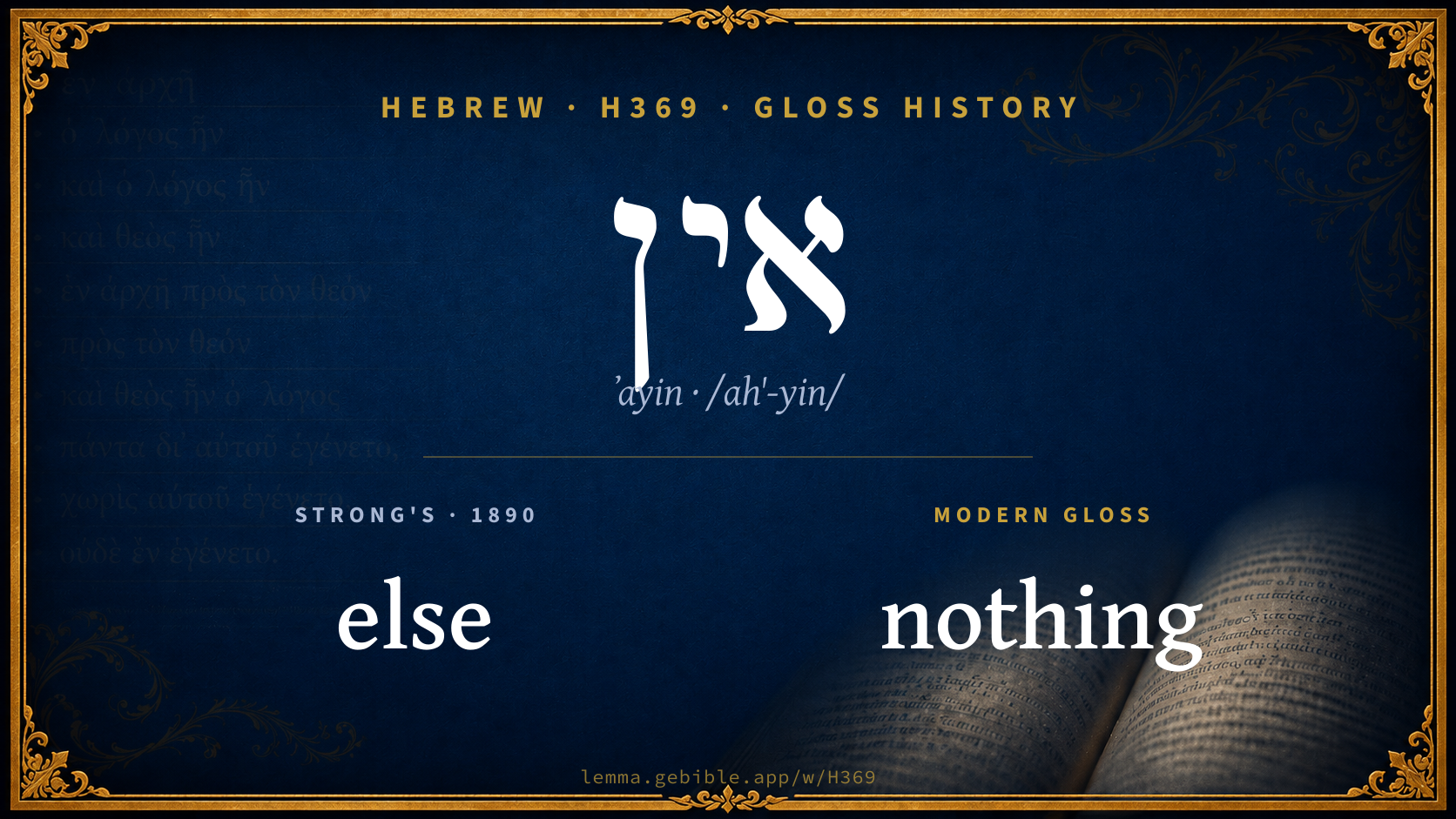
Gloss history
Strong's 1890 vs modern scholarship
About this word
Strong's H369 catalogs a Hebrew word from the Hebrew Old Testament.
These counts are not copied from any lexicon or concordance. They are computed here, from the morphology-tagged Hebrew Old Testament. What Lemma adds →
- 686
- distinct verses
- The word appears in 686 distinct verses.
- 38 / 39
- OT books
- The word appears in 38 of 39 Old Testament books.
- #59
- by frequency
- Top 100 most frequent Hebrew words (rank 59 of 8,640 Hebrew words by occurrence).
View all 686 occurrences in the concordance →
By section of the Old Testament
By traditional corpus
Conventional, traditional groupings — biblical authorship is debated, so this is a traditional corpus grouping, not an authorship claim. Each share is this word’s portion of its verses in that division of the Hebrew canon. Each figure is a share of the word’s 686 distinct verses.
- Prophets (Nevi'im) 325 verses · 47%
- Writings (Ketuvim) 241 verses · 35%
- Torah (Pentateuch) 120 verses · 17%
How translations render this word
Counts come from each version’s own published word-to-Strong’s tagging or interlinear alignment — an approximate guide to how each version renders this word, not a word-level alignment the data otherwise carries. Because each total is that version’s own tagged count, the per-version totals vary from one another and need not match the appearance or distinct-verse counts above. These counts may also differ from a printed concordance because Lemma counts each distinctly tagged rendering and does not collapse phrase taggings into a single head-word total. This is a fixed set of word-tagged versions (KJV, ASV, BSB, ULT) and does not change with the reading translation you choose elsewhere. Each version’s license is shown beside its name below (and on Sources).
BDB lists this Strong’s number as 4 distinct words (homographs). Each count above pools all of them and is not split by sense — see the Senses section below. A low-frequency rendering may belong to a different one of those words, not the primary meaning.
- King James Version†: Abundance 1×, Are innumerable 1×, Are not 1×
- American Standard Version†: Abundance 1×, Are innumerable 1×, Are not 1×
- Berean Standard Bible†: No 114×, Is no 85×, One 68×
- unfoldingWord Literal Text†: Is no 168×, Is not 78×, Was no 52×
King James Version Public Domain
Renders H369 across 29† tagged occurrences — most commonly:
Plus other, less common renderings.
American Standard Version Public Domain
Renders H369 across 29† tagged occurrences — most commonly:
Plus other, less common renderings.
Berean Standard Bible Public Domain
Renders H369 across 745† tagged occurrences — most commonly:
Plus other, less common renderings. Plus 134 renderings that appear only once — usually multi-word phrases or single function words the recovered tagging swept in, not distinct renderings. Not rendered by a distinct English word in 32 further occurrences.
unfoldingWord Literal Text CC BY-SA 4.0
Renders H369 across 834† tagged occurrences — most commonly:
Plus other, less common renderings. Plus 72 renderings that appear only once — usually multi-word phrases or single function words the recovered tagging swept in, not distinct renderings.
16 senses and sub-senses in the full BDB
What do BDB’s symbols mean?
BDB uses these scholarly abbreviations:
| Symbol | Meaning |
|---|---|
| 𝔊 | the Septuagint (the ancient Greek translation, LXX) |
| 𝔙 | the Vulgate (the Latin translation) |
| 𝔖 | the Syriac version (the Peshitta) |
| 𝔗 | the Targum (the Aramaic translation) |
| ψ | the Psalms |
| √ | root (the underlying root or stem) |
| ‖ | parallel passage (a synonymous or contrasted parallel) |
| † | the dagger: every passage where the word occurs is cited |
The 16 senses and sub-senses the full Brown-Driver-Briggs lexicon distinguishes for this word, in lexicon order (not ranked by frequency), with BDB’s own verbatim wording and sub-sense lettering. Shown in Hebrew script with BDB’s own scholarly abbreviations. The condensed entry is in the Lexicon Entry tab. See also the Forms in the corpus table below.
אין I (from אַי
אין II ought, v. p. 34.
אין III whence? v. sub אַי.
אין IV cstr. אֵין subst. proposes nothing, nought (Moab. אן, As. iûnu).
- 1. †Is 40:23 הַנּוֹתֵן רוֹזְנִים לְאָ֑יִן who bringeth princes to nothing; †כְּאַיִן as nothing, ib. 40:17; 41:11, 12 Hg 2:3 ψ 39:6; almost (‖ כִּמְעַט) ψ 73:2; †מֵאַיִן of nothing Is 41:24. e.g. Isaiah 40:23
- 2. cstr. אֵין, very freq. as particle of negation, is not, are not, was not, were not, etc. (corresp. to the affirm. יֵשׁ q.v. Similar in usage, though not etym. akin, are لَيْسَ, לַיִת, ܠܰܝܬ, አልቦ), proposes ‘there is nought of …’ sq. a subst. or a pron. suffix (אֵינֶנִּי [verbal form, Ges§ 100, 5; 152, 1 c], אֵינְךָ, אֵינֵךְ, אֵינֶנּוּ, אֵינֶנָּה, אֵינְכֶם, אֵינָם, also ψ 59:14 אֵינֵ֫מוֹ, 73:5 אֵינֵ֫ימוֹ): twice abnormally, in late Heb., a nom. אֵין אֲנִי, אֵין אֲנַחְנוּ Ne 4:17 (so sts. לַיִת, ܠܰܝܬ, NöM. p. 295); once, incorrectly, את Hg 2:17 (?). e.g. Psalms 59:14
- a. denying existence absolutely Is 44:6; 47:10 אֵין רֹאָנִי there is none that seeth me, lit. nought of one seeing me! אֵין עוֹד there is none else Dt 4:39 1 K 8:60 Is 45:5, 6, 18, 22. e.g. Isaiah 44:6
- b. more commonly, in a limited sense, there is none here or at hand Ex 2:12 and he saw כִּי־אֵין אִישׁ that there was no man (sc. there), Nu 21:5; Gn 5:24 וְאֵינֶנּוּ and he was not (of Enoch’s disappearance from earth) 42:13 one (cas.pend. as oft.), he is not, v 36; oft. = is (or has) vanished Gn 37:30 1 K 20:40 Is 17:14 ψ 37:10; 39:14; 103:16 Jb 8:22; 24:24; 27:19. e.g. Exodus 2:12
- c. with the sense determined by a predic. following: Gn 37:29 Joseph was not in the pit, 41:39 + often; Ex 5:10 אֵינֶנִּי נֹתֵן לָכֶם תֶּבֶן I am not giving you straw; and so often with particip. where duration has to be expressed Gn 39:23 Dt 21:18 Is 1:15 Je 7:16, or intention Gn 20:7 אִם אֵינְךָ מֵשִׁיב דַּע … if thou art not restoring her, know, 43:5 Ex 8:17; 33:15 (idiomatically, after אם; v. Dr§ 137) Ju 12:3. Foll. once pleon. by יֵשׁ ψ 135:17. Treated as a mere part. of negation, אֵין may vary its position in the sentence, the subst. which should strictly stand in the genitive being not only separated from it by a little word, as בּוֹ Gn 37:24, לוֹ Ex 22:1, שָׁם Ex 12:30, גַּם ψ 14:3, etc., but even for emphasis prefixed to it, as Gn 19:31; 40:8 וּפֹתֵר אֵין אֹתוֹ 41:15 Ex 5:16 Ju 13:9; 14:6; 16:15; 19:1 (so MI 24): if however it be thus brought to the end of a sentence, or be disconnected with what follows, it stands in the absol. form, as Gn 2:5 ואדם אַיִן לעבד האדמה and man there was none to till the ground, Lv 26:37 וְרֹדֵף אָ֑יִן, Nu 20:5 2 K 19:3 Ho 13:4 Mi 7:2. e.g. Genesis 37:29
- d. sometimes the subj. has to be supplied from the context: thus (α) †1 S 9:4 and they passed through the land of Shaalim וָאַיִן and they (the asses) were not (lit. and nought!), especially after vbs. of waiting or seeking Is 59:11 ψ 69:21 Jb 3:9; Is 41:17 Ez 7:25 Pr 14:6; 13:4; 20:4. (β) †Ex 17:7 is י׳ in the midst of us אִם־אָֽיִן׃ or not? Nu 13:20. (γ) †Ju 4:20 וְאָמַרְתְּ אָֽיִן׃ then thou shalt say, There is not, 1 K 18:10 1 S 10:14. (δ) Gn 30:1 give me children, וְאִם־אַיִן and if not, I die, Ex 32:32 Ju 9:15, 20 2 S 17:6 (v. Dr) 2 K 2:10 Jb 33:33. e.g. 1 Samuel 9:4
- e. with subj. not expressed, once (late), Dn 8:5 וְאֵין נוֹגֵעַ בָּאָרֶץ and (it) was not touching the earth. e.g. Daniel 8:5
- f. Ec 8:11, Jb 35:15 with the finite vb.; but rd. here כִּי אֵין פֹּקֵד (the usage of لَيْسَ, cited by De, does not justify the anomaly in Heb.) Je 38:5 the impf. may be due to the fact that no ptcp. of יָכֹל was in use, and a relat. must be tacitly supplied: ‘The king is not (one that) can do aught against you.’ On Ex 3:2 see Ges§ 52, 2 R. 6; Ew§ 169 d. e.g. Ecclesiastes 8:11
- 3. אֵין לְ׳, with subst., or pron., there is (was) not to … = … have, has, had, etc. not: Gn 11:30 אֵין לָהּ וָלָד she had no child, Nu 27:9 וְאִם־אֵין לוֹ בַּת and if he have no daughter + oft.; with a ptcp. Dt 22:27 Je 14:16; 30:17; 49:5; 50:32 ψ 142:5 La 1:2, 9, 17; Ex 22:2 אִם־אֵין לוֹ if he have nought, Dn 9:26 ואין לו and have nought (or none). e.g. Genesis 11:30
- 4. in circumst. clauses (Dr§ 164):—(a) Ex 21:11 she shall go out free אֵין כָּ֑סֶף without money, 22:9 אֵין רֹאֶה none seeing it, Nu 11:6 Is 47:1 Je 2:32 Ho 3:4; 7:11 ψ 32:9; 88:5 +. (b) Dt 32:4 a God of faithfulness וְאֵין עָוֶל and no iniquity, i.e. without iniquity, Je 5:21 Jo 1:6 ψ 104:25. (c) very oft., in such phrases as וְאֵין מַחֲרִיד with none to affright Lv 26:6 (12 textual); וְאֵין מְכַבֶּה Is 1:31 al.; וְאֵין מַצִּיל 5:29 ψ 7:3, etc. (Dr§ 159). e.g. Exodus 21:11
- 5. with inf. and ל׳, it is not to …: i.e. (α) like οὐκ ἔστιν, it is not possible to … (cf. sub יֵשׁ and לֹא), but hardly exc. in late Heb.; 2 Ch 20:6 וְאֵין עִמְּךָ לְהִתְיַצֵּב it is not possible to stand (in conflict) with thee, 22:9 Ezr 9:15 Ec 3:14 Est 4:2. Once without ל, ψ 40:6 אֵין עֲרֹךְ אֵלֶיךָ οὐκ ἔστι παραβάλλειν σοι. (β) there is no need to … 1 Ch 23:26 וְגַם לַלְוִיִּם אֵין־לָשֵׂאת for the Levites also there was no need to bear 2 Ch 5:11; 35:15 (v. Dr§ 202. 1). e.g. 2 Chronicles 20:6
- 6. with prefixes:—
- a. †בְּאֵין prop. in defect of:—(α) for want of, without—Pr 5:23 he will die בְּאֵין מוּסָר for lack of instruction, 11:14 בְּאֵין תַּחְבֻּלוֹת without guidance, 14:4; 15:22; 26:20; 29:18 Is 57:1 Ez 38:11; cf. בְּלֹא. (β) of time = when there was (were) not Pr 8:24(×2). e.g. Proverbs 5:23
- b. †כְּאֵין Is 59:10 כְּאֵין עֵינַיִם poet. for כַּאֲשֶׁר אֵין לוֹ עֵינַיִם (cf. Ew§ 286 g Ges§ 152. 1 h). e.g. Isaiah 59:10
- c. †לְאֵין (α) for לַאֲשֶׁר אֵין לוֹ Is 40:29; in late prose 2 Ch 14:10 Ne 8:10. (β) in the condition of not … (ל of state, v. sub ל) = without or so that not … (peculiar to Ch), 1 Ch 22:4 cedar trees לְאֵין מִסְפָּר without number, 2 Ch 14:12 and there fell of the Cushites לְאֵין־לָהֶם מִחְיָה so that they had none remaining alive, 20:25 לְאֵין מַשָּׂא so that there was no carrying away, 21:18 Ezr 9:14. (γ) עַד־לְאֵין (see עַד ל׳), 2 Ch 36:16 until there was no remedy (cf. עַד אֵין … ψ 40:13 Jb 5:9). e.g. Isaiah 40:29
- d. מֵאֵין (α) (מִן causal) from lack of … Is 50:2 Je 7:32; 19:11 Ez 34:8. (β) (v. מִן 7 b) proposes away from there being no … (with אֵין pleon., cf. מִבְּלִי, and מִבְּלִי אֵין), i.e. so that not …, without, mostly epexegetical of some term expressing desolation: Is 5:9 Surely many houses shall be desolate מֵאֵין יוֹשֵׁב without inhabitant, 6:11 + oft. Je & Zp; Is 6:11 מֵאֵין אָדָם, Je 32:43 מֵאֵין אָדָם וּבְהֵמָה 33:10, 12 Ez 33:28; La 3:49. Once sq. inf. Mal 2:13 so that there is no regarding more. (γ) in Je 10:6, 7 מֵאֵין כָּמוֹךָ, מֵאֵין is supposed by some to = a strengthened אֵין, even none, none at all; but it is difficult to justify this expl. logically; and it is preferable to point מֵאַיִן כָּמוֹךָ whence is any like thee? cf. 30:7. (So Mich v. DrHbr ii.34–7.) e.g. Isaiah 50:2
Senses from the full Brown-Driver-Briggs lexicon (Brown, Driver, Briggs; Oxford 1906 — public domain), digitized via Sefaria, supplemented by the OpenScriptures HebrewLexicon (CC BY 4.0). Full attribution on Sources.
Word origin
I. adv. (from אַי; Ass. aina, ainu, Ara. أَيْنَ where? مِنْ أَيْنَ whence?) only in the compound מֵאַ֫יִן17 whence? Gn 29:4; 42:7 (syn. אֵי־מִזֶּה e.g. Gn 16:8 1 S 30:13) Ju 17:9; 19:17 Jb 1:7 (2:2 אֵי־מִזֶּה); used in a rhet. or poet. style (where אֵי־מִזֶּה would be too prosaic) Nu 11:13 מֵאַיִן לִי בָּשָׂר whence have I flesh etc.? 2 K 6:27 Je 30:7 Alas! for that day is great; מֵאַיִן כָּמוֹהוּ whence is its like? (see also II. אַיִן ad fin.) Na 3:7 ψ 121:1 Jb 28:12, 20; in an indirect sentence Jos 2:4 (cf. אֵי־מִזֶּה 1 S 25:11).
III. whence? v. sub אַי.
IV. cstr. אֵין subst. proposes nothing, nought (Moab. אן, As. iûnu).
— Brown-Driver-Briggs (Oxford 1906, public domain), digitized via Sefaria, supplemented by the OpenScriptures HebrewLexicon (CC BY 4.0). See Sources.
Origin: as if from a primitive root meaning to be nothing or not exist
Jastrow Dictionary
A second Hebrew/Aramaic lexicon for comparison, covering Aramaic and post-biblical (Talmudic, Targumic, Midrashic) usage that the biblical-Hebrew BDB does not. Matched by lemma rather than by Strong’s number, so a lemma may carry more than one Jastrow headword (shown separately below), and the entries cover usage well beyond the Bible.
אָיַן
- , Pi. אִיֵּין (= עִיֵּין, v. next w.) to look upon, investigate. B. Bath. 115ᵃ (play on אִין) אַיֵּין עליו Ar. (ed. עַיֵּין) investigate his family relations. Kidd. 4ᵃ
אַיִן I
- (√או; cmp. אָוֶן, עַיִן) [b. h. naught], something rounded, decorative. Koh. R. to III, 12 expl. as נוֹי, ref. to the shape of the human buttock, v. אֱפִיפְּיוֹן.
אַיִן II
- where? (only with pref. מ or ל). לְאַ׳ whither? מֵאַ׳ whence? Y. Snh. X, 28ᵈ bot; Y. Ḥag. II, 77ᵃ bot. מא׳ ולא׳ whence and whither?—Aboth III, 1. Gen. R. s. 2 מא׳ הרגלים whence art thou coming? i.e. where hast thou been staying?—Y. Snh. X, 28ᵇ top היה לו מא׳ ללמוד he had (a precedent) to learn from.—Contr. of מן אין: מִנַיִן, v. מִן.
אֵין
- nothing, not. Ber. 5ᵃ אין עוף אלא וכ׳ uf (flight, Job V, 7) means nothing else but &c.; a. v. fr.—אֵינִי, אֵינְךָ not I &c. אֵינִי יודע I do not know; do I not know? B. Mets. 97ᵇ; a. fr. Ber. l. c. but the Holy One … אֵינוֹ כן is not so; a. fr.—אֵינוֹ דין is it not a legitimate conclusion?, whence so much the more. Y. Naz. VI, 55ᵃ; a. v. fr.—… אין לי אלא … מניין from this I could only prove …, whence, however, will you deduct …? Ḥull. 65ᵇ; a. fr. [Y. Git. IX, end, 50ᵈ אפי׳ כתב אינו read סימנו.] e.g. Job 5:7
אִין I
- (Syr. = הֵין, הֶן) yes, indeed. Keth. 65ᵃ השתא א׳ וכ׳ now,—yes, but not before. B. Mets. 98ᵃ חדא א׳ בעידן וכ׳ as regards the one (cow)—well, she died &c.; a. fr.—אֵינִי = אִין הִי is it really so? indeed?, i.e. it cannot be. Ḥull. 96ᵇ א׳ והאמר it cannot be so; for did not R. … say &c.? M. Kat. 20ᵃ; a. v. fr.
אִין II
- 1. if, whether. Targ. Ps. VII, 4; a. e. [Apocopated: אִי q. v.]—אין תימר (h. אם תאמר) if thou wilt say (argue). Y. Macc. II, 31ᵈ bot.; a. fr.—אין כיני (h. אם כן היא) if this is (be) the case. Y. Naz. VI, 54ᵈ bot.—Lam. R. introd. end אן את יתיב וכ׳ if thou remainest here, or &c. Koh. R. to X, 5 אן אתת ענתה וכ׳ if the (my dying) time comes first, what of it? and if &c.
- 2. adv. of interrogation, introducing the alternative, or. Targ. Job VI, 6; a. e.
A Dictionary of the Targumim, the Talmud Babli and Yerushalmi, and the Midrashic Literature (Marcus Jastrow; London, Luzac, 1903) — Public Domain. Digitized via Sefaria. Digitized via Sefaria. Full attribution on Sources.
Forms in the corpus
The 119 distinct written forms H369 takes in the Hebrew Bible, most frequent first — each parse links to that state’s occurrences in the concordance. Hebrew forms include their vowel points and cantillation, so a single lemma takes many written forms.
| Form | Parsing | Example | Uses |
|---|---|---|---|
| אֵ֥ין | Particle, Negative | Amos 5:2 | 102 |
| וְ/אֵ֥ין | Particle, Negative | Daniel 8:4 | 98 |
| אֵ֣ין | Particle, Negative | Amos 3:4 | 89 |
| וְ/אֵ֣ין | Particle, Negative | Daniel 9:26 | 73 |
| אֵֽין | Particle, Negative | Amos 2:11 | 60 |
| אֵין | Particle, Negative | Ecclesiastes 8:11 | 56 |
| אֵ֤ין | Particle, Negative | Deuteronomy 31:17 | 23 |
| וְ/אֵין | Particle, Negative | Amos 5:6 | 21 |
| מֵ/אֵ֥ין | Particle, Negative | Ezekiel 33:28 | 18 |
| אֵינֶ֥/נּוּ | Particle, Negative | Deuteronomy 21:20 | 11 |
| אֵ֖ין | Particle, Negative | Deuteronomy 4:39 | 10 |
| וְ/אֵ֖ין | Particle, Negative | Deuteronomy 28:26 | 10 |
| וְ/אֵֽין | Particle, Negative | Ecclesiastes 9:5 | 10 |
| אַ֖יִן | Particle, Negative | Genesis 30:1 | 8 |
| וְ/אֵ֤ין | Particle, Negative | Ecclesiastes 4:1 | 8 |
| בְּ/אֵ֣ין | Particle, Negative | Ezekiel 38:11 | 7 |
| אֵ֨ין | Particle, Negative | Ecclesiastes 2:16 | 6 |
| אֵינֶ֣/נּוּ | Particle, Negative | Deuteronomy 21:18 | 6 |
| וְ/אֵ֨ין | Particle, Negative | Daniel 10:21 | 6 |
| מֵ/אֵ֣ין | Particle, Negative | Ezekiel 34:8 | 6 |
| לְ/אֵ֣ין | Particle, Negative | 1 Chronicles 22:4 | 5 |
| אָ֑יִן | Particle, Negative | 1 Kings 18:10 | 4 |
| וְ/אֵינֶֽ/נּוּ | Particle, Negative | Isaiah 19:7 | 4 |
| אֵינֶ֣/נִּי | Particle, Negative | Isaiah 1:15 | 3 |
| אֵ֚ין | Particle, Negative | 1 Kings 8:9 | 3 |
| אֵינֶ֑/נּוּ | Particle, Negative | 1 Kings 20:40 | 3 |
| אֵינֶ֔/נּוּ | Particle, Negative | Genesis 37:30 | 3 |
| אֵינֶ֛/נּוּ | Particle, Negative | Deuteronomy 29:15 | 3 |
| אֵינֶ֨/נּוּ | Particle, Negative | Genesis 39:9 | 3 |
| אֵינֶֽ/נּוּ | Particle, Negative | Genesis 42:13 | 3 |
| אֵינָ֥/ם | Particle, Negative | Ecclesiastes 5:1 | 3 |
| אַ֔יִן | Particle, Negative | Genesis 2:5 | 3 |
| אַ֕יִן | Particle, Negative | Exodus 32:32 | 3 |
| אָֽיִן | Particle, Negative | Exodus 17:7 | 3 |
| הַ/אֵ֨ין | Particle, Negative | 1 Kings 22:7 | 3 |
| וְ/אֵינֶ֑/נּוּ | Particle, Negative | Job 3:21 | 3 |
| וְ/אֵינֶֽ/נִּי | Particle, Negative | Job 7:8 | 3 |
| וָ/אַ֔יִן | Particle, Negative | 1 Samuel 9:4 | 3 |
| לְ/אֵ֥ין | Particle, Negative | Ezra 9:14 | 3 |
| אֵ֝֗ין | Particle, Negative | Psalms 14:3 | 2 |
| אֵֽינְ/ךָ֣ | Particle, Negative | Genesis 20:7 | 2 |
| אֵֽינְ/כֶם֙ | Particle, Negative | Deuteronomy 1:32 | 2 |
| אֵין֙ | Particle, Negative | Genesis 47:13 | 2 |
| אֵינְ/ךָ֣ | Particle, Negative | 2 Samuel 19:7 | 2 |
| אֵינְ/כֶ֖ם | Particle, Negative | Ezekiel 20:39 | 2 |
| אֵינְ/כֶ֥ם | Particle, Negative | Deuteronomy 4:12 | 2 |
| אֵינֶ֛/נָּה | Particle, Negative | Leviticus 13:21 | 2 |
| אֵינֶ֣/נָּה | Particle, Negative | Leviticus 11:26 | 2 |
| אֵינֶ֤/נִּי | Particle, Negative | Jeremiah 14:12 | 2 |
| אֵינֶ֥/נִּי | Particle, Negative | Deuteronomy 4:22 | 2 |
| אֵינָ֣/ם | Particle, Negative | Esther 3:8 | 2 |
| אַ֭יִן | Particle, Negative | Job 33:33 | 2 |
| וְ/אֵינְ/ךָ֖ | Particle, Negative | Ezekiel 28:19 | 2 |
| וְ/אֵינָ֔/ם | Particle, Negative | Jeremiah 10:20 | 2 |
| וְ/אֵינָ֥/ם | Particle, Negative | Jeremiah 32:33 | 2 |
| וְֽ/אֵין | Particle, Negative | Hosea 4:1 | 2 |
| וָ/אַ֑יִן | Particle, Negative | Job 3:9 | 2 |
| וָ/אָֽיִן | Particle, Negative | Ezekiel 7:25 | 2 |
| וּ/מֵ/אֵ֥ין | Particle, Negative | Jeremiah 33:10 | 2 |
| כְ/אַ֛יִן | Noun, Common, Masculine, Singular, Absolute | Isaiah 41:11 | 2 |
The 60 most common forms are shown; 59 rarer forms follow in the full concordance.
Same root — word family
Other BDB entries built from the same root as H369, grouped by Strong’s listed origin. These share a root / origin per the lexicon — not necessarily a shared meaning. Each links to that word’s own entry.
Derived from this word
Proper names from this root
People and places named from this root — a name, not an additional meaning of the word.
Compare all same-root words → 1 of the same-root words is a proper name (a person or place). They share a root, not necessarily a meaning.
Septuagint verse parallels
This word appears in 646 verses that also exist in the Greek Old Testament (Septuagint), out of the 686 Hebrew verses it occurs in. You can read those verses in Greek by switching the Old Testament edition to the Septuagint.
Read these verses in the Septuagint
- Genesis 2:5
- Exodus 2:12
- Leviticus 11:4
- Numbers 5:8
- Deuteronomy 1:32
- Joshua 6:1
- Judges 3:25
- Ruth 4:4
- 1 Samuel 1:2
- 2 Samuel 3:22
- 1 Kings 3:18
- 2 Kings 1:3
This is a verse-level parallel only — the same verses exist in both the Hebrew and Greek Old Testaments. No word-level Hebrew↔Greek correspondence is claimed: the data carries no such alignment, so no Greek word is shown as this Hebrew word’s translation. Coverage is not total — the Septuagint omits the deuterocanon and renumbers the Psalms, so some Hebrew verses have no direct Greek parallel.