Genesis 41:49

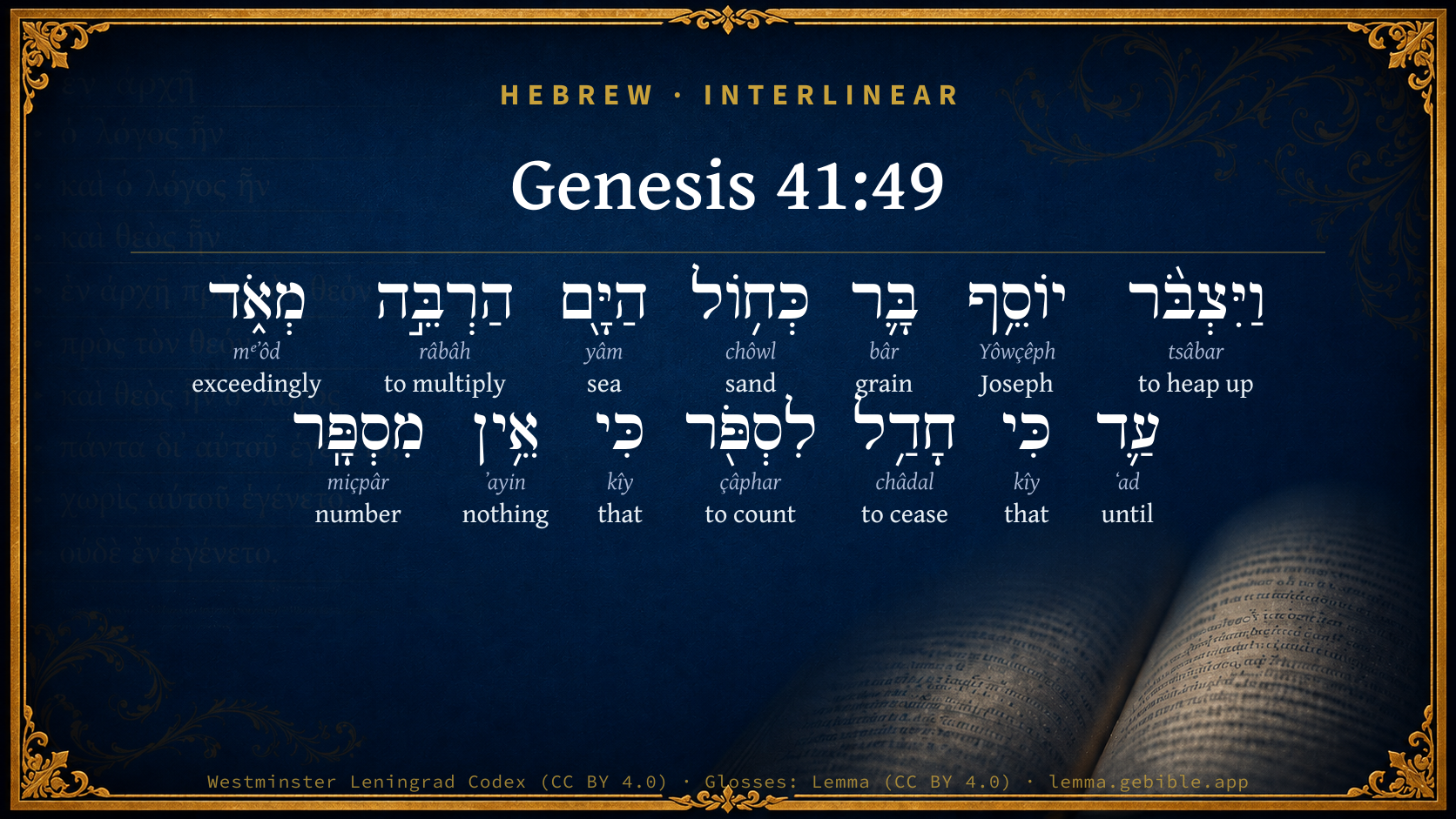
Hebrew (Westminster Leningrad Codex) Genesis 41:49 appears in the Hebrew Old Testament. The text above is from the Westminster Leningrad Codex. Each word links to its Strong’s number, a concise gloss, and parsing drawn from the Open Scriptures Hebrew Bible morphology. Click any word for its full Brown-Driver-Briggs (BDB) entry.
Download image
Cite this verse

Genesis 41:49 (World English Bible). Public Domain. Lemma interlinear Bible study tool, https://lemma.gebible.app/v/genesis/41/49.

Show BibTeX & RIS
BibTeX
RIS
English Translation
Joseph laid up grain as the sand of the sea, very much, until he stopped counting, for it was without number.
World English Bible · Public Domain
Download a study sheet

One document with this verse’s original text, its word-by-word gloss line, the meaning frame, cross-references with their text, attributed commentary, and full source and license credits — printable, and it pastes into notes with its structure intact.

This verse Autodidact and up

Study sheet (.html) Plain text (.txt)

A passage Seminary Student

Up to 50 verses in one chapter. A passage sheet keeps up to 6 commentary sources and 12 cross-references per verse, in the order this page ranks them, and says so on the sheet whenever that leaves anything out. Ask for a single verse and you get the Autodidact verse sheet above.

Everything on this page stays free to read, with no account — the sheet is a download of what is already on screen, not access to it.

Want to remove ads? Support Godless Engineer
Compare translations 3

The same verse in 3 English versions, stacked beneath the original-language interlinear above. Click any original word for its lexicon entry.

Each is an independent rendering of the whole verse — the interlinear is not word-aligned to these translations.

Highlighted words mark where these versions differ — a whole-verse word diff, not a word-by-word alignment.

  • World English Bible Public Domain
    Joseph laid up grain as the sand of the sea, very much, until he stopped counting, for it was without number.
  • King James Version Public Domain
    And Joseph gathered corn as the sand of the sea, very much, until he left numbering; for it was without number.
  • unfoldingWord Literal Text CC BY-SA 4.0
    So Joseph stored up grain like the sand of the sea, very much, until he stopped measuring because it was without number.

unfoldingWord Literal Text — © unfoldingWord, licensed CC BY-SA 4.0. Word-aligned USFM3 via Door43 (git.door43.org/unfoldingWord/en_ult).

Versions to compare (up to 4)

3 of 4 selected

Show all 18 translations

Every available English version of this verse, each an independent rendering of the whole verse.

  • World English Bible Public Domain
    Joseph laid up grain as the sand of the sea, very much, until he stopped counting, for it was without number.
  • Berean Standard Bible Public Domain
    So Joseph stored up grain in such abundance, like the sand of the sea, that he stopped keeping track of it; for it was beyond measure.
  • Majority Standard Bible Public Domain
    So Joseph stored up grain in such abundance, like the sand of the sea, that he stopped keeping track of it; for it was beyond measure.
  • King James Version Public Domain
    And Joseph gathered corn as the sand of the sea, very much, until he left numbering; for it was without number.
  • American Standard Version (1901) Public Domain
    And Joseph laid up grain as the sand of the sea, very much, until he left off numbering; for it was without number.
  • Revised Version (1885) Public Domain
    And Joseph laid up corn as the sand of the sea, very much, until he left numbering; for it was without number.
  • Geneva Bible (1599) Public Domain
    So Ioseph gathered wheate, like vnto the sand of the sea in multitude out of measure, vntill he left numbring: for it was without number.
  • Douay-Rheims (1899) Public Domain
    And the fruitfulness of the seven years came: and the corm being bound up into sheaves was gathered together into the barns of Egypt.
  • Young's Literal Translation Public Domain
    and Joseph gathereth corn as sand of the sea, multiplying exceedingly, until that he hath ceased to number, for there is no number.
  • Literal Standard Version CC BY-SA 4.0
    and Joseph gathers grain as sand of the sea, multiplying exceedingly, until he has ceased to number, for there is no number.
  • Unlocked Literal Bible CC BY-SA 4.0
    Joseph stored up grain like the sand of the sea, so much that he stopped counting, because it was beyond counting.
  • unfoldingWord Literal Text CC BY-SA 4.0
    So Joseph stored up grain like the sand of the sea, very much, until he stopped measuring because it was without number.
  • Darby Bible Public Domain
    And Joseph laid up corn as sand of the sea exceeding much, until they left off numbering; for it was without number.
  • World Messianic Bible Public Domain
    Joseph laid up grain as the sand of the sea, very much, until he stopped counting, for it was without number.
  • Webster's Bible Public Domain
    And Joseph gathered corn as the sand of the sea, very much, until he left numbering; for it was without number.
  • Free Bible Version CC BY-SA 4.0
    Joseph piled up so much grain that it was like the sand of the seashore. Eventually he stopped keeping records because there was just so much!
  • Bible in Basic English Public Domain
    So he got together a store of grain like the sand of the sea; so great a store that after a time he gave up measuring it, for it might not be measured.
  • JPS Tanakh (1917) Public Domain
    And Joseph laid up corn as the sand of the sea, very much, until they left off numbering; for it was without number.

Literal Standard Version (2020), Covenant Press — licensed CC BY-SA 4.0. Text via the HelloAO Bible API (eBible.org). Unlocked Literal Bible (unfoldingWord) — licensed CC BY-SA 4.0. Text via the HelloAO Bible API (eBible.org). unfoldingWord Literal Text — © unfoldingWord, licensed CC BY-SA 4.0. Word-aligned USFM3 via Door43 (git.door43.org/unfoldingWord/en_ult). Free Bible Version, Dr. Jonathan Gallagher — licensed CC BY-SA 4.0. Text via the HelloAO Bible API (eBible.org).

Word by word

More ways to search: Search by grammar → Find every occurrence → Compare this word →

Practice this passage: Drill this verse → Learn its vocabulary →

וַיִּצְבֹּ֨ר
tsâbar
H6651
“and · to heap up”
Conjunction + Verb, Qal, Sequential Imperfect, 3rd Person, Masculine, Singular
Part of Speech
Conjunction + Verb
Stem
Qal
Form
Sequential Imperfect
Person
3rd Person
Gender
Masculine
Number
Singular
Full BDB Definition

Origin: a primitive root

TWOT: 1874

(Qal) to heap up, pile up - of grain, dust, silver
  1. יוֹסֵ֥ף Yôwçêph H3130 “Joseph” Noun, Proper
  2. בָּ֛ר bâr H1250 “grain” Noun, Common, Masculine, Singular, Absolute
  3. כְּח֥וֹל chôwl H2344 “like/as · sand of” Preposition + Noun, Common, Masculine, Singular, Construct
  4. הַיָּ֖ם yâm H3220 “the · sea” Particle, Definite Article + Noun, Common, Masculine, Singular, Absolute
  5. הַרְבֵּ֣ה râbâh H7235 “to multiply” Verb, Hiphil, Infinitive Absolute
  6. מְאֹ֑ד mᵉʼôd H3966 “exceedingly” Adverb
  7. עַ֛ד ʻad H5704 “until” Preposition
  8. כִּי kîy H3588 “that” Conjunction
  9. חָדַ֥ל châdal H2308 “to cease” Verb, Qal, Perfect, 3rd Person, Masculine, Singular
  10. לִסְפֹּ֖ר çâphar H5608 “to count” Preposition + Verb, Qal, Infinitive Construct
  11. כִּי kîy H3588 “that” Conjunction
  12. אֵ֥ין ʼayin H369 “nothing” Particle, Negative
  13. מִסְפָּֽר miçpâr H4557 “number” Noun, Common, Masculine, Singular, Absolute

About this verse

These counts appear in no published source. They are computed here, from the morphology-tagged text and Lemma’s own curated glosses. What Lemma adds →

14
words
13
distinct lemmas
Pentateuch
section

Notable vocabulary

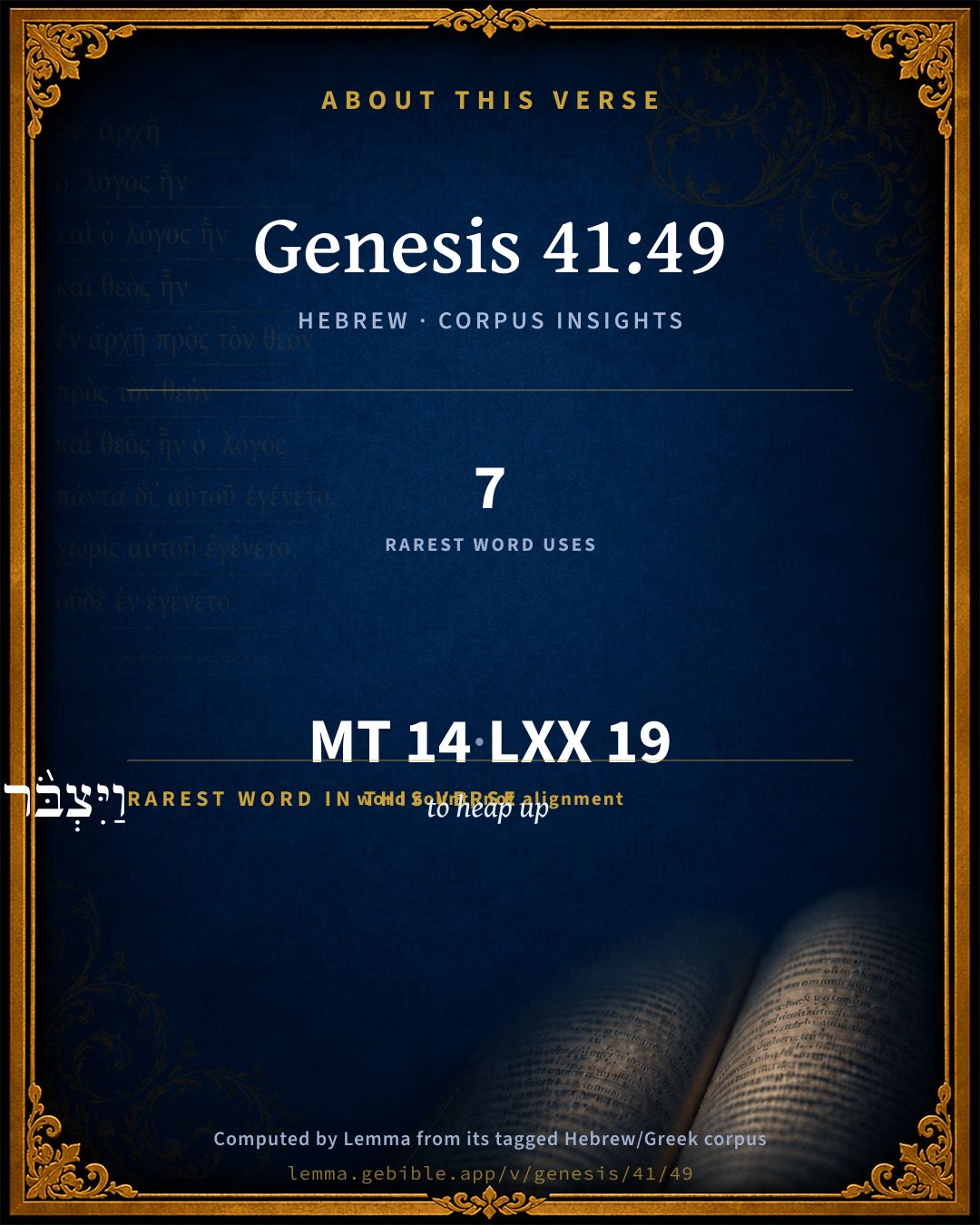
The rarest word here is וַיִּצְבֹּ֨ר to heap up H6651 — appearing just 7 times in the whole Hebrew Bible.

Shared distinctive vocabulary

וַיִּצְבֹּ֨ר to heap up H6651 occurs in 7 verses of the Hebrew Bible. Also found in:

Grammatical profile

  • 4 verbs
  • 5 nouns
  • 1 preposition
  • 2 conjunctions
  • 1 adverb
  • 1 particle

Verb forms

  • וַיִּצְבֹּ֨ר Qal · Sequential Imperfect
  • הַרְבֵּ֣ה Hiphil · Infinitive Absolute
  • חָדַ֥ל Qal · Perfect
  • לִסְפֹּ֖ר Qal · Infinitive Construct

Repetition

A word recurs within this verse — often emphatic in Hebrew:

  • כִּי that H3588 ×2

Hebrew & Septuagint length

In English translation the verse runs 21 words from the Hebrew and 25 from the Septuagint (LXX English) — closely comparable.

A rough comparison of the two English renderings, which tokenize alike — not a word-level alignment.

Word counts can differ between the Hebrew and the Greek without any difference in meaning — e.g. the Hebrew direct-object marker אֵת has no separate Greek word, and Greek often adds the article ὁ.

In the original languages it is 14 Hebrew tokens and 19 Greek tokens — but the two are counted differently (Hebrew bundles its prefixes and suffixes into one token; the Greek is in lemma form), so that isn’t a like-for-like length.

Cross-references

7

Topical passages linked to Genesis 41:49 in the Treasury of Scripture Knowledge — connected by theme and wording, ordered by reader-vote popularity; previews shown in the World English Bible.

  • Psalms 78:27 He rained also flesh on them as the dust; Winged birds as the sand of the seas.
  • Genesis 22:17 that in blessing I will bless you, and in multiplying I will multiply your seed as the stars of the heavens, and as the sand which is on the seashore. Your seed will possess the gate of his enemies.
  • Judges 6:5 For they came up with their cattle and their tents; they came in as locusts for multitude; both they and their camels were without number: and they came into the land to destroy it.
  • Judges 7:12 The Midianites and the Amalekites and all the children of the east lay along in the valley like locusts for multitude; and their camels were without number, as the sand which is on the sea-shore for multitude.
  • 1 Samuel 13:5 The Philistines assembled themselves together to fight with Israel, thirty thousand chariots, and six thousand horsemen, and people as the sand which is on the sea-shore in multitude: and they came up, and encamped in Michmash, eastward of Beth Aven.
  • Job 1:3 His possessions also were seven thousand sheep, three thousand camels, five hundred yoke of oxen, five hundred she-donkeys, and a very great household; so that this man was the greatest of all the children of the east.
  • Jeremiah 33:22 As the host of the sky can't be numbered, neither the sand of the sea measured; so will I multiply the seed of David my servant, and the Levites who minister to me.

Cross-references courtesy of OpenBible.info (CC BY 4.0).

Hebrew and Greek witnesses Masoretic Hebrew ↔ Greek Septuagint

The same verse in the two great witnesses to the Old Testament, shown verse-for-verse.

These are two independent witnesses, not word-aligned to each other, and the Septuagint is shown in lemma (dictionary) form.

Hebrew Genesis 41:49 Masoretic · Westminster Leningrad Codex

וַיִּצְבֹּ֨ר יוֹסֵ֥ף בָּ֛ר כְּח֥וֹל הַיָּ֖ם הַרְבֵּ֣ה מְאֹ֑ד עַ֛ד כִּי חָדַ֥ל לִסְפֹּ֖ר כִּי אֵ֥ין מִסְפָּֽר

Joseph laid up grain as the sand of the sea, very much, until he stopped counting, for it was without number.

World English Bible · Public Domain

Greek LXX Genesis 41:49 Septuagint · lemma form

καί συνἄγω ιωσηφ σῖτος ὡσεί ὁ ἄμμος ὁ θάλασσα πολύς σφόδρα ἕως οὐ δύναμαι ἀριθμέω οὐ γάρ εἰμί ἀριθμός

And Joseph gathered very much corn as the sand of the sea, until it could not be numbered, for there was no number of it.

LXX2012 (modern English Septuagint) · Public Domain

Hebrew: Westminster Leningrad Codex (CC BY 4.0). Greek: Septuagint (public domain); English from LXX2012 (modern English Septuagint) (Public Domain). How the Septuagint differs from the Hebrew →

Targum (Aramaic paraphrase)

1

The Targum is the ancient Jewish Aramaic paraphrase of the Hebrew Scriptures — an interpretive translation, not the Hebrew text itself. Onkelos (literal) and Pseudo-Jonathan (expansive) render the Torah, and Jonathan the Prophets. Coverage is partial: where no permissively-licensed English translation exists for a verse, only the Aramaic is shown. This is verse-level text, not a word-by-word alignment to the Hebrew.

  1. Targum Onkelos Torah (Genesis–Deuteronomy)
    וּכְנַשׁ יוֹסֵף עִיבוּרָא כְּחַלָּא דְיַמָּא סַגִּי לַחֲדָא עַד דִּי פְסַק לְמִמְנֵי אֲרֵי לֵית מִנְיָן

    (no public-domain English translation for this verse)

    Targum Onkelos — Aramaic: “Onkelos Genesis” (public domain); “Onkelos Exodus” (public domain); “Onkelos Leviticus” (public domain); “Onkelos Numbers” (public domain); “Onkelos Deuteronomy” (public domain). English: “Sefaria Community Translation” (CC0 1.0 (public-domain dedication)); “J.W. Etheridge. The Targums of Onkelos and Jonathan Ben Uzziel on the Pentateuch. London: Longmans, Green, 1862” (public domain). Text via Sefaria.

Commentary

Notes on Genesis 41:49 from classic Christian and Jewish commentators (each source and its license shown beneath its notes). The classic Christian expositions comment on the surrounding passage and are grouped to its opening verse, so a note may address several verses; the Jewish commentaries on the Tanakh (Rashi and others) are per-verse, so they appear only where the commentator wrote on this verse.

Lemma curates 59 commentaries, every one of them public domain or Creative Commons licensed, each selected and text-cleaned for this edition rather than reprinted as found. About our sources →

Trapp's Complete Commentary

John Trapp

Gen 41:49 And Joseph gathered corn as the sand of the sea, very much, until he left numbering; for [it was] without number.

Ver. 49. And Joseph gathered corn.] Against the future famine; mentioned also by Justin, lib. xxxvi., out of Trogus Pompeius. It happened, as Orosius computeth it, in the year before Rome was built, 1048. Ussher dates this about 1715 BC.

John Trapp, A Commentary or Exposition upon All the Books of the Old and New Testament (1647–1656) — public domain. Text from a community e-Sword module.

The Cambridge Bible for Schools and Colleges

gen. ed. J. J. S. Perowne

49. as the sand, of the sea] For this comparison cf. Gen_22:17, Gen_32:12.

The Cambridge Bible for Schools and Colleges (gen. ed. J. J. S. Perowne; Cambridge University Press, 1878–1918) — public domain. Text from a community e-Sword module.

John Gill's Exposition

And the seven years of plenteousness that was in the land of Egypt were ended. Perhaps quickly after the birth of Ephraim, Joseph's second son; since the account follows upon that, and it is certain that he was born before the years of famine began, Gen 41:50; some connect the words, "moreover when" the seven years of plenty were ended, then began, as follows, seven years of famine; these events were fulfilled just as Joseph had predicted.

; some connect the words, "moreover when" the seven years of plenty were ended, then began, as follows, seven years of famine; these events were fulfilled just as Joseph had predicted.

Genesis 41:54

gen 41:54

gen 41:54

gen 41:54And the seven years of dearth began to come, as Joseph had said,.... In the interpretation of Pharaoh's dreams; as soon as the seven years of plenty were over, there were quickly some appearances of the famine coming on; as particularly the river Nile not flowing to its usual height at the season of it; hence there was a drought, the earth was parched, and everything began to wither and decay, and the seed that was sown sprung not up:

and the dearth was in all lands; adjoining to Egypt, as Syria, Arabia, Palestine, Canaan, &c.

but in all the land of Egypt there was bread; which was in the hands of everyone, and remained of their old stores in the years of plenty not yet exhausted, and which continued for some time after the dearth began. It is very probable that to this seven years' drought in Egypt Ovid (t) refers, which he makes to be nine; as does also Apollodorus (u).

(t) "Dicitur Aegyptus caruisse juvantibus arva Imbribus, atque annis sicca fuisse novem." --Ovid de Artc Amandi, l. 1. ver. 647. (u) De Deor Orig. l. 2. p. 104.

John Gill's Exposition of the Whole Bible (1746–1763) — public domain (CC PDM 1.0). Text via the HelloAO Bible API.

The Pulpit Commentary

And Joseph gathered (or heaped up) corn as the sand of the sea, an image of great abundance (cf. Gen_32:12) very much, until he left numbering (i.e. writing, or keeping a record of the number of bushels); for it was without number. "In a tomb at Eilethya a man is represented whose business it evidently was to take account of the number of bushels. Which another man, acting under him, measures. The inscription is as follows "The writer or registrar of bushels Thutnofre," (Hengstenberg, "Egypt and the Books of Moses," p. 36).

The Pulpit Commentary (1880–1919), ed. H.D.M. Spence-Jones & Joseph S. Exell — public domain. Text from a community e-Sword module.

Rashi

Rabbi Shlomo Yitzchaki (Rashi)

עד כי חדל לספר UNTIL THEY CEASED NUMBERING — until the one who was numbering stopped numbering — it is an elliptical phrase

כי אין מספר means because it was without number — The word כי has the meaning of because (Rosh Hashanah 3a).

Rashi on the Tanakh — English translations: “The Judaica Press complete Tanach with Rashi, translated by A. J. Rosenberg” (CC BY 4.0); “Pentateuch with Rashi's commentary by M. Rosenbaum and A.M. Silbermann, 1929-1934” (public domain); “The Metsudah Tanach series, Lakewood, N.J” (CC BY 4.0); and “The Book of Joshua, Metsudah Publications, 1997” (CC BY 4.0). Text via Sefaria.

Radak

Rabbi David Kimhi (Radak)

כחול הים, an exaggerated way of describing the abundance of grain.

Radak on the Tanakh — English translations: “Sefaria Community Translation” (CC0 1.0 (public-domain dedication)); “Eliyahu Munk, HaChut Hameshulash” (CC BY 4.0); “Rabbi Mike Feuer, Jerusalem Anthology” (CC BY 4.0); and “R. David Kimhi on the first book of Psalms, Translated by R.G. Finch, London, 1919” (public domain). Text via Sefaria.

Lesson kit

Teaching starters — assembled from the data on this page, not authored interpretation. Every prompt links to the verse data it draws on. Edit before teaching.

Genesis, in the Pentateuch, opens this verse with 14 words (13 distinct Hebrew lemmas). Its most distinctive word is tsâbar (“to heap up”). A historical commentator’s framing appears above. Read the whole chapter for the surrounding context.

Discussion questions

  1. The word tsâbar carries the sense “to heap up.” How does it shape the verse?
  2. Genesis 41:35 shares the word «to heap up» with this verse. How do the two illuminate each other?
  3. “that” occurs 2× in this one verse. What is the effect of the repetition?
  4. These translations render this verse differently; the difference is in the English rendering, not the original. What questions does that raise?
  5. The verb «וַיִּצְבֹּ֨ר» is Qal Sequential Imperfect. How does its form color the action?
  6. Reading how Trapp's Complete Commentary and The Cambridge Bible for Schools and Colleges read this verse, where do the two commentators agree and where do they part?

Things to notice

Reading settings

Reading text

Shown beneath each verse's original-language words.

Old Testament
Old Testament edition

Read the OT as the Masoretic Hebrew (MT) or the Greek Septuagint (LXX).

English shown for the Greek Septuagint (in the Hebrew ↔ Greek comparison).

Comparing translations? Open the Compare panel on any verse page to stack up to four side by side.