
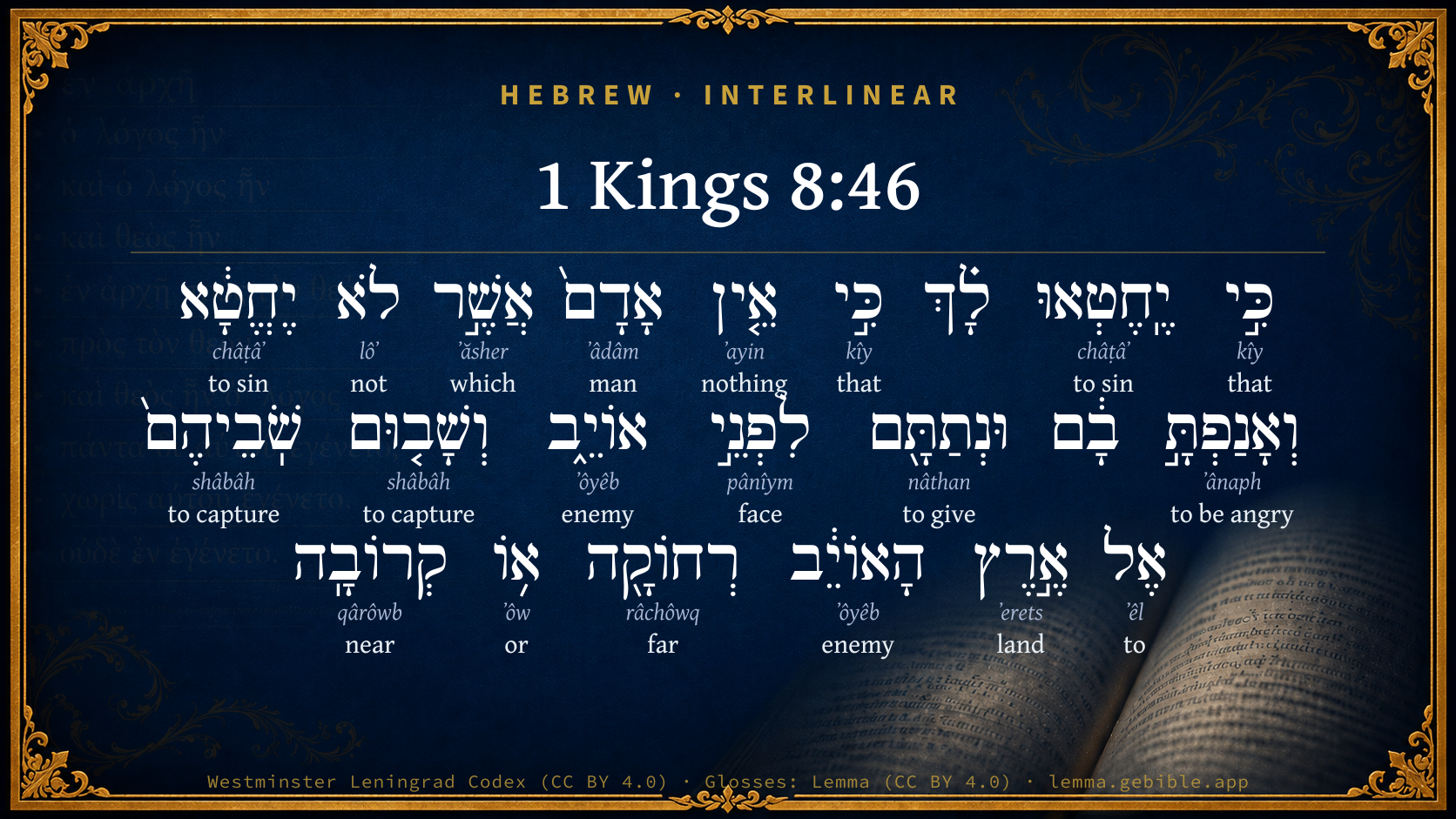
1 Kings 8:46

Hebrew (Westminster Leningrad Codex) 1 Kings 8:46 appears in the Hebrew Old Testament. The text above is from the Westminster Leningrad Codex. Each word links to its Strong’s number, a concise gloss, and parsing drawn from the Open Scriptures Hebrew Bible morphology. Click any word for its full Brown-Driver-Briggs (BDB) entry.
Download image
Cite this verse

1 Kings 8:46 (World English Bible). Public Domain. Lemma interlinear Bible study tool, https://lemma.gebible.app/v/1-kings/8/46.

Show BibTeX & RIS
BibTeX
RIS
English Translation
If they sin against you (for there is no man who doesn't sin), and you are angry with them, and deliver them to the enemy, so that they carry them away captive to the land of the enemy, far off or near;
World English Bible · Public Domain
Download a study sheet

One document with this verse’s original text, its word-by-word gloss line, the meaning frame, cross-references with their text, attributed commentary, and full source and license credits — printable, and it pastes into notes with its structure intact.

This verse Autodidact and up

Study sheet (.html) Plain text (.txt)

A passage Seminary Student

Up to 50 verses in one chapter. A passage sheet keeps up to 6 commentary sources and 12 cross-references per verse, in the order this page ranks them, and says so on the sheet whenever that leaves anything out. Ask for a single verse and you get the Autodidact verse sheet above.

Everything on this page stays free to read, with no account — the sheet is a download of what is already on screen, not access to it.

Want to remove ads? Support Godless Engineer
Compare translations 3

The same verse in 3 English versions, stacked beneath the original-language interlinear above. Click any original word for its lexicon entry.

Each is an independent rendering of the whole verse — the interlinear is not word-aligned to these translations.

Highlighted words mark where these versions differ — a whole-verse word diff, not a word-by-word alignment.

  • World English Bible Public Domain
    If they sin against you (for there is no man who doesn't sin), and you are angry with them, and deliver them to the enemy, so that they carry them away captive to the land of the enemy, far off or near;
  • King James Version Public Domain
    If they sin against thee, (for there is no man that sinneth not,) and thou be angry with them, and deliver them to the enemy, so that they carry them away captives unto the land of the enemy, far or near;
  • unfoldingWord Literal Text CC BY-SA 4.0
    If they sin against you (for no man who does not sin) and you are angry with them and you give them to the face of an enemy and they take them captive their captives to the land of the enemy, distant or near,

unfoldingWord Literal Text — © unfoldingWord, licensed CC BY-SA 4.0. Word-aligned USFM3 via Door43 (git.door43.org/unfoldingWord/en_ult).

Versions to compare (up to 4)

3 of 4 selected

Show all 18 translations

Every available English version of this verse, each an independent rendering of the whole verse.

  • World English Bible Public Domain
    If they sin against you (for there is no man who doesn't sin), and you are angry with them, and deliver them to the enemy, so that they carry them away captive to the land of the enemy, far off or near;
  • Berean Standard Bible Public Domain
    When they sin against You—for there is no one who does not sin—and You become angry with them and deliver them to an enemy who takes them as captives to his own land, whether far or near,
  • Majority Standard Bible Public Domain
    When they sin against You—for there is no one who does not sin—and You become angry with them and deliver them to an enemy who takes them as captives to his own land, whether far or near,
  • King James Version Public Domain
    If they sin against thee, (for there is no man that sinneth not,) and thou be angry with them, and deliver them to the enemy, so that they carry them away captives unto the land of the enemy, far or near;
  • American Standard Version (1901) Public Domain
    If they sin against thee (for there is no man that sinneth not), and thou be angry with them, and deliver them to the enemy, so that they carry them away captive unto the land of the enemy, far off or near;
  • Revised Version (1885) Public Domain
    If they sin against thee, (for there is no man that sinneth not,) and thou be angry with them, and deliver them to the enemy, so that they carry them away captive unto the land of the enemy, far off or near;
  • Geneva Bible (1599) Public Domain
    If they sinne against thee, ( for there is no man that sinneth not) and thou be angry with them, and deliuer them vnto the enemies, so that they cary them away prisoners vnto the land of the enemies, either farre or neere,
  • Douay-Rheims (1899) Public Domain
    But if they sin against thee (for there is no man who sinneth not) and thou being angry deliver them up to their enemies, so that they be led away captives into the land of their enemies far or near;
  • Young's Literal Translation Public Domain
    `When they sin against Thee (for there is not a man who sinneth not), and Thou hast been angry with them, and hast given them up before an enemy, and they have taken captive their captivity unto the land of the enemy far off or near;
  • Literal Standard Version CC BY-SA 4.0
    When they sin against You (for there is not a man who does not sin), and You have been angry with them, and have given them up before an enemy, and they have taken captive their captivity to the land of the enemy far off or near;
  • Unlocked Literal Bible CC BY-SA 4.0
    Suppose that they sin against you, since there is no one who does not sin, and suppose that you are angry with them and deliver them to the enemy, so that the enemy takes them away captive to their land, whether distant or near.
  • unfoldingWord Literal Text CC BY-SA 4.0
    If they sin against you (for no man who does not sin) and you are angry with them and you give them to the face of an enemy and they take them captive their captives to the land of the enemy, distant or near,
  • Darby Bible Public Domain
    If they have sinned against thee, (for there is no man that sinneth not,) and thou be angry with them, and give them up to the enemy, and they have carried them away captives unto the enemy's land, far or near;
  • World Messianic Bible Public Domain
    If they sin against you (for there is no man who doesn’t sin), and you are angry with them and deliver them to the enemy, so that they carry them away captive to the land of the enemy, far off or near;
  • Webster's Bible Public Domain
    If they shall sin against thee, (for there is no man that sinneth not,) and thou shalt be angry with them, and deliver them to the enemy, so that they carry them away captives to the land of the enemy, far or near;
  • Free Bible Version CC BY-SA 4.0
    If they sin against you—and there is nobody who does not sin—you may become angry with them and hand them over to an enemy who takes them away as prisoners to a foreign land, near or far away.
  • Bible in Basic English Public Domain
    If they do wrong against you, (for no man is without sin,) and you are angry with them and give them up into the power of those who are fighting against them, so that they take them away as prisoners into a strange land, far off or near;
  • JPS Tanakh (1917) Public Domain
    If they sin against Thee — for there is no man that sinneth not — and Thou be angry with them, and deliver them to the enemy, so that they carry them away captive unto the land of the enemy, far off or near;

Literal Standard Version (2020), Covenant Press — licensed CC BY-SA 4.0. Text via the HelloAO Bible API (eBible.org). Unlocked Literal Bible (unfoldingWord) — licensed CC BY-SA 4.0. Text via the HelloAO Bible API (eBible.org). unfoldingWord Literal Text — © unfoldingWord, licensed CC BY-SA 4.0. Word-aligned USFM3 via Door43 (git.door43.org/unfoldingWord/en_ult). Free Bible Version, Dr. Jonathan Gallagher — licensed CC BY-SA 4.0. Text via the HelloAO Bible API (eBible.org).

Word by word

More ways to search: Search by grammar → Find every occurrence → Compare this word →

Practice this passage: Drill this verse → Learn its vocabulary →

וְאָנַפְתָּ֣
ʼânaph
H599
“and · to be angry”
Conjunction + Verb, Qal, Sequential Perfect, 2nd Person, Masculine, Singular
Part of Speech
Conjunction + Verb
Stem
Qal
Form
Sequential Perfect
Person
2nd Person
Gender
Masculine
Number
Singular
Full BDB Definition

Origin: a primitive root

TWOT: 133

to be angry, to be displeased, to breathe hard - (Qal) to be angry (of God) - (Hithpael) to be angry (always of God)
  1. כִּ֣י kîy H3588 “that” Conjunction
  2. יֶֽחֶטְאוּ châṭâʼ H2398 “to sin” Verb, Qal, Imperfect, 3rd Person, Masculine, Plural
  3. כִּ֣י kîy H3588 “that” Conjunction
  4. אֵ֤ין ʼayin H369 “nothing” Particle, Negative
  5. אָדָם֙ ʼâdâm H120 “man” Noun, Common, Masculine, Singular, Absolute
  6. אֲשֶׁ֣ר ʼăsher H834 “which” Particle, Relative
  7. לֹא lôʼ H3808 “not” Particle, Negative
  8. יֶחֱטָ֔א châṭâʼ H2398 “to sin” Verb, Qal, Imperfect, 3rd Person, Masculine, Singular
  9. וּנְתַתָּ֖ם nâthan H5414 “and · to give · them” Conjunction + Verb, Qal, Sequential Perfect, 2nd Person, Masculine, Singular + Suffix, Personal, 3rd Person, Masculine, Plural
  10. לִפְנֵ֣י pânîym H6440 “to/for · face(s) of” Preposition + Noun, Common, Both, Plural, Construct
  11. אוֹיֵ֑ב ʼôyêb H341 “enemy” Verb, Qal, Participle Active, Masculine, Singular, Absolute
  12. וְשָׁב֤וּם shâbâh H7617 “and · to capture · them” Conjunction + Verb, Qal, Sequential Perfect, 3rd Person, Common, Plural + Suffix, Personal, 3rd Person, Masculine, Plural
  13. שֹֽׁבֵיהֶם֙ shâbâh H7617 “capturing · them” Verb, Qal, Participle Active, Masculine, Plural, Construct + Suffix, Personal, 3rd Person, Masculine, Plural
  14. אֶל ʼêl H413 “to” Preposition
  15. אֶ֣רֶץ ʼerets H776 “land of” Noun, Common, Both, Singular, Construct
  16. הָאוֹיֵ֔ב ʼôyêb H341 “the · enemy” Particle, Definite Article + Verb, Qal, Participle Active, Masculine, Singular, Absolute
  17. רְחוֹקָ֖ה râchôwq H7350 “far” Adjective, Adjective, Feminine, Singular, Absolute
  18. א֥וֹ ʼôw H176 “or” Conjunction
  19. קְרוֹבָֽה qârôwb H7138 “near” Adjective, Adjective, Feminine, Singular, Absolute

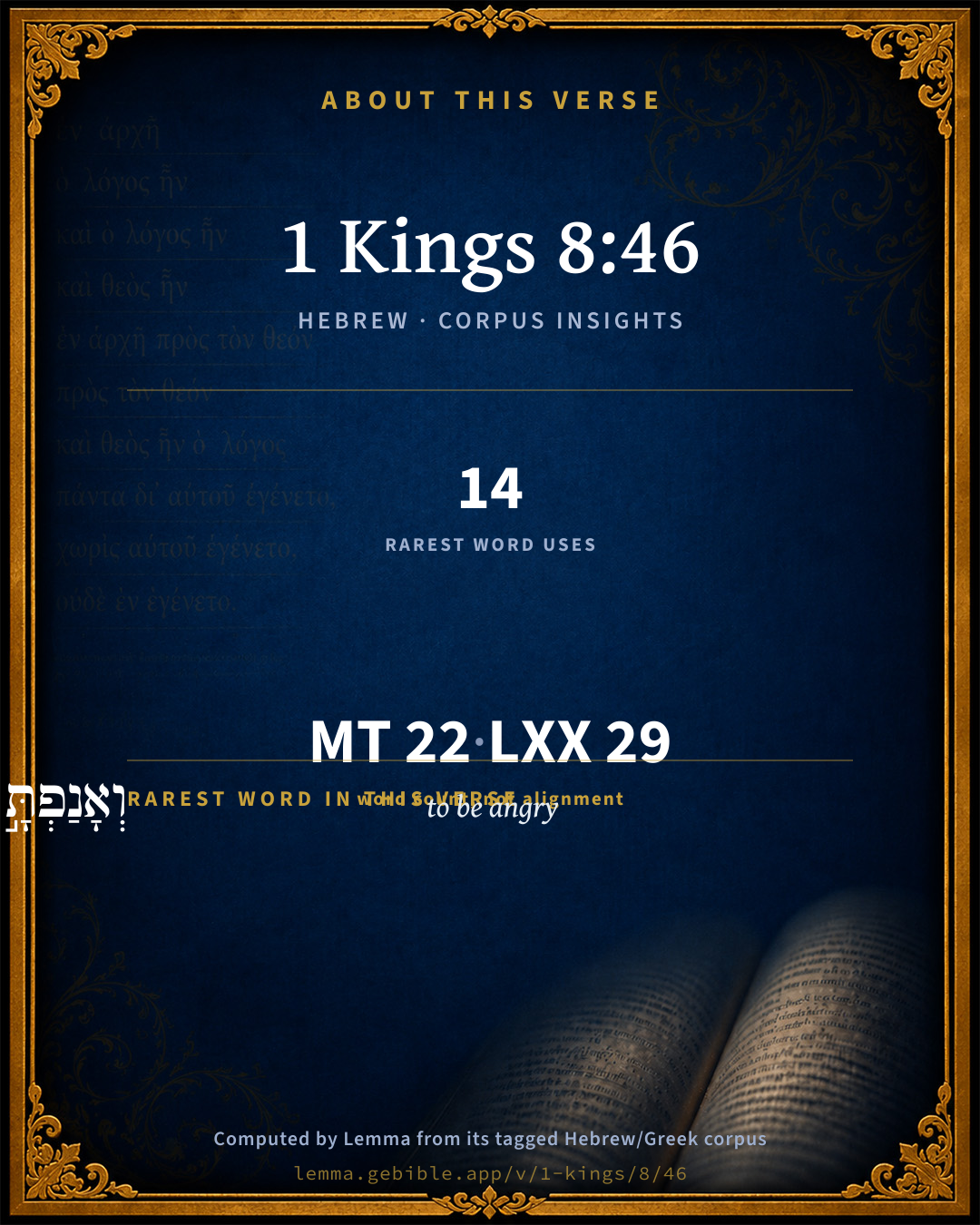
About this verse

These counts appear in no published source. They are computed here, from the morphology-tagged text and Lemma’s own curated glosses. What Lemma adds →

22
words
16
distinct lemmas
Historical
section

Notable vocabulary

The rarest word here is וְאָנַפְתָּ֣ to be angry H599 — appearing just 14 times in the whole Hebrew Bible.

Shared distinctive vocabulary

וְאָנַפְתָּ֣ to be angry H599 occurs in 14 verses of the Hebrew Bible. Also found in:

Grammatical profile

  • 8 verbs
  • 3 nouns
  • 2 adjectives
  • 3 prepositions
  • 3 conjunctions
  • 3 particles

Verb forms

  • יֶֽחֶטְאוּ Qal · Imperfect
  • יֶחֱטָ֔א Qal · Imperfect
  • וְאָנַפְתָּ֣ Qal · Sequential Perfect
  • וּנְתַתָּ֖ם Qal · Sequential Perfect
  • אוֹיֵ֑ב Qal · Participle Active
  • וְשָׁב֤וּם Qal · Sequential Perfect
  • שֹֽׁבֵיהֶם֙ Qal · Participle Active
  • הָאוֹיֵ֔ב Qal · Participle Active

Repetition

Words recur within this verse — often emphatic in Hebrew:

  • יֶֽחֶטְאוּ to sin H2398 ×2
  • אוֹיֵ֑ב enemy H341 ×2
  • וְשָׁב֤וּם to capture H7617 ×2
  • כִּ֣י that H3588 ×2

Hebrew & Septuagint length

In English translation the verse runs 42 words from the Hebrew and 46 from the Septuagint (LXX English) — closely comparable.

A rough comparison of the two English renderings, which tokenize alike — not a word-level alignment.

Word counts can differ between the Hebrew and the Greek without any difference in meaning — e.g. the Hebrew direct-object marker אֵת has no separate Greek word, and Greek often adds the article ὁ.

In the original languages it is 22 Hebrew tokens and 29 Greek tokens — but the two are counted differently (Hebrew bundles its prefixes and suffixes into one token; the Greek is in lemma form), so that isn’t a like-for-like length.

Cross-references

26

Topical passages linked to 1 Kings 8:46 in the Treasury of Scripture Knowledge — connected by theme and wording, ordered by reader-vote popularity; previews shown in the World English Bible.

  • Ecclesiastes 7:20 Surely there is not a righteous man on earth, who does good and doesn't sin.
  • Proverbs 20:9 Who can say, "I have made my heart pure. I am clean and without sin?"
  • Isaiah 53:6 All we like sheep have gone astray; everyone has turned to his own way; and Yahweh has laid on him the iniquity of us all.
  • Isaiah 64:6 For we are all become as one who is unclean, and all our righteousness are as a polluted garment: and we all do fade as a leaf; and our iniquities, like the wind, take us away.
  • Romans 3:23 for all have sinned, and fall short of the glory of God;
  • 1 John 1:8–10 If we say that we have no sin, we deceive ourselves, and the truth is not in us.
  • Psalms 130:3 If you, Yah, kept a record of sins, Lord, who could stand?
  • James 3:2 For in many things we all stumble. If anyone doesn't stumble in word, the same is a perfect man, able to bridle the whole body also.
  • Leviticus 26:34–39 Then the land will enjoy its sabbaths as long as it lies desolate and you are in your enemies' land. Even then the land will rest and enjoy its sabbaths.
  • Deuteronomy 28:36 Yahweh will bring you, and your king whom you shall set over you, to a nation that you have not known, you nor your fathers; and there shall you serve other gods, wood and stone.
  • 2 Kings 17:6 In the ninth year of Hoshea the king of Assyria took Samaria, and carried Israel away to Assyria, and placed them in Halah, and on the Habor, the river of Gozan, and in the cities of the Medes.
  • 2 Kings 17:18 Therefore Yahweh was very angry with Israel, and removed them out of his sight: there was none left but the tribe of Judah only.
  • Deuteronomy 4:26–27 I call heaven and earth to witness against you this day, that you shall soon utterly perish from off the land whereunto you go over the Jordan to possess it; you shall not prolong your days on it, but shall utterly be destroyed.
  • Deuteronomy 28:64–68 Yahweh will scatter you among all peoples, from the one end of the earth even to the other end of the earth; and there you shall serve other gods, which you have not known, you nor your fathers, even wood and stone.
  • Deuteronomy 29:28 and Yahweh rooted them out of their land in anger, and in wrath, and in great indignation, and cast them into another land, as at this day.
  • 2 Kings 17:23 until Yahweh removed Israel out of his sight, as he spoke by all his servants the prophets. So Israel was carried away out of their own land to Assyria to this day.
  • 2 Kings 25:21 The king of Babylon struck them, and put them to death at Riblah in the land of Hamath. So Judah was carried away captive out of his land.
  • 2 Chronicles 6:36 If they sin against you (for there is no man who doesn't sin), and you are angry with them, and deliver them to the enemy, so that they carry them away captive to a land far off or near;
  • Job 14:4 Who can bring a clean thing out of an unclean? Not one.
  • Job 15:14–16 What is man, that he should be clean? He who is born of a woman, that he should be righteous?
  • Psalms 19:12 Who can discern his errors? Forgive me from hidden errors.
  • Psalms 143:2 Don't enter into judgment with your servant, For in your sight no man living is righteous.
  • Daniel 9:7–14 Lord, righteousness belongs to you, but to us confusion of face, as at this day; to the men of Judah, and to the inhabitants of Jerusalem, and to all Israel, who are near, and who are far off, through all the countries where you have driven them, because of their trespass that they have trespassed against you.
  • Luke 21:24 They will fall by the edge of the sword, and will be led captive into all the nations. Jerusalem will be trampled down by the Gentiles, until the times of the Gentiles are fulfilled.
  • Romans 3:19 Now we know that whatever things the law says, it speaks to those who are under the law, that every mouth may be closed, and all the world may be brought under the judgment of God.
  • Galatians 3:22 But the Scriptures shut up all things under sin, that the promise by faith in Jesus Christ might be given to those who believe.

Cross-references courtesy of OpenBible.info (CC BY 4.0).

Hebrew and Greek witnesses Masoretic Hebrew ↔ Greek Septuagint

The same verse in the two great witnesses to the Old Testament, shown verse-for-verse.

These are two independent witnesses, not word-aligned to each other, and the Septuagint is shown in lemma (dictionary) form.

Hebrew 1 Kings 8:46 Masoretic · Westminster Leningrad Codex

כִּ֣י יֶֽחֶטְאוּ לָ֗ךְ כִּ֣י אֵ֤ין אָדָם֙ אֲשֶׁ֣ר לֹא יֶחֱטָ֔א וְאָנַפְתָּ֣ בָ֔ם וּנְתַתָּ֖ם לִפְנֵ֣י אוֹיֵ֑ב וְשָׁב֤וּם שֹֽׁבֵיהֶם֙ אֶל אֶ֣רֶץ הָאוֹיֵ֔ב רְחוֹקָ֖ה א֥וֹ קְרוֹבָֽה

If they sin against you (for there is no man who doesn't sin), and you are angry with them, and deliver them to the enemy, so that they carry them away captive to the land of the enemy, far off or near;

World English Bible · Public Domain

Greek LXX 1 Kings 8:46 Septuagint · lemma form

ὅτι ἁμαρτάνω σύ ὅτι οὐ εἰμί ἄνθρωπος ὅς οὐ ἁμαρτάνω καί ἐπιἄγω ἐπί αὐτός καί παραδίδωμι αὐτός ἐνώπιον ἐχθρός καί αἰχμαλωτίζω αὐτός ὁ αἰχμαλωτίζω εἰς γῆ μακράν καί ἐγγύς

If it be that they shall sin against you, (for there is not a man who will not sin,) and you shall bring them and deliver them up before their enemies, and they that take them captive shall carry them to a land far or near,

LXX2012 (modern English Septuagint) · Public Domain

Hebrew: Westminster Leningrad Codex (CC BY 4.0). Greek: Septuagint (public domain); English from LXX2012 (modern English Septuagint) (Public Domain). How the Septuagint differs from the Hebrew →

Targum (Aramaic paraphrase)

1

The Targum is the ancient Jewish Aramaic paraphrase of the Hebrew Scriptures — an interpretive translation, not the Hebrew text itself. Onkelos (literal) and Pseudo-Jonathan (expansive) render the Torah, and Jonathan the Prophets. Coverage is partial: where no permissively-licensed English translation exists for a verse, only the Aramaic is shown. This is verse-level text, not a word-by-word alignment to the Hebrew.

  1. Targum Jonathan Prophets (Joshua–Malachi)
    אֲרֵי יְחוֹבוּן קֳדָמָךְ אֲרֵי לֵית אֱנָשׁ דְלָא חָטֵי וְיֵחוּל רוּגְזָךְ בְּהוֹן וְתִמְסְרִינוּן קֳדָם בַּעֲלֵי דְבָבֵיהוֹן וְיִשְׁבּוּנוּן שׁוֹבֵיהוֹן לַאֲרַע בַּעֲלֵי דְבָבֵיהוֹן דִרְחִיקָא אוֹ קְרִיבָא:

    (no public-domain English translation for this verse)

    Targum Jonathan — Aramaic: “Mikraot Gedolot” (public domain). English: “Sefaria Community Translation” (CC0 1.0 (public-domain dedication)); “London "Chaldee Paraphrase," 1871” (public domain). Text via Sefaria.

Commentary

Notes on 1 Kings 8:46 from classic Christian and Jewish commentators (each source and its license shown beneath its notes). The classic Christian expositions comment on the surrounding passage and are grouped to its opening verse, so a note may address several verses; the Jewish commentaries on the Tanakh (Rashi and others) are per-verse, so they appear only where the commentator wrote on this verse.

Lemma curates 59 commentaries, every one of them public domain or Creative Commons licensed, each selected and text-cleaned for this edition rather than reprinted as found. About our sources →

Adam Clarke's Commentary

Verse 46. If they sin against thee] This SEVENTH case must refer to some general defection from truth, to some species of false worship, idolatry, or corruption of the truth and ordinances of the Most High; as for it they are here stated to be delivered into the hands of their enemies and carried away captive, which was the general punishment for idolatry, and what is called, 1Kg 8:47, acting perversely and committing wickedness.

In 1Kg 8:46 we read, If they sin against thee, for there is no man that sinneth not. On this verse we may observe that the second clause, as it is here translated, renders the supposition in the first clause entirely nugatory; for if there be no man that sinneth not, it is useless to say, IF they sin; but this contradiction is taken away by reference to the original, כי יחטאו לך ki yechetu lach, which should be translated IF they shall sin against thee, or should they sin against thee; כי אין אדם לא יחטא ki ein Adam asher lo yecheta, for there is no man that MAY not sin; i.e., there is no man impeccable, none infallible, none that is not liable to transgress. This is the true meaning of the phrase in various parts of the Bible, and so our translators have understood the original: for even in the thirty-first verse of this chapter they have translated יחטא yecheta, IF a man TRESPASS; which certainly implies he might or might not do it; and in this way they have translated the same word, IF a soul SIN, in Le 5:1; Le 6:2; 1Sa 2:25; 2Ch 6:22, and in several other places. The truth is, the Hebrew has no mood to express words in the permissive or optative way, but to express this sense it uses the future tense of the conjugation kal.

This text has been a wonderful strong hold for all who believe that there is no redemption from sin in this life, that no man can live without committing sin, and that we cannot be entirely freed from it till we die.

1. The text speaks no such doctrine: it only speaks of the possibility of every man sinning, and this must be true of a state of probation.

2. There is not another text in the Divine records that is more to the purpose than this.

3. The doctrine is flatly in opposition to the design of the Gospel; for Jesus came to save his people from their sins, and to destroy the works of the devil.

4. It is a dangerous and destructive doctrine,; and should be blotted out of every Christian's creed. There are too many who are seeking to excuse their crimes by all means in their power; and we need not embody their excuses in a creed, to complete their deception, by stating that their sins are unavoidable.

Adam Clarke's Commentary on the Bible (1810–1826) — public domain. Text from a community e-Sword/MySword module.

Trapp's Complete Commentary

John Trapp

1Ki 8:46 If they sin against thee, (for [there is] no man that sinneth not,) and thou be angry with them, and deliver them to the enemy, so that they carry them away captives unto the land of the enemy, far or near;

Ver. 46. For there is no man that sinneth not.] This is triste mortalitatis privilegium.

And thou be angry with them.] As thou canst not but be so, {Hab 1:13} and as the effects of thy just anger thou chide them, and smite them, either with thine own bare hand or by those men of thy band, their enemies.

John Trapp, A Commentary or Exposition upon All the Books of the Old and New Testament (1647–1656) — public domain. Text from a community e-Sword module.

Joseph Benson's Commentary

1Ki 8:46. If they sin against thee — The universal corruption of man’s whole race and nature, makes me presage that they will fall into sins; and withal makes me hope that thou wilt not be severe to deal with them as their sins deserve. For there is no man that sinneth not — That doth not fall short of his duty in many respects, “that doth not enough,” says Henry, “to justify God in the severest rebukes of his providence.” And “no man but what is in danger of falling even into gross sin, and will, if God leave him to himself.” Thus the Hebrew, אשׁר לא יחשׂא, asher lo jecheta, who may not, or will not, sin, even openly and wilfully, if divine grace prevent not. This last sense of the clause seems best to suit the context, as well as to express the meaning of the original. And, thus understood, the words do not contradict the declaration of St. John, that he who is born of God, sinneth not; that is, doth not commit known and actual sin; but has power over it, and is careful to shun the appearance of evil. See notes on 1Jn 3:4-10; 1Jn 5:18; Rom 6:14. Solomon did not mean that the weakness of human nature, and its proneness to sin, would excuse known and wilful offences against God, especially apostacy from him and his service, which was the cause of all the calamities of the Israelites.

Joseph Benson's Commentary on the Old and New Testaments (1811–1818) — public domain. Text from a community e-Sword module.

Tyndale Open Study Notes

Tyndale Open Resources

8:46-51 Solomon prayed concerning a time when Israel might be carried away captive (Lev 26:33). Solomon prayed that if the people genuinely repented and confessed their sin, God would listen, forgive them, and grant them favor with their captors (Lev 26:40-45; 2 Kgs 25:27-30; Dan 6:10; 9:3-19).

Tyndale Open Study Notes — © Tyndale Open Resources, licensed CC BY-SA 4.0. Text via the HelloAO Bible API.

The Cambridge Bible for Schools and Colleges

gen. ed. J. J. S. Perowne

46. If they sin against thee] With the language of these verses concerning the delivery of Israel into the hand of their enemies for their sins, the chapters of Leviticus (26.) and Deuteronomy (28) already frequently quoted should be compared. Though the verbal resemblance is less than in some other parts of this prayer, the idea and spirit of the language is exactly the same.

The Cambridge Bible for Schools and Colleges (gen. ed. J. J. S. Perowne; Cambridge University Press, 1878–1918) — public domain. Text from a community e-Sword module.

John Gill's Exposition

If they sin against thee,.... The same persons when they were gone forth to battle, not observing the divine commands as they should:

for there is no man that sinneth not; such are the depravity of human nature, the treachery of the heart, and the temptations of Satan, of which Solomon had early notice, and was afterwards still more confirmed in the truth of, Ecc 7:20.

and thou be angry with them; for their sins, and resent their conduct:

so as to deliver them to the enemy, so that they carry them away captive unto the land of the enemy, far or near; as into Assyria or Babylon, whither they were carried.

John Gill's Exposition of the Whole Bible (1746–1763) — public domain (CC PDM 1.0). Text via the HelloAO Bible API.

Matthew Poole's English Annotations

There is no man that sinneth not: the universal corruption of man’s whole race and nature makes me presage that they will fall into sins; and withal, makes me to hope that thou wilt not be severe to deal with them as their sins deserve.

Matthew Poole's English Annotations on the Holy Bible (1683–1685) — public domain. Text from a community e-Sword/MySword module.

Whedon's Commentary on the Bible

Daniel D. Whedon

46. No man that sinneth not — Or, rather, That may not sin. The statement is not made with reference to the possibilities of gracious attainment in the Christian life, but to the ordinary facts of human history. The meaning is. There is no man, and no nation, that can claim to be beyond the possibility of sinning. Israel must not assume, that because they are the chosen people they may not, by running into sin, draw down the Divine anger in bitter judgments upon them. But here is surely no such universal proposition as to involve, (as some assume,) that even the New Testament saint whose life is hid with Christ in God, sees never in this life the hour in which he does not sin. Such teaching is as absurd as it is unscriptural.

Daniel D. Whedon (gen. ed.), Commentary on the Old and New Testaments (1874–1909) — public domain. Text from a community e-Sword module.

The Pulpit Commentary

If they sin against thee (for there is no man that sinneth not), and thou be angry with them, and deliver them to the enemy Heb. give them before an enemy, so that they carry them away captives unto the land of the enemy, fax or near;

The Pulpit Commentary (1880–1919), ed. H.D.M. Spence-Jones & Joseph S. Exell — public domain. Text from a community e-Sword module.

unfoldingWord translationNotes

Door43 World Missions Community

Suppose that they sin ... suppose that you are ... suppose that they realize ... suppose that they repent ... Suppose that they say

When Solomon was speaking, these hypothetical situations had not happened, but Solomon knew that they might happen in the future. Use the form in your language for talking about events that have not happened but might happen in the future. (See: Hypothetical Situations)

where they have been exiled

This can be stated in active form. AT: "where their enemies have taken them as exiles" (See: Active or Passive)

captors

people who keep others as prisoners

We have acted perversely and sinned. We have behaved wickedly

These two sentences mean the same thing. Together they emphasize how bad the people's actions were. (See: Parallelism)

acted perversely and sinned

The words mean basically the same thing and emphasize how badly the people sinned. (See: Doublet)

translationWords

sin

anger

hand

adversary

captive

exile

repent

favor

perverse

evil

unfoldingWord translationNotes — © Distant Shores Media and the Door43 World Missions Community, licensed CC BY-SA 4.0. Source: git.door43.org/Door43/en_tn.

Lesson kit

Teaching starters — assembled from the data on this page, not authored interpretation. Every prompt links to the verse data it draws on. Edit before teaching.

1 Kings, in the Historical, opens this verse with 22 words (16 distinct Hebrew lemmas). Its most distinctive word is ʼânaph (“to be angry”). A historical commentator’s framing appears above. Read the whole chapter for the surrounding context.

Discussion questions

  1. How does “to be angry” (ʼânaph) shape what this verse is saying?
  2. How does Deuteronomy 1:37, which shares the word «to be angry», read alongside this verse?
  3. What does the repetition of “to sin” (2× in this one verse) do in this verse?
  4. The translations on this page render this verse differently — a whole-verse word diff, not a word-by-word alignment. What might account for the different wordings?
  5. «יֶֽחֶטְאוּ» is a Qal Imperfect verb. How does that grammatical form shape the action described?
  6. Compare how Adam Clarke's Commentary and Trapp's Complete Commentary read this verse. Where do they agree or differ?

Things to notice

Reading settings

Reading text

Shown beneath each verse's original-language words.

Old Testament
Old Testament edition

Read the OT as the Masoretic Hebrew (MT) or the Greek Septuagint (LXX).

English shown for the Greek Septuagint (in the Hebrew ↔ Greek comparison).

Comparing translations? Open the Compare panel on any verse page to stack up to four side by side.