
1 Kings 8:60

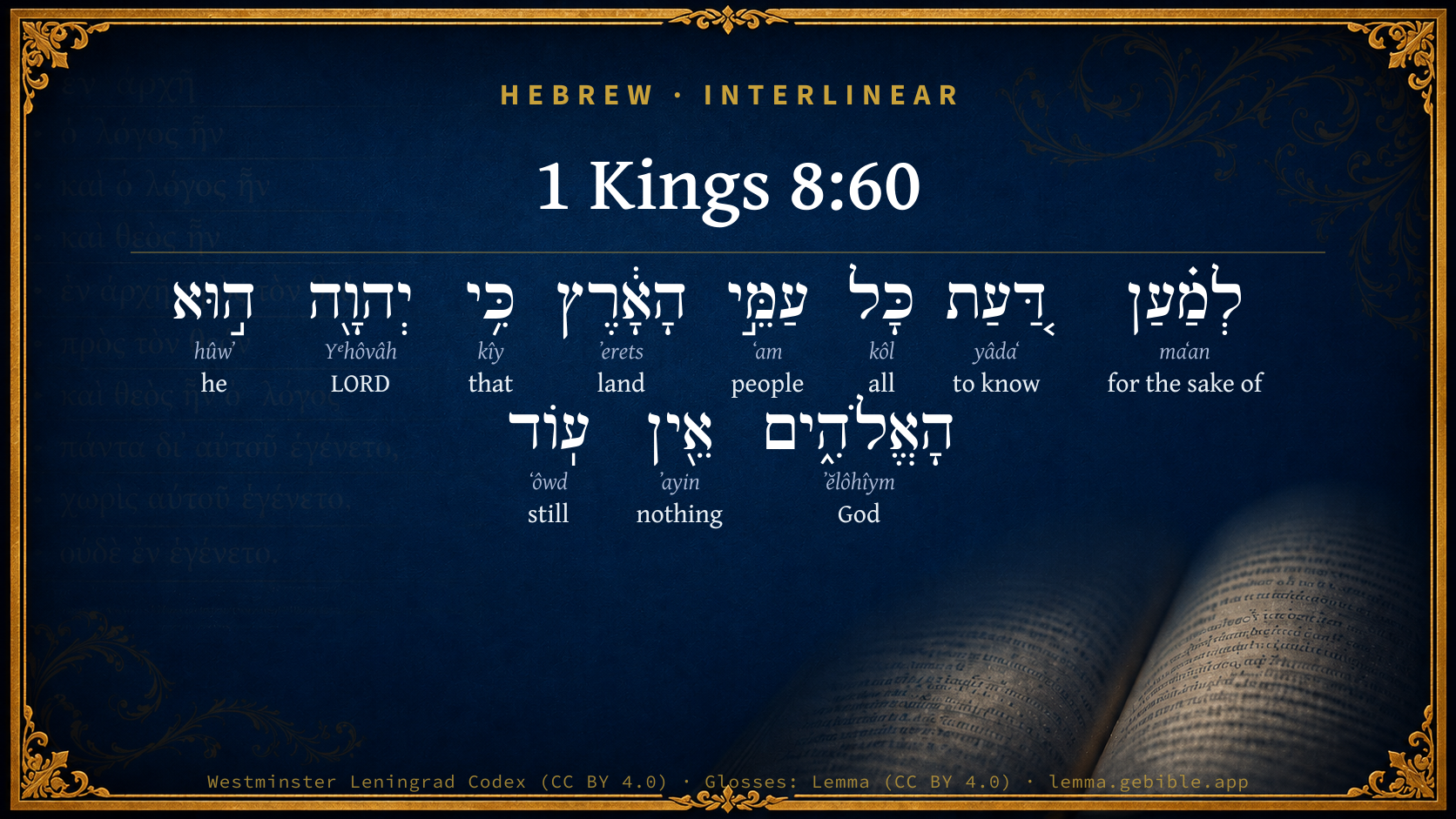
Hebrew (Westminster Leningrad Codex) 1 Kings 8:60 appears in the Hebrew Old Testament. The text above is from the Westminster Leningrad Codex. Each word links to its Strong’s number, a concise gloss, and parsing drawn from the Open Scriptures Hebrew Bible morphology. Click any word for its full Brown-Driver-Briggs (BDB) entry.
Download image
Cite this verse

1 Kings 8:60 (World English Bible). Public Domain. Lemma interlinear Bible study tool, https://lemma.gebible.app/v/1-kings/8/60.

Show BibTeX & RIS
BibTeX
RIS
English Translation
that all the peoples of the earth may know that Yahweh, he is God; there is none else.
World English Bible · Public Domain
Download a study sheet

One document with this verse’s original text, its word-by-word gloss line, the meaning frame, cross-references with their text, attributed commentary, and full source and license credits — printable, and it pastes into notes with its structure intact.

This verse Autodidact and up

Study sheet (.html) Plain text (.txt)

A passage Seminary Student

Up to 50 verses in one chapter. A passage sheet keeps up to 6 commentary sources and 12 cross-references per verse, in the order this page ranks them, and says so on the sheet whenever that leaves anything out. Ask for a single verse and you get the Autodidact verse sheet above.

Everything on this page stays free to read, with no account — the sheet is a download of what is already on screen, not access to it.

Want to remove ads? Support Godless Engineer
Compare translations 3

The same verse in 3 English versions, stacked beneath the original-language interlinear above. Click any original word for its lexicon entry.

Each is an independent rendering of the whole verse — the interlinear is not word-aligned to these translations.

Highlighted words mark where these versions differ — a whole-verse word diff, not a word-by-word alignment.

  • World English Bible Public Domain
    that all the peoples of the earth may know that Yahweh, he is God; there is none else.
  • King James Version Public Domain
    That all the people of the earth may know that the LORD is God, and that there is none else.
  • unfoldingWord Literal Text CC BY-SA 4.0
    so that all of the peoples of the earth may know that Yahweh, he God, no other!

unfoldingWord Literal Text — © unfoldingWord, licensed CC BY-SA 4.0. Word-aligned USFM3 via Door43 (git.door43.org/unfoldingWord/en_ult).

Versions to compare (up to 4)

3 of 4 selected

Show all 18 translations

Every available English version of this verse, each an independent rendering of the whole verse.

  • World English Bible Public Domain
    that all the peoples of the earth may know that Yahweh, he is God; there is none else.
  • Berean Standard Bible Public Domain
    so that all the peoples of the earth may know that the LORD is God. There is no other!
  • Majority Standard Bible Public Domain
    so that all the peoples of the earth may know that the LORD is God. There is no other!
  • King James Version Public Domain
    That all the people of the earth may know that the LORD is God, and that there is none else.
  • American Standard Version (1901) Public Domain
    that all the peoples of the earth may know that Jehovah, he is God; there is none else.
  • Revised Version (1885) Public Domain
    that all the peoples of the earth may know that the LORD, he is God; there is none else.
  • Geneva Bible (1599) Public Domain
    That all the people of ye earth may knowe, that the Lord is God, and none other.
  • Douay-Rheims (1899) Public Domain
    That all the people of the earth may know, that the Lord he is God, and there is no other besides him.
  • Young's Literal Translation Public Domain
    for all the peoples of the earth knowing that Jehovah, He `is' God; there is none else;
  • Literal Standard Version CC BY-SA 4.0
    that all the peoples of the earth may know that He, YHWH, [is] God; there is none else;
  • Unlocked Literal Bible CC BY-SA 4.0
    that all the peoples of the earth may know that Yahweh, he is God, and there is no other God!
  • unfoldingWord Literal Text CC BY-SA 4.0
    so that all of the peoples of the earth may know that Yahweh, he God, no other!
  • Darby Bible Public Domain
    that all peoples of the earth may know that Jehovah is God, that there is none else;
  • World Messianic Bible Public Domain
    that all the peoples of the earth may know that the LORD himself is God. There is no one else.
  • Webster's Bible Public Domain
    That all the people of the earth may know, that the LORD is God, and that there is none else.
  • Free Bible Version CC BY-SA 4.0
    in order that everyone on the earth may know that the Lord is God, and that there is no other!
  • Bible in Basic English Public Domain
    So that all the peoples of the earth may see that the Lord is God, and there is no other.
  • JPS Tanakh (1917) Public Domain
    that all the peoples of the earth may know that the LORD, He is God; there is none else.

Literal Standard Version (2020), Covenant Press — licensed CC BY-SA 4.0. Text via the HelloAO Bible API (eBible.org). Unlocked Literal Bible (unfoldingWord) — licensed CC BY-SA 4.0. Text via the HelloAO Bible API (eBible.org). unfoldingWord Literal Text — © unfoldingWord, licensed CC BY-SA 4.0. Word-aligned USFM3 via Door43 (git.door43.org/unfoldingWord/en_ult). Free Bible Version, Dr. Jonathan Gallagher — licensed CC BY-SA 4.0. Text via the HelloAO Bible API (eBible.org).

Word by word

More ways to search: Search by grammar → Find every occurrence → Compare this word →

Practice this passage: Drill this verse → Learn its vocabulary →

About this verse

These counts appear in no published source. They are computed here, from the morphology-tagged text and Lemma’s own curated glosses. What Lemma adds →

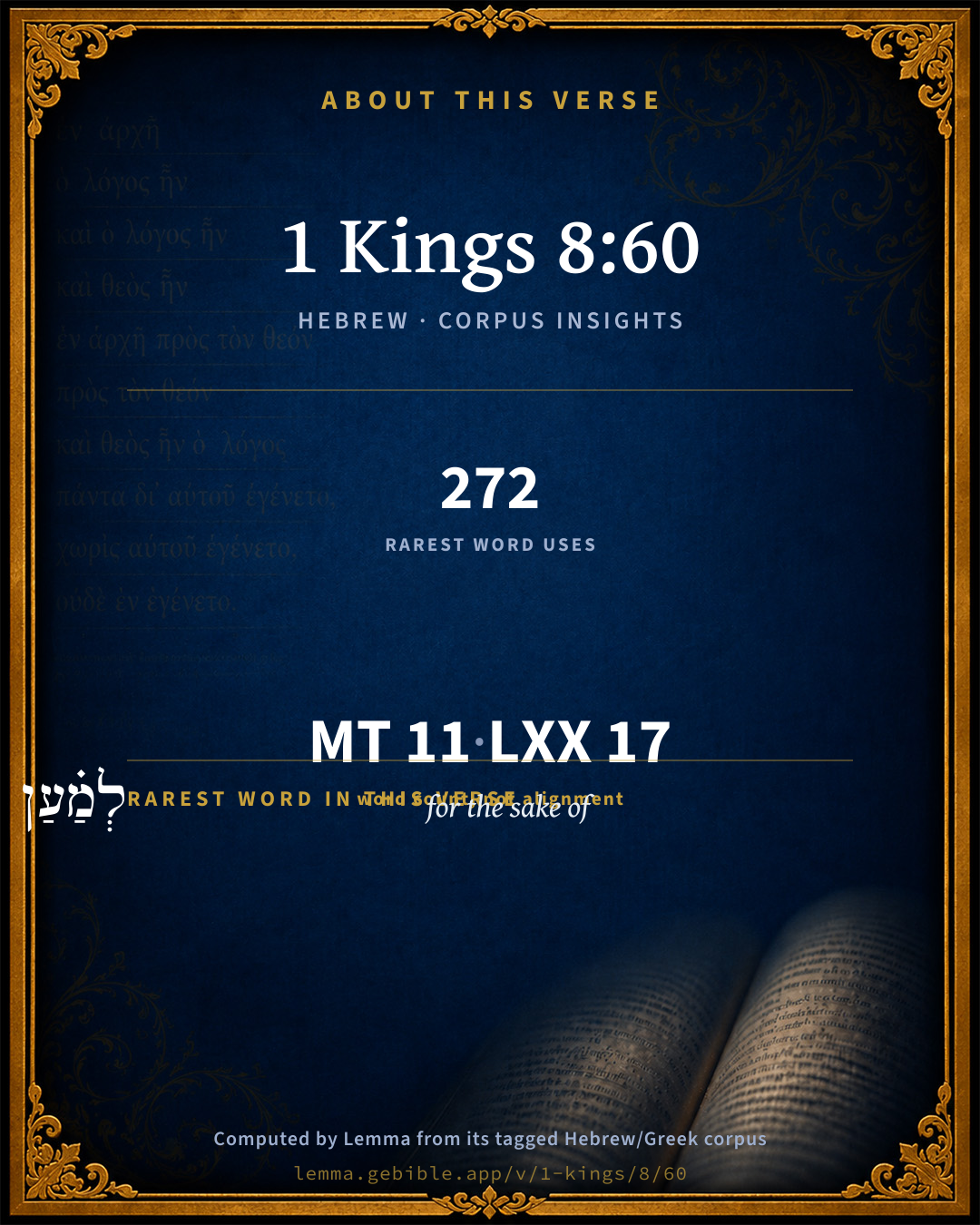
11
words
11
distinct lemmas
Historical
section

Grammatical profile

  • 1 verb
  • 5 nouns
  • 1 pronoun
  • 1 preposition
  • 1 conjunction
  • 1 adverb
  • 1 particle

Verb forms

  • דַּ֚עַת Qal · Infinitive Construct

Hebrew & Septuagint length

In English translation the verse runs 18 words from the Hebrew and 21 from the Septuagint (LXX English) — closely comparable.

A rough comparison of the two English renderings, which tokenize alike — not a word-level alignment.

Word counts can differ between the Hebrew and the Greek without any difference in meaning — e.g. the Hebrew direct-object marker אֵת has no separate Greek word, and Greek often adds the article ὁ.

In the original languages it is 11 Hebrew tokens and 17 Greek tokens — but the two are counted differently (Hebrew bundles its prefixes and suffixes into one token; the Greek is in lemma form), so that isn’t a like-for-like length.

Cross-references

14

Topical passages linked to 1 Kings 8:60 in the Treasury of Scripture Knowledge — connected by theme and wording, ordered by reader-vote popularity; previews shown in the World English Bible.

  • Deuteronomy 4:35 To you it was shown, that you might know that Yahweh he is God; there is none else besides him.
  • 1 Kings 18:39 When all the people saw it, they fell on their faces: and they said, Yahweh, he is God; Yahweh, he is God.
  • 2 Kings 19:19 Now therefore, Yahweh our God, save you us, I beg you, out of his hand, that all the kingdoms of the earth may know that you Yahweh are God alone.
  • Jeremiah 10:10–12 But Yahweh is the true God; he is the living God, and an everlasting King: at his wrath the earth trembles, and the nations are not able to abide his indignation.
  • Isaiah 44:6 Thus says Yahweh, the King of Israel, and his Redeemer, Yahweh of Hosts: I am the first, and I am the last; and besides me there is no God.
  • Isaiah 44:8 Don't fear, neither be afraid: haven't I declared to you of old, and shown it? You are my witnesses. Is there a God besides me? Indeed, there is not. I don't know any Rock.
  • Isaiah 45:5–6 I am Yahweh, and there is none else; besides me there is no God. I will gird you, though you have not known me;
  • Isaiah 45:22 Look to me, and be you saved, all the ends of the earth; for I am God, and there is none else.
  • Deuteronomy 4:39 Know therefore this day, and lay it to your heart, that Yahweh he is God in heaven above and on the earth beneath; there is none else.
  • 1 Samuel 17:46 This day will Yahweh deliver you into my hand; and I will strike you, and take your head from off you; and I will give the dead bodies of the host of the Philistines this day to the birds of the sky, and to the wild animals of the earth; that all the earth may know that there is a God in Israel,
  • Isaiah 44:24 Thus says Yahweh, your Redeemer, and he who formed you from the womb: I am Yahweh, who makes all things; who stretches forth the heavens alone; who spreads abroad the earth (who is with me?);
  • Joshua 4:24 that all the peoples of the earth may know the hand of Yahweh, that it is mighty; that you may fear Yahweh your God forever.
  • 1 Kings 8:43 hear in heaven, your dwelling-place, and do according to all that the foreigner calls to you for; that all the peoples of the earth may know your name, to fear you, as does your people Israel, and that they may know that this house which I have built is called by my name.
  • Joel 2:27 You will know that I am in the midst of Israel, And that I am Yahweh, your God, and there is no one else; And my people will never again be disappointed.

Cross-references courtesy of OpenBible.info (CC BY 4.0).

Hebrew and Greek witnesses Masoretic Hebrew ↔ Greek Septuagint

The same verse in the two great witnesses to the Old Testament, shown verse-for-verse.

These are two independent witnesses, not word-aligned to each other, and the Septuagint is shown in lemma (dictionary) form.

Hebrew 1 Kings 8:60 Masoretic · Westminster Leningrad Codex

לְמַ֗עַן דַּ֚עַת כָּל עַמֵּ֣י הָאָ֔רֶץ כִּ֥י יְהוָ֖ה ה֣וּא הָאֱלֹהִ֑ים אֵ֖ין עֽוֹד

that all the peoples of the earth may know that Yahweh, he is God; there is none else.

World English Bible · Public Domain

Greek LXX 1 Kings 8:60 Septuagint · lemma form

ὅπως γιγνώσκω πᾶς ὁ λαός ὁ γῆ ὅτι κύριος ὁ θεός αὐτός θεός καί οὐ εἰμί ἔτι

that all the nations of the earth may know that the Lord God, he is God, and there is none beside.

LXX2012 (modern English Septuagint) · Public Domain

Hebrew: Westminster Leningrad Codex (CC BY 4.0). Greek: Septuagint (public domain); English from LXX2012 (modern English Septuagint) (Public Domain). How the Septuagint differs from the Hebrew →

Targum (Aramaic paraphrase)

1

The Targum is the ancient Jewish Aramaic paraphrase of the Hebrew Scriptures — an interpretive translation, not the Hebrew text itself. Onkelos (literal) and Pseudo-Jonathan (expansive) render the Torah, and Jonathan the Prophets. Coverage is partial: where no permissively-licensed English translation exists for a verse, only the Aramaic is shown. This is verse-level text, not a word-by-word alignment to the Hebrew.

  1. Targum Jonathan Prophets (Joshua–Malachi)
    בְּדִיל דְיֵדְעוּן כָּל עַמְמֵי אַרְעָא אֲרֵי יְיָ הוּא אֱלֹהִים לֵית עוֹד:

    (no public-domain English translation for this verse)

    Targum Jonathan — Aramaic: “Mikraot Gedolot” (public domain). English: “Sefaria Community Translation” (CC0 1.0 (public-domain dedication)); “London "Chaldee Paraphrase," 1871” (public domain). Text via Sefaria.

Commentary

Notes on 1 Kings 8:60 from classic Christian and Jewish commentators (each source and its license shown beneath its notes). The classic Christian expositions comment on the surrounding passage and are grouped to its opening verse, so a note may address several verses; the Jewish commentaries on the Tanakh (Rashi and others) are per-verse, so they appear only where the commentator wrote on this verse.

Lemma curates 59 commentaries, every one of them public domain or Creative Commons licensed, each selected and text-cleaned for this edition rather than reprinted as found. About our sources →

Trapp's Complete Commentary

John Trapp

1Ki 8:60 That all the people of the earth may know that the LORD [is] God, [and that there is] none else.

Ver. 60. That all the people, &c.] It is the ingenuity of saints, in all their desired and expected mercies, to study and to promote God’s ends more than their own.

John Trapp, A Commentary or Exposition upon All the Books of the Old and New Testament (1647–1656) — public domain. Text from a community e-Sword module.

Joseph Benson's Commentary

1Ki 8:60. That all the people of the earth may know that the Lord (Hebrew, Jehovah) is God — That both by our virtuous and holy lives, to which his grace inclines us; and by the eminent manifestations of his power and goodness in defending and delivering us from the assaults and devices of our enemies, all the nations of the world may be convinced that our God is the living and true God, and he alone, and may thereupon be induced to renounce their idols and to serve him. For Solomon did not desire that Israel should be thus blessed, thus favoured, in order that all people might become tributaries to him and his successors, (his kingdom being already as great as he desired,) but that all people might know and worship Jehovah. Thus Solomon’s prayers, like the prayers of his father David, the son of Jesse, are ended, Psa 72:19-20, with this petition, Let the whole earth be filled with his glory. And “we cannot close our prayers,” says Henry, “with a better summary than this, Father, glorify thy name.”

Joseph Benson's Commentary on the Old and New Testaments (1811–1818) — public domain. Text from a community e-Sword module.

MacLaren's Expositions of Holy Scripture

Alexander MacLaren

1 Kings

THE KING ‘BLESSING’ HIS PEOPLE

1Ki 8:54 - 1Ki 8:63.

The great ceremonial of dedicating the Temple was threefold. The first stage was setting the ark in its place, which was the essence of the whole thing. God’s presence was the true dedication, and that was manifested by the bright cloud that filled the sanctuary as soon as the ark was placed there. The second stage was the lofty and spiritual prayer, saturated with the language and tone of Deuteronomy, and breathing the purest conceptions of the character and nature of God, and all aglow with trust in Him. Then followed, thirdly, this ‘Blessing of the Congregation.’ The prayer had been uttered by the kneeling king. Now he stands up, and, with ringing tones that reach to the outskirts of the crowd, he gathers the spirit of his prayer into two petitions, preceded by praise for national blessings, and followed by exhortation to national obedience. A huge sacrifice of unexampled magnitude closes the whole.

I. Note the thankful retrospect of the nation’s past {1Ki 8:56}.

Solomon ‘blessed the congregation’ when, in their name, he lifted up his voice to bless the Lord, prayed that God would incline their hearts to keep His law, and would maintain their cause, and exhorted them to keep their hearts perfect with Him. We bless each other when we ask God to bless, and when we draw each other nearer Him. Standing there in the new Temple, with a united nation gathered before him, the cloud filling the house, and peace resting on all his land to its farthest border, the king looks back on the long road from Sinai and the desert, and sums up the whole history in one sentence. The end has vindicated the methods. There had been many a dark time when enemies had oppressed, and many a hard-fought field had been stained with Israel’s blood; but all had tended to this calm hour, when Israel’s multitudes were gathered in worship, and their unguarded homes were safe. There had been many heroes in the long line.

‘Time would fail’ him ‘to tell of Gideon, Barak, Samson, Jephthah; of David and Samuel . . . who . . . turned to flight armies of aliens.’ One name alone is worthy to be named,-the name of the true Deliverer and Monarch. It is the Lord who ‘hath given rest unto His people.’ We look on the past most wisely when we see in it all the working of one mighty Hand, and pass beyond the great names of history or the dear names which have made the light of our homes, to the ever-living God, who works through changing instruments; and ‘the help that is done on earth, He doeth it Himself.’ We read the past most truly when we see in all its vicissitudes God’s unchanging faithfulness, and recognise that the foes and sorrows which often pressed sore upon us were no breach of His faithful promises, but either His loving chastisement for our faithlessness, or His loving discipline meant to perfect our characters. We read the past best from the vantage-ground of the Temple. From its height we understand the lie of the land. Communion with God explains much which is else inexplicable. Solomon’s judgment of Israel’s checkered history will be our judgment of our own when we stand in the higher courts of the heavenly home, and look from that height upon all the way by which the Lord our God hath led us. In the meantime, it is often a trial for faith to repeat these words; but the blessing that comes from believing them true is worth the effort to stifle our tears in order to say them.

II. Note the prayer for obedient hearts {1Ki 8:57 - 1Ki 8:58}. The proper subject-matter of this petition is ‘that He may incline our hearts to walk in His ways,’ and God’s presence is invoked as a means thereto. The deepest desire of a truly religious soul is for the felt nearness of God. That goes before all other blessings, and contains them all. Nothing is so needful or so sweet as that The presence of God is the absence of evil, the evil both of pain and of sin, as surely as the rising sun is the routing of night’s black hosts. ‘The best of all is, God is with us.’ The prayer again looks back to the past, and asks that the ancient experiences may be renewed. The generations of those who trust in God are knit together, and the wonders of old time are capable of repetition to-day. Faith can say with deeper meaning than the Preacher, ‘That which hath been is that which shall be.’ However varying may be the forms, the fact of a divine presence and help according to need is invariable, and they that have gone before have not exhausted the fountain, which will fill the vessel of the latest comer as it did that of the first. How beautifully the abiding God and the fleeting series of ‘our fathers’ is contrasted! A moment of triumph, when some work, like that of building the Temple, which has for ages been looked forward to, and into which the sacrifices and aspirations of a long line of dead toilers are built, brings strongly before all thoughtful men the continuity of a nation or a Church, and the transiency of its individual members. It should suggest the abiding God yet more strongly than it does the passing fathers. The mercy remains the same, while the receivers change. The sunshine and the tree are the same, though the leaves which glisten and grow in the light have but one summer to live.

But Solomon desires that God may be with him and his people for one specific purpose. Is it to bring outward prosperity, or to extend their territory, or to give them victory? As in his choice in his dream, so now, he asks, not for these things, but for an inward influence on heart and will. What he wants most for himself and them is moral conformity to God’s will. All must be right if that be right. The prayer implies that, without God’s help, the heart will wander from the paths of duty. The weakness of human nature, and the consequent necessity for God’s grace in order to obedience, were as deeply felt by the devout men of the Old Testament as by Apostles. They are felt by every man who has honestly tried to measure the sweep and inwardness of God’s law, and to realise it in life. We need go but a very short way on the road to discover that temptations to diverge lie so thick on either side, and that our feet grow weary so soon, that we shall make but little progress without help from above.

The synonyms for the law are worthy of notice. Why are there so many of these in the Old Testament? For the same reason that there are so many for ‘money’ in English,-because those who made the language thought so much about the thing, and delighted in it so much. As ‘commandments,’ it was solemnly imposed by rightful authority, and obedience was obligatory. The word rendered ‘statutes’ means something engraved, or written, and recalls the tables inscribed by God’s finger. ‘Judgments’ are the divine decisions or sentences as to what is right, and therefore the infallible clue to the else bewildering labyrinth. To obey these commandments, to read that solemn writing, and to accept these decisions as our guides, is man’s perfection and blessedness; and for that God’s felt presence is indispensable.

III. Note the prayer for God’s defence {1Ki 8:59 - 1Ki 8:60}. The proper subject-matter of this petition is that God would maintain the cause of king and nation; and it is preceded by a petition that, to that end, the preceding prayer may be answered, and is followed by the desire that thereby the knowledge of God may fill the earth. The prayer for outward blessings comes after the prayer for inward heart-obedience. Is not that the right order? Our prayers need to be prayed for, and a true desire is not contented with one utterance. To ask that what we have asked may be given is no vain repetition, nor a sign of weak faith, or undue anxiety. How bold the figure in asking that the prayer may lie before God day and night, like some suppliant at the foot of His throne!

Note the grand aim of God’s help of Israel,-the universal diffusion of His name among all the peoples of the earth. Solomon understood the divine vocation of Israel, and had risen above desiring blessings only for his own or his subjects’ sake. Later ages fell from that elevation of feeling, and hugged their special privileges without a thought of the obligations which they involved. God’s choice of Israel was not meant for the exclusion of the Gentiles, but as the means of transmitting the knowledge of God to them. The one nation was chosen that God’s grace might fructify through it to all. The fire was gathered into a hearth, that the whole house might be warmed. But selfishness marred the divine plan, and Israel became a nonconductor, and the privileges selfishly kept became corrupt; as the miser’s corn stored in his barns in famine breeds weevils. Christians need no more solemn lesson of what comes from selfishly hoarding spiritual blessings than the fate of Israel. God hath shined into our hearts, that we may give to others who sit in the dark the light which we possess; and if we fail to do so, the light will darken within us.

IV. The blessing ends with one brief, all-comprehensive charge to the people, which seems based, by its ‘therefore,’ on the preceding thought of Jehovah as the only God. The only attitude corresponding to His sole and supreme Majesty is the entire devotion of heart, which leads to thoroughgoing obedience to His commandments. The word rendered ‘perfect’ literally means ‘entire’ or ‘sound,’ and here expresses the complete devotion of the whole nature. Solomon meant that it should be complete, in contradistinction to any sidelong glances to idolatry. The principle underlying that ‘therefore’ is that, God being what He is, our only God and refuge, the only adequate hope and object of our nature, we should give our whole selves to Him. We, too, are tempted to bring Him divided hearts, and to carry some of our love and trust as offerings at other shrines. But if there be ‘one God, and none other but He,’ then to serve Him with all our heart and strength and mind is the dictate of common sense, and the only service which He can accept, or which can bring to our else distracted natures peace and satisfaction. His voice to us is, ‘My son, give Me thy whole heart.’ Our answer to Him should ever be that prayer, ‘Lord, . . . unite my heart to fear Thy name.’ A divided heart is misery. Partial trust is distrust. ‘Love me all in all, or not at all,’ is the requirement of all deep, human love; and shall God ask less than men and women ask from and give to one another?

Alexander MacLaren, Expositions of Holy Scripture (1904–1910) — public domain. Text from a community e-Sword module.

The Cambridge Bible for Schools and Colleges

gen. ed. J. J. S. Perowne

60. that all the people of the earth may know] This was always the view of the pious Israelite that God’s glory might be known among all nations. Cf. Jos_4:24; 1Sa_17:46. There is nothing in 2 Chronicles of the 1Ki_8:54-61, but preceding the account of the sacrifices we are told (2Ch_7:1-3) that fire came down from heaven (which Josephus also speaks of at this point of the narrative) and consumed the burnt-offering and the sacrifice, that the glory of God filled the house so that the priests could not enter, and that at the sight thereof all the people worshipped and praised the Lord. After this the narrative continues in parallelism with 1 Kings.

The Cambridge Bible for Schools and Colleges (gen. ed. J. J. S. Perowne; Cambridge University Press, 1878–1918) — public domain. Text from a community e-Sword module.

John Gill's Exposition

And the king and all Israel with him offered sacrifice before the Lord. For burnt offerings, which having been laid upon the altar, as soon as the king had done praying to God, and blessing the people, and exhorting them, fire came down from heaven, and consumed them; which showed the Lord's acceptance of the sacrifices, and was another confirmation, besides the cloud, of the Lord's well pleasedness with the temple, and of his taking possession of it to reside in it; upon which the people bowed and worshipped, and praised the Lord for his goodness and mercy, Ch2 7:1.

.

1 Kings 8:63

kg1 8:63

kg1 8:63

kg1 8:63And Solomon offered a sacrifice of peace offerings, which he offered unto the Lord,.... Part of which belonged to the offerer, and with those Solomon feasted the people all the days of the feast of the dedication, if not of tabernacles also; for the number was exceeding large, as follows:

22,000 oxen, and 120,000 sheep; which, as suggested, might be the number for all the fourteen days; nor need it seem incredible, since, as Josephus (b) says, at a passover celebrated in the times of Cestius the Roman governor, at the evening of the passover, in two hours time 256,500 lambs were slain; however, this was a very munificent sacrifice of Solomon's, in which he greatly exceeded the Heathens, whose highest number of sacrifices were hecatombs, or by hundreds, but his by thousands:

so the king and all the children of Israel dedicated the house of the Lord; devoted it to divine and religious worship by these sacrifices: hence in imitation of this sprung the dedication of temples with the Heathens; the first of which among the Romans was that in the capitol at Rome (c) by Romulus; the rites and ceremonies used therein by them may be read in Cicero, Livy, Tacitus, and others (d).

(b) De Bello Jud. l. 6. c. 9. sect. 3. (c) Vid. Liv. Hist. Decad. 1. l. 1. p. s. & l. 2. p. 33. (d) Vid. Hospinian. de Templis, l. 4. c. 2. p. 451. & Alex. ab Alex. Genial. Dier. l. 6. c. 14.

John Gill's Exposition of the Whole Bible (1746–1763) — public domain (CC PDM 1.0). Text via the HelloAO Bible API.

Matthew Poole's English Annotations

Both by our virtuous and holy lives, to which thou inclinest us by thy grace; and by the eminent manifestations of thy power and goodness, in defending and delivering us from all the assaults and devices of our enemies.

Matthew Poole's English Annotations on the Holy Bible (1683–1685) — public domain. Text from a community e-Sword/MySword module.

The Pulpit Commentary

That the people of the earth may know that the Lord is God, and that there is none else. See ver. 22. We have here a recurrence to the thought of ver. 43, which was evidently prominent in Solomon"s mind. He hopes the house now dedicated will be fraught with blessing for the world, and that the Gentiles will come to its light. Cf. Isa_2:2, 3

The Pulpit Commentary (1880–1919), ed. H.D.M. Spence-Jones & Joseph S. Exell — public domain. Text from a community e-Sword module.

Lesson kit

Teaching starters — assembled from the data on this page, not authored interpretation. Every prompt links to the verse data it draws on. Edit before teaching.

1 Kings, in the Historical, opens this verse with 11 words (11 distinct Hebrew lemmas). Its most distinctive word is maʻan (“for the sake of”). A historical commentator’s framing appears above. Read the whole chapter for the surrounding context.

Discussion questions

  1. What does “for the sake of” (maʻan) contribute to the verse as a whole?
  2. How does Deuteronomy 4:35, which shares this passage’s theme, read alongside this verse?
  3. The translations on this page render this verse differently — a whole-verse word diff, not a word-by-word alignment. What might account for the different wordings?
  4. «דַּ֚עַת» is a Qal Infinitive Construct verb. How does that grammatical form shape the action described?
  5. Compare how Trapp's Complete Commentary and Joseph Benson's Commentary read this verse. Where do they agree or differ?

Things to notice

Reading settings

Reading text

Shown beneath each verse's original-language words.

Old Testament
Old Testament edition

Read the OT as the Masoretic Hebrew (MT) or the Greek Septuagint (LXX).

English shown for the Greek Septuagint (in the Hebrew ↔ Greek comparison).

Comparing translations? Open the Compare panel on any verse page to stack up to four side by side.