
Malachi 2:13

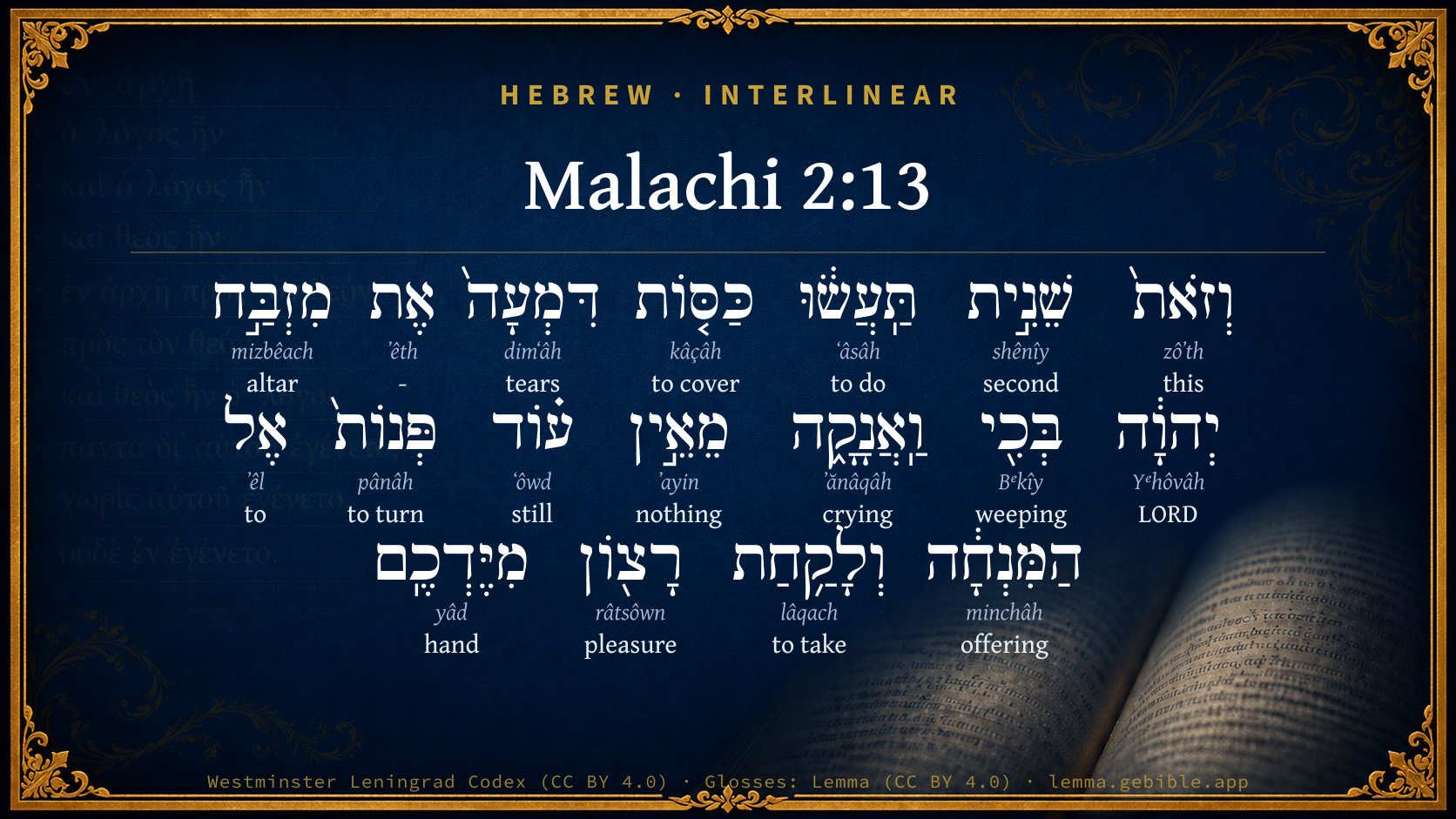
Hebrew (Westminster Leningrad Codex) Malachi 2:13 appears in the Hebrew Old Testament. The text above is from the Westminster Leningrad Codex. Each word links to its Strong’s number, a concise gloss, and parsing drawn from the Open Scriptures Hebrew Bible morphology. Click any word for its full Brown-Driver-Briggs (BDB) entry.
Download image
Cite this verse

Malachi 2:13 (World English Bible). Public Domain. Lemma interlinear Bible study tool, https://lemma.gebible.app/v/malachi/2/13.

Show BibTeX & RIS
BibTeX
RIS
English Translation
This again you do: you cover the altar of Yahweh with tears, with weeping, and with sighing, because he doesn't regard the offering any more, neither receives it with good will at your hand.
World English Bible · Public Domain
Download a study sheet

One document with this verse’s original text, its word-by-word gloss line, the meaning frame, cross-references with their text, attributed commentary, and full source and license credits — printable, and it pastes into notes with its structure intact.

This verse Autodidact and up

Study sheet (.html) Plain text (.txt)

A passage Seminary Student

Up to 50 verses in one chapter. A passage sheet keeps up to 6 commentary sources and 12 cross-references per verse, in the order this page ranks them, and says so on the sheet whenever that leaves anything out. Ask for a single verse and you get the Autodidact verse sheet above.

Everything on this page stays free to read, with no account — the sheet is a download of what is already on screen, not access to it.

Want to remove ads? Support Godless Engineer
Compare translations 3

The same verse in 3 English versions, stacked beneath the original-language interlinear above. Click any original word for its lexicon entry.

Each is an independent rendering of the whole verse — the interlinear is not word-aligned to these translations.

Highlighted words mark where these versions differ — a whole-verse word diff, not a word-by-word alignment.

  • World English Bible Public Domain
    This again you do: you cover the altar of Yahweh with tears, with weeping, and with sighing, because he doesn't regard the offering any more, neither receives it with good will at your hand.
  • King James Version Public Domain
    And this have ye done again, covering the altar of the LORD with tears, with weeping, and with crying out, insomuch that he regardeth not the offering any more, or receiveth it with good will at your hand.
  • unfoldingWord Literal Text CC BY-SA 4.0
    And this second you do: covering the altar of Yahweh tears, weeping and groaning, because there is no longer turning to the offering or taking with favor your hand.

unfoldingWord Literal Text — © unfoldingWord, licensed CC BY-SA 4.0. Word-aligned USFM3 via Door43 (git.door43.org/unfoldingWord/en_ult).

Versions to compare (up to 4)

3 of 4 selected

Show all 18 translations

Every available English version of this verse, each an independent rendering of the whole verse.

  • World English Bible Public Domain
    This again you do: you cover the altar of Yahweh with tears, with weeping, and with sighing, because he doesn't regard the offering any more, neither receives it with good will at your hand.
  • Berean Standard Bible Public Domain
    And this is another thing you do: You cover the altar of the LORD with tears, with weeping and groaning, because He no longer regards your offerings or receives them gladly from your hands.
  • Majority Standard Bible Public Domain
    And this is another thing you do: You cover the altar of the LORD with tears, with weeping and groaning, because He no longer regards your offerings or receives them gladly from your hands.
  • King James Version Public Domain
    And this have ye done again, covering the altar of the LORD with tears, with weeping, and with crying out, insomuch that he regardeth not the offering any more, or receiveth it with good will at your hand.
  • American Standard Version (1901) Public Domain
    And this again ye do: ye cover the altar of Jehovah with tears, with weeping, and with sighing, insomuch that he regardeth not the offering any more, neither receiveth it with good will at your hand.
  • Revised Version (1885) Public Domain
    And this again ye do: ye cover the altar of the LORD with tears, with weeping, and with sighing, insomuch that he regardeth not the offering any more, neither receiveth it with good will at your hand.
  • Geneva Bible (1599) Public Domain
    And this haue ye done againe, and couered the altar of the Lord with teares, with weeping and with mourning: because the offering is no more regarded, neither receiued acceptably at your handes.
  • Douay-Rheims (1899) Public Domain
    And this again have you done, you have covered the altar of the Lord with tears, with weeping, and bellowing, so that I have no more a regard to sacrifice, neither do I accept any atonement at your hands.
  • Young's Literal Translation Public Domain
    And this a second time ye do, Covering with tears the altar of Jehovah, With weeping and groaning, Because there is no more turning unto the present, Or receiving of a pleasing thing from your hand.
  • Literal Standard Version CC BY-SA 4.0
    And you do this a second time, || Covering the altar of YHWH with tears, || With weeping and groaning, || Because there is no more turning to the present, || Or receiving of a pleasing thing from your hand.
  • Unlocked Literal Bible CC BY-SA 4.0
    You also do this: You cover the altar of Yahweh with tears, with weeping and sighing, because he still does not turn toward the offering or accept it with favor from your hand.
  • unfoldingWord Literal Text CC BY-SA 4.0
    And this second you do: covering the altar of Yahweh tears, weeping and groaning, because there is no longer turning to the offering or taking with favor your hand.
  • Darby Bible Public Domain
    And further ye do this: ye cover the altar of Jehovah with tears, with weeping, and with sighing, insomuch that he regardeth not the oblation any more, nor receiveth [it] with satisfaction at your hand.
  • World Messianic Bible Public Domain
    “This again you do: you cover the LORD’s altar with tears, with weeping, and with sighing, because he doesn’t regard the offering any more, neither receives it with good will at your hand.
  • Webster's Bible Public Domain
    And this have ye done again, covering the altar of the LORD with tears, with weeping, and with crying out, insomuch that he regardeth not the offering any more, or receiveth it with good will at your hand.
  • Free Bible Version CC BY-SA 4.0
    Something else you do is to pour out your tears on the Lord's altar weeping and moaning because he no longer pays attention to your offerings or doesn't want to accept them.
  • Bible in Basic English Public Domain
    And this again you do: covering the altar of the Lord with weeping and with grief, so that he gives no more thought to the offering, and does not take it with pleasure from your hand.
  • JPS Tanakh (1917) Public Domain
    And this further ye do: ye cover the altar of the LORD with tears, with weeping, and with sighing, insomuch that He regardeth not the offering any more, neither receiveth it with good will at your hand.

Literal Standard Version (2020), Covenant Press — licensed CC BY-SA 4.0. Text via the HelloAO Bible API (eBible.org). Unlocked Literal Bible (unfoldingWord) — licensed CC BY-SA 4.0. Text via the HelloAO Bible API (eBible.org). unfoldingWord Literal Text — © unfoldingWord, licensed CC BY-SA 4.0. Word-aligned USFM3 via Door43 (git.door43.org/unfoldingWord/en_ult). Free Bible Version, Dr. Jonathan Gallagher — licensed CC BY-SA 4.0. Text via the HelloAO Bible API (eBible.org).

Word by word

More ways to search: Search by grammar → Find every occurrence → Compare this word →

Practice this passage: Drill this verse → Learn its vocabulary →

וַֽאֲנָקָ֑ה
ʼănâqâh
H603
“and · crying”
Conjunction + Noun, Common, Feminine, Singular, Absolute
Part of Speech
Conjunction + Noun
Type
Common
Gender
Feminine
Number
Singular
State
Absolute
Full BDB Definition

Origin: from H602

TWOT: 134a

crying, groaning, lamentation
  1. וְזֹאת֙ zôʼth H2063 “and · this” Conjunction + Pronoun, Demonstrative, Feminine, Singular
  2. שֵׁנִ֣ית shênîy H8145 “second” Adjective, Ordinal number, Feminine, Singular, Absolute
  3. תַּֽעֲשׂ֔וּ ʻâsâh H6213 “to do” Verb, Qal, Imperfect, 2nd Person, Masculine, Plural
  4. כַּסּ֤וֹת kâçâh H3680 “to cover” Verb, Piel, Infinitive Construct
  5. דִּמְעָה֙ dimʻâh H1832 “tears” Noun, Common, Feminine, Singular, Absolute
  6. אֶת ʼêth H853 “-” Particle, Direct Object
  7. מִזְבַּ֣ח mizbêach H4196 “altar of” Noun, Common, Masculine, Singular, Construct
  8. יְהוָ֔ה Yᵉhôvâh H3068 “LORD” Noun, Proper
  9. בְּכִ֖י Bᵉkîy H1065 “weeping” Noun, Common, Masculine, Singular, Absolute
  10. מֵאֵ֣ין ʼayin H369 “from · nothing” Preposition + Particle, Negative
  11. ע֗וֹד ʻôwd H5750 “still” Adverb
  12. פְּנוֹת֙ pânâh H6437 “to turn” Verb, Qal, Infinitive Construct
  13. אֶל ʼêl H413 “to” Preposition
  14. הַמִּנְחָ֔ה minchâh H4503 “the · offering” Particle, Definite Article + Noun, Common, Feminine, Singular, Absolute
  15. וְלָקַ֥חַת lâqach H3947 “and · to take” Conjunction + Preposition + Verb, Qal, Infinitive Construct
  16. רָצ֖וֹן râtsôwn H7522 “pleasure” Noun, Common, Masculine, Singular, Absolute
  17. מִיֶּדְכֶֽם yâd H3027 “from · hand · your” Preposition + Noun, Common, Both, Singular, Construct + Suffix, Personal, 2nd Person, Masculine, Plural

About this verse

These counts appear in no published source. They are computed here, from the morphology-tagged text and Lemma’s own curated glosses. What Lemma adds →

18
words
18
distinct lemmas
Prophets
section

Notable vocabulary

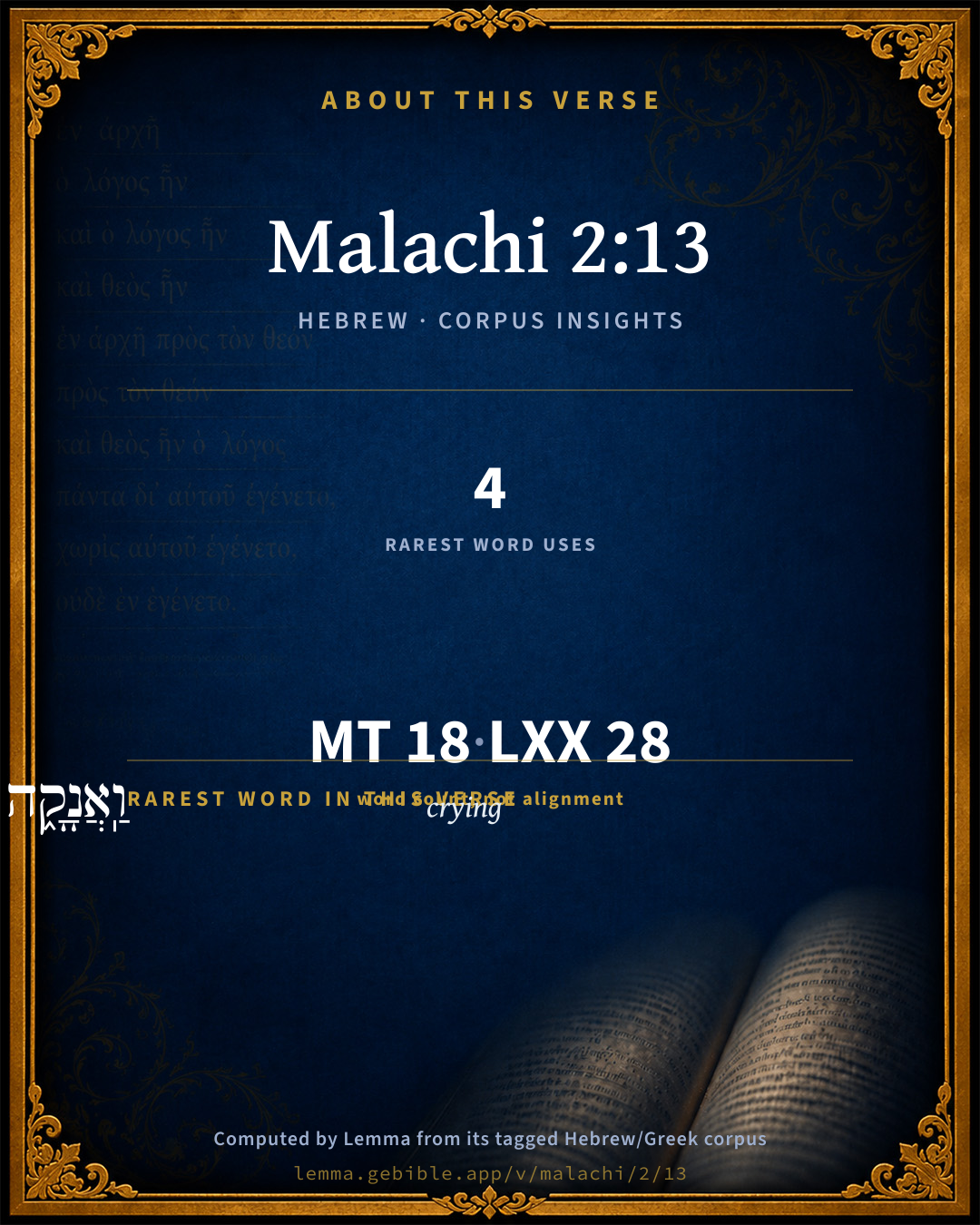
The rarest word here is וַֽאֲנָקָ֑ה crying H603 — appearing just 4 times in the whole Hebrew Bible.

Shared distinctive vocabulary

וַֽאֲנָקָ֑ה crying H603 occurs in 4 verses of the Hebrew Bible. Also found in:

Grammatical profile

  • 4 verbs
  • 8 nouns
  • 1 adjective
  • 1 pronoun
  • 1 preposition
  • 1 adverb
  • 2 particles

Verb forms

  • תַּֽעֲשׂ֔וּ Qal · Imperfect
  • כַּסּ֤וֹת Piel · Infinitive Construct
  • פְּנוֹת֙ Qal · Infinitive Construct
  • וְלָקַ֥חַת Qal · Infinitive Construct

Hebrew & Septuagint length

In English translation the verse runs 34 words from the Hebrew and 45 from the Septuagint (LXX English) — closely comparable.

A rough comparison of the two English renderings, which tokenize alike — not a word-level alignment.

Word counts can differ between the Hebrew and the Greek without any difference in meaning — e.g. the Hebrew direct-object marker אֵת has no separate Greek word, and Greek often adds the article ὁ.

In the original languages it is 18 Hebrew tokens and 28 Greek tokens — but the two are counted differently (Hebrew bundles its prefixes and suffixes into one token; the Greek is in lemma form), so that isn’t a like-for-like length.

Cross-references

12

Topical passages linked to Malachi 2:13 in the Treasury of Scripture Knowledge — connected by theme and wording, ordered by reader-vote popularity; previews shown in the World English Bible.

  • Isaiah 1:11–15 "What are the multitude of your sacrifices to me?," says Yahweh. "I have had enough of the burnt offerings of rams, And the fat of fed animals. I don't delight in the blood of bulls, Or of lambs, Or of male goats.
  • Psalms 78:34–37 When he killed them, then they inquired after him. They returned and sought God earnestly.
  • Jeremiah 14:12 When they fast, I will not hear their cry; and when they offer burnt offering and meal-offering, I will not accept them; but I will consume them by the sword, and by the famine, and by the pestilence.
  • Deuteronomy 15:9 Beware that there not be a base thought in your heart, saying, The seventh year, the year of release, is at hand; and your eye be evil against your poor brother, and you give him nothing; and he cry to Yahweh against you, and it be sin to you.
  • Deuteronomy 26:14 I have not eaten of it in my mourning, neither have I put away of it, being unclean, nor given of it for the dead: I have listened to the voice of Yahweh my God; I have done according to all that you have commanded me.
  • 1 Samuel 1:9–10 So Hannah rose up after they had eaten in Shiloh, and after they had drunk. Now Eli the priest was sitting on his seat by the door-post of the temple of Yahweh.
  • 2 Samuel 13:19–20 Tamar put ashes on her head, and tore her garment of various colors that was on her; and she laid her hand on her head, and went her way, crying aloud as she went.
  • Nehemiah 8:9–12 Nehemiah, who was the governor, and Ezra the priest the scribe, and the Levites who taught the people, said to all the people, This day is holy to Yahweh your God; don't mourn, nor weep. For all the people wept, when they heard the words of the law.
  • Proverbs 15:8 The sacrifice made by the wicked is an abomination to Yahweh, But the prayer of the upright is his delight.
  • Ecclesiastes 4:1 Then I returned and saw all the oppressions that are done under the sun: and, behold, the tears of those who were oppressed, and they had no comforter; and on the side of their oppressors there was power; but they had no comforter.
  • Jeremiah 6:20 To what purpose comes there to me frankincense from Sheba, and the sweet cane from a far country? your burnt offerings are not acceptable, nor your sacrifices pleasing to me.
  • Proverbs 21:27 The sacrifice of the wicked is an abomination: How much more, when he brings it with a wicked mind!

Cross-references courtesy of OpenBible.info (CC BY 4.0).

Hebrew and Greek witnesses Masoretic Hebrew ↔ Greek Septuagint

The same verse in the two great witnesses to the Old Testament, shown verse-for-verse.

These are two independent witnesses, not word-aligned to each other, and the Septuagint is shown in lemma (dictionary) form.

Hebrew Malachi 2:13 Masoretic · Westminster Leningrad Codex

וְזֹאת֙ שֵׁנִ֣ית תַּֽעֲשׂ֔וּ כַּסּ֤וֹת דִּמְעָה֙ אֶת מִזְבַּ֣ח יְהוָ֔ה בְּכִ֖י וַֽאֲנָקָ֑ה מֵאֵ֣ין ע֗וֹד פְּנוֹת֙ אֶל הַמִּנְחָ֔ה וְלָקַ֥חַת רָצ֖וֹן מִיֶּדְכֶֽם

This again you do: you cover the altar of Yahweh with tears, with weeping, and with sighing, because he doesn't regard the offering any more, neither receives it with good will at your hand.

World English Bible · Public Domain

Greek LXX Malachi 2:13 Septuagint · lemma form

καί οὗτος ὅς μισέω ποιέω καλύπτω δάκρυ ὁ θυσιαστήριον κύριος καί κλαυθμός καί στεναγμός ἐκ κόπος ἔτι ἄξιος ἐπιβλέπω εἰς θυσία ἤ λαμβάνω δεκτός ἐκ ὁ χείρ σύ

And these things which I hated, you⌃ did: you⌃ covered with tears the altar of the Lord, and with weeping and groaning because of troubles: is it meet for me to have respect to your sacrifice, or to receive anything from your hands as welcome?

LXX2012 (modern English Septuagint) · Public Domain

On this verse, The Pulpit Commentary discusses the Septuagint’s reading. Read the note in Commentary ↓

Hebrew: Westminster Leningrad Codex (CC BY 4.0). Greek: Septuagint (public domain); English from LXX2012 (modern English Septuagint) (Public Domain). How the Septuagint differs from the Hebrew →

Targum (Aramaic paraphrase)

1

The Targum is the ancient Jewish Aramaic paraphrase of the Hebrew Scriptures — an interpretive translation, not the Hebrew text itself. Onkelos (literal) and Pseudo-Jonathan (expansive) render the Torah, and Jonathan the Prophets. Coverage is partial: where no permissively-licensed English translation exists for a verse, only the Aramaic is shown. This is verse-level text, not a word-by-word alignment to the Hebrew.

  1. Targum Jonathan Prophets (Joshua–Malachi)
    וְדָא תִּנְיָנוּת דִי אַתּוּן עָבְדִין חֲפַת דִמְעַתָא יַת מַדְבְּחָא דַייָ דִי בָּכָן וְדִי מְדַנְקִין מִדְלֵית עוֹד אִתְפְּנָאָה לְקוּרְבָּנָא וּלְקַבָּלָא יָתֵיהּ בְּרַעֲוָא מִיֶדְכוֹן:

    (no public-domain English translation for this verse)

    Targum Jonathan — Aramaic: “Mikraot Gedolot” (public domain). English: “Sefaria Community Translation” (CC0 1.0 (public-domain dedication)); “London "Chaldee Paraphrase," 1871” (public domain). Text via Sefaria.

Commentary

Notes on Malachi 2:13 from classic Christian and Jewish commentators (each source and its license shown beneath its notes). The classic Christian expositions comment on the surrounding passage and are grouped to its opening verse, so a note may address several verses; the Jewish commentaries on the Tanakh (Rashi and others) are per-verse, so they appear only where the commentator wrote on this verse.

Lemma curates 59 commentaries, every one of them public domain or Creative Commons licensed, each selected and text-cleaned for this edition rather than reprinted as found. About our sources →

The Cambridge Bible for Schools and Colleges

gen. ed. J. J. S. Perowne

13. again] Lit. second. The first evil of marrying heathen women was accompanied by a second, the cruel treatment and divorce (“putting-away,” Mal_2:16) of their lawful wives, which is now dealt with, Mal_2:13-16.

covering the altar] The weeping crowd of insulted and divorced wives turn to God, as their only refuge, so that the courts of His Temple resound with their sad complaints, and His very altar, round which they gather, is bathed, as it were, with their tears.

crying out] Rather, sighing, R.V., as the same word is rendered in Psa_79:11; or groaning, Psa_102:20.

The Cambridge Bible for Schools and Colleges (gen. ed. J. J. S. Perowne; Cambridge University Press, 1878–1918) — public domain. Text from a community e-Sword module.

Trapp's Complete Commentary

John Trapp

Mal 2:13 And this have ye done again, covering the altar of the LORD with tears, with weeping, and with crying out, insomuch that he regardeth not the offering any more, or receiveth [it] with good will at your hand.

Ver. 13. And this have ye done again] Or, in the second place: q.d. Not content to have married strange wives, ye have brought them in to your lawful wives, to their intolerable vexation; so adding this sin to the former, as a greater to the less. This is still the guise of graceless men, to add drunkenness to thirst, rebellion to sin, to amass and heap up one evil upon another, till wrath come upon them to the utmost. "For three transgressions, and for four, I will not turn away their punishment," Amo 1:3; that is, so long as the wicked commit one or two iniquities, I forbear them; but when it comes once to threes and fours (how much more to so many scores, hundreds, thousands, as one cipher added to a figure makes it so many tens, two so many hundreds, three so many thousands, &c.), God will bear with them no longer. Of those old Israelites it is demanded, not without great indignation on God’s part, "How often did they provoke him in the wilderness, and grieve him in the desert? Yea, they turned back and tempted God," &c. Psa 78:40-41. Good men, if they fall once into foul practices, they fall not often. Of Judah it is expressly recorded that he knew Tamar no more. Lot indeed committed incest two nights together; but the orifice of his lust was not yet stopped by repentance. Think the same of Solomon, Samson, Jonah, &c., their acts were, as it were, continued acts; and, in the interim, little or no remorse or regret. Let us that have received mercy be admonished to sin no more, lest a worse thing come unto us, Joh 5:14. There is a woe to such as draw iniquity with cords of vanity, and sin as it were with a cart rope, Isa 5:18. Babylon’s sins in the Revelation reached up to heaven, or they were thwacked together thick and threefold one upon another, Rev 18:5, there was a concatenation or a continued series of them; therefore she fell surely and suddenly. When wickedness is once ripe in the field God will not let it shed to grow again; but cuts it up by a just and seasonable vengeance.

Covering the altar of the Lord with tears] That is, You caused your poor wives, when they should have been cheerful in God’s service, as 1Sa 1:10, and in many other places it was required of the Israelites to rejoice whensoever they appeared before the Lord. Earthly princes love not the company of mourners, Est 4:4, to cover the Lord’s altar with tears, with weeping, and with crying out, to throw themselves, blubbered and swollen with tears, upon the altar, which was a profanation of it; so that God regarded not the offering any more. It were happy if we could be so affected with our unkindness to Christ, our Husband, that we could cover his table, when we come to it, with our tears. How should the Lord regard our service so much the more! how should it be unto him as music upon the waters, far more harmonious! What a gracious respect had he to the weeping women that followed him to the cross! and what an honour was that to one of them (Mary Magdalene, I mean) that she had the first sight of the revived Phoenix, whom she held fast by those feet that she had once washed with her tears, and that had now lately trod upon the lion and adder Psa 91:13. It was appointed by Moses’ law that the bondwoman should bewail her father and mother a full month before she might become an Israelite’s wife, Deu 21:13. We, that are strangers to the commonwealth of Israel, as we cannot be presented a chaste virgin to Christ, but as weeping over him that bled over us, so we never please him better than when we weep over our tears ( Ipsae lachrymae sunt lachrymabiles), sigh over our sobs, mourn over our griefs, as not proportionable to our miscarriages. But to return to the text; the Jews, as they are noted for a nation overmuch effeminate, and given to women, as they say, so, when they have satisfied their lust, and served their own turns, they are as willing to be rid of them as Amnon was of Tamar. Hence those many cautions in the law to put bounds to their petulance; and that political permission of a divorce, for the relief of the poor despised woman, lest she should come to a mischief, by the hatred of the churl her husband, Deu 22:18; Deu 22:14; Deu 24:3. At this day they look upon women as not having so divine a soul as men, but are of a lower creation, made only for the propagation and pleasure of man. They use them as their drudges, lay upon them with their unmanly fists, are ready to cut out their tongues (as the Welshmen dealt by their French wives, lest they should corrupt the language of their children), put them away upon every slight occasion, covering that violence with the garment of the law, as Mal 2:16. Or if they kept them, they took other wives to them, to vex them, and to make them to fret, 1Sa 1:6, or (as the word there signifies) to thunder; not only tabering upon their breasts, with the voice of doves (as Nahum’s expression is, Nah 2:7), but filling the air, yea, covering the altar (as it is here) with their laments and lowings, flectu et mugitu (so the Vulgate rendereth), for their husbands’ harshness, and their concubines’ insolencies and indignities: Lamentis gemituque et foemineo ululatu Tecta fremunt (Virg. Aeneid). Jerome tells us that these returned captives slighted their old wives brought with them from Babylon (as being by that tedious journey become infirm and deformed), and matched with strangers, who were fresh, fair, rich, &c.; this he gathers out of Ezr 9:1-15; Ezr 10:1-44, whereas they should rather have nourished and cherished them as their own flesh, Eph 5:29, they should have handled them gently, because of their weakness, as so many crystal glasses. They should have given them all lawful content, as Abraham did Sarah, his faithful fellow traveller. They should have given all honour unto them, saith St Peter, 1Pe 3:7; and why? Mark his many reasons. 1. They are the weaker vessels, and are, therefore, to be handled with all tenderness. Some translate it the weaker instrument; and (as Luther speaks of it) as a knife with a tender edge men will not cut stones, brass, or iron with, so here. 2. They are heirs together of the grace of life, that is, of the life of grace, and of glory too; for souls have no sexes, and as every one is in Christ, all are equal, so that the husband is bound, in this respect, to make his wife’s yoke as easy as may be, since she draws even with him, though on the left side. 3. That your prayers be not hindered, as they will be, where there is not so much coniugium wedlock as coniurgium. quarrelling. How can they pray together comfortably that live so discontentedly? How can they bring their gift to that altar that is covered with the tears and moans of their justly aggrieved and abused wives? Or, if they do, will God regard their offering any more, or receive it with good will at their hands? Will not the tears and groans of their distressed wives (who yet hold out their devotion, and will not be hindered by their just grief from praying to God and pouring out their souls before him) move God more than their sacrifices can do? Especially if they bring them with a wicked mind, as Solomon hath it, Pro 21:27; and as Lyra maketh it to be the sense of this text; Ye have covered the altar of the Lord with tears, &c., but he regardeth not the offering any more, &c., that is (saith Lyra, and he hath it from Chrysostom), you are resolved to retain your idolatrous wives, though God have declared against it; and that ye may expiate this wickedness, and make amends by your good deeds for your bad, you run to the temple, and there, with many tears and groans, you beg pardon. But all in vain, because you have no purpose at all to break off your sins, but will needs persist in your unlawful marriages. {See Trapp on "Mal 3:16"}

John Trapp, A Commentary or Exposition upon All the Books of the Old and New Testament (1647–1656) — public domain. Text from a community e-Sword module.

The Biblical Illustrator

Joseph S. Exell

Mal_2:13-15

Between thee and the wife of thy youth.

Marriage

I. As a social compact. She is thy wife, here is the peculiarity of the relation. It is the fountain of humanity in its perpetuation, and the source of its purest affections, its dearest charities, and its richest enjoyments. It is a relation of choice, not of blood. Here is the mutual compact, with which, in the first instance, the two parties themselves have alone to do. It is a social compact, involving civil responsibilities. It is not enough that the individuals agree in the formation of this union; the magistracy of every state, watching over the weal of the whole, has a right to require a guarantee for the public, as well as for the parties. So far as society is concerned, and the public interest involved, marriage is exclusively a civil contract. All other relations arise out of this first alliance. This, being voluntary, and the root of all social ramifications, it becomes necessary that it should be formed with the greatest care, watched with the greatest circumspection, and secured by the most indestructible bond. She is thy companion. Here is the propriety and solace of the relation. One crime alone dissolves the marriage tie, but many offences may occur to render it sore bondage. Incompatibility of temper and of habits will not fail, first or last, in a greater or less degree, to introduce estrangement into the heart, and disorder into the family. As thy companion, let her be treated as an equal. She is so in moral, intellectual, and immortal constitution--a partaker of the same nature, a possessor of the same qualities, a recipient of the same salvation. Society depends upon the participation of a common nature and a community of interests.

II. As a religious institution. In view of the closeness of the union, the duties involved in it reciprocally, the inseparable connection of it with human happiness, such an alliance can acquire stability only from motives of a religious character, and from strength derived from spiritual aid. But God has laid down express laws for the regulation of the state thus entered upon, and watches over it to enforce those laws and to punish their violation. Consider the religious character of marriage--

1. In its formation.

2. In its design.

3. In its connection with the altar.

4. In its responsibilities.

5. In its duties.

6. In the typical use made of it. (W. B. Collyer, D. D.)

The Divine institution of marriage

1. It implies a loving union of two, and only two souls, until death.

2. It has been sadly outraged in all ages. Polygamy, cruelty, and mutual unfaithfulness are outrages on it.

3. The outrage of this institution is fraught with calamitous results. It is abhorrent to God. It involves violence. (Homilist.)

The Biblical Illustrator, edited by Joseph S. Exell (c. 1880s–1900s) — public domain. Text from a community e-Sword module.

Keil & Delitzsch

C. F. Keil & F. Delitzsch

Mal 2:13. "And this ye do a second time: cover the altar of Jehovah with tears, with weeping and signs, so that He does not turn any more to the sacrifice, and accept the well-pleasing thing at your hand. Mal 2:14. And ye say, Wherefore? Because Jehovah has been witness between thee and the wife of thy youth, towards whom thou hast acted treacherously; whereas she is nevertheless thy companion, and the wife of thy covenant. Mal 2:15. And not one did so who had still a remnant of spirit. And what (did) the one? He sought seed of God. Therefore shall ye take heed for your spirit, and deal not faithlessly to the wife of thy youth. Mal 2:16. For I hate divorce, saith Jehovah, the God of Israel; and he will cover wickedness over his garment, saith Jehovah of hosts. Thus shall ye take heed to your spirit, and not deal treacherously." In these verses the prophet condemns a second moral transgression on the part of the people, viz., the putting away of their wives. By shēnı̄th (as a second thing, i.e., for the second time) this sin is placed in the same category as the sin condemned in the previous verses. Here again the moral reprehensibility of the sin is described in Mal 2:11, before the sin itself is named. They cover the altar of Jehovah with tears, namely, by compelling the wives who have been put away to lay their trouble before God in the sanctuary. The inf. constr. introduces the more minute definition of זאת; and בּכי ואנקה is a supplementary apposition to דּמעה ot , added to give greater force to the meaning. מאין עוד, so that there is no more a turning (of Jehovah) to the sacrifice, i.e., so that God does not graciously accept your sacrifice any more (cf. Num 16:15). The following infinitive ולקחת is also dependent upon מאין, but on account of the words which intervene it is attached with ל . רצון , the good pleasure or satisfaction, used as abstractum pro concreto for the well-pleasing sacrifice. Mal 2:14. This sin also the persons addressed will not recognise. They inquire the reason why God will no more graciously accept their sacrifices, whereupon the prophet discloses their sin in the plainest terms. על־כּי = על־אשׁר, as in Deu 31:17; Jdg 3:12, etc. The words, "because Jehovah was a witness between thee and the wife of thy youth," cannot be understood as Ges., Umbreit, and Koehler assume, in accordance with Mal 3:5, as signifying that Jehovah had interposed between them as an avenging witness; for in that case העיד would necessarily be construed with ב, but they refer to the fact that the marriage took place before the face of God, or with looking up to God; and the objection that nothing is known of any religious benediction at the marriage, or any mutual vow of fidelity, is merely an argumentum a silentio, which proves nothing. If the marriage was a berı̄th 'Elōhı̄m (a covenant of God), as described in Pro 2:17, it was also concluded before the face of God, and God was a witness to the marriage. With the expression "wife of thy youth" the prophet appeals to the heart of the husband, pointing to the love of his youth with which the marriage had been entered into; and so also in the circumstantial clause, through which he brings to the light the faithless treatment of the wife in putting her away: "Yet she was thy companion, who shared thy joy and sorrow, and the wife of thy covenant, with whom thou didst made a covenant for life."

In Mal 2:15 the prophet shows still further the reprehensible character of the divorce, by rebutting the appeal to Abraham's conduct towards Hagar as inapplicable. The true interpretation of this hemistich, which has been explained in very different, and to some extent in very marvellous ways, is obvious enough if we only bear in mind that the subordinate clause וּשׁאר רוּח לו, from its very position and from the words themselves, can only contain a more precise definition of the subject of the principal clause. The affirmation "a remnant of spirit is (was) to him" does not apply to God, but only to man, as L. de Dieu has correctly observed. Rūăch denote here, as in Num 27:18; Jos 5:1; Kg1 10:5, not so much intelligence and consideration, as the higher power breathed into man by God, which determines that moral and religious life to which we are accustomed to give the name of virtue. By 'echâd (one), therefore, we cannot understand God, but only a man; and לא אחד (not any one = no one, not one man) is the subject of the sentence, whilst the object to עשׂה must be supplied from the previous sentence: "No man, who has even a remnant of reason, or of sense for right and wrong, has done," sc. what ye are doing, namely, faithlessly put away the wife of his youth. To this there is appended the objection: "And what did the one do?" which the prophet adduces as a possible exception that may be taken to his statement, for the purpose of refuting it. The words וּמה האחד are elliptical, the verb עשׂה, which may easily be supplied from the previous clause, being omitted (cf. Ecc 2:12). האחד, not unus aliquis, but the well-known one, whom it was most natural to think of when the question in hand was that of putting away a wife, viz., Abraham, who put away Hagar, by whom he had begotten Ishmael, and who was therefore also his wife (Genesis 21). The prophet therefore replies, that Abraham sought to obtain the seed promised him by God, i.e., he dismissed Hagar, because God promised to give him the desired posterity, not in Ishmael through the maid Hagar, but through Sarah in Isaac, so that in doing this he was simply acting in obedience to the word of God (Gen 21:12). After meeting this possible objection, Malachi warns his contemporaries to beware of faithlessly putting away their wives. The Vav before nishmartem is the Vav rel., through which the perfect acquires the force of a cohortative as a deduction from the facts before them, as in ועשׂית in Kg1 2:6 (see Ewald, 342, c). נשׁמר בּרוּחו is synonymous with נשׁמר בּנפשׁו in Jer 17:21, and this is equivalent to נשׁמר לנפשׁו in Deu 4:15 and Jos 23:11. The instrumental view of ב ("by means of the Spirit:" Koehler) is thus proved to be inadmissible. "Take heed to your spirit," i.e., beware of losing your spirit. We need not take rūăch in a different sense here from that in which it is used in the clause immediately preceding; for with the loss of the spiritual and moral vis vitae, which has been received from God, the life itself perishes. What it is that they are to beware of is stated in the last clause, which is attached by the simple copula (Vav), and in which the address passes from the second person into the third, to express what is affirmed as applying to every man. This interchange of thou (in wife of thy youth) and he (in יבגּד) in the same clause appears very strange to our mode of thought and speech; but it is not without analogy in Hebrew (e.g., in Isa 1:29; cf. Ewald, 319, a), so that we have no right to alter יבגּד into תּבגּד, since the ancient versions and the readings of certain codices do not furnish sufficient critical authority for such a change. The subject in יבגּד is naturally thought of as indefinite: any one, men. This warning is accounted for in Mal 2:16, first of all in the statement that God hates putting away. שׁלּח is the inf. constr. piel and the object to שׂנא: "the sending away (of a wife), divorce." שׂנא is a participle, the pronominal subject being omitted, as in maggı̄d in Zac 9:12, because it may easily be inferred from the following words: אמר יי (saith the Lord of hosts). The thought is not at variance with Deu 24:1., where the putting away of a wife is allowed; for this was allowed because of the hardness of their hearts, whereas God desires that a marriage should be kept sacred (cf. Mat 19:3. and the comm. on Deu 24:1-5). A second reason for condemning the divorce is given in the words וכסּה חמס על ל, which do not depend upon כּי שׂנא, but form a sentence co-ordinate to this. We may either render these words, "he (who puts away his wife) covers his garment with sin," or "sin covers his garment." The meaning is the same in either case, namely, that wickedness will adhere irremoveably to such a man. The figurative expression may be explained from the idea that the dress reflects the inward part of a man, and therefore a soiled garment is a symbol of uncleanness of heart (cf. Zac 3:4; Isa 64:5; Rev 3:4; Rev 7:14). With a repetition of the warning to beware of this faithlessness, the subject is brought to a close.

Keil & Delitzsch — Biblical Commentary on the Old Testament (1861–1891) — public domain (CC PDM 1.0). Text via the HelloAO Bible API. (Old Testament only.)

Geneva Bible (1599)

Geneva Bible translators

Yet cause the people to lament, because that God doth not regard their sacrifices, so that they seem to sacrifice in vain.

Geneva Bible (1599) marginal notes — public domain. Text via Bolls.life.

Jamieson, Fausset & Brown

Robert Jamieson, A. R. Fausset & David Brown

done again--"a second time": an aggravation of your offense (Neh 13:23-31), in that it is a relapse into the sin already checked once under Ezra (Ezr 9:10) [HENDERSON]. Or, "the second time" means this: Your first sin was your blemished offerings to the Lord: now "again" is added your sin towards your wives [CALVIN].

covering . . . altar . . . with tears--shed by your unoffending wives, repudiated by you that ye might take foreign wives. CALVIN makes the "tears" to be those of all the people on perceiving their sacrifices to be sternly rejected by God.

Jamieson, Fausset & Brown — Commentary Critical and Explanatory on the Whole Bible (1871) — public domain (CC PDM 1.0). Text via the HelloAO Bible API.

Adam Clarke's Commentary

Verse 13. Covering the altar of the Lord with tears] Of the poor women who, being divorced by cruel husbands, come to the priests, and make an appeal to God at the altar; and ye do not speak against this glaring injustice.

Adam Clarke's Commentary on the Bible (1810–1826) — public domain. Text from a community e-Sword/MySword module.

John Calvin's Commentaries

The Prophet amplifies again the fault of the priests, because the people, when they perceived that God was adverse to them, found no means of pacifying him. And when men have an idea that God is inexorable to them, every zeal for religion must necessarily decay; and hence it is said in Psalm 130:4 — “With thee is propitiation, that thou mayest be feared.” As the people then gained nothing by sacrificing, they had now nearly fallen off from divine worship. This evil, a most grievous one, the Prophet says, was to be justly ascribed to the priests; for as they were become polluted, how could their persons have been accepted by God, that they might be mediators to expiate sins and to pacify God?

This is the real meaning of the Prophet, which none of the interpreters have perceived. The Rabbins think that the priests are here reproved, because their wives filled the altar in the sanctuary with weeping, because they saw that their husbands did not faithfully treat them, according to the law of marriage; and almost all have agreed with them. Thus then they explain the verse — Ye have in the second place done this; that is, “That sin was of itself sufficiently grievous, when ye suffered lean victims to be sacrificed to me, as it were in mockery; but in addition to this comes your sin against your wives, who continually complain and deplore their condition before the altar of God, even because they are not loved by you, as the right of marriage requires.” They thus refer the tears, the weeping, and lamentation, to the wives of the priests, which were so cruelly treated by their husbands: they were not able to do anything else than to fill God’s sanctuary with their constant complaints. Hence they render, מאין עוד פנות, main oud penut, “I will not therefore regard,” or, “no one regards;” but both versions are not only obscure, but wholly pervert the sense of the Prophet.

But what I have already stated is the most suitable — that it was to be ascribed to the priests that no one could from the heart worship God, at least with a cheerful and willing mind; for God was implacable to the people, because the only way of obtaining favor under the law was when the priests, who represented the Mediator, humbly entreated pardon in the name of the whole people. But how could God attend to the prayers of the priests when they had polluted his altar by the filth of wickedness? We then see the object of this amplification — Ye cover the altar of Jehovah with tears, with weeping and wailing. The praises of God ought to have resounded in the temple, according to what is said —

“Praise, O God, waits for thee in Zion.” (Psalm 65:1.)

And the principal sacrifice was, that the people exercised themselves in contemplating the blessings of God, and in thanksgiving. But he says that none went forth before the altar with a cheerful mind, but all were sad and sorrowful, because they found that God was severe and rigid.

And the reason is added — מאין עוד פנות, main oud penut, literally, “Is it not any more by regarding,” etc.? It is easy to see how far they depart from the meaning of the Prophet who read — “They shall therefore offer no more;” for is this to be applied to God? Others also, who give this rendering — “I shall not therefore accept,” pervert also the very letter of the text. But the most appropriate meaning is this — that all wept and groaned before the altar, because they saw that they came there without any advantage, that their sacrifices did not please God, and that the whole worship was in vain, inasmuch as God did not answer their prayers. The Prophet ascribes the fault to the priests, that God did not turn to mercy, so as to forgive the people when they sacrificed. With weeping, then, he says, was the altar filled or covered, because God received not what pleased him from their hand; that is, because no victims pleased him which were offered by polluted and impure hands. He afterwards joins

John Calvin's Commentaries (1540-1563) — public domain. Text from the Calvin Translation Society English edition (1840s-50s) via the Christian Classics Ethereal Library (ccel.org). Calvin's coverage is partial (roughly two-thirds of the Bible); uncommented books and verses are honest gaps, never fabricated. The 19th-century editor's footnotes and remarks are omitted so the notes are faithfully Calvin's own voice.

Ellicott's Commentary for English Readers

(13) The prophet now rebukes the people for their frivolous divorces of their first wives, which was a natural result of their marriage with heathen women.

And this . . . again.—Or perhaps, And this a second thing ye do—viz., infidelity to the wife of their youth (Mal_2:14). But the rendering of the English Version is in accordance with the Hebrew accentuation. That rendering is not improbably the right one. It would mean: “And this you do again (Nehemiah 13), even after Ezra has reformed the abuse, and you have solemnly undertaken not to act so again” (Neh_9:10).

Covering the altar . . . with tears . . . and with crying out—i.e., with the plaints of the Israelitish women who were divorced against their will.

Insomuch that.—Or rather, so that.

A Bible Commentary for English Readers, edited by Charles John Ellicott (1878–1897) — public domain. Text from a community e-Sword module.

John Gill's Exposition

And this have ye done again,.... Or "in the second" (b) place; to their rejection and ill treatment of Christ they added their hypocritical prayers and tears, as follows:

covering the altar of the Lord with tears and weeping, and with crying out; for the Messiah they vainly expect, pretending great humiliation for their sins: though some, as Kimchi and Aben Ezra, make the first evil to be their offering illegal sacrifices on the altar, complained of in the former chapter Mal 1:1; and this second, their marrying strange wives, on account of which their lawful wives came into the house of God, and wept over the altar before the Lord, complaining of the injury that was done them:

insomuch that he regardeth not the offering any more, or receiveth it with good will at your hand; which expresses an utter rejection and abrogation of legal sacrifices; and which some make to be the reason of their covering the altar with tears and weeping: or the altar is represented as weeping, because sacrifice is no more offered upon it; see Dan 9:27.

(b) "secundo", Pagninus, Vatablus, Calvin, Cocceius, Burkius.

John Gill's Exposition of the Whole Bible (1746–1763) — public domain (CC PDM 1.0). Text via the HelloAO Bible API.

Albert Barnes' Notes on the Bible

And this ye have done again - , adding the second sin of cruelty to their wives to the taking foreign women; “they covered the altar of God with tears,” in that they by ill-treatment occasioned their wives to weep there to God; and God regarded this, as though they had stained the altar with their tears.

Insomuch that He regardeth not the offering anymore - God regarded the tears of the oppressed, not the sacrifices of the oppressors. He would not accept what was thus offered Him as a thing well-pleasing to Him, acceptable to win His good pleasure.

Albert Barnes' Notes on the Bible (1834–1885) — public domain. Text from a community e-Sword/MySword module.

Haydock's Catholic Bible Commentary

With tears; viz., by occasion of your wives, whom you have put away, and who came to weep and lament before the altar. (Challoner) --- Though divorces were tolerated, (Matthew xix. 6.) the more virtuous did not approve of them, particularly when a wife is put away who had been married in youth. See ver. 10. Perhaps this corruption had crept in, like others, (Calmet) owing to the people’s commerce with strangers. (Diodorus in Photius.)

George Leo Haydock (1774–1849), Haydock's Catholic Family Bible and Commentary, 1859 edition — public domain. Excludes Psalms (Douay-Rheims chapter numbering differs from Protestant) and Deuterocanonical books (Catholic canon only).

Matthew Poole's English Annotations

This have ye done again; beside that first fault, you have committed another, you slight, misuse, and afflict your Jewish wives, whom alone you should have loved and cherished, but you make them drudges and slaves to idolatresses, your new and illegal wives.

Covering the altar of the Lord with tears; your despised and misused wives flee to the temple, weep, and cry out unto God for redress of their injuries.

With weeping: this is added to show the abundance of their tears.

With crying out; with vehemency crying to God against such husbands.

Insomuch that he, the Lord, who seeth their tears and heareth their cries,

regardeth not the offering any more; valueth not such offerings made to him by such people and such priests; or receiveth it with good will at your hand; is not at all pleased with such offerings, whether expiatory or peace-offerings, none of them from such people shall ever avail them.

Matthew Poole's English Annotations on the Holy Bible (1683–1685) — public domain. Text from a community e-Sword/MySword module.

The Pulpit Commentary

Not only did they marry heathen females, but they divorced their own legitimate wives to facilitate such unholy alliances. This have ye done again; this again ye do. Here is another and a further offence. Others take "again" in the sense of "a second time," referring to the fact that Ezra had effected a reform in this matter, but the people had relapsed into the same sin. But the first explanation is preferable. Septuagint, kai tauta, aemisoun epoieite , "and this which I hated ye did." Covering (ye cover) the altar of the Lord with tears. The prophet, as before (ver. 10), does not at once declare what this fresh outrage is, but intimates its nature. The picture he exhibits is that of a multitude of repudiated wives coming to the temple with weeping and lamentation, and laying their cause before the Lord. Insomuch that he regardeth not the offering any more. This cruel and wicked conduct raised a barrier between them and God, so that he regarded with favour no offering of theirs.

The Pulpit Commentary (1880–1919), ed. H.D.M. Spence-Jones & Joseph S. Exell — public domain. Text from a community e-Sword module.

John Wesley's Explanatory Notes

And this - Beside that first fault, you have committed another, you misuse, and afflict your Jewish wives, whom alone you should have cherished. With tears - Your despised wives fly to the temple, weep and cry to God for redress. With weeping - This is added to shew the abundance of their tears. He - The Lord.

John Wesley, Explanatory Notes Upon the Whole Bible (1754–1765) — public domain. Text via the GEBible commentary corpus.

unfoldingWord translationNotes

Door43 World Missions Community

General Information:

Malachi continues to speak to his fellow Israelites.

You cover the altar of Yahweh with tears

This sarcastically exaggerates the amount of tears the people cry to show that Yahweh knows that the people do not really feel sad. (See: Hyperbole and Generalization and Irony)

with weeping and sighing

The words "weeping" and "sighing" share similar meanings and intensify the idea of weeping. AT: "with great weeping" (See: Doublet)

does not turn toward the offering

Here turning toward a gift stands for receiving it and showing favor to the giver. (See: Metonymy)

does not turn toward the offering

This implies that those who are weeping at Yahweh's altar have offered sacrifices to him. (See: Assumed Knowledge and Implicit Information)

from your hand

Here "hand" stands for the person giving the offering. AT: "from you" (See: Synecdoche)

translationWords

altar

favor

hand

unfoldingWord translationNotes — © Distant Shores Media and the Door43 World Missions Community, licensed CC BY-SA 4.0. Source: git.door43.org/Door43/en_tn.

Rashi

Rabbi Shlomo Yitzchaki (Rashi)

And this second thing you do The first matter concerning which I reproved you is, indeed, very grave, for one to have married a gentile woman even if he was unmarried; but this second matter is graver, for those [who were] married to Israelite women and married gentile women in addition to them. [The men did this] because the Israelite women became black from hunger and from exile, and became repugnant to them. [Such a man] would, therefore, sit her [his Israelite wife] in his house, bound in living widowhood, and the gentile wife would be the chief wife.

to cover the altar of the Lord with tears For the [Israelite wives] would come before the altar of the Lord and weep before it, saying, “What have we sinned? And what wrong have our husbands found in us? Behold! We are before the altar to be tested as suspected adulteresses.”

such that he will no longer turn, etc. So that you are not fit for Me to turn to your offering or take any thing willingly from your hand.

and sighing an expression of sighing, that a person feels pain in his heart; demonisement in Old French, groaning. The source of all of them is (Ezek. 24:17), “Be silent in groaning” But if אֳנָקָה is an expression of a cry, where is the silence? The Targum of this word is דִמְדַנְקִין, and so did Jonathan translate (ibid. 30: 43) “And you shall sigh before yourselves ותְדַנְקוּן.” [This is] an expression of a person who roars and feels pain within himself.

Rashi on the Tanakh — English translations: “The Judaica Press complete Tanach with Rashi, translated by A. J. Rosenberg” (CC BY 4.0); “Pentateuch with Rashi's commentary by M. Rosenbaum and A.M. Silbermann, 1929-1934” (public domain); “The Metsudah Tanach series, Lakewood, N.J” (CC BY 4.0); and “The Book of Joshua, Metsudah Publications, 1997” (CC BY 4.0). Text via Sefaria.

Lesson kit

Teaching starters — assembled from the data on this page, not authored interpretation. Every prompt links to the verse data it draws on. Edit before teaching.

Malachi, in the Prophets, opens this verse with 18 words (18 distinct Hebrew lemmas). Its most distinctive word is ʼănâqâh (“crying”). A historical commentator’s framing appears above. Read the whole chapter for the surrounding context.

Discussion questions

  1. What does “crying” (ʼănâqâh) contribute to the verse as a whole?
  2. How does Psalms 12:5, which shares the word «crying», read alongside this verse?
  3. The translations on this page render this verse differently — a whole-verse word diff, not a word-by-word alignment. What might account for the different wordings?
  4. «תַּֽעֲשׂ֔וּ» is a Qal Imperfect verb. How does that grammatical form shape the action described?
  5. Compare how The Cambridge Bible for Schools and Colleges and Trapp's Complete Commentary read this verse. Where do they agree or differ?

Things to notice

Reading settings

Reading text

Shown beneath each verse's original-language words.

Old Testament
Old Testament edition

Read the OT as the Masoretic Hebrew (MT) or the Greek Septuagint (LXX).

English shown for the Greek Septuagint (in the Hebrew ↔ Greek comparison).

Comparing translations? Open the Compare panel on any verse page to stack up to four side by side.