
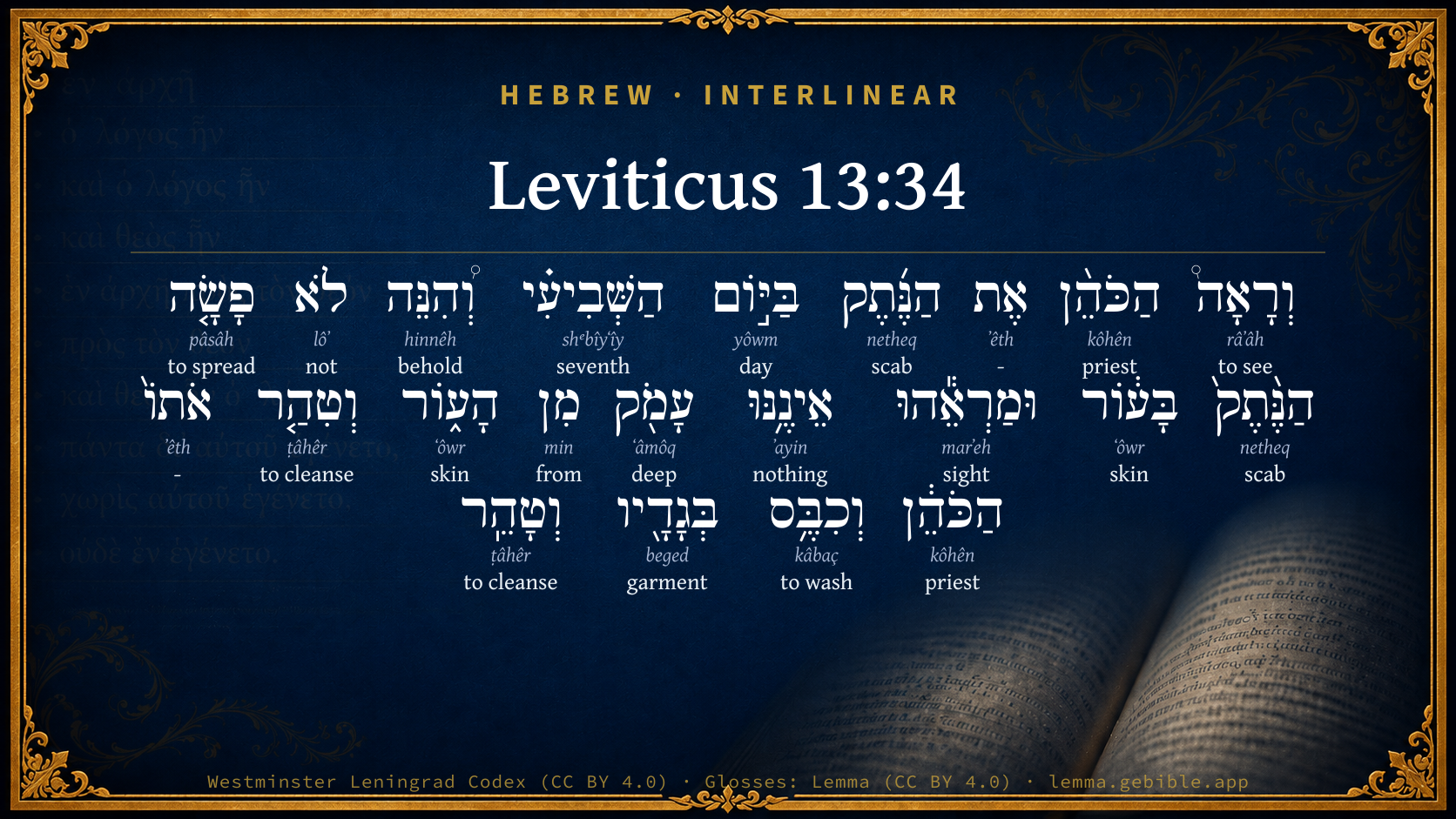
Leviticus 13:34

Hebrew (Westminster Leningrad Codex) Leviticus 13:34 appears in the Hebrew Old Testament. The text above is from the Westminster Leningrad Codex. Each word links to its Strong’s number, a concise gloss, and parsing drawn from the Open Scriptures Hebrew Bible morphology. Click any word for its full Brown-Driver-Briggs (BDB) entry.
Download image
Cite this verse

Leviticus 13:34 (World English Bible). Public Domain. Lemma interlinear Bible study tool, https://lemma.gebible.app/v/leviticus/13/34.

Show BibTeX & RIS
BibTeX
RIS
English Translation
On the seventh day, the priest shall examine the itch; and, behold, if the itch hasn't spread in the skin, and its appearance isn't deeper than the skin, then the priest shall pronounce him clean. He shall wash his clothes, and be clean.
World English Bible · Public Domain
Download a study sheet

One document with this verse’s original text, its word-by-word gloss line, the meaning frame, cross-references with their text, attributed commentary, and full source and license credits — printable, and it pastes into notes with its structure intact.

This verse Autodidact and up

Study sheet (.html) Plain text (.txt)

A passage Seminary Student

Up to 50 verses in one chapter. A passage sheet keeps up to 6 commentary sources and 12 cross-references per verse, in the order this page ranks them, and says so on the sheet whenever that leaves anything out. Ask for a single verse and you get the Autodidact verse sheet above.

Everything on this page stays free to read, with no account — the sheet is a download of what is already on screen, not access to it.

Want to remove ads? Support Godless Engineer
Compare translations 3

The same verse in 3 English versions, stacked beneath the original-language interlinear above. Click any original word for its lexicon entry.

Each is an independent rendering of the whole verse — the interlinear is not word-aligned to these translations.

Highlighted words mark where these versions differ — a whole-verse word diff, not a word-by-word alignment.

  • World English Bible Public Domain
    On the seventh day, the priest shall examine the itch; and, behold, if the itch hasn't spread in the skin, and its appearance isn't deeper than the skin, then the priest shall pronounce him clean. He shall wash his clothes, and be clean.
  • King James Version Public Domain
    And in the seventh day the priest shall look on the scall: and, behold, if the scall be not spread in the skin, nor be in sight deeper than the skin; then the priest shall pronounce him clean: and he shall wash his clothes, and be clean.
  • unfoldingWord Literal Text CC BY-SA 4.0
    And the priest shall see the scall on the seventh day. And behold, the scall has not spread on the skin, and the appearance of it is not deeper than the skin. Then the priest shall pronounce him clean. And he shall wash his clothes, and he will be clean.

unfoldingWord Literal Text — © unfoldingWord, licensed CC BY-SA 4.0. Word-aligned USFM3 via Door43 (git.door43.org/unfoldingWord/en_ult).

Versions to compare (up to 4)

3 of 4 selected

Show all 18 translations

Every available English version of this verse, each an independent rendering of the whole verse.

  • World English Bible Public Domain
    On the seventh day, the priest shall examine the itch; and, behold, if the itch hasn't spread in the skin, and its appearance isn't deeper than the skin, then the priest shall pronounce him clean. He shall wash his clothes, and be clean.
  • Berean Standard Bible Public Domain
    On the seventh day the priest shall examine the scaly outbreak, and if it has not spread on the skin and does not appear to be deeper than the skin, the priest is to pronounce him clean. He must wash his clothes, and he will be clean.
  • Majority Standard Bible Public Domain
    On the seventh day the priest shall examine the scaly outbreak, and if it has not spread on the skin and does not appear to be deeper than the skin, the priest is to pronounce him clean. He must wash his clothes, and he will be clean.
  • King James Version Public Domain
    And in the seventh day the priest shall look on the scall: and, behold, if the scall be not spread in the skin, nor be in sight deeper than the skin; then the priest shall pronounce him clean: and he shall wash his clothes, and be clean.
  • American Standard Version (1901) Public Domain
    and in the seventh day the priest shall look on the scall; and, behold, if the scall be not spread in the skin, and the appearance thereof be not deeper than the skin; then the priest shall pronounce him clean: and he shall wash his clothes, and be clean.
  • Revised Version (1885) Public Domain
    and in the seventh day the priest shall look on the scall: and, behold, if the scall be not spread in the skin, and the appearance thereof be not deeper than the skin; then the priest shall pronounce him clean: and he shall wash his clothes, and be clean.
  • Geneva Bible (1599) Public Domain
    And the seuenth day the Priest shall looke on the blacke spot: and if the blacke spot growe not in the skinne, nor seeme lower then the other skinne, then the Priest shall clense him, and hee shall wash his clothes, and be cleane.
  • Douay-Rheims (1899) Public Domain
    If on the seventh day the evil seem to have stayed in its place, and not lower than the other flesh, he shall cleanse him, and his clothes being washed he shall be clean.
  • Young's Literal Translation Public Domain
    And the priest hath seen the scall on the seventh day, and lo, the scall hath not spread in the skin, and its appearance is not deeper than the skin, and the priest hath pronounced him clean, and he hath washed his garments, and hath been clean.
  • Literal Standard Version CC BY-SA 4.0
    And the priest has seen the scale on the seventh day, and behold, the scale has not spread in the skin, and its appearance is not deeper than the skin, and the priest has pronounced him clean, and he has washed his garments, and has been clean.
  • Unlocked Literal Bible CC BY-SA 4.0
    On the seventh day the priest will examine the disease to see if it has stopped spreading in the skin. If it appears to be no deeper than the skin, then the priest must pronounce him clean. The person must wash his clothes, and then he will be clean.
  • unfoldingWord Literal Text CC BY-SA 4.0
    And the priest shall see the scall on the seventh day. And behold, the scall has not spread on the skin, and the appearance of it is not deeper than the skin. Then the priest shall pronounce him clean. And he shall wash his clothes, and he will be clean.
  • Darby Bible Public Domain
    And the priest shall look on the scall on the seventh day, and behold, the scall hath not spread in the skin, nor is in sight deeper than the skin, then the priest shall pronounce him clean; and he shall wash his garments, and be clean.
  • World Messianic Bible Public Domain
    On the seventh day, the priest shall examine the itch; and behold, if the itch hasn’t spread in the skin, and its appearance isn’t deeper than the skin, then the priest shall pronounce him clean. He shall wash his clothes and be clean.
  • Webster's Bible Public Domain
    And in the seventh day the priest shall look on the scall: and behold, if the scall is not spread in the skin, nor is in sight deeper than the skin; then the priest shall pronounce him clean: and he shall wash his clothes, and be clean.
  • Free Bible Version CC BY-SA 4.0
    On the seventh day the priest will inspect the scabby infection, and if it has not spread on the skin and doesn't seem to be more than superficial, the priest is to pronounce the person clean. They must wash their clothes and will be clean.
  • Bible in Basic English Public Domain
    And on the seventh day the priest will see the place: and if it is not increased, and does not seem to go deeper than the skin, the priest will say that he is clean: and after his clothing has been washed he will be clean.
  • JPS Tanakh (1917) Public Domain
    And in the seventh day the priest shall look on the scall; and, behold, if the scall be not spread in the skin, and the appearance thereof be not deeper than the skin, then the priest shall pronounce him clean; and he shall wash his clothes, and be clean.

Literal Standard Version (2020), Covenant Press — licensed CC BY-SA 4.0. Text via the HelloAO Bible API (eBible.org). Unlocked Literal Bible (unfoldingWord) — licensed CC BY-SA 4.0. Text via the HelloAO Bible API (eBible.org). unfoldingWord Literal Text — © unfoldingWord, licensed CC BY-SA 4.0. Word-aligned USFM3 via Door43 (git.door43.org/unfoldingWord/en_ult). Free Bible Version, Dr. Jonathan Gallagher — licensed CC BY-SA 4.0. Text via the HelloAO Bible API (eBible.org).

Word by word

More ways to search: Search by grammar → Find every occurrence → Compare this word →

Practice this passage: Drill this verse → Learn its vocabulary →

הַנֶּ֜תֶק
netheq
H5424
“the · scab”
Particle, Definite Article + Noun, Common, Masculine, Singular, Absolute
Part of Speech
Particle + Noun
Type
Common
Gender
Masculine
Number
Singular
State
Absolute
Full BDB Definition

Origin: from H5423

TWOT: 1447a

scab, skin eruption, scall (of leprosy)
  1. וְרָאָה֩ râʼâh H7200 “and · to see” Conjunction + Verb, Qal, Sequential Perfect, 3rd Person, Masculine, Singular
  2. הַכֹּהֵ֨ן kôhên H3548 “the · priest” Particle, Definite Article + Noun, Common, Masculine, Singular, Absolute
  3. אֶת ʼêth H853 “-” Particle, Direct Object
  4. בַּיּ֣וֹם yôwm H3117 “in/at the · day” Preposition, Determined + Noun, Common, Masculine, Singular, Absolute
  5. הַשְּׁבִיעִ֗י shᵉbîyʻîy H7637 “the · seventh” Particle, Definite Article + Adjective, Ordinal number, Masculine, Singular, Absolute
  6. וְ֠הִנֵּה hinnêh H2009 “and · behold” Conjunction + Particle, Demonstrative
  7. לֹא lôʼ H3808 “not” Particle, Negative
  8. פָשָׂ֤ה pâsâh H6581 “to spread” Verb, Qal, Perfect, 3rd Person, Masculine, Singular
  9. הַנֶּ֨תֶק֙ netheq H5424 “the · scab” Particle, Definite Article + Noun, Common, Masculine, Singular, Absolute
  10. בָּע֔וֹר ʻôwr H5785 “in/at the · skin” Preposition, Determined + Noun, Common, Masculine, Singular, Absolute
  11. וּמַרְאֵ֕הוּ marʼeh H4758 “and · sight · his” Conjunction + Noun, Common, Masculine, Singular, Construct + Suffix, Personal, 3rd Person, Masculine, Singular
  12. אֵינֶ֥נּוּ ʼayin H369 “nothing · him” Particle, Negative + Suffix, Personal, 3rd Person, Masculine, Singular
  13. עָמֹ֖ק ʻâmôq H6013 “deep” Adjective, Adjective, Masculine, Singular, Absolute
  14. מִן min H4480 “from” Preposition
  15. הָע֑וֹר ʻôwr H5785 “the · skin” Particle, Definite Article + Noun, Common, Masculine, Singular, Absolute
  16. וְטִהַ֤ר ṭâhêr H2891 “and · to cleanse” Conjunction + Verb, Piel, Sequential Perfect, 3rd Person, Masculine, Singular
  17. אֹתוֹ֙ ʼêth H853 “- · him” Particle, Direct Object + Suffix, Personal, 3rd Person, Masculine, Singular
  18. הַכֹּהֵ֔ן kôhên H3548 “the · priest” Particle, Definite Article + Noun, Common, Masculine, Singular, Absolute
  19. וְכִבֶּ֥ס kâbaç H3526 “and · to wash” Conjunction + Verb, Piel, Sequential Perfect, 3rd Person, Masculine, Singular
  20. בְּגָדָ֖יו beged H899 “garments · his” Noun, Common, Masculine, Plural, Construct + Suffix, Personal, 3rd Person, Masculine, Singular
  21. וְטָהֵֽר ṭâhêr H2891 “and · to cleanse” Conjunction + Verb, Qal, Sequential Perfect, 3rd Person, Masculine, Singular

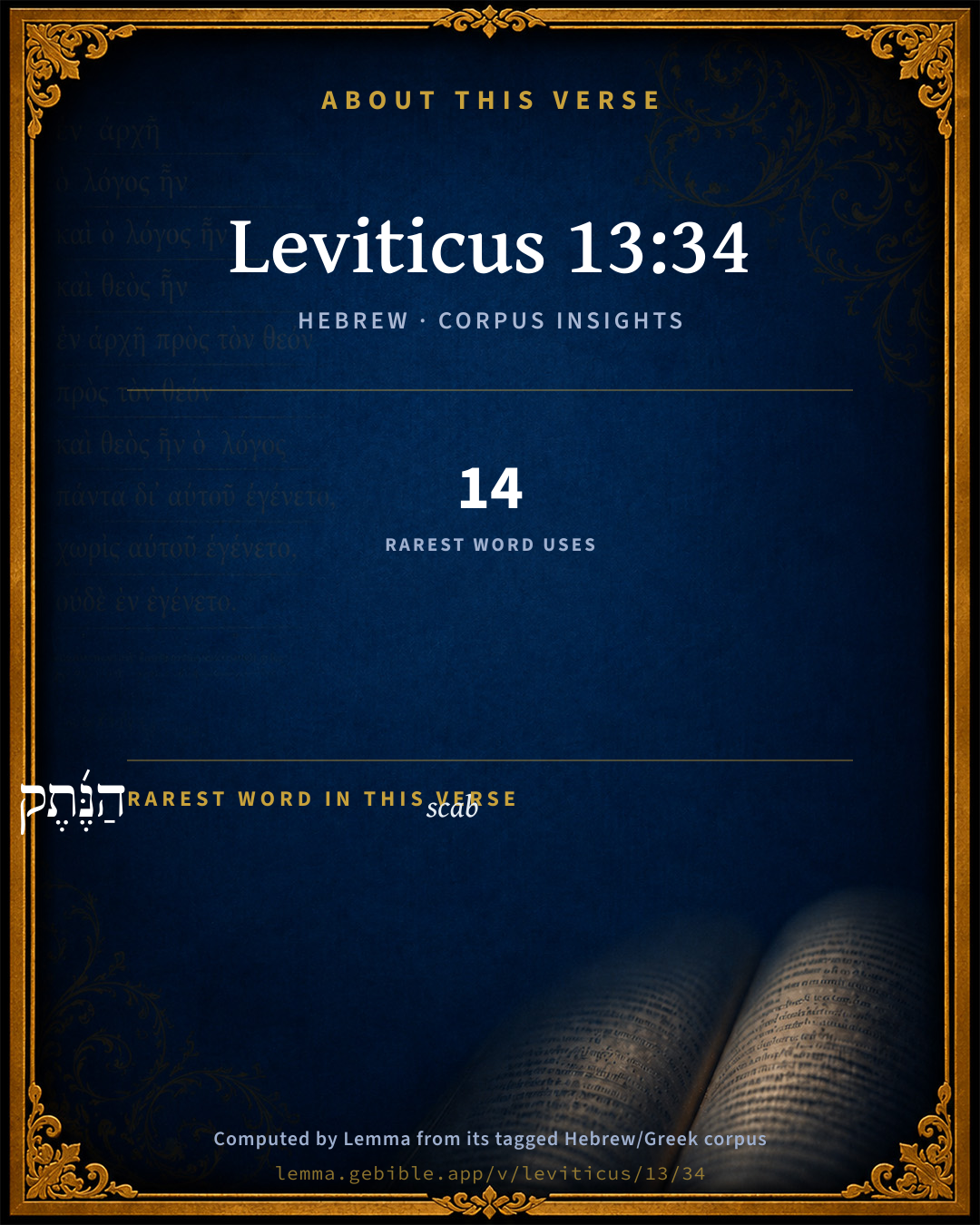
About this verse

These counts appear in no published source. They are computed here, from the morphology-tagged text and Lemma’s own curated glosses. What Lemma adds →

22
words
17
distinct lemmas
Pentateuch
section

Notable vocabulary

The rarest word here is הַנֶּ֜תֶק scab H5424 — appearing just 14 times in the whole Hebrew Bible.

Shared distinctive vocabulary

הַנֶּ֜תֶק scab H5424 occurs in 9 verses of the Hebrew Bible. Also found in:

Grammatical profile

  • 5 verbs
  • 9 nouns
  • 2 adjectives
  • 1 preposition
  • 5 particles

Verb forms

  • וְרָאָה֩ Qal · Sequential Perfect
  • פָשָׂ֤ה Qal · Perfect
  • וְטִהַ֤ר Piel · Sequential Perfect
  • וְכִבֶּ֥ס Piel · Sequential Perfect
  • וְטָהֵֽר Qal · Sequential Perfect

Repetition

Words recur within this verse — often emphatic in Hebrew:

  • הַכֹּהֵ֨ן priest H3548 ×2
  • הַנֶּ֜תֶק scab H5424 ×2
  • בָּע֔וֹר skin H5785 ×2
  • וְטִהַ֤ר to cleanse H2891 ×2

Hebrew & Septuagint length

In English translation the verse runs 43 words from the Hebrew and 55 from the Septuagint (LXX English) — closely comparable.

A rough comparison of the two English renderings, which tokenize alike — not a word-level alignment.

Word counts can differ between the Hebrew and the Greek without any difference in meaning — e.g. the Hebrew direct-object marker אֵת has no separate Greek word, and Greek often adds the article ὁ.

Cross-references

3

Topical passages linked to Leviticus 13:34 in the Treasury of Scripture Knowledge — connected by theme and wording, ordered by reader-vote popularity; previews shown in the World English Bible.

  • 1 John 4:1 Beloved, don't believe every spirit, but test the spirits, whether they are of God, because many false prophets have gone out into the world.
  • Jude 1:22 On some have compassion, making a distinction,
  • Revelation 2:2 "I know your works, and your toil and perseverance, and that you can't tolerate evil men, and have tested those who call themselves apostles, and they are not, and found them false.

Cross-references courtesy of OpenBible.info (CC BY 4.0).

Hebrew and Greek witnesses Masoretic Hebrew ↔ Greek Septuagint

The same verse in the two great witnesses to the Old Testament, shown verse-for-verse.

These are two independent witnesses, not word-aligned to each other, and the Septuagint is shown in lemma (dictionary) form.

Hebrew Leviticus 13:34 Masoretic · Westminster Leningrad Codex

וְרָאָה֩ הַכֹּהֵ֨ן אֶת הַנֶּ֜תֶק בַּיּ֣וֹם הַשְּׁבִיעִ֗י וְ֠הִנֵּה לֹא פָשָׂ֤ה הַנֶּ֨תֶק֙ בָּע֔וֹר וּמַרְאֵ֕הוּ אֵינֶ֥נּוּ עָמֹ֖ק מִן הָע֑וֹר וְטִהַ֤ר אֹתוֹ֙ הַכֹּהֵ֔ן וְכִבֶּ֥ס בְּגָדָ֖יו וְטָהֵֽר

On the seventh day, the priest shall examine the itch; and, behold, if the itch hasn't spread in the skin, and its appearance isn't deeper than the skin, then the priest shall pronounce him clean. He shall wash his clothes, and be clean.

World English Bible · Public Domain

Greek LXX Leviticus 13:34 Septuagint · lemma form

καί ὁράω ὁ ἱερεύς ὁ θραῦσμα ὁ ἡμέρα ὁ ἕβδομος καί ἰδού οὐ διαχέω ὁ θραῦσμα ἐν ὁ δέρμα μετά ὁ ξυράω αὐτός καί ὁ ὄψις ὁ θραῦσμα οὐ εἰμί κοῖλος ἀπό ὁ δέρμα καί καθαρίζω αὐτός ὁ ἱερεύς καί πλύνω ὁ ἱμάτιον καθαρός εἰμί

And the priest shall see the scurf on the seventh day; and, behold, if the scurf is not spread in the skin after the man's being shaved, and the appearance of the scurf is not hollow beneath the skin, then the priest shall pronounce him clean; and he shall wash his garments, and be clean.

LXX2012 (modern English Septuagint) · Public Domain

Hebrew: Westminster Leningrad Codex (CC BY 4.0). Greek: Septuagint (public domain); English from LXX2012 (modern English Septuagint) (Public Domain). How the Septuagint differs from the Hebrew →

Targum (Aramaic paraphrase)

2

The Targum is the ancient Jewish Aramaic paraphrase of the Hebrew Scriptures — an interpretive translation, not the Hebrew text itself. Onkelos (literal) and Pseudo-Jonathan (expansive) render the Torah, and Jonathan the Prophets. Coverage is partial: where no permissively-licensed English translation exists for a verse, only the Aramaic is shown. This is verse-level text, not a word-by-word alignment to the Hebrew.

  1. Targum Onkelos Torah (Genesis–Deuteronomy)
    וְיֶחֱזֵי כַהֲנָא יָת נִתְקָא בְּיוֹמָא שְׁבִיעָאָה וְהָא לָא אוֹסֵף נִתְקָא בְּמַשְׁכָּא וּמֶחֱזוֹהִי לֵיתוֹהִי עַמִיק מִן מַשְׁכָּא וִידַכֵּי יָתֵהּ כַּהֲנָא וִיצַבַּע לְבוּשׁוֹהִי וְיִדְכֵּי

    (no public-domain English translation for this verse)

    Targum Onkelos — Aramaic: “Onkelos Genesis” (public domain); “Onkelos Exodus” (public domain); “Onkelos Leviticus” (public domain); “Onkelos Numbers” (public domain); “Onkelos Deuteronomy” (public domain). English: “Sefaria Community Translation” (CC0 1.0 (public-domain dedication)); “J.W. Etheridge. The Targums of Onkelos and Jonathan Ben Uzziel on the Pentateuch. London: Longmans, Green, 1862” (public domain). Text via Sefaria.

  2. Targum Pseudo-Jonathan Torah (Genesis–Deuteronomy)
    וְיֶחֱמֵי כַּהֲנָא יַת נִיתְקָא בְּיוֹמָא שְׁבִיעָאָה וְהָא לָא הֲלִיךְ פִּסְיוֹן נִיתְקָא בְּמַשְׁכָא וְחֵיזְוֵי לֵיתוֹי עַמִיק לְמֶחְוַור יַתִּיר מִן מַשְׁכָא וְיִדְכֵּי יָתֵיהּ כַּהֲנָא וְיִצְבַּע לְבוּשׁוֹי וְיִדְכֵּי

    Then shall the priest look upon the scurf on the seventh day; and, behold, if the scar hath not gone on in breadth in the skin, and its appearance is not deeper nor becoming whiter than the skin, the priest shall make him to be clean; and he shall wash his clothes and be clean.

    Targum Pseudo-Jonathan — Aramaic: “Targum Jonathan on Genesis” (public domain); “Targum Jonathan on Exodus” (public domain); “Targum Jonathan on Leviticus” (public domain); “Targum Jonathan on Numbers” (public domain); “Targum Jonathan on Deuteronomy” (public domain). English: “The Targum of Jonathan ben Uzziel, trans. J. W. Etheridge, London, 1862” (public domain). Text via Sefaria.

Commentary

Notes on Leviticus 13:34 from classic Christian and Jewish commentators (each source and its license shown beneath its notes). The classic Christian expositions comment on the surrounding passage and are grouped to its opening verse, so a note may address several verses; the Jewish commentaries on the Tanakh (Rashi and others) are per-verse, so they appear only where the commentator wrote on this verse.

Lemma curates 59 commentaries, every one of them public domain or Creative Commons licensed, each selected and text-cleaned for this edition rather than reprinted as found. About our sources →

Trapp's Complete Commentary

John Trapp

Lev 13:34 And in the seventh day the priest shall look on the scall: and, behold, [if] the scall be not spread in the skin, nor [be] in sight deeper than the skin; then the priest shall pronounce him clean: and he shall wash his clothes, and be clean.

Ver. 34. He shall wash his clothes.] {See Trapp on "Lev 13:6"}

John Trapp, A Commentary or Exposition upon All the Books of the Old and New Testament (1647–1656) — public domain. Text from a community e-Sword module.

Ellicott's Commentary for English Readers

(34) And in the seventh day.—If at the expiration of the second week of quarantine the priest sees that none of the symptoms which generally indicate this distemper have appeared, he is to pronounce him clean, upon which, after performing the necessary ablutions, he is restored to the privileges of the sanctuary. (See Lev_13:6.)

Be in sight deeper than the skin.—Better, is in appearance deeper than the other skin.

A Bible Commentary for English Readers, edited by Charles John Ellicott (1878–1897) — public domain. Text from a community e-Sword module.

John Gill's Exposition

But if the scall spread much in his skin after cleansing. After he has been declared clean by the priest; for it was possible that it might spread after this, though so much precaution had been used, and so much time taken to observe it: with this compare Pe2 1:9.

.

Leviticus 13:36

lev 13:36

lev 13:36

lev 13:36Then the priest shall look on him,.... Again, and which is no less than the fourth time; for notwithstanding his being pronounced clean, he was still subject to the inspection of the priest, if any alteration appeared:

and, behold, if the scall be spread in the skin; which was a certain sign of a leprosy:

the priest shall not seek for yellow hair; or be solicitous about that, whether there is any or not, for either one or the other of these signs were sufficient to determine the case:

he is unclean; and so to be pronounced.

John Gill's Exposition of the Whole Bible (1746–1763) — public domain (CC PDM 1.0). Text via the HelloAO Bible API.

unfoldingWord translationNotes

Door43 World Missions Community

General Information:

Yahweh continues telling Moses and Aaron what the people must do when someone has a skin disease."

the disease

Here "the disease" refers to the disease on the person's head or chin.

the priest must pronounce him clean ... he will be clean

The man whom other people may touch is spoken of as if he were physically clean. (See: Metaphor)

translationWords

priest

clean

unfoldingWord translationNotes — © Distant Shores Media and the Door43 World Missions Community, licensed CC BY-SA 4.0. Source: git.door43.org/Door43/en_tn.

Lesson kit

Teaching starters — assembled from the data on this page, not authored interpretation. Every prompt links to the verse data it draws on. Edit before teaching.

Leviticus, in the Pentateuch, opens this verse with 22 words (17 distinct Hebrew lemmas). Its most distinctive word is netheq (“scab”). A historical commentator’s framing appears above. Read the whole chapter for the surrounding context.

Discussion questions

  1. The word netheq carries the sense “scab.” How does it shape the verse?
  2. How does Leviticus 13:30, which shares the word «scab», read alongside this verse?
  3. What does the repetition of “priest” (2× in this one verse) do in this verse?
  4. These translations render this verse differently. What is at stake in choosing one wording over another?
  5. «וְרָאָה֩» is a Qal Sequential Perfect verb. How does that grammatical form shape the action described?
  6. Compare how Trapp's Complete Commentary and Ellicott's Commentary for English Readers read this verse. Where do they agree or differ?

Things to notice

Reading settings

Reading text

Shown beneath each verse's original-language words.

Old Testament
Old Testament edition

Read the OT as the Masoretic Hebrew (MT) or the Greek Septuagint (LXX).

English shown for the Greek Septuagint (in the Hebrew ↔ Greek comparison).

Comparing translations? Open the Compare panel on any verse page to stack up to four side by side.