
Isaiah 41:11

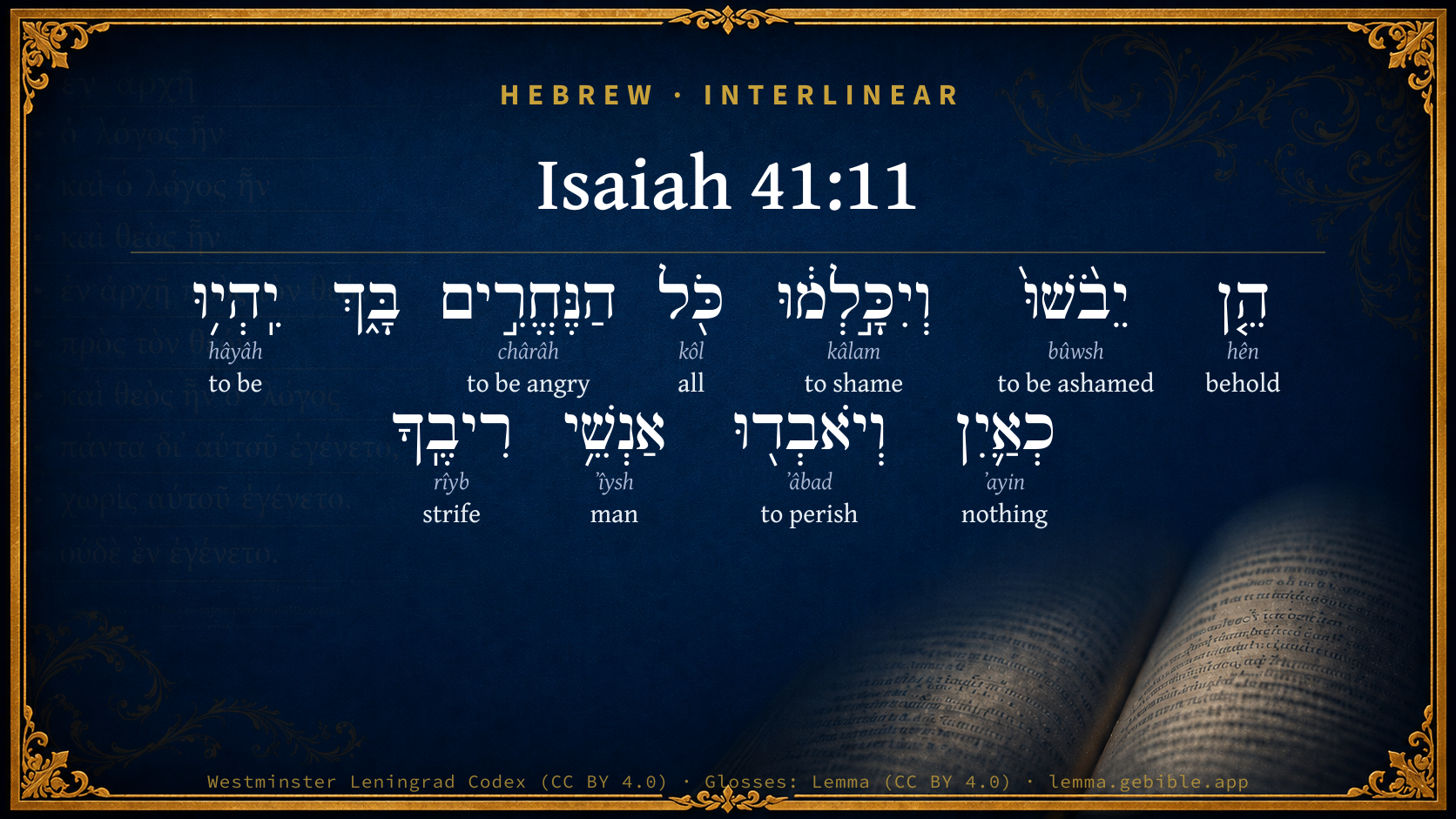
Hebrew (Westminster Leningrad Codex) Isaiah 41:11 appears in the Hebrew Old Testament. The text above is from the Westminster Leningrad Codex. Each word links to its Strong’s number, a concise gloss, and parsing drawn from the Open Scriptures Hebrew Bible morphology. Click any word for its full Brown-Driver-Briggs (BDB) entry.
Download image
Cite this verse

Isaiah 41:11 (World English Bible). Public Domain. Lemma interlinear Bible study tool, https://lemma.gebible.app/v/isaiah/41/11.

Show BibTeX & RIS
BibTeX
RIS
English Translation
Behold, all those who are incensed against you shall be disappointed and confounded: those who strive with you shall be as nothing, and shall perish.
World English Bible · Public Domain
Download a study sheet

One document with this verse’s original text, its word-by-word gloss line, the meaning frame, cross-references with their text, attributed commentary, and full source and license credits — printable, and it pastes into notes with its structure intact.

This verse Autodidact and up

Study sheet (.html) Plain text (.txt)

A passage Seminary Student

Up to 50 verses in one chapter. A passage sheet keeps up to 6 commentary sources and 12 cross-references per verse, in the order this page ranks them, and says so on the sheet whenever that leaves anything out. Ask for a single verse and you get the Autodidact verse sheet above.

Everything on this page stays free to read, with no account — the sheet is a download of what is already on screen, not access to it.

Want to remove ads? Support Godless Engineer
Compare translations 3

The same verse in 3 English versions, stacked beneath the original-language interlinear above. Click any original word for its lexicon entry.

Each is an independent rendering of the whole verse — the interlinear is not word-aligned to these translations.

Highlighted words mark where these versions differ — a whole-verse word diff, not a word-by-word alignment.

  • World English Bible Public Domain
    Behold, all those who are incensed against you shall be disappointed and confounded: those who strive with you shall be as nothing, and shall perish.
  • King James Version Public Domain
    Behold, all they that were incensed against thee shall be ashamed and confounded: they shall be as nothing; and they that strive with thee shall perish.
  • unfoldingWord Literal Text CC BY-SA 4.0
    Behold, they will have shame and be humiliated, all of the ones having been kindled against you. They will be like nought, and they will perish, the men of your contention.

unfoldingWord Literal Text — © unfoldingWord, licensed CC BY-SA 4.0. Word-aligned USFM3 via Door43 (git.door43.org/unfoldingWord/en_ult).

Versions to compare (up to 4)

3 of 4 selected

Show all 18 translations

Every available English version of this verse, each an independent rendering of the whole verse.

  • World English Bible Public Domain
    Behold, all those who are incensed against you shall be disappointed and confounded: those who strive with you shall be as nothing, and shall perish.
  • Berean Standard Bible Public Domain
    Behold, all who rage against you will be ashamed and disgraced; those who contend with you will be reduced to nothing and will perish.
  • Majority Standard Bible Public Domain
    Behold, all who rage against you will be ashamed and disgraced; those who contend with you will be reduced to nothing and will perish.
  • King James Version Public Domain
    Behold, all they that were incensed against thee shall be ashamed and confounded: they shall be as nothing; and they that strive with thee shall perish.
  • American Standard Version (1901) Public Domain
    Behold, all they that are incensed against thee shall be put to shame and confounded: they that strive with thee shall be as nothing, and shall perish.
  • Revised Version (1885) Public Domain
    Behold, all they that are incensed against thee shall be ashamed and confounded: they that strive with thee shall be as nothing, and shall perish.
  • Geneva Bible (1599) Public Domain
    Beholde, all they that prouoke thee, shalbe ashamed, and confounded: they shalbe as nothing, and they that striue with thee, shall perish.
  • Douay-Rheims (1899) Public Domain
    Behold all that fight against thee shall be confounded and ashamed, they shall be as nothing, and the men shall perish that strive against thee.
  • Young's Literal Translation Public Domain
    Lo, all those displeased with thee, They are ashamed and blush, They are as nothing, yea, perish Do the men who strive with thee.
  • Literal Standard Version CC BY-SA 4.0
    Behold, all those displeased with you, || They are ashamed and blush, || They are as nothing, indeed, || The men who strive with you perish.
  • Unlocked Literal Bible CC BY-SA 4.0
    See, they will be ashamed and disgraced, all who have been angry with you; they will be as nothing and will perish, those who oppose you.
  • unfoldingWord Literal Text CC BY-SA 4.0
    Behold, they will have shame and be humiliated, all of the ones having been kindled against you. They will be like nought, and they will perish, the men of your contention.
  • Darby Bible Public Domain
    Lo, all that are incensed against thee shall be ashamed and confounded; they that strive with thee shall be as nothing, and shall perish.
  • World Messianic Bible Public Domain
    Behold, all those who are incensed against you will be disappointed and confounded. Those who strive with you will be like nothing, and shall perish.
  • Webster's Bible Public Domain
    Behold, all they that were incensed against thee shall be ashamed and confounded: they shall be as nothing; and they that contend with thee shall perish.
  • Free Bible Version CC BY-SA 4.0
    See—everyone who is angry with you will be ashamed and disgraced. Those who fight against you will end up as nothing and die.
  • Bible in Basic English Public Domain
    Truly, all those who are angry with you will be made low and put to shame: those desiring to do you wrong will come to nothing and never again be seen.
  • JPS Tanakh (1917) Public Domain
    Behold, all they that were incensed against thee shall be ashamed and confounded; they that strove with thee shall be as nothing, and shall perish.

Literal Standard Version (2020), Covenant Press — licensed CC BY-SA 4.0. Text via the HelloAO Bible API (eBible.org). Unlocked Literal Bible (unfoldingWord) — licensed CC BY-SA 4.0. Text via the HelloAO Bible API (eBible.org). unfoldingWord Literal Text — © unfoldingWord, licensed CC BY-SA 4.0. Word-aligned USFM3 via Door43 (git.door43.org/unfoldingWord/en_ult). Free Bible Version, Dr. Jonathan Gallagher — licensed CC BY-SA 4.0. Text via the HelloAO Bible API (eBible.org).

Word by word

More ways to search: Search by grammar → Find every occurrence → Compare this word →

Practice this passage: Drill this verse → Learn its vocabulary →

וְיִכָּ֣לְמ֔וּ
kâlam
H3637
“and · to shame”
Conjunction + Verb, Niphal, Imperfect, 3rd Person, Masculine, Plural
Part of Speech
Conjunction + Verb
Stem
Niphal
Form
Imperfect
Person
3rd Person
Gender
Masculine
Number
Plural
Full BDB Definition

Origin: a primitive root

TWOT: 987

to insult, shame, humiliate, blush, be ashamed, be put to shame, be reproached, be put to confusion, be humiliated - (Niphal) - to be humiliated, be ashamed - to be put to shame, be dishonoured, be confounded - (Hiphil) - to put to shame, insult, humiliate, cause shame to - to exhibit shame - (Hophal) - to be insulted, be humiliated - to be put to shame, be dishonoured, be confounded
  1. הֵ֤ן hên H2005 “behold” Particle, Demonstrative
  2. יֵבֹ֨שׁוּ֙ bûwsh H954 “to be ashamed” Verb, Qal, Imperfect, 3rd Person, Masculine, Plural
  3. כֹּ֖ל kôl H3605 “all of” Noun, Common, Masculine, Singular, Construct
  4. הַנֶּחֱרִ֣ים chârâh H2734 “the · being angry” Particle, Definite Article + Verb, Niphal, Participle Active, Masculine, Plural, Absolute
  5. יִֽהְי֥וּ hâyâh H1961 “to be” Verb, Qal, Imperfect, 3rd Person, Masculine, Plural
  6. כְאַ֛יִן ʼayin H369 “like/as · nothing” Preposition + Noun, Common, Masculine, Singular, Absolute
  7. וְיֹאבְד֖וּ ʼâbad H6 “and · to perish” Conjunction + Verb, Qal, Imperfect, 3rd Person, Masculine, Plural
  8. אַנְשֵׁ֥י ʼîysh H376 “men of” Noun, Common, Masculine, Plural, Construct
  9. רִיבֶֽךָ rîyb H7379 “strife · your” Noun, Common, Both, Singular, Construct + Suffix, Personal, 2nd Person, Masculine, Singular

About this verse

These counts appear in no published source. They are computed here, from the morphology-tagged text and Lemma’s own curated glosses. What Lemma adds →

11
words
10
distinct lemmas
Prophets
section

Shared distinctive vocabulary

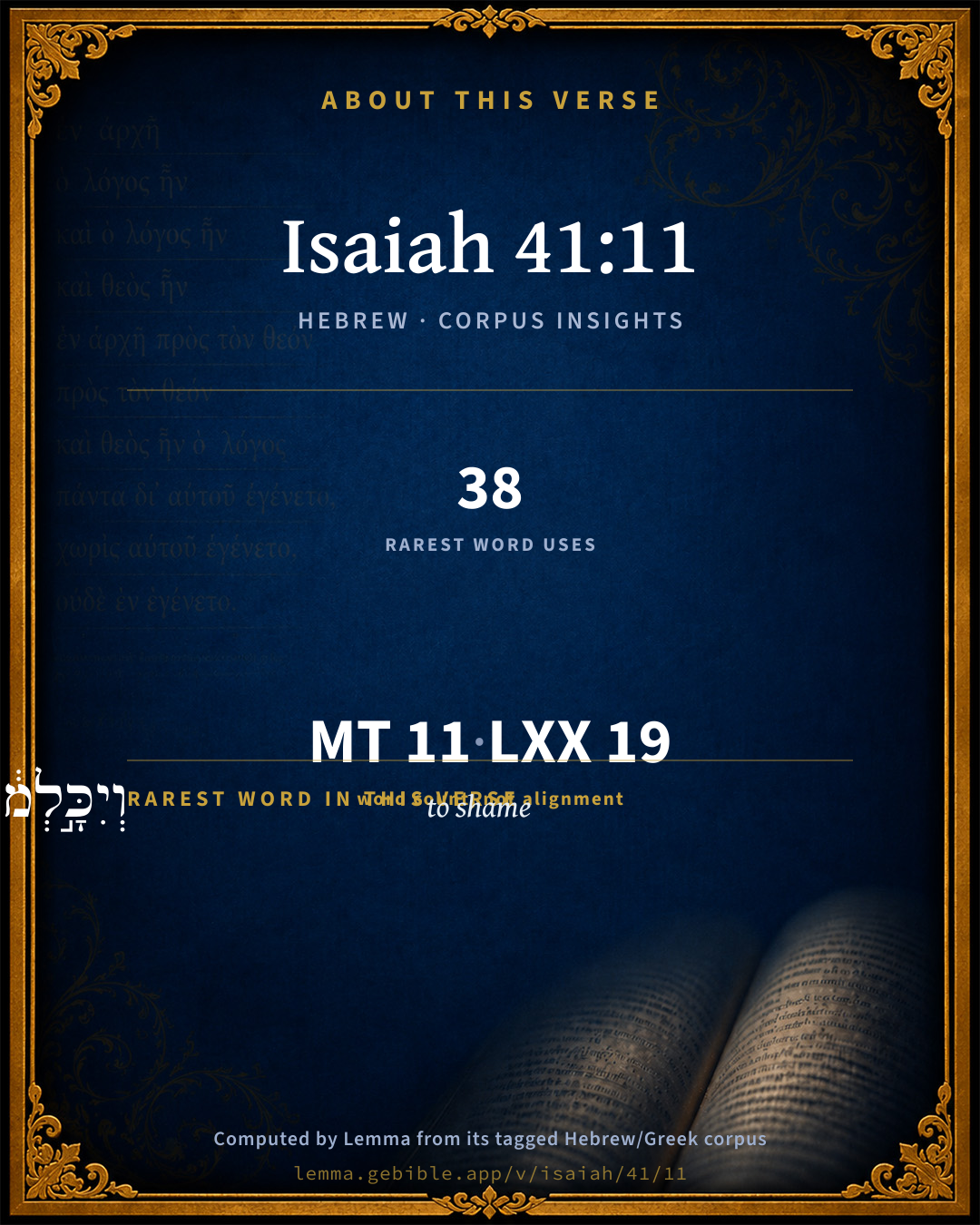
וְיִכָּ֣לְמ֔וּ to shame H3637 occurs in 38 verses of the Hebrew Bible. Also found in:

Grammatical profile

  • 5 verbs
  • 4 nouns
  • 1 preposition
  • 1 particle

Verb forms

  • יֵבֹ֨שׁוּ֙ Qal · Imperfect
  • וְיִכָּ֣לְמ֔וּ Niphal · Imperfect
  • הַנֶּחֱרִ֣ים Niphal · Participle Active
  • יִֽהְי֥וּ Qal · Imperfect
  • וְיֹאבְד֖וּ Qal · Imperfect

Hebrew & Septuagint length

In English translation the verse runs 25 words from the Hebrew and 24 from the Septuagint (LXX English) — closely comparable.

A rough comparison of the two English renderings, which tokenize alike — not a word-level alignment.

Word counts can differ between the Hebrew and the Greek without any difference in meaning — e.g. the Hebrew direct-object marker אֵת has no separate Greek word, and Greek often adds the article ὁ.

In the original languages it is 11 Hebrew tokens and 19 Greek tokens — but the two are counted differently (Hebrew bundles its prefixes and suffixes into one token; the Greek is in lemma form), so that isn’t a like-for-like length.

Cross-references

15

Topical passages linked to Isaiah 41:11 in the Treasury of Scripture Knowledge — connected by theme and wording, ordered by reader-vote popularity; previews shown in the World English Bible.

  • Exodus 23:22 But if you indeed listen to his voice, and do all that I speak, then I will be an enemy to your enemies, and an adversary to your adversaries.
  • Isaiah 45:24 Only in Yahweh, it is said of me, is righteousness and strength; even to him shall men come; and all those who were incensed against him shall be disappointed.
  • Revelation 3:9 Behold, I give of the synagogue of Satan, of those who say they are Jews, and they are not, but lie. Behold, I will make them to come and worship before your feet, and to know that I have loved you.
  • Isaiah 54:17 No weapon that is formed against you shall prosper; and every tongue that shall rise against you in judgment you shall condemn. This is the heritage of the servants of Yahweh, and their righteousness which is of me, says Yahweh.
  • Acts 16:39 and they came and begged them. When they had brought them out, they asked them to depart from the city.
  • Acts 13:8–11 But Elymas the sorcerer (for so is his name by interpretation) withstood them, seeking to turn aside the proconsul from the faith.
  • Exodus 11:8 All these your servants shall come down to me, and bow down themselves to me, saying, 'Get out, and all the people who follow you; and after that I will go out.'" He went out from Pharaoh in hot anger.
  • Isaiah 49:26 I will feed those who oppress you with their own flesh; and they shall be drunken with their own blood, as with sweet wine: and all flesh shall know that I, Yahweh, am your Savior, and your Redeemer, the Mighty One of Jacob.
  • Daniel 4:35 All the inhabitants of the earth are reputed as nothing; and he does according to his will in the army of heaven, and among the inhabitants of the earth; and none can stay his hand, or tell him, What do you?
  • Isaiah 29:8 It shall be as when a hungry man dreams, and, behold, he eats; but he awakes, and his soul is empty: or as when a thirsty man dreams, and, behold, he drinks; but he awakes, and, behold, he is faint, and his soul has appetite: so shall the multitude of all the nations be, that fight against Mount Zion.
  • Isaiah 41:29 Behold, all of them, their works are vanity [and] nothing; their molten images are wind and confusion.
  • Isaiah 60:12–14 For that nation and kingdom that will not serve you shall perish; yes, those nations shall be utterly wasted.
  • Zechariah 12:3 It will happen in that day, that I will make Jerusalem a burdensome stone for all the peoples. All who burden themselves with it will be severely wounded, and all the nations of the earth will be gathered together against it.
  • Isaiah 40:17 All the nations are as nothing before him; they are accounted by him as less than nothing, and vanity.
  • Isaiah 41:24 Behold, you are of nothing, and your work is of nothing; an abomination is he who chooses you.

Cross-references courtesy of OpenBible.info (CC BY 4.0).

Hebrew and Greek witnesses Masoretic Hebrew ↔ Greek Septuagint

The same verse in the two great witnesses to the Old Testament, shown verse-for-verse.

These are two independent witnesses, not word-aligned to each other, and the Septuagint is shown in lemma (dictionary) form.

Hebrew Isaiah 41:11 Masoretic · Westminster Leningrad Codex

הֵ֤ן יֵבֹ֨שׁוּ֙ וְיִכָּ֣לְמ֔וּ כֹּ֖ל הַנֶּחֱרִ֣ים בָּ֑ךְ יִֽהְי֥וּ כְאַ֛יִן וְיֹאבְד֖וּ אַנְשֵׁ֥י רִיבֶֽךָ

Behold, all those who are incensed against you shall be disappointed and confounded: those who strive with you shall be as nothing, and shall perish.

World English Bible · Public Domain

Greek LXX Isaiah 41:11 Septuagint · lemma form

ἰδού αἰσχύνω καί ἐντρέπω πᾶς ὁ ἀντικεῖμαι σύ εἰμί γάρ ὡς οὐ εἰμί καί ἀποὀλλύω πᾶς ὁ ἀντίδικος σύ

Behold, all your adversaries shall be ashamed and confounded; for they shall be as if they were not: and all your opponents shall perish.

LXX2012 (modern English Septuagint) · Public Domain

Hebrew: Westminster Leningrad Codex (CC BY 4.0). Greek: Septuagint (public domain); English from LXX2012 (modern English Septuagint) (Public Domain). How the Septuagint differs from the Hebrew →

Targum (Aramaic paraphrase)

1

The Targum is the ancient Jewish Aramaic paraphrase of the Hebrew Scriptures — an interpretive translation, not the Hebrew text itself. Onkelos (literal) and Pseudo-Jonathan (expansive) render the Torah, and Jonathan the Prophets. Coverage is partial: where no permissively-licensed English translation exists for a verse, only the Aramaic is shown. This is verse-level text, not a word-by-word alignment to the Hebrew.

  1. Targum Jonathan Prophets (Joshua–Malachi)
    הָא יִבָּהֲתוּן וְיִתְכַּנְעוּן כָּל עַמְמַיָא דַהֲווֹ מִתְגָרִין בָּךְ יְהוֹן כִּלְמָא וְיֵבְדוּן אֱנָשֵׁי דִינָךְ:

    Behold, all the nations that are incensed against thee shall be ashamed and confounded: they shall be as nothing; and they that strive with thee shall perish.

    Targum Jonathan — Aramaic: “Mikraot Gedolot” (public domain). English: “Sefaria Community Translation” (CC0 1.0 (public-domain dedication)); “London "Chaldee Paraphrase," 1871” (public domain). Text via Sefaria.

Commentary

Notes on Isaiah 41:11 from classic Christian and Jewish commentators (each source and its license shown beneath its notes). The classic Christian expositions comment on the surrounding passage and are grouped to its opening verse, so a note may address several verses; the Jewish commentaries on the Tanakh (Rashi and others) are per-verse, so they appear only where the commentator wrote on this verse.

Lemma curates 59 commentaries, every one of them public domain or Creative Commons licensed, each selected and text-cleaned for this edition rather than reprinted as found. About our sources →

The Cambridge Bible for Schools and Colleges

gen. ed. J. J. S. Perowne

11–13. Humanly speaking Israel has cause for fear, being surrounded by opponents; but they shall be put to utter confusion.

11f. incensed] lit. “inflamed,” as in ch. Isa_45:24; Son_1:6. The precise form occurs only in these passages.

they that strive … them that contend … they that war] Lit. men of thy contention … strife … warfare; a climax which Delitzsch renders by adversarii, inimici, hostes. These expressions are emphatic and stand at the end of their respective clauses, and to each are attached two (logical) predicates; hence in Isa_41:11 we should read (as R.V. nearly): they shall be as nothing, and shall perish—the men etc.

thou shalt seek and not find them that &c.] Cf. ch. Isa_33:18.

The Cambridge Bible for Schools and Colleges (gen. ed. J. J. S. Perowne; Cambridge University Press, 1878–1918) — public domain. Text from a community e-Sword module.

Trapp's Complete Commentary

John Trapp

Isa 41:11 Behold, all they that were incensed against thee shall be ashamed and confounded: they shall be as nothing; and they that strive with thee shall perish.

Ver. 11. Behold, all that were incensed against thee.] These and the following precious promises the Jews misapply to the coming and kingdom of their Messiah, the Papists to their hierarchy. Let every true servant of God take them home as spoken to himself; every promise droppeth myrrh and mercy.

John Trapp, A Commentary or Exposition upon All the Books of the Old and New Testament (1647–1656) — public domain. Text from a community e-Sword module.

Jamieson, Fausset & Brown

Robert Jamieson, A. R. Fausset & David Brown

ashamed--put to the shame of defeat (compare Isa 54:17; Rom 9:33).

Jamieson, Fausset & Brown — Commentary Critical and Explanatory on the Whole Bible (1871) — public domain (CC PDM 1.0). Text via the HelloAO Bible API.

Ellicott's Commentary for English Readers

(11, 12) Behold . . .—The choice of the Servant has, as its complement, the indignation of Jehovah against those who attack him, and this thought is emphasised by a four-fold iteration. “They that strive with thee, &c,” represents the Hebrew idiom, the men of thy conflict, which stands emphatically at the end of each clause.

A Bible Commentary for English Readers, edited by Charles John Ellicott (1878–1897) — public domain. Text from a community e-Sword module.

John Gill's Exposition

Behold, all they that were incensed against thee,.... For rejecting their idols, and idol worship; for receiving the Gospel, and professing it:

shall be ashamed and confounded; their idols not being able to help them, nor they to defend the worship of them: the same is said with respect to Christ, Isa 45:24,

they shall be as nothing, and they that strive with thee shall perish; or, "the men of thy strife" (o); all shall come to nothing, and utterly perish, as to their persons, substance, power, and dignity; as did the Roman emperors, the persecutors of God's people.

(o) "viri litis tuae", Montanus; "rixae tuae", Vatablus.

John Gill's Exposition of the Whole Bible (1746–1763) — public domain (CC PDM 1.0). Text via the HelloAO Bible API.

Albert Barnes' Notes on the Bible

All they that were incensed against thee - They who were enraged against thee, that is, the Chaldeans who made war upon you, and reduced you to bondage.

Shall be ashamed and confounded - To be ashamed and confounded is often used as synonymous with being overcome and destroyed.

They that strive with thee - Margin, as Hebrew, ‘The men of thy strife.’ The expression refers to their enemies, the Babylonians.

Albert Barnes' Notes on the Bible (1834–1885) — public domain. Text from a community e-Sword/MySword module.

Matthew Poole's English Annotations

Shall be ashamed and confounded, both because their hopes and designs shall be utterly disappointed, and because the mischief which they contrived against thee shall fall upon themselves.

Shall be as nothing; shall come to nothing, or perish, as the next clause explains it.

Matthew Poole's English Annotations on the Holy Bible (1683–1685) — public domain. Text from a community e-Sword/MySword module.

Whedon's Commentary on the Bible

Daniel D. Whedon

11. The tables shall turn. Israel’s persecutors hitherto shall come to mortification, and, like their idols, to nothingness. The usual conversive Hebrew past tenses here contemplate things yet future as already past.

Daniel D. Whedon (gen. ed.), Commentary on the Old and New Testaments (1874–1909) — public domain. Text from a community e-Sword module.

The Pulpit Commentary

Vers. 11, 12. As Israel would grow strong through God"s help, so her enemies would grow weak through God"s disfavour. That enemies of all kinds may be seen to be included, the designation is four times varied that are angry with thee;" "that are at strife with thee;" "that are in conflict with thee;" "that are at war with thee." The order is one of climax. Similarly, with each augmentation of the hostility there is an augmentation of the sentence of punishment be covered with shame;" "shall perish;" "shall not be found;" "shall become as nothingness."

The Pulpit Commentary (1880–1919), ed. H.D.M. Spence-Jones & Joseph S. Exell — public domain. Text from a community e-Sword module.

John Wesley's Explanatory Notes

Confounded - Because the mischief which they contrived against thee shall fall upon themselves.

John Wesley, Explanatory Notes Upon the Whole Bible (1754–1765) — public domain. Text via the GEBible commentary corpus.

Keil & Delitzsch

C. F. Keil & F. Delitzsch

With the exclamation hēn (behold) the eyes of Israel are now directed to the saving interposition of Jehovah in the immediate future. "Behold, all they that were incensed against thee must be ashamed and confounded; the men of thy conflict become as nothing, and perish. Thou wilt seek them, and not find them, the men of thy feuds; the men of thy warfare become as nothing, and nonentity. For I, Jehovah thy God, lay hold of thy right hand, He who saith to thee, Fear not; I will help thee." The comprehensive expression omnes inflammati in te (niphal, as in Isa 45:24) stands at the head; and then, in order that every kind may be included, the enemies are called by a different name every time. The three substantives bear much the same relation to one another as lis, rixa, bellum (milchâmâh, lit., throng = war-tumult, like the epic κλόνος), hence adversarii, inimici, hostes. The suffixes have the force of objective genitives. We have founded our translation upon the reading מצּוּתיך. The three names of the enemies are placed emphatically at the close of the sentences, and these are long drawn out, whilst the indignation gives vent to itself; whereas in Isa 41:13 there follows nothing but short sentences, in which the persecuted church is encouraged and affectionately embraced. Two clauses, which are made to rhyme with ēm, announce the utter destruction of their foes; then the inflective rhyme ekha is repeated five times; and the sixth time it passes over into ı̄kha.

Keil & Delitzsch — Biblical Commentary on the Old Testament (1861–1891) — public domain (CC PDM 1.0). Text via the HelloAO Bible API. (Old Testament only.)

J. A. Alexander on Isaiah

Joseph Addison Alexander

“Lo, ashamed and confounded shall be all those incensed (or inflamed) against thee; they shall be as nothing (or as though they were not), and destroyed shall be thy men of strife (or they that strive with thee).” Not only shall Israel himself escape, but his enemies shall perish. To be ashamed and confounded, here as usual, includes the frustration of their plans and disappointment of their hopes. On the meaning of ‘as nothing’, see above, on 40.17. The construction of the phrase ‘thy men of strife’ is the same as that of ‘my right hand of righteousness’ in v. 10.

Joseph Addison Alexander, The Prophecies of Isaiah (1846–1847; New York: Scribner, 1870–1878) — public domain. Text from a community e-Sword module.

unfoldingWord translationNotes

Door43 World Missions Community

General Information:

Yahweh continues speaking to the people of Israel.

they will be ashamed and disgraced, all who have been angry with you

"all who have been angry with you will be ashamed and disgraced"

ashamed and disgraced

These two words mean basically the same thing and emphasize the greatness of their shame. (See: Doublet)

they will be as nothing and will perish, those who oppose you

"those who oppose you will be as nothing and will perish"

translationWords

shame

anger

perish

unfoldingWord translationNotes — © Distant Shores Media and the Door43 World Missions Community, licensed CC BY-SA 4.0. Source: git.door43.org/Door43/en_tn.

Ibn Ezra

Rabbi Abraham ibn Ezra

הנחרים They that were incensed. It is the Niphal; Comp. חרי lit. the burning; נחרו were angry (Song 1:6). The Babylonians are meant; when God punished and destroyed Babylon, He released His people, who returned home to their country with the permission of Cyrus.

Ibn Ezra on the Tanakh — English translations: “Sefaria Community Translation” (CC0 1.0 (public-domain dedication)); “Yalkut, Sifsei Chachomim Chumash, Metsudah Publications, 2009” (CC BY 4.0); and “Commentary of Ibn Ezra on Isaiah - trans. by M. Friedlander, 1873” (public domain). Text via Sefaria.

Lesson kit

Teaching starters — assembled from the data on this page, not authored interpretation. Every prompt links to the verse data it draws on. Edit before teaching.

Isaiah, in the Prophets, opens this verse with 11 words (10 distinct Hebrew lemmas). Its most distinctive word is kâlam (“to shame”). A historical commentator’s framing appears above. Read the whole chapter for the surrounding context.

Discussion questions

  1. How does “to shame” (kâlam) shape what this verse is saying?
  2. Numbers 12:14 shares the word «to shame» with this verse. How do the two illuminate each other?
  3. These translations render this verse differently; the difference is in the English rendering, not the original. What questions does that raise?
  4. The verb «יֵבֹ֨שׁוּ֙» is Qal Imperfect. How does its form color the action?
  5. Reading how The Cambridge Bible for Schools and Colleges and Trapp's Complete Commentary read this verse, where do the two commentators agree and where do they part?

Things to notice

Reading settings

Reading text

Shown beneath each verse's original-language words.

Old Testament
Old Testament edition

Read the OT as the Masoretic Hebrew (MT) or the Greek Septuagint (LXX).

English shown for the Greek Septuagint (in the Hebrew ↔ Greek comparison).

Comparing translations? Open the Compare panel on any verse page to stack up to four side by side.