
Genesis 37:29

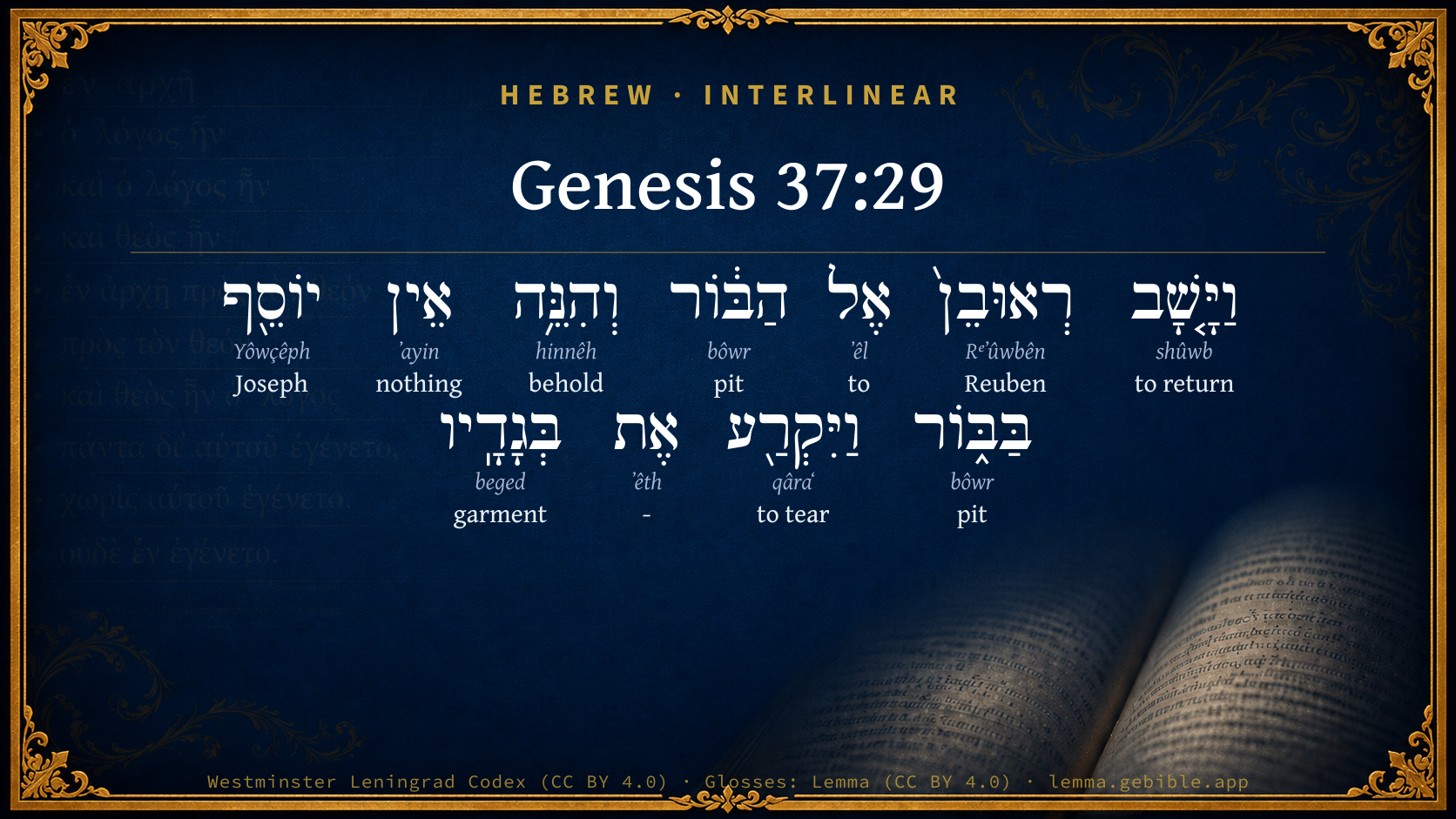
Hebrew (Westminster Leningrad Codex) Genesis 37:29 appears in the Hebrew Old Testament. The text above is from the Westminster Leningrad Codex. Each word links to its Strong’s number, a concise gloss, and parsing drawn from the Open Scriptures Hebrew Bible morphology. Click any word for its full Brown-Driver-Briggs (BDB) entry.
Download image
Cite this verse

Genesis 37:29 (World English Bible). Public Domain. Lemma interlinear Bible study tool, https://lemma.gebible.app/v/genesis/37/29.

Show BibTeX & RIS
BibTeX
RIS
English Translation
Reuben returned to the pit; and saw that Joseph wasn't in the pit; and he tore his clothes.
World English Bible · Public Domain
Highlights
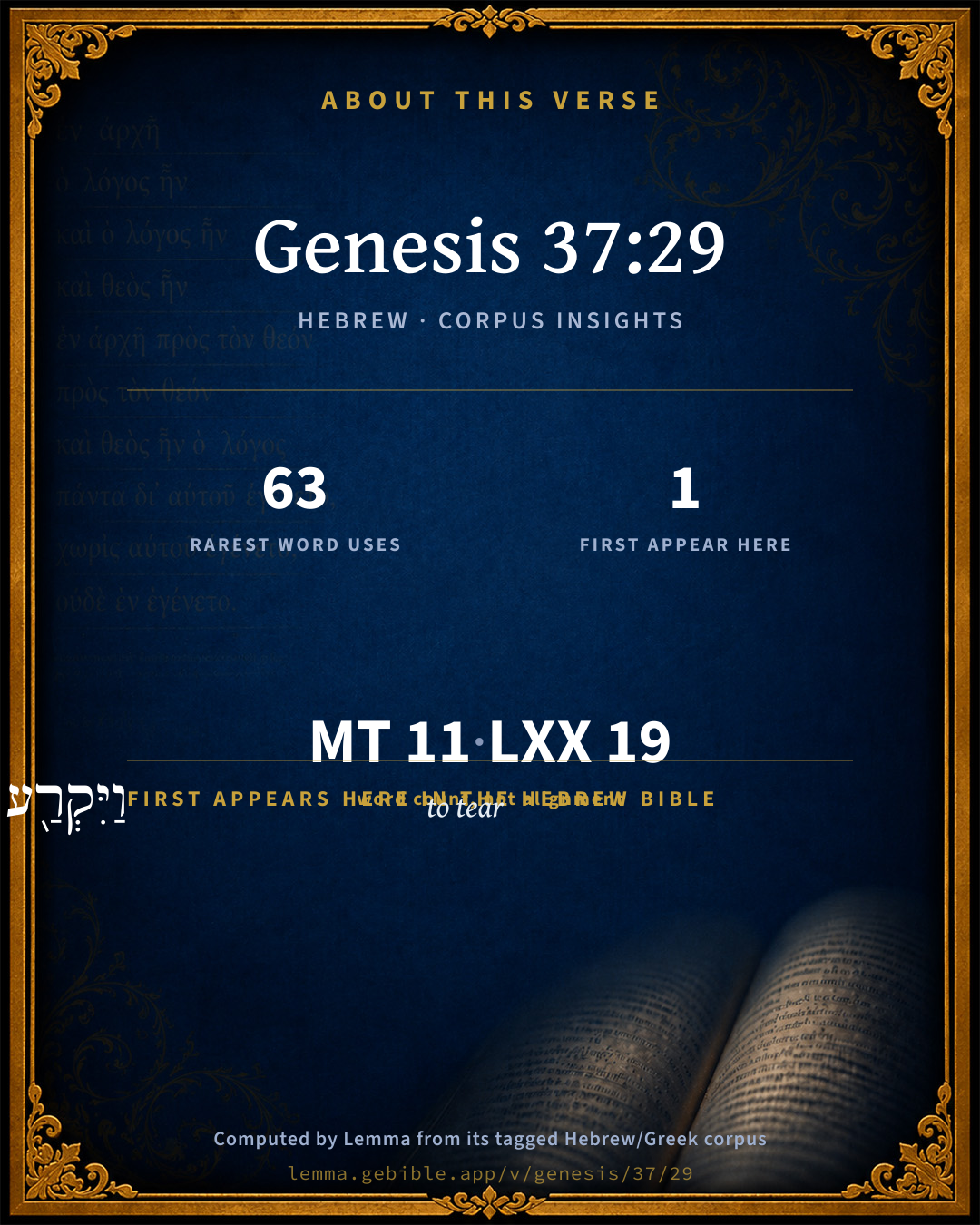
  • 1 first appearance in the Hebrew Bible
Full analysis ↓
Download a study sheet

One document with this verse’s original text, its word-by-word gloss line, the meaning frame, cross-references with their text, attributed commentary, and full source and license credits — printable, and it pastes into notes with its structure intact.

This verse Autodidact and up

Study sheet (.html) Plain text (.txt)

A passage Seminary Student

Up to 50 verses in one chapter. A passage sheet keeps up to 6 commentary sources and 12 cross-references per verse, in the order this page ranks them, and says so on the sheet whenever that leaves anything out. Ask for a single verse and you get the Autodidact verse sheet above.

Everything on this page stays free to read, with no account — the sheet is a download of what is already on screen, not access to it.

Want to remove ads? Support Godless Engineer
Compare translations 3

The same verse in 3 English versions, stacked beneath the original-language interlinear above. Click any original word for its lexicon entry.

Each is an independent rendering of the whole verse — the interlinear is not word-aligned to these translations.

Highlighted words mark where these versions differ — a whole-verse word diff, not a word-by-word alignment.

  • World English Bible Public Domain
    Reuben returned to the pit; and saw that Joseph wasn't in the pit; and he tore his clothes.
  • King James Version Public Domain
    And Reuben returned unto the pit; and, behold, Joseph was not in the pit; and he rent his clothes.
  • unfoldingWord Literal Text CC BY-SA 4.0
    Then Reuben returned to the cistern, but behold, Joseph was not in the cistern, so he tore his clothes.

unfoldingWord Literal Text — © unfoldingWord, licensed CC BY-SA 4.0. Word-aligned USFM3 via Door43 (git.door43.org/unfoldingWord/en_ult).

Versions to compare (up to 4)

3 of 4 selected

Show all 18 translations

Every available English version of this verse, each an independent rendering of the whole verse.

  • World English Bible Public Domain
    Reuben returned to the pit; and saw that Joseph wasn't in the pit; and he tore his clothes.
  • Berean Standard Bible Public Domain
    When Reuben returned to the pit and saw that Joseph was not there, he tore his clothes,
  • Majority Standard Bible Public Domain
    When Reuben returned to the pit and saw that Joseph was not there, he tore his clothes,
  • King James Version Public Domain
    And Reuben returned unto the pit; and, behold, Joseph was not in the pit; and he rent his clothes.
  • American Standard Version (1901) Public Domain
    And Reuben returned unto the pit; and, behold, Joseph was not in the pit; and he rent his clothes.
  • Revised Version (1885) Public Domain
    And Reuben returned unto the pit; and, behold, Joseph was not in the pit; and he rent his clothes.
  • Geneva Bible (1599) Public Domain
    Afterwarde Reuben returned to the pit, and beholde, Ioseph was not in the pit: then he rent his clothes,
  • Douay-Rheims (1899) Public Domain
    And Ruben, returning to the pit, found not the boy:
  • Young's Literal Translation Public Domain
    And Reuben returneth unto the pit, and lo, Joseph is not in the pit, and he rendeth his garments,
  • Literal Standard Version CC BY-SA 4.0
    And Reuben returns to the pit, and behold, Joseph is not in the pit, and he tears his garments,
  • Unlocked Literal Bible CC BY-SA 4.0
    Reuben returned to the pit, and, behold, Joseph was not in the pit. He tore his clothes.
  • unfoldingWord Literal Text CC BY-SA 4.0
    Then Reuben returned to the cistern, but behold, Joseph was not in the cistern, so he tore his clothes.
  • Darby Bible Public Domain
    And Reuben returned to the pit, and behold, Joseph [was] not in the pit; and he rent his garments,
  • World Messianic Bible Public Domain
    Reuben returned to the pit, and saw that Joseph wasn’t in the pit; and he tore his clothes.
  • Webster's Bible Public Domain
    And Reuben returned to the pit; and behold, Joseph was not in the pit: and he rent his clothes.
  • Free Bible Version CC BY-SA 4.0
    When Reuben came back later and looked into the pit, Joseph was gone. He tore his clothes in grief.
  • Bible in Basic English Public Domain
    Now when Reuben came back to the hole, Joseph was not there; and giving signs of grief,
  • JPS Tanakh (1917) Public Domain
    And Reuben returned unto the pit; and, behold, Joseph was not in the pit; and he rent his clothes.

Literal Standard Version (2020), Covenant Press — licensed CC BY-SA 4.0. Text via the HelloAO Bible API (eBible.org). Unlocked Literal Bible (unfoldingWord) — licensed CC BY-SA 4.0. Text via the HelloAO Bible API (eBible.org). unfoldingWord Literal Text — © unfoldingWord, licensed CC BY-SA 4.0. Word-aligned USFM3 via Door43 (git.door43.org/unfoldingWord/en_ult). Free Bible Version, Dr. Jonathan Gallagher — licensed CC BY-SA 4.0. Text via the HelloAO Bible API (eBible.org).

Word by word

More ways to search: Search by grammar → Find every occurrence → Compare this word →

Practice this passage: Drill this verse → Learn its vocabulary →

וַיִּקְרַ֖ע
qâraʻ
H7167
“and · to tear”
Conjunction + Verb, Qal, Sequential Imperfect, 3rd Person, Masculine, Singular
Part of Speech
Conjunction + Verb
Stem
Qal
Form
Sequential Imperfect
Person
3rd Person
Gender
Masculine
Number
Singular
Full BDB Definition

Origin: a primitive root

TWOT: 2074

to tear, tear in pieces - (Qal) - to tear, rend - to tear away or out - to tear, rend asunder - to make wide or large (of eyes) - to rend open (of heavens) - to tear, rend (of wild beasts) - (Niphal) to be rent, be split asunder
  1. וַיָּ֤שָׁב shûwb H7725 “and · to return” Conjunction + Verb, Qal, Sequential Imperfect, 3rd Person, Masculine, Singular
  2. רְאוּבֵן֙ Rᵉʼûwbên H7205 “Reuben” Noun, Proper
  3. אֶל ʼêl H413 “to” Preposition
  4. הַבּ֔וֹר bôwr H953 “the · pit” Particle, Definite Article + Noun, Common, Masculine, Singular, Absolute
  5. וְהִנֵּ֥ה hinnêh H2009 “and · behold” Conjunction + Particle, Demonstrative
  6. אֵין ʼayin H369 “nothing” Particle, Negative
  7. יוֹסֵ֖ף Yôwçêph H3130 “Joseph” Noun, Proper
  8. בַּבּ֑וֹר bôwr H953 “in/at the · pit” Preposition, Determined + Noun, Common, Masculine, Singular, Absolute
  9. אֶת ʼêth H853 “-” Particle, Direct Object
  10. בְּגָדָֽיו beged H899 “garments · his” Noun, Common, Masculine, Plural, Construct + Suffix, Personal, 3rd Person, Masculine, Singular

About this verse

These counts appear in no published source. They are computed here, from the morphology-tagged text and Lemma’s own curated glosses. What Lemma adds →

11
words
10
distinct lemmas
Pentateuch
section

First appearance in Scripture

This word makes its first canonical appearance in the Hebrew Bible here:

  • וַיִּקְרַ֖ע to tear H7167

Grammatical profile

  • 2 verbs
  • 5 nouns
  • 1 preposition
  • 3 particles

Verb forms

  • וַיָּ֤שָׁב Qal · Sequential Imperfect
  • וַיִּקְרַ֖ע Qal · Sequential Imperfect

Repetition

A word recurs within this verse — often emphatic in Hebrew:

  • הַבּ֔וֹר pit H953 ×2

Hebrew & Septuagint length

In English translation the verse runs 18 words from the Hebrew and 18 from the Septuagint (LXX English) — the same length.

A rough comparison of the two English renderings, which tokenize alike — not a word-level alignment.

Word counts can differ between the Hebrew and the Greek without any difference in meaning — e.g. the Hebrew direct-object marker אֵת has no separate Greek word, and Greek often adds the article ὁ.

In the original languages it is 11 Hebrew tokens and 19 Greek tokens — but the two are counted differently (Hebrew bundles its prefixes and suffixes into one token; the Greek is in lemma form), so that isn’t a like-for-like length.

Cross-references

9

Topical passages linked to Genesis 37:29 in the Treasury of Scripture Knowledge — connected by theme and wording, ordered by reader-vote popularity; previews shown in the World English Bible.

  • Genesis 37:34 Jacob tore his clothes, and put sackcloth on his loins, and mourned for his son many days.
  • Job 1:20 Then Job arose, and tore his robe, and shaved his head, and fell down on the ground, and worshiped.
  • Genesis 44:13 Then they tore their clothes, and loaded every man his donkey, and returned to the city.
  • Numbers 14:6 Joshua the son of Nun and Caleb the son of Jephunneh, who were of those who spied out the land, tore their clothes:
  • Joel 2:13 Tear your heart, and not your garments, And turn to Yahweh, your God; For he is gracious and merciful, Slow to anger, and abundant in loving kindness, And relents from sending calamity.
  • Acts 14:14 But when the apostles, Barnabas and Paul, heard of it, they tore their clothes, and sprang into the multitude, crying out,
  • Genesis 34:13 The sons of Jacob answered Shechem and Hamor his father with deceit, and spoke, because he had defiled Dinah their sister,
  • Judges 11:35 It happened, when he saw her, that he tore his clothes, and said, Alas, my daughter! you have brought me very low, and you are one of those who trouble me; for I have opened my mouth to Yahweh, and I can't go back.
  • 2 Kings 19:1 It happened, when king Hezekiah heard it, that he tore his clothes, and covered himself with sackcloth, and went into the house of Yahweh.

Cross-references courtesy of OpenBible.info (CC BY 4.0).

Hebrew and Greek witnesses Masoretic Hebrew ↔ Greek Septuagint

The same verse in the two great witnesses to the Old Testament, shown verse-for-verse.

These are two independent witnesses, not word-aligned to each other, and the Septuagint is shown in lemma (dictionary) form.

Hebrew Genesis 37:29 Masoretic · Westminster Leningrad Codex

וַיָּ֤שָׁב רְאוּבֵן֙ אֶל הַבּ֔וֹר וְהִנֵּ֥ה אֵין יוֹסֵ֖ף בַּבּ֑וֹר וַיִּקְרַ֖ע אֶת בְּגָדָֽיו

Reuben returned to the pit; and saw that Joseph wasn't in the pit; and he tore his clothes.

World English Bible · Public Domain

Greek LXX Genesis 37:29 Septuagint · lemma form

ἀναστρέφω δέ ρουβην ἐπί ὁ λάκκος καί οὐ ὁράω ὁ ιωσηφ ἐν ὁ λάκκος καί διαῥήγνυμι ὁ ἱμάτιον αὐτός

And Ruben returned to the pit, and sees not Joseph in the pit; and he tore his garments.

LXX2012 (modern English Septuagint) · Public Domain

Hebrew: Westminster Leningrad Codex (CC BY 4.0). Greek: Septuagint (public domain); English from LXX2012 (modern English Septuagint) (Public Domain). How the Septuagint differs from the Hebrew →

Targum (Aramaic paraphrase)

2

The Targum is the ancient Jewish Aramaic paraphrase of the Hebrew Scriptures — an interpretive translation, not the Hebrew text itself. Onkelos (literal) and Pseudo-Jonathan (expansive) render the Torah, and Jonathan the Prophets. Coverage is partial: where no permissively-licensed English translation exists for a verse, only the Aramaic is shown. This is verse-level text, not a word-by-word alignment to the Hebrew.

  1. Targum Onkelos Torah (Genesis–Deuteronomy)
    וְתָב רְאוּבֵן לְגֻבָּא וְהָא לֵית יוֹסֵף בְּגֻבָּא וּבְזַע יָת לְבוּשׁוֹהִי

    (no public-domain English translation for this verse)

    Targum Onkelos — Aramaic: “Onkelos Genesis” (public domain); “Onkelos Exodus” (public domain); “Onkelos Leviticus” (public domain); “Onkelos Numbers” (public domain); “Onkelos Deuteronomy” (public domain). English: “Sefaria Community Translation” (CC0 1.0 (public-domain dedication)); “J.W. Etheridge. The Targums of Onkelos and Jonathan Ben Uzziel on the Pentateuch. London: Longmans, Green, 1862” (public domain). Text via Sefaria.

  2. Targum Pseudo-Jonathan Torah (Genesis–Deuteronomy)
    וְתַב רְאוּבֵן לְגוֹבָא אֲרוּם לָא הֲוָה עִמְהוֹן לְמִסְעוֹד כַּד זַבְּנוֹהִי דַהֲוָה יָתֵיב בְּצוֹמָא עַל דְבַלְבֵּל מַצַע אָבוֹי וַאֲזַל וְיָתֵיב בֵּינֵי טַוְורַיָא לְמֶהֱדוֹר לְגוּבָא לְאַסְקוּתֵיהּ לְאָבוּי מָאִים יִסַב לֵיהּ אַפִּין וְכֵיוַון דְתָב וַחֲמָא וְהָא לֵית יוֹסֵף בְּגוֹבָא וּבְזַע יַת לְבוּשׁוֹי

    And Reuben returned to the pit; for he had not been with them to assist when they sold him, because he had sat fasting on account that he had confounded the couch of his father; and he had gone and sat among the hills, that he might return to the pit and bring him up for his father, if haply he might avert his anger. But when he had returned, and looked, and, behold, Joseph was not in the pit, he rent his clothes,

    Targum Pseudo-Jonathan — Aramaic: “Targum Jonathan on Genesis” (public domain); “Targum Jonathan on Exodus” (public domain); “Targum Jonathan on Leviticus” (public domain); “Targum Jonathan on Numbers” (public domain); “Targum Jonathan on Deuteronomy” (public domain). English: “The Targum of Jonathan ben Uzziel, trans. J. W. Etheridge, London, 1862” (public domain). Text via Sefaria.

Commentary

Notes on Genesis 37:29 from classic Christian and Jewish commentators (each source and its license shown beneath its notes). The classic Christian expositions comment on the surrounding passage and are grouped to its opening verse, so a note may address several verses; the Jewish commentaries on the Tanakh (Rashi and others) are per-verse, so they appear only where the commentator wrote on this verse.

Lemma curates 59 commentaries, every one of them public domain or Creative Commons licensed, each selected and text-cleaned for this edition rather than reprinted as found. About our sources →

Trapp's Complete Commentary

John Trapp

Gen 37:29 And Reuben returned unto the pit; and, behold, Joseph [was] not in the pit; and he rent his clothes.

Ver. 29. He rent his clothes.] In token of extreme passion. A custom in use also among some heathens.

John Trapp, A Commentary or Exposition upon All the Books of the Old and New Testament (1647–1656) — public domain. Text from a community e-Sword module.

The Biblical Illustrator

Joseph S. Exell

Gen_37:29-30

Reuben returned

Lessons

1.

Under the wise providence of God, helpers may come too late to so save oppressed.

2. Creatures as they intend, so may they do their utmost to save, when God will not have it so.

3. The pit, under Gods disposal, giveth up to sale, when it is intended unto freedom.

4. Nature is apt to be passionate to rending cloths upon disappointments (Gen_37:29).

5. Brotherly affection disappointed, though not true, will make one fall upon disappointers with indignation.

6. Passiom may make men judge that not to be, which is, and so may make mourners.

7. Natural affection may put men to their wits end upon disappointments, and fears of worse events (Gen_37:30). (G. Hughes, B. D.)

Lessons

1. Hypocrisy may admit trouble in some evil, but conspires wilfully to do other. Reuben with them.

2. The coat of innocency may be made a cloak to cover cruelty.

3. Cruelty makes use of policy to hide itself from discovery. Kids blood for mans.

4. Sinners subtlety sometimes to put it off from themselves, makes evil worse than it is. Blood without blood (Gen_37:31.)

5. Beastly acting sinners use, to turn over their sins to beasts (so if the word be striking through).

6. The guilty have their harbingers, to conceal sin more cunningly.

7. Sin makes men shameless to bring the tokens of their wickedness to plead for them.

8. Sellers of brethren make not much to do that, which may kill their fathers.

9. Sinners use to make their refuge in lies, and so add sin to sin.

10. Impudent sinners, though they be conscious, yet make things doubtful unto others (Gen_37:32).

11. Good men may be deceived by sinners, upon that which they know.

12. Gracious souls may be too credulous toward the wicked, who speaks falsely to them.

13. Over much credulity makes men receive that which afterwards they find false (Gen_37:33). (G. Hughes, B. D.)

The Biblical Illustrator, edited by Joseph S. Exell (c. 1880s–1900s) — public domain. Text from a community e-Sword module.

The Preacher's Complete Homiletical Commentary

Joseph S. Exell (gen. ed.)

CRITICAL NOTES.—

Gen_37:35. The grave.] Heb. Sheol. The unseen world, or the place of departed spirits. The A.V. also renders this word in some places hell, in others the pit. Probably derived from Heb. verb sha-al, to ask or inquire. It is that condition in which we ask after the lost ones. Where are they? Others derive it from a word which means cavity or pit. It is ever craving, never satisfied, demanding the whole human race.

MAIN HOMILETICS OF THE PARAGRAPH.—Gen_37:29-36

JACOB’S GRIEF FOR HIS SON

I. It was deep and overwhelming. Jacob had felt many a sorrow before, had mourned over the loss of those who were dear, but this sorrow went the deepest to his heart. The other calamities which fell upon him seemed to be more directly from the hand of God. They were to be expected in the ordinary course of Providence. But this fatality which happened to his beloved son would raise in him painful and inevitable self-questionings, and a sad sense of self condemnation. He could impute the blame to no one but himself. Why did he let the boy go alone on such a journey? Why did he send him without protection into a country abounding in wild beasts? Of course our sympathy is relieved when we know that Jacob’s sorrows were founded upon no real ground of fact. But it was all real to him. This was the saddest sorrow of all.

II. It was inconsolable. “He refused to be comforted.” (Gen_37:35.) It seemed now as if his whole house had been given over to destruction, every prospect ruined! He speaks as one who had lost all hope in life. To allow grief to overwhelm the soul, and sink it into such depths of sorrow, betokens a want of confidence in God and in the power of His supporting grace. Eminent saints may have grievous afflictions, but even then they should not speak of them as insupportable. God had dispelled many dark clouds for Jacob before, and he should not have given way to despondency now.

III. It cast him upon the future. He ought to have sought God’s consolations in this world, though he looked to the future for full satisfaction and recompence. But he renounced the hope of seeing any more good in what remained to him of this present life. “I will go down,” he said, “into the grave unto my son mourning.” The word rendered “grave” is the Heb. Sheol, the place to which the souls of men depart after death, and where they await God. Jacob did not expect to go to his son in the grave, for (as he believed) Joseph had no grave. The Hebrews had a well-known word for “grave” (Gen_23:9), which would have been employed here had it been intended to convey the idea of the last resting-place of the body. Surely Jacob looked beyond the grave, where was assembled the congregation of the fathers who had resigned their souls to God. The form of the Heb. word has the idea of direction, Shoel-ward. Thus he speaks of his life as passing on to that unknown land. He does not contemplate a state of non-existence. Joseph was still his son. There was a tie still between them. Each had a personality undestroyed. His son had a being somehow and somewhere. Jacob had learned from the promises of the Covenant that God was his God, and surely he must have felt the conviction that this sacred relationship would not end at death, but last on for ever. “He is not a God of the dead, but of the living,” for all live unto Him.” (Luk_20:37-38.)

SUGGESTIVE COMMENTS ON THE VERSES

Gen_37:29-30. His intentions were good, and his plan seemed to be well concerted, but it was not successful. It was not by Reuben that Joseph was to be delivered; he must yet pass through a deep scene of affliction before he obtains that glory for which he was destined. God often blasts the designs that are formed for the good of His people, not because He frowns upon them, but because the whole work is not yet accomplished which He intends to accomplish by their afflictions.—(Bush.)

The day came when Joseph’s brethren were compelled to hear Reuben and to remember bitterly this time.—(Gen_42:22).

Gen_37:31-32. They could not deny themselves the brutal pleasure of thus insulting their father, even in the hour of his distress, for his former partiality.—(Fuller.)

Gen_37:33-34. Seldom does misfortune come alone. It is but a short time since Jacob was deprived of Rachel; now he has lost Joseph. In such a concealment of guilt they pass twenty-two years.—(Lange.)

It is no evil beast, but men more cruel than tigers that have done towards him what is done; but thus Jacob thought, and thus he mourned. We are ready to wonder how Reuben could keep his counsel; yet with all his grief he did so; perhaps he might be afraid of his own life.—(Fuller.)

Gen_37:35. Joseph’s brethren add sin to sin, and dare to cover all with the infamous hypocrisy of comforting their father, when they themselves were the cause of his grief.

Jacob renounced the hope of seeing any more good in this world when his choicest comfort in life was taken away. He had the prospect of no days of gladness when Joseph, the joy of his heart, was torn in pieces by wild beasts. But he did not know what joys were yet before him in the recovery of his long lost son. We know not what joys or what sorrows are before us. It is rash, therefore, to prejudge the allotments of Providence, to infer the permanence of what we now feel. At any rate, we have no reason to despond while God’s throne continues firm and stable in heaven.—(Bush.)

Gen_37:36. Little did the Egyptians dream that their future lord was come to be sold in their country; still less did they know the dignity and glory of our Lord Jesus Christ when He was brought into their country by another Joseph, and by Mary his wife. Time brings the real characters and dignity of some men to light.—(Bush.)

Little knew Joseph what God was in doing. Have patience, till He have brought both ends together.—(Trapp).

The Preacher's Complete Homiletical Commentary (gen. ed. Joseph S. Exell; Funk & Wagnalls, c. 1892) — public domain (pre-1929). A full-Bible homiletical/sermon-outline anthology covering 65 of 66 books (2 John is absent from the source module). Text from a community e-Sword module.

Tyndale Open Study Notes

Tyndale Open Resources

37:29-30 When Reuben returned, he tore his clothes in grief. His attempt to restore his relationship with his father by saving Joseph had gone awry.

Tyndale Open Study Notes — © Tyndale Open Resources, licensed CC BY-SA 4.0. Text via the HelloAO Bible API.

Jamieson, Fausset & Brown

Robert Jamieson, A. R. Fausset & David Brown

Reuben returned unto the pit--He seems to have designedly taken a circuitous route, with a view of secretly rescuing the poor lad from a lingering death by starvation. His intentions were excellent, and his feelings no doubt painfully lacerated when he discovered what had been done in his absence. But the thing was of God, who had designed that Joseph's deliverance should be accomplished by other means than his.

Jamieson, Fausset & Brown — Commentary Critical and Explanatory on the Whole Bible (1871) — public domain (CC PDM 1.0). Text via the HelloAO Bible API.

Adam Clarke's Commentary

Verse 29. Reuben returned unto the pit] It appears he was absent when the caravan passed by, to whom the other brethren had sold Joseph.

Adam Clarke's Commentary on the Bible (1810–1826) — public domain. Text from a community e-Sword/MySword module.

Ellicott's Commentary for English Readers

(29) Reuben returned.—Evidently he was not present when Joseph was sold to the Midianites. This has been made into a difficulty, but really it confirms the truth of the narrative. For the difficulty arises solely from the supposition that Joseph’s brethren immediately after casting him into the pit “sat down to eat bread,” an act well described as most cold-blooded. But they were not actually guilty of it; for what the narrative says is that they were having their evening meal when the caravan came in sight. Reuben, between the casting of Joseph into the pit and the evening meal, had apparently gone a long round to fetch in the more distant cattle, and probably had remained away as long as possible, in order to feel sure that his brethren would on his return be at their dinner. He hoped thus to be able to go alone to the cistern, and rescue Joseph, and send him away home before the rest could interfere. Thus rightly understood, it is a proof of the trustworthiness of the history.

A Bible Commentary for English Readers, edited by Charles John Ellicott (1878–1897) — public domain. Text from a community e-Sword module.

The Cambridge Bible for Schools and Colleges

gen. ed. J. J. S. Perowne

29. And Reuben] Reuben returning to “the pit” finds it empty. The Midianites had carried off the lad. Reuben’s distress reveals his purpose to his brethren. Clearly this is a different picture from that of the sale of Joseph to the Ishmaelites.

The Cambridge Bible for Schools and Colleges (gen. ed. J. J. S. Perowne; Cambridge University Press, 1878–1918) — public domain. Text from a community e-Sword module.

John Gill's Exposition

And he returned unto his brethren,.... From the pit, and whom he suspected had took him and killed him, as was their first design, not being with them when they proposed to sell him, and did:

and said, the child is not; not in the pit, nor in the land of the living, but is dead, which is sometimes the meaning of the phrase, Jer 31:15; he calls him a child, though seventeen years of age, because the youngest brother but one, and he himself was the eldest, and also because of his tender concern for him:

and I, whither shall I go? to find the child or flee from his father's face, which he could not think of seeing any more; whom he had highly offended already in the case of Bilhah, and now he would be yet more incensed against him for his neglect of Joseph, who, he might have expected, would have taken particular care of him, being the eldest son: he speaks like one in the utmost perplexity, not knowing what to do, what course to steer, being almost distracted and at his wits' end.

John Gill's Exposition of the Whole Bible (1746–1763) — public domain (CC PDM 1.0). Text via the HelloAO Bible API.

Haydock's Catholic Bible Commentary

Ruben, who, in the mean time had been absent while his brethren hearkened to the proposal of Juda only, and therefore consented to this evil. (Haydock)

George Leo Haydock (1774–1849), Haydock's Catholic Family Bible and Commentary, 1859 edition — public domain. Excludes Psalms (Douay-Rheims chapter numbering differs from Protestant) and Deuterocanonical books (Catholic canon only).

Matthew Poole's English Annotations

Reuben returned unto the pit, that, according to his brethren’s order, Gen 37:27, he might take him thence and sell him.

He rent his clothes, as the manner was upon doleful occurrences. See below, Gen 37:34; Num 14:6; Ezr 9:3; Job 1:20; 2:12.

Matthew Poole's English Annotations on the Holy Bible (1683–1685) — public domain. Text from a community e-Sword/MySword module.

The Pulpit Commentary

Vers. 29, 30. And Reuben (in whose absence apparently the scheme of sale had been concocted and carried through) returned to the pit (obviously with a view to deliver Joseph); and, behold, Joseph was not in the pit; and he rent his clothes a token of his mingled grief and horror at the discovery (of. ver. 34; 44:13; 2Sa_13:31; 2Ki_18:37; Job_1:20) And he returned unto his brethren, and said, The child (or young man, as in Gen_4:23, where dl,y, in the one hemistich is equivalent to vyai in the other) is not; and I, whither shall I goi.e. however shall I account for his disappearance?

The Pulpit Commentary (1880–1919), ed. H.D.M. Spence-Jones & Joseph S. Exell — public domain. Text from a community e-Sword module.

Keil & Delitzsch

C. F. Keil & F. Delitzsch

The business was settled in Reuben's absence; probably because his brethren suspected that he intended to rescue Joseph. When he came to the pit and found Joseph gone, he rent his clothes (a sign of intense grief on the part of the natural man) and exclaimed: "The boy is no more, and I, whither shall I go!" - how shall I account to his father for his disappearance! But the brothers were at no loss; they dipped Joseph's coat in the blood of a goat and sent it to his father, with the message, "We have found this; see whether it is thy son's coat or not." Jacob recognised the coat at once, and mourned bitterly in mourning clothes (שׂק) for his son, whom he supposed to have been devoured and destroyed by a wild beast (טרף טרף inf. abs. of Kal before Pual, as an indication of undoubted certainty), and refused all comfort from his children, saying, "No (כּי immo, elliptical: Do not attempt to comfort me, for) I will go down mourning into Sheol to my son." Sheol denotes the place where departed souls are gathered after death; it is an infinitive form from שׁאל to demand, the demanding, applied to the place which inexorably summons all men into its shade (cf. Pro 30:15-16; Isa 5:14; Hab 2:5). How should his sons comfort him, when they were obliged to cover their wickedness with the sin of lying and hypocrisy, and when even Reuben, although at first beside himself at the failure of his plan, had not courage enough to disclose his brothers' crime?

Keil & Delitzsch — Biblical Commentary on the Old Testament (1861–1891) — public domain (CC PDM 1.0). Text via the HelloAO Bible API. (Old Testament only.)

Kretzmann's Popular Commentary

Paul E. Kretzmann

Jacob’s Grief over Joseph

v. 29. And Reuben returned unto the pit. The brothers had taken advantage of his absence to carry out Judah’s plan. And, behold, Joseph was not in the pit; and he rent his clothes in deep grief and sorrow.

v. 30. And he returned unto his brethren and said, the child is not; and I, whither shall I go? He felt that his father would hold him, as the oldest, responsible for the welfare of, Joseph.

v. 31. And they took Joseph’s coat, and killed a kid of the goats, and dipped the coat in the blood;

v. 32. and they sent the coat of many colors, and they brought it to their father, and said, This have we found; know now whether it be thy son’s coat or no. In this way the brothers answered the cry of Reuben. The fine coat of Joseph, the object of their jealousy and their wrath, they soaked in the blood of a young goat and then delivered it to their father with a heartless notice. Thus one transgression gave birth to another, and the hearts of the sons were estranged from their father.

v. 33. And he knew it and said, It is my son’s coat. Love sharpened Jacob’s eyesight so that he had no difficulty in recognizing the coat. An evil beast hath devoured him; Joseph is without doubt rent in pieces: torn, torn to pieces is Joseph. Thus the father was misled by the deception of his sons, reaching the conclusion which they had intended.

v. 34. And Jacob rent his clothes, and put sackcloth upon his loins, and mourned for his son many days. He continued to wear the garment of deepest mourning for a long time.

v. 35. And all his sons and all his daughters rose up to comfort him. A poor enough effort it must have been on the part of the guilty sons, unless they were absolutely callous by this time. But he refused to be comforted; and he said, for I will go down in to the grave, into the realm of death,unto my son mourning. Thus his father wept for him. He saw only the dark night of death and mourning before him.

v. 36. and the Midianites sold him (Joseph)in to Egypt unto Potiphar, an officer of Pharaoh’s and captain of the guard. As a slave he was sold to this eunuch, or officer, of the Egyptian king, who was the commander or captain of Pharaoh’s body-guard, and incidentally the head-executioner. Joseph is a type of Jesus Christ, the only-begotten Son of the heavenly Father, sent down from heaven for the welfare of His brethren on earth. He also was sold for a few pieces of silver and subjected to every form of indignity. But in all these things, God’s gracious counsel of salvation was carried out.

Paul E. Kretzmann, Popular Commentary of the Bible (1921–1924) — public domain. Text from a community e-Sword module.

unfoldingWord translationNotes

Door43 World Missions Community

Reuben returned to the pit, and, behold, Joseph was not in the pit

"Reuben returned to the pit, and was surprised to see that Joseph was not there." The word "behold" here shows that Reuben was surprised to find out Joseph was gone.

He tore his clothes

This is an act of deep distress and grief. This can be written more clearly. AT: "He was so grieved that he tore his clothes" (See: Assumed Knowledge and Implicit Information)

The boy is not there! And I, where can I go?

Reuben uses questions for emphasis the problem that Joseph was missing. These can be written as statements. AT: "The boy is gone! I cannot go back home now!" (See: Rhetorical Question)

translationWords

Reuben

unfoldingWord translationNotes — © Distant Shores Media and the Door43 World Missions Community, licensed CC BY-SA 4.0. Source: git.door43.org/Door43/en_tn.

Rashi

Rabbi Shlomo Yitzchaki (Rashi)

וישב ראובן AND REUBEN RETURNED — When he (Joseph) was sold he had not been present, for it was his day (his turn) to go to attend to his father (Genesis Rabbah 84:19). Another explanation is: he had not sat with them at the meal because he was occupied with his sack-cloth and fast in penitence for having disturbed his father’s couch (Genesis Rabbah 84:19).

Rashi on the Tanakh — English translations: “The Judaica Press complete Tanach with Rashi, translated by A. J. Rosenberg” (CC BY 4.0); “Pentateuch with Rashi's commentary by M. Rosenbaum and A.M. Silbermann, 1929-1934” (public domain); “The Metsudah Tanach series, Lakewood, N.J” (CC BY 4.0); and “The Book of Joshua, Metsudah Publications, 1997” (CC BY 4.0). Text via Sefaria.

Radak

Rabbi David Kimhi (Radak)

וישב, he returned from wherever he had gone to his brothers, going back to the pit to see if he could rescue Joseph without his brothers finding out, and to return him to his father. There is a discussion in Bereshit Rabbah 84,19 as to where Reuven had been in the interval. According to some, it had been his turn to attend to the needs of his father, whereas according to Rabbi Eliezer he was engaged in doing penance, etc., for having slept with Bilhah, his father’s concubine.

Radak on the Tanakh — English translations: “Sefaria Community Translation” (CC0 1.0 (public-domain dedication)); “Eliyahu Munk, HaChut Hameshulash” (CC BY 4.0); “Rabbi Mike Feuer, Jerusalem Anthology” (CC BY 4.0); and “R. David Kimhi on the first book of Psalms, Translated by R.G. Finch, London, 1919” (public domain). Text via Sefaria.

Lesson kit

Teaching starters — assembled from the data on this page, not authored interpretation. Every prompt links to the verse data it draws on. Edit before teaching.

Genesis, in the Pentateuch, opens this verse with 11 words (10 distinct Hebrew lemmas). Its most distinctive word is qâraʻ (“to tear”). A historical commentator’s framing appears above. Read the whole chapter for the surrounding context.

Discussion questions

  1. How does “to tear” (qâraʻ) shape what this verse is saying?
  2. This is the first place “to tear” appears in Scripture (first appears here). What does its debut here establish?
  3. How does Genesis 37:34, which shares this passage’s theme, read alongside this verse?
  4. What does the repetition of “pit” (2× in this one verse) do in this verse?
  5. The translations on this page render this verse differently — a whole-verse word diff, not a word-by-word alignment. What might account for the different wordings?
  6. «וַיָּ֤שָׁב» is a Qal Sequential Imperfect verb. How does that grammatical form shape the action described?
  7. Compare how Trapp's Complete Commentary and The Biblical Illustrator read this verse. Where do they agree or differ?

Things to notice

Reading settings

Reading text

Shown beneath each verse's original-language words.

Old Testament
Old Testament edition

Read the OT as the Masoretic Hebrew (MT) or the Greek Septuagint (LXX).

English shown for the Greek Septuagint (in the Hebrew ↔ Greek comparison).

Comparing translations? Open the Compare panel on any verse page to stack up to four side by side.