1 Kings 6:18

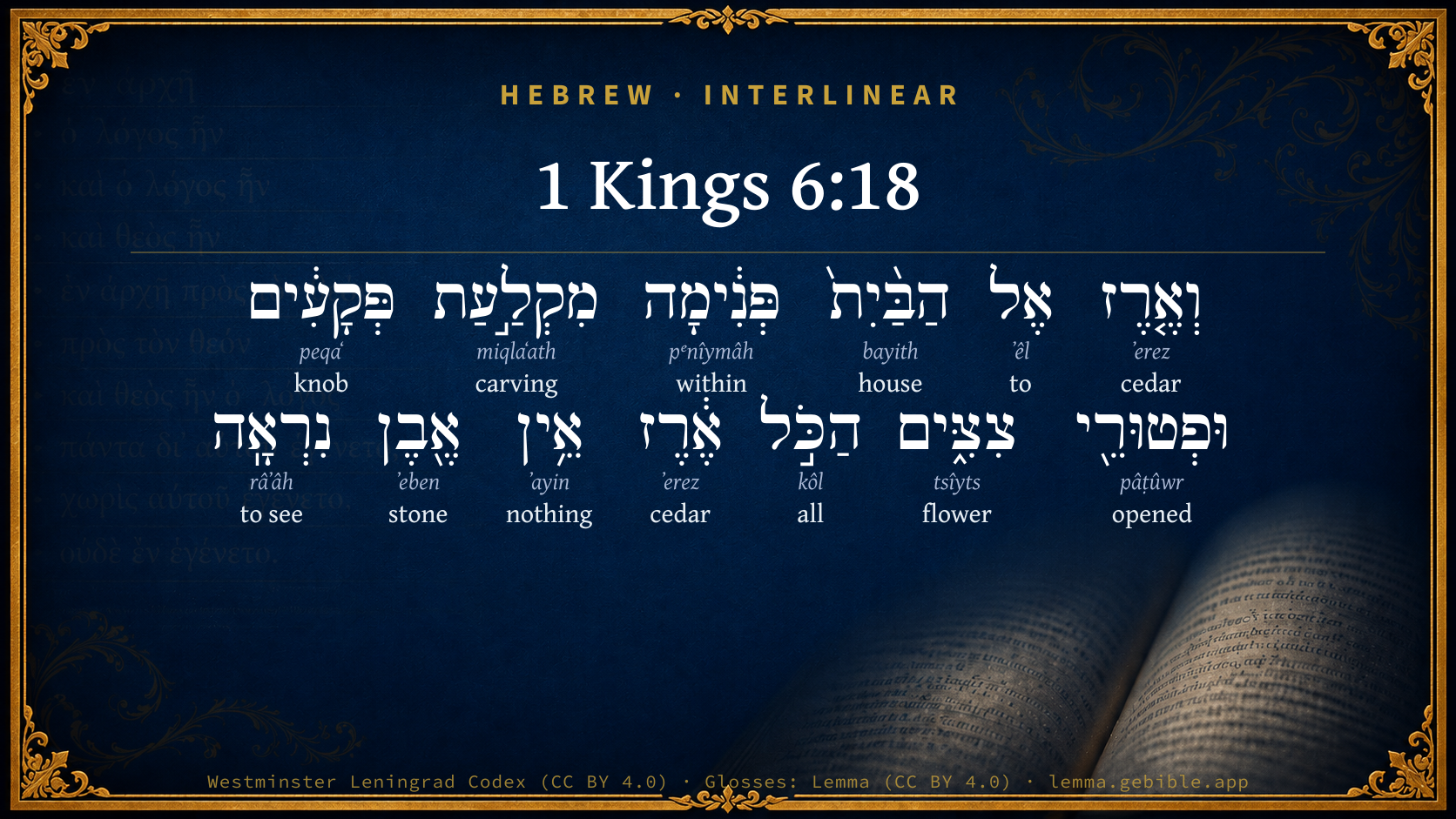
Hebrew (Westminster Leningrad Codex) 1 Kings 6:18 appears in the Hebrew Old Testament. The text above is from the Westminster Leningrad Codex. Each word links to its Strong’s number, a concise gloss, and parsing drawn from the Open Scriptures Hebrew Bible morphology. Click any word for its full Brown-Driver-Briggs (BDB) entry.
Download image
Cite this verse

1 Kings 6:18 (World English Bible). Public Domain. Lemma interlinear Bible study tool, https://lemma.gebible.app/v/1-kings/6/18.

Show BibTeX & RIS
BibTeX
RIS
English Translation
There was cedar on the house within, carved with buds and open flowers: all was cedar; there was no stone seen.
World English Bible · Public Domain
Highlights
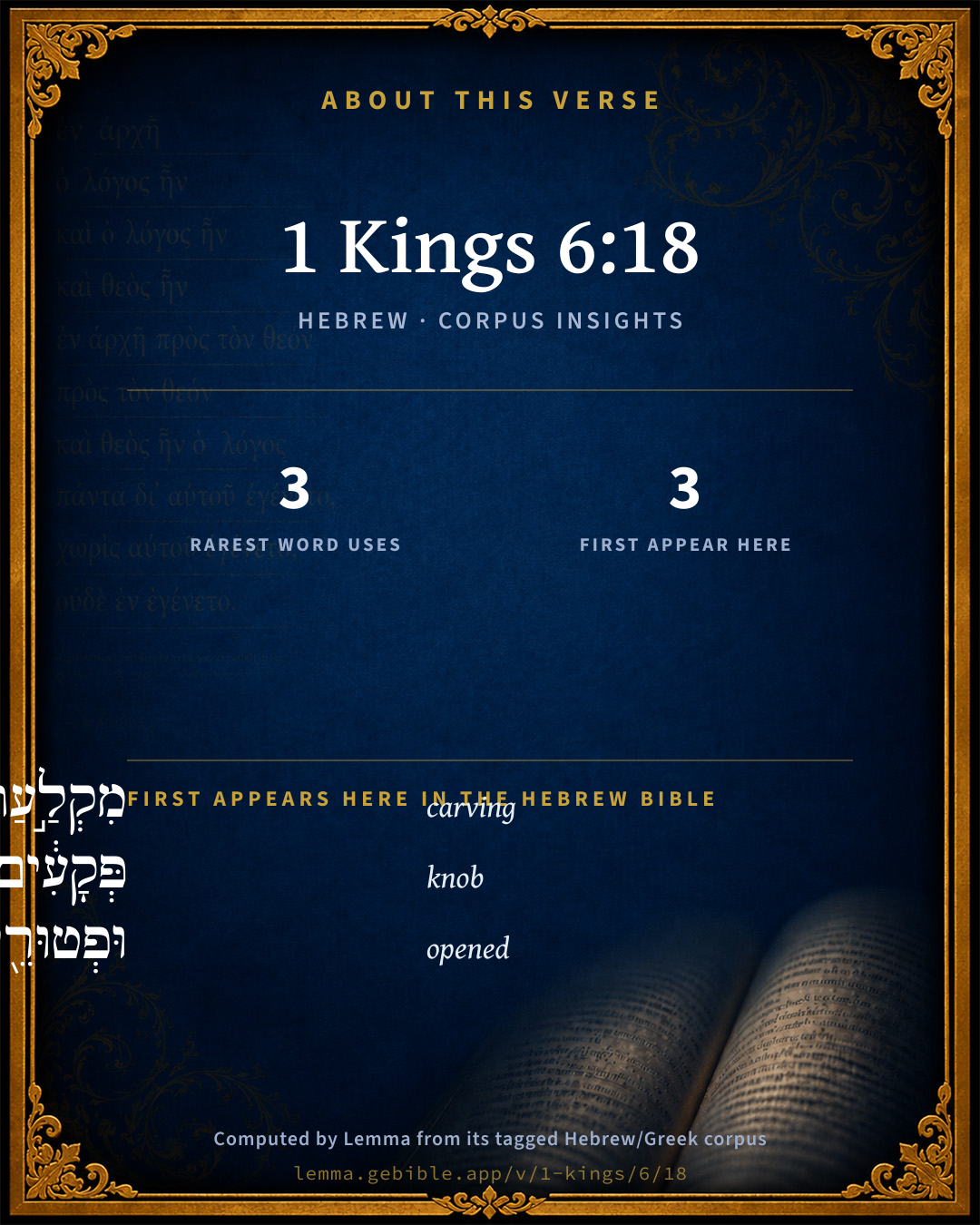
  • 3 first appearances in the Hebrew Bible
Full analysis ↓
Download a study sheet

One document with this verse’s original text, its word-by-word gloss line, the meaning frame, cross-references with their text, attributed commentary, and full source and license credits — printable, and it pastes into notes with its structure intact.

This verse Autodidact and up

Study sheet (.html) Plain text (.txt)

A passage Seminary Student

Up to 50 verses in one chapter. A passage sheet keeps up to 6 commentary sources and 12 cross-references per verse, in the order this page ranks them, and says so on the sheet whenever that leaves anything out. Ask for a single verse and you get the Autodidact verse sheet above.

Everything on this page stays free to read, with no account — the sheet is a download of what is already on screen, not access to it.

Want to remove ads? Support Godless Engineer
Compare translations 3

The same verse in 3 English versions, stacked beneath the original-language interlinear above. Click any original word for its lexicon entry.

Each is an independent rendering of the whole verse — the interlinear is not word-aligned to these translations.

Highlighted words mark where these versions differ — a whole-verse word diff, not a word-by-word alignment.

  • World English Bible Public Domain
    There was cedar on the house within, carved with buds and open flowers: all was cedar; there was no stone seen.
  • King James Version Public Domain
    And the cedar of the house within was carved with knops and open flowers: all was cedar; there was no stone seen.
  • unfoldingWord Literal Text CC BY-SA 4.0
    And cedar was to the house within, carving of gourds and opened ones of flowers. The whole cedar, no stone was seen.

unfoldingWord Literal Text — © unfoldingWord, licensed CC BY-SA 4.0. Word-aligned USFM3 via Door43 (git.door43.org/unfoldingWord/en_ult).

Versions to compare (up to 4)

3 of 4 selected

Show all 18 translations

Every available English version of this verse, each an independent rendering of the whole verse.

  • World English Bible Public Domain
    There was cedar on the house within, carved with buds and open flowers: all was cedar; there was no stone seen.
  • Berean Standard Bible Public Domain
    The cedar paneling inside the temple was carved with gourds and open flowers. Everything was cedar; not a stone could be seen.
  • Majority Standard Bible Public Domain
    The cedar paneling inside the temple was carved with gourds and open flowers. Everything was cedar; not a stone could be seen.
  • King James Version Public Domain
    And the cedar of the house within was carved with knops and open flowers: all was cedar; there was no stone seen.
  • American Standard Version (1901) Public Domain
    And there was cedar on the house within, carved with knops and open flowers: all was cedar; there was no stone seen.
  • Revised Version (1885) Public Domain
    And there was cedar on the house within, carved with knops and open flowers: all was cedar; there was no stone seen.
  • Geneva Bible (1599) Public Domain
    And the cedar of the house within was carued with knops, and grauen with floures: all was cedar, so that no stone was seene.
  • Douay-Rheims (1899) Public Domain
    And all the house was covered within with cedar, having the turnings, and the joints thereof artfully wrought and carvings projecting out: all was covered with boards of cedar: and no stone could be seen in the wall at all.
  • Young's Literal Translation Public Domain
    And the cedar for the house within `is' carvings of knobs and openings of flowers; the whole `is' cedar, there is not a stone seen.
  • Literal Standard Version CC BY-SA 4.0
    And the cedar for the house within [is] carvings of knobs and openings of flowers; the whole [is] cedar, there is not a stone seen.
  • Unlocked Literal Bible CC BY-SA 4.0
    There was cedar inside the house, carved in the shape of gourds and open flowers. All was cedar inside. No stonework was visible on the inside.
  • unfoldingWord Literal Text CC BY-SA 4.0
    And cedar was to the house within, carving of gourds and opened ones of flowers. The whole cedar, no stone was seen.
  • Darby Bible Public Domain
    And the cedar of the house within was carved with colocynths and half-open flowers: all was cedar; there was no stone seen.
  • World Messianic Bible Public Domain
    There was cedar on the house within, carved with buds and open flowers. All was cedar. No stone was visible.
  • Webster's Bible Public Domain
    And the cedar of the house within was carved with knobs and open flowers: all was cedar; there was no stone seen.
  • Free Bible Version CC BY-SA 4.0
    The cedar panels inside the Temple were decorated with carvings of gourds and open flowers. Everything was lined with cedar—none of the stone was visible.
  • Bible in Basic English Public Domain
    (All the inside of the house was cedar-wood, ornamented with designs of buds and flowers; no stonework was to be seen inside.)
  • JPS Tanakh (1917) Public Domain
    And the cedar on the house within was carved with knops and open flowers; all was cedar; there was no stone seen.

Literal Standard Version (2020), Covenant Press — licensed CC BY-SA 4.0. Text via the HelloAO Bible API (eBible.org). Unlocked Literal Bible (unfoldingWord) — licensed CC BY-SA 4.0. Text via the HelloAO Bible API (eBible.org). unfoldingWord Literal Text — © unfoldingWord, licensed CC BY-SA 4.0. Word-aligned USFM3 via Door43 (git.door43.org/unfoldingWord/en_ult). Free Bible Version, Dr. Jonathan Gallagher — licensed CC BY-SA 4.0. Text via the HelloAO Bible API (eBible.org).

Word by word

More ways to search: Search by grammar → Find every occurrence → Compare this word →

Practice this passage: Drill this verse → Learn its vocabulary →

פְּקָעִ֔ים
peqaʻ
H6497
“knobs”
Noun, Common, Masculine, Plural, Absolute
Part of Speech
Noun
Type
Common
Gender
Masculine
Number
Plural
State
Absolute
Full BDB Definition

Origin: from an unused root meaning to burst

TWOT: 1804a

knob-shaped or ball-shaped or gourd-shaped carved wood or metal ornament
  1. וְאֶ֤רֶז ʼerez H730 “and · cedar” Conjunction + Noun, Common, Masculine, Singular, Absolute
  2. אֶל ʼêl H413 “to” Preposition
  3. הַבַּ֨יִת֙ bayith H1004 “the · house” Particle, Definite Article + Noun, Common, Masculine, Singular, Absolute
  4. פְּנִ֔ימָה pᵉnîymâh H6441 “within” Adverb
  5. מִקְלַ֣עַת miqlaʻath H4734 “carving of” Noun, Common, Feminine, Singular, Construct
  6. וּפְטוּרֵ֖י pâṭûwr H6358 “and · opened” Conjunction + Verb, Qal, Participle Passive, Masculine, Plural, Construct
  7. צִצִּ֑ים tsîyts H6731 “flowers” Noun, Common, Masculine, Plural, Absolute
  8. הַכֹּ֣ל kôl H3605 “the · all” Particle, Definite Article + Noun, Common, Masculine, Singular, Absolute
  9. אֶ֔רֶז ʼerez H730 “cedar” Noun, Common, Masculine, Singular, Absolute
  10. אֵ֥ין ʼayin H369 “nothing” Particle, Negative
  11. אֶ֖בֶן ʼeben H68 “stone” Noun, Common, Feminine, Singular, Absolute
  12. נִרְאָֽה râʼâh H7200 “seen” Verb, Niphal, Participle Passive, Feminine, Singular, Absolute

About this verse

These counts appear in no published source. They are computed here, from the morphology-tagged text and Lemma’s own curated glosses. What Lemma adds →

13
words
12
distinct lemmas
Historical
section

Notable vocabulary

The rarest word here is פְּקָעִ֔ים knob H6497 — appearing just 3 times in the whole Hebrew Bible.

First appearance in Scripture

These words make their first canonical appearance in the Hebrew Bible here:

  • מִקְלַ֣עַת carving H4734
  • פְּקָעִ֔ים knob H6497
  • וּפְטוּרֵ֖י opened H6358

Shared distinctive vocabulary

פְּקָעִ֔ים knob H6497 occurs in 2 verses of the Hebrew Bible. Also found in:

Grammatical profile

  • 2 verbs
  • 8 nouns
  • 1 preposition
  • 1 adverb
  • 1 particle

Verb forms

  • וּפְטוּרֵ֖י Qal · Participle Passive
  • נִרְאָֽה Niphal · Participle Passive

Repetition

A word recurs within this verse — often emphatic in Hebrew:

  • וְאֶ֤רֶז cedar H730 ×2

Cross-references

1

Topical passages linked to 1 Kings 6:18 in the Treasury of Scripture Knowledge — connected by theme and wording, ordered by reader-vote popularity; previews shown in the World English Bible.

  • 1 Kings 7:24 Under the brim of it round about there were buds which did compass it, for ten cubits, compassing the sea round about: the buds were in two rows, cast when it was cast.

Cross-references courtesy of OpenBible.info (CC BY 4.0).

Hebrew and Greek witnesses Masoretic Hebrew ↔ Greek Septuagint

The same verse in the two great witnesses to the Old Testament, shown verse-for-verse.

These are two independent witnesses, not word-aligned to each other, and the Septuagint is shown in lemma (dictionary) form.

Hebrew 1 Kings 6:18 Masoretic · Westminster Leningrad Codex

וְאֶ֤רֶז אֶל הַבַּ֨יִת֙ פְּנִ֔ימָה מִקְלַ֣עַת פְּקָעִ֔ים וּפְטוּרֵ֖י צִצִּ֑ים הַכֹּ֣ל אֶ֔רֶז אֵ֥ין אֶ֖בֶן נִרְאָֽה

There was cedar on the house within, carved with buds and open flowers: all was cedar; there was no stone seen.

World English Bible · Public Domain

On this verse, The Cambridge Bible for Schools and Colleges discusses the Septuagint’s reading. Read the note in Commentary ↓

Hebrew: Westminster Leningrad Codex (CC BY 4.0). Greek: Septuagint (public domain); English from a public-domain English Septuagint. How the Septuagint differs from the Hebrew →

Targum (Aramaic paraphrase)

1

The Targum is the ancient Jewish Aramaic paraphrase of the Hebrew Scriptures — an interpretive translation, not the Hebrew text itself. Onkelos (literal) and Pseudo-Jonathan (expansive) render the Torah, and Jonathan the Prophets. Coverage is partial: where no permissively-licensed English translation exists for a verse, only the Aramaic is shown. This is verse-level text, not a word-by-word alignment to the Hebrew.

  1. Targum Jonathan Prophets (Joshua–Malachi)
    וְנִסְרִין דְאַרְזָא חֲפֵי בֵיתָא מִלְגָיו וּגְלַף חֵיזוּ בֵיעִין וְאַטוּנִין שׁוֹשַׁנִין כָּל בֵּיתָא חֲפֵי נִסְרִין דְאַרְזָא לֵית אַבְנָא מִתְחַזְיָא:

    (no public-domain English translation for this verse)

    Targum Jonathan — Aramaic: “Mikraot Gedolot” (public domain). English: “Sefaria Community Translation” (CC0 1.0 (public-domain dedication)); “London "Chaldee Paraphrase," 1871” (public domain). Text via Sefaria.

Commentary

Notes on 1 Kings 6:18 from classic Christian and Jewish commentators (each source and its license shown beneath its notes). The classic Christian expositions comment on the surrounding passage and are grouped to its opening verse, so a note may address several verses; the Jewish commentaries on the Tanakh (Rashi and others) are per-verse, so they appear only where the commentator wrote on this verse.

Lemma curates 59 commentaries, every one of them public domain or Creative Commons licensed, each selected and text-cleaned for this edition rather than reprinted as found. About our sources →

Trapp's Complete Commentary

John Trapp

1Ki 6:18 And the cedar of the house within [was] carved with knops and open flowers: all [was] cedar; there was no stone seen.

Ver. 18. Carved with knops and open flowers.] To show the multifarious flourishing graces that are in Christ and Christians. For in this piece of Scripture, by a specialty, we may say with Possevine, Tot esse sacramenta quot literas, tot mysteria quot puncta, tot arcana quot apices; { a} there are so many words, so many mysteries.

{a} Biblioth. Select.

John Trapp, A Commentary or Exposition upon All the Books of the Old and New Testament (1647–1656) — public domain. Text from a community e-Sword module.

The Biblical Illustrator

Joseph S. Exell

1Ki_6:18

No stone seen.

The temple of God flawless

All was cedar; there was no stone seen. Take stone in the type for that which was really so, and in the antitype for that which is so mystically, and then it may import to us, that in heaven, the antitype of this holiest, there will never be anything of hardness of heart in them that possess it for ever. All imperfection ariseth from the badness of the heart, but there will be no bad hearts in glory. No shortness in knowledge, no crossness of disposition, no workings of lusts, no corruptions will be there. Here, alas, they are seen, and that in the best of saints, because here our light is mixed with darkness; but there will be no night there, nor any stone seen (John Bunyan.)

The Biblical Illustrator, edited by Joseph S. Exell (c. 1880s–1900s) — public domain. Text from a community e-Sword module.

Geneva Bible (1599)

Geneva Bible translators

Or, wild cucumbers.

Geneva Bible (1599) marginal notes — public domain. Text via Bolls.life.

The Cambridge Bible for Schools and Colleges

gen. ed. J. J. S. Perowne

18. And the cedar of the house within] Better more literally, with R.V. ‘And there was cedar upon the house within.’ He is now describing the wainscot of the holy place.

carved with knops] There is a feminine form of the word here rendered ‘knops,’ which in 2Ki_4:39 is used of ‘wild gourds.’ Hence ‘gourds’ is put on the margin of A.V. and R.V. The ornaments were in relief, and were perhaps somewhat of that shape. The Targum describes them as ‘egg-shaped.’ The Vat. LXX. (not Alex.) omits the verse altogether.

The Cambridge Bible for Schools and Colleges (gen. ed. J. J. S. Perowne; Cambridge University Press, 1878–1918) — public domain. Text from a community e-Sword module.

John Gill's Exposition

And the oracle he prepared in the house within,.... In the innermost part of the house he fitted up the oracle, or speaking place, from whence the Lord spake and gave answer, to receive what was to be put into it: particularly

to set there the ark of the covenant of the Lord; even the very same that Moses made, Exo 37:1, for which David had pitched a tent in Zion, Ch1 15:1, and where it now was; for Solomon made no new ark.

John Gill's Exposition of the Whole Bible (1746–1763) — public domain (CC PDM 1.0). Text via the HelloAO Bible API.

Albert Barnes' Notes on the Bible

Knops and open flowers - Rather, “gourds and opening flower-buds.” Imitations of the vegetable world are among the earliest of architectural ornaments. They abound in the architecture of Egypt and Persia. In that of Assyria they occur more sparingly.

Albert Barnes' Notes on the Bible (1834–1885) — public domain. Text from a community e-Sword/MySword module.

Haydock's Catholic Bible Commentary

CHAPTER VI.

Out. Hebrew, "and the cedar boards of the house within, were carved with knops (fruits) and open flowers," (Haydock) alternately. (Calmet) --- At all. So the bones in the human body, though concealed, strengthen it; and monks, in their deserts, fortify the Church. (Worthington)

George Leo Haydock (1774–1849), Haydock's Catholic Family Bible and Commentary, 1859 edition — public domain. Excludes Psalms (Douay-Rheims chapter numbering differs from Protestant) and Deuterocanonical books (Catholic canon only).

Matthew Poole's English Annotations

All was cedar, i.e. all the house was covered with cedar.

Quest. How was this true, when it was covered with fir, 2Ch 3:5?

Answ. 1. It was done with cedar and fir; of which See Poole "1Ki 6:15".

2. It may be said to be all cedar, because the greatest part was so, universal particles being oft so used.

3. Cedar is here named, not to exclude all other wood, but stone only, as the following words show.

4. Or, all was of cedar; that is, all the carving was of cedar.

Matthew Poole's English Annotations on the Holy Bible (1683–1685) — public domain. Text from a community e-Sword/MySword module.

Whedon's Commentary on the Bible

Daniel D. Whedon

18. Carved with knops — Or, gourds, as in margin, and as the kindred word is rendered in 2Ki_4:39. The carving was an artificial imitation of wild gourds or cucumbers.

Open flowers — Flowers in full bloom. Hence probably a carved imitation of festoons or garlands.

Daniel D. Whedon (gen. ed.), Commentary on the Old and New Testaments (1874–1909) — public domain. Text from a community e-Sword module.

The Pulpit Commentary

And the cedar of the house within lit. cedar (wood) was placed against the house inside was carved with knops Heb. sculpture of gourds. The sculpture is in apposition to cedar. The authorities are divided as to the kind of sculpture intended. Keil thinks they were bassi relievi; Bahr contends that, like those of the Egyptian monuments, they were sunken, is generally assumed to be synonymous with tOquP "squirting cucumbers". (2Ki_4:39, note) Bahr, however, justly observes that a deadly fruit, such as this is described to have been, was hardly likely to be employed in the decoration of the sanctuary, and he would render the word "buds." Keil thinks the gourds were oval ornaments, something like the wild gourd, which ran in rows along the walls. See the illustration, "Slab from Kouyunjik," Dict. Bib. 2 p. 49) and open flowers lit. burstings of flowers. These words again are very variously interpreted. Thenius: festoons of flowers; Keil: open flower buds; Gesen.: expanded flowers: all was cedar; there was no stone seen. Really, the cedar was no more seen than the stone, for this in turn was overlaid with gold (ver. 22.)

The Pulpit Commentary (1880–1919), ed. H.D.M. Spence-Jones & Joseph S. Exell — public domain. Text from a community e-Sword module.

John Wesley's Explanatory Notes

Cedar - Cedar is here named, not to exclude all other wood, but stone only; as the following words shew.

John Wesley, Explanatory Notes Upon the Whole Bible (1754–1765) — public domain. Text via the GEBible commentary corpus.

Rashi

Rabbi Shlomo Yitzchaki (Rashi)

The cedar of the inside of the Beis Hamikdosh was carved with designs. This means, that those cedar boards which he made for the inside of the building to cover the stone walls, were carved with figured carvings and forms of fragments resembling knobs; פקעים are imosjjls, in O.F.

Of buds and blossoming flowers. [Targum] Yonoson rendered, “and cords and flowers,” in the form of chains.

Buds. [פטורי is] an expression of cords in the language of the Talmud, as in, “as the rope through the loophole.”

Blossoming flowers. [צצים is] an expression of flowers, as in, “and it bloomed [ויצץ] buds [ציץ],” cords and blossoms. But Menachem related פטורי as an expression of, “to open [פטר] of the womb,” and as in, “they open [יפטירו] the lip.”

All was cedar [wood] no stone was visible. [Targum Yonoson rendered,] “the whole building was covered with cedar boards, no stone was visible.”

Carved with designs. [Targum] Yonoson rendered, “and engraved was a resemblance of eggs.” (Meaning engraved in the shape of round eggs.)

Rashi on the Tanakh — English translations: “The Judaica Press complete Tanach with Rashi, translated by A. J. Rosenberg” (CC BY 4.0); “Pentateuch with Rashi's commentary by M. Rosenbaum and A.M. Silbermann, 1929-1934” (public domain); “The Metsudah Tanach series, Lakewood, N.J” (CC BY 4.0); and “The Book of Joshua, Metsudah Publications, 1997” (CC BY 4.0). Text via Sefaria.

Lesson kit

Teaching starters — assembled from the data on this page, not authored interpretation. Every prompt links to the verse data it draws on. Edit before teaching.

1 Kings, in the Historical, opens this verse with 13 words (12 distinct Hebrew lemmas). Its most distinctive word is peqaʻ (“knob”). A historical commentator’s framing appears above. Read the whole chapter for the surrounding context.

Discussion questions

  1. How does “knob” (peqaʻ) shape what this verse is saying?
  2. 3 words here appear for the first time in Scripture. What is being introduced at this debut?
  3. 1 Kings 7:24 shares the word «knob» with this verse. How do the two illuminate each other?
  4. “cedar” occurs 2× in this one verse. What is the effect of the repetition?
  5. These translations render this verse differently. What is at stake in choosing one wording over another?
  6. The verb «וּפְטוּרֵ֖י» is Qal Participle Passive. How does its form color the action?
  7. Reading how Trapp's Complete Commentary and The Biblical Illustrator read this verse, where do the two commentators agree and where do they part?

Things to notice

  • 3 words make their first canonical appearance in Scripture here.
  • These translations choose different wording for 11 words in this verse.
  • “cedar” occurs 2× in this single verse.
  • 12 distinct Hebrew lemmas span 13 words in this verse.

Reading settings

Reading text

Shown beneath each verse's original-language words.

Old Testament
Old Testament edition

Read the OT as the Masoretic Hebrew (MT) or the Greek Septuagint (LXX).

English shown for the Greek Septuagint (in the Hebrew ↔ Greek comparison).

Comparing translations? Open the Compare panel on any verse page to stack up to four side by side.