Genesis 7:8

Hebrew (Westminster Leningrad Codex) Genesis 7:8 appears in the Hebrew Old Testament. The text above is from the Westminster Leningrad Codex. Each word links to its Strong’s number, a concise gloss, and parsing drawn from the Open Scriptures Hebrew Bible morphology. Click any word for its full Brown-Driver-Briggs (BDB) entry.
Download image
Cite this verse

Genesis 7:8 (World English Bible). Public Domain. Lemma interlinear Bible study tool, https://lemma.gebible.app/v/genesis/7/8.

Show BibTeX & RIS
BibTeX
RIS
English Translation
Clean animals, animals that are not clean, birds, and everything that creeps on the ground
World English Bible · Public Domain
Download a study sheet

One document with this verse’s original text, its word-by-word gloss line, the meaning frame, cross-references with their text, attributed commentary, and full source and license credits — printable, and it pastes into notes with its structure intact.

This verse Autodidact and up

Study sheet (.html) Plain text (.txt)

A passage Seminary Student

Up to 50 verses in one chapter. A passage sheet keeps up to 6 commentary sources and 12 cross-references per verse, in the order this page ranks them, and says so on the sheet whenever that leaves anything out. Ask for a single verse and you get the Autodidact verse sheet above.

Everything on this page stays free to read, with no account — the sheet is a download of what is already on screen, not access to it.

Want to remove ads? Support Godless Engineer
Compare translations 3

The same verse in 3 English versions, stacked beneath the original-language interlinear above. Click any original word for its lexicon entry.

Each is an independent rendering of the whole verse — the interlinear is not word-aligned to these translations.

Highlighted words mark where these versions differ — a whole-verse word diff, not a word-by-word alignment.

  • World English Bible Public Domain
    Clean animals, animals that are not clean, birds, and everything that creeps on the ground
  • King James Version Public Domain
    Of clean beasts, and of beasts that are not clean, and of fowls, and of every thing that creepeth upon the earth,
  • unfoldingWord Literal Text CC BY-SA 4.0
    from the clean animal and from the animal that are not clean and from the bird and everything that moves on the ground

unfoldingWord Literal Text — © unfoldingWord, licensed CC BY-SA 4.0. Word-aligned USFM3 via Door43 (git.door43.org/unfoldingWord/en_ult).

Versions to compare (up to 4)

3 of 4 selected

Show all 18 translations

Every available English version of this verse, each an independent rendering of the whole verse.

  • World English Bible Public Domain
    Clean animals, animals that are not clean, birds, and everything that creeps on the ground
  • Berean Standard Bible Public Domain
    The clean and unclean animals, the birds, and everything that crawls along the ground
  • Majority Standard Bible Public Domain
    The clean and unclean animals, the birds, and everything that crawls along the ground
  • King James Version Public Domain
    Of clean beasts, and of beasts that are not clean, and of fowls, and of every thing that creepeth upon the earth,
  • American Standard Version (1901) Public Domain
    Of clean beasts, and of beasts that are not clean, and of birds, and of everything that creepeth upon the ground,
  • Revised Version (1885) Public Domain
    Of clean beasts, and of beasts that are not clean, and of fowls, and of every thing that creepeth upon the ground,
  • Geneva Bible (1599) Public Domain
    Of the cleane beastes, and of the vncleane beastes, and of the foules, and of all that creepeth vpon the earth,
  • Douay-Rheims (1899) Public Domain
    And of the beasts clean and unclean, and of fowls, and of every thing that moveth upon the earth,
  • Young's Literal Translation Public Domain
    of the clean beasts and of the beasts that `are' not clean, and of the fowl, and of every thing that is creeping upon the ground,
  • Literal Standard Version CC BY-SA 4.0
    from the clean beast, and from the beast that [is] not clean, and from the bird, and of everything that is creeping on the ground,
  • Unlocked Literal Bible CC BY-SA 4.0
    Clean animals and unclean animals, birds, and everything that creeps upon the ground,
  • unfoldingWord Literal Text CC BY-SA 4.0
    from the clean animal and from the animal that are not clean and from the bird and everything that moves on the ground
  • Darby Bible Public Domain
    Of clean beasts, and of beasts that are not clean, and of fowl, and of everything that creeps on the ground,
  • World Messianic Bible Public Domain
    Clean animals, unclean animals, birds, and everything that creeps on the ground
  • Webster's Bible Public Domain
    Of clean beasts, and of beasts that are not clean, and of fowls, and of every animal that creepeth upon the earth;
  • Free Bible Version CC BY-SA 4.0
    Clean and unclean animals, birds, and creatures that run along the ground,
  • Bible in Basic English Public Domain
    Of clean beasts, and of beasts which are not clean, and of birds, and of everything which goes on the earth,
  • JPS Tanakh (1917) Public Domain
    Of clean beasts, and of beasts that are not clean, and of fowls, and of every thing that creepeth upon the ground,

Literal Standard Version (2020), Covenant Press — licensed CC BY-SA 4.0. Text via the HelloAO Bible API (eBible.org). Unlocked Literal Bible (unfoldingWord) — licensed CC BY-SA 4.0. Text via the HelloAO Bible API (eBible.org). unfoldingWord Literal Text — © unfoldingWord, licensed CC BY-SA 4.0. Word-aligned USFM3 via Door43 (git.door43.org/unfoldingWord/en_ult). Free Bible Version, Dr. Jonathan Gallagher — licensed CC BY-SA 4.0. Text via the HelloAO Bible API (eBible.org).

Word by word

More ways to search: Search by grammar → Find every occurrence → Compare this word →

Practice this passage: Drill this verse → Learn its vocabulary →

רֹמֵ֖שׂ
râmas
H7430
“creeping”
Verb, Qal, Participle Active, Masculine, Singular, Absolute
Part of Speech
Verb
Stem
Qal
Form
Participle Active
Gender
Masculine
Number
Singular
State
Absolute
Full BDB Definition

Origin: a primitive root

TWOT: 2177

to creep, move lightly, move about, walk on all fours - (Qal) - to creep, teem (of all creeping things) - to creep (of animals) - to move lightly, glide about (of water animals) - to move about (of all land animals generally)
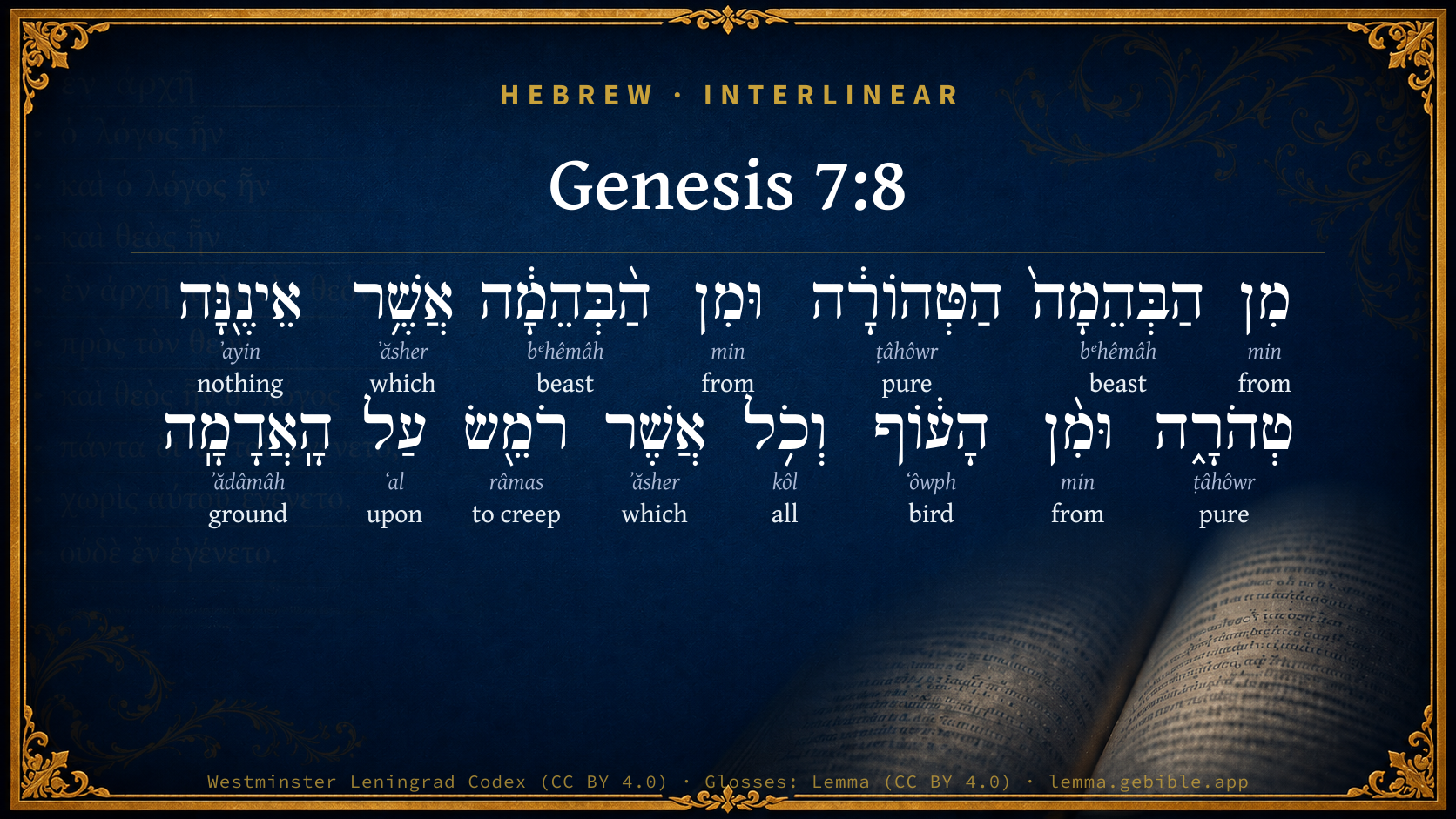
  1. מִן min H4480 “from” Preposition
  2. הַבְּהֵמָה֙ bᵉhêmâh H929 “the · beast” Particle, Definite Article + Noun, Common, Feminine, Singular, Absolute
  3. הַטְּהוֹרָ֔ה ṭâhôwr H2889 “the · pure” Particle, Definite Article + Adjective, Adjective, Feminine, Singular, Absolute
  4. וּמִן min H4480 “and · from” Conjunction + Preposition
  5. הַ֨בְּהֵמָ֔ה bᵉhêmâh H929 “the · beast” Particle, Definite Article + Noun, Common, Feminine, Singular, Absolute
  6. אֲשֶׁ֥ר ʼăsher H834 “which” Particle, Relative
  7. אֵינֶ֖נָּה ʼayin H369 “nothing · her” Particle, Negative + Suffix, Personal, 3rd Person, Feminine, Singular
  8. טְהֹרָ֑ה ṭâhôwr H2889 “pure” Adjective, Adjective, Feminine, Singular, Absolute
  9. וּמִ֨ן min H4480 “and · from” Conjunction + Preposition
  10. הָע֔וֹף ʻôwph H5775 “the · bird” Particle, Definite Article + Noun, Common, Masculine, Singular, Absolute
  11. וְכֹ֥ל kôl H3605 “and · all” Conjunction + Noun, Common, Masculine, Singular, Absolute
  12. אֲשֶׁר ʼăsher H834 “which” Particle, Relative
  13. עַל ʻal H5921 “upon” Preposition
  14. הָֽאֲדָמָֽה ʼădâmâh H127 “the · ground” Particle, Definite Article + Noun, Common, Feminine, Singular, Absolute

About this verse

These counts appear in no published source. They are computed here, from the morphology-tagged text and Lemma’s own curated glosses. What Lemma adds →

15
words
10
distinct lemmas
Pentateuch
section

Notable vocabulary

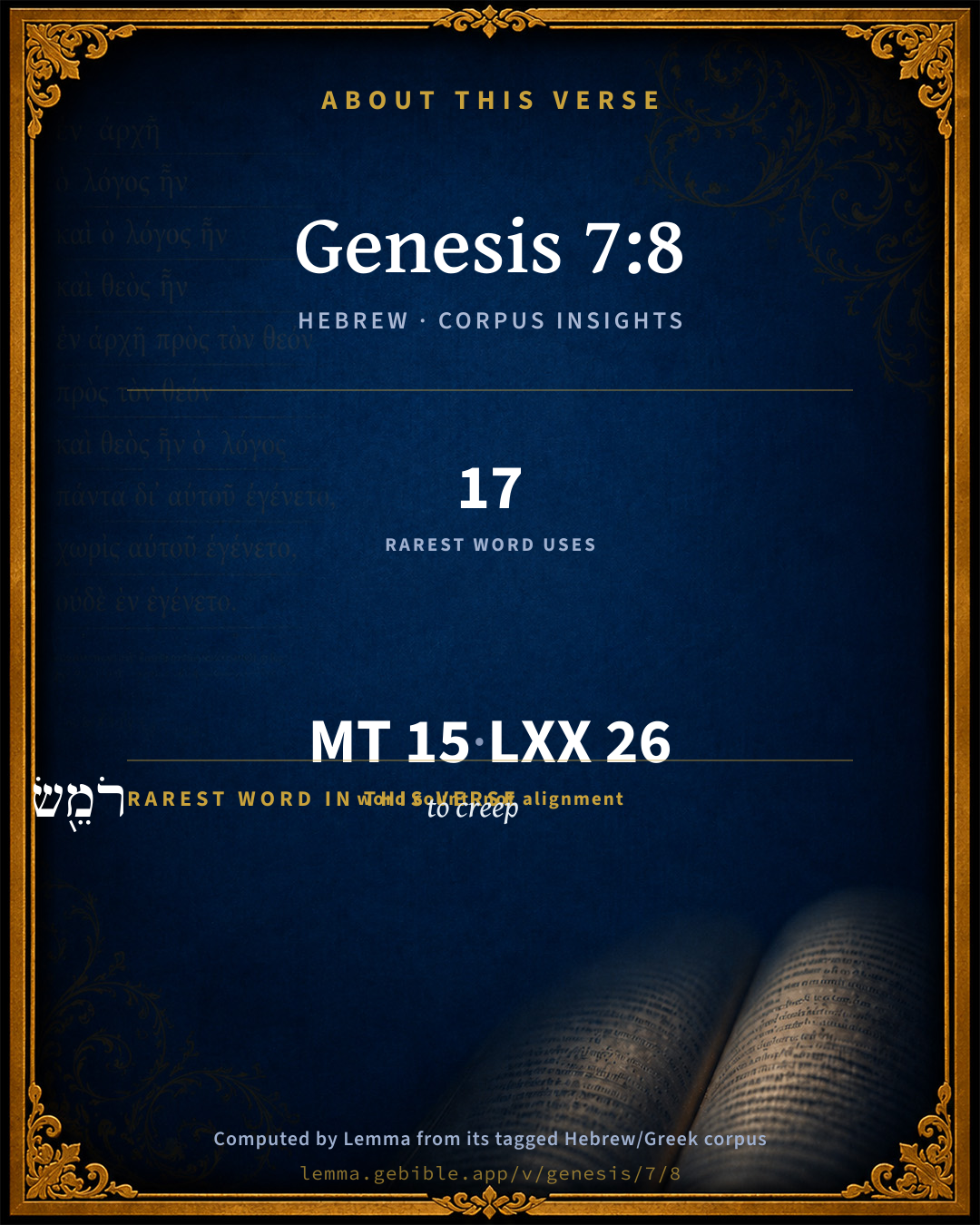
The rarest word here is רֹמֵ֖שׂ to creep H7430 — appearing just 17 times in the whole Hebrew Bible.

Shared distinctive vocabulary

רֹמֵ֖שׂ to creep H7430 occurs in 17 verses of the Hebrew Bible. Also found in:

Grammatical profile

  • 1 verb
  • 5 nouns
  • 2 adjectives
  • 4 prepositions
  • 3 particles

Verb forms

  • רֹמֵ֖שׂ Qal · Participle Active

Repetition

Words recur within this verse — often emphatic in Hebrew:

  • הַבְּהֵמָה֙ beast H929 ×2
  • הַטְּהוֹרָ֔ה pure H2889 ×2
  • מִן from H4480 ×3
  • אֲשֶׁ֥ר which H834 ×2

Hebrew & Septuagint length

In English translation the verse runs 15 words from the Hebrew and 27 from the Septuagint (LXX English) — the Septuagint runs noticeably longer here. See the side-by-side →

A rough comparison of the two English renderings, which tokenize alike — not a word-level alignment.

Word counts can differ between the Hebrew and the Greek without any difference in meaning — e.g. the Hebrew direct-object marker אֵת has no separate Greek word, and Greek often adds the article ὁ.

In the original languages it is 15 Hebrew tokens and 26 Greek tokens — but the two are counted differently (Hebrew bundles its prefixes and suffixes into one token; the Greek is in lemma form), so that isn’t a like-for-like length.

Hebrew and Greek witnesses Masoretic Hebrew ↔ Greek Septuagint

The same verse in the two great witnesses to the Old Testament, shown verse-for-verse.

Here the Septuagint runs noticeably longer than the Hebrew — LXX2012 (modern English Septuagint) 27 words vs World English Bible 15. A rough length comparison of the two English translations, not a word-level alignment — read both below.

These are two independent witnesses, not word-aligned to each other, and the Septuagint is shown in lemma (dictionary) form.

Hebrew Genesis 7:8 Masoretic · Westminster Leningrad Codex

מִן הַבְּהֵמָה֙ הַטְּהוֹרָ֔ה וּמִן הַ֨בְּהֵמָ֔ה אֲשֶׁ֥ר אֵינֶ֖נָּה טְהֹרָ֑ה וּמִ֨ן הָע֔וֹף וְכֹ֥ל אֲשֶׁר רֹמֵ֖שׂ עַל הָֽאֲדָמָֽה

Clean animals, animals that are not clean, birds, and everything that creeps on the ground

World English Bible · Public Domain

Greek LXX Genesis 7:8 Septuagint · lemma form

καί ἀπό ὁ πετεινόν καί ἀπό ὁ κτῆνος ὁ καθαρός καί ἀπό ὁ κτῆνος ὁ μή καθαρός καί ἀπό πᾶς ὁ ἑρπετόν ὁ ἐπί ὁ γῆ

And of clean flying creatures and of unclean flying creatures, and of clean cattle and of unclean cattle, and of all things that creep upon the earth,

LXX2012 (modern English Septuagint) · Public Domain

On this verse, The Pulpit Commentary discusses the Septuagint’s reading. Read the note in Commentary ↓

Hebrew: Westminster Leningrad Codex (CC BY 4.0). Greek: Septuagint (public domain); English from LXX2012 (modern English Septuagint) (Public Domain). How the Septuagint differs from the Hebrew →

Targum (Aramaic paraphrase)

2

The Targum is the ancient Jewish Aramaic paraphrase of the Hebrew Scriptures — an interpretive translation, not the Hebrew text itself. Onkelos (literal) and Pseudo-Jonathan (expansive) render the Torah, and Jonathan the Prophets. Coverage is partial: where no permissively-licensed English translation exists for a verse, only the Aramaic is shown. This is verse-level text, not a word-by-word alignment to the Hebrew.

  1. Targum Onkelos Torah (Genesis–Deuteronomy)
    מִן בְּעִירָא דַּכְיָא וּמִן בְּעִירָא דִּי לֵיתָהָא דַּכְיָא וּמִן עוֹפָא וְכֹל דִּי רָחֵשׁ עַל אַרְעָא

    Of animals clean, and of animals not clean, and of birds, and of all which creepeth upon the earth,

    Targum Onkelos — Aramaic: “Onkelos Genesis” (public domain); “Onkelos Exodus” (public domain); “Onkelos Leviticus” (public domain); “Onkelos Numbers” (public domain); “Onkelos Deuteronomy” (public domain). English: “Sefaria Community Translation” (CC0 1.0 (public-domain dedication)); “J.W. Etheridge. The Targums of Onkelos and Jonathan Ben Uzziel on the Pentateuch. London: Longmans, Green, 1862” (public domain). Text via Sefaria.

  2. Targum Pseudo-Jonathan Torah (Genesis–Deuteronomy)
    מִן בְּעִירָא דַכְיָא וּמִן בְּעִירָא דְלֵיתָא דַכְיָא וּמִן עוֹפָא וְכָל דְרָחִישׁ עַל אַרְעָא

    Of all cattle clean, and of cattle unclean, of birds, and of whatever creepeth upon the earth,

    Targum Pseudo-Jonathan — Aramaic: “Targum Jonathan on Genesis” (public domain); “Targum Jonathan on Exodus” (public domain); “Targum Jonathan on Leviticus” (public domain); “Targum Jonathan on Numbers” (public domain); “Targum Jonathan on Deuteronomy” (public domain). English: “The Targum of Jonathan ben Uzziel, trans. J. W. Etheridge, London, 1862” (public domain). Text via Sefaria.

Commentary

Notes on Genesis 7:8 from classic Christian and Jewish commentators (each source and its license shown beneath its notes). The classic Christian expositions comment on the surrounding passage and are grouped to its opening verse, so a note may address several verses; the Jewish commentaries on the Tanakh (Rashi and others) are per-verse, so they appear only where the commentator wrote on this verse.

Lemma curates 59 commentaries, every one of them public domain or Creative Commons licensed, each selected and text-cleaned for this edition rather than reprinted as found. About our sources →

Trapp's Complete Commentary

John Trapp

Gen 7:8 Of clean beasts, and of beasts that [are] not clean, and of fowls, and of every thing that creepeth upon the earth,

Ver. 8. And of those that are not clean.] So a Doeg may set his foot as far within the sanctuary as a David: A "generation of vipers" may come to John’s baptism, {Mat 3:7} as well as better men. But as these beasts came unclean to the ark, and went thence as unclean; so do most men to the holy ordinances; which yet are the heavenly exchange betwixt God and his elect: they present duty, He confers mercy. "The just Lord is in the midst thereof; he will not do iniquity: … but the unjust knoweth no shame"; {Zep 3:5} he that is "filthy," will "be filthy still". {Rev 22:11}

John Trapp, A Commentary or Exposition upon All the Books of the Old and New Testament (1647–1656) — public domain. Text from a community e-Sword module.

Tyndale Open Study Notes

Tyndale Open Resources

7:8 See study note on 7:2.

Tyndale Open Study Notes — © Tyndale Open Resources, licensed CC BY-SA 4.0. Text via the HelloAO Bible API.

John Calvin's Commentaries

8. Of clean beasts. Moses now explains, — what had before been doubtful, — in which manner the animals were gathered together into the ark, and says that they came of their own accord. If this should seem to any one absurd, let him recall to mind what was said before, that in the beginning every kind of animals presented themselves to Adam, that he might give them names. And, truly, we dread the sight of wild beasts from no other cause than this, that seeing we have shaken off the yoke of God, we have lost that authority over them with which Adam was endued. Now, it was a kind of restoration of the former state of things when God brought to Noah those animals which he intended should be preserved through Noah’s labor and service. For Noah retained the untamed animals in his ark, in the very same way in which hens and geese are preserved in a coop. And it is not superfluously added, that the animals themselves came, as God had instructed Noah; for it shows that the blessing of God rested on the obedience of Noah, so that his labor should not be in vain. It was impossible, humanly speaking, that in a moment such an assemblage of all animals should take place; but because Noah, simply trusting the event with God, executed what was enjoined upon him; God, in return, gave power to his own precept, that it might not be without effect. Properly speaking, this was a promise of God annexed to his commands. And, therefore, we must conclude, that the faith of Noah availed more, than all snares and nets, for the capture of animals; and that, by the very same gate, lions, and wolves, and tigers, meekly entered, with oxen, and with lambs, into the ark. And this is the only method by which we may overcome all difficulties; while, — being persuaded, that what is impossible to us is easy to God, — we derive alacrity from hope. It has before been stated that the animals entered in by pairs. We have also related the different opinions of interpreters respecting the month in which the deluge took place. For since the Hebrews begin their year in sacred things from March, but in earthly affairs from September; or, — which is the same thing, — since the two equinoxes form with them a double commencement of the year, some think that the sacred year, and some the political, is here intended. But because the former method of reckoning the years was Divinely appointed, and is also more agreeable to nature, it seems probable that the deluge began about the time of spring.

John Calvin's Commentaries (1540-1563) — public domain. Text from the Calvin Translation Society English edition (1840s-50s) via the Christian Classics Ethereal Library (ccel.org). Calvin's coverage is partial (roughly two-thirds of the Bible); uncommented books and verses are honest gaps, never fabricated. The 19th-century editor's footnotes and remarks are omitted so the notes are faithfully Calvin's own voice.

Ellicott's Commentary for English Readers

(8) Beasts.—Heb., of the clean cattle and of the cattle that was not clean. In the Chaldean Genesis, Xisuthrus takes also wild animals, seeds of all kinds of plants, gold and silver, male and female slaves, the “sons of the best,” and the “sons of the people” (pp. 280-283). There it is a whole tribe, with their chief, who are saved—here one family only.

A Bible Commentary for English Readers, edited by Charles John Ellicott (1878–1897) — public domain. Text from a community e-Sword module.

The Cambridge Bible for Schools and Colleges

gen. ed. J. J. S. Perowne

8. and of fowls] There is no mention of a distinction between clean and not clean in the birds and the creeping things, see note on Gen_7:3. The mention of a distinction between “clean” and “unclean” beasts (behêmah, “cattle” or “domestic animals” of Gen_6:20) is certainly a later insertion by the compiler. The account in Gen_6:19-20 (P) does not recognize the distinction of clean and unclean.

The Cambridge Bible for Schools and Colleges (gen. ed. J. J. S. Perowne; Cambridge University Press, 1878–1918) — public domain. Text from a community e-Sword module.

John Gill's Exposition

There went in two and two unto Noah into the ark,.... Of themselves, as Jarchi and Aben Ezra, being impressed with an instinct from God so to do; or by the ministry of angels, as observed See Gill on Gen 6:20 there were two of a sort, and some think four:

the male and the female; and of some seven, or seven pairs, as before observed:

as God commanded Noah; which respects his own and his family's entrance and the creatures; both were commanded by God, and attended to by Noah, who was obedient in all things.

John Gill's Exposition of the Whole Bible (1746–1763) — public domain (CC PDM 1.0). Text via the HelloAO Bible API.

The Pulpit Commentary

Vers. 8, 9. Of clean beasts, and of beasts that are not clean, and of fowls, and of every thing that creepeth upon the earth, there went in two and two into the ark, the male and the female. In obedience to a Divine impulse. Nothing short of Divine power could have effected such a timely and orderly entrance of the creatures into the huge vessel (cf. their mode of exit. (Gen_8:18) The seeming inconsistency of this verse with ver. 2, which says that the clean animals entered the ark by sevens, will be at once removed by connecting vers. 7 and 8 instead of 8 and 9, and commencing a new sentence with ver. 9. It favors this, that "of" is awanting before "everything that creepeth," and that the LXX begin ver. 8 with "and" (cf. Quarry, p. 373). As God had commanded Noah.

The Pulpit Commentary (1880–1919), ed. H.D.M. Spence-Jones & Joseph S. Exell — public domain. Text from a community e-Sword module.

unfoldingWord translationNotes

Door43 World Missions Community

General Information:

Verses 6-12 repeat for a second time and give more detail about how Noah went into the ark with his family and the animals in Genesis 7:1-5. This is not a new event.

clean animals

These were animals that God allowed people to eat and to give to him as sacrifices.

unclean animals

These were animals that God did not allow people to eat or to give to him as sacrifices.

two by two

The animals entered the boat in pairs of one male and one female.

It came about that

This phrase is used here to mark an important event in the story: the start of the flood. If your language has a way for doing this, you could consider using it here.

after the seven days

"after seven days" or "seven days later"

the waters of the flood came upon the earth

The implicit information, "it started to rain" can be made explicit. AT: "it started to rain and the waters of the flood came upon the earth" (See: Assumed Knowledge and Implicit Information)

translationWords

clean

clean

command

flood

unfoldingWord translationNotes — © Distant Shores Media and the Door43 World Missions Community, licensed CC BY-SA 4.0. Source: git.door43.org/Door43/en_tn.

Ramban (Nachmanides)

Rabbi Moshe ben Nachman (Ramban / Nachmanides)

OF CLEAN BEASTS, AND OF BEASTS THAT ARE NOT CLEAN. TWO AND TWO THERE CAME IN UNTO NOAH. Rashi explained: “They were all equal with respect to this number for the least number of any species was two.” Others said that the meaning of “two” is pairs, meaning that they came couplewise, male and female together.In my opinion, the matter was thus: two — a male and a female — came of their own accord from each species, and Noah added by bringing six additional pairs from the clean ones since those that came to be saved arrived of their own accord while he busied himself for the sake of the commandment with those that were destined for sacrifice, for so it was told to him. And the meaning of the verse, And Noah did according unto all that the Eternal commanded him, is, as the Rabbis have said in Bereshith Rabbah, that he was to prepare to bring in the cattle, beast, and fowl, meaning the clean ones, those which he himself went after and brought to his house. The verse which states a third time, as G-d hath commanded Noah, means that he did as He had commanded him concerning entering the ark, for this verse is connected with the above verse: And Noah came in. The verse thus states that Noah and his sons and his wife and his sons’ wives came into the ark along with two and two of the cattle and fowl and creeping things that came to him in order to enter into the ark. All of them came with him, entering the ark because of the waters of the flood, as G-d commanded him. Scripture then returns and sets forth the month and the day in which the flood came and how he entered the ark, stating that on that selfsame day when the rains began — and not before — Noah entered the ark, and with him were all living things.

Ramban (Nachmanides) on the Tanakh — English translation: “Commentary on the Torah by Ramban (Nachmanides). Translated and annotated by Charles B. Chavel. New York, Shilo Pub. House, 1971-1976” (CC BY 4.0). Text via Sefaria.

Radak

Rabbi David Kimhi (Radak)

מן הבהמה, we explained this already on verse 2 of this chapter.

Radak on the Tanakh — English translations: “Sefaria Community Translation” (CC0 1.0 (public-domain dedication)); “Eliyahu Munk, HaChut Hameshulash” (CC BY 4.0); “Rabbi Mike Feuer, Jerusalem Anthology” (CC BY 4.0); and “R. David Kimhi on the first book of Psalms, Translated by R.G. Finch, London, 1919” (public domain). Text via Sefaria.

Lesson kit

Teaching starters — assembled from the data on this page, not authored interpretation. Every prompt links to the verse data it draws on. Edit before teaching.

Genesis, in the Pentateuch, opens this verse with 15 words (10 distinct Hebrew lemmas). Its most distinctive word is râmas (“to creep”). The Greek Septuagint runs longer here. A historical commentator’s framing appears above. Read the whole chapter for the surrounding context.

Discussion questions

  1. The word râmas carries the sense “to creep.” How does it shape the verse?
  2. How does Genesis 1:21, which shares the word «to creep», read alongside this verse?
  3. What does the repetition of “beast” (2× in this one verse) do in this verse?
  4. The Septuagint runs longer here than the Hebrew. What might account for the difference?
  5. These translations render this verse differently; the difference is in the English rendering, not the original. What questions does that raise?
  6. «רֹמֵ֖שׂ» is a Qal Participle Active verb. How does that grammatical form shape the action described?
  7. Compare how Trapp's Complete Commentary and Tyndale Open Study Notes read this verse. Where do they agree or differ?

Things to notice

Reading settings

Reading text

Shown beneath each verse's original-language words.

Old Testament
Old Testament edition

Read the OT as the Masoretic Hebrew (MT) or the Greek Septuagint (LXX).

English shown for the Greek Septuagint (in the Hebrew ↔ Greek comparison).

Comparing translations? Open the Compare panel on any verse page to stack up to four side by side.