

1 Samuel 11:3

Hebrew (Westminster Leningrad Codex) 1 Samuel 11:3 appears in the Hebrew Old Testament. The text above is from the Westminster Leningrad Codex. Each word links to its Strong’s number, a concise gloss, and parsing drawn from the Open Scriptures Hebrew Bible morphology. Click any word for its full Brown-Driver-Briggs (BDB) entry.
Download image
Cite this verse

1 Samuel 11:3 (World English Bible). Public Domain. Lemma interlinear Bible study tool, https://lemma.gebible.app/v/1-samuel/11/3.

Show BibTeX & RIS
BibTeX
RIS
English Translation
The elders of Jabesh said to him, Give us seven days' respite, that we may send messengers to all the borders of Israel; and then, if there be none to save us, we will come out to you.
World English Bible · Public Domain
Download a study sheet

One document with this verse’s original text, its word-by-word gloss line, the meaning frame, cross-references with their text, attributed commentary, and full source and license credits — printable, and it pastes into notes with its structure intact.

This verse Autodidact and up

Study sheet (.html) Plain text (.txt)

A passage Seminary Student

Up to 50 verses in one chapter. A passage sheet keeps up to 6 commentary sources and 12 cross-references per verse, in the order this page ranks them, and says so on the sheet whenever that leaves anything out. Ask for a single verse and you get the Autodidact verse sheet above.

Everything on this page stays free to read, with no account — the sheet is a download of what is already on screen, not access to it.

Want to remove ads? Support Godless Engineer
Compare translations 3

The same verse in 3 English versions, stacked beneath the original-language interlinear above. Click any original word for its lexicon entry.

Each is an independent rendering of the whole verse — the interlinear is not word-aligned to these translations.

Highlighted words mark where these versions differ — a whole-verse word diff, not a word-by-word alignment.

  • World English Bible Public Domain
    The elders of Jabesh said to him, Give us seven days' respite, that we may send messengers to all the borders of Israel; and then, if there be none to save us, we will come out to you.
  • King James Version Public Domain
    And the elders of Jabesh said unto him, Give us seven days' respite, that we may send messengers unto all the coasts of Israel: and then, if there be no man to save us, we will come out to thee.
  • unfoldingWord Literal Text CC BY-SA 4.0
    And the elders of Jabesh said to him, “Leave us alone seven days, and let us send messengers through all of the border of Israel. And if no one saving us, then we will go out to you.”

unfoldingWord Literal Text — © unfoldingWord, licensed CC BY-SA 4.0. Word-aligned USFM3 via Door43 (git.door43.org/unfoldingWord/en_ult).

Versions to compare (up to 4)

3 of 4 selected

Show all 18 translations

Every available English version of this verse, each an independent rendering of the whole verse.

  • World English Bible Public Domain
    The elders of Jabesh said to him, Give us seven days' respite, that we may send messengers to all the borders of Israel; and then, if there be none to save us, we will come out to you.
  • Berean Standard Bible Public Domain
    “Hold off for seven days,” replied the elders of Jabesh, “and let us send messengers throughout Israel. If there is no one to save us, we will surrender to you.”
  • Majority Standard Bible Public Domain
    “Hold off for seven days,” replied the elders of Jabesh, “and let us send messengers throughout Israel. If there is no one to save us, we will surrender to you.”
  • King James Version Public Domain
    And the elders of Jabesh said unto him, Give us seven days' respite, that we may send messengers unto all the coasts of Israel: and then, if there be no man to save us, we will come out to thee.
  • American Standard Version (1901) Public Domain
    And the elders of Jabesh said unto him, Give us seven days' respite, that we may send messengers unto all the borders of Israel; and then, if there be none to save us, we will come out to thee.
  • Revised Version (1885) Public Domain
    And the elders of Jabesh said unto him, Give us seven days’ respite, that we may send messengers unto all the borders of Israel: and then, if there be none to save us, we will come out to thee.
  • Geneva Bible (1599) Public Domain
    To whome the Elders of Iabesh said, Giue vs seuen daies respet, that we may sende messengers vnto all the coastes of Israel: and then if no man deliuer vs, we will come out to thee.
  • Douay-Rheims (1899) Public Domain
    And the ancients of Jabes said to him: Allow us seven days, that we may send messengers to all the coasts of Israel: and if there be no one to defend us, we will come out to thee.
  • Young's Literal Translation Public Domain
    And the elders of Jabesh say to him, `Let us alone seven days, and we send messengers into all the border of Israel: and if there is none saving us -- then we have come out unto thee.'
  • Literal Standard Version CC BY-SA 4.0
    And [the] elderly of Jabesh say to him, “Leave us alone [for] seven days, and we send messengers into all the border of Israel: and if there is none saving us—then we have come out to you.”
  • Unlocked Literal Bible CC BY-SA 4.0
    Then the elders of Jabesh replied to him, “Leave us alone for seven days, so that we may send messengers to all the territory of Israel. Then, if there is no one to save us, we will surrender to you.”
  • unfoldingWord Literal Text CC BY-SA 4.0
    And the elders of Jabesh said to him, “Leave us alone seven days, and let us send messengers through all of the border of Israel. And if no one saving us, then we will go out to you.”
  • Darby Bible Public Domain
    And the elders of Jabesh said to him, Allow us seven days, and we will send messengers into all the districts of Israel; and if there be no man to deliver us, we will come out to thee.
  • World Messianic Bible Public Domain
    The elders of Jabesh said to him, “Give us seven days, that we may send messengers to all the borders of Israel; and then, if there is no one to save us, we will come out to you.”
  • Webster's Bible Public Domain
    And the elders of Jabesh said to him, Give us seven days respit, that we may send messengers to all the borders of Israel: and then, if there is no man to save us, we will come out to thee.
  • Free Bible Version CC BY-SA 4.0
    “Let us have seven days so we can send messengers all over Israel,” replied the town elders of Jabesh. “If no one comes to help us, we will surrender to you.”
  • Bible in Basic English Public Domain
    Then the responsible men of Jabesh said to him, Give us seven days, so that we may send men to every part of Israel: and then, if no one comes to our help, we will come out to you.
  • JPS Tanakh (1917) Public Domain
    And the elders of Jabesh said unto him: 'Give us seven days' respite, that we may send messengers unto all the borders of Israel; and then, if there be none to deliver us, we will come out to thee.'

Literal Standard Version (2020), Covenant Press — licensed CC BY-SA 4.0. Text via the HelloAO Bible API (eBible.org). Unlocked Literal Bible (unfoldingWord) — licensed CC BY-SA 4.0. Text via the HelloAO Bible API (eBible.org). unfoldingWord Literal Text — © unfoldingWord, licensed CC BY-SA 4.0. Word-aligned USFM3 via Door43 (git.door43.org/unfoldingWord/en_ult). Free Bible Version, Dr. Jonathan Gallagher — licensed CC BY-SA 4.0. Text via the HelloAO Bible API (eBible.org).

Word by word

More ways to search: Search by grammar → Find every occurrence → Compare this word →

Practice this passage: Drill this verse → Learn its vocabulary →

יָבֵ֗ישׁ
Yâbêsh
H3003
“Jabesh”
Noun, Proper
Part of Speech
Noun
Type
Proper
Full BDB Definition

Origin: the same as H3002 (also Yabeysh yaw-bashe')

TWOT: None

Jabesh = "dry" - a town in the territory of Gilead; according to Eusebius, it is beyond the Jordan, 6 miles (10 kilometers) from Pella, on the mountain road to Gerasa; site unknown but may be modern 'Wadi Yabes' (noun proper locative) - father of Shallum, the 15th king of the northern kingdom (noun proper masculine)
  1. וַיֹּאמְר֨וּ ʼâmar H559 “and · to say” Conjunction + Verb, Qal, Sequential Imperfect, 3rd Person, Masculine, Plural
  2. אֵלָ֜יו ʼêl H413 “to · him” Preposition + Suffix, Personal, 3rd Person, Masculine, Singular
  3. זִקְנֵ֣י zâqên H2205 “old of” Adjective, Adjective, Masculine, Plural, Construct
  4. הֶ֤רֶף râphâh H7503 “relax” Verb, Hiphil, Imperative, 2nd Person, Masculine, Singular
  5. שִׁבְעַ֣ת shebaʻ H7651 “seven” Adjective, Cardinal number, Masculine, Singular, Construct
  6. יָמִ֔ים yôwm H3117 “days” Noun, Common, Masculine, Plural, Absolute
  7. וְנִשְׁלְחָה֙ shâlach H7971 “and · to send” Conjunction + Verb, Qal, Cohortative, 1st Person, Common, Plural
  8. מַלְאָכִ֔ים mălʼâk H4397 “messengers” Noun, Common, Masculine, Plural, Absolute
  9. בְּכֹ֖ל kôl H3605 “in/at · all of” Preposition + Noun, Common, Masculine, Singular, Construct
  10. גְּב֣וּל gᵉbûwl H1366 “border of” Noun, Common, Masculine, Singular, Construct
  11. יִשְׂרָאֵ֑ל Yisrâʼêl H3478 “Israel” Noun, Proper
  12. וְאִם ʼim H518 “and · if” Conjunction + Conjunction
  13. אֵ֥ין ʼayin H369 “nothing” Particle, Negative
  14. מוֹשִׁ֛יעַ yâshaʻ H3467 “saving” Verb, Hiphil, Participle Active, Masculine, Singular, Absolute
  15. אֹתָ֖נוּ ʼêth H853 “- · us” Particle, Direct Object + Suffix, Personal, 1st Person, Common, Plural
  16. וְיָצָ֥אנוּ yâtsâʼ H3318 “and · to go out” Conjunction + Verb, Qal, Sequential Perfect, 1st Person, Common, Plural
  17. אֵלֶֽיךָ ʼêl H413 “to · you” Preposition + Suffix, Personal, 2nd Person, Masculine, Singular

About this verse

These counts appear in no published source. They are computed here, from the morphology-tagged text and Lemma’s own curated glosses. What Lemma adds →

19
words
17
distinct lemmas
Historical
section

Notable vocabulary

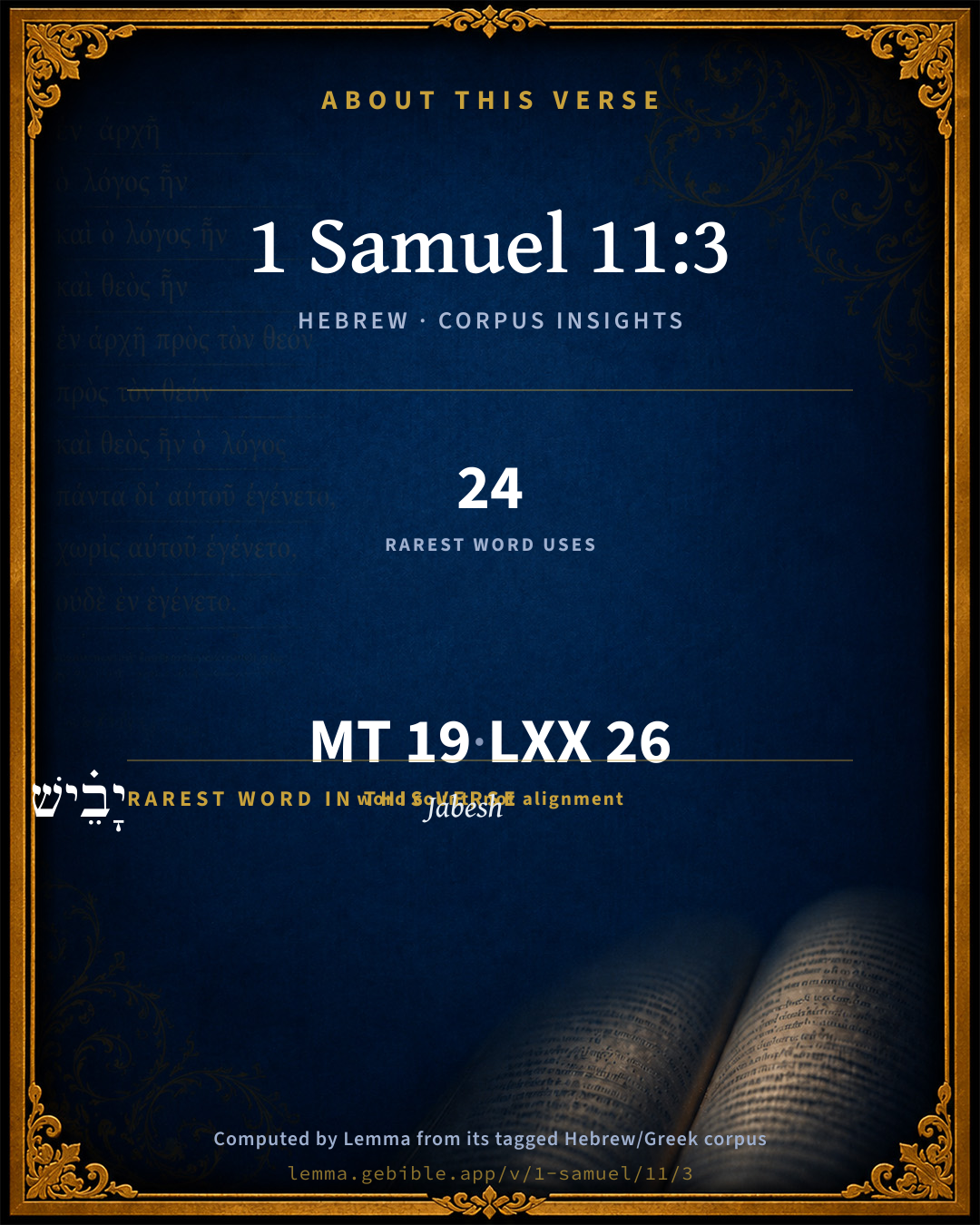
The rarest word here is יָבֵ֗ישׁ Jabesh H3003 — appearing just 24 times in the whole Hebrew Bible.

Shared distinctive vocabulary

יָבֵ֗ישׁ Jabesh H3003 occurs in 21 verses of the Hebrew Bible. Also found in:

Grammatical profile

  • 5 verbs
  • 6 nouns
  • 2 adjectives
  • 3 prepositions
  • 1 conjunction
  • 2 particles

Verb forms

  • וַיֹּאמְר֨וּ Qal · Sequential Imperfect
  • הֶ֤רֶף Hiphil · Imperative
  • וְנִשְׁלְחָה֙ Qal · Cohortative
  • מוֹשִׁ֛יעַ Hiphil · Participle Active
  • וְיָצָ֥אנוּ Qal · Sequential Perfect

Repetition

A word recurs within this verse — often emphatic in Hebrew:

  • אֵלָ֜יו to H413 ×2

Hebrew & Septuagint length

In English translation the verse runs 38 words from the Hebrew and 38 from the Septuagint (LXX English) — the same length.

A rough comparison of the two English renderings, which tokenize alike — not a word-level alignment.

Word counts can differ between the Hebrew and the Greek without any difference in meaning — e.g. the Hebrew direct-object marker אֵת has no separate Greek word, and Greek often adds the article ὁ.

In the original languages it is 19 Hebrew tokens and 26 Greek tokens — but the two are counted differently (Hebrew bundles its prefixes and suffixes into one token; the Greek is in lemma form), so that isn’t a like-for-like length.

Hebrew and Greek witnesses Masoretic Hebrew ↔ Greek Septuagint

The same verse in the two great witnesses to the Old Testament, shown verse-for-verse.

These are two independent witnesses, not word-aligned to each other, and the Septuagint is shown in lemma (dictionary) form.

Hebrew 1 Samuel 11:3 Masoretic · Westminster Leningrad Codex

וַיֹּאמְר֨וּ אֵלָ֜יו זִקְנֵ֣י יָבֵ֗ישׁ הֶ֤רֶף לָ֨נוּ֙ שִׁבְעַ֣ת יָמִ֔ים וְנִשְׁלְחָה֙ מַלְאָכִ֔ים בְּכֹ֖ל גְּב֣וּל יִשְׂרָאֵ֑ל וְאִם אֵ֥ין מוֹשִׁ֛יעַ אֹתָ֖נוּ וְיָצָ֥אנוּ אֵלֶֽיךָ

The elders of Jabesh said to him, Give us seven days' respite, that we may send messengers to all the borders of Israel; and then, if there be none to save us, we will come out to you.

World English Bible · Public Domain

Greek LXX 1 Samuel 11:3 Septuagint · lemma form

καί λέγω αὐτός ὁ ἀνήρ ιαβις ἀναἵημι ἐγώ ἑπτά ἡμέρα καί ἀποστέλλω ἄγγελος εἰς πᾶς ὅριον ἰσραήλ ἐάν μή εἰμί ὁ σώζω ἐγώ ἐκἔρχομαι πρός σύ

And the men of Jabis say to him, Allow us seven days, and we will send messengers into all the coasts of Israel: if there should be no one to deliver us, we will come out to you.

LXX2012 (modern English Septuagint) · Public Domain

Hebrew: Westminster Leningrad Codex (CC BY 4.0). Greek: Septuagint (public domain); English from LXX2012 (modern English Septuagint) (Public Domain). How the Septuagint differs from the Hebrew →

Targum (Aramaic paraphrase)

1

The Targum is the ancient Jewish Aramaic paraphrase of the Hebrew Scriptures — an interpretive translation, not the Hebrew text itself. Onkelos (literal) and Pseudo-Jonathan (expansive) render the Torah, and Jonathan the Prophets. Coverage is partial: where no permissively-licensed English translation exists for a verse, only the Aramaic is shown. This is verse-level text, not a word-by-word alignment to the Hebrew.

  1. Targum Jonathan Prophets (Joshua–Malachi)
    וַאֲמַרוּ לֵיהּ סָבֵי יָבֵשׁ אוֹרִיךְ לָנָא שַׁבְעָא יוֹמִין וְנִשְׁלַח אִזְגַדִין בְּכָל תְּחוּם יִשְׂרָאֵל וְאִם לֵית דְפָרִיק יָתָנָא וְנִפּוֹק לְוָתָךְ:

    (no public-domain English translation for this verse)

    Targum Jonathan — Aramaic: “Mikraot Gedolot” (public domain). English: “Sefaria Community Translation” (CC0 1.0 (public-domain dedication)); “London "Chaldee Paraphrase," 1871” (public domain). Text via Sefaria.

Commentary

Notes on 1 Samuel 11:3 from classic Christian and Jewish commentators (each source and its license shown beneath its notes). The classic Christian expositions comment on the surrounding passage and are grouped to its opening verse, so a note may address several verses; the Jewish commentaries on the Tanakh (Rashi and others) are per-verse, so they appear only where the commentator wrote on this verse.

Lemma curates 59 commentaries, every one of them public domain or Creative Commons licensed, each selected and text-cleaned for this edition rather than reprinted as found. About our sources →

Trapp's Complete Commentary

John Trapp

1Sa 11:3 And the elders of Jabesh said unto him, Give us seven days’ respite, that we may send messengers unto all the coasts of Israel: and then, if [there be] no man to save us, we will come out to thee.

Ver. 3. Give us seven days’ respite.] This the tyrant yielded unto, non ex pietate, sed ex animositate, which proved to be his ruin. Pride goeth before destruction. Meanwhile the men of Jabeshgilead tempted God in setting him a time; but he helped them nevertheless, and made way thereby for Saul’s settlement in his kingdom.

John Trapp, A Commentary or Exposition upon All the Books of the Old and New Testament (1647–1656) — public domain. Text from a community e-Sword module.

Joseph Benson's Commentary

1Sa 11:3. Give us seven days respite — It may seem strange, either that they should propose to submit so soon to such base conditions, if they did not receive help, or that Nahash should grant them so much respite when he saw them so abject and inclined to yield to him. But the reason of both is evident; for the elders of Jabesh thought Saul was not able to help them, having not yet taken upon him the government, but living privately, 1Sa 11:5; and Nahash, it is probable, was loath to drive them to desperation by denying them this short space wherein to expect relief, which he thought they could not possibly obtain in the time, even if Saul should endeavour to levy an army and come to their aid, for that, he would naturally suppose, could not be done in so few days.

Joseph Benson's Commentary on the Old and New Testaments (1811–1818) — public domain. Text from a community e-Sword module.

Tyndale Open Study Notes

Tyndale Open Resources

11:3 Nahash agreed to grant a reprieve of seven days, reflecting his arrogant confidence of victory and his desire to humiliate Israel as much as possible.

Tyndale Open Study Notes — © Tyndale Open Resources, licensed CC BY-SA 4.0. Text via the HelloAO Bible API.

Jamieson, Fausset & Brown

Robert Jamieson, A. R. Fausset & David Brown

send messengers unto all the coasts of Israel--a curious proof of the general dissatisfaction that prevailed as to the appointment of Saul. Those Gileadites deemed him capable neither of advising nor succoring them; and even in his own town the appeal was made to the people--not to the prince.

Jamieson, Fausset & Brown — Commentary Critical and Explanatory on the Whole Bible (1871) — public domain (CC PDM 1.0). Text via the HelloAO Bible API.

Adam Clarke's Commentary

Verse 3. Give us seven days respite] Such promises are frequently made by besieged places: "We will surrender if not relieved in so many days;" and such conditions are generally received by the besiegers.

Adam Clarke's Commentary on the Bible (1810–1826) — public domain. Text from a community e-Sword/MySword module.

Ellicott's Commentary for English Readers

(3) Give us seven days’ respite.—This kind of proposal has always in time of war been a common one; such a request from a beleaguered fortress we meet with constantly, especially in mediæval chronicles. It was, no doubt, made by the citizens in the hope that Saul the Benjamite, in whose election as king they had recently taken a part, would devise some means for their rescue. Between Benjamin and the city of Jabesh-gilead there had long existed the closest ties of friendship. How far back this strange link between the southern tribe and the distant frontier town dated, we know not. When Israel was summoned “as one man” (Judges 21), probably under the direction of Phinehas, the grandson of Aaron, to avenge on Benjamin the crime committed by the men of Gibeah, Jabesh-gilead alone, among the cities of Israel—no doubt, out of its friendship for the sinning tribe—declined to obey the imperious summons, and for this act of disobedience was rased to the ground, and its inhabitants put to the sword. The tribes, however, subsequently regretted their remorseless cruelty in their punishment of Benjamin, and feared lest their brother’s name might perish out of the land; mindful, then, of the old loving feeling which existed between the city of Jabesh-gilead and the tribe of Benjamin, they gave the maidens of the ruined city spared in the judicial massacre perpetrated on the citizens, to the fighting remnant of Benjamin, still defending themselves on the impregnable Rock of the Pomegranate, “Rimmon,” and did what was in their power to restore the ruined and broken tribe. Jabesh-gilead seems to have risen again from its ashes, and Benjamin once more held up its head among the tribes of Israel, and just now had given the first king to the people. No wonder, then, that the city in the hour of its sore need and deadly peril should send for succour to Gibeah in Benjamin, and to Saul, the Benjamite king. Neither the tribe nor the king failed them in their distress.

A Bible Commentary for English Readers, edited by Charles John Ellicott (1878–1897) — public domain. Text from a community e-Sword module.

The Cambridge Bible for Schools and Colleges

gen. ed. J. J. S. Perowne

3. the elders of Jabesh] See note on ch. 1Sa_8:4, and cp. Jdg_11:5 ff.

The Cambridge Bible for Schools and Colleges (gen. ed. J. J. S. Perowne; Cambridge University Press, 1878–1918) — public domain. Text from a community e-Sword module.

John Gill's Exposition

And the elders of Jabesh said,.... The magistrates and principal men of the city:

give us seven days' respite, that we may send messengers to all the coasts of Israel; that is, cease from besieging them, from throwing in darts into the city, or any other missive weapons, and from attempting to break open the gates, or break down the walls of it, and storm it; such a space of time they desire, which was as little as could be granted, to go and return in, and without this it would not be a reproach to all Israel, if they were ill used by them, since they had no knowledge of their case, nor time to come up for their assistance:

and then, if there be no man to save us, we will come out to thee; and submit to be used at thy pleasure. And it seems that this was granted by Nahash out of a bravado, and to reproach and insult all Israel, and bid them defiance; with whom he sought to quarrel, having a design upon their land, and knowing very well their condition, being awed by the Philistines; and having just chosen a king, and he an inexperienced man in the affairs of war, and had no army; nor was it likely that one could be assembled in so short a time, and come to the relief of this people, and therefore he thought himself safe enough in granting their request.

John Gill's Exposition of the Whole Bible (1746–1763) — public domain (CC PDM 1.0). Text via the HelloAO Bible API.

Albert Barnes' Notes on the Bible

The elders - Observe the universal form of civil government among the Israelites, by elders (Jdg 8:14, Jdg 8:16, etc.).

Albert Barnes' Notes on the Bible (1834–1885) — public domain. Text from a community e-Sword/MySword module.

Haydock's Catholic Bible Commentary

Days. We have examples of similar requests in history. (Grotius, Jur. iii. 23.) See Judith vii. 23.

George Leo Haydock (1774–1849), Haydock's Catholic Family Bible and Commentary, 1859 edition — public domain. Excludes Psalms (Douay-Rheims chapter numbering differs from Protestant) and Deuterocanonical books (Catholic canon only).

Matthew Poole's English Annotations

Give us seven days’ respite; which it is very probable, and Josephus and others affirm, that Nahash granted, out of a foolish self-confidence, and contempt of the broken condition of the Israelites, which he thought utterly unable to give them any relief; at least, in so short a time.

Matthew Poole's English Annotations on the Holy Bible (1683–1685) — public domain. Text from a community e-Sword/MySword module.

Whedon's Commentary on the Bible

Daniel D. Whedon

3. Give us seven days’ respite — Literally, Let us alone seven days. They deemed this a sufficient length of time to ascertain whether help could be obtained for them beyond the Jordan. But why, it may be asked, would Nahash, who could dictate such barbarous terms of surrender, allow the defenceless town such an opportunity to strengthen itself? He probably supposed that the tribes on the west of the Jordan were in no condition to render Jabesh any considerable aid, and that it would add all the more to Israel’s reproach to have it said that the inhabitants of Jabesh implored their aid in vain. Josephus tells us that the besieged had already sought in vain for aid from the tribes on the east of the Jordan, and this fact may have made Nahash feel all the more secure. Then, perhaps, he was not just at that time in a condition to take the city easily, in case the besieged should offer a fierce resistance; nor must we forget that Jehovah designed, by this war with the Ammonites, to magnify Saul in the eyes of Israel.

Daniel D. Whedon (gen. ed.), Commentary on the Old and New Testaments (1874–1909) — public domain. Text from a community e-Sword module.

The Pulpit Commentary

The elders who govern the town know nothing of a king having been appointed, nor do they send to Samuel to ask him, as the judge, to protect them; but they request a seven days" respite, that they may send messengers unto all the coasts of Israel, and Nahash, feeling sure that no combined action would be the result, grants their request, that so Israel far and wide might know of his triumph.

The Pulpit Commentary (1880–1919), ed. H.D.M. Spence-Jones & Joseph S. Exell — public domain. Text from a community e-Sword module.

unfoldingWord translationNotes

Door43 World Missions Community

seven days

"7 days" (See: Numbers)

translationWords

elder

send

messenger

save

unfoldingWord translationNotes — © Distant Shores Media and the Door43 World Missions Community, licensed CC BY-SA 4.0. Source: git.door43.org/Door43/en_tn.

Lesson kit

Teaching starters — assembled from the data on this page, not authored interpretation. Every prompt links to the verse data it draws on. Edit before teaching.

1 Samuel, in the Historical, opens this verse with 19 words (17 distinct Hebrew lemmas). Its most distinctive word is Yâbêsh (“Jabesh”). A historical commentator’s framing appears above. Read the whole chapter for the surrounding context.

Discussion questions

  1. How does “Jabesh” (Yâbêsh) shape what this verse is saying?
  2. How does Judges 21:8, which shares the word «Jabesh», read alongside this verse?
  3. What does the repetition of “to” (2× in this one verse) do in this verse?
  4. These translations render this verse differently. What is at stake in choosing one wording over another?
  5. «וַיֹּאמְר֨וּ» is a Qal Sequential Imperfect verb. How does that grammatical form shape the action described?
  6. Compare how Trapp's Complete Commentary and Joseph Benson's Commentary read this verse. Where do they agree or differ?

Things to notice

Reading settings

Reading text

Shown beneath each verse's original-language words.

Old Testament
Old Testament edition

Read the OT as the Masoretic Hebrew (MT) or the Greek Septuagint (LXX).

English shown for the Greek Septuagint (in the Hebrew ↔ Greek comparison).

Comparing translations? Open the Compare panel on any verse page to stack up to four side by side.