
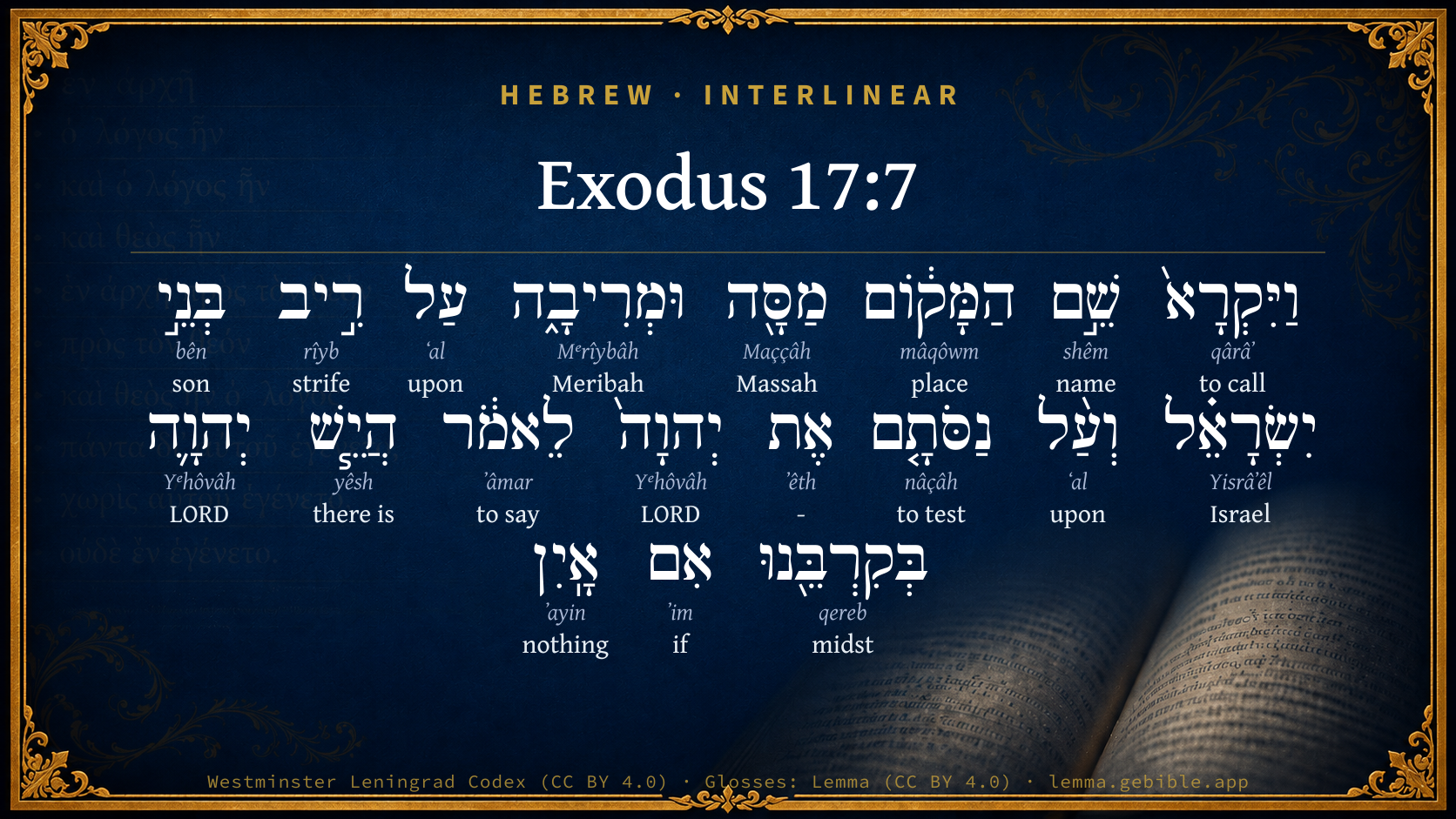
Exodus 17:7

Hebrew (Westminster Leningrad Codex) Exodus 17:7 appears in the Hebrew Old Testament. The text above is from the Westminster Leningrad Codex. Each word links to its Strong’s number, a concise gloss, and parsing drawn from the Open Scriptures Hebrew Bible morphology. Click any word for its full Brown-Driver-Briggs (BDB) entry.
Download image
Cite this verse

Exodus 17:7 (World English Bible). Public Domain. Lemma interlinear Bible study tool, https://lemma.gebible.app/v/exodus/17/7.

Show BibTeX & RIS
BibTeX
RIS
English Translation
He called the name of the place Massah, and Meribah, because the children of Israel quarreled, and because they tested Yahweh, saying, "Is Yahweh among us, or not?"
World English Bible · Public Domain
Highlights
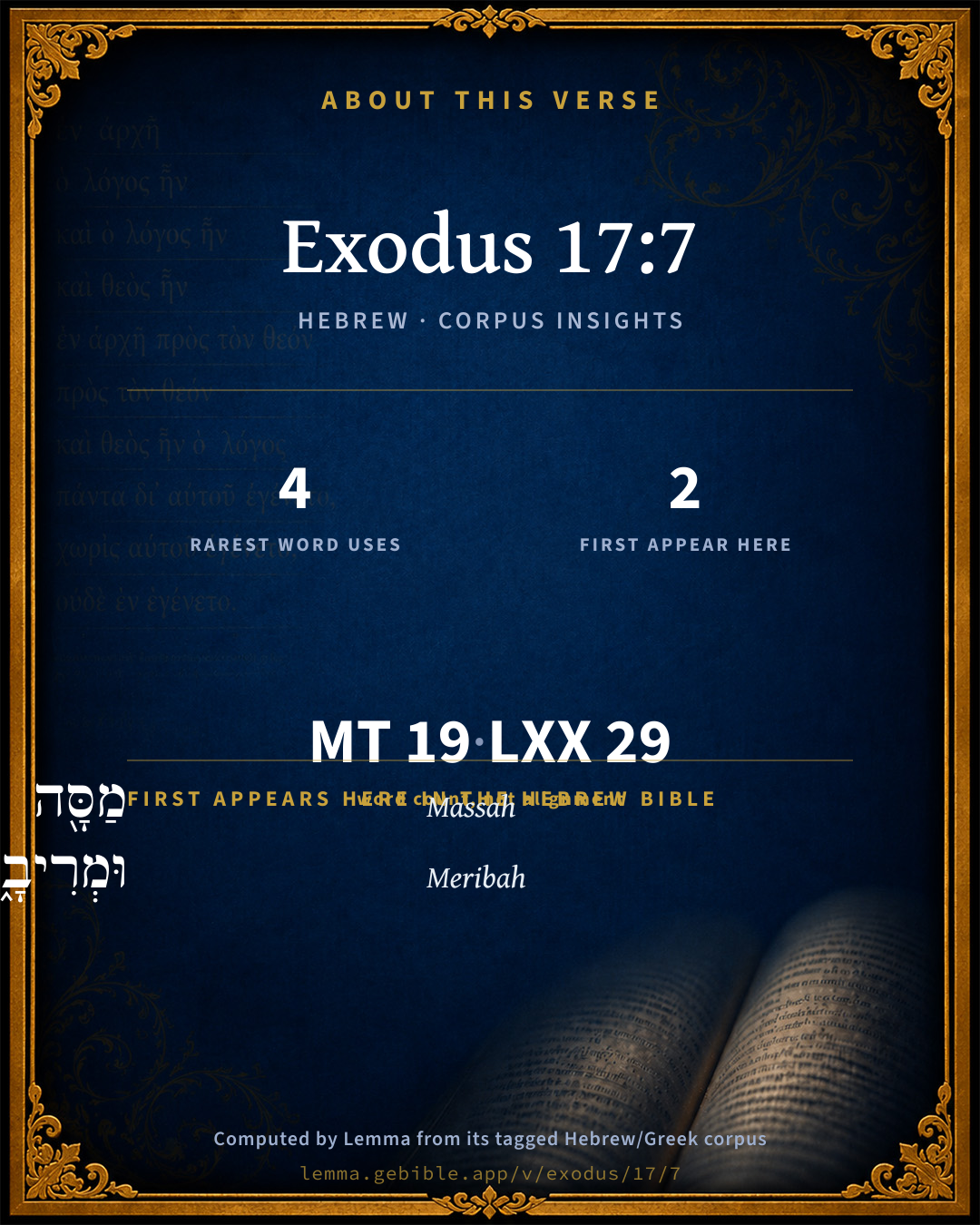
  • 2 first appearances in the Hebrew Bible
Full analysis ↓
Download a study sheet

One document with this verse’s original text, its word-by-word gloss line, the meaning frame, cross-references with their text, attributed commentary, and full source and license credits — printable, and it pastes into notes with its structure intact.

This verse Autodidact and up

Study sheet (.html) Plain text (.txt)

A passage Seminary Student

Up to 50 verses in one chapter. A passage sheet keeps up to 6 commentary sources and 12 cross-references per verse, in the order this page ranks them, and says so on the sheet whenever that leaves anything out. Ask for a single verse and you get the Autodidact verse sheet above.

Everything on this page stays free to read, with no account — the sheet is a download of what is already on screen, not access to it.

Want to remove ads? Support Godless Engineer
Compare translations 3

The same verse in 3 English versions, stacked beneath the original-language interlinear above. Click any original word for its lexicon entry.

Each is an independent rendering of the whole verse — the interlinear is not word-aligned to these translations.

Highlighted words mark where these versions differ — a whole-verse word diff, not a word-by-word alignment.

  • World English Bible Public Domain
    He called the name of the place Massah, and Meribah, because the children of Israel quarreled, and because they tested Yahweh, saying, "Is Yahweh among us, or not?"
  • King James Version Public Domain
    And he called the name of the place Massah, and Meribah, because of the chiding of the children of Israel, and because they tempted the LORD, saying, Is the LORD among us, or not?
  • unfoldingWord Literal Text CC BY-SA 4.0
    And he called the name of the place Massah and Meribah, for the conflict of the sons of Israel and for their testing of Yahweh by saying, “Is Yahweh among us or not?”

unfoldingWord Literal Text — © unfoldingWord, licensed CC BY-SA 4.0. Word-aligned USFM3 via Door43 (git.door43.org/unfoldingWord/en_ult).

Versions to compare (up to 4)

3 of 4 selected

Show all 18 translations

Every available English version of this verse, each an independent rendering of the whole verse.

  • World English Bible Public Domain
    He called the name of the place Massah, and Meribah, because the children of Israel quarreled, and because they tested Yahweh, saying, "Is Yahweh among us, or not?"
  • Berean Standard Bible Public Domain
    He named the place Massah and Meribah because the Israelites quarreled, and because they tested the LORD, saying, “Is the LORD among us or not?”
  • Majority Standard Bible Public Domain
    He named the place Massah and Meribah because the Israelites quarreled, and because they tested the LORD, saying, “Is the LORD among us or not?”
  • King James Version Public Domain
    And he called the name of the place Massah, and Meribah, because of the chiding of the children of Israel, and because they tempted the LORD, saying, Is the LORD among us, or not?
  • American Standard Version (1901) Public Domain
    And he called the name of the place Massah, and Meribah, because of the striving of the children of Israel, and because they tempted Jehovah, saying, Is Jehovah among us, or not?
  • Revised Version (1885) Public Domain
    And he called the name of the place Massah, and Meribah, because of the striving of the children of Israel, and because they tempted the LORD, saying, Is the LORD among us, or not?
  • Geneva Bible (1599) Public Domain
    And he called the name of the place, Massah and Meribah, because of the contention of the children of Israel, and because they had tempted the Lord, saying, Is the Lord among vs, or no?
  • Douay-Rheims (1899) Public Domain
    And he called the name of that place Temptation, because the chiding of the children of Israel, and for that they tempted the Lord, saying: Is the Lord amongst us or not?
  • Young's Literal Translation Public Domain
    and he calleth the name of the place Massah, and Meribah, because of the `strife' of the sons of Israel, and because of their `trying' Jehovah, saying, `Is Jehovah in our midst or not?'
  • Literal Standard Version CC BY-SA 4.0
    and he calls the name of the place Massah, and Meribah, because of the strife of the sons of Israel, and because of their trying YHWH, saying, “Is YHWH in our midst or not?”
  • Unlocked Literal Bible CC BY-SA 4.0
    He called that place Massah and Meribah because of the Israelites' complaining, and because they had tested the Lord by saying, “Is Yahweh among us or not?”
  • unfoldingWord Literal Text CC BY-SA 4.0
    And he called the name of the place Massah and Meribah, for the conflict of the sons of Israel and for their testing of Yahweh by saying, “Is Yahweh among us or not?”
  • Darby Bible Public Domain
    And he called the name of the place Massah, and Meribah, because of the contention of the children of Israel, and because they had tempted Jehovah, saying, Is Jehovah among us, or not?
  • World Messianic Bible Public Domain
    He called the name of the place Massah, and Meribah, because the children of Israel quarreled, and because they tested the LORD, saying, “Is the LORD among us, or not?”
  • Webster's Bible Public Domain
    And he called the name of the place Massah, and Meribah, because of the chiding of the children of Israel, and because they tempted the LORD, saying, Is the LORD among us, or not?
  • Free Bible Version CC BY-SA 4.0
    He called the place Massah and Meribah because the Israelites argued there, and because they challenged the Lord, saying, “Is the Lord with us, or not?”
  • Bible in Basic English Public Domain
    And he gave that place the name Massah and Meribah, because the children of Israel were angry, and because they put the Lord to the test, saying, Is the Lord with us or not?
  • JPS Tanakh (1917) Public Domain
    And the name of the place was called Massah, and Meribah, because of the striving of the children of Israel, and because they tried the LORD, saying: 'Is the LORD among us, or not?'

Literal Standard Version (2020), Covenant Press — licensed CC BY-SA 4.0. Text via the HelloAO Bible API (eBible.org). Unlocked Literal Bible (unfoldingWord) — licensed CC BY-SA 4.0. Text via the HelloAO Bible API (eBible.org). unfoldingWord Literal Text — © unfoldingWord, licensed CC BY-SA 4.0. Word-aligned USFM3 via Door43 (git.door43.org/unfoldingWord/en_ult). Free Bible Version, Dr. Jonathan Gallagher — licensed CC BY-SA 4.0. Text via the HelloAO Bible API (eBible.org).

Word by word

More ways to search: Search by grammar → Find every occurrence → Compare this word →

Practice this passage: Drill this verse → Learn its vocabulary →

מַסָּ֖ה
Maççâh
H4532
“Massah”
Noun, Proper
Part of Speech
Noun
Type
Proper
Full BDB Definition

Origin: the same as H4531

TWOT: None

Massah = "temptation" - the place in the wilderness where the Israelites tested Jehovah - also 'Meribah'
  1. וַיִּקְרָא֙ qârâʼ H7121 “and · to call” Conjunction + Verb, Qal, Sequential Imperfect, 3rd Person, Masculine, Singular
  2. שֵׁ֣ם shêm H8034 “name of” Noun, Common, Masculine, Singular, Construct
  3. הַמָּק֔וֹם mâqôwm H4725 “the · place” Particle, Definite Article + Noun, Common, Masculine, Singular, Absolute
  4. וּמְרִיבָ֑ה Mᵉrîybâh H4809 “and · Meribah” Conjunction + Noun, Proper
  5. עַל ʻal H5921 “upon” Preposition
  6. רִ֣יב rîyb H7379 “strife of” Noun, Common, Both, Singular, Construct
  7. בְּנֵ֣י bên H1121 “sons of” Noun, Common, Masculine, Plural, Construct
  8. יִשְׂרָאֵ֗ל Yisrâʼêl H3478 “Israel” Noun, Proper
  9. וְעַ֨ל ʻal H5921 “and · upon” Conjunction + Preposition
  10. נַסֹּתָ֤ם nâçâh H5254 “to test · them” Verb, Piel, Infinitive Construct + Suffix, Personal, 3rd Person, Masculine, Plural
  11. אֶת ʼêth H853 “-” Particle, Direct Object
  12. יְהוָה֙ Yᵉhôvâh H3068 “LORD” Noun, Proper
  13. לֵאמֹ֔ר ʼâmar H559 “to say” Preposition + Verb, Qal, Infinitive Construct
  14. הֲיֵ֧שׁ yêsh H3426 “there is” Particle, Interrogative + Particle, Demonstrative
  15. יְהוָ֛ה Yᵉhôvâh H3068 “LORD” Noun, Proper
  16. בְּקִרְבֵּ֖נוּ qereb H7130 “in/at · midst · our” Preposition + Noun, Common, Masculine, Singular, Construct + Suffix, Personal, 1st Person, Common, Plural
  17. אִם ʼim H518 “if” Conjunction
  18. אָֽיִן ʼayin H369 “nothing” Particle, Negative

About this verse

These counts appear in no published source. They are computed here, from the morphology-tagged text and Lemma’s own curated glosses. What Lemma adds →

19
words
17
distinct lemmas
Pentateuch
section

Notable vocabulary

The rarest word here is מַסָּ֖ה Massah H4532 — appearing just 4 times in the whole Hebrew Bible.

First appearance in Scripture

These words make their first canonical appearance in the Hebrew Bible here:

  • מַסָּ֖ה Massah H4532
  • וּמְרִיבָ֑ה Meribah H4809

Shared distinctive vocabulary

מַסָּ֖ה Massah H4532 occurs in 4 verses of the Hebrew Bible. Also found in:

Grammatical profile

  • 3 verbs
  • 10 nouns
  • 2 prepositions
  • 1 conjunction
  • 3 particles

Verb forms

  • וַיִּקְרָא֙ Qal · Sequential Imperfect
  • נַסֹּתָ֤ם Piel · Infinitive Construct
  • לֵאמֹ֔ר Qal · Infinitive Construct

Repetition

Words recur within this verse — often emphatic in Hebrew:

  • עַל upon H5921 ×2
  • יְהוָה֙ LORD H3068 ×2

Hebrew & Septuagint length

In English translation the verse runs 28 words from the Hebrew and 34 from the Septuagint (LXX English) — closely comparable.

A rough comparison of the two English renderings, which tokenize alike — not a word-level alignment.

Word counts can differ between the Hebrew and the Greek without any difference in meaning — e.g. the Hebrew direct-object marker אֵת has no separate Greek word, and Greek often adds the article ὁ.

In the original languages it is 19 Hebrew tokens and 29 Greek tokens — but the two are counted differently (Hebrew bundles its prefixes and suffixes into one token; the Greek is in lemma form), so that isn’t a like-for-like length.

Cross-references

14

Topical passages linked to Exodus 17:7 in the Treasury of Scripture Knowledge — connected by theme and wording, ordered by reader-vote popularity; previews shown in the World English Bible.

  • Psalms 81:7 You called in trouble, and I delivered you. I answered you in the secret place of thunder. I tested you at the waters of Meribah." Selah.
  • Numbers 20:13 These are the waters of Meribah; because the children of Israel strove with Yahweh, and he was sanctified in them.
  • Psalms 95:8 Don't harden your heart, as at Meribah, As in the day of Massah in the wilderness,
  • Deuteronomy 9:22 At Taberah, and at Massah, and at Kibroth-hattaavah, you provoked Yahweh to wrath.
  • Exodus 17:2 Therefore the people quarreled with Moses, and said, "Give us water to drink." Moses said to them, "Why do you quarrel with me? Why do you test Yahweh?"
  • Hebrews 3:8–9 Don't harden your hearts, as in the provocation, Like as in the day of the trial in the wilderness,
  • Numbers 20:24 Aaron shall be gathered to his people; for he shall not enter into the land which I have given to the children of Israel, because you rebelled against my word at the waters of Meribah.
  • Acts 7:37–39 This is that Moses, who said to the children of Israel, 'The Lord our God will raise up a prophet for you from among your brothers, like me.'
  • Exodus 34:9 He said, "If now I have found favor in your sight, Lord, please let the Lord go in the midst of us; although this is a stiff-necked people; pardon our iniquity and our sin, and take us for your inheritance."
  • Deuteronomy 31:17 Then my anger shall be kindled against them in that day, and I will forsake them, and I will hide my face from them, and they shall be devoured, and many evils and troubles shall come on them; so that they will say in that day, Haven't these evils come on us because our God is not among us?
  • Joshua 22:31 Phinehas the son of Eleazar the priest said to the children of Reuben, and to the children of Gad, and to the children of Manasseh, This day we know that Yahweh is in the midst of us, because you have not committed this trespass against Yahweh: now have you delivered the children of Israel out of the hand of Yahweh.
  • Isaiah 12:6 Cry aloud and shout, you inhabitant of Zion; for great in the midst of you is the Holy One of Israel!"
  • Micah 3:11 Her leaders judge for bribes, And her priests teach for a price, And her prophets of it tell forturnes for money: Yet they lean on Yahweh, and say, Isn't Yahweh in the midst of us? No disaster will come on us.
  • John 1:14 The Word became flesh, and lived among us. We saw his glory, such glory as of the one and only Son of the Father, full of grace and truth.

Cross-references courtesy of OpenBible.info (CC BY 4.0).

Hebrew and Greek witnesses Masoretic Hebrew ↔ Greek Septuagint

The same verse in the two great witnesses to the Old Testament, shown verse-for-verse.

These are two independent witnesses, not word-aligned to each other, and the Septuagint is shown in lemma (dictionary) form.

Hebrew Exodus 17:7 Masoretic · Westminster Leningrad Codex

וַיִּקְרָא֙ שֵׁ֣ם הַמָּק֔וֹם מַסָּ֖ה וּמְרִיבָ֑ה עַל רִ֣יב בְּנֵ֣י יִשְׂרָאֵ֗ל וְעַ֨ל נַסֹּתָ֤ם אֶת יְהוָה֙ לֵאמֹ֔ר הֲיֵ֧שׁ יְהוָ֛ה בְּקִרְבֵּ֖נוּ אִם אָֽיִן

He called the name of the place Massah, and Meribah, because the children of Israel quarreled, and because they tested Yahweh, saying, "Is Yahweh among us, or not?"

World English Bible · Public Domain

Greek LXX Exodus 17:7 Septuagint · lemma form

καί ἐπιὀνομάζω ὁ ὄνομα ὁ τόπος ἐκεῖνος πειρασμός καί λοιδόρησις διά ὁ λοιδορία ὁ υἱός ἰσραήλ καί διά ὁ πειράζω κύριος λέγω εἰ εἰμί κύριος ἐν ἐγώ ἤ οὐ

And he called the name of that place, Temptation, and Reviling, because of the reviling of the children of Israel, and because they tempted the Lord, saying, Is the Lord among us or not?

LXX2012 (modern English Septuagint) · Public Domain

Hebrew: Westminster Leningrad Codex (CC BY 4.0). Greek: Septuagint (public domain); English from LXX2012 (modern English Septuagint) (Public Domain). How the Septuagint differs from the Hebrew →

Targum (Aramaic paraphrase)

2

The Targum is the ancient Jewish Aramaic paraphrase of the Hebrew Scriptures — an interpretive translation, not the Hebrew text itself. Onkelos (literal) and Pseudo-Jonathan (expansive) render the Torah, and Jonathan the Prophets. Coverage is partial: where no permissively-licensed English translation exists for a verse, only the Aramaic is shown. This is verse-level text, not a word-by-word alignment to the Hebrew.

  1. Targum Onkelos Torah (Genesis–Deuteronomy)
    וּקְרָא שְׁמָא דְאַתְרָא נִסֵיתָא וּמַצוּתָא עַל דִנְצוֹ בְּנֵי יִשְׂרָאֵל וְעַל דְנַסִיאוּ קֳדָם יְיָ לְמֵימַר הֲאִית שְׁכִינְתָּא דַיְיָ בֵּינָנָא אִם לָא:

    (no public-domain English translation for this verse)

    Targum Onkelos — Aramaic: “Onkelos Genesis” (public domain); “Onkelos Exodus” (public domain); “Onkelos Leviticus” (public domain); “Onkelos Numbers” (public domain); “Onkelos Deuteronomy” (public domain). English: “Sefaria Community Translation” (CC0 1.0 (public-domain dedication)); “J.W. Etheridge. The Targums of Onkelos and Jonathan Ben Uzziel on the Pentateuch. London: Longmans, Green, 1862” (public domain). Text via Sefaria.

  2. Targum Pseudo-Jonathan Torah (Genesis–Deuteronomy)
    וּקְרָא שְׁמָא דְאַתְרָא הַהוּא נִסְיוֹנָא וּמַצּוּתָא בְּגִין דְּנָצוּ בְּנֵי יִשְרָאֵל עִם משֶׁה וּבְגִין דְּנַסְיַין קֳדָם יְיָ לְמֵימַר הַאִין קוּשְׁטָא אִיקַר שְׁכִינְתָּא דַיְיָ שַׁרְיָא בֵּינָנָא אִין לָא

    And he called the name of that place Temptation and Strife; because there the sons of Israel contended with Mosheh, and because they tempted the Lord, saying, Doth the glory of the majesty of the Lord truly dwell among us, or not?

    Targum Pseudo-Jonathan — Aramaic: “Targum Jonathan on Genesis” (public domain); “Targum Jonathan on Exodus” (public domain); “Targum Jonathan on Leviticus” (public domain); “Targum Jonathan on Numbers” (public domain); “Targum Jonathan on Deuteronomy” (public domain). English: “The Targum of Jonathan ben Uzziel, trans. J. W. Etheridge, London, 1862” (public domain). Text via Sefaria.

Commentary

Notes on Exodus 17:7 from classic Christian and Jewish commentators (each source and its license shown beneath its notes). The classic Christian expositions comment on the surrounding passage and are grouped to its opening verse, so a note may address several verses; the Jewish commentaries on the Tanakh (Rashi and others) are per-verse, so they appear only where the commentator wrote on this verse.

Lemma curates 59 commentaries, every one of them public domain or Creative Commons licensed, each selected and text-cleaned for this edition rather than reprinted as found. About our sources →

Trapp's Complete Commentary

John Trapp

Exo 17:7 And he called the name of the place Massah, and Meribah, because of the chiding of the children of Israel, and because they tempted the LORD, saying, Is the LORD among us, or not?

Ver. 7. Is the Lord among us?] As if that could not be, and they athirst. But he is most present when he afflicts. "He knows our souls in adversity." {Psa 31:7}

John Trapp, A Commentary or Exposition upon All the Books of the Old and New Testament (1647–1656) — public domain. Text from a community e-Sword module.

The Biblical Illustrator

Joseph S. Exell

Exo_17:7

Is the Lord among us, or not?

Evidences of the Divine presence

I. We observe an increase of spiritual enlightenment is an evidence of the Divine presence among a people.

II. We observe spiritual-mindedness is an evidence of the Divine presence among a people.

III. We observe Christian love is an evidence of the Divine presence among a people.

IV. Activity and devotedness in the cause of Christ is an evidence of the Divine presence among a people. We have three remarks in conclusion--

1. The unrenewed may learn from this subject that there is no hope for him of any radical improvement save in the grace of God. The Holy Spirit is the sole agent for this work.

2. The Church of God should learn from this subject that the grace and presence of the Lord in the midst of them is the one thing needful.

3. Let all know that the Lord is to be found in the power and sufficiency of His grace by all who seek Him through the Saviour. (H. F. Holmes.)

Is the Lord among us, or not?-a false inference

Notwithstanding all the other tokens of Gods presence they thought that their renewed difficulties were a proof that God was no longer amongst them. And are not our hearts far too apt to come to the same conclusion on the same grounds? We enter on some new path, on some fresh work, because we think that the hand of God is leading us to it, and, almost unconsciously to ourselves, we suppose that His presence will secure us from any great and discouraging difficulties. Our expectations are disappointed--one difficulty after another presents itself--one door after another is closed. What follows? Too often doubts begin to arise in our minds whether God is really with us. But these doubts should not be encouraged. It is altogether a false inference, that because our path is one of difficulty or trial, therefore the Lord is not among us. The very reverse will usually be found to be the true conclusion. (G. Wagner.)

The Biblical Illustrator, edited by Joseph S. Exell (c. 1880s–1900s) — public domain. Text from a community e-Sword module.

Joseph Benson's Commentary

Exo 17:7. Is the Lord among us or not? — To protect and provide for us according to his word; will he be as good as his word, or will he not? Words which implied that to them it was very doubtful. Against doubts of this kind we ought constantly to guard. For, whatever may be suggested to our minds by the enemy of our souls, we ought never to question whether God will be gracious to those that desire and endeavour to follow him in the ways of his appointment.

Joseph Benson's Commentary on the Old and New Testaments (1811–1818) — public domain. Text from a community e-Sword module.

Geneva Bible (1599)

Geneva Bible translators

Or, tentation.

Or, strife.

When in adversity we think God to be absent, then we neglect his promise, and make him a liar.

Geneva Bible (1599) marginal notes — public domain. Text via Bolls.life.

Jamieson, Fausset & Brown

Robert Jamieson, A. R. Fausset & David Brown

called the name of the place--Massah ("temptation"); Meribah ("chiding," "strife"): the same word which is rendered "provocation" (Heb 3:8).

Jamieson, Fausset & Brown — Commentary Critical and Explanatory on the Whole Bible (1871) — public domain (CC PDM 1.0). Text via the HelloAO Bible API.

Adam Clarke's Commentary

Verse 7. He called the name of the place Massah, and Meribah] מסה Massah signifies temptation or trial; and מריבה Meribah, contention or litigation. From 1Co 10:4, we learn that this rock was a type of Christ, and their drinking of it is represented as their being made partakers of the grace and mercy of God through Christ Jesus; and yet many who drank fell and perished in the wilderness in the very act of disobedience! Reader, be not high minded, but fear!

On the smiting of the rock by the rod of Moses, Mr. Ainsworth has the following pious note: "This rock signified Christ, and is therefore called a spiritual Rock, 1Co 10:4. He being smitten with Moses's rod, and bearing the curse of the law for our sins, and by the preaching of the Gospel crucified among his people, Ga 3:1, from him floweth the spiritual drink wherewith all believing hearts are refreshed." Joh 7:37, and Isa 53:1-3.

Adam Clarke's Commentary on the Bible (1810–1826) — public domain. Text from a community e-Sword/MySword module.

Ellicott's Commentary for English Readers

(7) Massah means trial, or temptation, being formed from the root used in Exo_17:2 (“Wherefore do ye tempt the Lord ?”) It is the word translated by “trial” in Job_9:23, and by “temptation” in Deu_4:34; Deu_7:19; Deu_29:3, and Psa_95:8.

Meribah means chiding, or quarrel, and is from the root rub, or rib, translated “chide” in Exo_17:2, and rendered elsewhere generally by “strive,” or “contend.” The name Meribah was given also to the place where water was again produced miraculously by Moses striking the rock (Num_20:13.) It is this latter “Meribah” to which reference is made in Deu_33:8, and Psa_81:7, and which is called by way of distinction in Deu_32:51, “Meribah-Kadesh.”

A Bible Commentary for English Readers, edited by Charles John Ellicott (1878–1897) — public domain. Text from a community e-Sword module.

The Cambridge Bible for Schools and Colleges

gen. ed. J. J. S. Perowne

7. Massah] i.e. ‘Proving,’ from nissâh, to ‘prove,’ v. 2.

Meribah] i.e. ‘Strife’ (Gen_13:8), from rîb, to ‘strive,’ v. 2. In Num_20:1-13 (J and P) there is a similar account, which reads like a variant tradition, of water produced by Moses from a rock (séla‘, not ṣûr as here) at Kadesh (‘Ain Ḳadish, 50 miles S. of Beersheba), the spring being afterwards called, from the fact that the Israelites ‘strove’ there with Jehovah, the ‘waters of Meribah’ (vv. 3, 13 al.), or ‘of Meribath-Kadesh’ (Num_27:14, Eze_48:28 al.). It is strange in the present narrative that one place should receive two names; it is doubtless due, as suggested above, to the combination of two narratives. Massah is mentioned besides in Deu_6:16; Deu_9:22; Deu_33:8 (|| ‘the waters of Meribah,’ Numbers 20.), Psa_95:8 (|| ‘Meribah’).

tempted the Lord] put Jehovah to the proof: see on v. 2.

The Cambridge Bible for Schools and Colleges (gen. ed. J. J. S. Perowne; Cambridge University Press, 1878–1918) — public domain. Text from a community e-Sword module.

John Gill's Exposition

And he called the name of the place Massah, and Meribah,.... The former signifies "temptation", and the latter "contention": the reason of which names being given by Moses, or whoever was the name of the place, follows: "because of the chiding of the children of Israel"; that was the reason why it was called by the last name, Meribah, because here, the Israelites chid and contended with Moses, and used him opprobriously:

and because they tempted the Lord; therefore it had the former name of Massah:

saying, is the Lord among us or not? as if they should say, if we perish through thirst, the Lord is not among us, nor takes any care of us; nor was it he that brought us out of Egypt, but Moses; nor is he in the pillar of cloud and fire, as is said; but if he works a miracle, and gives us water, for us, our children, and cattle, then it will appear he is among us; and thus they tempted the Lord, though without this they had full proof, by many instances, that he was among them, and even in a very extraordinary manner.

John Gill's Exposition of the Whole Bible (1746–1763) — public domain (CC PDM 1.0). Text via the HelloAO Bible API.

Albert Barnes' Notes on the Bible

Massah ...Meribah - See the margin. On the importance of this lesson see our Lord’s words, Mat 4:7.

Albert Barnes' Notes on the Bible (1834–1885) — public domain. Text from a community e-Sword/MySword module.

Haydock's Catholic Bible Commentary

Temptation. Massa and Meriba "quarrel," as the Hebrew reads.

George Leo Haydock (1774–1849), Haydock's Catholic Family Bible and Commentary, 1859 edition — public domain. Excludes Psalms (Douay-Rheims chapter numbering differs from Protestant) and Deuterocanonical books (Catholic canon only).

Matthew Poole's English Annotations

viz. To protect and provide for us according to his word given to us. Will God be as good as his word, or will he not? For it is to us very doubtful.

Matthew Poole's English Annotations on the Holy Bible (1683–1685) — public domain. Text from a community e-Sword/MySword module.

Whedon's Commentary on the Bible

Daniel D. Whedon

7. Massah — Temptation.

Meribah — Strife.

Daniel D. Whedon (gen. ed.), Commentary on the Old and New Testaments (1874–1909) — public domain. Text from a community e-Sword module.

The Pulpit Commentary

He called the name of the place Massah. Massah is from the root nasah, "to try," or "tempt," and means "trial" or "temptation." Meribah is from rub, "to chide, quarrel," and means "contention, chiding, strife." Moses gave the same name to the place near Kadesh, where water was once more brought out of the rock, near the end of the wanderings. (Num_20:13; Deu_32:51; Psa_106:32)

HOMILIES BY G. A. GOODHART Ver. 7. They tempted God in the desert.

Illustration. Child cries; parent sends for doctor; pleasant medicine is prescribed. Later the child cries again; cry is apparently addressed to parent, but real aim is to see if the doctor will give more pleasant medicine. Chiding with the parent is a cover for experimenting upon the doctor. Here previous murmuring against Moses had resulted (Exo_16:2-5) in food from God. The people would see whether like conduct might not lead to a like result; they chode with Moses, but, in reality, they were tempting trying experiments upon God. Notice:

I THE CHIDING (ver. 2). An outward manifestation of displeasure against the visible leader. Why should Moses have brought them, thirsting, to this barren and inhospitable spot? The fact that their journeys were "according to the commandment of Jehovah" (ver. 1) is altogether forgotten or ignored. Not a rare offence: the people, displeased, blame the minister, quite forgetting that he has a master other than themselves. Churches are called Eben-ezers and the like; they might often as truly be called Meribahs. The question which must be put in such cases is one not easy to answer: "Why strive ye with me?" The answer is involved in that other question which few grumblers care to face do ye tempt Jehovah?" Chiding can only be passed on with the motive which inspires it to its true object; he who tries to answer it otherwise does but stand in God"s light, doing that which Joash declined to do for Baal, (Jud_1:6:31) and which, with yet more reason, God"s servants had best abstain from in his cause.

II THE TEMPTATION. The inner motive for the outward manifestation was to see whether God was really among them, and would indicate his presence by supporting his servant. He had given quails and bread, would he now shield Moses by supplying the demand for water? Observe

1. The favourable side of the offence. The people remembered that God had helped, whence they inferred that he might help again. Memory fed hope. So far it was well. Memory, however, was but half instructed, The remembered gift was more thought of than the giver. Hope was not faith; it could not prompt the prayer of faith. God was not regarded as he should have been, and consequently men could not state their needs with confidence, "nothing doubting.

2. The unfavourable side of the offense. Jehovah, they thought, was the friend, if of any one, of Moses. They regarded him as a being apart, quite as likely to be their enemy as the enemy of the Egyptians. Perhaps, however, if they put his friend in difficulties, to help his friend he might appease them. Is not the same thought latent still in like cases? "If the minister is a good man, God will help him, and we shall be the gainers. If not, we shall get quit of him, and possibly his successor may remedy his defects." A kind of witches" ordeal from which the accusers hope to profit any way. Trouble should strengthen trust, and when it does, trust will be rewarded. Beware, however, lest imperfect trust take the form of temptation. God will justify his own elect, but experiments made on him are apt to recoil on the experimenters.

III THE RESULT (vers. 5, 6). The people spoke at God instead of to him. Moses, instead of being the channel for their prayers, was the rock whence might echo their complaints. God, in answer, draws himself yet further off from the complainers. They get their water; but they lose that which they might have had as well, the sense of the presence of their God. The experiment was successful, physical thirst was slaked; it was also a disastrous failure: instead of gaining a strong assurance that God was indeed among them, they gained rather a confirmation of their suspicion that he was not among them, but at a distance.

Conclusion. Beware how you tempt God. Whether is it better to endure discomfort and have a nearer sense of his presence, or to escape discomfort and endure his absence? Thirst endured trustfully must have brought the Israelites such a realisation of the Divine presence as would have quenched, what was worse than thirst, the irrepressible desire to murmur. Temporary satisfaction then, as ever, thus obtained, led on to yet deeper doubt. G.

The Pulpit Commentary (1880–1919), ed. H.D.M. Spence-Jones & Joseph S. Exell — public domain. Text from a community e-Sword module.

Lesson kit

Teaching starters — assembled from the data on this page, not authored interpretation. Every prompt links to the verse data it draws on. Edit before teaching.

Exodus, in the Pentateuch, opens this verse with 19 words (17 distinct Hebrew lemmas). Its most distinctive word is Maççâh (“Massah”). A historical commentator’s framing appears above. Read the whole chapter for the surrounding context.

Discussion questions

  1. The word Maççâh carries the sense “Massah.” How does it shape the verse?
  2. 2 words make their first appearance in Scripture here. What does this debut establish?
  3. How does Deuteronomy 6:16, which shares the word «Massah», read alongside this verse?
  4. What does the repetition of “upon” (2× in this one verse) do in this verse?
  5. The translations on this page render this verse differently — a whole-verse word diff, not a word-by-word alignment. What might account for the different wordings?
  6. «וַיִּקְרָא֙» is a Qal Sequential Imperfect verb. How does that grammatical form shape the action described?
  7. Compare how Trapp's Complete Commentary and The Biblical Illustrator read this verse. Where do they agree or differ?

Things to notice

Reading settings

Reading text

Shown beneath each verse's original-language words.

Old Testament
Old Testament edition

Read the OT as the Masoretic Hebrew (MT) or the Greek Septuagint (LXX).

English shown for the Greek Septuagint (in the Hebrew ↔ Greek comparison).

Comparing translations? Open the Compare panel on any verse page to stack up to four side by side.