Exodus 22:3

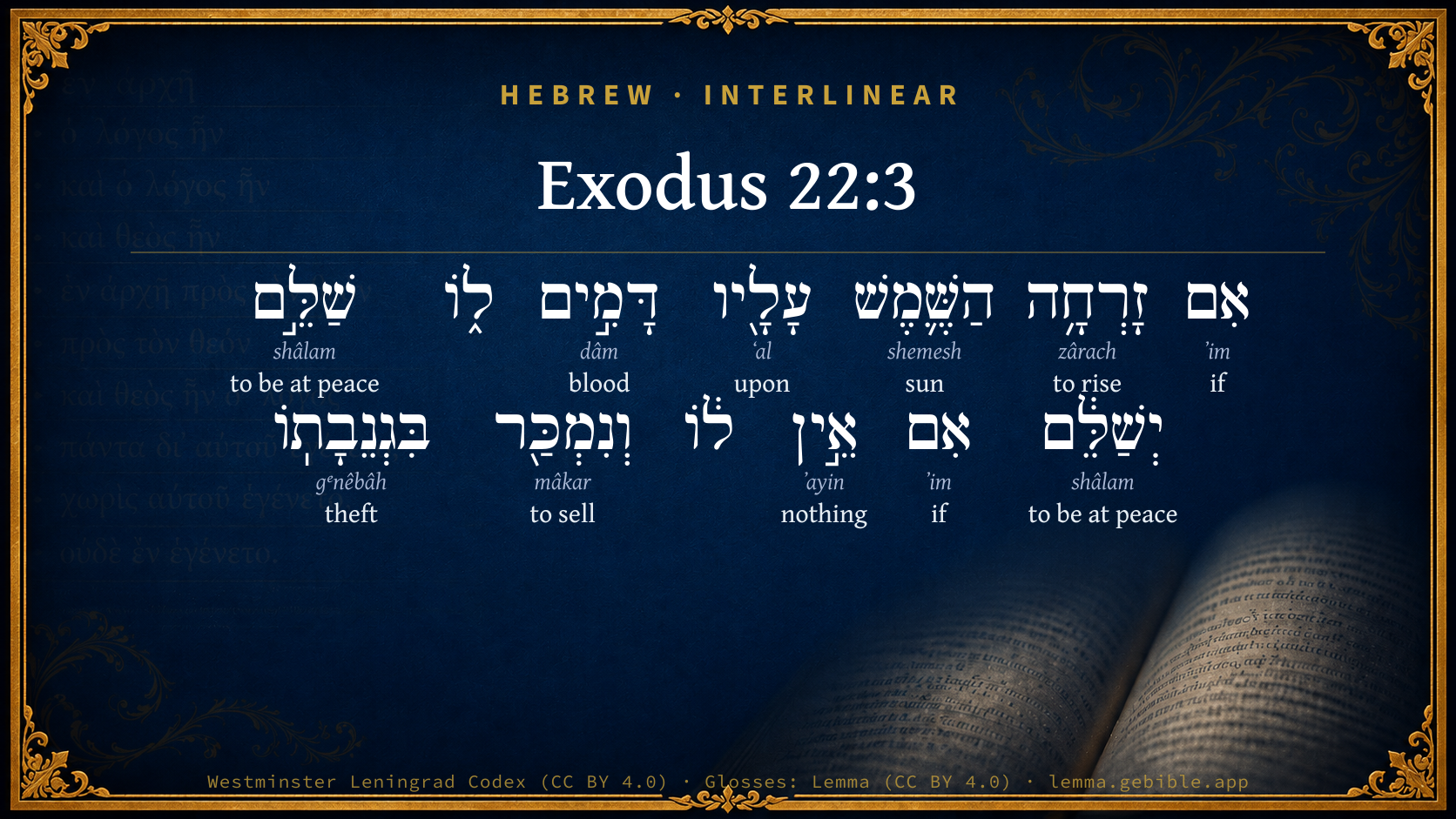
Hebrew (Westminster Leningrad Codex) Exodus 22:3 appears in the Hebrew Old Testament. The text above is from the Westminster Leningrad Codex. Each word links to its Strong’s number, a concise gloss, and parsing drawn from the Open Scriptures Hebrew Bible morphology. Click any word for its full Brown-Driver-Briggs (BDB) entry.
Download image
Cite this verse

Exodus 22:3 (World English Bible). Public Domain. Lemma interlinear Bible study tool, https://lemma.gebible.app/v/exodus/22/3.

Show BibTeX & RIS
BibTeX
RIS
English Translation
If the sun has risen on him, there shall be guilt of bloodshed for him; he shall make restitution. If he has nothing, then he shall be sold for his theft.
World English Bible · Public Domain
Highlights
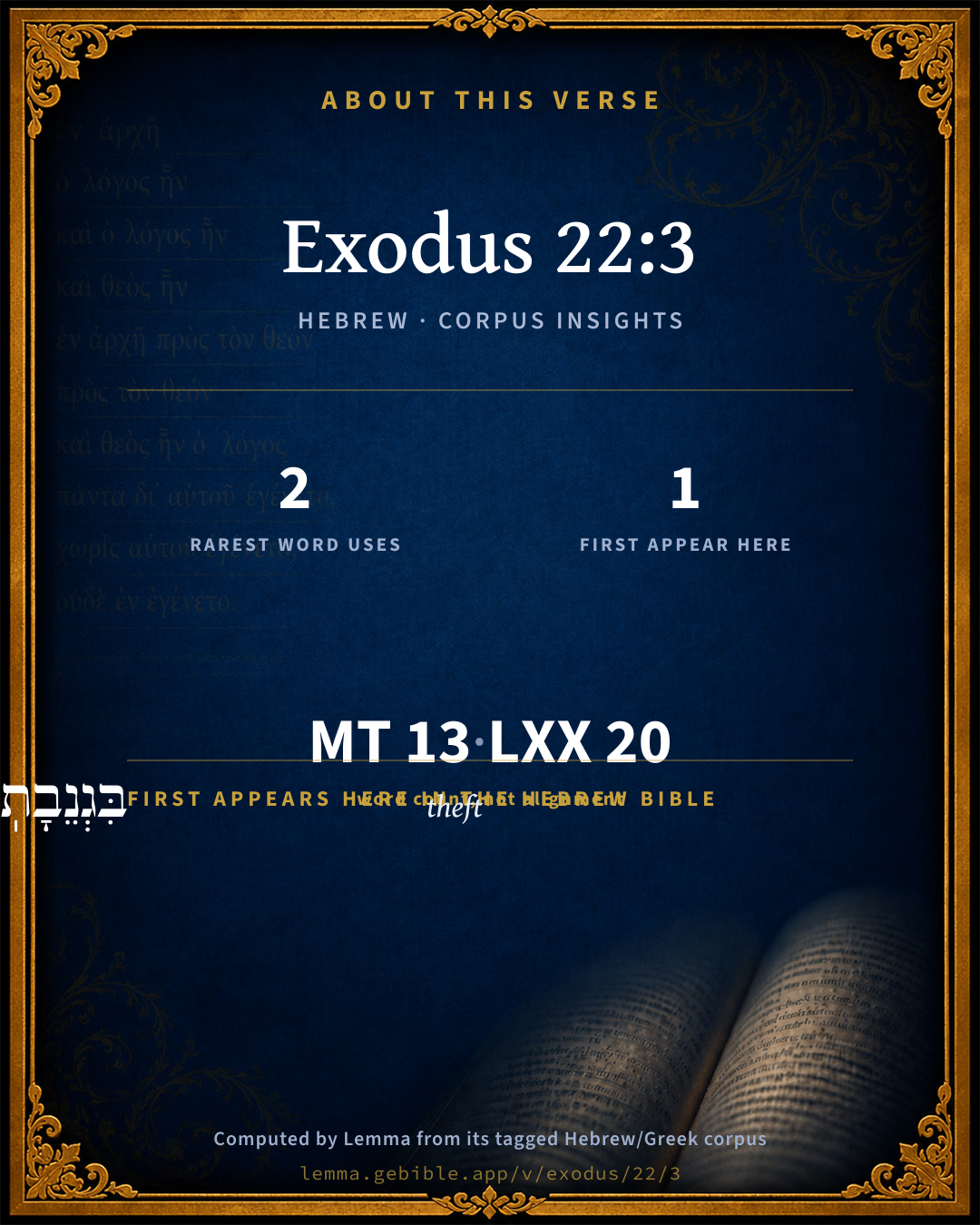
  • 1 first appearance in the Hebrew Bible
Full analysis ↓
Download a study sheet

One document with this verse’s original text, its word-by-word gloss line, the meaning frame, cross-references with their text, attributed commentary, and full source and license credits — printable, and it pastes into notes with its structure intact.

This verse Autodidact and up

Study sheet (.html) Plain text (.txt)

A passage Seminary Student

Up to 50 verses in one chapter. A passage sheet keeps up to 6 commentary sources and 12 cross-references per verse, in the order this page ranks them, and says so on the sheet whenever that leaves anything out. Ask for a single verse and you get the Autodidact verse sheet above.

Everything on this page stays free to read, with no account — the sheet is a download of what is already on screen, not access to it.

Want to remove ads? Support Godless Engineer
Compare translations 3

The same verse in 3 English versions, stacked beneath the original-language interlinear above. Click any original word for its lexicon entry.

Each is an independent rendering of the whole verse — the interlinear is not word-aligned to these translations.

Highlighted words mark where these versions differ — a whole-verse word diff, not a word-by-word alignment.

  • World English Bible Public Domain
    If the sun has risen on him, there shall be guilt of bloodshed for him; he shall make restitution. If he has nothing, then he shall be sold for his theft.
  • King James Version Public Domain
    If the sun be risen upon him, there shall be blood shed for him; for he should make full restitution; if he have nothing, then he shall be sold for his theft.
  • unfoldingWord Literal Text CC BY-SA 4.0
    But if the sun has risen on him, there is bloodguilt for him. He shall surely make restitution. If he has nothing, then he shall be sold for his theft.

unfoldingWord Literal Text — © unfoldingWord, licensed CC BY-SA 4.0. Word-aligned USFM3 via Door43 (git.door43.org/unfoldingWord/en_ult).

Versions to compare (up to 4)

3 of 4 selected

Show all 18 translations

Every available English version of this verse, each an independent rendering of the whole verse.

  • World English Bible Public Domain
    If the sun has risen on him, there shall be guilt of bloodshed for him; he shall make restitution. If he has nothing, then he shall be sold for his theft.
  • Berean Standard Bible Public Domain
    But if it happens after sunrise, there is guilt for his bloodshed. A thief must make full restitution; if he has nothing, he himself shall be sold for his theft.
  • Majority Standard Bible Public Domain
    But if it happens after sunrise, there is guilt for his bloodshed. A thief must make full restitution; if he has nothing, he himself shall be sold for his theft.
  • King James Version Public Domain
    If the sun be risen upon him, there shall be blood shed for him; for he should make full restitution; if he have nothing, then he shall be sold for his theft.
  • American Standard Version (1901) Public Domain
    If the sun be risen upon him, there shall be bloodguiltiness for him; he shall make restitution: if he have nothing, then he shall be sold for his theft.
  • Revised Version (1885) Public Domain
    If the sun be risen upon him, there shall be bloodguiltiness for him: he should make restitution; if he have nothing, then he shall be sold for his theft.
  • Geneva Bible (1599) Public Domain
    But if it be in the day light, blood shall be shed for him: for he should make full restitution: if he had not wherewith, then shoulde he bee solde for his theft.
  • Douay-Rheims (1899) Public Domain
    But if he did this when the sun is risen, he hath committed murder, and he shall die. If he have not wherewith to make restitution for the theft, he shall be sold.
  • Young's Literal Translation Public Domain
    if the sun hath risen upon him, blood `is' for him, he doth certainly repay; if he have nothing, then he hath been sold for his theft;
  • Literal Standard Version CC BY-SA 4.0
    if the sun has risen on him, blood [is] for him, he certainly repays; if he has nothing, then he has been sold for his theft;
  • Unlocked Literal Bible CC BY-SA 4.0
    But if the sun has risen before he breaks in, guilt for murder will attach to the person who kills him. A thief must make restitution. If he has nothing, then he must be sold for his theft.
  • unfoldingWord Literal Text CC BY-SA 4.0
    But if the sun has risen on him, there is bloodguilt for him. He shall surely make restitution. If he has nothing, then he shall be sold for his theft.
  • Darby Bible Public Domain
    If the sun be risen on him, there shall be blood-guiltiness for him; he should have made full restitution: if he had nothing, he would have been sold for his theft.
  • World Messianic Bible Public Domain
    If the sun has risen on him, he is guilty of bloodshed. He shall make restitution. If he has nothing, then he shall be sold for his theft.
  • Webster's Bible Public Domain
    If the sun shall have risen upon him, there shall be blood shed for him: for he should make full restitution; if he have nothing, then he shall be sold for his theft.
  • Free Bible Version CC BY-SA 4.0
    But if it happens during daylight, then someone is guilty of murder. A thief must pay everything back that's stolen. If he doesn't have anything, then he must be sold to pay for what was stolen.
  • Bible in Basic English Public Domain
    But if it is after dawn, he will be responsible.
  • JPS Tanakh (1917) Public Domain
    (22-2) If the sun be risen upon him, there shall be bloodguiltiness for him — he shall make restitution; if he have nothing, then he shall be sold for his theft.

Literal Standard Version (2020), Covenant Press — licensed CC BY-SA 4.0. Text via the HelloAO Bible API (eBible.org). Unlocked Literal Bible (unfoldingWord) — licensed CC BY-SA 4.0. Text via the HelloAO Bible API (eBible.org). unfoldingWord Literal Text — © unfoldingWord, licensed CC BY-SA 4.0. Word-aligned USFM3 via Door43 (git.door43.org/unfoldingWord/en_ult). Free Bible Version, Dr. Jonathan Gallagher — licensed CC BY-SA 4.0. Text via the HelloAO Bible API (eBible.org).

Word by word

More ways to search: Search by grammar → Find every occurrence → Compare this word →

Practice this passage: Drill this verse → Learn its vocabulary →

בִּגְנֵבָתֽוֹ
gᵉnêbâh
H1591
“in/at · theft · his”
Preposition + Noun, Common, Feminine, Singular, Construct + Suffix, Personal, 3rd Person, Masculine, Singular
Part of Speech
Preposition + Noun
Type
Common
Gender
Feminine
Number
Singular
State
Construct
Full BDB Definition

Origin: from H1589

TWOT: 364a

thing stolen, theft
  1. אִם ʼim H518 “if” Conjunction
  2. זָרְחָ֥ה zârach H2224 “to rise” Verb, Qal, Perfect, 3rd Person, Feminine, Singular
  3. הַשֶּׁ֛מֶשׁ shemesh H8121 “the · sun” Particle, Definite Article + Noun, Common, Both, Singular, Absolute
  4. עָלָ֖יו ʻal H5921 “upon · him” Preposition + Suffix, Personal, 3rd Person, Masculine, Singular
  5. דָּמִ֣ים dâm H1818 “blood” Noun, Common, Masculine, Plural, Absolute
  6. שַׁלֵּ֣ם shâlam H7999 “to be at peace” Verb, Piel, Infinitive Absolute
  7. יְשַׁלֵּ֔ם shâlam H7999 “to be at peace” Verb, Piel, Imperfect, 3rd Person, Masculine, Singular
  8. אִם ʼim H518 “if” Conjunction
  9. אֵ֣ין ʼayin H369 “nothing” Particle, Negative
  10. וְנִמְכַּ֖ר mâkar H4376 “and · to sell” Conjunction + Verb, Niphal, Sequential Perfect, 3rd Person, Masculine, Singular

About this verse

These counts appear in no published source. They are computed here, from the morphology-tagged text and Lemma’s own curated glosses. What Lemma adds →

13
words
9
distinct lemmas
Pentateuch
section

Notable vocabulary

The rarest word here is בִּגְנֵבָתֽוֹ theft H1591 — appearing just 2 times in the whole Hebrew Bible.

First appearance in Scripture

This word makes its first canonical appearance in the Hebrew Bible here:

  • בִּגְנֵבָתֽוֹ theft H1591

Shared distinctive vocabulary

בִּגְנֵבָתֽוֹ theft H1591 occurs in 2 verses of the Hebrew Bible. Also found in:

Grammatical profile

  • 4 verbs
  • 3 nouns
  • 3 prepositions
  • 2 conjunctions
  • 1 particle

Verb forms

  • זָרְחָ֥ה Qal · Perfect
  • שַׁלֵּ֣ם Piel · Infinitive Absolute
  • יְשַׁלֵּ֔ם Piel · Imperfect
  • וְנִמְכַּ֖ר Niphal · Sequential Perfect

Repetition

Words recur within this verse — often emphatic in Hebrew:

  • שַׁלֵּ֣ם to be at peace H7999 ×2
  • אִם if H518 ×2

Hebrew & Septuagint length

In English translation the verse runs 31 words from the Hebrew and 32 from the Septuagint (LXX English) — closely comparable.

A rough comparison of the two English renderings, which tokenize alike — not a word-level alignment.

Word counts can differ between the Hebrew and the Greek without any difference in meaning — e.g. the Hebrew direct-object marker אֵת has no separate Greek word, and Greek often adds the article ὁ.

In the original languages it is 13 Hebrew tokens and 20 Greek tokens — but the two are counted differently (Hebrew bundles its prefixes and suffixes into one token; the Greek is in lemma form), so that isn’t a like-for-like length.

Cross-references

5

Topical passages linked to Exodus 22:3 in the Treasury of Scripture Knowledge — connected by theme and wording, ordered by reader-vote popularity; previews shown in the World English Bible.

  • Exodus 21:2 If you buy a Hebrew servant, he shall serve six years and in the seventh he shall go out free without paying anything.
  • Judges 2:14 The anger of Yahweh was kindled against Israel, and he delivered them into the hands of spoilers who despoiled them; and he sold them into the hands of their enemies round about, so that they could not any longer stand before their enemies.
  • Judges 10:7 The anger of Yahweh was kindled against Israel, and he sold them into the hand of the Philistines, and into the hand of the children of Ammon.
  • Isaiah 50:1 Thus says Yahweh, Where is the bill of your mother's divorce, with which I have put her away? or which of my creditors is it to whom I have sold you? Behold, for your iniquities were you sold, and for your transgressions was your mother put away.
  • Matthew 18:25 But because he couldn't pay, his lord commanded him to be sold, with his wife, his children, and all that he had, and payment to be made.

Cross-references courtesy of OpenBible.info (CC BY 4.0).

Hebrew and Greek witnesses Masoretic Hebrew ↔ Greek Septuagint

The same verse in the two great witnesses to the Old Testament, shown verse-for-verse.

These are two independent witnesses, not word-aligned to each other, and the Septuagint is shown in lemma (dictionary) form.

Hebrew Exodus 22:3 Masoretic · Westminster Leningrad Codex

אִם זָרְחָ֥ה הַשֶּׁ֛מֶשׁ עָלָ֖יו דָּמִ֣ים ל֑וֹ שַׁלֵּ֣ם יְשַׁלֵּ֔ם אִם אֵ֣ין ל֔וֹ וְנִמְכַּ֖ר בִּגְנֵבָתֽוֹ

If the sun has risen on him, there shall be guilt of bloodshed for him; he shall make restitution. If he has nothing, then he shall be sold for his theft.

World English Bible · Public Domain

Greek LXX Exodus 22:3 Septuagint · lemma form

ἐάν δέ καταλαμβάνω καί εὑρίσκω ἐν ὁ χείρ αὐτός ὁ κλέμμα ἀπό τε ὄνος ἕως πρόβατον ζάω διπλοῦς αὐτός ἀποτίνω

But if the sun be risen upon him, he is guilty, he shall die instead; and if a thief have nothing, let him be sold in compensation for what he has stolen.

LXX2012 (modern English Septuagint) · Public Domain

Hebrew: Westminster Leningrad Codex (CC BY 4.0). Greek: Septuagint (public domain); English from LXX2012 (modern English Septuagint) (Public Domain). How the Septuagint differs from the Hebrew →

Targum (Aramaic paraphrase)

2

The Targum is the ancient Jewish Aramaic paraphrase of the Hebrew Scriptures — an interpretive translation, not the Hebrew text itself. Onkelos (literal) and Pseudo-Jonathan (expansive) render the Torah, and Jonathan the Prophets. Coverage is partial: where no permissively-licensed English translation exists for a verse, only the Aramaic is shown. This is verse-level text, not a word-by-word alignment to the Hebrew.

  1. Targum Onkelos Torah (Genesis–Deuteronomy)
    אִם אִשְׁתְּכָחָא יִשְׁתְּכַח בִּידֵהּ גְנֻבְתָּא מִתּוֹר עַד חֲמַר עַד אִמַר דְאִנוּן חַיִין עַל חַד תְּרֵין יְשַׁלֵם:

    (no public-domain English translation for this verse)

    Targum Onkelos — Aramaic: “Onkelos Genesis” (public domain); “Onkelos Exodus” (public domain); “Onkelos Leviticus” (public domain); “Onkelos Numbers” (public domain); “Onkelos Deuteronomy” (public domain). English: “Sefaria Community Translation” (CC0 1.0 (public-domain dedication)); “J.W. Etheridge. The Targums of Onkelos and Jonathan Ben Uzziel on the Pentateuch. London: Longmans, Green, 1862” (public domain). Text via Sefaria.

  2. Targum Pseudo-Jonathan Torah (Genesis–Deuteronomy)
    אִין בְּסַהֲדַיָא מִשְׁתַּכְּחָא בִּרְשׁוּתֵיהּ גְּנִיבוּתֵיהּ מִן תּוֹר עַד חֲמוֹר עַד אִימַר כַּד הִינוּן קַיְימִין עַל חַד תְּרֵין יְשַׁלֵּם

    If before witnesses, the thing stolen was found in his possession, from an ox or an ass, unto a sheep alive, he shall restore two for one.

    Targum Pseudo-Jonathan — Aramaic: “Targum Jonathan on Genesis” (public domain); “Targum Jonathan on Exodus” (public domain); “Targum Jonathan on Leviticus” (public domain); “Targum Jonathan on Numbers” (public domain); “Targum Jonathan on Deuteronomy” (public domain). English: “The Targum of Jonathan ben Uzziel, trans. J. W. Etheridge, London, 1862” (public domain). Text via Sefaria.

Commentary

Notes on Exodus 22:3 from classic Christian and Jewish commentators (each source and its license shown beneath its notes). The classic Christian expositions comment on the surrounding passage and are grouped to its opening verse, so a note may address several verses; the Jewish commentaries on the Tanakh (Rashi and others) are per-verse, so they appear only where the commentator wrote on this verse.

Lemma curates 59 commentaries, every one of them public domain or Creative Commons licensed, each selected and text-cleaned for this edition rather than reprinted as found. About our sources →

Trapp's Complete Commentary

John Trapp

Exo 22:3 If the sun be risen upon him, [there shall be] blood [shed] for him; [for] he should make full restitution; if he have nothing, then he shall be sold for his theft.

Ver. 3. If the sun be risen.] Chaldee hath it, If the eye of witnesses: if he can raise the town, and call in aid.

John Trapp, A Commentary or Exposition upon All the Books of the Old and New Testament (1647–1656) — public domain. Text from a community e-Sword module.

Joseph Benson's Commentary

Exo 22:3-4. For he should make full restitution — This the law determined: not that he should die. In his hand alive — Not killed, nor sold, as Exo 22:1, so that the owner recover it with less charge and trouble.

Joseph Benson's Commentary on the Old and New Testaments (1811–1818) — public domain. Text from a community e-Sword module.

Geneva Bible (1599)

Geneva Bible translators

He shall be put to death that killeth him.

Hebrew, when the sun riseth upon him.

Geneva Bible (1599) marginal notes — public domain. Text via Bolls.life.

Ellicott's Commentary for English Readers

(3) If the sun be risen upon him.—In the daytime no violence is to be feared. The housebreaker seeks to avoid observation, and decamps if discovered. Moreover, assistance is readily obtainable, and thus there is no need of resorting to extreme measures. The English law makes exactly the same distinction as the Mosaic.

For he should make full restitution.—Heb., restoring, he shall restore. It is not quite clear whether he is to restore double; but so most commentators understand the passage.

If he have nothing.—Rather, if he have not enough. If he cannot make the full restitution of the preceding verse, then “he shall be sold for his theft.” He shall become the slave for the term of six years of the man whom he has robbed, and in that way pay his debt.

A Bible Commentary for English Readers, edited by Charles John Ellicott (1878–1897) — public domain. Text from a community e-Sword module.

John Gill's Exposition

If the sun be risen upon him,.... Either upon the thief, or upon the master of the house, or the person that finds the thief and smites him that he dies; it matters not which it is interpreted, it is true of both, for when it is risen on the one, it is on the other:

there shall be blood shed for him; the person that kills him shall die for it: the Targum of Jonathan is,"if it is as clear as the sun (and so Jarchi), that not to kill any he entered, and he should kill him, there is guilt of shedding innocent blood:''because coming at broad daylight, and when the sun was up, it was a plain case he came not with a design to murder, but only to steal; besides, being at such a time, the master of the house could call for help and assistance, and take him; which is what is suggested he should do, and not take away his life, but oblige him, if he had got any of his goods, to restore them, as follows:

for he should makes full restitution; by returning them and as much more, as the following verse shows:

if he have nothing, then he shall be sold for his theft, by the sanhedrim, or court, of judicature: as the Targum of Jonathan, before whom he should be brought, and the theft proved upon him, and unto the year of the remission or release, as the same Targum; nor were such to be sold to strangers, or to serve forever, for they were to be dismissed after six years, as Josephus (b) observes: and it is a canon with the Jews (c), that,"an Hebrew servant whom the sanhedrim sell, they do not sell him but to an Israelite, or to a proselyte of righteousness;''according to the Targum of Jonathan, it seems as if he was to be sold to the person from whom he stole, since it is,"he shall he sold to him;''but if not, however, the price he was sold at was to be given to him for a recompence of his loss; so says Maimonides (d),"if he have not goods, neither movable nor immovable the sanhedrim sell him, and give the price to him that is injured, as it is said: "if he have nothing", &c. and adds, a man is sold for his theft but not a woman (e):''from hence it appears that theft was not a capital crime by the law of Moses: Draco is said to be the first who made it so; but his law being thought by the Athenians to be too severe, was annulled by them (f): the law of the twelve tables, with the Romans greatly agrees with the Mosaic laws about theft; these permitted to kill a thief who should be taken in open theft, if either when he committed the theft it was night or if in the daytime, and he defended himself with weapons when about to be taken (g) or, as elsewhere expressed (h), an open thief was delivered to servitude to him who was robbed, but nocturnal thief it was lawful to kill by the law of the twelve tables.

(b) Antiqu. l. 16. c. 1. sect. 1. (c) Maimon. Abadim. c. 1. sect. 3. (d) Hilchot Genubah, c. 3. sect. 11. (e) So Misn. Sotah, c. 3. sect, 8. (f) A. Gell Noct. Attic. l. 11. c. 18. (g) Ib. (h) Ib. l. 20. c. 1.

John Gill's Exposition of the Whole Bible (1746–1763) — public domain (CC PDM 1.0). Text via the HelloAO Bible API.

Matthew Poole's English Annotations

There shall be blood shed for him; he that kills him shall be put to death, because he punished him more than his crime deserved, and might have been otherwise either secured or righted; and in that case, it is probable, the thief designed not murder, but theft only. But if it were evident that the housebreaker designed murder, he might doubtless kill him in his own defence.

He shall be sold; either so long till his service was worth the thing stolen, or rather for the ordinary time of six years, because this was not a simple thief, but a housebreaker, which was much worse.

Quest. How can he be sold, who is supposed to be killed?

Answ. 1. The Hebrew word may be better rendered should be sold, as the foregoing word of the same future time is rendered, should make restitution, to wit, if he were not killed; and therefore the killer of him being sufficiently secured against this injury, was more culpable in killing him without necessity.

Matthew Poole's English Annotations on the Holy Bible (1683–1685) — public domain. Text from a community e-Sword/MySword module.

Whedon's Commentary on the Bible

Daniel D. Whedon

3. If the sun be risen upon him — If he commits his crime in the daylight, his movements and purposes are generally so apparent that an attempt upon his life would be utterly unjustifiable, and punishable as wilful manslaughter.

He should make full restitution — This, of course, supposes his apprehension and conviction. The satisfactory restitution might often require more than the mere return of stolen goods. These goods might be damaged by the seizure, and the affright and trouble occasioned by the crime ought not to go unnoticed. So if the thief had not wherewith to make full recompense he was to be sold for his theft, and so, by bondservice, make due compensation.

Daniel D. Whedon (gen. ed.), Commentary on the Old and New Testaments (1874–1909) — public domain. Text from a community e-Sword module.

The Pulpit Commentary

If the sun be risen upon him. If the entry is attempted after daybreak. In this case it is charitably assumed that the thief does not contemplate murder. There shall be blood shed for him. Or, "the blood-feud shall hold good in his casei.e. , his slayer shall be liable to be put to death by the next of kin. For he should make full restitution. Rather, "He shall make full restitution." The punishment of the housebreaker, who enters a house by day, shall be like that of other thieves to restore double. If he have nothing. Rather, "if he have not enoughi.e. , if he cannot make the restitution required, then he shall be sold for his theft. It is somewhat fanciful to suppose, that this punishment aimed at enforcing labour on those who preferred stealing to working for their own living (Kalisch). Probably the idea was simply the compensation of the injured party, who no doubt received the proceeds of the man"s sale.

The Pulpit Commentary (1880–1919), ed. H.D.M. Spence-Jones & Joseph S. Exell — public domain. Text from a community e-Sword module.

John Wesley's Explanatory Notes

For he should make full restitution - This the law determined: not that he should die.

John Wesley, Explanatory Notes Upon the Whole Bible (1754–1765) — public domain. Text via the GEBible commentary corpus.

Rashi

Rabbi Shlomo Yitzchaki (Rashi)

המצא תמצא IF THE THEFT BE CERTAINLY FOUND IN HIS HAND i. e. in his possession (Mekhilta), he having neither sold it nor slaughtered it he shall pay only double.

משור עד חמור WHETHER IT BE AN OX OR AN ASS — Every thing stolen whether it be animate or inanimate comes under the category of things for which two-fold compensation (“kefel”) must be made, for it is said in another verse, (8) “[for every matter of tresspass whether it be for ox, for ass…], for sheep, for raiment or for any lost thing … he shall pay double unto his fellow-man”(Bava Kamma 62b).

חיים שנים ישלם means, two living animals (חיים שנים) shall he pay and he shall not give dead animals in payment (Mekhilta) — but either living animals or the value of living animals.

Rashi on the Tanakh — English translations: “The Judaica Press complete Tanach with Rashi, translated by A. J. Rosenberg” (CC BY 4.0); “Pentateuch with Rashi's commentary by M. Rosenbaum and A.M. Silbermann, 1929-1934” (public domain); “The Metsudah Tanach series, Lakewood, N.J” (CC BY 4.0); and “The Book of Joshua, Metsudah Publications, 1997” (CC BY 4.0). Text via Sefaria.

Lesson kit

Teaching starters — assembled from the data on this page, not authored interpretation. Every prompt links to the verse data it draws on. Edit before teaching.

Exodus, in the Pentateuch, opens this verse with 13 words (9 distinct Hebrew lemmas). Its most distinctive word is gᵉnêbâh (“theft”). A historical commentator’s framing appears above. Read the whole chapter for the surrounding context.

Discussion questions

  1. The word gᵉnêbâh carries the sense “theft.” How does it shape the verse?
  2. This is the first place “theft” appears in Scripture (first appears here). What does its debut here establish?
  3. How does Exodus 22:4, which shares the word «theft», read alongside this verse?
  4. What does the repetition of “to be at peace” (2× in this one verse) do in this verse?
  5. These translations render this verse differently. What is at stake in choosing one wording over another?
  6. «זָרְחָ֥ה» is a Qal Perfect verb. How does that grammatical form shape the action described?
  7. Compare how Trapp's Complete Commentary and Joseph Benson's Commentary read this verse. Where do they agree or differ?

Things to notice

Reading settings

Reading text

Shown beneath each verse's original-language words.

Old Testament
Old Testament edition

Read the OT as the Masoretic Hebrew (MT) or the Greek Septuagint (LXX).

English shown for the Greek Septuagint (in the Hebrew ↔ Greek comparison).

Comparing translations? Open the Compare panel on any verse page to stack up to four side by side.